Gong Forecast vs Clari: How Each Predicts the Quarter (2026)
Gong Forecast vs Clari: how each predicts the quarter, what history it needs, and where Weflow fits.


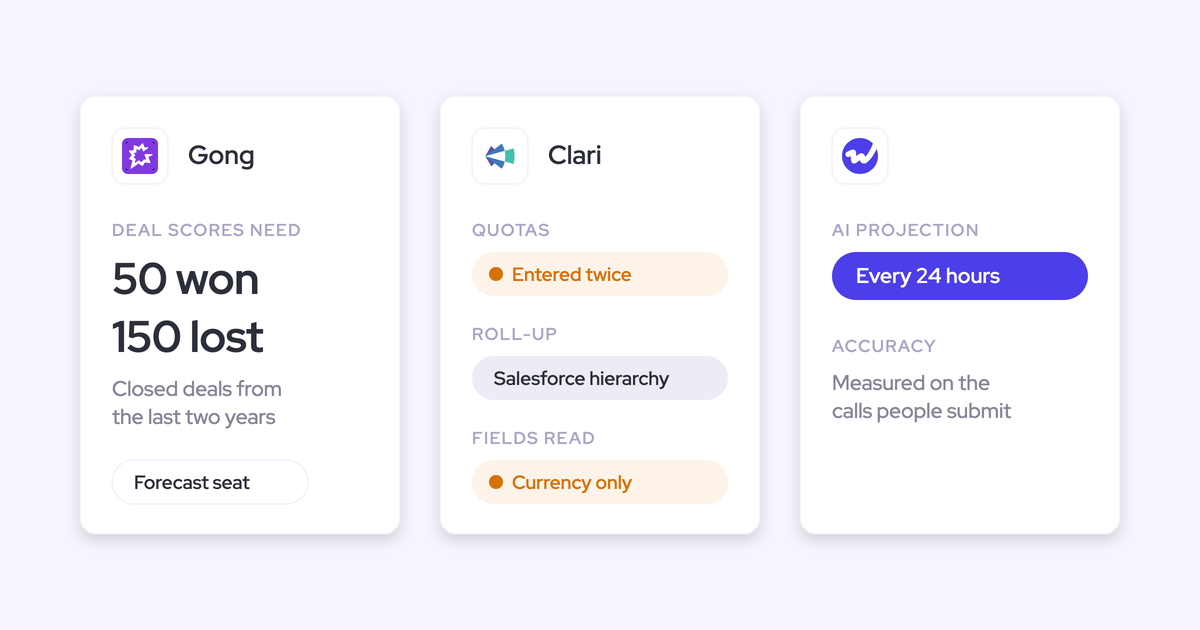

Gong Forecast adds closed-won deals, open pipeline weighted by historical stage conversion, and the new, pulled-in and pushed-in deals it expects. Gong's own documentation asks for at least 400 created and 150 closed-won opportunities across 4 quarters before that projection is reliable.
Clari's AI forecast, now sold under the Salesloft brand, predicts only new business closing in the current quarter. Salesloft switches it on per team once your data shows 4 quarters with at least 50 closed deals each.
Weflow is the Revenue AI Orchestration platform for sales, customer success, and RevOps teams. Built for Salesforce teams, its AI projection scores every opportunity on more than 50 deal signals, including the activity and conversations on the deal, and returns a low, middle and high range from 6 months of history.
If you run Salesforce and need a projection you can use this quarter, we'd pick Weflow, because its first projection arrives within 48 to 72 hours. If your managers already live in Gong's deal board and you clear Gong's history bar, Gong Forecast is the easier addition on top of Gong Foundation. If a private equity sponsor standardized Clari, or your roll-up spans 1,000 or more reps, stay on Clari, whose enterprise roll-ups are more mature.
Gong Forecast, Clari and Weflow compared at a glance
Gong Forecast, Clari and Weflow differ most in what the AI projection reads and how much history it needs before you can use it.
| Capability | Weflow | Gong | Clari |
|---|---|---|---|
| AI forecast prediction: how it is calculated | Per-opportunity model on 50+ deal signals, including communication cadence and next meeting booked; returns a low, middle and high range | Closed won, plus pipeline weighted by historical stage conversion, plus expected new, pulled-in and pushed-in deals; See the math shows each part | Machine learning model on Salesforce opportunity history; closed won plus AI-weighted pipeline, new business in the current quarter |
| AI forecast prediction: history needed | 6 months minimum; up to 2 years imported at setup; first projection in 48 to 72 hours | 400 created and 150 closed-won opportunities across 4 quarters | 4 quarters with 50+ closed deals each; switched on per team by Salesloft |
| Integrations with other tools | Salesforce as the only CRM; Gmail, Outlook, Zoom, Teams, Meet, Slack and dialers such as Outreach | About 450 integrations and partner solutions, about 30 dialers, 11 meeting platforms | Salesloft data layer syncs Salesforce, Dynamics, Snowflake, Databricks, Gmail, DocuSign, ZoomInfo and LinkedIn |
| Access from AI assistants (MCP) | Read-only connector; forecast data per rep for up to 25 owners, with opportunity IDs | 9 read-only tools; AI tools draw credits; paid Gong seat and paid AI plan required | Separate Forecast, Copilot and Salesloft servers; Salesloft server needs the Agentic add-on |
| Raw data access outside the tool | REST API bulk export of transcripts, scores and signals; no forecast data; no native warehouse connector | Rate-limited API for call data; Data Cloud, a separate purchase, for warehouses | Forecast history CSV export; data layer sync to Snowflake and Databricks |
| Pricing | Public: $39 per user per month for forecasting, billed annually; 10-user minimum | No public pricing; custom proposal on top of Gong Foundation | No public pricing; Talk to Sales; forecasting is an add-on |
| Best for | Salesforce teams that want a deal-level projection within days, beside the roll-up and weighted forecast | Teams already on Gong Foundation that run pipeline from the deal board | Large, roll-up-driven forecast motions, especially Salesloft buyers |
Why RevOps teams put Gong Forecast and Clari on the same shortlist
RevOps teams put Gong Forecast and Clari on the same shortlist because a forecasting renewal forces one question both vendors answer: which AI number goes in front of your CRO and CFO? When the contract comes up, you audit what you actually use, and that audit opens the evaluation.
The AI number is meant to fix a familiar problem. You maintain 3 forecasts that never agree:
- what reps committed
- what the weighted pipeline calculates on stage probabilities set once and never revisited
- your own judgment, which is usually a haircut on the rep call
You buy an AI projection to arbitrate between them, so how it's calculated decides the purchase.
Forecast parity rarely decides it. When you evaluate a replacement honestly, it usually lands at about 80% of what your mature forecast does today. The missing pieces are the ones you built over years, such as splits or dual date logic. So you decide the switch on what your incumbent can't do at all, which is usually the intelligence built on activity and conversation data.
The shortlist also changed shape. Clari and Salesloft merged in December 2025, and Clari now sells under the Salesloft brand, so renewing Clari means a commercial relationship with Salesloft.
An AI projection, a team call and a weighted forecast are three different numbers
An AI projection, a team call and a weighted forecast are 3 different calculations of the same quarter. Each one alone is wrong in a predictable direction:
- Weighted forecast: multiplies each open deal by its stage's win rate. It errs wherever stage probabilities were typed once and never revisited, and it's only accurate across many deals. In a renewal-heavy business it needs each motion's own conversion, because renewals sit in early stages yet close at high rates.
- Team call: the roll-up of what reps commit and managers adjust. It moves with the rep's mood, optimistic in month 1 and pessimistic in month 3, and a leader's instinct then haircuts it.
- AI projection: predicts from history and deal data. It errs when the history is thin, when the business is changing, and when the model can't see the activity and conversations that show a deal slipping.
We recommend reading the 3 numbers together, because together they give you a corridor instead of a single figure nobody trusts. The gaps between what the team says, what the pipeline supports and what history predicts then become the agenda for your forecast call.
Combine a weighted forecast, a roll-up, and an AI prediction to get a corridor - Janis Zech, Co-founder and CEO, Weflow
When a vendor shows you its "AI forecast", ask these questions before you trust the number, because each vendor's model reads different inputs and needs different history:
- What does the projection read: stage history and amounts only, or the emails, meetings and calls on each deal?
- How much history does the projection need, in what shape, and can it use the history already in your Salesforce?
- Which motions and periods does the projection cover: new business only or renewals too, and the current quarter only or further out?
How Weflow Deal Intelligence & Forecasting predicts the quarter
Weflow Deal Intelligence & Forecasting predicts the quarter by projecting each opportunity from its own deal signals and history. It then shows that projection beside your team's roll-up and a dynamic weighted forecast.
How Weflow's AI projection is calculated and how much history it needs
Weflow calculates its AI projection per opportunity from more than 50 deal signals, including:
- seasonality
- the seller's own historical win rate
- conversion rates
- communication cadence
- whether a next meeting is booked
- whether the deal is healthy against your sales methodology
So when a large deal is being poorly worked, Weflow projects it down, which a stage probability can't do.
We learned why those signals matter from our own first AI forecast, which shipped early and didn't work well. We concluded that no model can tell whether a deal is stalling without the activity and conversation data underneath it.
Weflow's history requirement is short, so you can use the projection in the quarter you set it up:
- At least 6 months of opportunity history.
- Up to 2 years of that history imported from Salesforce when you set up forecasting.
- A first projection within 48 to 72 hours, not after months of running.
- A nightly refresh as a low, middle and high value. When the model isn't confident in a range, it shows none and says why.
Weflow builds a separate model for each forecast configuration, so new logo and renewal are each projected from their own history. Weflow also treats a user newly created in Salesforce as a ramping seller and lowers the close likelihood of their deals, instead of trusting their thin history.
You see the AI projection in the Pacing chart, beside the team forecast and the weighted forecast. Weflow's roll-up adds a Dynamic weighting column, which recalculates each stage's win rate from a rolling window, such as the last 90 or 180 days, instead of using the fixed stage probability.
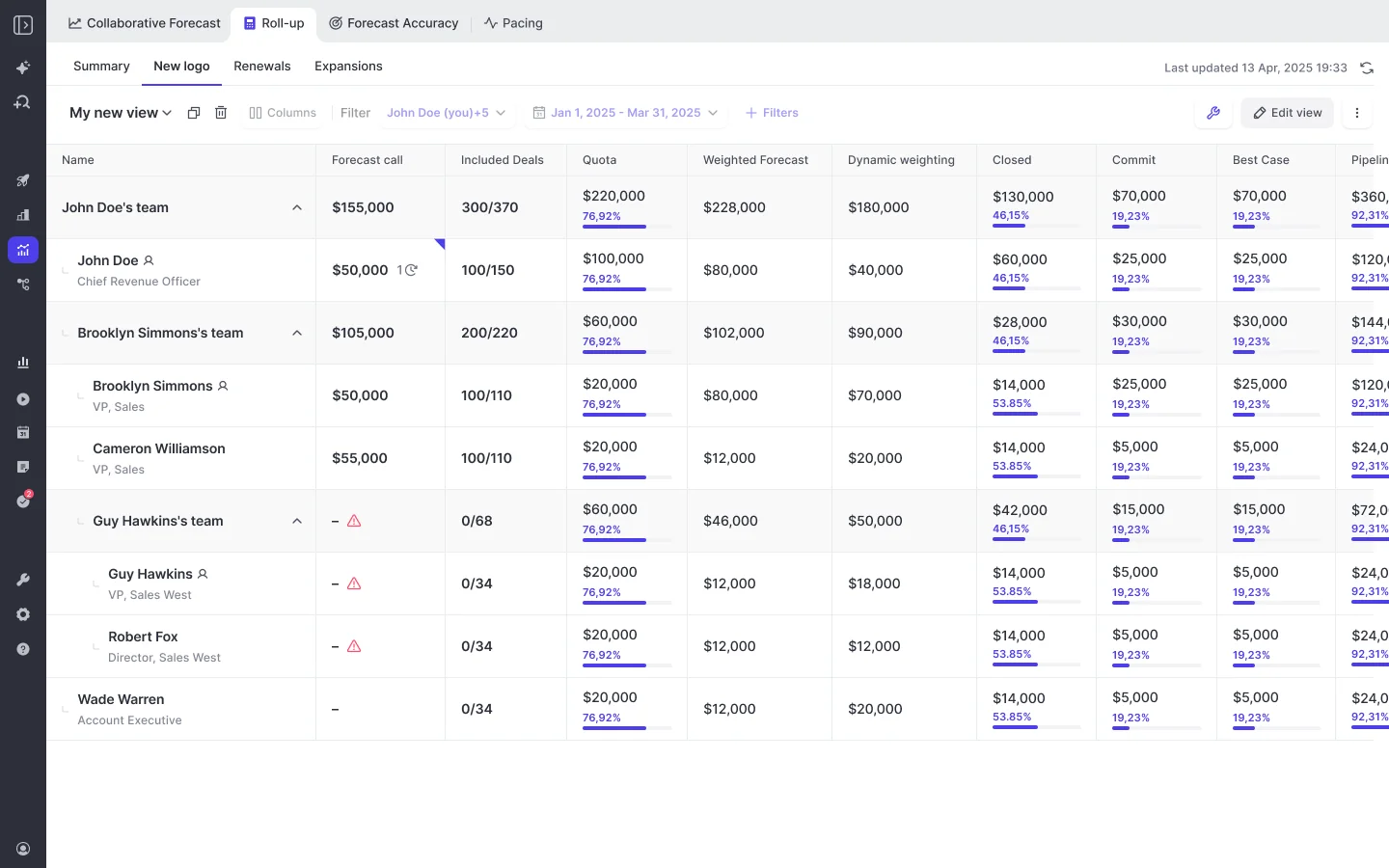
For Zeotap, one Weflow customer, that combination produced a number the leadership team could trust early in the quarter.
With Weflow, we forecast within 7% by week 4 of the quarter. - Tibor Stefán, Chief Revenue Officer, Zeotap
How Weflow forecast data reaches your stack, your AI assistant and your warehouse
Weflow forecast data reaches an AI assistant through Weflow's MCP connector. The public API and your warehouse get conversation and activity data, but not the forecast:
- Native integrations cover Salesforce as the only CRM, plus Gmail, Google Calendar, Outlook, Zoom, Microsoft Teams, Google Meet and Slack. An admin connects the Outreach dialer directly, and Weflow's team activates Aircall, CloudTalk, Dialpad and Zoom Phone.
- The MCP connector is read-only and works in Claude, ChatGPT or any client that supports remote MCP servers. An admin switches it on per workspace.
- The Get Forecast tool returns forecast data for a close-date period, scoped to your own opportunities or your team hierarchy, with a per-rep breakdown for up to 25 owners. Each breakdown carries weighted and unweighted pipeline, closed-won amount, win rate, coverage, gap to forecast and the opportunity IDs behind each number. Where no hierarchy is configured, team scope resolves to every active user, so set the hierarchy before you point an assistant at it.
- The public API bulk-exports transcripts, metadata, scores and signals as JSON or CSV. There's no native warehouse connector, so teams move that data into Snowflake, Databricks or BigQuery through the API.
- Forecast submissions, targets and roll-up data stay in the Weflow application. Weflow doesn't write them to Salesforce and the public API doesn't return them, so MCP is the route for forecast data.
What Weflow Deal Intelligence & Forecasting costs
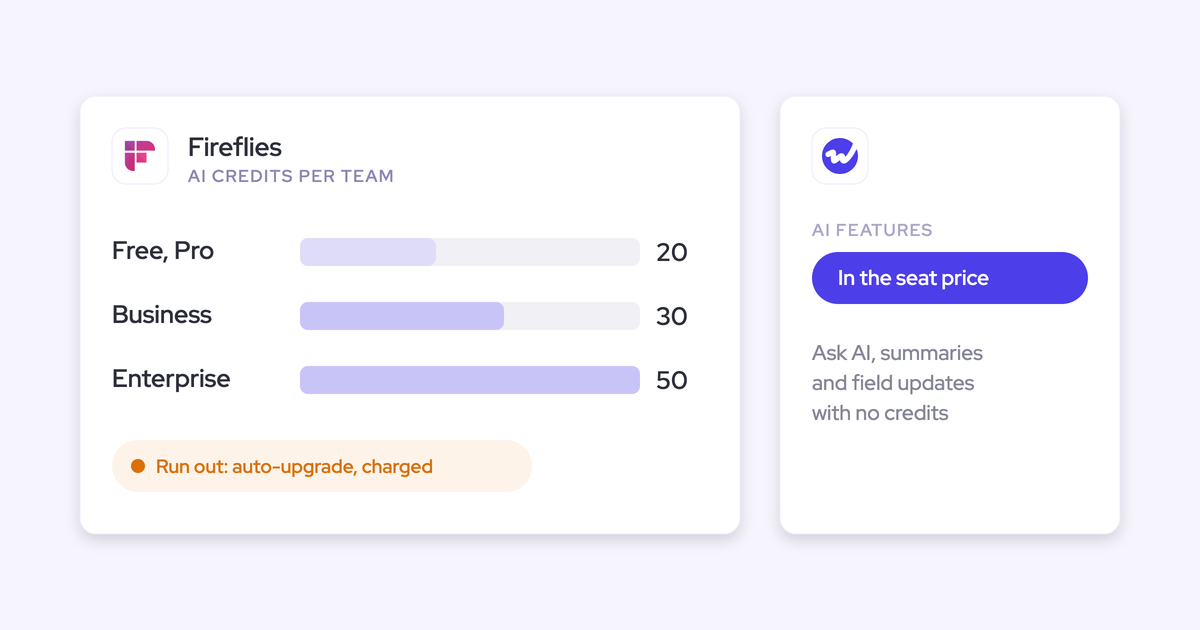
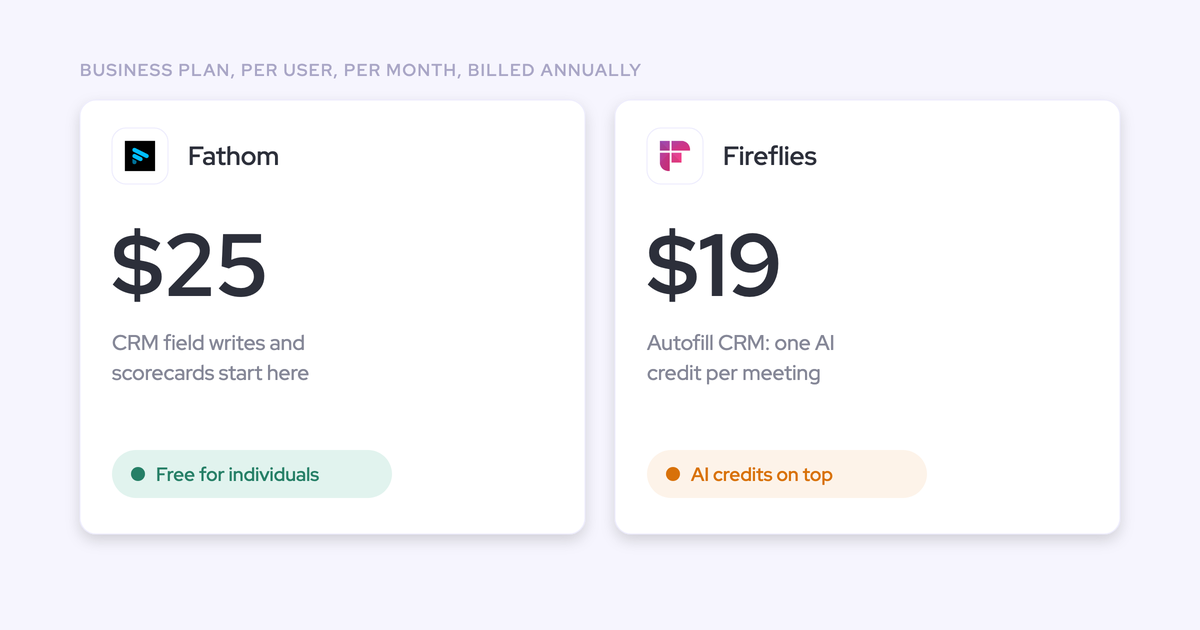
Weflow Deal Intelligence & Forecasting costs $39 per user per month standalone, billed annually. Weflow prices per seat with AI included, so Ask Weflow AI, AI summaries and AI Field Updates never draw down credits. Agent Builder is the only product priced by consumption.
Weflow also sells bundles:
- Revenue AI Foundation at $49 pairs Weflow Activity & Contact Capture with Weflow Conversation Intelligence.
- Revenue AI Business at $59 adds deal intelligence.
- Revenue AI Enterprise at $79 adds the full pipeline analytics and forecasting layer.
Every product or bundle needs at least 10 users on a 12-month term, and implementation is free. If a forecasting contract still has time to run, start with capture and conversation intelligence and add forecasting when it ends, because the projection reads the activity and conversations those products capture.
How Gong Forecast projects where your quarter lands
Gong Forecast projects where your quarter lands with stage-conversion arithmetic over your own CRM history, and it shows you every component of the sum.
How Gong Forecast's projection is calculated and how much history it needs
Gong Forecast's projection adds up 3 components for the period:
- the closed-won deals already booked
- open pipeline, weighted by historical stage conversion at the same point in the period
- the new, pulled-in and pushed-in deals Gong expects
A See the math panel shows each component, so when your CFO asks where the number came from, you can answer from inside the product. You pick the historical period the projection is based on. Gong's documentation says reliable projections need at least 400 created opportunities with 150 closed-won across 4 quarters, and CRM hygiene and changes to stages or board definitions affect accuracy.
Gong Forecast's trend chart shows, week by week, the deals in each forecast category or stage as they stood that week. Lines for the projection, the team's forecast, the manager's forecast and the target run against them, and the projection line uses up to 4 quarters of history. If you need older history in those reports, ask your customer success manager: Gong can backfill up to 5 quarters of CRM field history in 3 to 5 business days.
Gong's deal likelihood score sits outside the projection. It's a percentile rank against other open deals, not a probability of closing.
Gong Forecast strains when 1 module has to forecast several teams or products, such as enterprise, commercial and post-sale. RevOps then ends up rebuilding the forecast in spreadsheets, which is what Chris Nethercote saw as a Gong enterprise customer.
Our RevOps team spent too many hours building it out and trying to get it to work super well. So we ended up actually doing most forecasting back in spreadsheets. - Chris Nethercote, Head of Sales and former Gong enterprise customer, Weflow
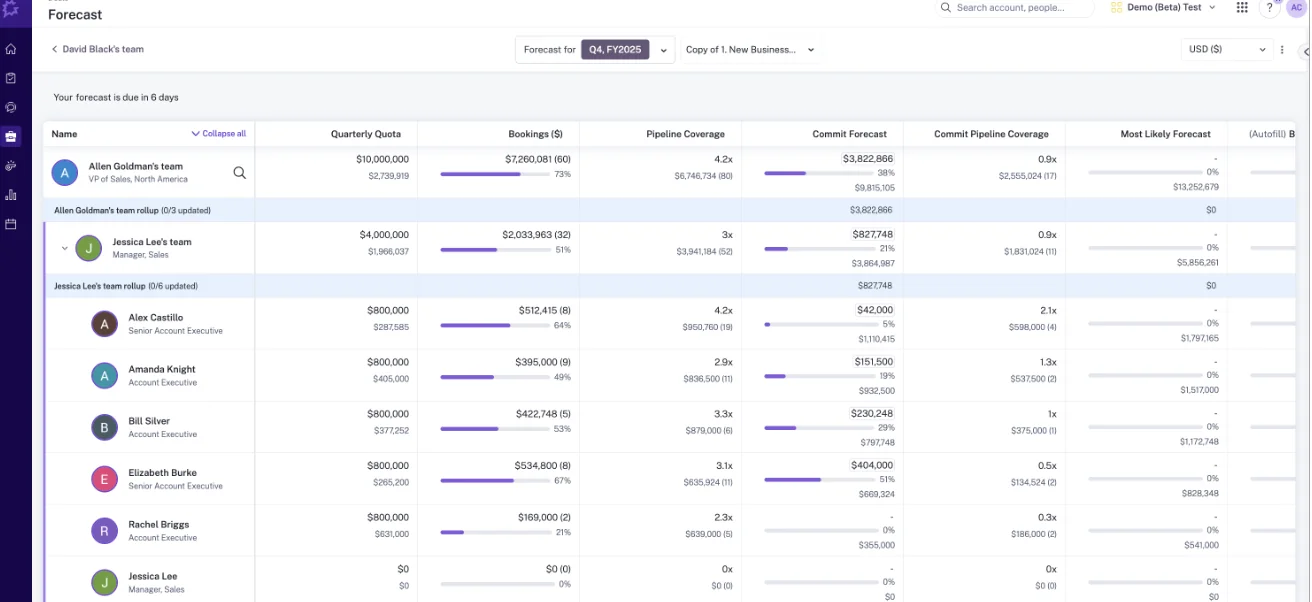
Gong's forecast screen rolls each quarter up from a VP's team through managers to named account executives, with quota, bookings and coverage on every row.
How Gong data reaches your stack, your AI assistant and your warehouse
Gong connects to a wide revenue stack, but AI access over MCP draws metered credits and warehouse delivery is a separate purchase:
- The Gong Collective, Gong's marketplace, lists about 450 integrations and partner solutions across CRM, dialers, web conferencing, email and calendar, BI and data, enrichment and workflow automation.
- Calls come in from about 30 dialers by API, and Gong records meetings on 11 conferencing platforms, including Zoom, Google Meet, Microsoft Teams and Webex.
- The MCP server exposes 9 read-only tools for Claude, ChatGPT and Copilot, covering accounts, deals, calls and people; none of them is a forecast tool.
- The 4 AI tools on the MCP server, ask_account, ask_deal, generate_brief and research_conversations, draw credits on every request, so asking the same question twice costs twice. Call search and transcripts draw none.
- MCP access needs a paid Gong seat and a paid tier of the AI tool, and collaborator accounts can't connect at all.
- The public API returns transcripts, participants, trackers and scorecards, capped at 3 calls a second and 10,000 a day.
- Gong Data Cloud delivers data to Snowflake, Databricks, BigQuery and Redshift as a separate purchase of about $5,000 a year.
What Gong Forecast costs on top of Gong Foundation
Gong has no public pricing. It prices licences per user, adds a platform fee that scales with the number of users, and quotes every buyer through a custom proposal.
Gong Foundation is the mandatory core licence, and Gong Forecast is an application you buy on top of it. Gong assigns seats per application, so one person's cost is the sum of every application they touch.
Gong meters AI usage on top: each paid core seat adds 2,000 credits a year to a company-wide pool that resets each contract year. For scale, one Gong renewal proposal we've seen for 45 licences came to about $80,000 a year, and forecasting was only about $10,000 of it.
How Clari predicts the quarter now that it is part of Salesloft
Clari predicts the quarter with a machine learning model trained on your own Salesforce history, scoped to new business closing in the current quarter.
How Clari's AI forecast is calculated and how much history it needs
Clari Forecast has been sold under the Salesloft brand since 1 September 2026, so Salesloft's AI Forecast documentation describes the model. The model trains on your Salesforce Opportunity, OpportunityHistory and Account objects, using features such as deal size, deal stage and days open.
The model gives each open deal a close probability, banded high, medium or low. Clari's forecast number is closed won plus that AI-weighted pipeline, for new business deals closing in the current quarter.
Salesloft switches Clari's AI forecast on per team after an engineering evaluation of your data. A team qualifies with:
- Deals enabled in Salesloft.
- Data from the 4 preceding quarters, with at least 50 closed opportunities in each.
- An average of at least 10 open opportunities per day in the current quarter.
- Configured new business settings, deal amount field and fiscal quarters.
Teams that don't qualify see a weighted pipeline based on stage probabilities instead. Once the AI forecast is on, RevOps teams report that Clari's AI projection:
- takes 12 to 18 months after adoption before they find it useful
- looks only 3 months ahead, so they build a rolling 12-month forecast outside Clari
- tends to land close to the quarter's actual result once it's running
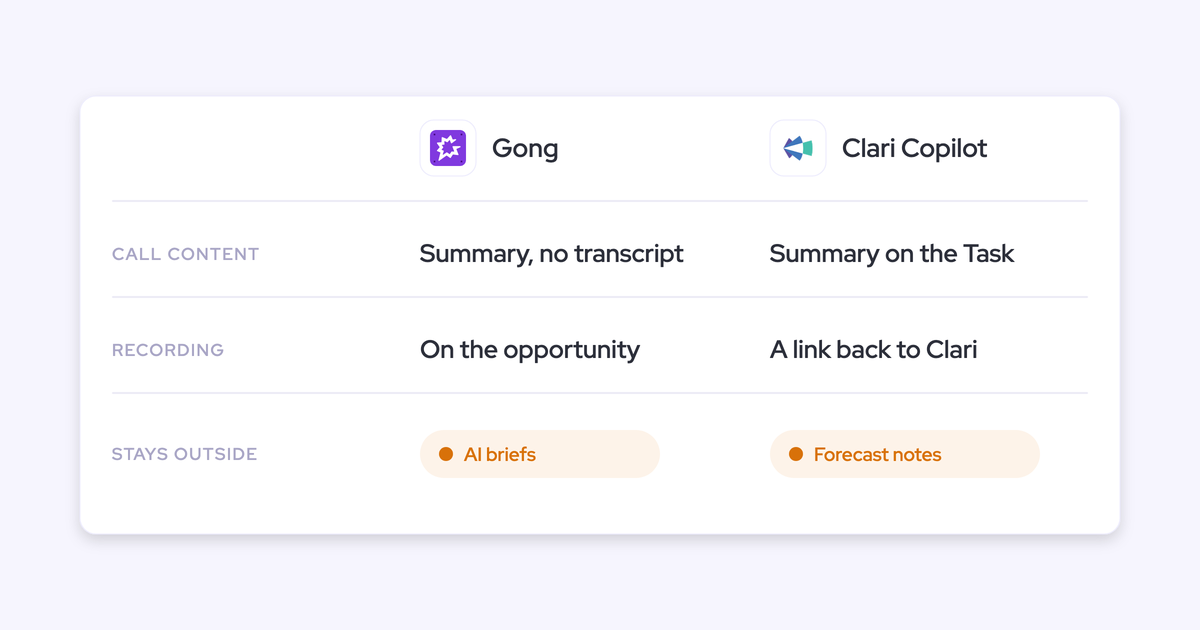
Call data from Clari Copilot doesn't feed Clari's forecast, because the forecasting and conversation intelligence products don't talk to each other. So the projection can't see what your calls show about a deal.
How Clari data reaches your stack, your AI assistant and your warehouse
Clari reaches the rest of your stack through Salesloft's data layer and 3 separate MCP servers, each with its own scope and requirement:
- Salesloft's Unified Revenue Data Layer syncs with Salesforce, Microsoft Dynamics, Snowflake, Databricks, Gmail, DocuSign, ZoomInfo and LinkedIn.
- The Clari Forecast MCP server gives Claude and ChatGPT live forecast data and historical snapshots, scoped to each user's Clari permissions. Its 7 tools cover forecast tabs, grid values, the hierarchy, time periods, snapshots, field configuration and related deals. A Clari admin switches it on in Clari Studio, and users need a Claude or ChatGPT Business or Enterprise subscription.
- The Clari Copilot MCP server exposes Copilot call data only. A Copilot admin switches it on, and users need a paid ChatGPT Business or Enterprise plan or a Claude subscription.
- The Salesloft MCP server is read-only, with 13 tools over accounts, people, users, opportunities, conversations and team data, and needs the paid Salesloft Agentic add-on. It returns AI call summaries, extracted fields and key moments, not raw transcripts.
- Clari's forecast history exports as a CSV, so admins can load 2 years of submitted forecasts into a BI tool.
What Clari costs and how you get a quote
Clari has no public pricing: clari.com/pricing and salesloft.com/pricing both lead to a Salesloft Talk to Sales page where you book a call. Salesloft sells 2 packages, Advanced and Elite, and forecasting is a paid add-on on top of either.
We estimate Clari at $120 to $180 per user per month, and Clari raises its prices regularly. Implementation adds professional services fees, which we estimate at $15,000 to $50,000, with no public price list.
Where Gong and Clari beat Weflow, and where Weflow pulls ahead
Gong and Clari beat Weflow on enterprise roll-up maturity, dashboards and integration breadth. Weflow pulls ahead on what its projection reads, how soon it's usable and what it costs.
Where Gong Forecast and Clari are stronger than Weflow
Gong Forecast and Clari are ahead of Weflow in a few places that matter for forecasting:
- Clari's enterprise roll-ups are more mature than Weflow's, especially across orgs of 1,000 or more reps.
- Clari's dashboards go further than Weflow's: Weflow has no funnel report and no view comparing today's pipeline with the same point in earlier quarters, a comparison Clari users rely on.
- Gong's integration catalogue, at about 450 integrations and partner solutions, is far wider than Weflow's native list.
- Gong's See the math panel shows every component of the projection, so you can walk a CFO through the number.
- Gong Forecast runs a separate board per motion, such as new business, renewals or retention, each with its own filters, columns, metrics and targets.
Weflow isn't the right fit for every team. These are its limits:
- Weflow works only with Salesforce, so if you run HubSpot, Microsoft Dynamics or another CRM, Weflow isn't an option.
- Weflow's forecast data isn't in its public API or written to Salesforce; it reaches an AI assistant over MCP only, so you can't pull Weflow's forecast into BI through the API.
- Weflow requires at least 10 users per product or bundle, so a team smaller than that sits outside its standard terms.
Where Weflow pulls ahead for a Salesforce team
Weflow pulls ahead for a Salesforce team on what its projection reads, how soon it's usable and what it costs to reach the forecast:
- The projection reads activity and conversation signals Weflow captures itself, such as communication cadence and whether a next meeting is booked. Gong's projection is stage-conversion arithmetic, and Clari's forecast doesn't read its own call data.
- The projection needs 6 months of history and is ready within 48 to 72 hours, against 4 quarters for Gong and Clari.
- You see 3 methods side by side, the AI projection, the rep and manager roll-up and a dynamic weighted forecast, so the gap between them is visible.
- The roll-up ties every call to the deals behind it. Reps submit a total, select the opportunities, or both; every submission is versioned, and the roll-up shows how many of each person's deals are included.
- Forecast data reaches Claude or ChatGPT over MCP with opportunity IDs, and because AI is included in Weflow's seat price, nobody rations it against a credit pool.
- Prices are public and per seat, from $39 per user per month for forecasting.
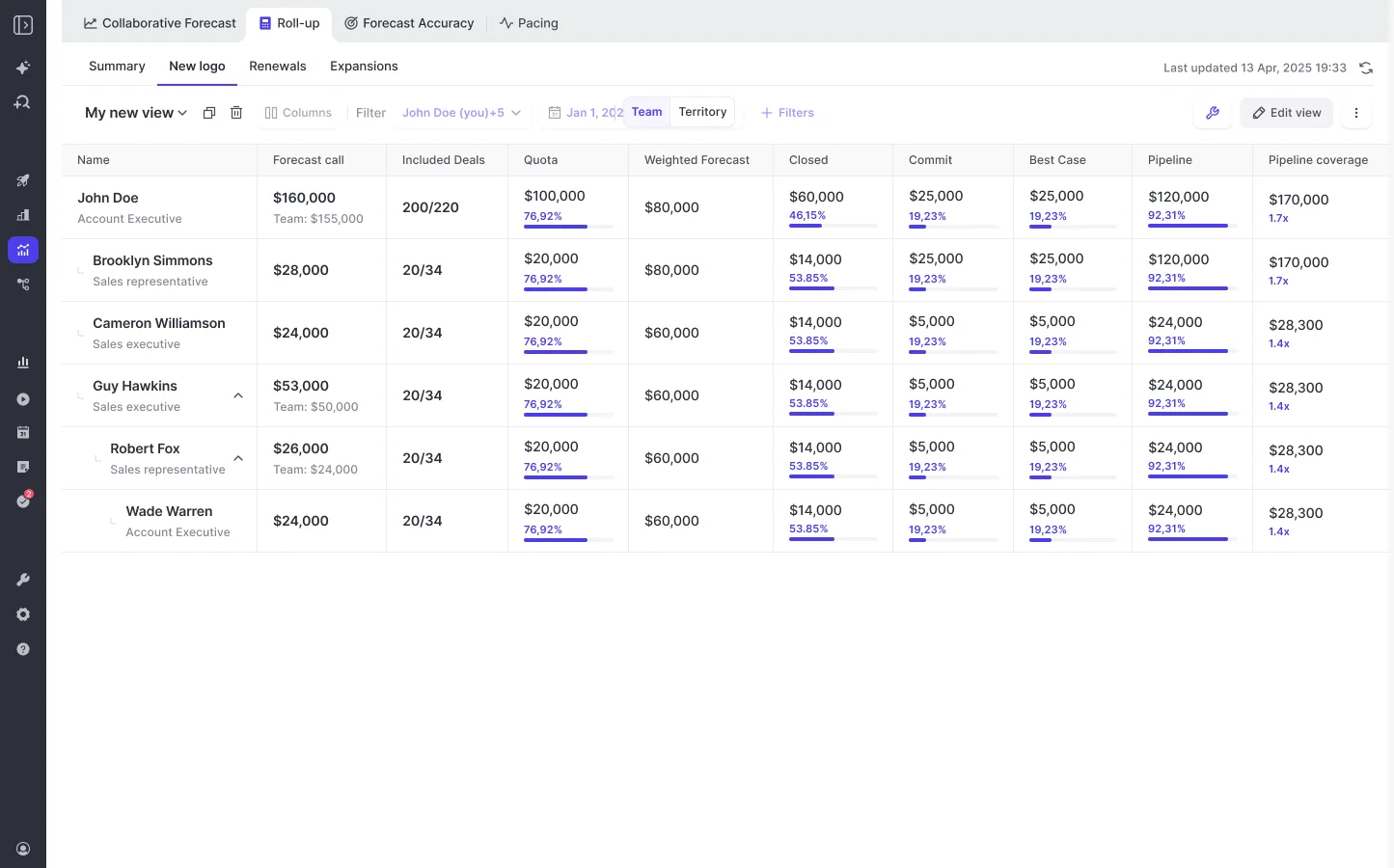
Weflow's roll-up shows each manager's and rep's forecast call with the deals included, such as 20 of 34, beside quota, attainment and pipeline coverage.
Choose Gong Forecast, Clari or Weflow by how your team forecasts
Choose by how your team forecasts today, how much clean history you have and which CRM you run, because those decide which projection you can use.
Choose Gong Forecast if:
- You already pay for Gong Foundation and your managers run pipeline reviews from Gong's deal board.
- You have at least 400 created and 150 closed-won opportunities across the last 4 quarters.
- You want a projection you can take apart in See the math, inside a large integration ecosystem.
Choose Clari if:
- You run a large, roll-up-driven forecast across many management layers and want mature enterprise dashboards.
- You're buying Salesloft anyway, since forecasting is an add-on to its Advanced or Elite package.
- Your forecast is mainly new business in the current quarter, and you have 4 quarters with 50 or more closed deals each.
Choose Weflow if:
- You run Salesforce and want a deal-level projection within days from 6 months of history.
- You want the AI projection, the team roll-up and a dynamic weighted forecast side by side, per motion.
- You want the projection built on captured activity and conversations, at public per-seat prices.
Stay where you are if:
- A private equity sponsor has standardized your forecasting tool across its portfolio, so the switch isn't yours to make.
- Your quarter rests on about 10 material deals. Native Salesforce forecasting and pipeline inspection can carry that deal-by-deal judgment; a dedicated tool pays off as deals, managers and roll-up layers grow.
- Your incumbent's forecast works and the gap you feel is somewhere else, because a replacement only reaches about 80% parity on forecasting itself.
How to move your forecast to Weflow from Gong or Clari
Moving your forecast to Weflow follows a fixed order, because Weflow's history import reads the forecast configurations you set up first.
- Retire the legacy forecast fields. Before you connect anything, decide which formula fields and deprecated columns die, so the new forecast reads a small number of named fields you can point at. If you want year-on-year comparisons on a custom amount field, switch on Salesforce field history tracking for it now, or the comparison starts at go-live.
- Configure a forecast per motion. Set up new logo, renewal and expansion as separate configurations, each mapping its own amount, close date and owner fields, because Weflow builds one projection model per configuration. Where a renewal opportunity carries both the retained amount and an upgrade, keep them in separate amount fields.
- Run the opportunity import. Weflow imports up to 2 years of opportunity history from Salesforce field history tracking, falling back to opportunity history, using the configurations' field mapping. Pacing and forecast accuracy views have nothing to show until the import runs.
- Read the first projection within 48 to 72 hours. A low, middle and high range means the model is confident. Where it shows no range, it gives the reason, so fix that before the number goes into a forecast call.
- Migrate your Gong call history. Weflow migrates up to 2 years of Gong calls at no charge and restores each call's link to its Salesforce account. The migration runs through Gong's API one call at a time, at about 2,000 to 2,500 calls a day, so around 30,000 calls take about 15 days.
- Train and go live. Weflow runs onboarding itself, with separate leadership and rep training, and time to live is typically 2 to 3 weeks. Forecasting takes the longest, because it encodes who submits, how often and against which quota.
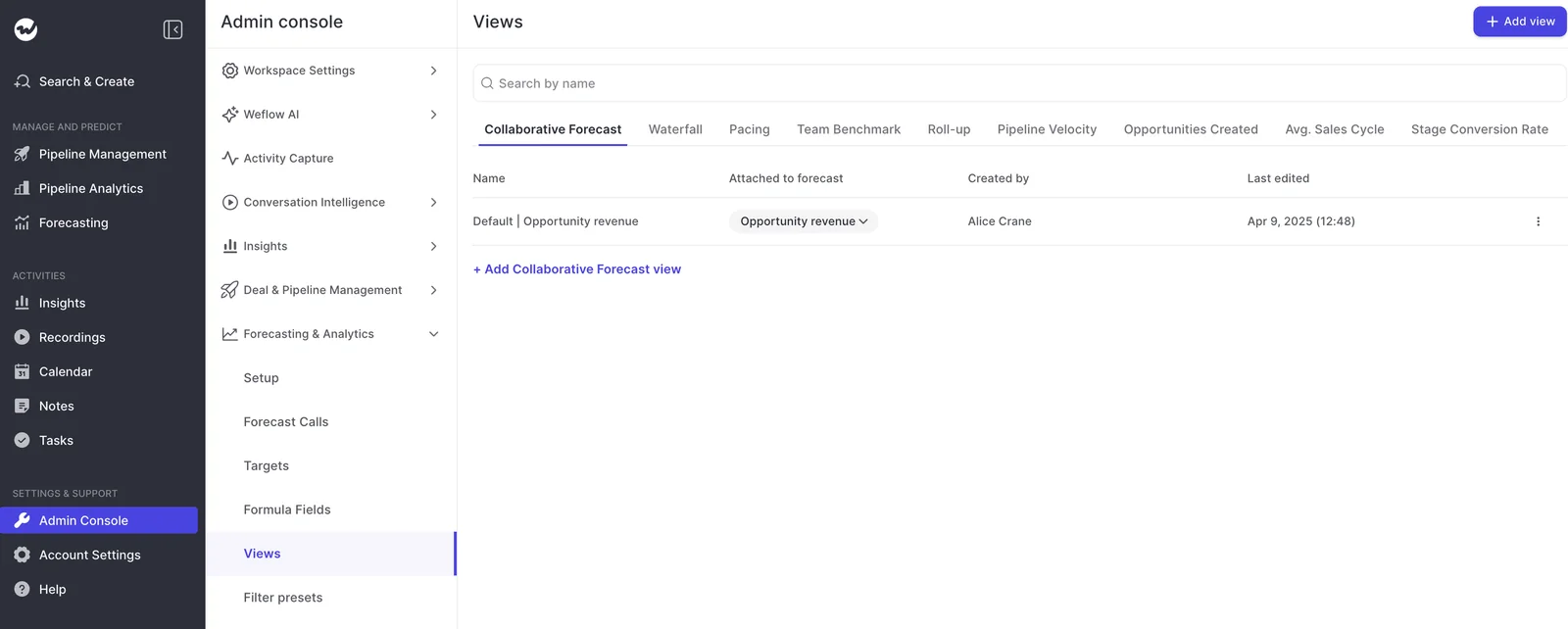
An admin then attaches views to each forecast configuration in Weflow's Admin Console, from Collaborative Forecast and Roll-up to Pacing and Stage Conversion Rate.
If a private equity sponsor has standardized Gong or Clari across its portfolio, you can coexist with it instead of displacing it. Start with Revenue AI Foundation, which runs Weflow Activity & Contact Capture and Weflow Conversation Intelligence beside the incumbent forecasting tool and improves the data it consumes. Then add Weflow Deal Intelligence & Forecasting when the window opens.
FAQs RevOps leaders ask about Gong Forecast, Clari and Weflow
How much history does each AI forecast need, and can it use history I already have?
Weflow needs 6 months of opportunity history and imports up to 2 years of it from Salesforce at setup, so the first projection arrives within 48 to 72 hours. Gong Forecast needs at least 400 created and 150 closed-won opportunities across 4 quarters; new customers import historical CRM data through Gong's professional services onboarding consultant. Clari's AI forecast needs 4 quarters with at least 50 closed deals each, read from your Salesforce history, and Salesloft decides per team whether you qualify.
Does the AI forecast read call and email data?
Weflow's projection does: it reads communication cadence and whether a next meeting is booked, from the activity and conversations Weflow captures. Clari's forecast doesn't use call data from Clari Copilot, because the two products don't talk to each other. Gong's projection is built from closed-won deals, stage-weighted pipeline and expected deal movement.
Do Gong Forecast, Clari and Weflow forecast renewals?
Each of the three covers renewals in its own way. Weflow builds a separate model for each forecast configuration, so renewals are projected from their own history, and Gong Forecast runs a separate board for renewals or retention. Salesloft scopes Clari's AI forecast to new business and adds account-based forecasting with a machine-predicted Pace number for existing customer revenue.
RevOps teams report that Clari's renewal projection follows the full renewal amount, so upgrades booked on the renewal can push projected retention past 100%.
Can I see why the projected number is what it is?
Yes, in different forms. Gong's See the math panel breaks the projection into its components, and Clari gives each open deal a high, medium or low close probability. Weflow shows a low, middle and high range, and when it isn't confident it shows no range and says why. The ramp adjustment for new hires shapes Weflow's projection without appearing as a reason on the deal.
Can Claude, ChatGPT or a BI tool read the forecast, and what does it cost?
Weflow's MCP connector returns per-rep forecast data with opportunity IDs, with AI included in the seat, though Weflow's public API doesn't return forecast data. Gong's AI tools over MCP draw credits from a shared pool, and warehouse delivery needs Data Cloud. Clari's Forecast MCP server gives live forecast data to Claude or ChatGPT Business or Enterprise users, and Clari's forecast history exports as a CSV for BI.
Does Weflow work outside Salesforce?
No. Weflow supports Salesforce as its only CRM, and HubSpot, Microsoft Dynamics, Pipedrive and Zoho aren't supported. Gong is a better fit when you're not on Salesforce, because its marketplace lists integrations across CRM.
Can we keep Gong for recording and forecast in Weflow?
You can, but Weflow's projection then loses part of what it reads, because Weflow's forecast accuracy depends on its own activity capture and conversation intelligence data. Weflow's API doesn't take an ongoing feed of recordings from another tool; Weflow's team brings historic Gong calls in through the migration import.
What happens to my history when I switch to Weflow?
Two histories move to Weflow: your Salesforce opportunity history, up to 2 years of it, and your Gong call history, up to 2 years at no charge. From go-live, Weflow snapshots every opportunity itself for as long as the contract runs. If you want Clari's submitted forecasts on record, export Clari's forecast history as a CSV before the contract ends.