Gong vs Clari for MEDDIC Tracking (2026)
Gong vs Clari for MEDDIC tracking: which tool judges whole deals, and how Weflow compares.


Gong and Clari can both write MEDDIC values into your Salesforce fields from calls. Gong does it with AI Data Extractor and AI Deal Reviewer agents, and Clari does it through Salesloft Deals and Clari Copilot.
What separates them is whether anything judges the whole deal across every call and email and shows you the pipeline against MEDDIC. Gong's deal board shows which MEDDIC fields are filled, not what each deal still lacks, and Clari has no view that compares deals against a methodology at all.
Which tool fits depends on what you need most:
- Pick Gong if you want the deepest call analytics and about 450 integrations.
- Pick Clari if your organization lives in roll-up forecasts on Salesloft.
- Pick Weflow if you're on Salesforce and want MEDDIC judged per deal at a public per-seat price.
Weflow is the Revenue AI Orchestration platform for sales, customer success, and RevOps teams. Built for Salesforce teams, it tracks MEDDIC with AI Playbooks that read every email, meeting, transcript and field on an opportunity and judge how well each element is established.
Weflow shows the result as a color-coded column across your pipeline views and writes it into your own Salesforce fields once you switch write-back on. The capture underneath comes from Weflow Conversation Intelligence + AI Field Updates.
Gong, Clari and Weflow side by side on MEDDIC tracking
Gong, Clari and Weflow all capture MEDDIC from conversations, and they differ on how they judge it, how far their data reaches and how you find out the price.
| Capability | Weflow | Gong | Clari |
|---|---|---|---|
| Qualification methodology capture | AI Playbooks fill and judge every element across calls, emails and fields; color-coded pipeline column | AI Deal Reviewer's 7 playbooks plus AI Data Extractor into existing fields; no weighted deal score | Salesloft Deals and Clari Copilot fill MEDDPICC fields from calls; no multi-deal methodology view |
| Integrations with other tools | Narrower native set: Salesforce, Gmail, Outlook, Zoom, Teams, Meet, Slack, Outreach dialer | About 450 integrations and partner apps, about 30 dialers | Salesloft data layer syncs Salesforce, Dynamics, Snowflake, Databricks |
| Access from AI assistants (MCP) | Read-only connector with 6 tools and a transcript toggle | 9 read-only tools; AI tools draw credits | 3 separate servers, each narrow |
| Raw data access outside the tool | REST API bulk export in JSON or CSV; warehouses via API | API capped at 3 calls a second; warehouses via Data Cloud, bought separately | Salesloft syncs to Snowflake and Databricks; forecast history as CSV |
| Pricing | Public per-seat prices, AI usage included | No public prices; custom proposal plus AI credits | No public seat prices; book a Talk to Sales call |
| Best for | Salesforce teams wanting MEDDIC judged per deal in their own fields | Deepest call analytics and widest ecosystem, on any of 3 CRMs | Forecast-led enterprises already on Salesloft |
Why MEDDIC fields stay empty, and what Gong or Clari has to fix
MEDDIC fields stay empty because they depend on reps typing qualification by hand, and reps don't. Across the Salesforce orgs we connect to, the methodology fields are almost always empty before we deploy Weflow. Nobody can say which deals are qualified, and managers have nothing to coach against.
We see the same chain almost everywhere:
- Leadership mandates the methodology.
- Reps skip the manual entry.
- Leadership answers with more training and stage-gate fields.
- Reps park deals in earlier stages to avoid the forms, so every stage-based number goes wrong in the same direction.
Conversation intelligence records the qualification that did happen, but it scores it one call at a time or inside its own interface. The evidence never reaches the fields your deal review reads.
So hold Gong, Clari or Weflow to these 4 pass conditions:
- Values land in your existing Salesforce fields. The MEDDIC fields your reports already read fill in. A score kept in a vendor's interface sits where nobody looks and becomes a second scorecard while those fields stay blank.
- Assessment spans every call, email and field on the deal. A champion named only in an email still counts, and a deal that ran across a dozen calls and a hundred emails is judged as one deal.
- Judgment covers whether an element is established, not only whether text exists. A Metrics field holding filler, or the customer's headcount, gets flagged instead of counted as done.
- A manager sees the pipeline, and each rep, against the methodology. You can see which deals and which reps are missing which element without opening deals one at a time.
Automation moves the rep's job from typing answers to judging the AI's assessment, deciding the next step and explaining any disagreement. Some leaders still want the reflection the questions force. That's why enablement on the framework matters more once the fields fill themselves: reps still need to know what each element asks.
The score fills itself from Salesforce. I still want reps to sit with the questions. - Julien Cerutti, VP of Global Revenue Strategy, Meltwater
How Weflow tracks MEDDIC across the whole deal in your Salesforce
Weflow is the Revenue AI Orchestration platform for sales, customer success, and RevOps teams. For MEDDIC, it assesses each opportunity across everything on it and stores the result as your own Salesforce data.
Weflow AI Playbooks fill and judge every MEDDIC element across calls and emails
Weflow AI Playbooks fill and judge each MEDDIC element in 2 passes, reading every email, meeting, transcript and CRM field on the deal. The first pass fills in each element from the deal's evidence. The second judges how well each element is actually established.
The second pass checks rep-typed text too, so Weflow marks a MEDDIC field filled with filler as not assessed rather than complete.
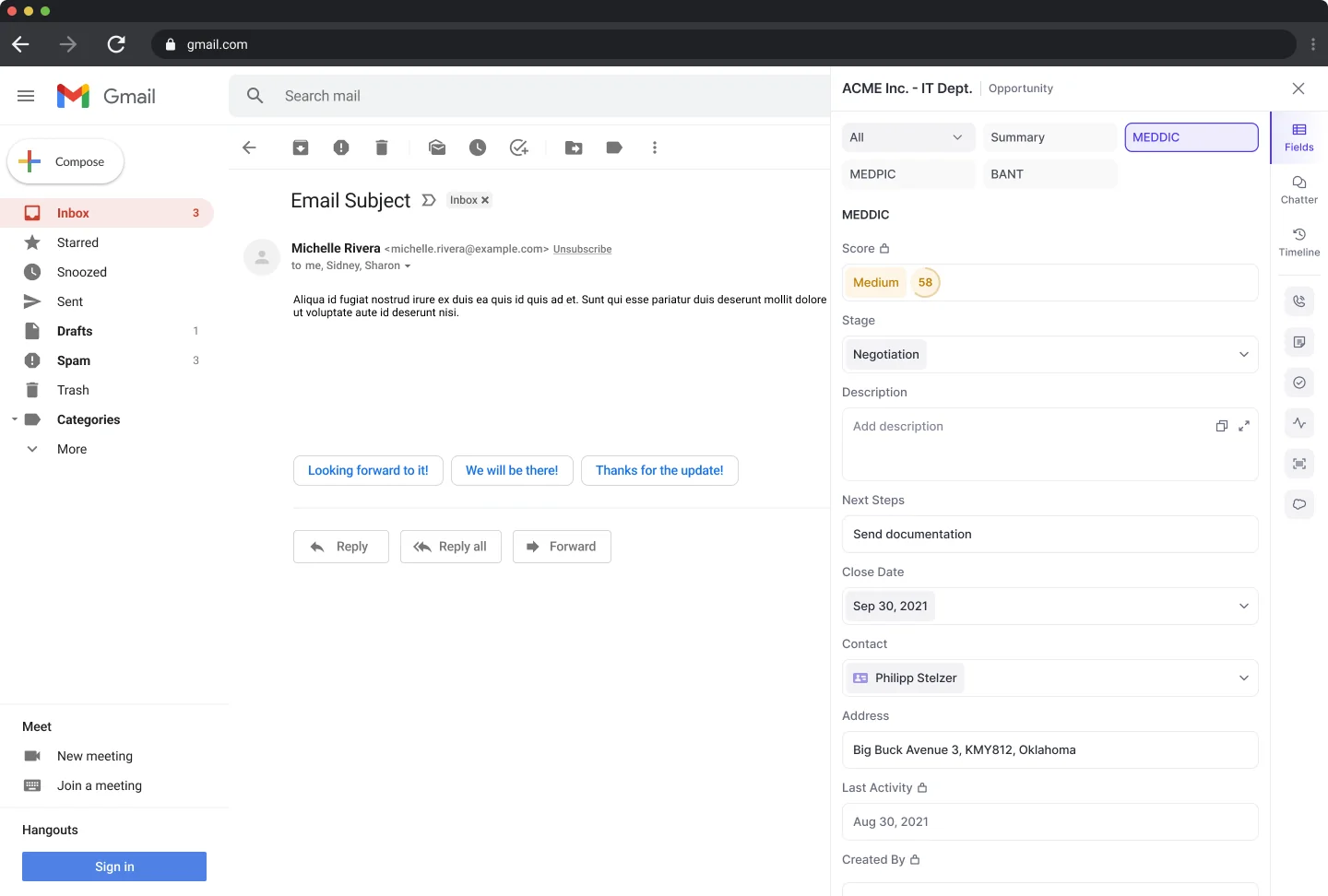
Each element lands in 1 of 3 states, which Weflow shades in the record sidebar and as a column in your pipeline views:
- Fully established, in full blue.
- Partially established, in light blue, with a note on what's missing.
- Never discussed, in grey.
You spot the deals with no economic buyer without opening them. A playbook re-evaluates a record every 2 hours once something on it has changed: an edit, a new activity or a new Weflow recording.
The same Weflow sidebar opens in Gmail, in the Chrome extension and on Salesforce pages, so a rep reads the opportunity's MEDDIC view next to the email they're answering.
Weflow AI Playbooks vs AI Field Updates for MEDDIC
You start a playbook from one of around 30 methodology templates or from scratch. For a house framework, you build each element with your own evaluation criteria and prompts. You then assign each playbook to teams, so enterprise reps can run MEDDIC while a transactional team runs BANT.
Weflow scores methodology at 3 levels, and each answers a different question:
- A single call. Weflow coaching templates judge one recorded conversation and return free-text feedback or a 1 to 5 rating per section.
- A whole deal. AI Playbooks assess every email, meeting, transcript and related record on the opportunity, so you know whether the deal is qualified.
- A rep. Scores across every deal the rep has worked over months show the element that rep keeps leaving open, such as champion or decision process, which you can't see from single calls.
When a rep leaves champion open deal after deal, review their discovery calls. Check whether they identify potential champions, ask about internal influence and test whether the champion will carry the solution.
Playbook write-back is off by default, and Weflow added it in late October 2026. Until an admin switches it on, a playbook is a reference view inside Weflow.
Once write-back is on and Weflow's integration user can edit the target fields, each element's result goes into a text field you choose on the Salesforce record, automatically and with no approval step. Playbook writes fill fields far more reliably, and nobody checks them before they land.
AI Field Updates do a different job. Each one reads a single call transcript and writes to specific Salesforce fields. By default, it waits for the rep to approve the suggestion, with the current value beside the new one.
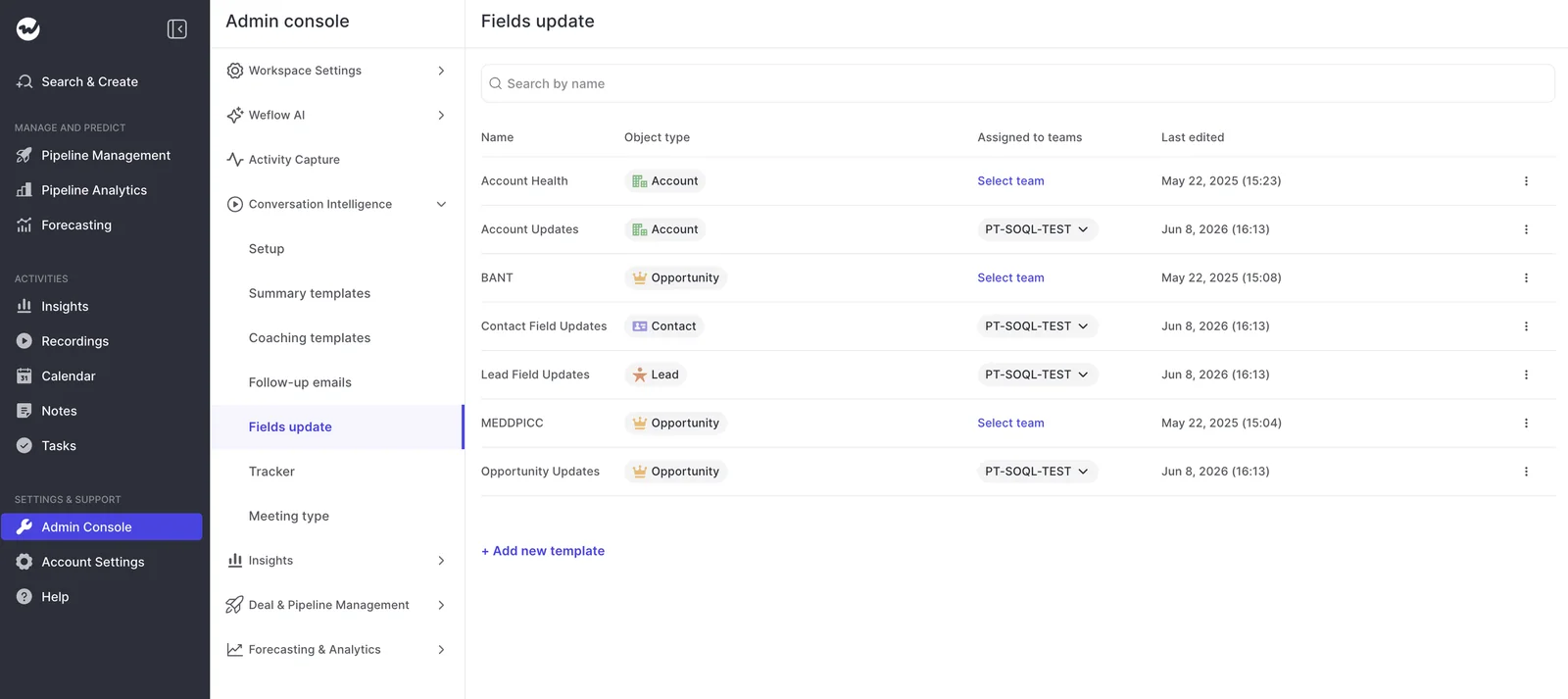
We split the work by the kind of field. Let playbooks keep cumulative qualification such as champion and metrics current automatically. Route single-value fields like next step, close date and amount through AI Field Updates the rep confirms after each call, because one misheard sentence there moves your forecast.
Opportunities that existed before you set up the playbook stay unscored until you select them in a pipeline view and run Generate AI Playbooks, up to 100 records at a time. Weflow evaluates new opportunities automatically.
AI Playbooks read only the transcripts of meetings Weflow recorded. If you keep a different recorder, playbooks still read the CRM record, emails and meeting metadata, plus any transcripts or summaries that recorder writes into Salesforce.
Playbook results don't cite the emails, calls or fields behind each answer. To trace a value, you ask Ask Weflow AI about the deal, and its answers list the sources they read.
I love being able to go right to the call, transcript or email and see where something was said that the AI is referencing. - Scott Jones, SVP of GTM Revenue Intelligence & Enablement, KORE Wireless
Weflow sends MEDDIC data to BI tools and AI assistants through its API and MCP connector
Weflow sends MEDDIC data to BI tools through a REST API and to AI assistants through a read-only MCP connector, on top of a short list of native integrations:
- Salesforce for CRM.
- Gmail, Google Calendar and Outlook for email and calendar.
- Zoom, Microsoft Teams and Google Meet for meetings.
- Slack for messaging.
- The Outreach dialer, plus Aircall, CloudTalk, Dialpad and Zoom Phone, which Weflow's support team switches on.
Weflow's REST API bulk-exports transcripts, metadata, scores and signals as JSON or CSV, and it supports BI connectors such as Tableau and Looker. Weflow has no native Snowflake, Databricks or BigQuery connector, so you move data into a warehouse through the API.
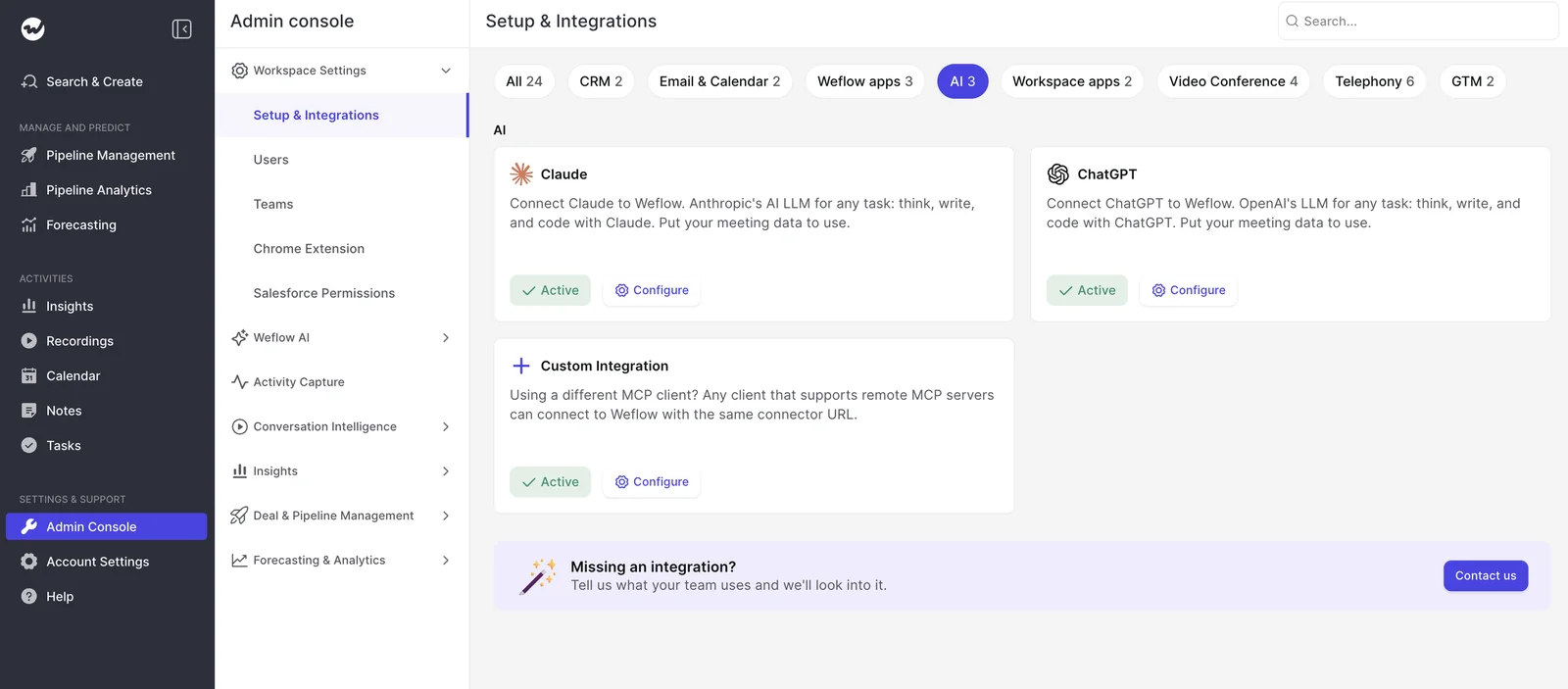
Weflow's MCP connector gives Claude, ChatGPT or any client that supports remote MCP servers 6 read-only tools, including List Playbooks and Playbook Values. An admin switches the Weflow MCP connector on per workspace, and its reach has set limits:
- A separate toggle decides whether assistants read full transcripts or only AI summaries.
- Forecast data breaks down per rep for up to 25 owners.
- Captured email content and values stored on Salesforce records don't come back through the connector.
What Weflow costs for MEDDIC tracking, and which teams it fits
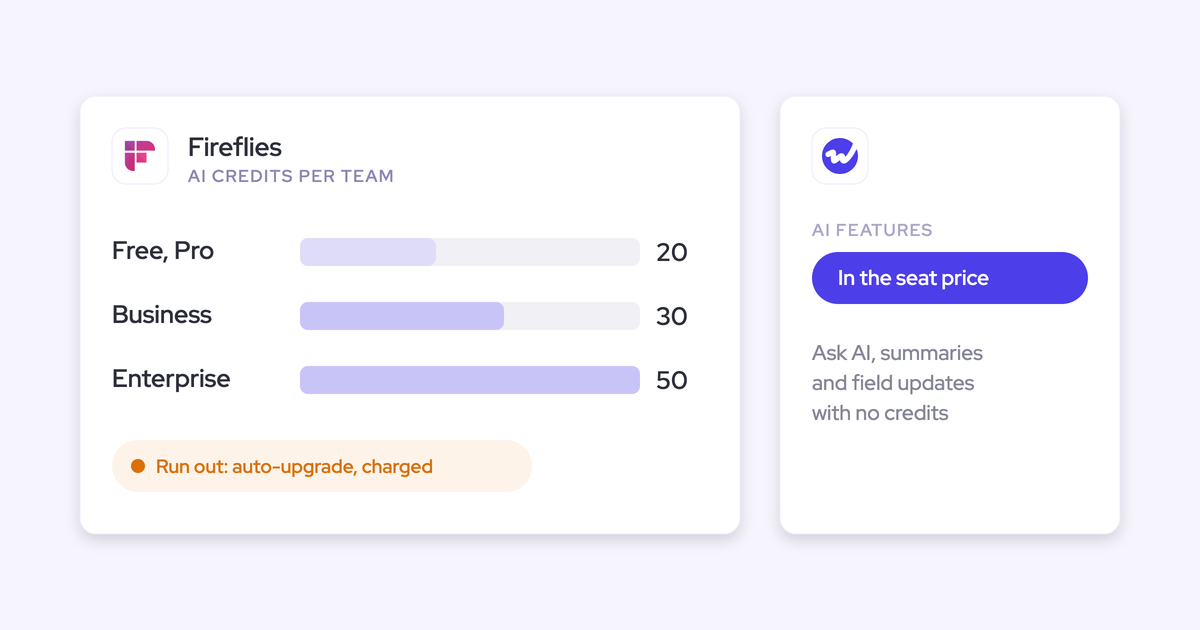
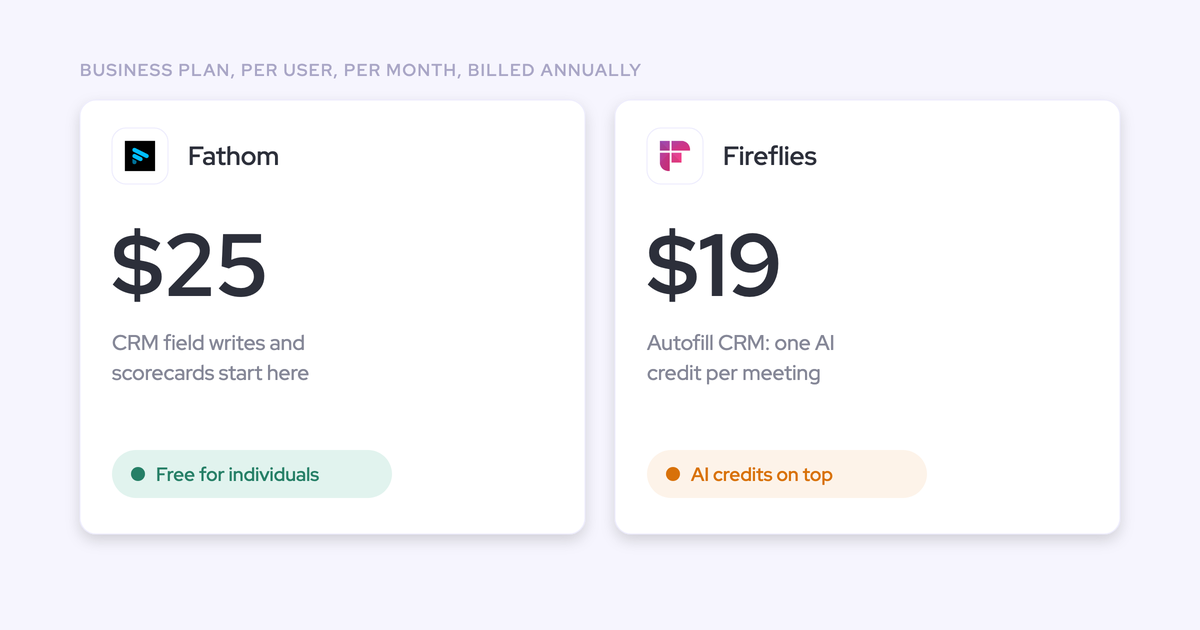
Weflow prices per seat with AI usage included, so you have no credits to track. AI Playbooks come with Weflow Deal Intelligence & Forecasting at $39 per user per month, billed annually, or inside the Revenue AI Business bundle at $59 and Revenue AI Enterprise at $79.
Contracts start at 10 users per product or bundle on a 12-month term. At roughly 62 seats, Weflow Activity & Contact Capture plus Weflow Conversation Intelligence lands around $36K a year and the full platform around $58K. Weflow prices at roughly half of what Gong charges.
Weflow isn't the right fit for every team. These are its limits:
- Salesforce only. If you run HubSpot or Dynamics, Weflow is the wrong choice, and Gong is the better fit.
- Far fewer integrations than Gong, and no native warehouse connector. If your team depends on a broad connector catalogue, you'll find Weflow thin.
- Thinner analytics and roll-ups. Gong has deeper conversation analytics, and Clari has more mature enterprise roll-ups, so a large Clari forecasting organization that's happy with its roll-ups should stay on Clari.
How Gong tracks MEDDIC with AI Deal Reviewer and AI Data Extractor
Gong tracks MEDDIC through 2 agents: AI Deal Reviewer for methodology status and AI Data Extractor for writing values into CRM fields. Around them sit the deepest conversation analytics of the three tools.
Gong fills MEDDIC fields from calls once each field has its own extractor
Gong fills MEDDIC fields from calls once an admin has built an AI Data Extractor for each field. Methodology status lives in AI Deal Reviewer, which ships 7 playbooks you can customize, or you build one from scratch: MEDDICC, BANT, SPIN, Challenger, SPICED, Solution Selling and Sandler.
Each AI Deal Reviewer element maps to a smart tracker that recognizes it in conversation. The AI suggests notes, the rep reviews them and a manager validates them. Along the way, the element moves through 4 color-coded states on the deal board, from nothing found to manager-validated, and status and notes sync both ways with the CRM opportunity.
Gong's AI Data Extractor is the route into your MEDDIC fields, and you'll meet the limits of its setup early:
- It writes only into CRM fields that already exist and are imported into Gong. On custom objects, it writes only where the record already exists with a one-to-one link to the account or deal.
- It answers from a rolling 6-month window of call data and overwrites the previous value when it finds newer information.
- A Gong workspace can publish at most 20 AI Data Extractors, and only a business admin can create them.
- Gong asks you to wait up to 24 hours before a methodology tracker shows results, so each tuning round takes a day.
- AI Trackers draw credits, and tracker configuration has the biggest effect on how many credits you consume.
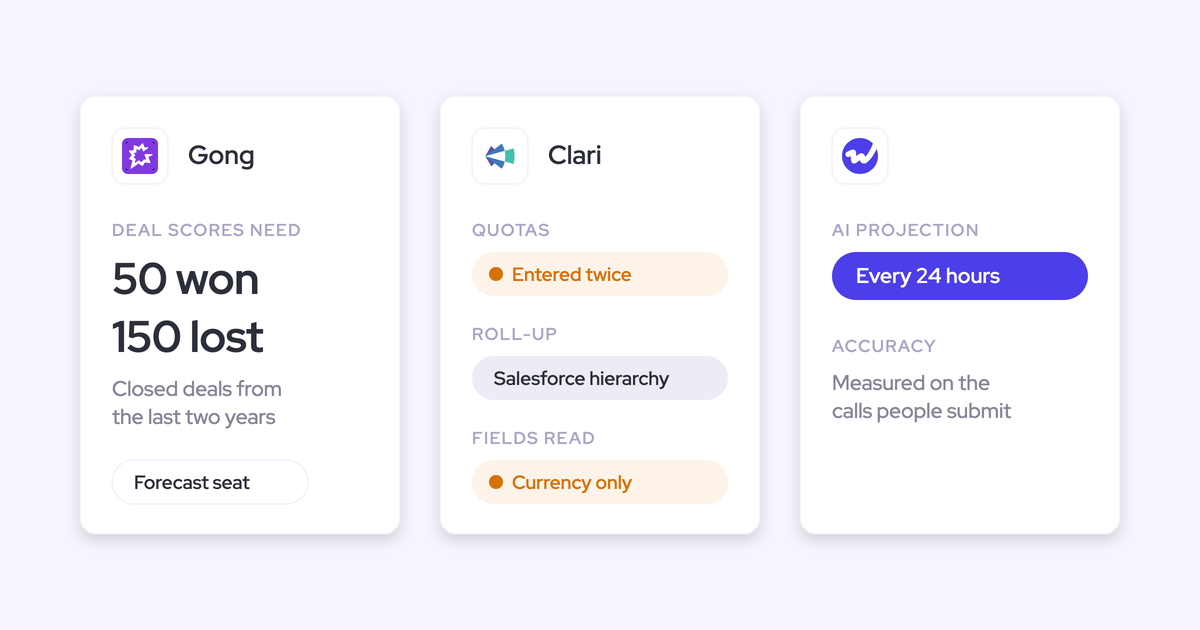
Gong doesn't produce a weighted methodology deal score. If you want one on the opportunity, you build it in Salesforce with your RevOps and IT teams.
Gong's deal board shows whether each methodology field is filled, not what a deal still lacks to reach signature. Some RevOps teams find Gong's built-in MEDDIC tool hard to tailor, so they build their own MEDDIC analysis in Claude and keep Gong as the recorder.
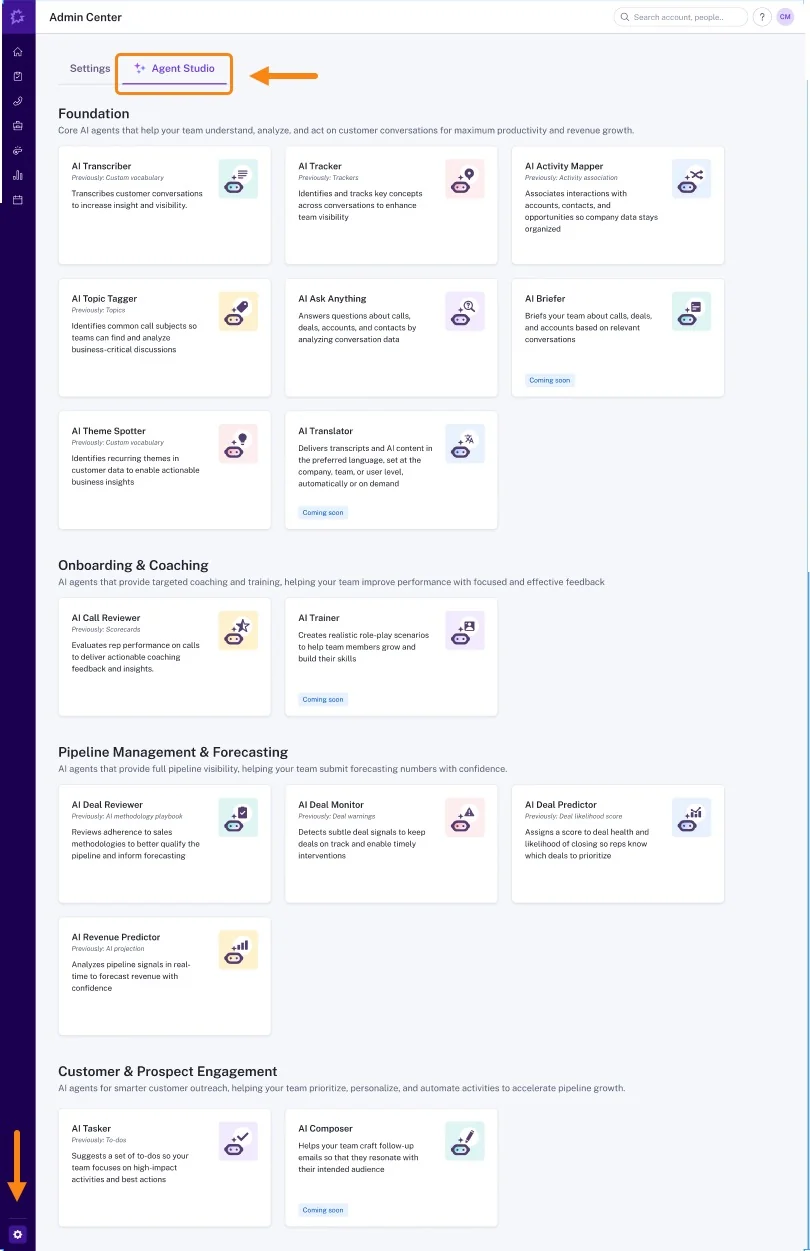
Gong's Agent Studio catalogue lists AI Deal Reviewer among Gong's named agents, grouped by job.
Gong connects to about 450 integrations and partner apps, with warehouse access sold separately
Gong reaches further into the rest of your stack than Weflow or Clari. Its marketplace, the Gong Collective, lists about 450 integrations and partner solutions across CRM, dialers, web conferencing, email and calendar, BI and data, enrichment, workflow automation and MCP servers.
For MEDDIC tracking, these are the connections you'll use:
- Dialers: calls import from about 30, including Aircall, Dialpad, Five9, RingCentral, Talkdesk and Zoom Phone.
- Meetings: recording works on Zoom, Google Meet, Microsoft Teams, Webex and 7 other meeting platforms.
- CRMs: native integrations cover 3, Salesforce, HubSpot and Microsoft Dynamics 365.
- AI assistants: Gong's MCP server gives them 9 read-only tools. get_transcript returns one call's transcript per request, a page at a time, and the 4 AI tools draw credits.
- API: capped at 3 calls a second and 10,000 a day.
- Warehouses: Snowflake, Databricks, BigQuery or Redshift through Data Cloud, a separate purchase at about $5,000 a year.
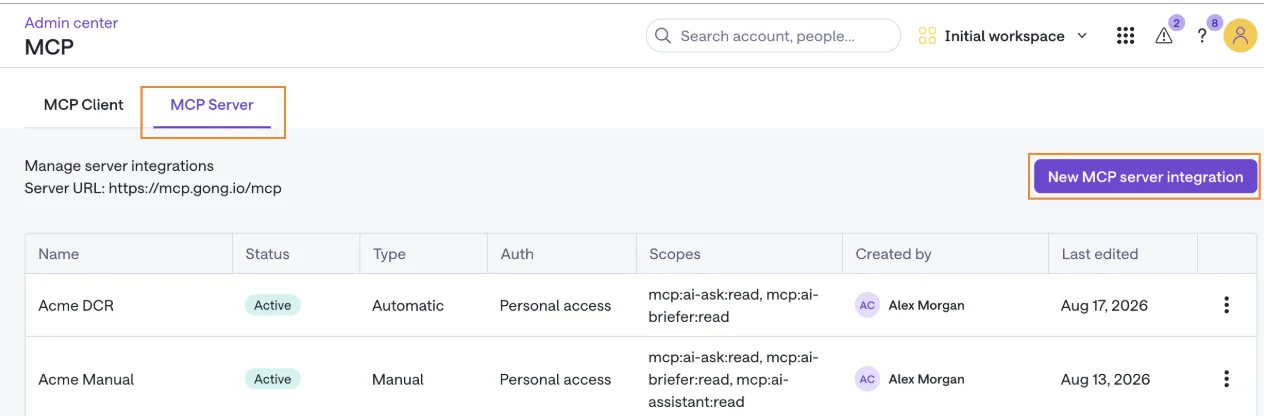
In Gong's admin center, the MCP Server tab lists each connected assistant integration with its scopes.
What Gong costs for MEDDIC tracking, and which teams it fits
Gong has no public pricing. It prices licences per user, adds a platform fee based on the number of users, and quotes each buyer through a custom proposal.
Gong Foundation is the mandatory core, applications sit on top, and AI Deal Reviewer needs Forecast Essentials or Gong Forecast. Gong assigns seats per application, so a manager who needs deal features takes a Foundation seat and a Forecast Essentials seat.
Gong meters AI usage in credits, 2,000 a year per paid core seat in a company-wide pool. One Gong renewal proposal for 45 licences came to about $80,000 a year, of which forecasting was about $10,000.
Gong fits teams that want the deepest call analytics and the widest ecosystem, and teams on HubSpot or Dynamics.
How Clari tracks MEDDIC through Salesloft and Clari Copilot
Since Clari and Salesloft merged in December 2025, Clari tracks MEDDIC through Salesloft and Clari Copilot. Clari is the stronger tool for roll-up forecasting and board reporting, and its enterprise roll-ups at 1,000+ reps are more mature than Weflow's.
Salesloft fills MEDDPICC fields from calls, but Clari has no pipeline view by methodology
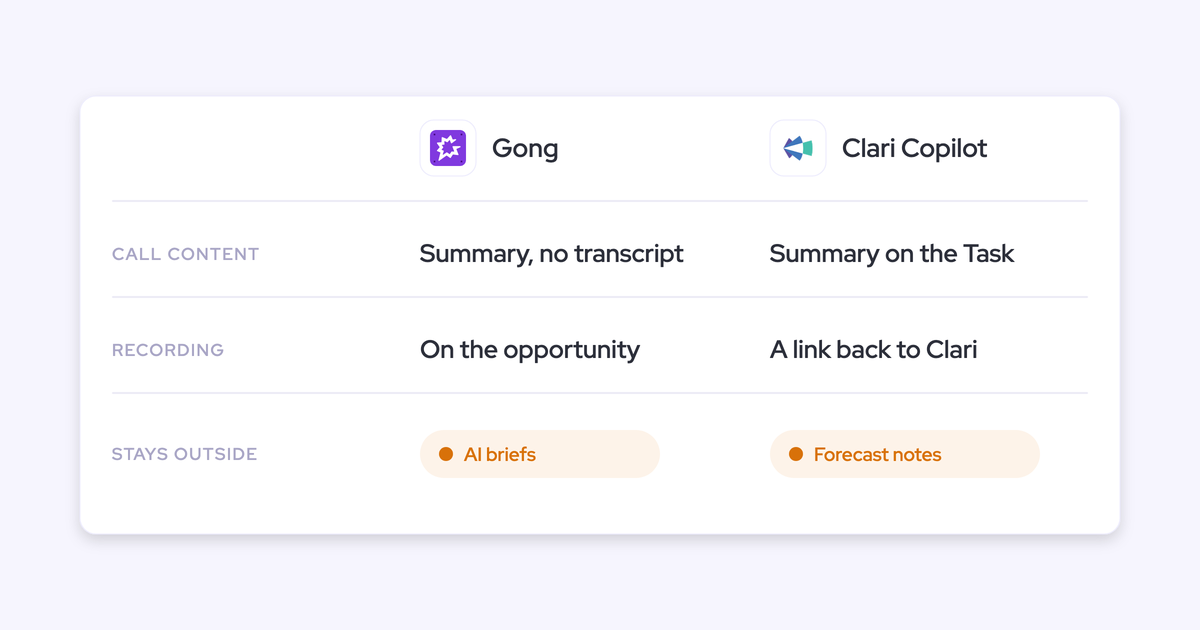
Salesloft and Clari Copilot fill MEDDPICC fields from call transcripts; Clari's forecasting and Inspect products don't. You have 3 routes, and the one you use decides whether a rep sees the value before it lands:
- Salesloft Deals fills MEDDPICC and BANT fields in the CRM from call transcripts through its automatic CRM sync. Reps get no step to review the values first.
- Salesloft Conversation Intelligence suggests Salesforce field updates from each call, grouped into sets such as MEDDIC. The rep applies them from the call review page with Update Fields in CRM.
- Clari Copilot can read a call transcript against MEDDPICC and write the result to Salesforce fields once the rep approves it.
Clari Copilot is replacing Salesloft Conversations as the conversation intelligence layer inside Salesloft. New Salesloft customers get it first and existing Conversations customers migrate later. You need an Advanced or higher Salesloft licence tier to use it.
None of the 3 routes gives a manager a methodology view of the pipeline. Clari Inspect produces AI deal insights, but it has no playbook that checks a deal against MEDDPICC.
Clari also has no view where a manager compares several opportunities against a methodology. Managers open deals one at a time or ask reps for the criteria in forecast reviews.
Clari reaches warehouses through Salesloft and AI assistants through 3 separate MCP servers
Clari reaches data warehouses through Salesloft's Unified Revenue Data Layer, which syncs with Salesforce, Microsoft Dynamics, Snowflake, Databricks, Gmail, DocuSign, ZoomInfo and LinkedIn. For a BI tool, Salesloft Forecast exports 2 years of submitted forecasts as a CSV.
Clari Copilot records Zoom calls through Zoom's native recording or with its own bot.
AI assistants reach Clari through 3 separate MCP servers, one per product, each with its own limit:
- The Clari Forecast MCP server gives Claude and ChatGPT live forecast numbers and historical snapshots, but no deal-level opportunity data.
- The Clari Copilot MCP server exposes Copilot tools only, once a Copilot admin switches it on.
- The Salesloft MCP server is read-only, needs the paid Salesloft Agentic add-on, and returns AI call summaries and extracted fields but no raw transcripts or cadences.
What Clari costs for MEDDIC tracking, and which teams it fits
Clari and Salesloft have no public seat prices: both pricing pages send you to a Salesloft Talk to Sales page to book a call. Salesloft sells 2 packages, Advanced and Elite, and prices forecasting, AI agents and the dialer as add-ons on top of either.
Estimates put Clari at around $120 to $180 per user per month, and Clari raises its prices regularly.
Clari fits forecast-led organizations at enterprise scale that already run Salesloft and live in roll-ups and board reporting.
Choose Gong, Clari or Weflow by how your team runs MEDDIC
Choose by where your MEDDIC problem sits: in call analytics, in the forecast roll-up, or in deals nobody can see are qualified.
- Gong is the pick if you want the deepest conversation analytics, manager-validated methodology playbooks and a 450-integration ecosystem, and you have the admin time to build an extractor per field and the budget for credits.
- Clari is the pick if your organization runs on roll-up forecasting and board reporting, already uses Salesloft, and can live with MEDDPICC filled call by call and checked one deal at a time.
- Weflow is the pick if you're on Salesforce, want MEDDIC judged across every call, email and field on the deal, need to see the pipeline and each rep against it, and want the result in your own Salesforce fields at a public per-seat price.
- Gong or Clari, whichever you run today, stays the right call if you're on HubSpot or Dynamics, or if you're a Clari forecasting organization at 1,000+ reps that's happy with its roll-ups.
Moving MEDDIC tracking from Gong or Clari to Weflow
Moving MEDDIC tracking to Weflow means a rollout of typically 2 to 3 weeks, plus a call history import that you time against your Gong or Clari renewal date. We recommend these steps, in this order:
- Sign early enough for the history import to finish before your renewal. A Gong import runs through Gong's API one call at a time, at about 2,000 to 2,500 calls a day: around 30,000 calls take about 15 days. Weflow migrates up to 2 years of Gong history at no charge and restores each call's link to its Salesforce account. A Clari import takes 2 to 3 days, and you set up your users in Weflow first, because Weflow assigns each recording to its owner.
- Keep the old contract and its API access live until the import ends, because the import reads through that access.
- Configure the playbook and its fields. Start from the MEDDIC template or your house framework, set each element's evaluation criteria and sources, and assign the playbook to teams. Trackers from Gong or Clari don't carry over, so set up again the ones you still need.
- Point write-back at test fields first and compare a sample of deals with what your managers know. Then switch it to your live MEDDIC fields, because playbook writes land there with no approval step.
- Run Generate AI Playbooks on your open pipeline from a pipeline view, up to 100 records at a time, so existing deals are scored before your first pipeline review.
- Roll out by role, with separate leadership and rep training. Weflow switches Conversation Intelligence on for each group of reps after their training session. Implementation is free.
See how Weflow captures activity, updates Salesforce fields from calls, and rolls up your forecast. Book a 30-minute demo.
FAQs sales managers ask about MEDDIC tracking in Gong, Clari and Weflow
Does Weflow handle MEDDPICC or our own house framework?
Weflow handles both. It ships around 30 methodology templates, and you can change every part of a template. You define a house framework element by element with your own evaluation criteria, so Weflow encodes it exactly like a standard one. Each playbook runs for the teams you assign it to, so different teams can run different frameworks.
Will automatic MEDDIC tracking overwrite what reps typed?
Automatic MEDDIC tracking can overwrite rep-typed values, so decide which fields each route owns. A Weflow playbook with write-back on pushes its result into the text field you choose with no approval step, after its second pass has judged what the rep typed and marked filler as not assessed.
AI Field Updates replace a field's content. For MEDDIC fields, use review mode, where the rep sees the current value beside the suggestion, or tell the prompt to leave the field unchanged when a call adds nothing new.
Does Weflow read email as MEDDIC evidence, or only calls?
Weflow AI Playbooks read every email on the deal alongside meetings, transcripts and CRM fields. That matters because the champion and the decision maker often come up only in email. Clari's 3 routes, Salesloft Deals, Salesloft Conversation Intelligence and Clari Copilot, fill fields from calls.
Can we keep recording with Gong and use Weflow for MEDDIC?
You can keep Gong as the recorder, with less evidence behind each playbook. AI Playbooks read the transcripts of meetings Weflow recorded, so with Gong recording they work from the CRM record, emails, meeting metadata and any transcripts or summaries Gong writes into Salesforce. Teams that switch recorders bring up to 2 years of Gong history across at no charge.
Does Weflow work on HubSpot or Dynamics?
Weflow doesn't work on HubSpot or Dynamics; it supports Salesforce as its only CRM. Gong integrates natively with Salesforce, HubSpot and Microsoft Dynamics 365, so it's the better fit when you're not on Salesforce.
How long does a Weflow rollout take?
A Weflow rollout typically takes 2 to 3 weeks. It starts with a 45 to 60 minute technical session with your Salesforce and mail admins, then a configuration phase for the playbook and fields, then role-based training. A Gong history import runs alongside it, at about 2,000 to 2,500 calls a day.