
MEDDIC Sales Framework: How It Works and How to Apply It
Learn how the MEDDIC sales framework works and how to apply it to qualify deals.



.png)

What is the MEDDIC sales process?
MEDDIC is a B2B deal qualification framework built around six elements: Metrics, Economic Buyer, Decision Criteria, Decision Process, Identify Pain, and Champion. It gives sales teams a structured way to evaluate whether a deal is real, winnable, and worth pursuing—before investing weeks of selling effort.
Jack Napoli and Dick Dunkel created MEDDIC at PTC in the mid-1990s. At the time, PTC was struggling with inconsistent deal qualification and unpredictable revenue. After rolling out MEDDIC across the sales org, PTC tripled revenue from $300 million to $1 billion in four years. That track record turned MEDDIC into one of the most widely adopted qualification frameworks in enterprise B2B sales.
One critical distinction: MEDDIC isn’t a sequential sales process. You don’t start with Metrics and end with Champion. It’s a qualification checklist—a set of conditions that must be true for a deal to close. Reps should be gathering this information throughout the sales cycle, filling in gaps as the deal progresses rather than following a rigid order.
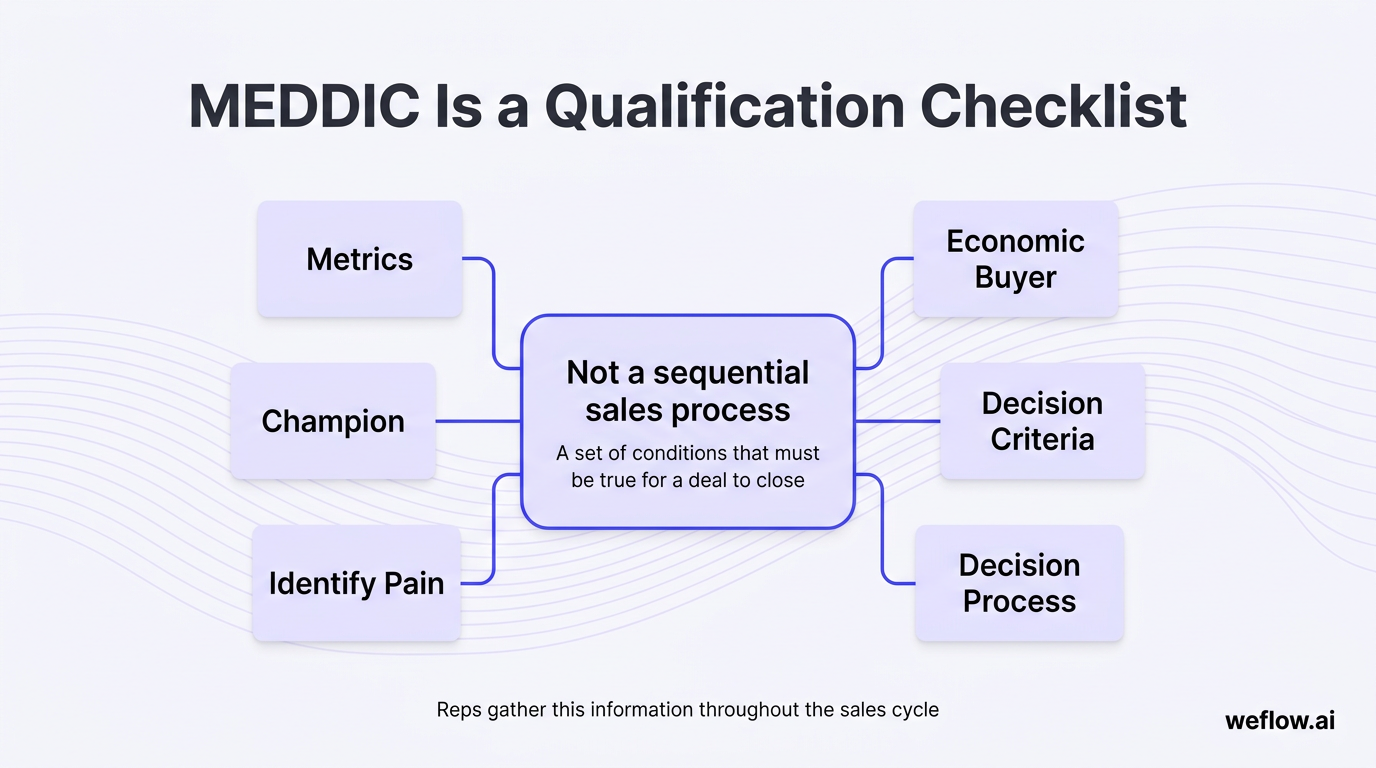
The six elements at a glance
Element | Definition |
|---|---|
Metrics | The quantifiable business outcomes the buyer expects from your solution |
Economic Buyer | The person with final authority to approve budget and sign the deal |
Decision Criteria | The technical and business requirements the buyer uses to evaluate vendors |
Decision Process | The steps, stakeholders, and timeline the buyer follows to make a purchase decision |
Identify Pain | The specific business problem driving the buyer to evaluate solutions now |
Champion | An internal advocate who has power, influence, and a personal stake in your solution winning |
How to apply each element of the MEDDIC framework
Metrics
Metrics are the quantifiable business outcomes your buyer needs to justify the purchase. Without clear metrics, there’s no business case—and without a business case, deals stall or die in procurement.
Strong MEDDIC metrics fall into four categories:
Cost reduction: How much does the current problem cost? Calculate labor hours wasted, tool spend that can be consolidated, or operational inefficiencies that carry a dollar value.
Revenue impact: Can your solution help the buyer close more deals, expand existing accounts, or shorten sales cycles? Tie these to specific dollar amounts.
Time savings: How many hours per week or month does your solution save? For example, if reps spend five hours per week on manual CRM updates, that’s 260 hours per year per rep.
ROI: What’s the payback period? A buyer who can show their CFO a 6-month payback has a much stronger internal case than one with vague “efficiency gains.”
The goal isn’t to guess—it’s to co-build the business case with your buyer. Use their data, their numbers, and their language. A metric the buyer owns is 10x more persuasive than one you project onto them.
Discovery questions for Metrics:
“What does this problem cost your organization today—in dollars, hours, or missed revenue?”
“If you solve this, what does success look like in 12 months? What numbers would you point to?”
“What ROI threshold does your finance team need to see before approving a purchase of this size?”
Economic Buyer
The Economic Buyer is the person who can say yes when everyone else has said no. They control the budget, have veto power, and ultimately sign off on the purchase. In most enterprise deals, this is a VP, SVP, or C-level executive—not the person running the evaluation.
Identifying the Economic Buyer early matters because deals without executive sponsorship get stuck. They lose funding, get deprioritized, or die in legal review. You need to know who this person is, what they care about, and how to get in front of them—even if it’s through your Champion rather than directly.
Tactical guidance:
Ask your primary contact directly: “Who signs off on the budget for this project?” If they hesitate or say “a committee,” push further—someone always has final authority.
Research the org chart. LinkedIn, annual reports, and your Champion’s insights all help map the power structure.
Plan a specific engagement for the Economic Buyer. They won’t sit through a product demo—they need a 15-minute business case conversation focused on outcomes.
Discovery questions for Economic Buyer:
“Who has final sign-off authority on the budget for this initiative?”
“Have you worked with [that person] on a purchase like this before? What did they prioritize?”
“What would be the most effective way for us to present the business case to them?”
Decision Criteria
Decision Criteria are the specific requirements the buying committee uses to evaluate and compare vendors. They split into two categories: technical criteria and business criteria.
Technical criteria include things like integration requirements, security certifications, deployment model, scalability, and feature parity with current tools. These are typically owned by IT, security, or the technical evaluation team.
Business criteria include ROI expectations, time to value, vendor stability, support model, and alignment with strategic priorities. These are owned by the business sponsor and Economic Buyer.
Your job isn’t just to learn the criteria—it’s to influence them. Work with your Champion to ensure the evaluation criteria include areas where you’re strong. If you discover criteria where you’re weak, address them head-on rather than hoping they won’t matter.
Discovery questions for Decision Criteria:
“What are the must-have requirements versus nice-to-haves for this evaluation?”
“Who defined these criteria, and are they finalized or still evolving?”
“Are there any criteria from past evaluations that ended up being more important than expected?”
Decision Process
The Decision Process maps out how the buyer goes from evaluation to signed contract. If you don’t understand the process, you can’t forecast accurately—and you’ll be surprised by delays you should’ve seen coming.
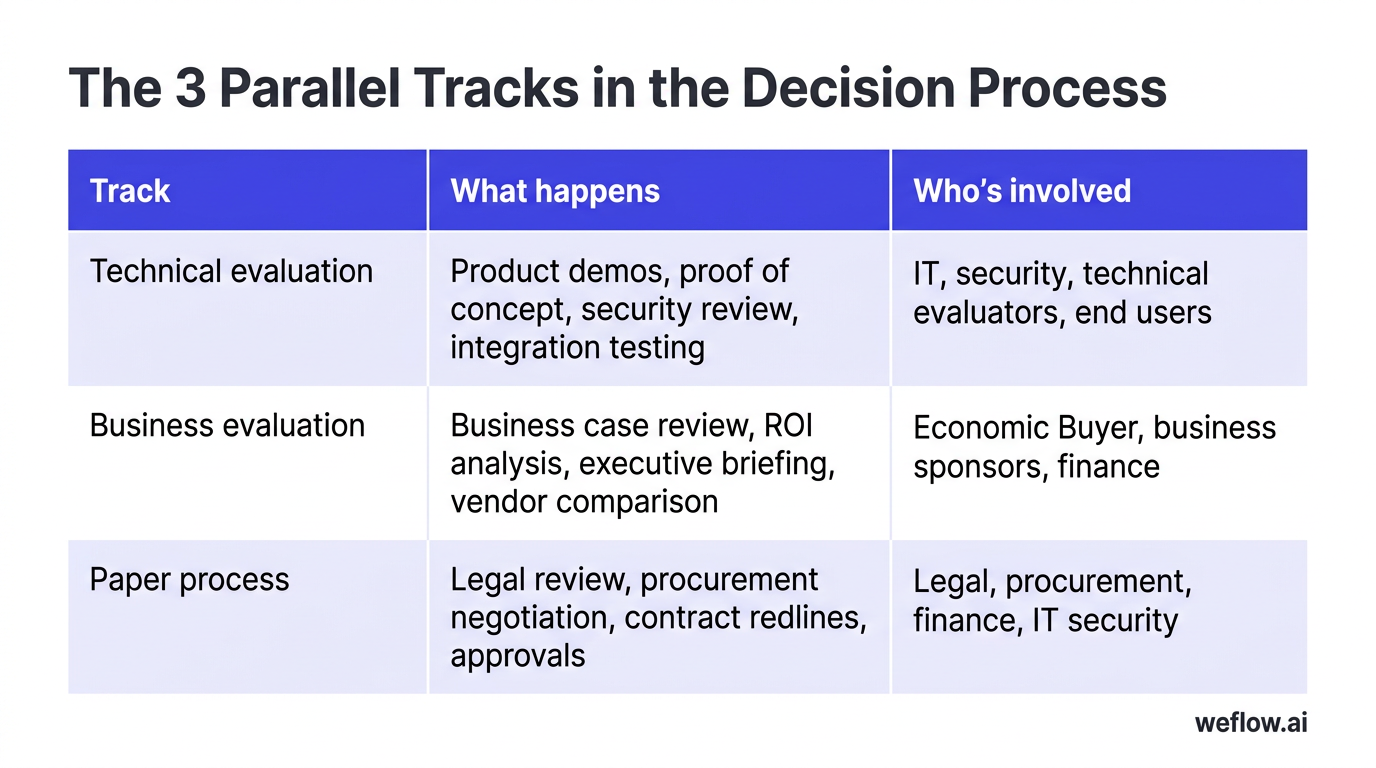
Most enterprise deals involve three parallel tracks:
[banner type="download" url="https://www.weflow.ai/resources/cheat-sheets/meddic-checklist" text="MEDDIC Qualification Checklist" subtitle="Validate every deal before it hits your commit forecast" button="Get the checklist"]
Track | What happens | Who’s involved |
|---|---|---|
Technical evaluation | Product demos, proof of concept, security review, integration testing | IT, security, technical evaluators, end users |
Business evaluation | Business case review, ROI analysis, executive briefing, vendor comparison | Economic Buyer, business sponsors, finance |
Paper process | Legal review, procurement negotiation, contract redlines, approvals | Legal, procurement, finance, IT security |
Map each track with dates, stakeholders, and dependencies. Many reps forecast a close date without understanding the paper process—then lose three weeks to legal review they didn’t anticipate. Ask your Champion to walk you through the last similar purchase the company made. That historical pattern is your best predictor of this deal’s timeline.
Discovery questions for Decision Process:
“Can you walk me through the steps between selecting a vendor and getting a contract signed?”
“How long did the last purchase of this size take from evaluation to signature?”
“Are there any approval gates—security review, procurement, legal—that tend to create delays?”
Identify Pain
Pain is why the buyer is talking to you at all. Without a clearly identified, urgent business problem, there’s no motivation to change—and the default decision is always “do nothing.”
Effective pain identification digs deeper than surface-level symptoms. “We need better reporting” is a symptom. “Our CRO doesn’t trust the forecast because pipeline data is incomplete, and we missed our number two quarters in a row” is pain with urgency, consequences, and a clear trigger for action.
Three levels of pain to uncover:
Technical pain: What’s broken or missing in their current tools and processes?
Business pain: What business outcomes are being missed because of the technical problem?
Personal pain: How does this problem affect the individuals involved? Are they spending weekends fixing reports? Are they losing credibility with their board?
Personal pain is the strongest motivator. People buy for business reasons and justify with logic, but the emotional urgency of personal pain is what gets deals prioritized.
Discovery questions for Identify Pain:
“What’s happening today that made you start looking for a solution?”
“What’s the cost of not solving this in the next six months—to the business and to your team?”
“Have you tried to fix this before? What happened?”
Champion
Your Champion is the internal person who actively sells on your behalf when you’re not in the room. They’re not just friendly—they have power, access, and a personal stake in your solution winning.
A true Champion meets all three criteria:
Access to the Economic Buyer: They can get you a meeting with the decision-maker—or deliver your business case directly.
Actively selling internally: They’re lobbying for your solution in meetings you’re not invited to, handling objections from skeptics, and pushing the process forward.
Shares inside intel: They tell you about competing vendors, internal politics, budget concerns, and timeline changes. If your “Champion” only shares good news, they’re a coach—not a Champion.
If your contact doesn’t meet all three criteria, you don’t have a Champion yet. You have a supporter. The difference is often the difference between winning and losing.
To develop a Champion, help them build their internal business case. Give them the slides, the data, and the talking points they need to sell your solution to their leadership. Make them look good, and they’ll fight for you.
Discovery questions for Champion:
“If we’re the right solution, what’s your plan to get this approved internally?”
“Who else on the buying committee do we need to get aligned? Can you introduce us?”
“What concerns or objections have you heard internally about this project?”
MEDDIC vs. MEDDPICC vs. MEDDICC: what’s the difference?
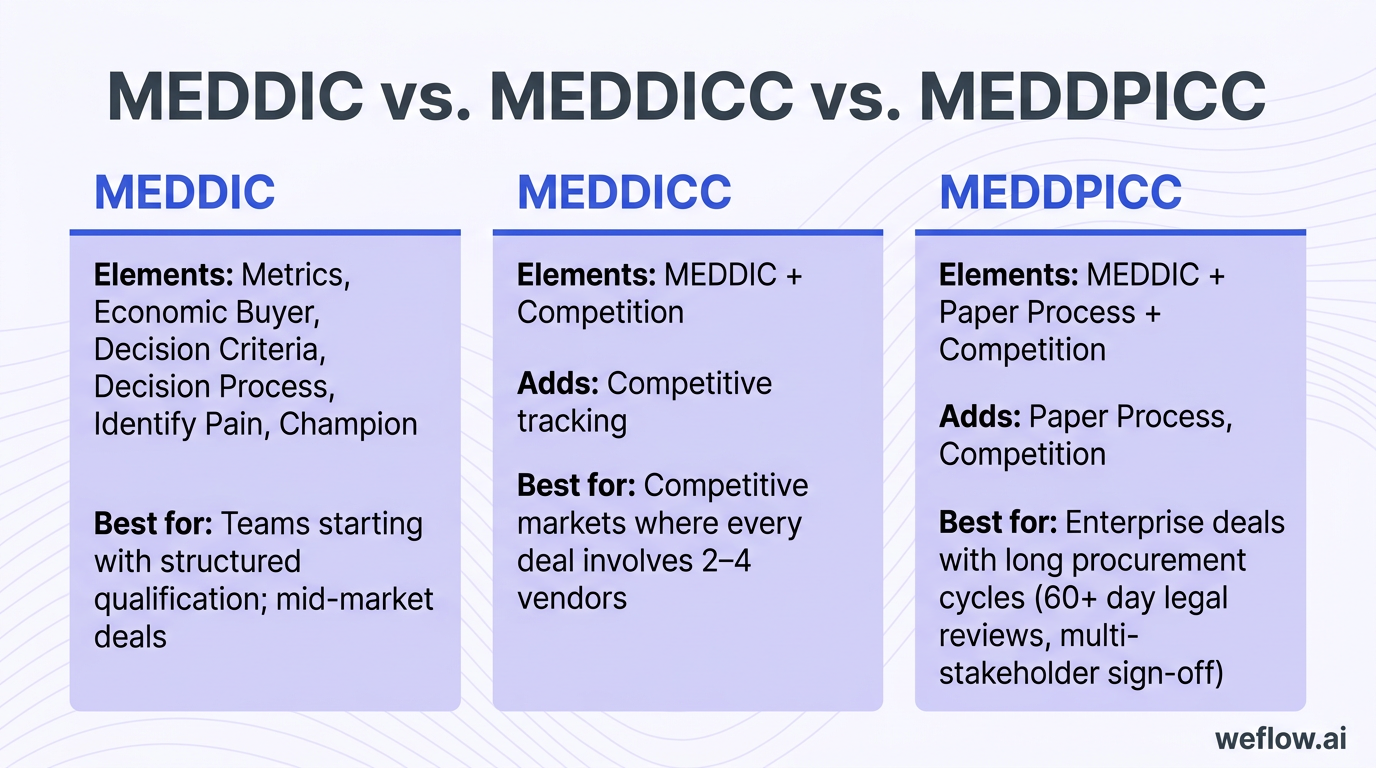
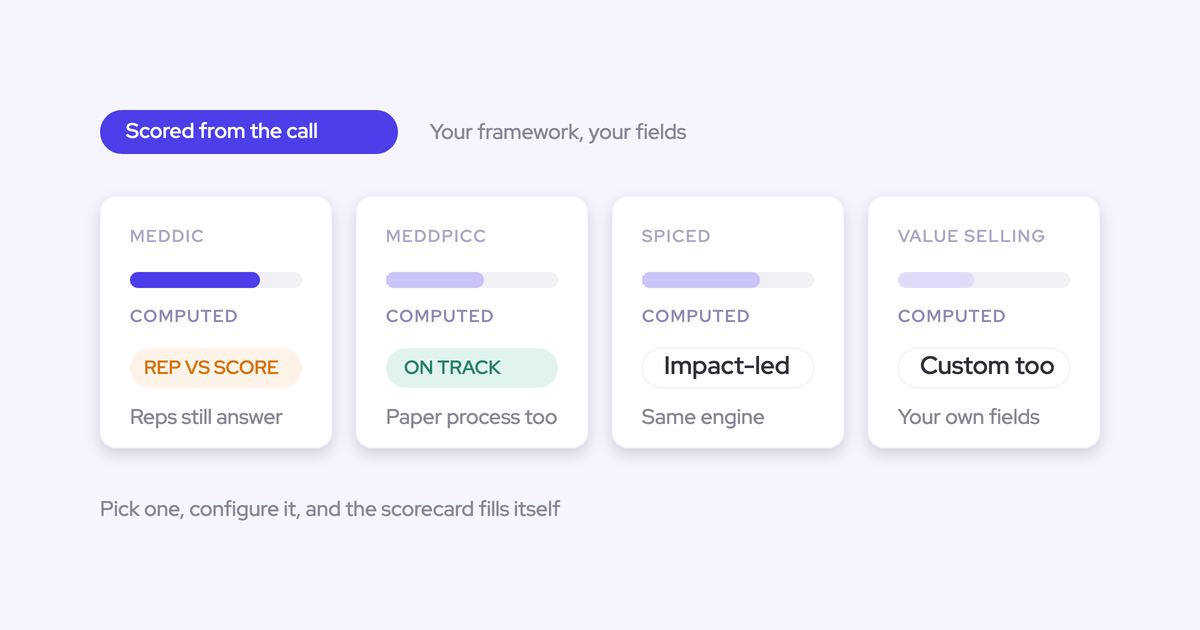
MEDDIC has spawned two popular variants as practitioners adapted the framework for different selling environments. The core six elements stay the same—the variants add layers for specific deal dynamics.
MEDDICC adds Competition (the second C). This pushes reps to document who they’re competing against—including the status quo—and understand the buyer’s perception of each competitor’s strengths and weaknesses.
MEDDPICC adds both Paper Process (the P) and Competition (the second C). Paper Process separates the legal, procurement, and contract-signing steps from the broader Decision Process, giving reps a dedicated checklist for the steps that most often cause deals to slip past their forecast date.
Framework | Elements | Adds | Best for |
|---|---|---|---|
MEDDIC | Metrics, Economic Buyer, Decision Criteria, Decision Process, Identify Pain, Champion | — | Teams starting with structured qualification; mid-market deals |
MEDDICC | MEDDIC + Competition | Competitive tracking | Competitive markets where every deal involves 2–4 vendors |
MEDDPICC | MEDDIC + Paper Process + Competition | Paper Process, Competition | Enterprise deals with long procurement cycles (60+ day legal reviews, multi-stakeholder sign-off) |
Which one should you use? Start with MEDDIC. If you’re losing deals to competitors you didn’t know about, add the Competition element. If deals keep slipping past their close date because of procurement and legal delays, add Paper Process. Don’t adopt MEDDPICC because it sounds more thorough—adopt it because your deal data tells you those extra elements will solve a real problem.
How to implement MEDDIC in your CRM and deal reviews
Embedding MEDDIC in Salesforce
The fastest way to make MEDDIC stick is to build it directly into Salesforce Opportunity records. Create custom fields for each MEDDIC element so reps fill them in as part of their normal deal workflow—not as a separate exercise.
Recommended Salesforce field setup:
MEDDIC element | Salesforce field type | What to capture |
|---|---|---|
Metrics | Long text area or rich text | Quantified business case: cost savings, revenue impact, ROI, payback period |
Economic Buyer | Lookup to Contact | Name and title of the person with budget authority |
Decision Criteria | Long text area | Technical and business requirements the buyer is evaluating against |
Decision Process | Long text area | Steps, stakeholders, timeline, and approval gates from evaluation to signature |
Identify Pain | Long text area | The specific business problem, its impact, and why the buyer is acting now |
Champion | Lookup to Contact | Name and validation status (access to EB, selling internally, sharing intel) |
Add a MEDDIC Score field (picklist or formula) that calculates completeness. A simple approach: assign one point per element that’s filled in with meaningful information (not just “TBD”). Deals scoring below 4 out of 6 at Stage 3+ should trigger a coaching conversation.
[banner type="download" url="https://www.weflow.ai/resources/cheat-sheets/meddpicc-sales-process-checklist" text="MEDDPICC Qualification Checklist" subtitle="Stop losing enterprise deals to procurement delays and unknown competitors" button="Get the checklist"]
Using MEDDIC in pipeline reviews
MEDDIC becomes most valuable when it’s baked into your weekly pipeline and deal review cadence. Instead of asking reps “How’s the deal going?” (which always gets an optimistic answer), use the MEDDIC elements to ask specific questions:
“Who’s the Economic Buyer, and when did you last speak with them?”
“What are the buyer’s Decision Criteria, and which ones do we win on?”
“What’s the paper process look like? Have they started legal review?”
“What’s your Champion telling you about the competition?”
Deals with incomplete MEDDIC fields aren’t bad deals—they’re deals where you don’t have enough information to forecast accurately. Use the gaps to assign next steps: “Before next week’s review, get the Decision Process mapped with dates.”
Automating MEDDIC data capture
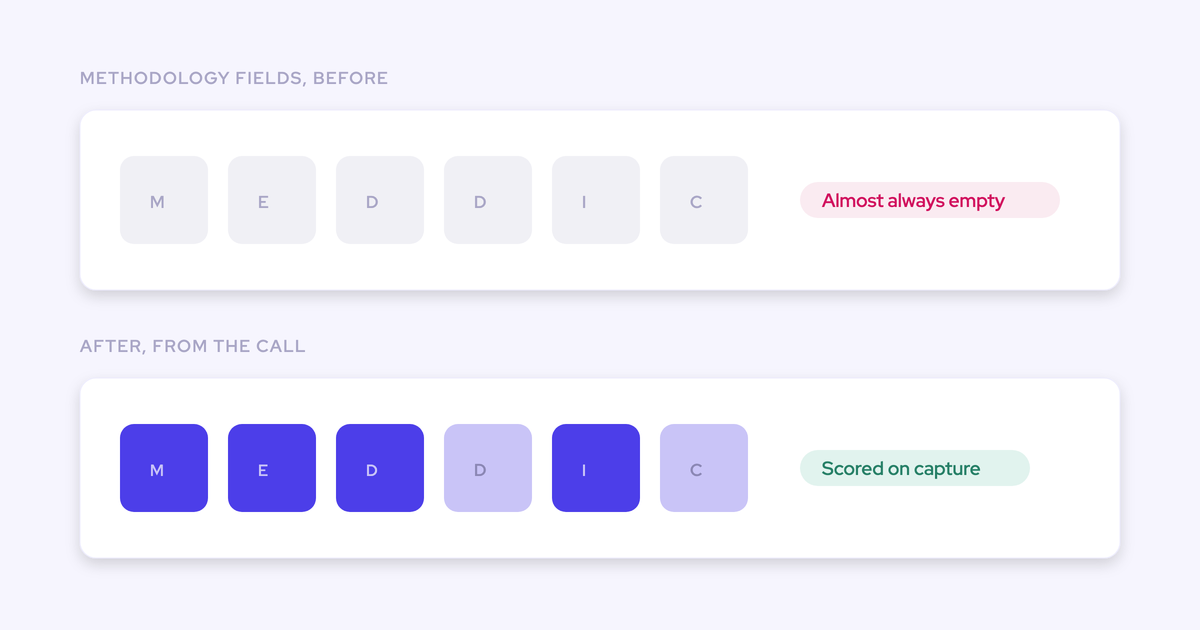
The biggest barrier to MEDDIC adoption is the manual work. Reps learn the framework, use it on calls, then don’t update Salesforce because it takes 10 minutes per deal. Over time, MEDDIC fields go stale and managers lose trust in the data.
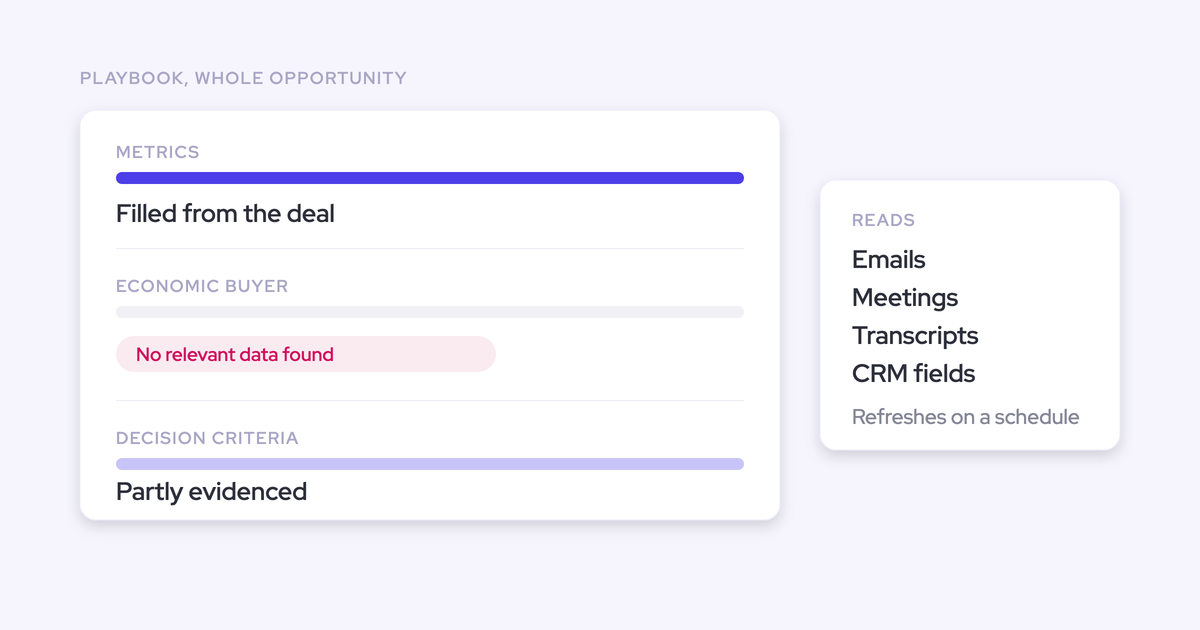
Tools like Weflow, a Salesforce-native revenue AI platform, help solve this by automatically capturing conversation data and populating Salesforce fields. When a rep discusses the buyer’s pain points or decision timeline on a call, AI can extract that information and write it to the corresponding MEDDIC fields—no manual entry required. This keeps MEDDIC data current and makes the framework sustainable at scale.
MEDDIC vs. BANT, SPIN, and Challenger: which methodology fits?
MEDDIC isn’t the only qualification framework available. Depending on your deal complexity, sales cycle length, and team structure, a different methodology—or a combination—might be a better fit.
Methodology | Best for | Depth of qualification | Ideal deal size |
|---|---|---|---|
MEDDIC | Complex B2B deals with multiple stakeholders and long sales cycles | Deep—maps buying committee, criteria, and process | $50K+ ACV |
Initial lead qualification and SDR/BDR discovery calls | Surface-level—checks four basic criteria | Any, but strongest under $25K ACV | |
Consultative selling where the buyer hasn’t fully defined their problem | Medium—focuses on uncovering and developing needs | $25K–$100K+ ACV | |
Markets where buyers need to be educated on problems they don’t know they have | Medium—emphasizes insight delivery and commercial teaching | $50K+ ACV |
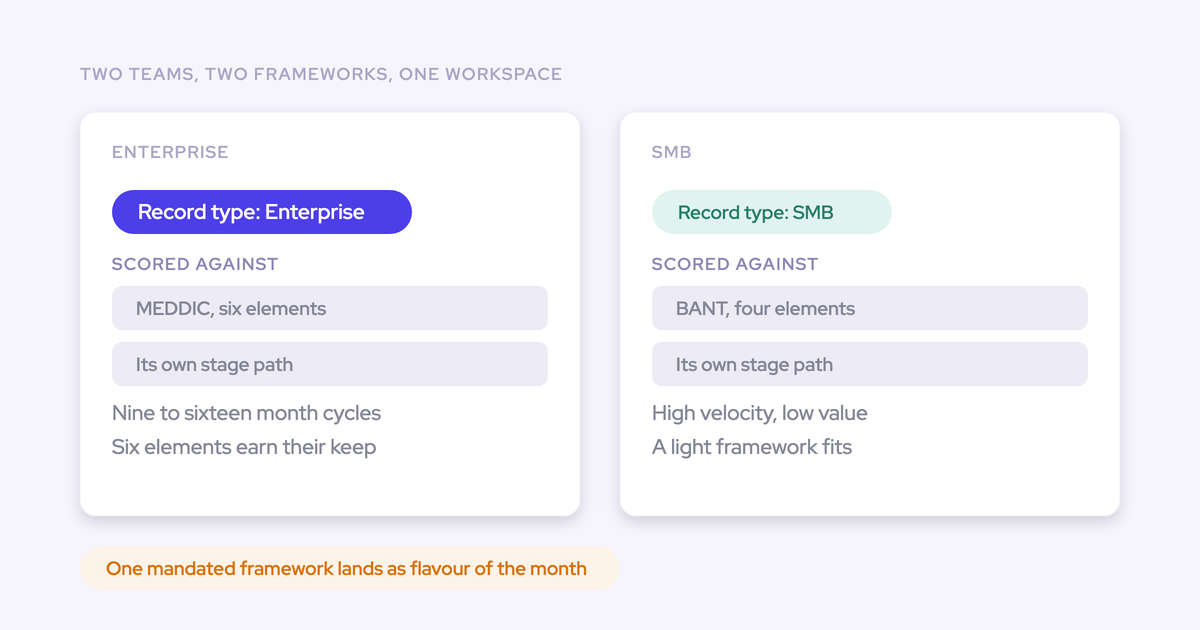
BANT (Budget, Authority, Need, Timeline) is the simplest framework. It works well for SDRs qualifying inbound leads but doesn’t give you the depth needed for enterprise deal management. Many teams use BANT for initial qualification and MEDDIC for opportunity management.
SPIN Selling (Situation, Problem, Implication, Need-payoff) focuses on discovery technique—how to ask questions that help buyers articulate their own pain and urgency. It’s a questioning methodology, not a qualification framework. SPIN and MEDDIC are complementary: use SPIN’s questioning structure to uncover the information MEDDIC requires.
Challenger Sale teaches reps to lead with insight, challenge the buyer’s assumptions, and reshape how they think about their problem. It’s an approach to selling, not a deal qualification framework. Challenger works well alongside MEDDIC when your market requires buyer education.
The practical answer for most mid-market and enterprise B2B teams: use BANT for lead qualification, MEDDIC for deal qualification and management, and borrow elements from SPIN and Challenger for your discovery and selling approach.
Pros and cons of the MEDDIC sales framework
Pros
Better deal qualification: MEDDIC forces reps to validate that a deal is real before investing time. Teams using MEDDIC typically see higher win rates because they focus on deals they can actually close.
Improved forecast accuracy: When every deal in the pipeline has documented metrics, an identified Economic Buyer, and a mapped decision process, managers can forecast with data instead of gut feel.
Common language across the org: MEDDIC gives sales managers, reps, and leadership a shared vocabulary for deal reviews. Instead of subjective assessments, everyone discusses the same six elements.
Faster rep onboarding: New reps ramp faster when they have a clear framework for what “qualified” looks like. MEDDIC gives them a checklist to follow on every deal.
Earlier deal risk identification: Missing MEDDIC elements surface deal risks early—before the deal is in the commit forecast and everyone’s counting on it.
Cons
Time-intensive for reps: Filling in MEDDIC fields for every deal takes work. Without the right tools to automate data capture, CRM adoption drops and the fields go stale.
Requires training and reinforcement: Learning the MEDDIC acronym takes 30 minutes. Applying it well on live deals takes months of coaching. Without ongoing manager reinforcement, teams revert to old habits.
Less suited for transactional sales: If your average deal size is under $10K and your sales cycle is under 30 days, MEDDIC adds overhead that doesn’t pay off. Simpler frameworks like BANT are a better fit for high-velocity, low-ACV sales motions.
Can become a checkbox exercise: If managers only check whether MEDDIC fields are filled in—not whether the information is meaningful—the framework becomes administrative theater that reps resent.
Doesn’t cover everything: MEDDIC focuses on qualification, not on how to sell. It won’t teach reps how to run a demo, handle objections, or negotiate pricing. You’ll likely need to pair it with a selling methodology.
Frequently asked questions
What does MEDDIC stand for?
MEDDIC stands for Metrics, Economic Buyer, Decision Criteria, Decision Process, Identify Pain, and Champion. Each element represents a condition that must be validated for a deal to be well-qualified.
What’s the difference between MEDDIC and MEDDPICC?
MEDDPICC adds two elements: Paper Process and Competition. Paper Process breaks out the legal, procurement, and contract-signing steps as a separate qualification item. Competition tracks which vendors the buyer is evaluating and how your solution compares. Use MEDDPICC when your deals have long procurement cycles or highly competitive evaluations.
When should a sales team adopt MEDDIC?
MEDDIC works best for teams selling deals with $50K+ ACV, multiple stakeholders, and sales cycles longer than 60 days. If your reps are losing deals they expected to win, struggling with forecast accuracy, or can’t articulate why deals stall, MEDDIC will help. If your sales motion is high-velocity and transactional, BANT or a simpler framework is a better fit.
How do I implement MEDDIC in Salesforce?
Create custom fields on the Opportunity object for each MEDDIC element. Use long text areas for Metrics, Decision Criteria, Decision Process, and Identify Pain. Use Contact Lookup fields for Economic Buyer and Champion. Add a MEDDIC Score formula field that calculates completeness, and build reports to track scores across the pipeline. Make MEDDIC fields part of your stage exit criteria—for example, require Economic Buyer and Identify Pain to be filled before a deal can move to Stage 3.
What is a Champion in MEDDIC?
A Champion is an internal advocate at the buyer’s organization who has power, influence, and a personal stake in your solution winning. They’re not just someone who likes your product—they actively sell for you internally, can access the Economic Buyer, and share candid information about the competitive landscape and internal dynamics. If your contact doesn’t meet all three criteria, they’re a supporter or a coach, not a Champion.
How is MEDDIC different from BANT?
BANT (Budget, Authority, Need, Timeline) checks four surface-level qualification criteria. MEDDIC goes deeper: it maps the full buying committee, documents specific decision criteria, tracks the decision process step by step, and validates that you have an active Champion. BANT is better for initial lead qualification. MEDDIC is better for managing complex, multi-stakeholder deals. Many teams use both—BANT for SDR qualification and MEDDIC for opportunity management.
What are the limitations of MEDDIC?
MEDDIC is a qualification framework, not a complete sales methodology. It tells you whether a deal is qualified but doesn’t teach reps how to sell. It requires ongoing coaching to apply well—reps who fill in MEDDIC fields without meaningful information create a false sense of deal health. It’s also time-intensive for reps, which is why many teams pair MEDDIC with tools that automate CRM data capture to reduce the admin burden.
Can MEDDIC be combined with other sales methodologies?
Yes—and most teams do. MEDDIC handles deal qualification. SPIN Selling provides a discovery questioning technique for uncovering the information MEDDIC requires. Challenger Sale provides an approach for teaching buyers and reshaping their thinking. BANT works as a first-pass lead filter before MEDDIC takes over. These aren’t competing frameworks—they address different parts of the sales process and work well together.
-p-1600.png)

.png)
-p-1600.png)
-p-1600.png)
-p-1600.png)