
GPCT vs. BANT: How to Choose a Sales Qualification Framework
Learn when to use GPCT vs. BANT and choose the right sales qualification framework.



.png)

GPCT is a buyer-centric sales qualification framework developed by HubSpot that replaces BANT's seller-focused approach. Instead of asking "Can they buy?", GPCT asks "Can we help them hit their goals?"—a shift that aligns qualification with how B2B buying actually works in 2026. This article breaks down how each framework works, where each one fails, and how to pick the right one for your sales org.
What is a sales qualification framework?
A sales qualification framework is a structured set of criteria reps use to evaluate whether a prospect is worth pursuing. It standardizes how your team decides which deals move forward and which get deprioritized—so pipeline reviews aren't based on gut feel. The right framework reduces wasted selling time and gives managers a consistent language for coaching and forecasting.
| Framework | Full name | Origin | Best for |
|---|---|---|---|
| BANT | Budget, Authority, Need, Timeline | IBM, 1960s | Transactional, short-cycle deals |
| GPCT | Goals, Plans, Challenges, Timeline | HubSpot, 2010s | Consultative, mid-market B2B sales |
| MEDDIC | Metrics, Economic Buyer, Decision Criteria, Decision Process, Identify Pain, Champion | PTC, 1990s | Complex enterprise deals with long cycles |
| CHAMP | Challenges, Authority, Money, Prioritization | InsightSquared | Inbound-heavy teams qualifying warm leads |
What is BANT? Origin, definition, and the four criteria
BANT was created by IBM in the 1960s to qualify prospects for mainframe computer sales. It made sense when purchase decisions were made by a single executive with a defined budget and a clear timeline. The framework filters prospects through four criteria:
- Budget: Does the prospect have budget allocated for this purchase?
- Authority: Is the person you're talking to the decision-maker?
- Need: Does the prospect have a defined need your product addresses?
- Timeline: Is there a specific timeframe for making the purchase?
BANT treats these as binary checkboxes. If a prospect doesn't check all four, they're disqualified. That worked when a VP could sign a purchase order over lunch. It doesn't work when buying committees have six to 10 people and budgets get created mid-cycle.
Why BANT fails in modern B2B sales

- It disqualifies instead of discovering. BANT's checkbox approach kills deals that haven't matured yet. A prospect might not have budget today—but they might secure it next quarter if you help them build an internal business case. BANT treats "no budget" as a dead end. A consultative seller treats it as a starting point.
- It assumes a single decision-maker. According to Gartner, the average B2B buying group includes six to 10 stakeholders. BANT asks "Are you the decision-maker?" as if one person controls the outcome. In practice, deals require alignment across finance, IT, operations, and end users. Asking about "authority" in a single-threaded way misses how the buying process actually works.
- It's a seller-focused interrogation. Running through Budget-Authority-Need-Timeline on a discovery call feels like a checklist, not a conversation. Buyers notice. They disengage when they feel like they're being qualified rather than helped. BANT puts the seller's pipeline needs ahead of the buyer's goals—and that's the fastest way to lose trust on a first call.
What is GPCT? Goals, plans, challenges, timeline explained
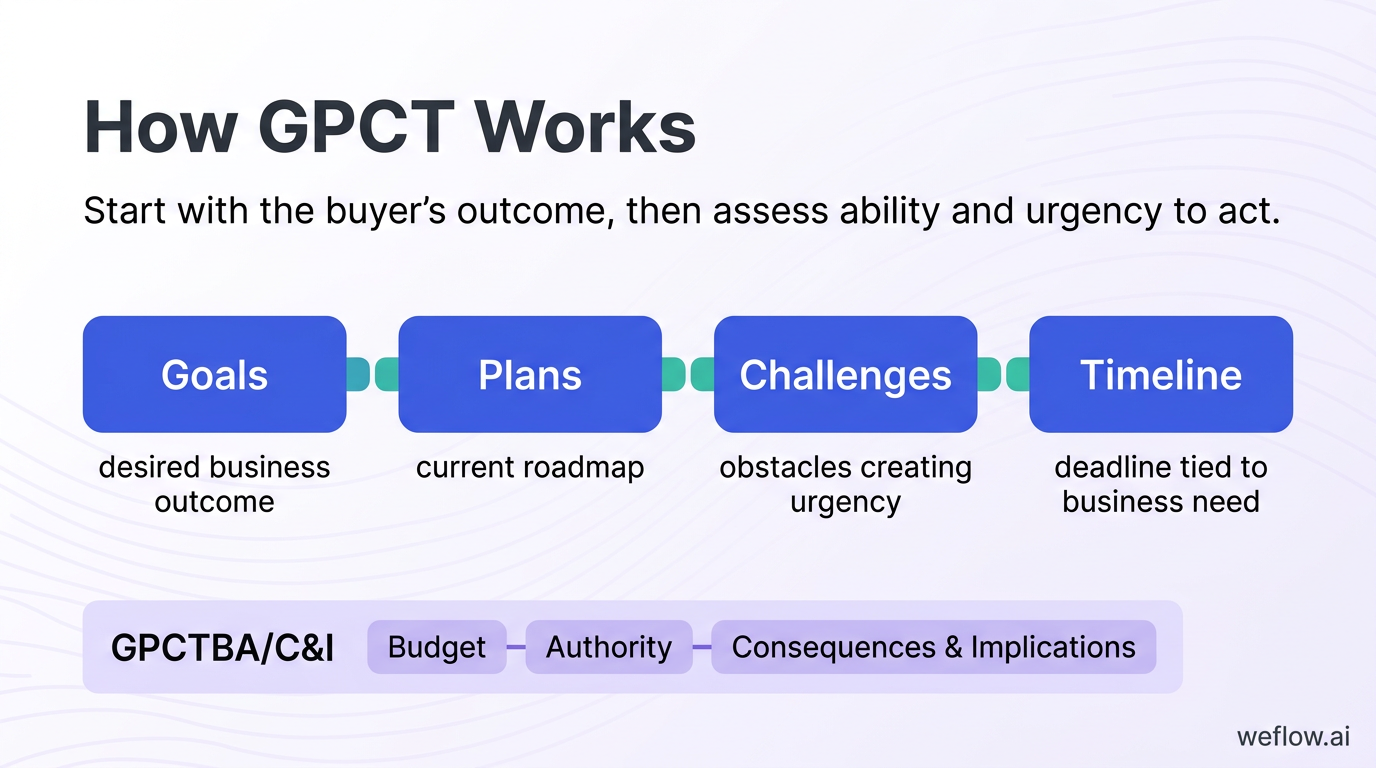
GPCT stands for Goals, Plans, Challenges, and Timeline. HubSpot developed it to match the consultative selling era—where reps act as advisors, not order-takers. The framework starts with the buyer's desired outcome and works backward to understand whether your product can help them get there.
The extended version, GPCTBA/C&I, adds Budget, Authority, and Consequences & Implications. This gives you a complete qualification picture: you understand what the prospect wants to achieve (GPCT), whether they can buy (BA), and what happens if they do or don't act (C&I). The extended framework is ideal for mid-market and enterprise B2B deals where multiple stakeholders, longer timelines, and higher stakes are the norm.
Goals: how to identify what your prospect wants to achieve
You're qualifying whether the prospect has a specific, measurable business outcome they're trying to reach—and whether your product maps to it.
Key discovery questions:
- "What are your top revenue or growth priorities for the next two quarters?"
- "How are you measuring success against those goals today?"
- "What would hitting that number mean for your team and your role?"
- "Where does this initiative rank against your other priorities?"
Good answers sound like: specific targets tied to revenue, headcount, efficiency, or market position. "We need to increase pipeline coverage from 2.5x to 3.5x by Q3" tells you there's a real goal with a measurable gap.
Red flags: vague answers like "We want to grow" or "We're exploring options." If the prospect can't articulate a goal, they haven't built internal urgency—and without urgency, deals stall.
Plans: evaluating your prospect's roadmap
You're qualifying whether the prospect has a plan to hit their goal—and whether that plan has gaps your product fills.
Key discovery questions:
- "What's your current plan to hit that target?"
- "Have you tried solving this before? What happened?"
- "What tools or processes are you using today to address this?"
- "Where do you see the biggest gaps in your current approach?"
Good answers sound like: specific actions already underway with identified shortcomings. "We hired three SDRs but our data quality is so poor that outbound targeting is a guessing game" tells you there's a plan with a gap you can address.
Red flags: no plan at all ("We haven't thought about it yet") or a plan that's already working well. If they've solved the problem, there's no deal to close.
Challenges: uncovering obstacles that block the deal
You're qualifying whether the prospect faces specific challenges that create urgency—and whether those challenges are painful enough to drive action.
Key discovery questions:
- "What's the biggest obstacle standing between you and that goal?"
- "How is this problem affecting your team's day-to-day work?"
- "What happens if you don't solve this in the next six months?"
- "Have internal stakeholders flagged this as a priority?"
Good answers sound like: operational pain that's costing time, money, or credibility. "Our forecast was off by 30% last quarter and the board called it out" is a challenge with consequences attached.
Red flags: challenges that are acknowledged but not prioritized. If the prospect says "Yeah, it's annoying but we're managing," there's not enough pain to drive a buying decision this quarter.
Timeline: qualifying urgency and implementation readiness
You're qualifying whether the prospect has a real deadline—and whether that deadline is driven by business need or just a vague intention to "look at this soon."
[banner type="download" url="https://www.weflow.ai/resources/cheat-sheets/gpct-selling-checklist" text="GPCT Selling Checklist" subtitle="Run discovery calls that qualify on goals, not budget gates" button="Get the checklist"]
Key discovery questions:
- "When do you need this in place to hit your target?"
- "Is there an event driving the timeline—board review, fiscal year, hiring plan?"
- "What does your evaluation and approval process look like?"
- "Who else needs to sign off before you can move forward?"
Good answers sound like: specific dates tied to business events. "We present our tech stack plan to the CFO in April, so we need to complete evaluation by mid-March" gives you a real close date to work backward from.
Red flags: "No rush" or "Sometime this year." Without a forcing function, deals drift into next quarter—or disappear entirely.
Budget: when and how to discuss pricing in GPCT
In GPCT, budget comes after goals, plans, and challenges—not before. That's deliberate. If you lead with "Do you have budget?", you disqualify prospects who haven't built a business case yet. By the time you've explored goals and challenges, the prospect understands the cost of inaction. Budget becomes a conversation about value, not a gate.
Key discovery questions:
- "Have you allocated budget for this initiative, or is this something you'd need to build a case for?"
- "What's the cost of the problem you described—in hours, revenue, or headcount?"
- "How have similar purchases been funded in the past?"
Good answers sound like: either confirmed budget or a clear path to securing it. "We have $50k earmarked in our ops budget" is ideal. "We'd need to get approval, but our VP has approved similar purchases before" still indicates a viable path.
Red flags: "We don't have any budget and there's no way to get it." That's a hard stop—but it's rare once you've established real pain and urgency.
Authority: identifying decision-makers in multi-stakeholder deals
In GPCTBA/C&I, authority isn't about finding the one person who says yes. It's about mapping the buying committee—who influences, who evaluates, who signs, and who can block the deal.
Key discovery questions:
- "Who else is involved in this decision?"
- "Who would need to approve the budget for a purchase like this?"
- "Is there anyone on the team who's evaluated a similar tool before?"
- "What does your typical procurement process look like for tools in this price range?"
Good answers sound like: a named list of stakeholders with defined roles. "I'm leading the evaluation, our VP of Sales will make the final call, and IT needs to approve the security review" gives you a multi-threaded deal map.
Red flags: "I make all the decisions myself" in an enterprise deal. That usually means the prospect doesn't know (or isn't telling you) who else is involved—which means surprises later in the cycle.
Consequences and implications: using risk and reward to close
The C&I in GPCTBA/C&I stands for Consequences (what happens if the prospect doesn't act) and Implications (what happens if they do). This is where discovery becomes strategic. You're helping the prospect see the full picture—both the downside of inaction and the upside of solving the problem.
Key discovery questions:
- "What happens to your forecast accuracy if you don't address data quality this year?"
- "If you solve this, what does that mean for your team's productivity and your own goals?"
- "Have you quantified the cost of the status quo?"
Good answers sound like: specific consequences with business impact. "If we miss forecast again, my CRO is going to bring in a consultant to rebuild our process" is a consequence with personal stakes. "If we fix activity capture, we save each rep five hours a week and get clean data for board reporting" is a clear implication.
Red flags: the prospect can't articulate any consequences of inaction. If doing nothing is painless, there's no urgency to buy.
GPCT vs. BANT: side-by-side comparison
| Dimension | GPCT | BANT |
|---|---|---|
| Focus | Buyer's goals and challenges | Seller's qualification checklist |
| Question style | Consultative, open-ended discovery | Binary, checklist-driven interrogation |
| Best deal size | Mid-market and enterprise ($25k+ ACV) | Transactional and SMB ($1k-$15k ACV) |
| Strengths | Builds trust, uncovers latent needs, maps to complex buying processes | Simple, fast, easy to train new reps |
| Weaknesses | Takes longer, requires experienced reps, harder to enforce consistently | Disqualifies too early, ignores buying committees, feels transactional |
| Best for | SaaS, professional services, any deal requiring multi-stakeholder buy-in | High-volume inbound, product-led growth, simple procurement |
When to use GPCT vs. BANT vs. MEDDIC
The right framework depends on your deal profile, not your personal preference. Here's a decision matrix based on three variables that matter most: deal size, sales cycle length, and number of stakeholders involved.
| Scenario | Deal size | Cycle length | Stakeholders | Best framework | Why |
|---|---|---|---|---|---|
| High-volume inbound SaaS | < $15k ACV | < 30 days | 1-2 | BANT | Speed matters more than depth. Qualify fast, move on. |
| Mid-market B2B | $25k-$150k ACV | 30-90 days | 3-6 | GPCT | Consultative approach builds trust across buying committee. |
| Enterprise with defined process | $100k+ ACV | 3-9 months | 6-10+ | MEDDIC | Need to map decision process, economic buyer, and champion. |
| Inbound-heavy with warm leads | $10k-$50k ACV | 14-60 days | 2-4 | GPCT or CHAMP | Prospects have intent. Focus on challenges and goals, not budget. |
| Complex enterprise, new market | $200k+ ACV | 6-12+ months | 10+ | MEDDIC + GPCT hybrid | Use GPCT for discovery, MEDDIC for deal progression and forecasting. |
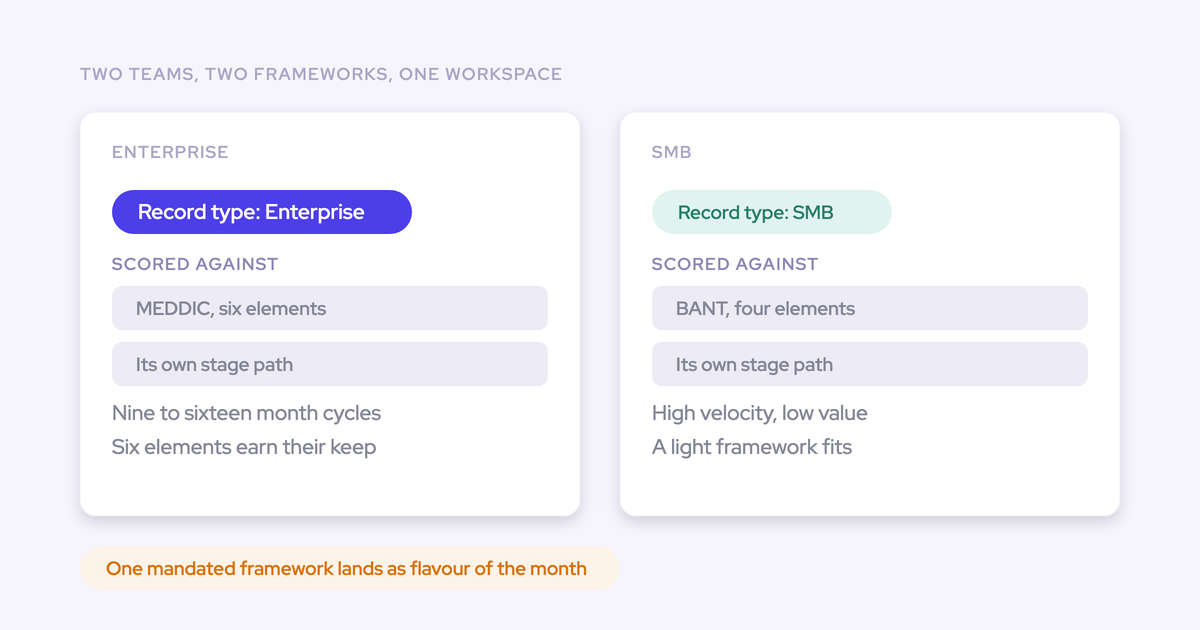
If your team sells across multiple segments, you don't have to pick one. Use BANT for inbound qualification at the SDR level, GPCT for mid-market AE discovery, and MEDDIC for enterprise deal management. The frameworks are additive, not mutually exclusive.
[banner type="download" url="https://www.weflow.ai/resources/cheat-sheets/sales-methodology-cheat-sheet" text="Sales Frameworks Cheat Sheet" subtitle="Pick the right framework for each segment your team sells into" button="Get the cheat sheet"]
GPCT discovery call example: a worked scenario
Here's how a SaaS AE might use GPCT to qualify a VP of Sales at a 200-person B2B company during a first discovery call:
Goals: "You mentioned you're trying to increase win rates from 18% to 25% this year. What's driving that target—board pressure, new funding, or something else?" The VP explains they raised a Series C and need to show efficient growth, not just more pipeline.
Plans: "What are you doing today to move the needle on win rates?" The VP says they hired a sales enablement manager and rolled out a new methodology, but reps aren't following it consistently and there's no way to measure adoption.
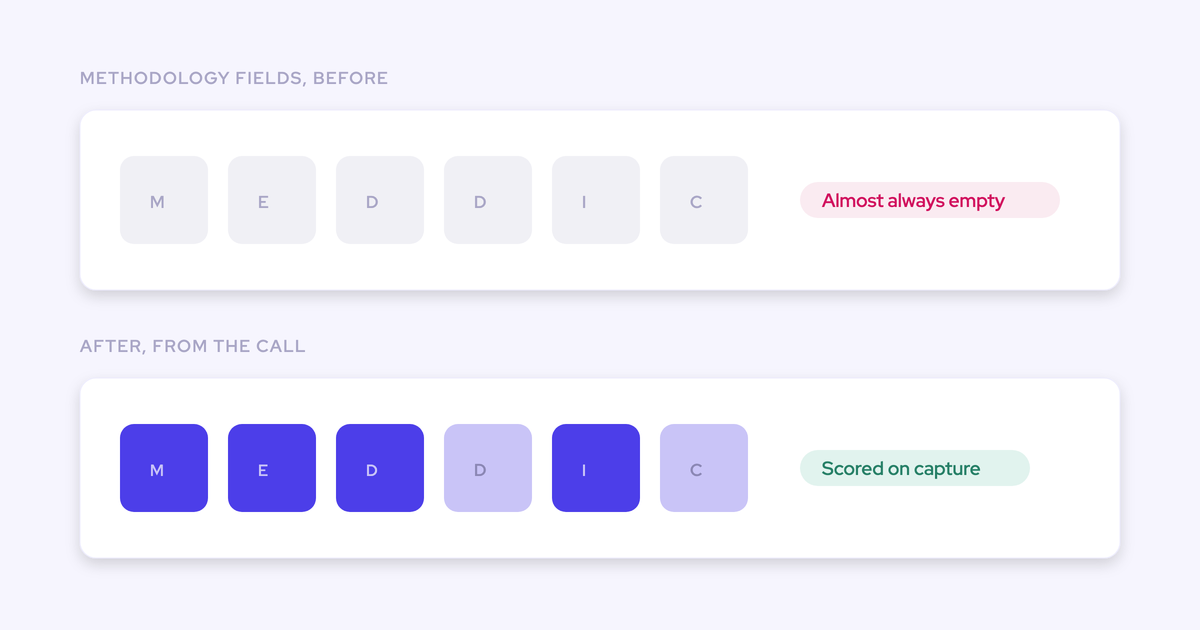
Challenges: "What's blocking methodology adoption?" The VP says reps see it as admin work. They're supposed to update MEDDIC fields in Salesforce after every call, but fewer than 30% actually do. Forecast accuracy suffers because pipeline data is incomplete.
Timeline: "When do you need to show progress on this?" The VP has a board meeting in eight weeks and needs to present a plan for improving forecast accuracy. That gives you a six-week evaluation window.
In four questions, you've learned: the goal is specific and measurable, the current plan has gaps, the challenge is operational (not theoretical), and there's a real deadline. That's a qualified deal worth pursuing.
How to implement GPCT in your CRM
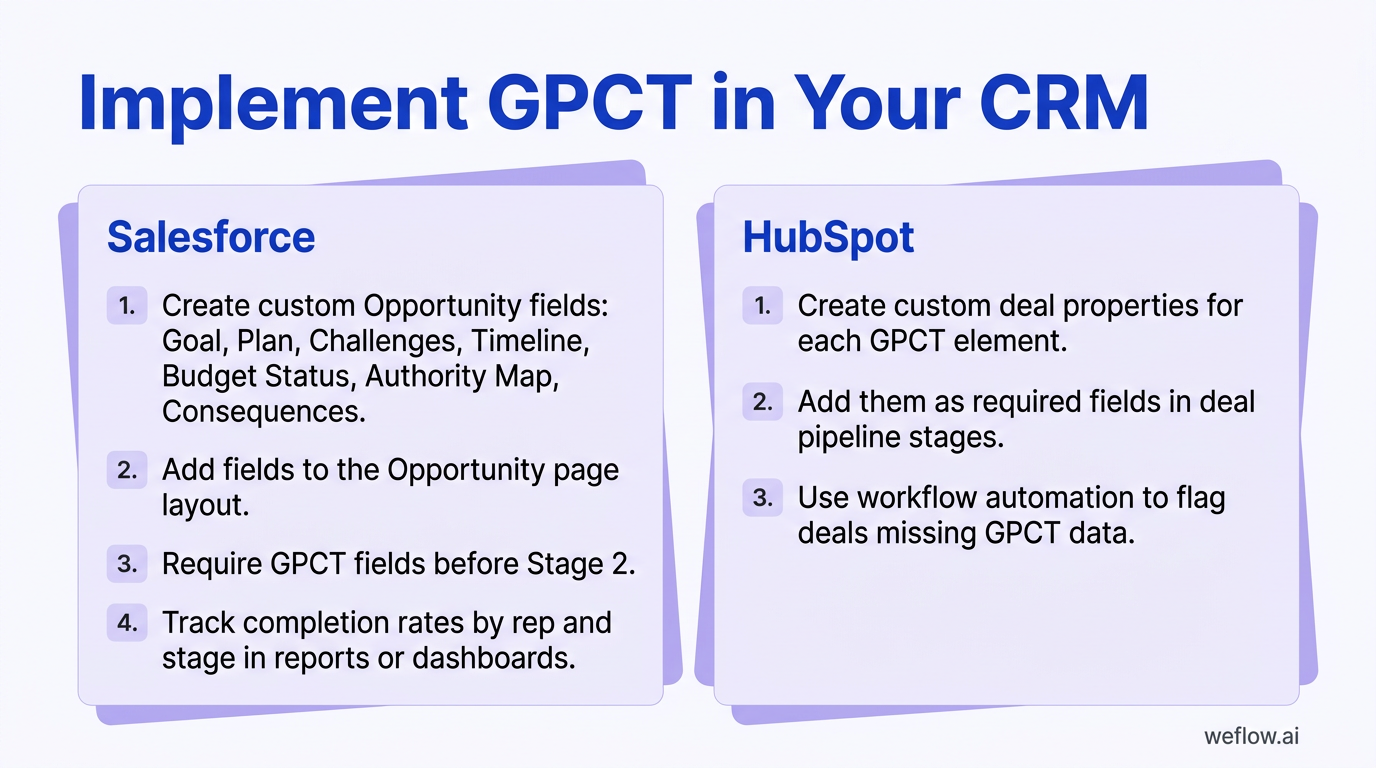
Getting GPCT into your sales process means embedding it where reps already work—your CRM. Here's how to set it up in Salesforce and HubSpot.
In Salesforce:
- Create custom fields on the Opportunity object for each GPCT element: Goal (text area), Plan (text area), Challenges (text area), Timeline (date), Budget Status (picklist), Authority Map (text area), and Consequences (text area).
- Add these fields to your Opportunity page layout and make them visible in the relevant record types.
- Set up validation rules to require GPCT fields before an Opportunity can advance past Stage 2. This enforces consistent discovery without relying on rep discipline.
- Build a report or dashboard that tracks GPCT completion rates by rep and by stage—so managers can coach on discovery quality, not just activity volume.
In HubSpot:
- Create custom deal properties for each GPCT element under Settings > Properties > Deal Properties.
- Add these properties to your deal pipeline stages as required fields.
- Use workflow automation to flag deals missing GPCT data after a set number of days in stage.
For Salesforce teams, tools like Weflow can automate GPCT data capture from sales conversations and write the data directly into your Salesforce Opportunity fields—so reps get credit for doing discovery without the manual CRM entry.
Frequently asked questions
What does GPCT stand for in sales?
GPCT stands for Goals, Plans, Challenges, and Timeline. It's a sales qualification framework developed by HubSpot that evaluates prospects based on their business objectives and the obstacles they face—rather than starting with budget or authority. The extended version, GPCTBA/C&I, adds Budget, Authority, Consequences, and Implications.
What is the difference between GPCT and BANT?
BANT starts with the seller's needs: does the prospect have budget and authority? GPCT starts with the buyer's needs: what are they trying to achieve and what's in their way? GPCT is consultative and open-ended. BANT is transactional and checklist-driven. GPCT works better for mid-market and enterprise B2B deals where buying decisions involve multiple people and longer timelines.
Is BANT still relevant in 2026?
BANT still works for high-volume, short-cycle sales where speed matters more than depth—think inbound SaaS deals under $15k ACV with one or two stakeholders. But for complex B2B sales with buying committees of six to 10 people, BANT's binary approach disqualifies too many prospects too early. Most mid-market and enterprise teams have moved to GPCT, MEDDIC, or a hybrid.
When should I use GPCT vs. MEDDIC?
Use GPCT for mid-market deals ($25k-$150k ACV) with three to six stakeholders and 30-to-90-day cycles. Use MEDDIC for enterprise deals ($100k+ ACV) with six to 10+ stakeholders and three-to-nine-month cycles, where you need to map decision criteria, economic buyers, and champions. Many teams use GPCT for discovery and MEDDIC for deal progression—they complement each other well.
What are the best GPCT discovery questions?
The strongest GPCT questions are open-ended and specific. For Goals: "What are your top revenue priorities for the next two quarters?" For Plans: "What have you tried so far, and where did it fall short?" For Challenges: "What's the biggest obstacle between you and that goal?" For Timeline: "Is there a business event driving the deadline?" Avoid yes/no questions—they produce shallow answers that don't qualify or disqualify.
How do I implement GPCT in Salesforce or HubSpot?
Create custom fields or properties for each GPCT element (Goals, Plans, Challenges, Timeline) on your Opportunity or Deal object. Add validation rules to require completion before deals advance past early stages. Build dashboards to track GPCT field completion rates by rep. In Salesforce, you can also use conversation intelligence tools to auto-populate GPCT fields from call transcripts.
Can I combine GPCT with other qualification frameworks?
Yes—and most mature sales orgs do. A common pattern: SDRs use BANT for fast inbound qualification, AEs use GPCT for discovery calls, and enterprise reps layer in MEDDIC for deal management. The frameworks address different stages of the sales cycle. GPCT excels at early discovery. MEDDIC excels at tracking complex deal progression. Use each where it adds the most value.
How many stakeholders does GPCT account for?
The extended GPCTBA/C&I framework includes Authority as an explicit element, designed for multi-stakeholder buying. Unlike BANT—which asks "Are you the decision-maker?"—GPCT's Authority section maps the full buying committee: evaluators, influencers, budget holders, and blockers. This makes it well-suited for deals with three to 10+ stakeholders, which is the norm in mid-market and enterprise B2B sales.
-p-1600.png)

.png)
-p-1600.png)
-p-1600.png)
-p-1600.png)