
Customer-Centric Selling: What It Is and How to Use It
Learn what customer-centric selling is, when to use it, and how to apply it in B2B sales.



.png)

What is the customer-centric selling methodology?
Customer-centric selling (CCS) is a structured B2B sales methodology that replaces product-led pitching with buyer-focused problem-solving. Developed by Michael Bosworth, John Holland, and Frank Visgatis, CCS positions the salesperson as a trusted advisor—not a gatekeeper controlling information or a closer pushing toward a signature.
The methodology requires three core skills: listening to understand the buyer’s actual situation, empathizing with their challenges and constraints, and guiding them toward a solution without applying pressure. Reps trained in CCS don’t lead with feature decks or pricing. They lead with questions designed to surface what the buyer needs to solve, then map capabilities to those specific problems.
CCS isn’t a philosophy or a mindset shift you can adopt casually. It’s a defined process with repeatable steps, qualification criteria, and measurable outcomes—built for B2B sales teams that sell complex solutions to multiple stakeholders.
Where did customer-centric selling come from? Origin and core principles
CCS was introduced in the early 2000s by Michael Bosworth, John Holland, and Frank Visgatis in their book CustomerCentric Selling. The methodology builds on consultative selling principles that Bosworth had been developing since the 1990s, but adds a more structured framework for how reps should engage buyers at every stage of the sales cycle.
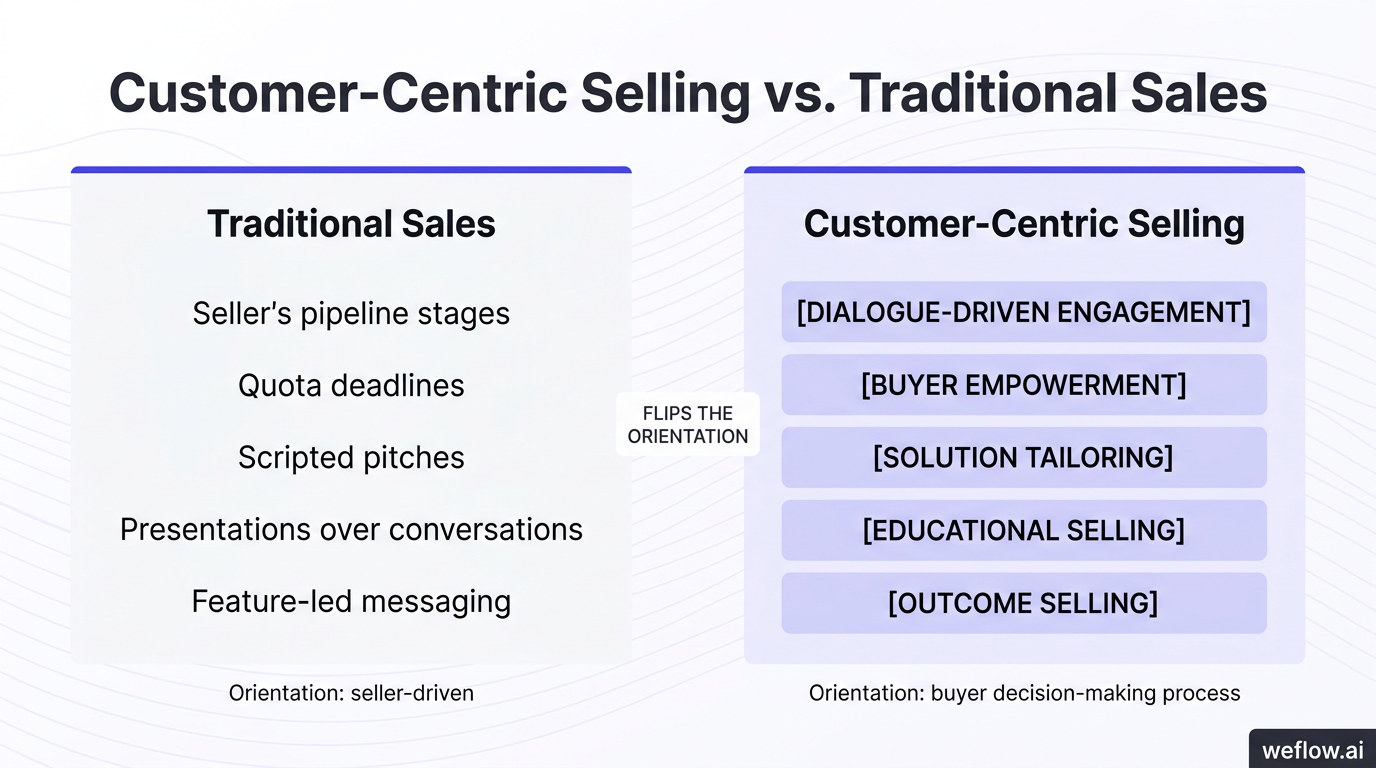
The core argument: traditional sales processes are built around the seller’s pipeline stages and quota deadlines, not the buyer’s decision-making process. CCS flips that orientation. Five principles define the methodology:
- Dialogue-driven engagement. Conversations replace presentations. Reps ask questions and listen rather than delivering scripted pitches. The goal is mutual understanding, not persuasion.
- Buyer empowerment. The buyer controls the pace and direction of the sales process. Reps provide information, frameworks, and options—but never manufacture urgency or withhold details to force a decision.
- Solution tailoring. Every proposal maps directly to problems the buyer has articulated. No generic packages. No “most customers choose this tier” defaults.
- Educational selling. Reps teach buyers something useful in every interaction—an industry trend, a peer benchmark, a framework for evaluating options. The sale becomes a byproduct of trust built through shared knowledge.
- Outcome selling. Features and capabilities are discussed only in terms of the business outcomes they produce. “This reduces your forecast error rate by 15%” replaces “this has an AI-powered forecasting engine.”
Bosworth, Holland, and Visgatis designed CCS for organizations where the buying process involves multiple stakeholders, long evaluation cycles, and high-value contracts—exactly the conditions where product-led pitching fails most consistently.
Why use customer-centric selling? Key benefits for B2B sales teams
CCS changes how reps interact with buyers, and those changes compound into measurable business outcomes. Here’s what shifts when a sales team adopts the methodology:
| Benefit | What changes | Business impact |
|---|---|---|
| Sustainable relationships | Reps invest in understanding the buyer’s business instead of pushing toward a close. Conversations focus on the buyer’s goals, not the rep’s quota. | Deals close with stronger alignment between what was sold and what the customer actually needs—reducing churn and post-sale friction. |
| Higher retention | Customers who feel heard during the sales process trust the vendor more after signing. Expectations are set accurately because reps solved for real problems, not perceived ones. | According to research from Bain & Company, increasing customer retention rates by 5% can increase profits by 25% to 95%. CCS directly targets the behaviors that drive retention. |
| Customer experience as competitive advantage | The buying experience itself becomes a differentiator. Buyers compare not just products but how it felt to evaluate them. CCS-trained reps create a consultative experience that commodity sellers can’t match. | In competitive deals, the team that made the buyer feel most understood wins more often—even when the product isn’t the cheapest option. |
| Higher deal quality | Reps qualify harder and earlier. Instead of inflating pipeline with poorly-fit opportunities, they spend time on accounts where there’s a genuine match between the buyer’s problem and the solution. | Win rates increase, discounting decreases, and average deal sizes grow because reps are selling to need—not competing on price. |
When should you use customer-centric selling? Best-fit sales environments
CCS delivers the most value in complex B2B environments where the buying process involves multiple stakeholders, long evaluation cycles, and solutions that require customization. If your average deal closes in one call with a single decision-maker, CCS is overkill.
The methodology fits best when these conditions are present:
- Long sales cycles (30+ days). Multiple meetings, stakeholder alignment, procurement reviews, and technical evaluations. CCS gives reps a framework for building consensus across all of these stages.
- Multiple decision-makers. When three to 12 people influence the purchase—each with different priorities—CCS helps reps map each stakeholder’s concerns and address them individually.
- High-value contracts. Deals worth $50,000 or more justify the time investment CCS requires. The deeper discovery and customized proposals pay off when the contract size supports it.
- Customizable solutions. Products or services that can be configured, packaged, or scoped differently based on the buyer’s situation. CCS depends on the ability to match the solution to the problem.
Industries where CCS works well: B2B technology (SaaS, infrastructure, security), professional services (consulting, legal, accounting), healthcare technology, and financial services. These sectors share a common pattern—buyers need to trust the vendor, understand the solution, and build internal consensus before committing.
Where CCS doesn’t fit: Transactional sales with short cycles, commodity products with price-driven decisions, and high-volume inside sales motions where the product sells itself through self-serve demos or free trials. Applying CCS to a $500/year SaaS subscription with a single buyer adds cost and friction without proportional benefit.
Customer-centric selling vs. other sales methodologies
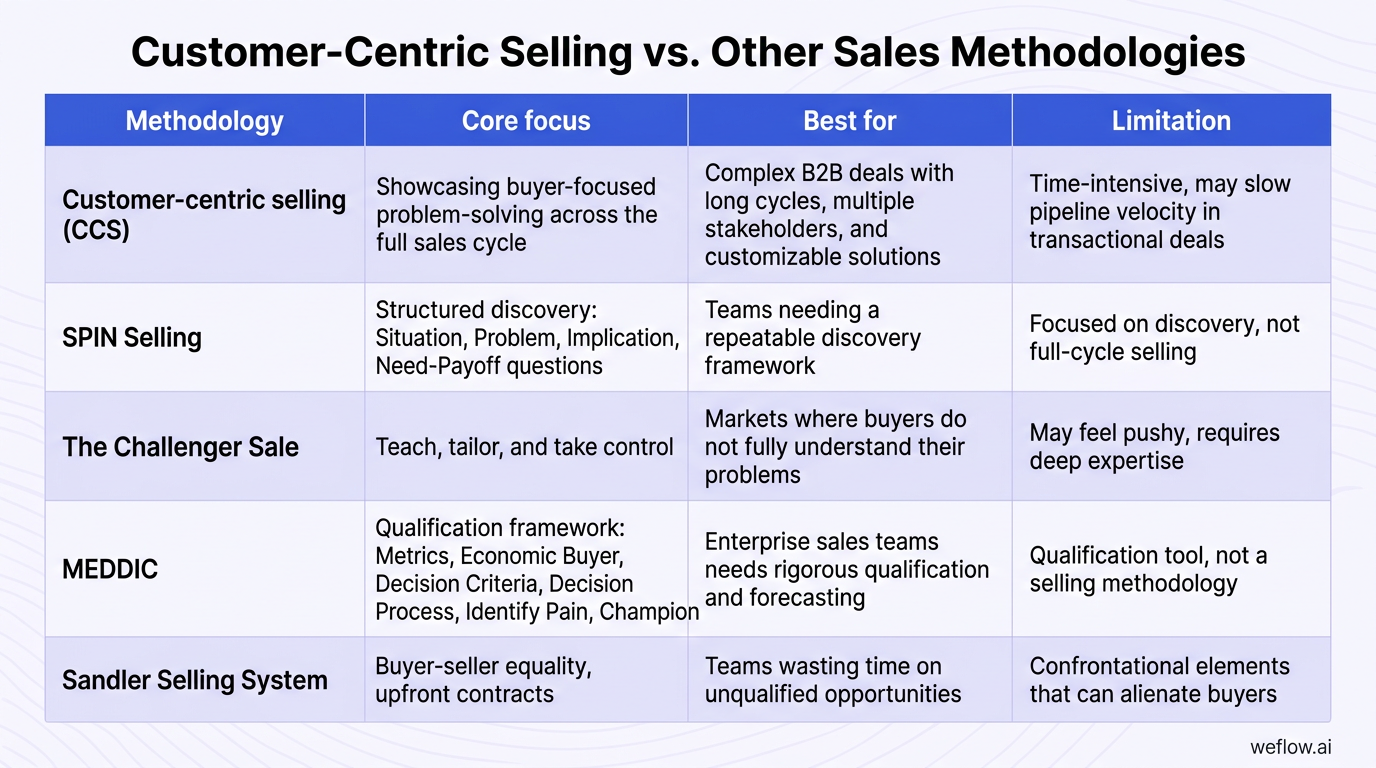
CCS operates at the philosophy and process level—it defines how reps should think about and engage with buyers throughout the entire sales cycle. That makes it distinct from frameworks like MEDDIC, which focus on deal qualification, or SPIN Selling, which focuses on discovery questioning.
| Methodology | Core focus | Best for | Limitation |
|---|---|---|---|
| Customer-centric selling (CCS) | Buyer-focused problem-solving across the full sales cycle. Reps act as advisors who help buyers make decisions. | Complex B2B deals with long cycles, multiple stakeholders, and customizable solutions. | Time-intensive. Requires organizational commitment and can slow pipeline velocity if applied to transactional deals. |
| SPIN Selling | Structured discovery using four question types: Situation, Problem, Implication, Need-Payoff. | Teams that need a repeatable discovery framework. Works across deal sizes. | Focuses on the discovery phase. Doesn’t provide a full-cycle selling process or guidance on proposal, negotiation, or close. |
| The Challenger Sale | Teaching buyers something new, tailoring the message to their situation, and taking control of the conversation. | Markets where buyers don’t fully understand their own problems. Reps with deep industry expertise. | Can come across as pushy if executed poorly. Requires reps who genuinely know more than the buyer—not all teams have that depth. |
| MEDDIC | Deal qualification framework: Metrics, Economic Buyer, Decision Criteria, Decision Process, Identify Pain, Champion. | Enterprise sales teams that need rigorous pipeline qualification and forecasting accuracy. | It’s a qualification tool, not a selling methodology. Tells you whether a deal is real—doesn’t tell you how to win it. |
| Sandler Selling System | Buyer-seller equality. Uses an “upfront contract” to set mutual expectations. Reps qualify aggressively and walk away from poor fits. | Teams that waste time on unqualified opportunities. Strong fit for mid-market sales. | The confrontational elements (pain funneling, reversing) require coaching. Can alienate buyers in relationship-driven industries. |
CCS combines well with other methodologies because it operates at a different level. You can run MEDDIC for qualification, use SPIN questions in discovery, and still apply CCS as your overarching approach to how reps engage buyers. CCS defines the mindset and process; the others provide specific tools for specific stages.
How to implement customer-centric selling: a step-by-step process
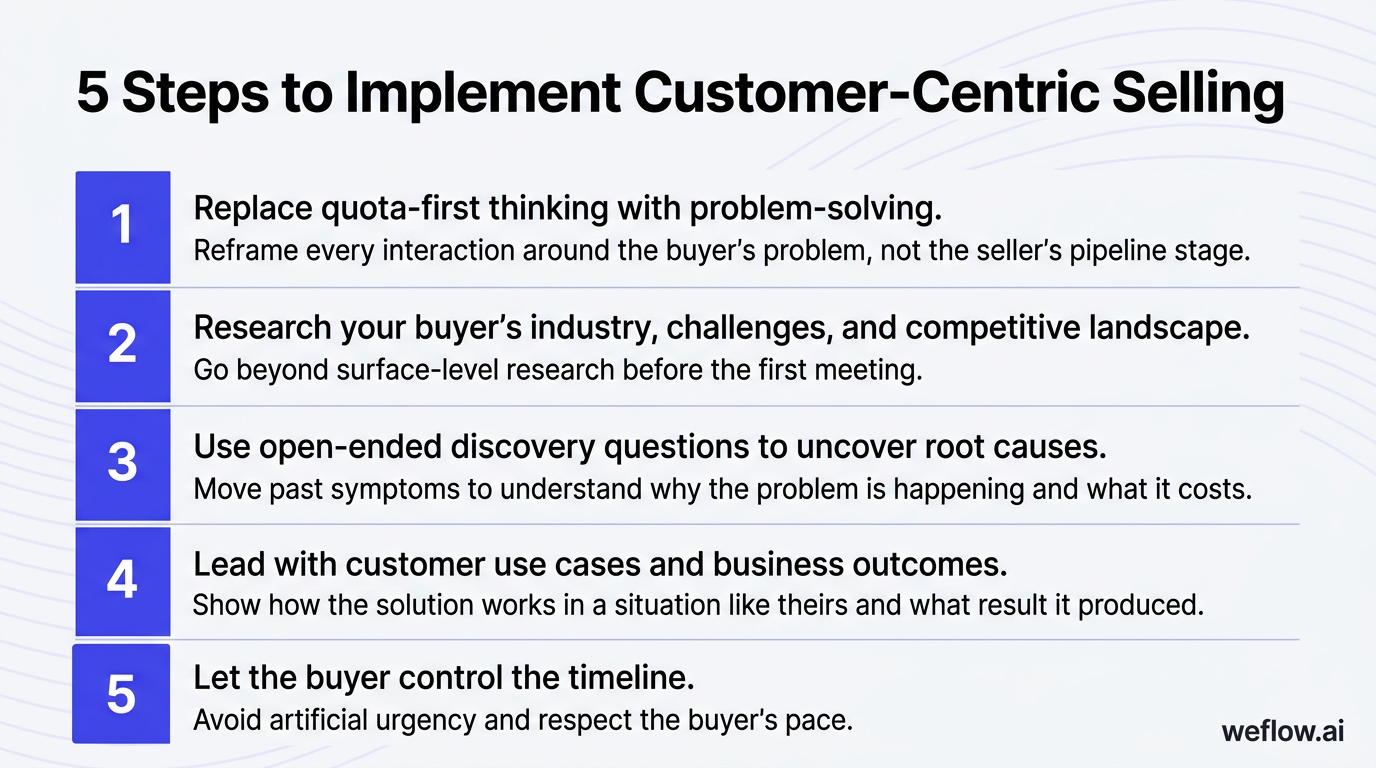
Adopting CCS isn’t a one-day training exercise. It requires changing how reps think about their role, how they prepare for conversations, and how they measure success. Here are five steps to implement it.
[banner type="download" url="https://www.weflow.ai/resources/cheat-sheets/customer-centric-selling-checklist" text="Customer-Centric Selling Checklist" subtitle="Run discovery that surfaces root causes, not symptoms reps already know" button="Get the checklist"]
Step 1: Replace quota-first thinking with problem-solving
The first shift is internal. Reps trained in traditional sales default to “how do I move this deal forward?” CCS reframes every interaction around the buyer’s problem, not the seller’s pipeline stage.
Before every call, reps should ask themselves four questions:
- How can I improve this customer’s situation today?
- What problem are they trying to solve, and do I understand it well enough to explain it back to them?
- What would a trusted advisor recommend—even if it’s not my product?
- Am I preparing to listen, or am I preparing to present?
This isn’t soft-skills coaching. It’s a practical reframe that changes what reps say in meetings, what questions they ask, and which deals they prioritize. Focus on solving, not showing.
Step 2: Research your buyer’s industry, challenges, and competitive landscape
Surface-level research—scanning a LinkedIn profile or reading the company’s About page—isn’t enough for CCS. Reps need to understand the buyer’s industry dynamics, their company’s competitive position, and the specific challenges their role faces.
Before the first meeting, answer these five questions:
- What are the top three challenges facing this buyer’s industry right now?
- Who are their direct competitors, and how is the competitive landscape shifting?
- What has this company publicly said about their priorities (earnings calls, press releases, job postings)?
- What regulatory or compliance pressures affect their buying decisions?
- What tools or solutions are they currently using to address this problem?
Pro tip: Set up Google Alerts or Feedly feeds for your top 20 target accounts and their industries. When you reference a recent industry development in a discovery call, it signals that you’ve done the work—and that you understand their world, not just your product.
Step 3: Use open-ended discovery questions to uncover root causes
Most discovery calls surface symptoms—“our forecasting is inaccurate” or “reps don’t update Salesforce.” CCS pushes reps to dig deeper. The symptom is what the buyer reports. The root cause is why it’s happening and what it’s actually costing them.
Here are 10 discovery questions designed to move past symptoms and uncover the real problem:
| Question | What it uncovers |
|---|---|
| What’s the biggest challenge your team faces when trying to hit revenue targets? | Top-of-mind priorities and whether the buyer has a clear diagnosis of the problem. |
| How does this problem affect your day-to-day work specifically? | Personal impact and emotional weight—helps you understand urgency. |
| What have you tried so far to solve this, and what happened? | Previous attempts, failed solutions, and implicit buying criteria. |
| If you could fix one thing about your current process, what would it be? | The buyer’s priority ranking—useful for tailoring your proposal. |
| Who else on your team is affected by this problem? | Stakeholder map. Identifies additional decision-makers and influencers. |
| What does success look like 12 months from now if you solve this? | The buyer’s definition of outcomes—lets you anchor your pitch to their goals. |
| What’s the cost of not fixing this? How does it show up in your numbers? | Quantified impact. Gives you the business case for the purchase. |
| How does your team currently make decisions about new tools or processes? | Decision process, approval workflow, and potential blockers. |
| What would make you confident that a solution is the right fit? | Buying criteria—often reveals concerns the buyer hasn’t stated directly. |
| Is there anything I haven’t asked about that I should understand before we go further? | Hidden objections, unstated requirements, and context the buyer wants to share but wasn’t prompted to. |
Step 4: Lead with customer use cases and business outcomes
Feature lists don’t close complex deals. Buyers need to see how your solution works in a situation that resembles theirs—and what specific outcomes it produced. CCS reps lead with use cases, not capabilities.
Practical tactics for outcome-focused selling:
- Customer stories and testimonials. Share examples from companies in the buyer’s industry or of similar size. Focus on the problem they faced, the approach taken, and the measurable result. “A 200-person SaaS company reduced their forecast error rate from 25% to 8% in one quarter” is more persuasive than “our forecasting module uses AI.”
- Outcome-focused demos. Don’t walk through every feature. Build the demo around the buyer’s specific problem. Show them exactly how your product addresses the three issues they raised in discovery.
- Free trials or proof-of-concept engagements. Let the buyer experience the solution in their environment. This removes risk and lets the product prove its value without the rep having to sell harder.
The question that anchors every CCS interaction at this stage: “How will this change your day-to-day?” If you can’t answer that for the specific buyer you’re talking to, you haven’t done enough discovery.
Step 5: Let the buyer control the timeline
CCS requires patience. Buyers move on their timeline, not yours. Forcing prospects through automated email sequences or creating artificial deadlines—“this pricing expires Friday”—undermines the trust you’ve built through consultative engagement. Don’t pressure buyers into decisions they’re not ready to make. A long-term relationship that closes in 90 days is worth more than a forced close in 30 that churns in six months.
[banner type="download" url="https://www.weflow.ai/resources/cheat-sheets/sales-methodology-cheat-sheet" text="Sales Methodology Cheat Sheet" subtitle="Pick the right framework for your deal size, cycle, and stakeholder count" button="Get the cheat sheet"]
Customer-centric selling metrics: how to measure what’s working
CCS optimizes for deal quality, not deal velocity. That means the metrics you track—and the timeframe you measure them over—need to reflect that orientation. Track these KPIs:
- Win rate. The percentage of qualified opportunities that close. CCS should increase this over time as reps focus on better-fit deals and deeper discovery.
- Average deal size. CCS reps who sell to need rather than price typically close larger deals. Monitor whether average contract value increases as the methodology takes hold.
- Sales cycle length. This one is nuanced. CCS may lengthen cycles initially as reps invest more in discovery and stakeholder alignment. Over two to three quarters, cycles should stabilize or shorten as reps get better at qualifying early.
- Customer retention rate. The strongest signal that CCS is working. Deals closed through consultative selling should retain at higher rates because expectations were set accurately during the sales process.
- Net Promoter Score (NPS). Measure whether customers who bought through a CCS process are more likely to recommend your product. This captures the relationship quality that CCS is designed to build.
- Pipeline-to-close ratio. The ratio of total pipeline to closed revenue. CCS should improve this ratio by reducing pipeline bloat—fewer unqualified deals enter the pipeline, so more of what’s there actually converts.
One caution: Measure these metrics over quarters, not weeks. CCS is a structural change to how your team sells. Expecting results in 30 days is unrealistic and leads to premature abandonment of the methodology. Give it two to three full sales cycles before evaluating impact.
How Weflow helps sales teams operationalize customer-centric selling
CCS fails when reps spend their time on data entry instead of consultative conversations. Weflow, a Salesforce-native revenue AI platform, removes that friction. Weflow automates Salesforce data capture—emails, meetings, and calls sync automatically—so reps can focus on listening, asking better questions, and solving buyer problems instead of logging activities after every call.
Weflow’s note templates can be structured around CCS discovery frameworks, giving reps a consistent format for capturing buyer challenges, stakeholder context, and next steps during calls. Activity capture ensures no buyer context is lost between interactions—every touchpoint is recorded in Salesforce without manual effort. For managers, pipeline inspection provides visibility into whether reps are following the CCS process: Are they running proper discovery? Are deals progressing through buyer-aligned stages? Are the right stakeholders engaged? That visibility turns CCS from a training concept into an observable, coachable practice.
Frequently asked questions
What is the customer-centric selling methodology?
Customer-centric selling is a B2B sales methodology created by Bosworth, Holland, and Visgatis that replaces product-focused pitching with buyer-focused problem-solving. Reps act as trusted advisors who listen, ask questions, and guide buyers toward solutions that match their specific challenges. It’s a defined process with repeatable steps—not just a mindset.
How is customer-centric selling different from consultative selling?
Consultative selling is a broad approach where reps act as advisors. CCS builds on that idea but adds a structured methodology—specific steps for discovery, qualification, proposal, and close that keep the buyer’s problem at the center of every stage. Think of consultative selling as the philosophy and CCS as the playbook.
When should a sales team use customer-centric selling?
CCS fits best in complex B2B environments with long sales cycles, multiple decision-makers, and high-value contracts. If your deals involve 30+ day evaluations, three or more stakeholders, and solutions that need to be customized per account, CCS will improve your close rates and deal quality. For transactional, single-call sales, it adds unnecessary overhead.
What are the core principles of customer-centric selling?
Five principles define CCS: dialogue-driven engagement (conversations over presentations), buyer empowerment (the buyer controls the process), solution tailoring (proposals mapped to stated problems), educational selling (teach something useful in every interaction), and outcome selling (discuss capabilities only in terms of business results they produce).
How do you measure the success of customer-centric selling?
Track win rate, average deal size, customer retention rate, NPS, sales cycle length, and pipeline-to-close ratio. Measure over quarters, not weeks—CCS optimizes for deal quality, which takes two to three sales cycles to show up in the numbers. Initial cycle length may increase before stabilizing.
Can customer-centric selling work alongside other sales methodologies?
Yes. CCS operates at the philosophy and process level, so it pairs well with frameworks that focus on specific stages. You can use MEDDIC for deal qualification, SPIN questions for discovery, and Challenger techniques for teaching—all within a CCS framework that keeps the buyer’s problem at the center.
What is the biggest mistake teams make when adopting customer-centric selling?
Treating it as a training event instead of an operational change. Teams attend a two-day workshop, then go back to quota-first selling within a month. CCS requires reinforcement through coaching, call reviews, and systems that make the process visible—like CRM data that shows whether reps are running proper discovery and engaging the right stakeholders.
How does CRM software support customer-centric selling?
CRM gives reps a record of every buyer interaction, so they can pick up conversations where they left off without asking the buyer to repeat context. It also gives managers visibility into whether the CCS process is being followed—are discovery notes captured, are stakeholders mapped, are next steps documented? The key is reducing the data entry burden so reps spend time selling, not logging. Automated activity capture tools eliminate that friction.
-p-1600.png)

.png)
-p-1600.png)
-p-1600.png)
-p-1600.png)