
17 Sales Methodologies Compared: How to Choose and Combine Them
Compare 17 sales methodologies and choose the right mix for your deal size, cycle, and buyers




What is a sales methodology (and how is it different from a sales process)?
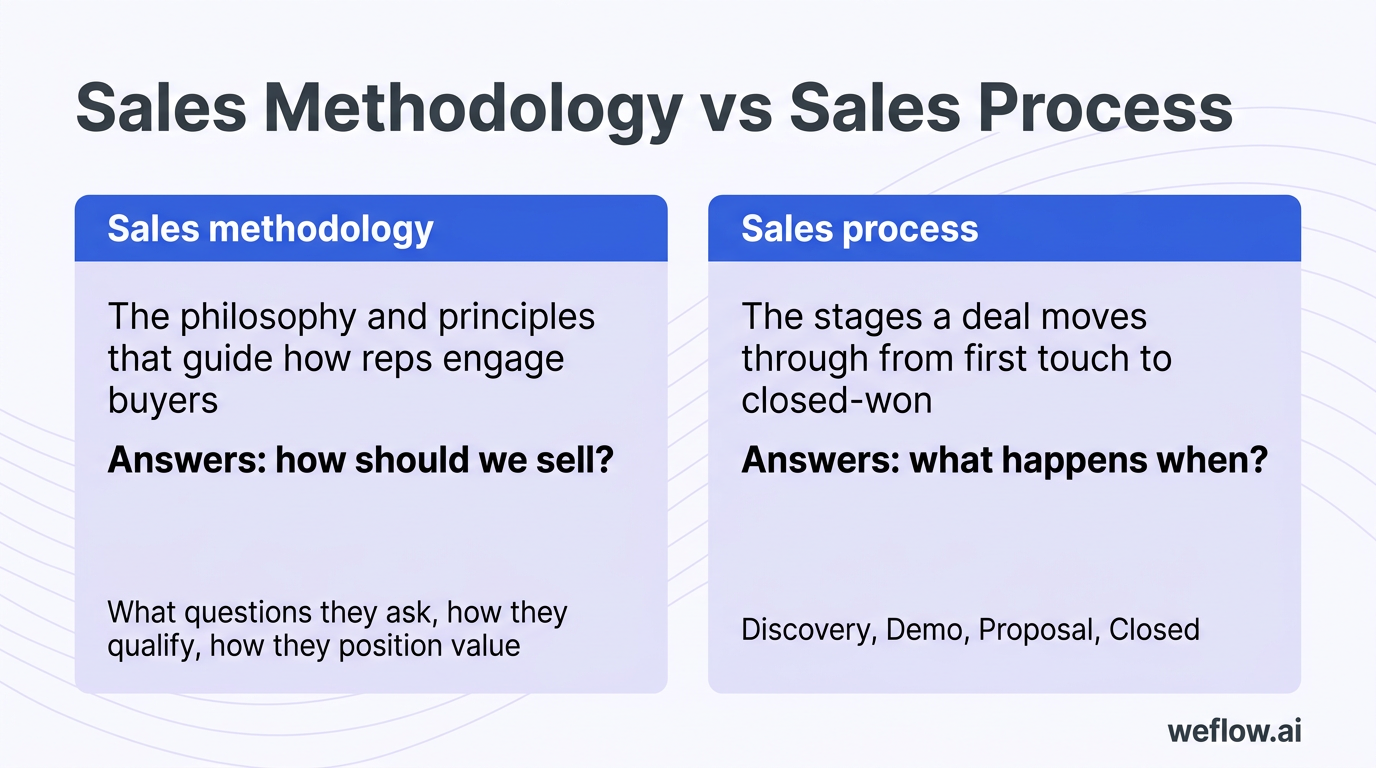
A sales methodology is the philosophy and principles that guide how reps engage buyers—it answers how should we sell. A sales process defines the stages a deal moves through from first touch to closed-won—it answers what happens when.
Your sales process might have stages like Discovery, Demo, Proposal, and Closed. Your methodology determines how reps behave within each stage—what questions they ask, how they qualify, how they position value. You can run multiple methodologies inside a single sales process.
Key takeaways
- Sales methodologies are frameworks for how to sell; processes define what stages deals move through
- Most enterprise B2B teams combine 2-3 methodologies—qualification, engagement, and stakeholder mapping
- The right methodology depends on deal complexity, cycle length, and buyer personas
- Methodology adoption fails when it isn’t embedded in CRM fields and deal inspection routines
1. Target account selling: best for high-value, low-volume pipelines
Target account selling (TAS) concentrates resources on a defined list of high-value accounts rather than casting a wide net. TAS aligns sales, marketing, and customer success around accounts most likely to become your best customers.
How it works
- Define your ideal customer profile based on firmographics, technographics, and historical win data
- Build a target account list—typically 50-500 accounts depending on team size
- Assign account owners and create multi-threaded engagement plans
- Map the buying committee and build relationships across stakeholders
Best for: Enterprise teams with deal sizes above $100k and sales cycles of 6+ months.
Not for: High-velocity transactional sales or companies still defining their ICP.
2. Consultative selling: how to win deals by acting as a trusted advisor
Consultative selling positions the rep as an advisor, not a vendor. Instead of pitching features, reps diagnose the buyer’s situation, understand goals, and recommend solutions—even if that means acknowledging competitors or a “do nothing” recommendation.
How it works
- Lead with questions—understand the buyer’s business before discussing your product
- Diagnose root causes rather than accepting stated needs at face value
- Offer insights based on patterns you’ve seen across similar companies
- Present solutions with clear trade-offs and limitations
Best for: Complex B2B sales where trust and expertise differentiate vendors.
Not for: Commodity sales or price-driven buyers.
3. Conceptual selling: selling the solution, not the product
Conceptual selling, developed by Miller and Heiman, starts from a core insight: buyers don’t buy products—they buy the concept of what the product will do for them. Reps align their offering to the buyer’s mental model of success rather than pushing features.
How it works
- Uncover the buyer’s concept—their picture of what success looks like
- Ask confirmation, new information, and attitude questions
- Connect your solution to the buyer’s concept, not a generic value proposition
- Get explicit agreement that your solution matches their concept before advancing
Best for: Solution sales where buyers have a clear vision of outcomes but haven’t defined how to get there.
Not for: Transactional purchases where discovery adds friction.
4. The Challenger Sale: disrupting buyer thinking to close complex deals
The Challenger Sale, based on CEB research, argues that effective reps don’t just respond to needs—they challenge assumptions and teach buyers something new. Challengers take control of conversations and push back constructively.
How it works
- Teach: Share insights the buyer hasn’t considered—reframe how they see their problem
- Tailor: Connect your message to the buyer’s specific context and priorities
- Take control: Drive the conversation, push back on objections, guide the buying process
Best for: Complex enterprise deals where buyers are stuck in status quo thinking.
Not for: Transactional sales or buyers who have already defined requirements.
5. The SPICED framework: a B2B qualification model for long-term impact
SPICED, developed by Winning by Design, focuses on identifying customers who will retain and expand—not just close.
| Letter | Meaning |
|---|---|
| S | Situation: Current state—company size, tech stack, processes |
| P | Pain: Problems they’re experiencing, quantified where possible |
| I | Impact: Business outcomes if solved or unsolved |
| C | Critical event: Deadline or trigger forcing action |
| E | Decision: Who decides and what criteria they’ll use |
| D | Decision process: Steps and approvals required to close |
Best for: SaaS and subscription businesses where lifetime value matters.
Not for: One-time transactional sales.
6. SPIN selling: the question-based method that still works in 2026
SPIN Selling, developed by Neil Rackham from analysis of 35,000+ sales calls, uses structured questioning to help buyers discover their own needs.
| Letter | Meaning |
|---|---|
| S | Situation: Questions establishing context—tools, team, processes |
| P | Problem: Questions uncovering difficulties and challenges |
| I | Implication: Questions exploring consequences if unsolved |
| N | Need-payoff: Questions getting buyers to articulate the value of solving |
Best for: Consultative B2B sales where buyers need help recognizing their problem’s scope.
Not for: Simple transactions or buyers who already know what they want.
7. MEDDIC: the enterprise lead qualification framework explained
MEDDIC is the go-to qualification framework for enterprise sales. Developed at PTC, it identifies whether a deal is real before investing significant time.
| Letter | Meaning |
|---|---|
| M | Metrics: Quantifiable outcomes the buyer expects |
| E | Economic buyer: Who controls budget and can say yes |
| D | Decision criteria: Requirements used to evaluate options |
| D | Decision process: Steps, stakeholders, and timelines |
| I | Identify pain: Specific business pain driving the initiative |
| C | Champion: Internal advocate with influence |
Best for: Enterprise deals above $50k with 3+ month cycles.
Not for: Transactional sales or teams that can’t enforce CRM discipline.
[banner type="download" url="https://www.weflow.ai/resources/cheat-sheets/sales-methodology-cheat-sheet" text="Sales Methodology Cheat Sheet" subtitle="Pick the right framework for your deal size, cycle, and buyer mix" button="Get the cheat sheet"]
8. N.E.A.T. selling: qualifying leads by economic impact, not just budget
N.E.A.T. Selling, developed by The Harris Consulting Group, starts with needs and economic impact rather than budget—which buyers often don’t know or won’t share.
| Letter | Meaning |
|---|---|
| N | Core needs: The fundamental problem to solve |
| E | Economic impact: Financial value of solving—revenue gained, costs avoided |
| A | Access to authority: Can you reach the economic buyer? |
| T | Timeline: What’s driving urgency? |
Best for: B2B sales where economic impact exceeds what buyers planned to spend.
Not for: Deals where budget is fixed and non-negotiable.
9. Solution selling: matching product benefits to buyer pain points
Solution selling shifts focus from features to outcomes. Lead with the buyer’s problems, position your offering as the answer.
How it works
- Research the buyer’s industry, company, and role before the conversation
- Ask diagnostic questions to understand their challenges
- Map product capabilities to stated pain points—only discuss relevant features
- Quantify value in terms they care about: time, money, risk
Best for: B2B sales with configurable products solving different problems for different buyers.
Not for: Commodity products or buyers with defined requirements.
10. Inbound selling: how to convert marketing-sourced leads into deals
Inbound selling aligns the sales process with how modern buyers research and purchase. Reps engage leads who have already expressed interest through content, website visits, or trials.
How it works
- Identify: Prioritize leads based on engagement signals
- Connect: Reach out with context about what they’ve done, not a generic pitch
- Explore: Diagnose needs through consultative discovery
- Advise: Present your solution in context of their specific situation
Best for: Companies with strong content marketing or product-led growth motions.
Not for: Markets where buyers don’t self-educate online.
11. The Sandler selling system: a consultative framework for pipeline qualification
The Sandler system flips traditional sales dynamics. Instead of reps chasing buyers, Sandler trains reps to qualify ruthlessly and let unqualified prospects self-select out.
How it works
- Bonding: Build trust through genuine curiosity
- Up-front contracts: Set clear expectations for every meeting
- Pain: Uncover real pain and its emotional impact
- Budget: Discuss investment early—no budget, no deal
- Decision: Map the decision process and stakeholders
- Fulfillment: Present only after qualification is complete
Best for: Teams wasting time on unqualified opportunities.
Not for: High-velocity transactional sales.
12. SNAP selling: how to win over overwhelmed, time-pressed buyers
SNAP Selling, developed by Jill Konrath, addresses modern B2B buyers who are overwhelmed, distracted, and allergic to complexity.
| Letter | Meaning |
|---|---|
| S | Simple: Reduce complexity—shorter emails, clearer proposals, fewer steps |
| N | iNvaluable: Share insights that help buyers even if they don’t buy |
| A | Aligned: Connect to what buyers already care about |
| P | Priority: Make your solution feel urgent |
Best for: Sales cycles where buyer attention is the scarcest resource.
Not for: Complex enterprise deals requiring deep stakeholder mapping.
13. CHAMP selling: a customer-first alternative to BANT qualification
CHAMP reorders BANT to lead with challenges rather than budget. Understand challenges deeply, and budget conversations become easier.
| Letter | Meaning |
|---|---|
| CH | Challenges: Problems the buyer is trying to solve |
| A | Authority: Who influences and decides |
| M | Money: Budget and how it’s justified |
| P | Prioritization: Where this ranks against other projects |
Best for: B2B sales where buyers don’t have pre-defined budgets.
Not for: RFP-driven purchases with fixed budgets.
14. Miller Heiman strategic selling: navigating multi-stakeholder enterprise deals
Strategic Selling focuses on mapping complex buying committees. Enterprise deals are won based on how well reps understand the people involved.
How it works
- Identify four buying influences: Economic buyer (controls budget), User buyer (daily user), Technical buyer (evaluates requirements), Coach (internal advocate)
- Map each stakeholder’s personal win from this purchase
- Identify red flags—stakeholder concerns, information gaps, competitive threats
- Develop action plans for each red flag
Best for: Enterprise deals with 5+ stakeholders and long cycles.
Not for: Single-threaded SMB sales.
15. Customer-centric selling: why buyer-first approaches outperform feature pitches
Customer-centric selling argues conversations should be driven by what buyers want to accomplish, not what sellers want to pitch.
[banner type="download" url="https://www.weflow.ai/resources/cheat-sheets/sales-methodologies-book" text="The Book Of Sales Methodologies" subtitle="Layer qualification, engagement, and stakeholder frameworks without overwhelming your reps" button="Download the book"]
How it works
- Focus on what buyers can do with your product, not what the product is
- Ask about goals before discussing solutions
- Replace features with usage scenarios: “When you need to X, you’ll Y”
- Let buyers discover value through questions rather than presentations
Best for: Complex B2B where buyers struggle connecting features to needs.
Not for: Buyers who know exactly what they need.
16. The value selling framework: selling benefits over features
Value selling quantifies business impact rather than describing features. Build ROI-based business cases that justify investment.
How it works
- Identify key business metrics—revenue, costs, time, risk
- Quantify current state: what are they spending or losing today?
- Project future state: what improves with your solution?
- Calculate and present the delta in terms economic buyers care about
Best for: High-consideration purchases requiring investment justification.
Not for: Low-cost purchases where ROI analysis is overkill.
17. Gap selling: helping buyers see the distance between current and future state
Gap selling focuses on the gap between where buyers are today and where they want to be. The larger the gap, the more urgency to act.
How it works
- Current state: Diagnose where the buyer is—processes, metrics, pain points
- Future state: Define where they want to be—outcomes, target metrics
- The gap: Quantify the distance in business terms
- Impact: Show the cost of staying in current state
Best for: Sales cycles where creating urgency is the main challenge.
Not for: Buyers with clear vision and timeline already.
Sales methodology comparison table
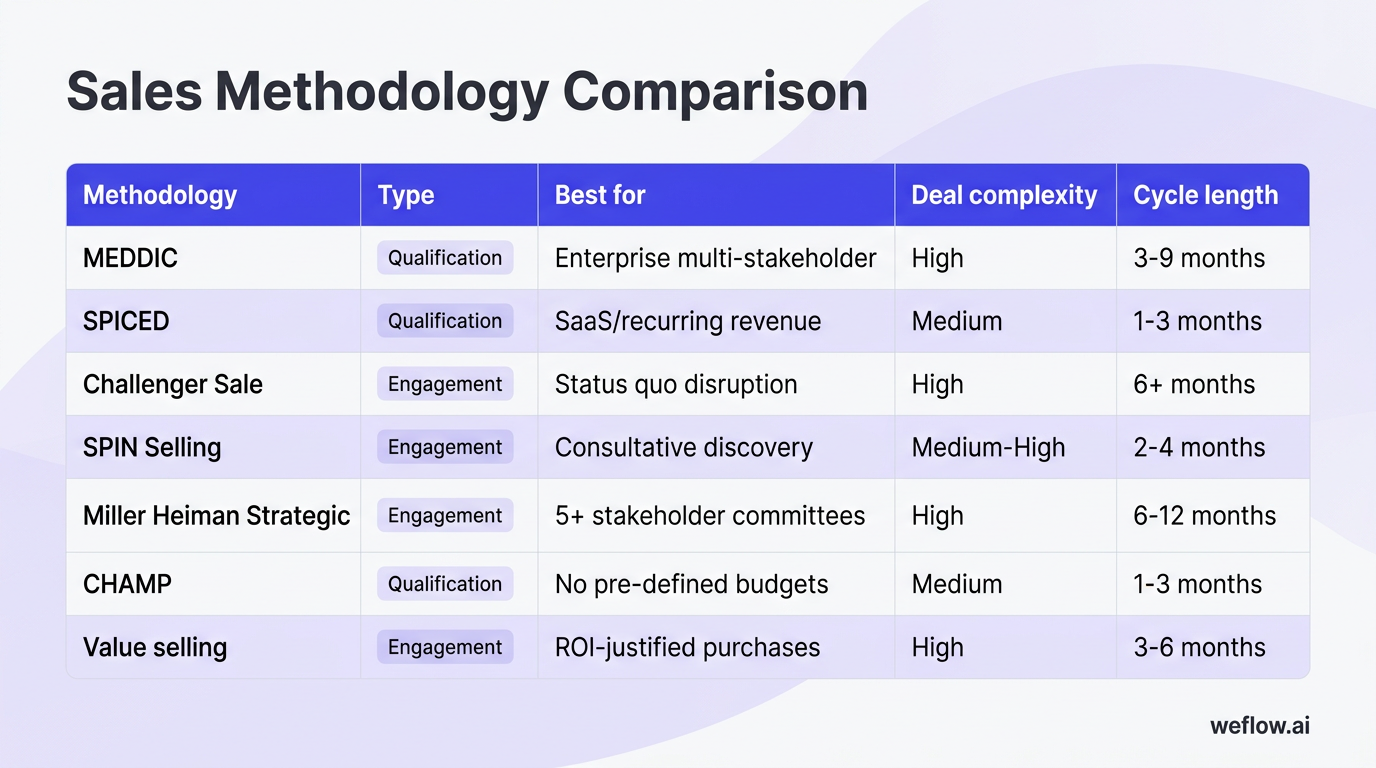
| Methodology | Type | Best for | Deal complexity | Cycle length |
|---|---|---|---|---|
| Target account selling | Engagement | Enterprise ABM teams | High | 6+ months |
| Consultative selling | Philosophy | Trust-driven B2B | Medium-High | 3-6 months |
| Conceptual selling | Engagement | Vision-driven buyers | Medium-High | 3-6 months |
| Challenger Sale | Engagement | Status quo disruption | High | 6+ months |
| SPICED | Qualification | SaaS/recurring revenue | Medium | 1-3 months |
| SPIN Selling | Engagement | Consultative discovery | Medium-High | 2-4 months |
| MEDDIC | Qualification | Enterprise multi-stakeholder | High | 3-9 months |
| N.E.A.T. Selling | Qualification | Impact > stated budget | Medium | 1-3 months |
| Solution selling | Engagement | Configurable products | Medium | 2-4 months |
| Inbound selling | Philosophy | Marketing-sourced leads | Low-Medium | 1-2 months |
| Sandler Selling | Qualification | Ruthless qualification | Medium-High | 2-6 months |
| SNAP Selling | Engagement | Distracted buyers | Medium | 1-3 months |
| CHAMP | Qualification | No pre-defined budgets | Medium | 1-3 months |
| Miller Heiman Strategic | Engagement | 5+ stakeholder committees | High | 6-12 months |
| Customer-centric selling | Philosophy | Usage over features | Medium | 2-4 months |
| Value selling | Engagement | ROI-justified purchases | High | 3-6 months |
| Gap selling | Engagement | Creating urgency | Medium-High | 2-4 months |
How to combine multiple sales methodologies into a hybrid approach
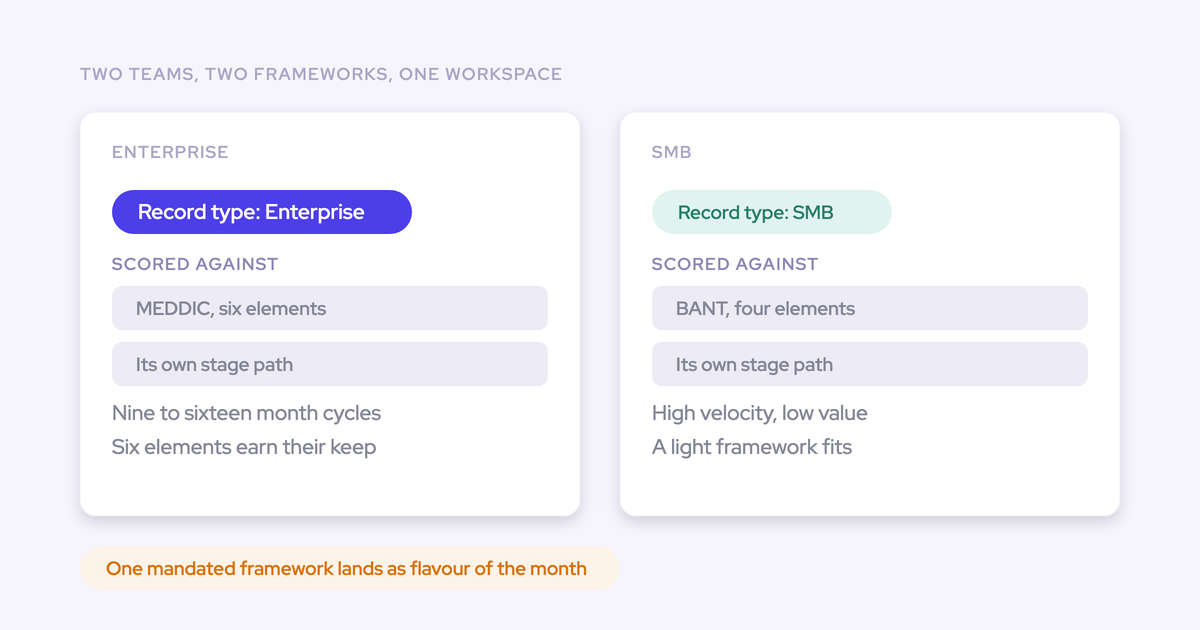
Most high-performing sales teams layer several methodologies together. The typical pattern: use a qualification framework (MEDDIC, SPICED, CHAMP) to assess deal viability, an engagement methodology (Challenger, SPIN, Consultative) for discovery and demos, and Miller Heiman for complex buying committees.
The key is knowing when each applies. MEDDIC handles top-of-funnel qualification. SPIN or Challenger techniques work during discovery. Gap selling creates urgency when deals stall. Value selling builds the business case. Match methodology intensity to deal complexity—over-engineering small deals frustrates buyers; under-engineering large deals loses winnable opportunities.
How to get your sales team to actually follow a methodology
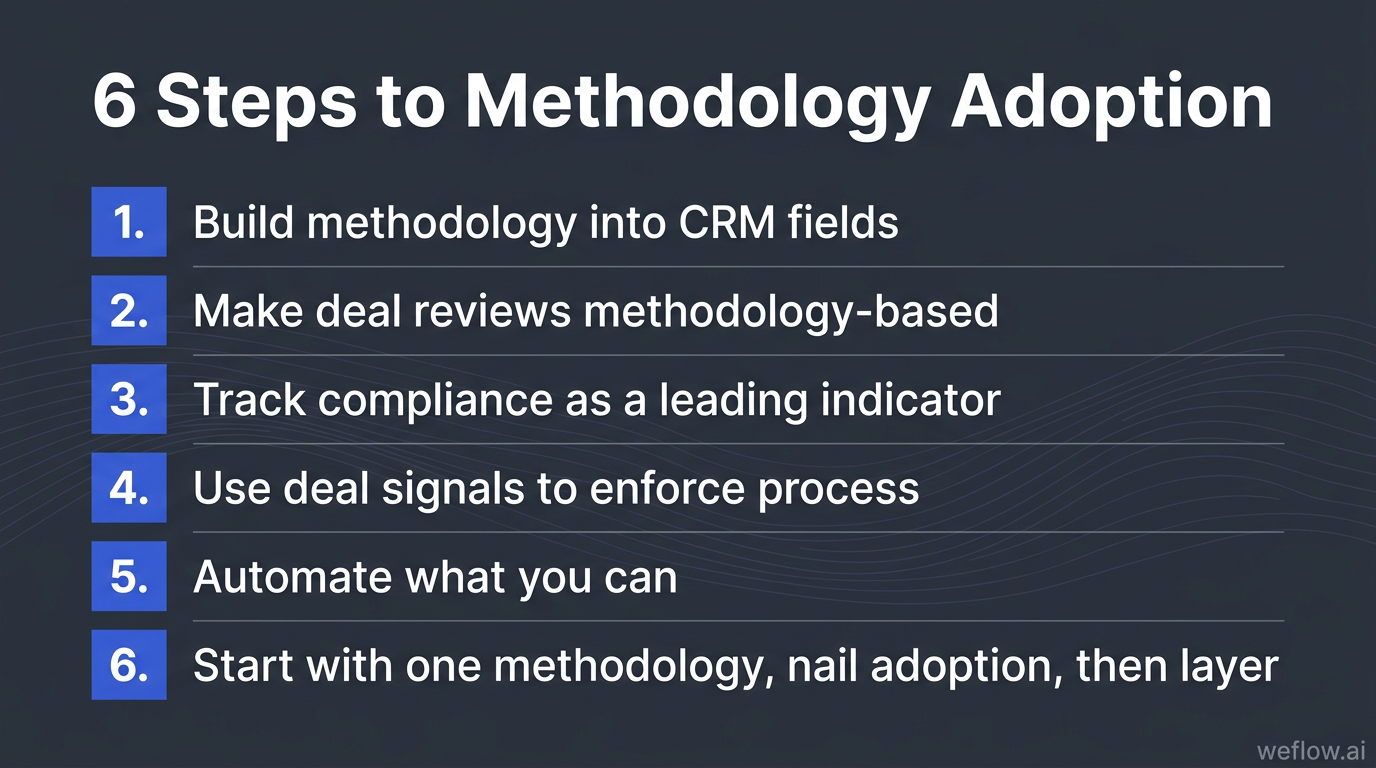
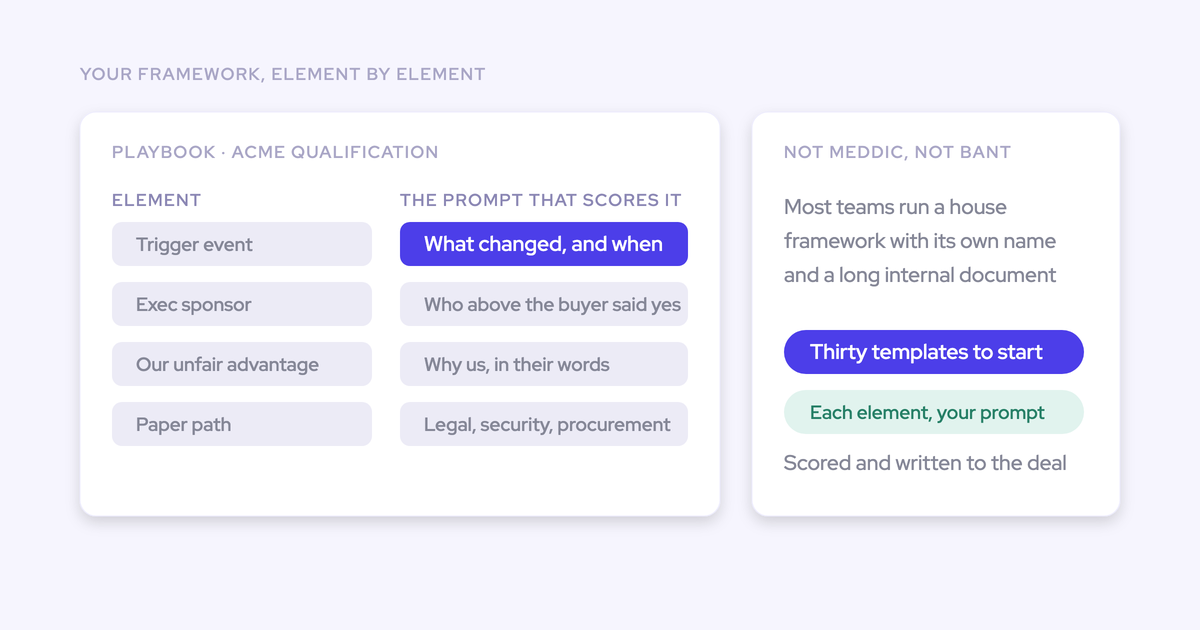
Methodology adoption fails when it lives in training decks instead of daily workflows. Reps don’t ignore methodologies because they disagree—they ignore them because following feels like extra work. The fix: embed methodology into tools reps already use.
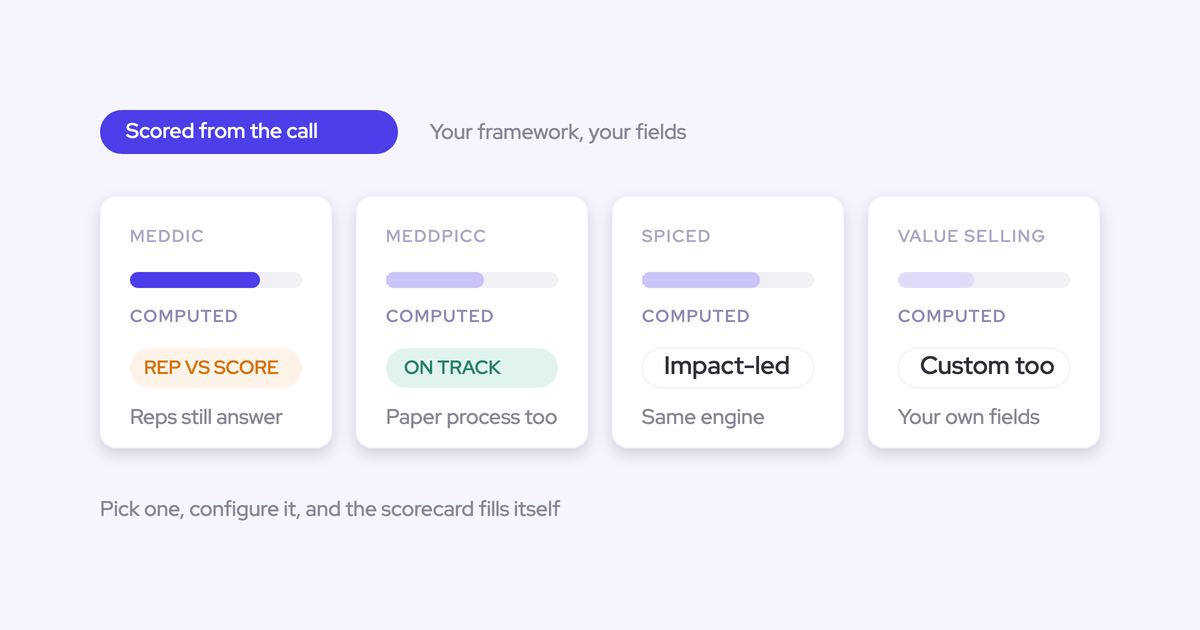
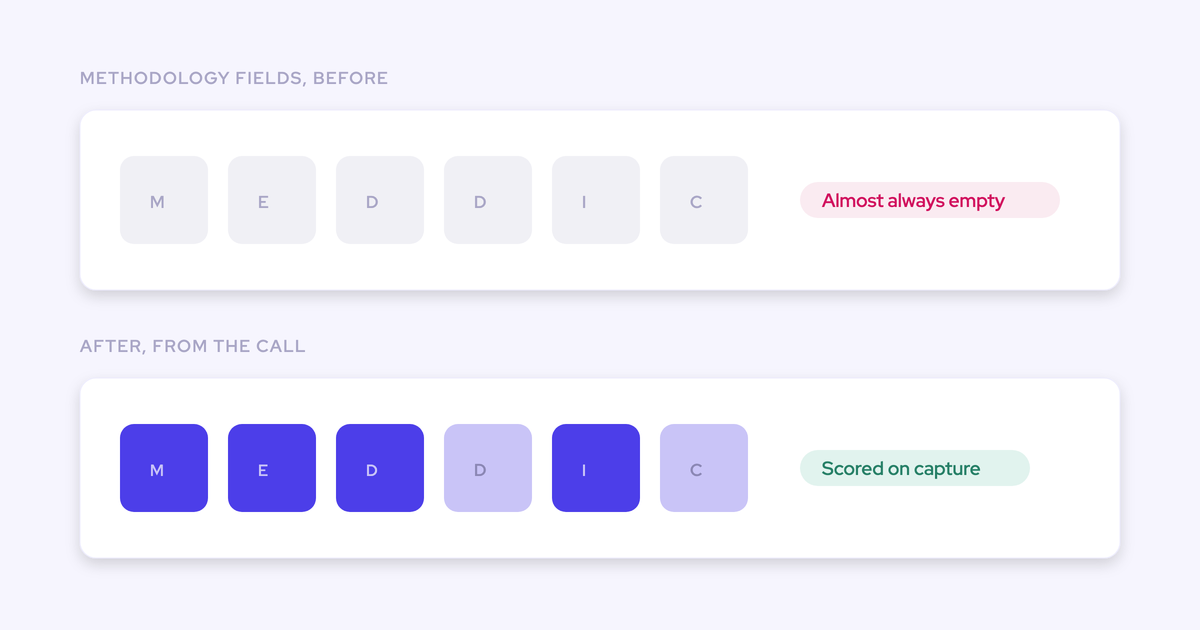
- Build methodology into CRM fields. MEDDIC users: create required fields for each element on Opportunity. Reps can’t close without filling in Champion and Economic Buyer.
- Make deal reviews methodology-based. Weekly pipeline reviews ask: “Walk me through the MEDDIC.” If reps know they’ll be asked, they’ll prepare.
- Track compliance as a leading indicator. Dashboards showing which deals have complete qualification data spot gaps before they become losses.
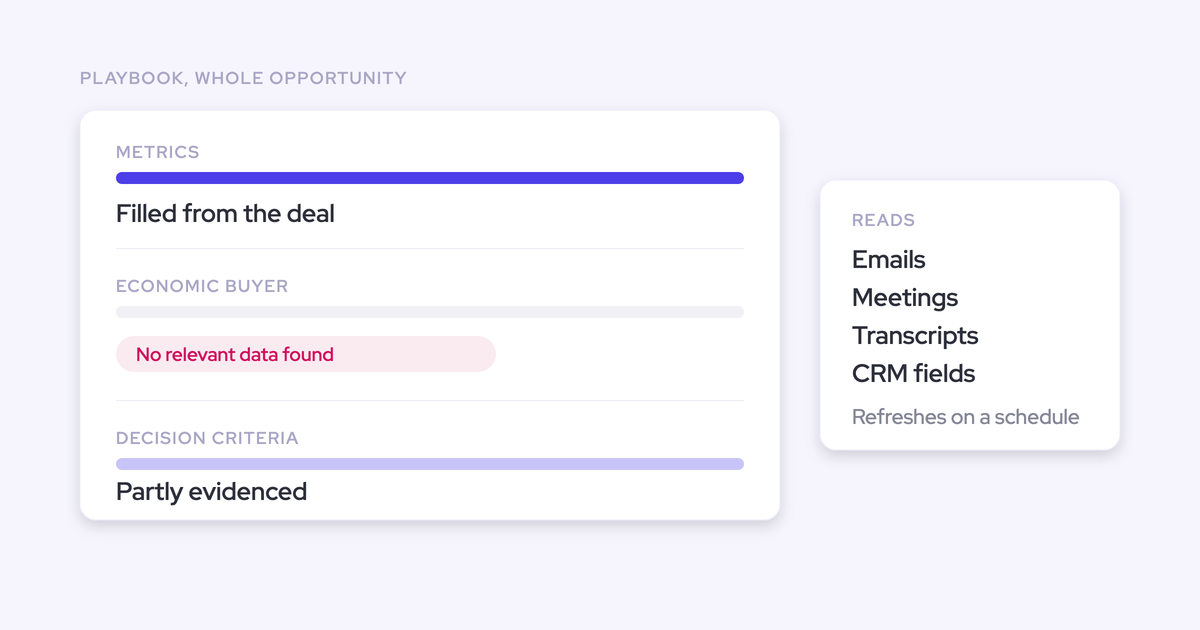
- Use deal signals to enforce process. Configure alerts when deals advance without required fields. Revenue AI tools can flag qualification gaps automatically.
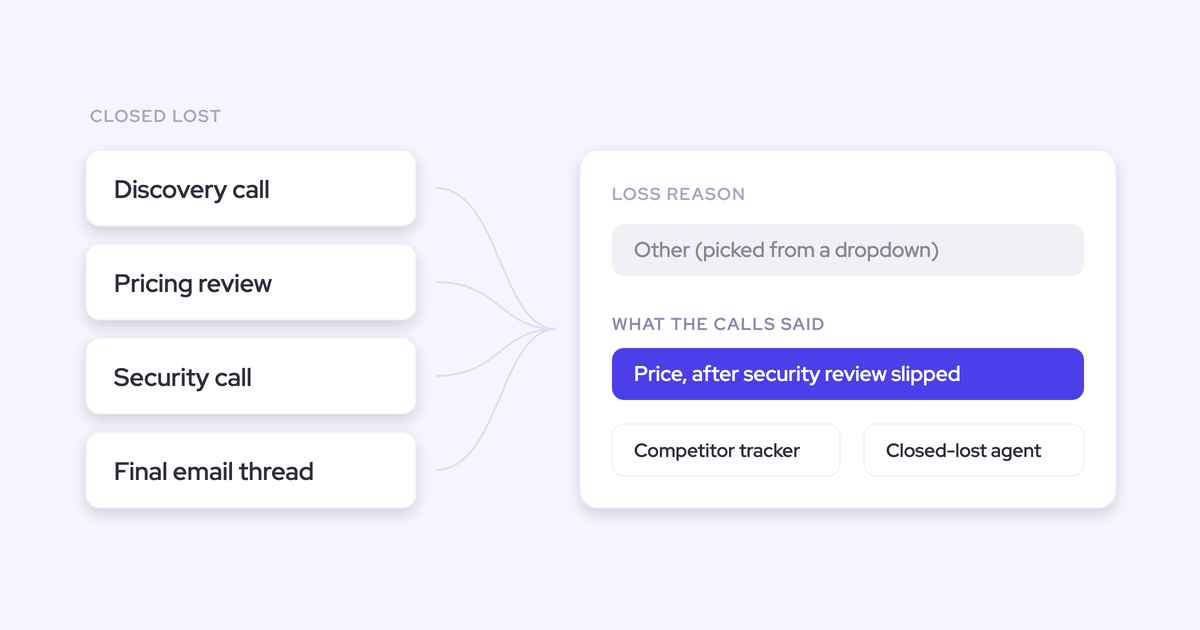
- Automate what you can. Modern CRM automation and AI capture call insights, populate methodology fields from conversations, and flag missing information.
- Start with one methodology, nail adoption, then layer. Implementing MEDDIC, Challenger, and Miller Heiman simultaneously overwhelms reps.
Frequently asked questions about sales methodologies
What is the difference between a sales methodology and a sales process?
A sales process defines stages deals move through—Discovery, Demo, Proposal, Closed. It answers “what happens when.” A methodology defines how reps behave within each stage. Process is structure; methodology is approach. Most teams need both.
Which sales methodology is best for B2B enterprise deals?
MEDDIC is most widely adopted for enterprise qualification. For engagement, Challenger Sale and Miller Heiman Strategic Selling work well. Many enterprise teams combine MEDDIC for qualification with Challenger or Strategic Selling for engagement.
Can you use more than one sales methodology at the same time?
Yes—and most successful teams do. Common pattern: qualification framework (MEDDIC, SPICED) plus engagement methodology (Challenger, SPIN) plus stakeholder mapping (Miller Heiman) for complex deals.
What is the easiest sales methodology to implement?
CHAMP is straightforward—a customer-first reordering of BANT. Inbound Selling is also easy for teams with marketing-generated leads. Start with a qualification framework before adding complex engagement methodologies.
How do I get my sales team to actually follow a new methodology?
Embed it into daily workflows: required CRM fields, methodology-based deal reviews, compliance dashboards, advancement alerts, AI-powered data capture. Start with one methodology and achieve 80% adoption before adding layers.
What sales methodology works best for SaaS companies?
SPICED was designed for recurring revenue businesses—it qualifies for retention and expansion, not just initial close. For enterprise SaaS, combine SPICED or MEDDIC with Challenger or Consultative Selling.
Is BANT still a relevant sales qualification framework?
BANT works for transactional and SMB sales. For complex B2B, modern alternatives like CHAMP, N.E.A.T., and MEDDIC provide more rigorous qualification by starting with challenges rather than budget.
How long does it take to implement a new sales methodology?
Plan for 3-6 months. Month one: training, CRM fields, deal review cadence. Months two through four: coaching and iteration. Months four through six: measure adoption and tie to outcomes. Methodology change is behavior change—it requires repetition and accountability.
Choosing the right sales methodology: key takeaways
There’s no universal “best” methodology. The right choice depends on deal complexity, cycle length, buyer personas, and team maturity.
Categorize what you need. Struggling to qualify? Implement MEDDIC, SPICED, or CHAMP. Losing to status quo? Train on Challenger. Complex buying committees? Add Miller Heiman. Stalled deals? Gap selling helps quantify inaction costs.
Implementation matters more than selection. A mediocre methodology implemented consistently outperforms a sophisticated one living in training decks. Embed your framework into CRM, deal reviews, and coaching. Measure adoption. Hold reps accountable. Expect to evolve as deals grow more complex.
-p-1600.png)

.png)
-p-1600.png)
-p-1600.png)
-p-1600.png)