
NEAT Selling: Framework, Discovery Questions, and When to Use It
Learn the NEAT selling framework, key discovery questions, and when to use it vs. BANT, MEDDIC, and SPIN.




What is NEAT selling? (definition, acronym, and core principles)
NEAT selling is a buyer-centric sales qualification framework built around four pillars: Need, Economic Impact, Access to Authority, and Timeline. Created by Richard Harris of The Harris Consulting Group, NEAT was designed to replace outdated qualification checklists like BANT with a framework that mirrors how modern B2B buyers actually make decisions.
The core principle: stop qualifying leads based on surface-level criteria (budget, authority, need, timeline) and start qualifying based on the depth of the buyer's pain and its measurable business impact. BANT asks "Do you have budget?" NEAT asks "What's the cost of doing nothing?"

Three principles define the NEAT approach:
- Lead with the buyer's problem, not your product. Discovery starts by understanding what's broken in the buyer's world—not by pitching features.
- Quantify everything. Pain without a dollar figure attached doesn't create urgency. NEAT requires reps to tie every identified need to revenue impact, cost savings, or risk reduction.
- Map the entire buying committee. Access to authority isn't about finding "the decision-maker." It's about identifying every stakeholder who can influence, block, or champion the deal.
NEAT works because it forces sales conversations toward the outcomes buyers care about—not the features sellers want to demo.
How NEAT selling improves on BANT, ANUM, and legacy qualification frameworks
BANT (Budget, Authority, Need, Timeline) was built for a sales environment where buyers had limited information and sellers controlled the process. That world doesn't exist anymore. Today's B2B buyers complete 60-70% of their research before talking to a rep, buying committees average six to 10 stakeholders, and budget often gets created or reallocated mid-cycle rather than sitting in a pre-approved line item.
BANT's biggest flaw: it treats qualification as a checklist. A rep confirms budget exists, finds a single decision-maker, and moves the deal forward. But budget confirmation at the top of funnel is misleading—budgets shift, get cut, or get redirected. And a single "authority" contact ignores the reality of consensus-driven B2B purchasing.
ANUM (Authority, Need, Urgency, Money) improved on BANT by prioritizing authority and urgency over budget. But it still treats authority as a single person and doesn't require reps to quantify the economic case for change.
NEAT addresses these gaps directly:
- Need replaces a checkbox with a conversation. Instead of asking "Do you have this need?", NEAT requires reps to uncover the root cause of the buyer's pain through open-ended discovery.
- Economic Impact replaces budget. Rather than asking "Do you have $50K?", reps help buyers calculate the cost of inaction—which often creates budget that didn't previously exist.
- Access to Authority replaces a single contact. NEAT maps the full buying committee: champions, blockers, technical evaluators, and economic sponsors.
- Timeline is driven by the buyer's urgency, not the seller's quota. NEAT ties timeline to business events, fiscal deadlines, or competitive pressure—not arbitrary close dates.
NEAT selling vs. BANT vs. MEDDIC vs. SPIN: framework comparison table
Each qualification framework makes trade-offs between depth, flexibility, and implementation effort. Here's how they compare across the dimensions that matter most for B2B sales teams:
| Framework | Focus | Flexibility | Best for | Limitation |
|---|---|---|---|---|
| NEAT | Buyer's pain and economic impact | High—adapts to complex and simple deals | Mid-market and enterprise B2B teams with consultative sales cycles | Requires strong discovery skills; less effective for transactional sales |
| BANT | Budget and authority confirmation | Low—rigid checklist approach | High-volume, shorter-cycle sales (SMB, inbound lead qualification) | Misses buying committee complexity; budget question is premature in early discovery |
| MEDDIC | Metrics, economic buyer, decision process, pain, champion | Low—requires disciplined adherence to all six components | Enterprise sales with $100K+ deal sizes and 6+ month cycles | Heavy implementation overhead; can slow down mid-market deals |
| SPIN | Situation, Problem, Implication, Need-Payoff questioning | Moderate—structured questioning sequence | Complex consultative sales where buyers don't yet recognize the problem | Question-heavy approach can feel interrogative; less effective when buyers are already educated |
The key difference: BANT and ANUM qualify leads. MEDDIC qualifies deals. NEAT qualifies the buyer's readiness to change. For teams selling into mid-market and enterprise accounts where buying committees are growing and budgets aren't pre-allocated, NEAT provides the flexibility BANT lacks without MEDDIC's implementation weight.
The 4 components of the NEAT framework (Need, Economic Impact, Access, Timeline)
How to uncover core buyer needs in NEAT discovery
In NEAT, "need" doesn't mean "Does the buyer need our product?" It means "What fundamental problem is the buyer trying to solve, and how deep does it go?"
Surface-level needs—"We need better reporting" or "We need a CRM"—aren't enough. NEAT pushes reps to dig two or three layers deeper until they reach the operational or strategic pain driving the request.
Effective techniques for uncovering core needs:
- Ask "why" three times. "We need better forecasting" → "Why?" → "Our forecasts are off by 30%" → "Why?" → "Reps don't update Salesforce" → "Why?" → "Manual data entry takes too long and they skip it." Now you've found the real problem.
- Listen for pain language. Phrases like "we're struggling with," "we keep running into," or "it's costing us" signal genuine pain versus aspirational wish-list items.
- Separate symptoms from causes. "We can't trust our pipeline" is a symptom. "Activity data is incomplete because reps don't log meetings" is the cause. NEAT discovery targets causes.
- Validate with multiple stakeholders. The need your champion describes may not match what the economic buyer or end user experiences. Cross-validate to ensure you're solving the right problem.
A well-uncovered need does two things: it gives you the language to build your business case, and it tells you whether this opportunity is worth pursuing at all.
Quantifying Economic Impact: tying pain points to revenue
Economic Impact is where NEAT creates the most separation from legacy frameworks. Instead of asking "What's your budget?", reps help buyers calculate what the problem is costing them—in revenue lost, time wasted, deals missed, or risk accumulated.
This matters because most mid-market and enterprise B2B purchases don't come from a pre-existing budget line. Budget gets created when someone builds a compelling enough case for change. NEAT gives reps the tools to build that case.
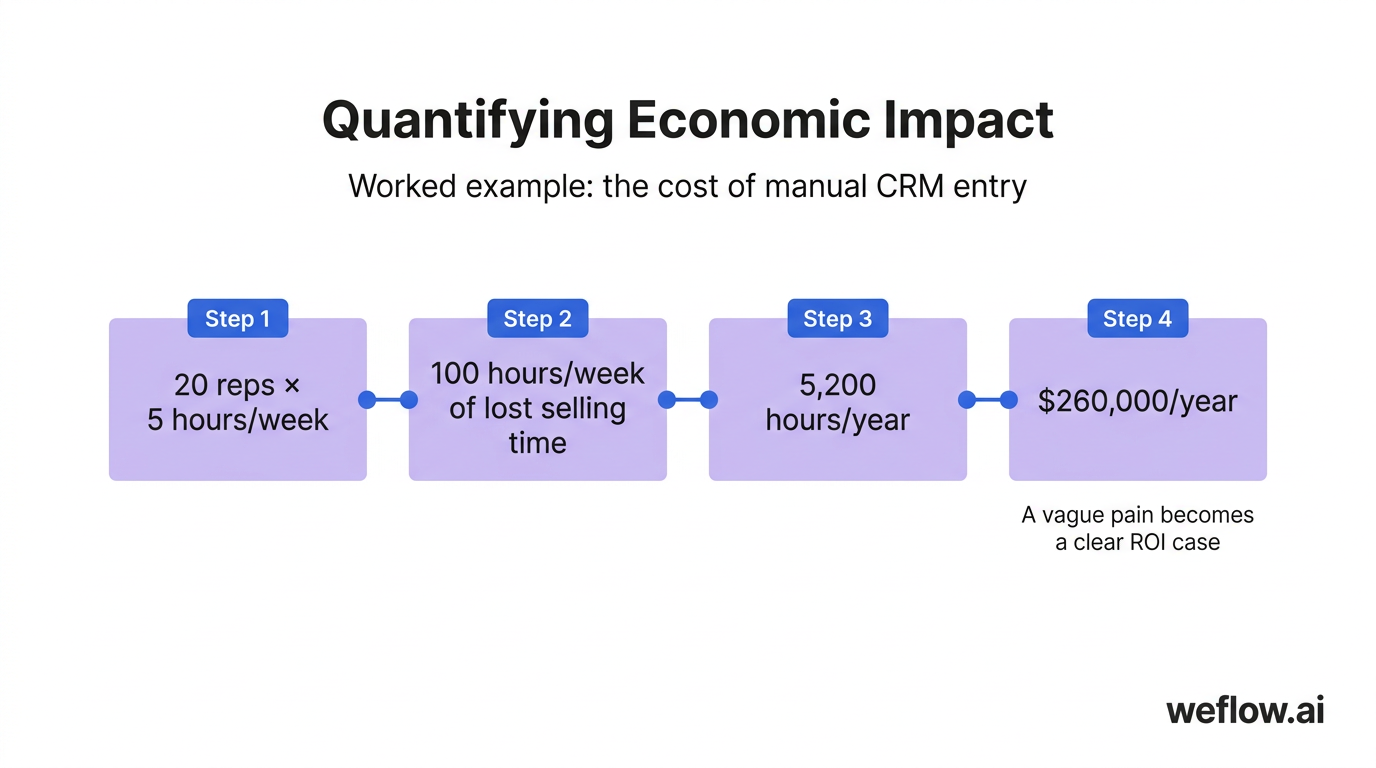
Worked example: the cost of manual CRM entry
Imagine a sales team of 20 reps, each spending five hours per week on manual Salesforce data entry—logging calls, updating opportunity fields, writing follow-up notes.
- 20 reps x 5 hours/week = 100 hours/week of lost selling time
- 100 hours/week x 52 weeks = 5,200 hours/year
- At a fully loaded cost of $50/hour, that's $260,000/year spent on data entry instead of selling
- If those 5,200 hours were redirected to pipeline-generating activities at even a 10% conversion improvement, the revenue impact compounds further
That calculation transforms a vague "we want better CRM adoption" into a $260K problem with a clear ROI case. When you present this to the economic buyer, you're not asking for budget—you're showing them money they're already spending on the wrong things.
Tips for quantifying economic impact in discovery:
[banner type="download" url="https://www.weflow.ai/resources/cheat-sheets/neat-selling-checklist" text="NEAT Selling Checklist" subtitle="Run discovery calls that qualify buyer readiness, not just interest" button="Get the checklist"]
- Use the buyer's own numbers. Ask "How many reps do you have?" and "How much time do they spend on [task]?" Let the math speak for itself.
- Include opportunity cost. Lost selling time isn't just a cost—it's unrealized revenue.
- Frame it annually. Monthly figures feel small. Annual figures get executive attention.
- Compare to the cost of your solution. A $60K/year tool that saves $260K/year in productivity is a straightforward business case.
Mapping Access to Authority across the buying committee
Access to Authority in NEAT doesn't mean "find the person who signs the check." It means mapping every stakeholder who influences the buying decision—and understanding their motivations, concerns, and power within the organization.
In B2B deals above $10K, buying committees typically include three to eight people across multiple functions. Missing even one stakeholder can stall or kill a deal in late stages.
Key roles to map:
- Economic buyer: Controls budget. Cares about ROI and business outcomes. Often a VP or C-level executive.
- Champion: Your internal advocate. Has the pain, wants the solution, and will sell internally on your behalf.
- Technical evaluator: Assesses whether the solution meets technical requirements. Can veto the deal on integration, security, or scalability grounds.
- End users: The people who'll use the product daily. Their adoption concerns can block deals even after executive approval.
- Blockers: Stakeholders who benefit from the status quo or prefer a competitor. Identifying them early prevents surprises.
Practical steps for mapping access:
- Ask your champion directly: "Who else is involved in this decision? Who might push back?"
- Research the org chart. LinkedIn and the company website often reveal reporting structures and relevant titles.
- Request multi-threaded meetings. Suggest including the IT lead, a sales manager, or the CFO in a follow-up call. The response tells you how much access you actually have.
- Track engagement across stakeholders. If only one person opens your emails and attends demos, you've got a single-threaded deal—and that's a risk.
Using Timeline urgency to prioritize and accelerate deals
Timeline in NEAT isn't about asking "When do you want to implement?" It's about understanding what's driving the buyer's urgency—or what's preventing it.
A deal without a compelling event or deadline is a deal that will stall. NEAT reps look for timeline drivers that create genuine urgency:
- Fiscal year or quarter end: Budget that expires, revenue targets that must be hit, or board reporting deadlines.
- Business events: A new CRO starting, a PE acquisition closing, a product launch, or a market expansion.
- Competitive pressure: A competitor just implemented a similar solution, or the buyer's market position is at risk.
- Pain escalation: The problem is getting worse—forecast misses are increasing, data quality is declining, or key people are leaving because of process frustration.
If none of these drivers exist, the deal isn't urgent—regardless of what the buyer says about "wanting to move quickly." NEAT reps use this signal to prioritize their pipeline: deals with strong timeline drivers get more attention, and deals without urgency get nurtured rather than chased.
Questions that reveal true timeline urgency:
- "What happens if you don't solve this in the next 90 days?"
- "Is there a specific event or deadline driving this initiative?"
- "Have you allocated budget for this fiscal year, or would it need to be created?"
- "What other projects are competing for your team's bandwidth right now?"
Which sales teams benefit most from NEAT selling?
NEAT isn't a universal framework. It's built for sales environments where qualification requires depth—not just a checklist. Here are the specific criteria that indicate NEAT is the right fit:
- Average deal size above $10K. Below that threshold, the discovery depth NEAT requires may not justify the time investment. For high-volume, low-ACV sales, BANT or a simpler qualification model is more efficient.
- Sales cycles longer than 30 days. NEAT's emphasis on economic impact and buying committee mapping pays off in deals that involve multiple conversations and decision stages. For one-call closes, it's over-engineered.
- Three or more stakeholders in the buying process. If deals are single-threaded (one buyer, one decision), NEAT's Access to Authority component adds limited value. When three to eight stakeholders are involved, it's critical.
- Consultative or solution selling motion. NEAT assumes reps are having discovery conversations, not reading scripts. Teams that sell through product demos without discovery won't get full value.
Industries where NEAT consistently performs well:
- B2B SaaS: Complex products, multiple stakeholders, budget often created rather than pre-allocated.
- Financial services: Regulated buying processes, long evaluation cycles, risk-averse committees.
- Professional services: Relationship-driven sales where understanding the client's business context is the differentiator.
- Healthcare technology: Multiple approval layers (clinical, IT, compliance, procurement), extended timelines, and high switching costs.
If your team sells a $5K/year product through inbound demos with a 14-day sales cycle, NEAT will slow you down. If you're selling a $50K+ platform into a six-person buying committee over three months, NEAT gives your reps a structured way to navigate that complexity.
Benefits of NEAT selling for B2B revenue teams
NEAT selling delivers measurable advantages for teams that operate in consultative, multi-stakeholder sales environments. Here are the benefits that matter most:
- Higher win rates through deeper qualification. Reps who quantify economic impact and map the buying committee early close deals at higher rates because they're pursuing opportunities with genuine urgency and organizational buy-in—not just interest from a single contact.
- Shorter sales cycles despite longer discovery. It seems counterintuitive, but spending more time on upfront discovery reduces back-and-forth later. When you've already built the business case and aligned stakeholders, the approval process moves faster.
- Larger deal sizes driven by economic framing. When reps help buyers calculate the cost of inaction, the conversation shifts from "Can we afford this?" to "Can we afford not to do this?" That reframing often expands deal scope as buyers realize the full extent of the problem.
- Better pipeline accuracy and forecast confidence. NEAT qualification gives managers and RevOps teams reliable signals about deal health. A deal with a quantified economic impact, mapped buying committee, and clear timeline driver is far more predictable than one qualified on "the buyer said they're interested."
- Reduced late-stage deal collapse. Most deals that die in late stages fail because of an unknown blocker, an unmapped stakeholder, or a timeline that was never real. NEAT surfaces these risks in early discovery instead of at the proposal stage.
5 best practices for implementing NEAT selling
Craft open-ended discovery questions that reveal true buyer needs
The quality of your NEAT discovery depends entirely on the questions you ask. Closed-ended questions ("Do you have a CRM?") give you data points. Open-ended questions ("Walk me through what happens after a rep finishes a call") give you insight.
Rules for NEAT discovery questions:
- Start broad, then go specific. "Tell me about your biggest challenge with pipeline visibility" opens the door. "How does that affect your weekly forecast call?" narrows to a specific pain.
- Avoid leading questions. "Wouldn't it be great if your CRM updated automatically?" isn't discovery—it's pitching. Instead: "How do your reps currently update deal information after meetings?"
- Use "how" and "what" more than "why." "Why" can feel confrontational. "How does that affect your team?" gets the same information with less friction.
- Let the buyer fill silence. After asking a question, wait. The most valuable information often comes after the buyer's initial response, when they elaborate on what they actually mean.
Practice active listening to guide the conversation forward
Discovery isn't an interview—it's a conversation. Active listening means using what the buyer says to guide your next question, not just waiting for your turn to talk.
Practical active listening techniques for NEAT discovery:
- Mirror key phrases. If the buyer says "We're drowning in manual updates," respond with "Drowning in manual updates—tell me more about that." This signals you're listening and invites elaboration.
- Summarize and confirm. "So if I'm hearing you right, the core issue is that your forecast accuracy suffers because reps aren't logging activity consistently. Is that fair?" This builds trust and ensures alignment.
- Follow the pain, not your script. If the buyer mentions an unexpected challenge, explore it—even if it's not on your talk track. The best discovery insights come from unscripted moments.
- Take notes on exact language. The phrases buyers use to describe their pain are the same phrases you should use in your proposal, business case, and follow-up emails. Their words resonate more than yours.
Frame the cost of inaction to create decision urgency
Most B2B deals don't lose to a competitor—they lose to "no decision." The buyer agrees they have a problem but decides it's not urgent enough to act on right now. NEAT's Economic Impact component gives reps the tool to fight this: the cost of inaction.
How to frame the cost of inaction effectively:
[banner type="download" url="https://www.weflow.ai/resources/cheat-sheets/sales-methodology-cheat-sheet" text="Sales Methodology Cheat Sheet" subtitle="Pick the right framework for your deal size, cycle, and committee" button="Get the cheat sheet"]
- Make it cumulative. "$260K per year" hits harder than "$5K per week." Show the buyer what 12 months of inaction costs.
- Make it personal. Tie the cost to the buyer's specific goals. "You mentioned your board wants forecast accuracy within 5%. Every quarter you delay, you're presenting numbers with a 30% error rate."
- Make it comparative. "The cost of this solution is $60K/year. The cost of not solving this problem is $260K/year. That's a 4x return before you count the revenue impact of better forecasting."
- Let the buyer do the math. Guide them through the calculation rather than presenting a pre-built slide. Numbers they've derived themselves are more compelling than numbers you've told them.
NEAT selling discovery questions by stage (with scenarios)
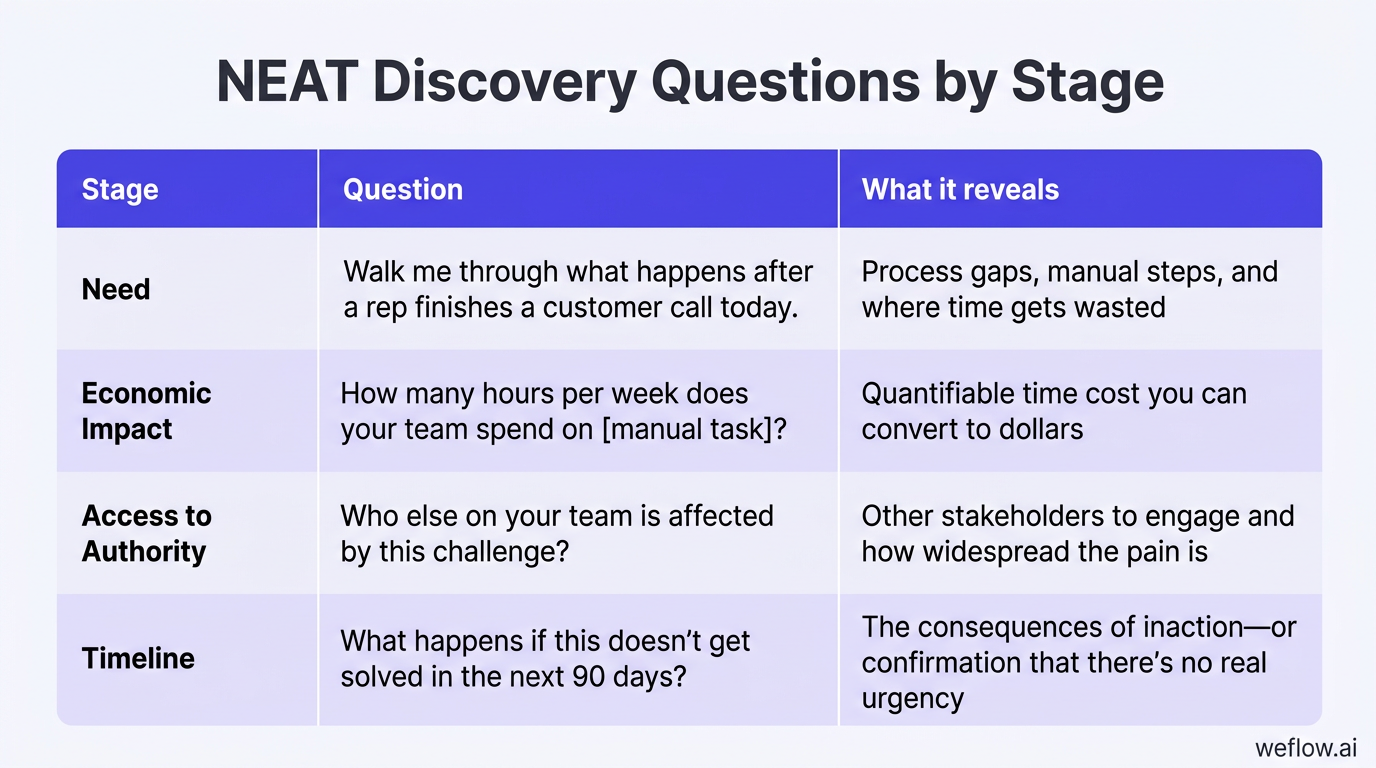
Here are proven discovery questions mapped to each NEAT component, along with the context for when to use them and what a strong answer looks like:
| Stage | Question | When to ask | What a good answer reveals |
|---|---|---|---|
| Need | "Walk me through what happens after a rep finishes a customer call today." | First discovery call, after initial rapport | Process gaps, manual steps, and where time gets wasted |
| Need | "What's the biggest challenge your team faces with [specific workflow]?" | Early discovery when scoping the problem | Whether the pain is felt broadly or isolated to one person |
| Need | "If you could fix one thing about your current process tomorrow, what would it be?" | When the buyer is describing multiple pain points | Their top priority—which tells you where to focus your pitch |
| Economic Impact | "How many hours per week does your team spend on [manual task]?" | After identifying a specific pain point | Quantifiable time cost you can convert to dollars |
| Economic Impact | "What does a missed forecast cost your organization in terms of planning and resource allocation?" | When speaking with a VP or C-level stakeholder | Business-level impact beyond the immediate team |
| Economic Impact | "If this problem didn't exist, what would your team be doing instead?" | Mid-discovery, after the pain is established | The opportunity cost—often larger than the direct cost |
| Access to Authority | "Who else on your team is affected by this challenge?" | After the buyer has described the problem in detail | Other stakeholders to engage and how widespread the pain is |
| Access to Authority | "What does the approval process look like for a purchase like this?" | When the buyer signals interest in next steps | The decision-making structure, potential blockers, and timeline |
| Access to Authority | "Who would need to be involved in a final decision, and what are their priorities?" | Before proposing a multi-stakeholder meeting | Names, roles, and what each person cares about |
| Timeline | "Is there a specific event or deadline driving this initiative?" | Mid to late discovery, after establishing interest | Whether urgency is real (fiscal year end, board mandate) or artificial |
| Timeline | "What happens if this doesn't get solved in the next 90 days?" | When the buyer seems interested but not urgent | The consequences of inaction—or confirmation that there's no real urgency |
| Timeline | "What other projects are competing for your team's bandwidth right now?" | When assessing whether the deal can realistically close this quarter | Competing priorities that could delay the decision |
Common mistakes when adopting NEAT selling
Teams that adopt NEAT often make predictable errors during the first few months. Recognizing these patterns early prevents wasted pipeline and frustrated reps.
- Treating NEAT as another checklist. The most common mistake. Reps add "Need," "Economic Impact," "Access," and "Timeline" as fields in Salesforce and check boxes without doing genuine discovery. NEAT isn't a form to fill out—it's a framework for deeper conversations. If your reps can complete all four components in a single 30-minute call, they're probably not going deep enough.
- Skipping Economic Impact because "the buyer already has budget." Even when budget exists, quantifying economic impact strengthens your position. It justifies the investment to other stakeholders, defends against budget cuts mid-cycle, and gives your champion ammunition for internal selling. Skipping this step leaves money on the table and makes your deal vulnerable to reprioritization.
- Confusing "access to authority" with "talking to the decision-maker." NEAT requires mapping the full buying committee—not just getting a meeting with the VP. Reps who focus exclusively on the economic buyer often miss technical evaluators who can veto the deal or end users whose adoption concerns surface late in the process.
- Accepting vague timelines. "We'd like to have something in place by Q3" isn't a timeline—it's a wish. NEAT reps push for the business event or consequence that makes Q3 meaningful. Without a compelling event, the deal will slip, and reps who accept soft timelines end up with inflated pipeline and missed forecasts.
How CRM automation and AI support NEAT selling
NEAT selling generates a wealth of qualitative insight—buyer pain points, economic calculations, stakeholder maps, timeline drivers. The challenge is capturing that information reliably and making it accessible to the rest of the revenue team.
This is where modern sales technology fills a critical gap. Here's how CRM automation and AI tools support each NEAT component:
- Activity capture ensures nothing gets lost. NEAT discovery conversations surface critical details—the CFO's concerns, the timeline driver, the cost calculation your champion shared. Tools that automatically log emails, meetings, and calls to your CRM ensure these insights get recorded without relying on reps to type up notes after every interaction.
- Conversation intelligence extracts NEAT signals automatically. AI-powered call recording and analysis can identify when buyers express pain, mention competitors, discuss budget constraints, or name other stakeholders. Instead of relying on reps to self-report discovery quality, managers can review whether NEAT components were actually covered in the conversation.
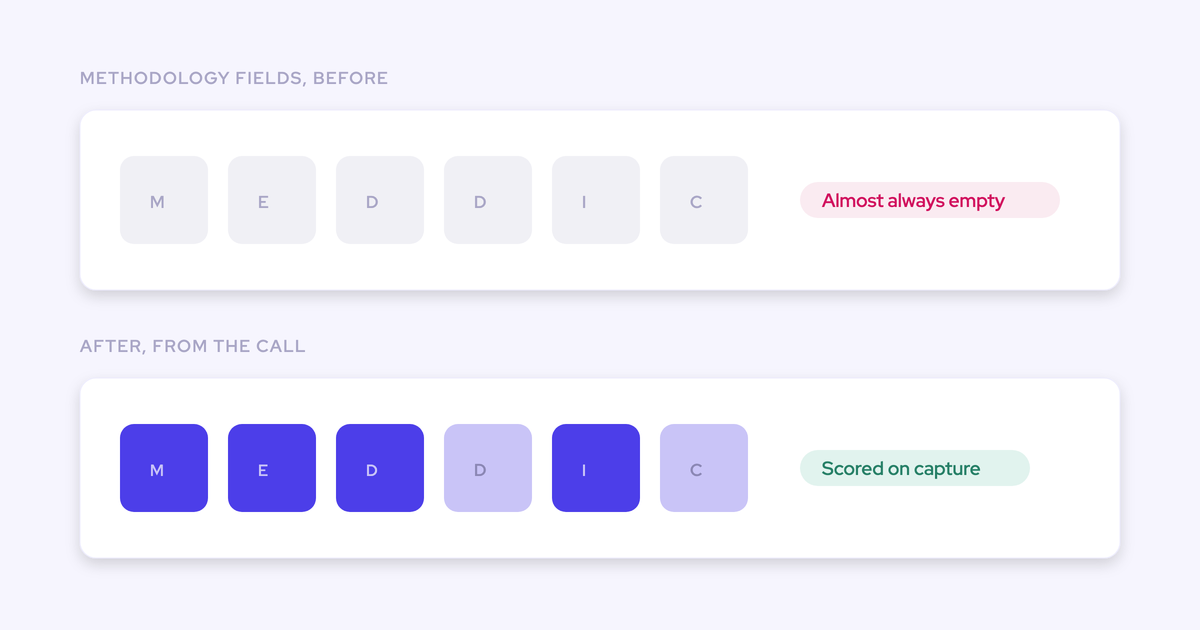
- Automated CRM field updates reduce admin burden. Reps who spend five hours a week updating Salesforce have less time for the discovery conversations NEAT requires. When AI handles CRM updates—populating methodology fields, updating deal stages, logging next steps—reps can invest that time in deeper qualification.
- Stakeholder tracking supports Access to Authority. CRM automation that captures email recipients, meeting attendees, and engagement patterns helps reps (and managers) see whether deals are truly multi-threaded. If all activity involves a single contact, that's a visible risk flag.
- Deal intelligence surfaces timeline risks. AI that analyzes deal velocity, stage duration, and activity patterns can flag when deals are stalling—before the rep notices. This helps managers coach on Timeline and keep pipeline forecasts honest.
The bottom line: NEAT selling works best when reps can focus on conversations, not data entry. Automation handles the capture; reps handle the discovery.
When to choose NEAT over other sales qualification frameworks
There's no single qualification framework that fits every sales motion. The right choice depends on your deal complexity, sales cycle length, and team maturity. Here's a decision framework:
Choose NEAT when:
- Your average deal size exceeds $10K and involves three or more stakeholders
- Budget isn't pre-allocated—your reps need to build the business case for change
- Your sales cycle is 30+ days with multiple discovery and evaluation stages
- You want a framework that's lighter than MEDDIC but more rigorous than BANT
- Your team sells into industries where the status quo is the primary competitor (not another vendor)
Choose BANT when:
- You're qualifying high-volume inbound leads and need a fast yes/no filter
- Deal sizes are under $10K with short sales cycles
- The buying process is straightforward—typically one or two stakeholders
Choose MEDDIC when:
- Deal sizes exceed $100K with six-month-plus cycles
- Your sales process requires formal metrics, decision criteria, and paper processes
- You have the enablement resources to train and enforce a six-component framework
Choose SPIN when:
- Buyers don't yet recognize they have a problem—your reps need to create awareness
- The sale is highly consultative and depends on changing the buyer's perspective
- You're selling into new categories where education is part of the sales process
Many teams find that NEAT works well as a primary framework combined with elements of other methodologies. You might use NEAT for qualification and discovery while borrowing MEDDIC's champion-testing techniques for enterprise deals. The frameworks aren't mutually exclusive—they're tools in a toolkit.
Frequently asked questions
What does NEAT stand for in sales?
NEAT stands for Need, Economic Impact, Access to Authority, and Timeline. It's a B2B sales qualification framework created by Richard Harris of The Harris Consulting Group, designed to replace legacy approaches like BANT with a buyer-centric methodology that prioritizes understanding the depth of the buyer's pain and its business impact.
How is NEAT selling different from BANT?
BANT asks whether a buyer has budget, authority, need, and a timeline—treating qualification as a checklist. NEAT goes deeper: it replaces budget with economic impact (what the problem costs), expands authority to map the full buying committee, and ties timeline to business events rather than arbitrary dates. NEAT qualifies the buyer's readiness to change, not just their ability to purchase.
When should a sales team use NEAT selling?
NEAT works best for B2B teams with deal sizes above $10K, sales cycles longer than 30 days, and three or more stakeholders in the buying process. It's particularly effective in industries like SaaS, financial services, and professional services where budget often needs to be created rather than allocated.
Can NEAT selling be combined with other sales methodologies?
Yes. NEAT pairs well with MEDDIC's champion-testing and metrics validation for enterprise deals, and with SPIN's questioning techniques for earlier-stage education-heavy sales. Many teams use NEAT for initial qualification and discovery, then layer in additional frameworks as deals progress into later stages.
What are the best NEAT selling discovery questions?
The strongest NEAT questions are open-ended and tied to specific workflows. For Need: "Walk me through what happens after a rep finishes a call." For Economic Impact: "How many hours per week does your team spend on [task]?" For Access: "Who else is affected by this challenge?" For Timeline: "What happens if this doesn't get solved in the next 90 days?"
How does NEAT selling help with multi-threaded deals?
NEAT's Access to Authority component requires reps to map every stakeholder in the buying process—champions, blockers, technical evaluators, and economic buyers. This ensures deals don't rely on a single contact and helps reps identify gaps in stakeholder coverage early, before missing relationships cause late-stage surprises or stalled deals.
What are common mistakes when implementing NEAT selling?
The four most frequent mistakes: treating NEAT as a checkbox exercise instead of a discovery framework, skipping economic impact quantification when budget already exists, equating "access to authority" with getting one meeting with a decision-maker, and accepting vague timelines without tying them to specific business events or consequences.
How can CRM automation support NEAT selling?
CRM automation supports NEAT by capturing the insights that discovery conversations generate—without requiring reps to manually log them. Activity capture records emails and meetings automatically, conversation intelligence identifies NEAT signals in calls, and automated field updates keep deal records current. This lets reps focus on deeper qualification instead of data entry.
-p-1600.png)

.png)
-p-1600.png)
-p-1600.png)
-p-1600.png)