

MEDDIC Sales Qualification Checklist: Steps, Questions, and Examples
Learn MEDDIC checklist steps, qualification questions, and examples to inspect complex deals.



-p-1600.png)

MEDDIC gives reps and RevOps teams a structured way to qualify complex deals before they turn into forecast surprises. Instead of relying on rep optimism, it forces the team to document business pain, quantify impact, map stakeholders, and confirm how the buying decision actually gets made.
This checklist breaks down each part of MEDDIC—Metrics, economic buyer, decision criteria, Decision process, Identify pain, and champion—and shows how to use it to remove pipeline blind spots and catch late-stage risks early. If you run Salesforce, it also gives you a practical framework to turn deal inspection into something you can enforce in the CRM.
[banner type="download" url="https://www.weflow.ai/resources/cheat-sheets/meddic-checklist" text="MEDDIC Sales Process Checklist" subtitle="Get MEDDIC qualification prompts, discovery questions, and a checklist for every deal." button="Download now"]
Deal qualification: quantify pain and measure business impact
The first job in MEDDIC is to build a real business case. That starts with pain, not product. If a rep jumps into features before the buyer has clearly stated what is broken, why it matters, and what it costs to leave it alone, the deal usually ends up with weak urgency and a shaky ROI story.
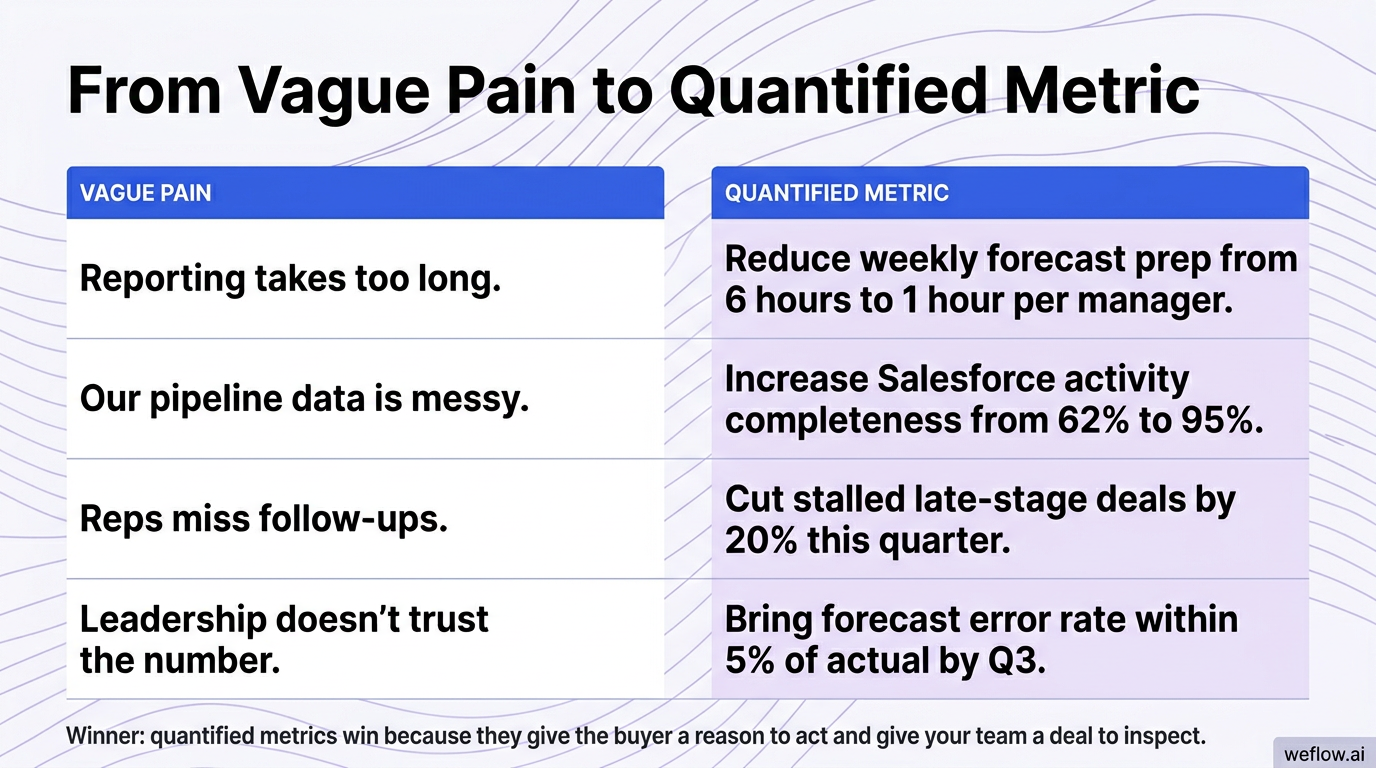
The sequence matters: uncover the problem in the buyer's words, understand the impact of doing nothing, then attach a measurable outcome to that problem. That transition—from emotional pain to financial impact—is what turns interest into budget.
Vague painQuantified metric“Reporting takes too long.”“Reduce weekly forecast prep from 6 hours to 1 hour per manager.”“Our pipeline data is messy.”“Increase Salesforce activity completeness from 62% to 95%.”“Reps miss follow-ups.”“Cut stalled late-stage deals by 20% this quarter.”“Leadership doesn’t trust the number.”“Bring forecast error rate within 5% of actual by Q3.”
Winner: quantified metrics win because they give the buyer a reason to act and give your team a deal to inspect.
Identify pain: uncover the core challenges
The goal here is simple: identify the prospect’s current challenges, understand the implications, and test whether inaction is acceptable. A surface-level problem statement isn’t enough. “We want better visibility” tells you almost nothing about urgency, ownership, or consequences.
Core pain discovery questions
When a prospect gives a broad answer, go one layer deeper. If they say, “Our forecasting process is inconsistent,” ask what that changes operationally—missed commits, low manager confidence, bad board reporting, or time lost reconciling Salesforce data before forecast calls. The point is to move from a general complaint to a business consequence.
The “what happens if you do nothing” question is where weak deals usually get exposed. If the honest answer is “not much,” the deal may not be real yet. If the answer is “we keep missing quarter-end targets because pipeline coverage is inflated and activity data is incomplete,” now you have urgency.
Define metrics: measure the financial impact
Once the pain is clear, the next step is to quantify success. This is where reps ask how the buyer measures improvement and what numbers they need to move to justify investment.
Use questions like these to get there: What are your business goals right now? Which metrics around cost, efficiency, or business do you need to achieve? How would you measure success?
A weak metric is “save time.” A strong metric is “reduce manual reporting by 10 hours a week across the RevOps team.” One is a nice idea. The other can survive procurement and CFO review.
Stakeholder mapping: find the buyers who drive final approval
Most enterprise deals do not fail because the product is wrong. They fail because the rep is single-threaded with one supportive contact and has not mapped who can approve budget and who will sell the project internally. MEDDIC separates those two roles: the economic buyer and the champion.
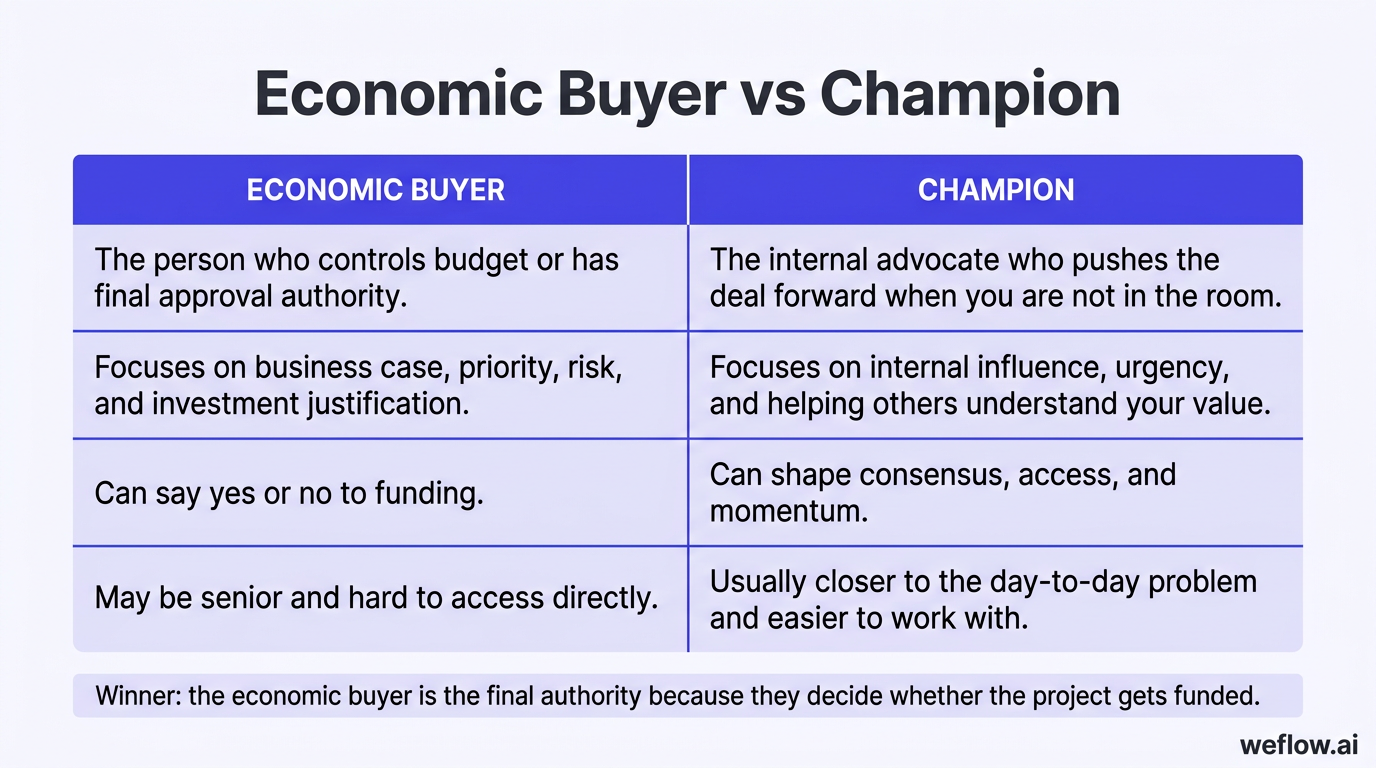
Economic buyerChampionThe person who controls budget or has final approval authority.The internal advocate who pushes the deal forward when you are not in the room.Focuses on business case, priority, risk, and investment justification.Focuses on internal influence, urgency, and helping others understand your value.Can say yes or no to funding.Can shape consensus, access, and momentum.May be senior and hard to access directly.Usually closer to the day-to-day problem and easier to work with.
Winner: the economic buyer is the final authority because they decide whether the project gets funded.
You still need both roles covered. A deal without a champion loses momentum between meetings. A deal without an economic buyer stalls when it is time to approve spend.
Locate the economic buyer: secure the sponsor
The goal is to identify the person who can take the project to the finish line, not just the person who is gathering information. That means understanding sponsorship, budget ownership, and who else has a vote when the deal reaches final approval.
Start with direct but respectful questions: Are you sponsoring this project? What do you need to take this project to the finish line? Is anyone else involved in making the final decision?
Checklist: signs you’ve found the true economic buyer
If you need to ask whether a contact is the final decision-maker, do it without putting them on the defensive. Try: “To make sure I’m helping you build this internally, how does final approval usually work on a purchase like this?” That keeps the focus on process, not status.
Build a champion: empower your internal advocate
A champion is not just someone who likes your product. A true champion has something to gain from solving the problem, can influence decision-makers, and can explain your value accurately when you are not in the meeting.
A friendly coach is helpful, but limited. They will give context, share internal history, and tell you who is skeptical. A champion does more than that—they lobby, translate your value into internal language, and help remove blockers.
If a rep says, “They love us,” but that contact has no influence, no urgency, and no path to the decision-maker, the deal is still exposed.
Decision mechanics: map the criteria and timeline to close
Once pain and stakeholders are clear, MEDDIC shifts to how the buyer will evaluate options and what has to happen to get the contract signed. This is where forecasted close dates usually break down. Reps may know the target date, but not the actual sequence of approvals required to hit it.
Losing control of decision mechanics is one of the main reasons deals slip. If the team does not know the criteria, timeline, review layers, and legal steps, the close date is a guess.
Clarify decision criteria: learn how they judge
The goal is to understand what the prospect will use to evaluate solutions and how they will justify the purchase internally. Ask directly: What are the most important criteria for you when making this decision? How are you calculating the ROI for this project to justify the investment?
Common criteria usually fall into a few categories:
The earlier you uncover criteria, the more chance you have to shape them. If your team waits until formal evaluation starts, the buyer may already be judging vendors on a checklist you did not influence. Good reps teach the buyer what should matter early—especially around integration footprint, data completeness, and implementation effort.
Map the decision process: track the exact steps
The goal is to document the full path from evaluation to signature. That means separating three different workflows that often get blurred together: technical decision making, business decision making, and the paper process.
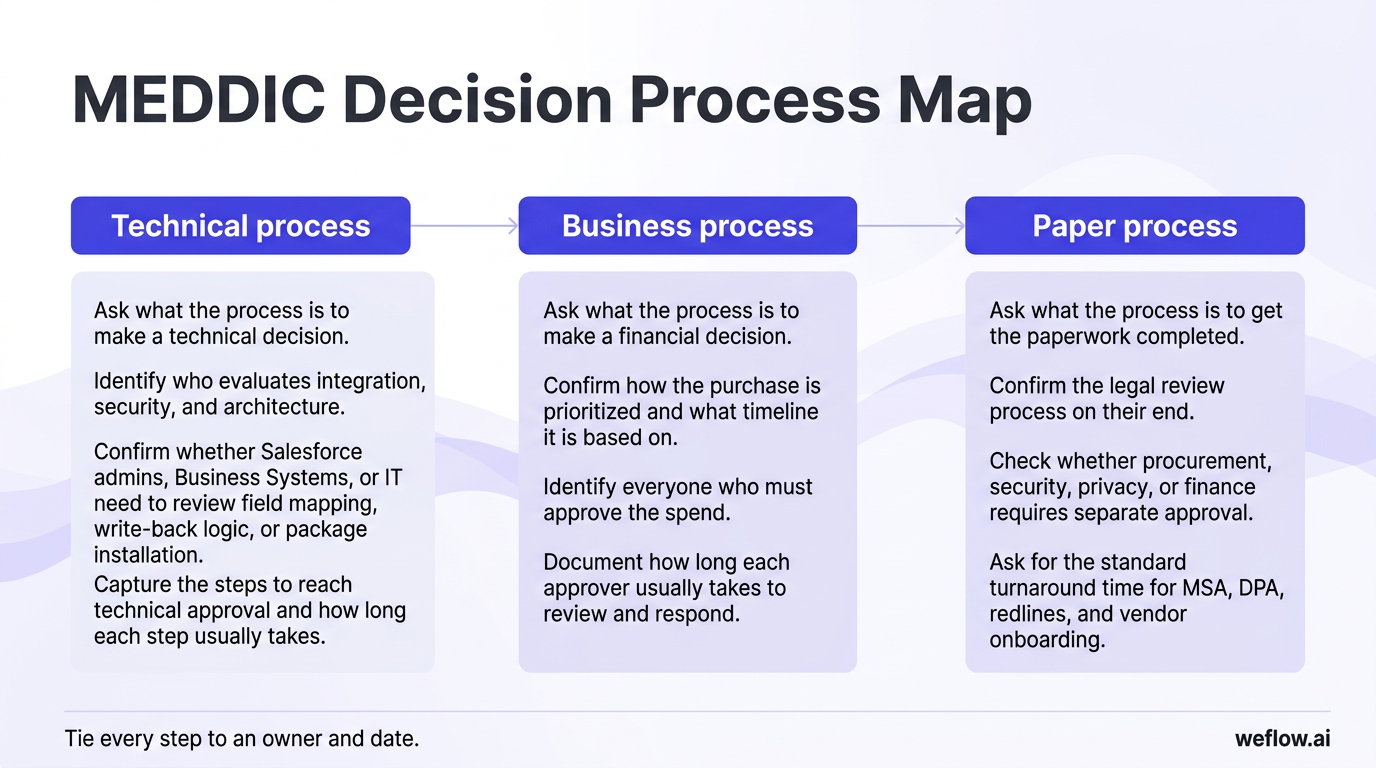
Technical process
Business process
Paper process
The paper process is the most common bottleneck, especially in mid-market and enterprise B2B organizations. A deal can be technically approved and budget-approved, then sit in legal or procurement for weeks. Reps need to ask about this well before the target close date—not after the verbal yes.
FAQ
What is the MEDDIC sales methodology used for?
MEDDIC is a B2B sales qualification framework used to inspect deals more accurately and reduce forecast risk. It helps teams confirm business pain, quantify impact, identify the real decision-makers, and expose missing deal information before a late-stage slip or loss.
How does MEDDIC differ from BANT qualification?
BANT checks for four basics: budget, authority, need, and timeline. MEDDIC goes further by mapping how the deal gets approved in a complex buying environment, including internal advocates, decision criteria, and the full approval process across technical, business, and legal stakeholders.
Who should use the MEDDIC sales process?
MEDDIC works best for B2B sales teams selling into complex, high-value deals with longer sales cycles and multiple stakeholders. It is especially useful for enterprise and mid-market teams that need better forecast accuracy and tighter inspection standards inside Salesforce.
When should you introduce MEDDIC in a deal?
MEDDIC should start at the first discovery call and continue through every stage of the deal. It is not a one-time script—it is an ongoing checklist that helps reps and managers confirm whether the opportunity is getting stronger or just moving forward without enough evidence.
-p-1600.png)

.png)
-p-1600.png)
-p-1600.png)
