
CHAMP Sales Methodology: 23 Qualification Questions and Examples
Learn CHAMP sales methodology with 23 qualification questions, examples, and CHAMP vs. BANT.




Sales teams lose 67% of deals because they qualify leads poorly—spending weeks on prospects who were never going to buy. The root cause isn't lazy selling. It's using qualification frameworks that ask the wrong questions in the wrong order.
CHAMP stands for Challenges, Authority, Money, Prioritization. Unlike older frameworks that lead with budget, CHAMP starts with the prospect's pain. If there's no real problem to solve, budget and authority don't matter.
Below: each CHAMP component with specific qualification questions, a CHAMP vs. BANT comparison, a worked example, and four gaps in the framework you should fix before rolling it out.
What is the CHAMP sales methodology?
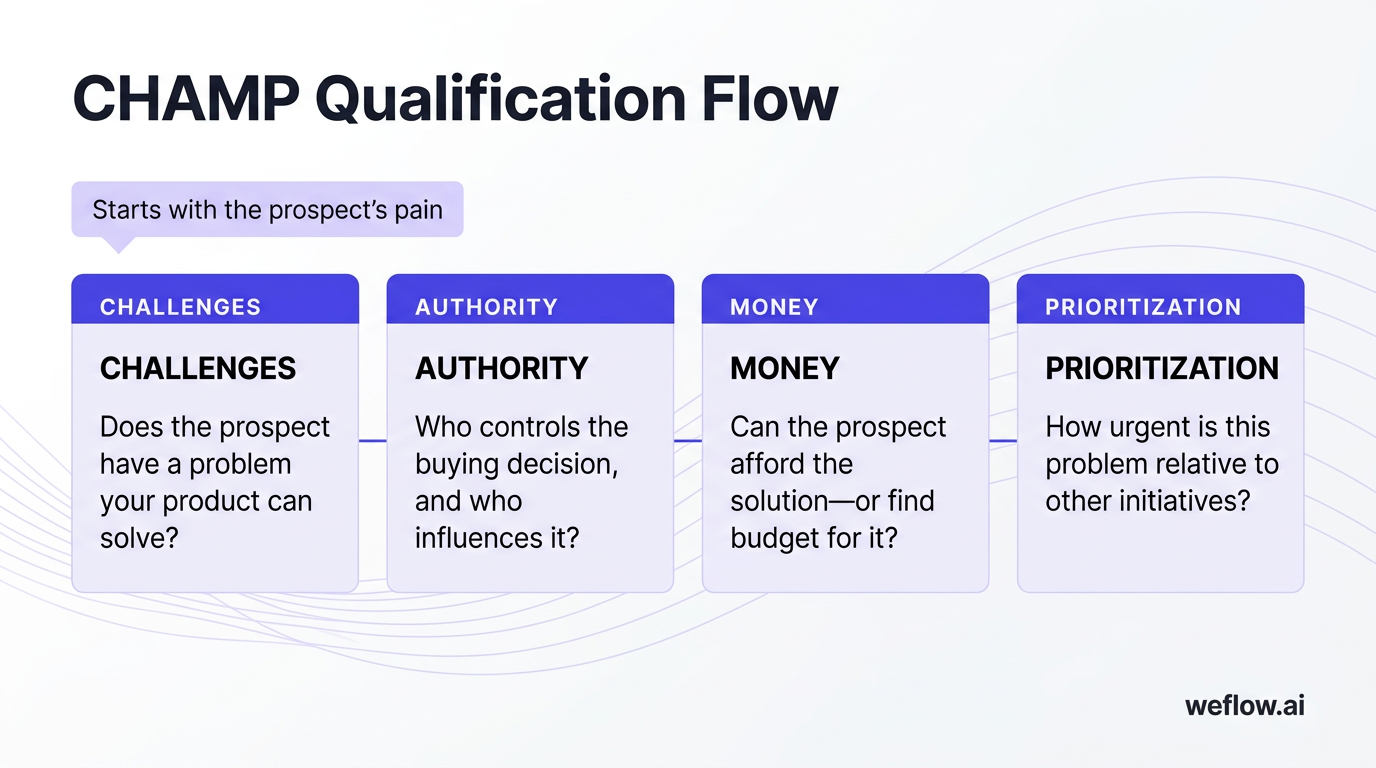
CHAMP is a lead qualification framework for B2B sales teams selling into mid-market and enterprise accounts. It reorders the conversation: instead of asking "Do you have budget?" in the first five minutes, CHAMP reps diagnose challenges first—then map authority, assess budget, and gauge priority. Prospects with painful, urgent problems find budget. Prospects with budget but no urgency don't convert.
| Component | What it answers | Example question |
|---|---|---|
| Challenges | Does the prospect have a problem your product can solve? | "What's the biggest bottleneck in your current sales process?" |
| Authority | Who controls the buying decision, and who influences it? | "Who else would need to sign off on a purchase like this?" |
| Money | Can the prospect afford the solution—or find budget for it? | "Has budget been allocated for solving this, or would this be a new line item?" |
| Prioritization | How urgent is this problem relative to other initiatives? | "Where does solving this rank against your other priorities this quarter?" |
How to qualify leads using the "Challenges" step
The Challenges step determines whether a prospect has a problem your product can solve. If you can't identify a real, measurable challenge, there's no deal to qualify.
You need to understand what's broken, how long it's been broken, and what it costs. The goal isn't to pitch—it's to determine whether your product addresses a problem they'd pay to fix.
Six qualification questions for the Challenges step
- "What's the biggest operational bottleneck your team faces right now?"
- "How long has this problem existed, and what's changed that makes it urgent now?"
- "What have you tried so far to fix this, and why didn't those approaches work?"
- "What does this problem cost you—in revenue, time, or headcount?"
- "If you don't solve this in the next six months, what happens?"
- "Who else on your team feels the impact of this problem daily?"
Pay attention to specificity. Prospects who describe their challenge with numbers ("we lose two hours per rep per day on manual data entry") are further along than those who speak in generalities. The more specific the pain, the more qualified the lead.
How to map decision-making authority in CHAMP
Authority identifies who controls the buying decision—and who influences it. Mapping authority early prevents deals from stalling in week six when an unknown VP suddenly has veto power. You need to identify three roles: the economic buyer (signs the check), the technical evaluator (assesses fit), and the deal champion (advocates internally).
Five qualification questions for the Authority step
- "Walk me through how your team typically evaluates and approves a new tool purchase."
- "Who would need to sign off on this decision, and what does each person care about most?"
- "Is there anyone who might block or slow down this purchase? What would their concerns be?"
- "Have you personally sponsored a purchase like this before? How did that process go?"
- "If you decided tomorrow that this was the right solution, what would happen next internally?"
Red flag: a prospect who can't describe their buying process. That usually means they haven't bought anything similar—or they aren't senior enough to know how it works.
How to assess budget fit without disqualifying early
CHAMP deliberately places Money after Challenges and Authority. Disqualifying on budget too early kills deals that could close with flexible timing. A prospect with a painful, quantified challenge and strong authority will find budget—even if it isn't allocated today.
The Money step isn't about getting a commitment to a number—it's about understanding financial context. If you've already helped quantify the pain at $400K per year, the budget conversation becomes a comparison, not a cold ask.
Six qualification questions for the Money step
- "Has budget been allocated for solving this problem, or would this be a new budget request?"
- "What are you spending today on the current solution or workaround—including staff time?"
- "If the ROI was clear, does your team have a process for creating a new budget line item mid-cycle?"
- "What price range would make this a straightforward decision versus one that needs executive approval?"
- "Are there other investments competing for the same budget this quarter?"
- "What would the cost of inaction look like over the next 12 months?"
Don't treat "we don't have budget" as a disqualifier. In CHAMP, that triggers a follow-up: "Is there a path to creating budget if we demonstrate clear ROI?" If yes and the challenge is real, the deal stays alive.
How to gauge deal priority and timeline
Prioritization gauges urgency. A prospect may have the challenge, authority, and budget—but if solving this ranks fifth on their list, the deal will stall.
Priority isn't just about timeline—it's about organizational attention. The best CHAMP reps use prioritization to forecast accurately: a deal with high challenge, strong authority, and budget but low priority isn't lost—it's a future quarter opportunity. Labeling it correctly prevents pipeline bloat and forecast misses.
Six qualification questions for the Prioritization step
- "Where does solving this rank against your other initiatives this quarter?"
- "What's driving the timeline—is there an event, a board meeting, or a renewal deadline creating urgency?"
- "If you had to choose between this project and [competing initiative], which gets resources first?"
- "What would need to happen for this to move from 'nice to have' to 'must do now'?"
- "Is there a specific date by which you need a solution in place? What happens if you miss it?"
- "Who else is pushing to get this done quickly, and what's their motivation?"
High-priority signals: a triggering event (new CRO, board pressure, failed audit), a deadline tied to a business outcome, and multiple stakeholders expressing urgency. Low-priority signals: "we're exploring options," no stated timeline, and a single evaluator without executive sponsorship.
All 23 CHAMP qualification questions—quick reference
Use this as a reference during discovery calls. You won't ask every question on every call, but cover at least two to three from each category.
| # | Component | Qualification question |
|---|---|---|
| 1 | Challenges | "What's the biggest operational bottleneck your team faces right now?" |
| 2 | Challenges | "How long has this problem existed, and what's changed that makes it urgent now?" |
| 3 | Challenges | "What have you tried so far to fix this, and why didn't those approaches work?" |
| 4 | Challenges | "What does this problem cost you—in revenue, time, or headcount?" |
| 5 | Challenges | "If you don't solve this in the next six months, what happens?" |
| 6 | Challenges | "Who else on your team feels the impact of this problem daily?" |
| 7 | Authority | "Walk me through how your team typically evaluates and approves a new tool purchase." |
| 8 | Authority | "Who would need to sign off on this decision, and what does each person care about most?" |
| 9 | Authority | "Is there anyone who might block or slow down this purchase? What would their concerns be?" |
| 10 | Authority | "Have you personally sponsored a purchase like this before? How did that process go?" |
| 11 | Authority | "If you decided tomorrow that this was the right solution, what would happen next internally?" |
| 12 | Money | "Has budget been allocated for solving this problem, or would this be a new budget request?" |
| 13 | Money | "What are you spending today on the current solution or workaround—including staff time?" |
| 14 | Money | "If the ROI was clear, does your team have a process for creating a new budget line item mid-cycle?" |
| 15 | Money | "What price range would make this a straightforward decision versus one that needs executive approval?" |
| 16 | Money | "Are there other investments competing for the same budget this quarter?" |
| 17 | Money | "What would the cost of inaction look like over the next 12 months?" |
| 18 | Prioritization | "Where does solving this rank against your other initiatives this quarter?" |
| 19 | Prioritization | "What's driving the timeline—is there an event, a board meeting, or a renewal deadline creating urgency?" |
| 20 | Prioritization | "If you had to choose between this project and [competing initiative], which gets resources first?" |
| 21 | Prioritization | "What would need to happen for this to move from 'nice to have' to 'must do now'?" |
| 22 | Prioritization | "Is there a specific date by which you need a solution in place? What happens if you miss it?" |
| 23 | Prioritization | "Who else is pushing to get this done quickly, and what's their motivation?" |
CHAMP vs BANT: which qualification framework should you use?
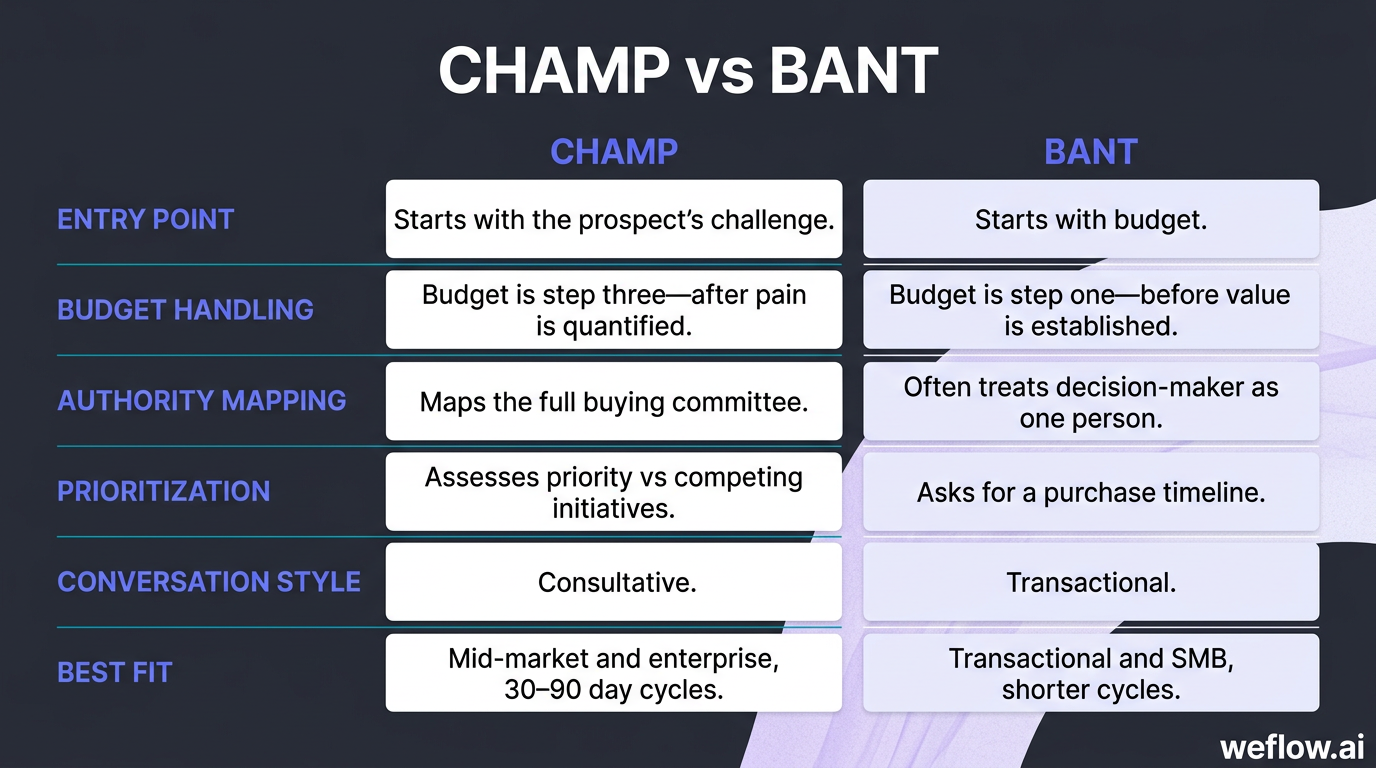
BANT has been the default qualification framework since IBM introduced it decades ago. CHAMP was built to fix what BANT gets wrong in modern B2B sales.
| Dimension | CHAMP approach | BANT approach | Why it matters |
|---|---|---|---|
| Entry point | Starts with the prospect's challenge. | Starts with budget. | Budget-first disqualifies prospects with real pain but no allocated funds. |
| Budget handling | Budget is step three—after pain is quantified, ROI is easier to frame. | Budget is step one—reps ask about money before value is established. | Prospects with urgent pain but no budget will create budget. BANT misses these deals. |
| Authority mapping | Maps the full buying committee: economic buyer, technical evaluator, deal champion. | Identifies the decision-maker, often treated as a single person. | B2B purchases average six to 10 stakeholders. Single-decision-maker assumptions cause late-stage surprises. |
| Timeline vs. prioritization | Assesses priority relative to competing initiatives—not just "when do you want to buy?" | Asks for a purchase timeline, which prospects often give as a polite placeholder. | A stated timeline without organizational priority is unreliable. Prioritization produces more accurate forecasts. |
| Conversation style | Consultative. The rep diagnoses problems before proposing solutions. | Transactional. Can feel like an interrogation if not handled carefully. | Modern buyers expect reps to understand their business before talking product. |
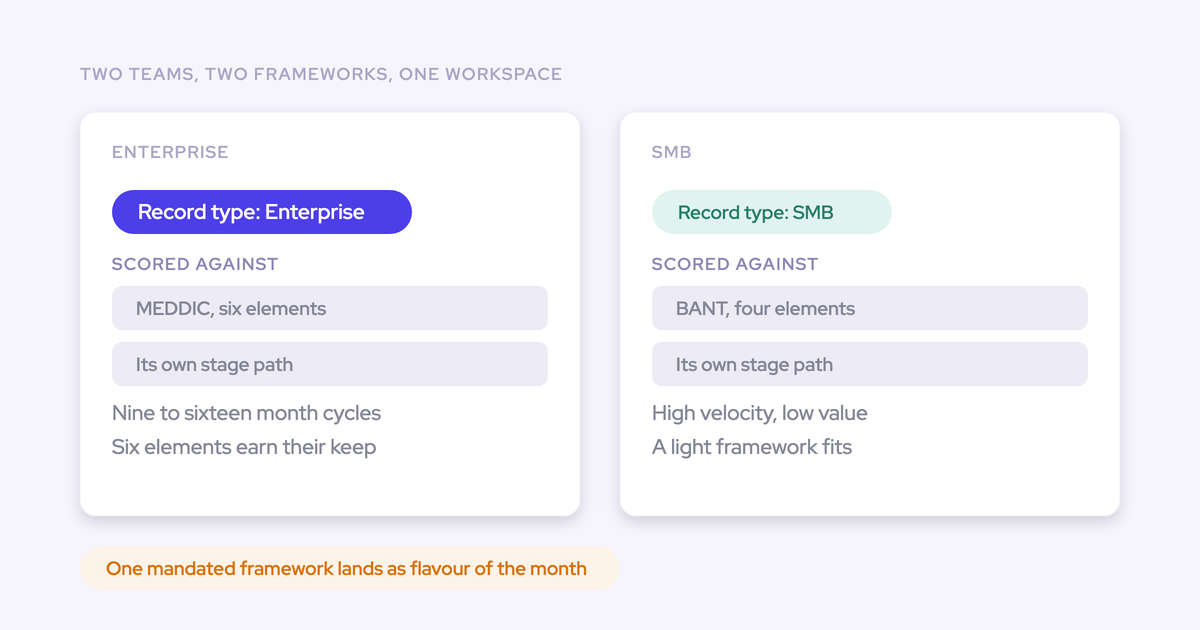
| Best fit | Mid-market and enterprise B2B, 30–90 day cycles, multiple stakeholders. | Transactional and SMB sales, shorter cycles, simpler buying processes. | The right choice depends on deal complexity and cycle length. |
When CHAMP beats BANT: Any environment where prospects don't have pre-allocated budget, buying decisions involve multiple stakeholders, and reps need to build a business case before discussing price. If your average deal involves three or more stakeholders and takes longer than 30 days, CHAMP produces better pipeline quality.
[banner type="download" url="https://www.weflow.ai/resources/cheat-sheets/sales-methodology-cheat-sheet" text="Sales Methodology Cheat Sheet" subtitle="Pick the right framework for your deal size and cycle length, not the one your last VP used" button="Get the cheatsheet"]
When BANT still works: High-volume, transactional sales where budget is a genuine gating factor. A $50/month tool with a single decision-maker and a five-day cycle doesn't need full CHAMP qualification.
The honest answer: use CHAMP for mid-market and enterprise segments, keep BANT for SMB or self-serve motions where speed matters more than depth.
CHAMP qualification in action—a worked example
Here's how a SaaS sales rep qualifies a VP of Sales at a mid-market company (80 reps, three regions) using all four CHAMP steps.
Step 1: Challenges
Rep: "You mentioned forecast accuracy has been a challenge. How far off were your forecasts last quarter?"
Prospect: "We missed our Q3 commit by 18%—about $2.4 million. Reps aren't updating deals consistently, so pipeline data is stale. I'm spending every Friday chasing managers for updates. And our board noticed."
Assessment: Quantified challenge ($2.4M), personal pain ("I'm spending every Friday"), and organizational pressure (board visibility). Strong signal.
Step 2: Authority
Rep: "If you found a solution, what would the buying process look like internally?"
Prospect: "I'd need buy-in from our CRO—she got burned by the forecast miss. Our RevOps director evaluates Salesforce fit. And IT signs off on security."
Rep: "Have you brought in a new tool before?"
Prospect: "I pushed through our Salesforce setup three years ago. I know the process."
Assessment: Three stakeholders identified (CRO, RevOps director, IT). Prospect has driven purchases before and is motivated by board pressure. This is a deal champion.
Step 3: Money
Rep: "Is there budget set aside, or would this be a new request?"
Prospect: "No line item today. But after the Q3 miss, the CRO told me to find a solution. We can pull from the tools budget we didn't use on the Gong expansion we shelved."
Rep: "What range would be comfortable for your team size?"
Prospect: "Under $80K annually and I can get it approved without a full procurement cycle."
Assessment: No pre-allocated budget, but a clear path to funding via the shelved Gong expansion. Budget range volunteered without pressure—positive signal.
Step 4: Prioritization
Rep: "Where does fixing forecast accuracy sit relative to your other priorities?"
[banner type="download" url="https://www.weflow.ai/resources/cheat-sheets/sales-discovery-questions-checklist" text="Sales Discovery Questions Checklist" subtitle="Run discovery calls that surface real pain instead of polite answers" button="Download checklist"]
Prospect: "Top two. Territory redesign wraps up this month—after that, this is the CRO's number-one ask. The board meets in March, so we need to be live by mid-February."
Assessment: High priority with an externally driven deadline (board meeting). Competing initiative resolves soon. Strong qualification across all four CHAMP criteria.
Outcome: Qualified on all four dimensions—$2.4M challenge, three-person buying committee with a champion, budget path under $80K, February deadline. The rep advances to a demo with the RevOps director and CRO.
4 gaps in the CHAMP framework (and how to fix them)
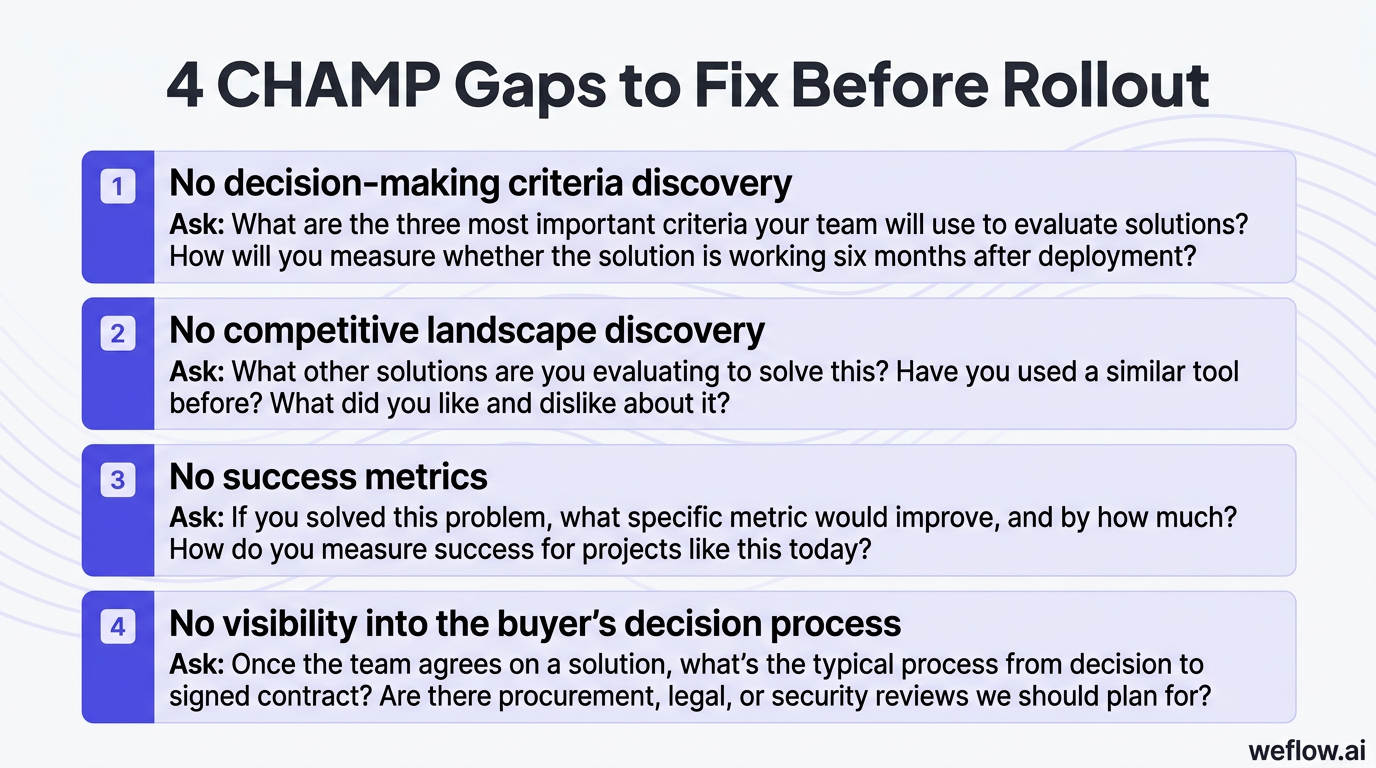
CHAMP is a strong qualification framework, but it has blind spots that can cause qualified deals to stall or lose.
Gap 1: No decision-making criteria discovery
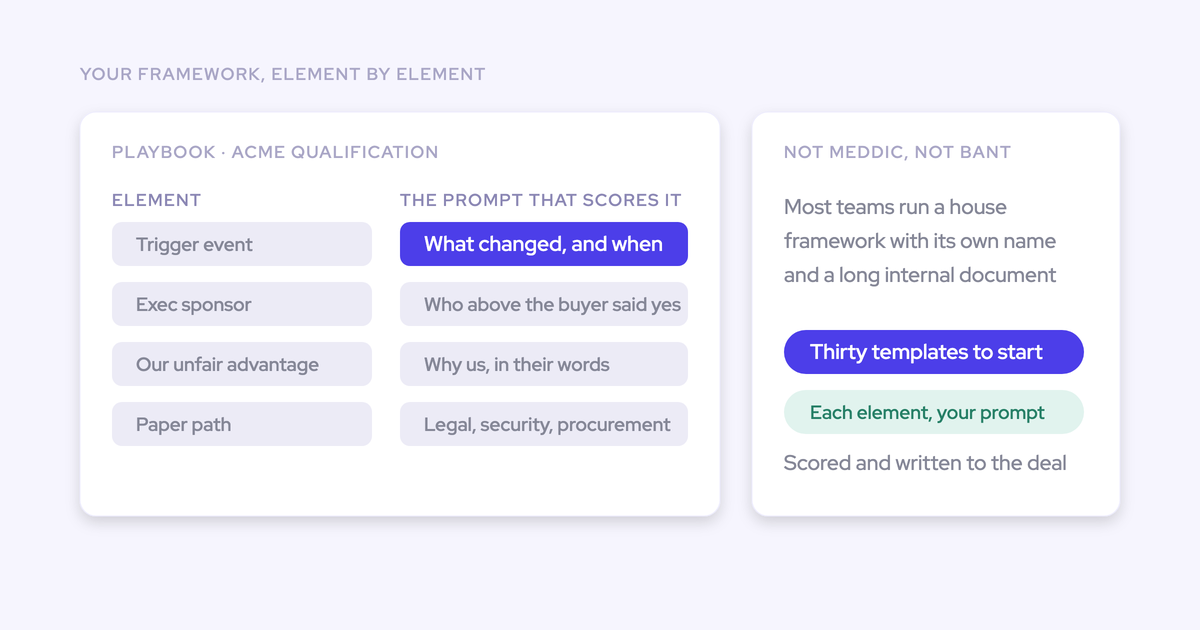
CHAMP tells you who makes the decision but not how they make it. Two companies with identical CHAMP profiles can evaluate using completely different criteria. Without understanding those criteria, you're guessing at what to emphasize.
Gap 2: No competitive landscape discovery
CHAMP doesn't ask what else the prospect is evaluating. Knowing your competition changes your strategy—flying blind makes your pitch generic when it should be targeted.
Gap 3: No success metrics
CHAMP qualifies whether a prospect has a problem and can buy, but it doesn't establish what "success" looks like after implementation. Without agreed-upon success metrics, you can't build a business case or prove value post-close.
Gap 4: No visibility into the buyer's decision process
CHAMP maps who is involved but not how the process unfolds. The gap between "everyone agrees" and "a PO gets issued" can stretch months—legal, procurement, and security reviews create friction CHAMP doesn't account for.
When should you use CHAMP? (and when you shouldn't)
CHAMP is the right fit when:
- Your sales cycle runs 30 to 90 days. CHAMP's depth is valuable in multi-week cycles but overkill for a five-day close.
- You sell to mid-market B2B organizations. Companies with 100 to 2,000 employees typically have buying committees of three to six people and budgets that can be created for the right solution.
- Budget isn't pre-allocated. CHAMP's challenge-first approach builds the business case that creates budget. BANT would disqualify these prospects on the first call.
- Your product solves operational pain. CHAMP excels when the challenge is tangible and quantifiable—lost revenue, wasted time, broken processes.
Consider a different framework when:
- Enterprise deals over $500K with 12+ month cycles: Look at MEDDIC or MEDDPICC. They add metrics, decision criteria, and paper process tracking that CHAMP lacks.
- Transactional sales under 14 days: BANT or a simple lead scoring model is faster when the decision-maker and budget holder are the same person.
- Product-led growth with self-serve conversion: Use product usage signals and scoring models instead—qualification frameworks built for human-led sales don't translate.
Tracking CHAMP qualification in your CRM
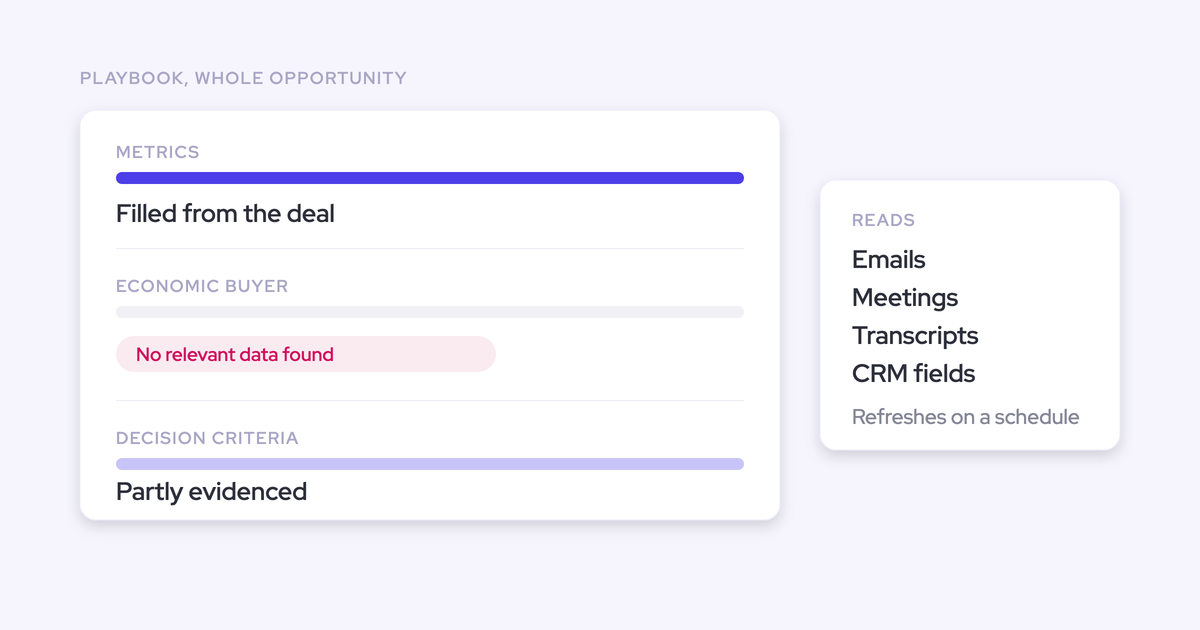
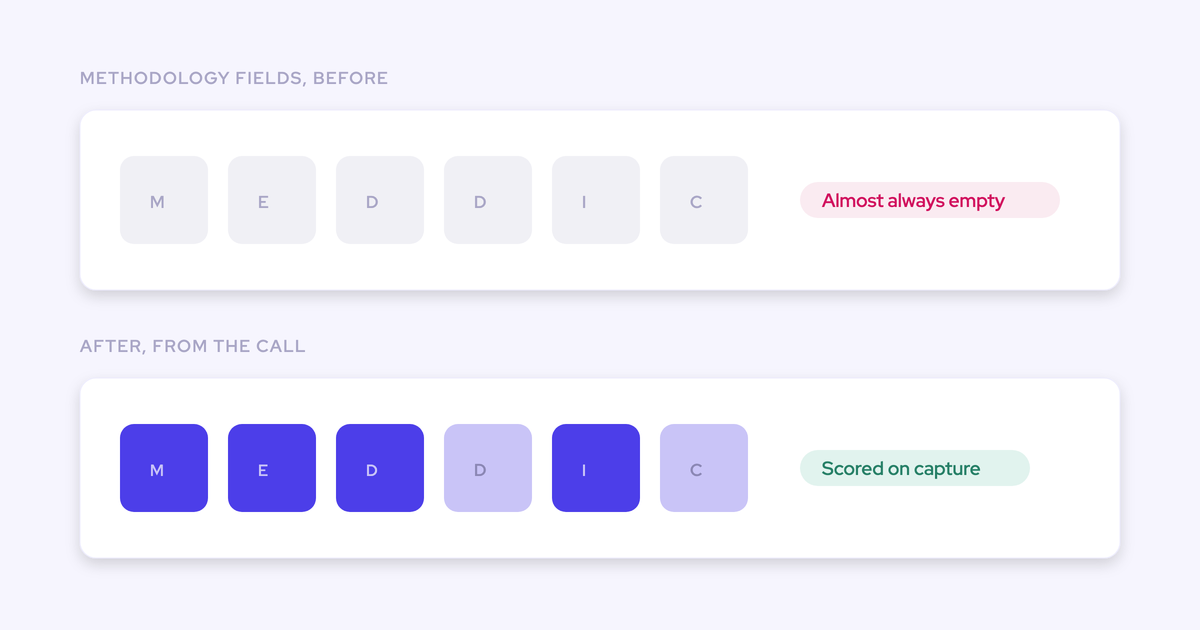
The biggest implementation challenge isn't the framework—it's getting reps to capture qualification data in Salesforce. Most teams create custom Opportunity fields for each CHAMP component, but adoption drops within weeks.
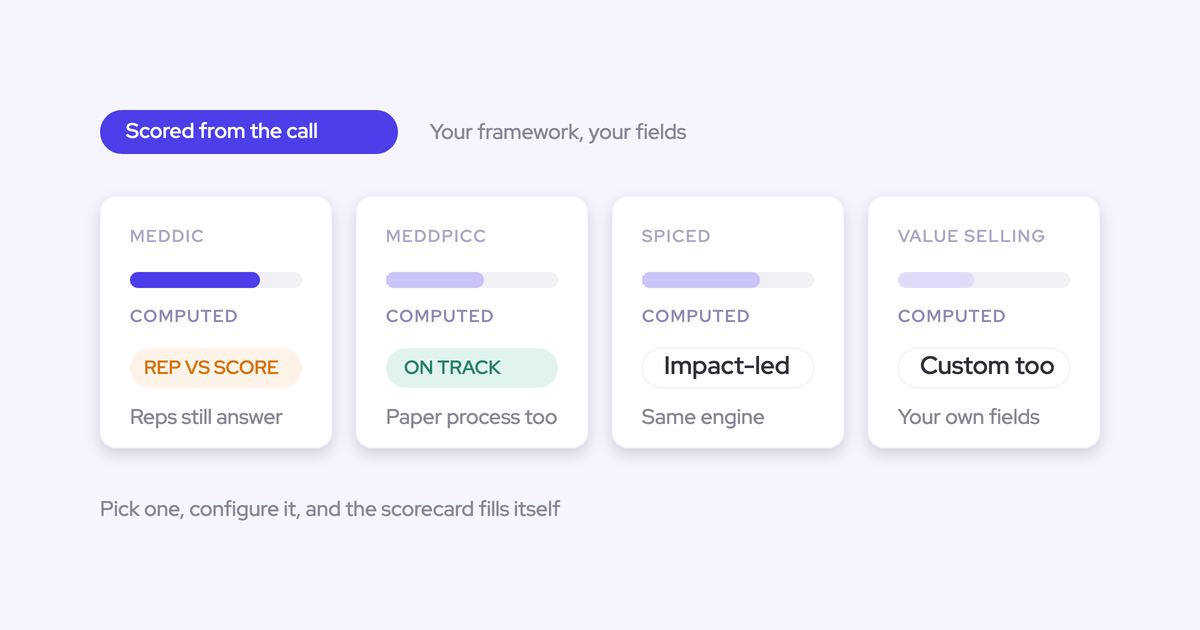
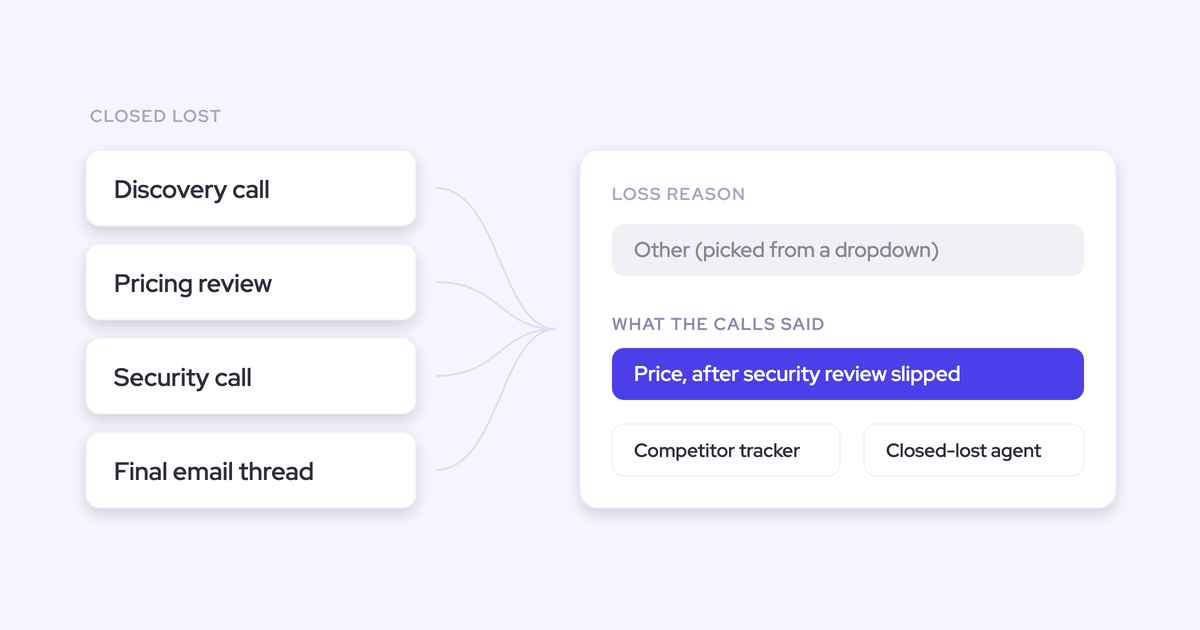
Revenue intelligence tools like Weflow, a Salesforce-native revenue AI platform, solve this by auto-capturing CHAMP data from sales conversations and syncing it to Salesforce. AI extracts qualification signals from call recordings and updates Opportunity fields—giving managers a complete view of pipeline qualification without relying on rep discipline.
Frequently asked questions
What does CHAMP stand for?
Challenges, Authority, Money, and Prioritization. It's a B2B sales qualification framework that prioritizes understanding the prospect's pain before discussing budget or timeline.
How is CHAMP different from BANT?
BANT starts with budget—CHAMP starts with challenges. CHAMP also replaces "Timeline" with "Prioritization," measuring urgency relative to competing initiatives rather than asking for a purchase date.
When should a sales team use CHAMP?
Mid-market B2B sales with 30 to 90 day cycles, multiple stakeholders, and products that solve quantifiable operational pain.
What are the best CHAMP qualification questions?
Focus on questions that quantify pain: "What does this problem cost you?" for Challenges, "Who else would need to sign off?" for Authority, "Has budget been allocated?" for Money, and "Where does this rank against your other priorities?" for Prioritization. See the 23-question reference table above.
Can CHAMP be combined with other methodologies?
Yes—most mature sales teams do this. CHAMP handles early-stage qualification (is this deal worth pursuing?), while MEDDIC or MEDDPICC handles mid-to-late-stage deal management. Use CHAMP to qualify in or out, then layer on MEDDIC for deals that advance past discovery.
What are the main limitations of the CHAMP framework?
Four gaps: no decision-making criteria discovery, no competitive landscape mapping, no success metrics definition, and no visibility into the buyer's procurement process. Each gap can be closed by adding two to three targeted questions to the relevant CHAMP step.
How do you track CHAMP qualification in a CRM?
Most teams create custom Opportunity fields for each CHAMP component. The adoption challenge is getting reps to fill them in. Weflow can automate this by extracting CHAMP signals from recorded conversations and writing data directly to Salesforce—removing the manual entry that kills CRM adoption.
-p-1600.png)

.png)
-p-1600.png)
-p-1600.png)
-p-1600.png)