
MEDDPICC Sales Methodology: Framework, Scorecard, and Implementation Guide
Learn the MEDDPICC framework, score deals with a scorecard, and implement it across your sales team.



.png)

What is MEDDPICC? Definition, acronym breakdown, and how it works
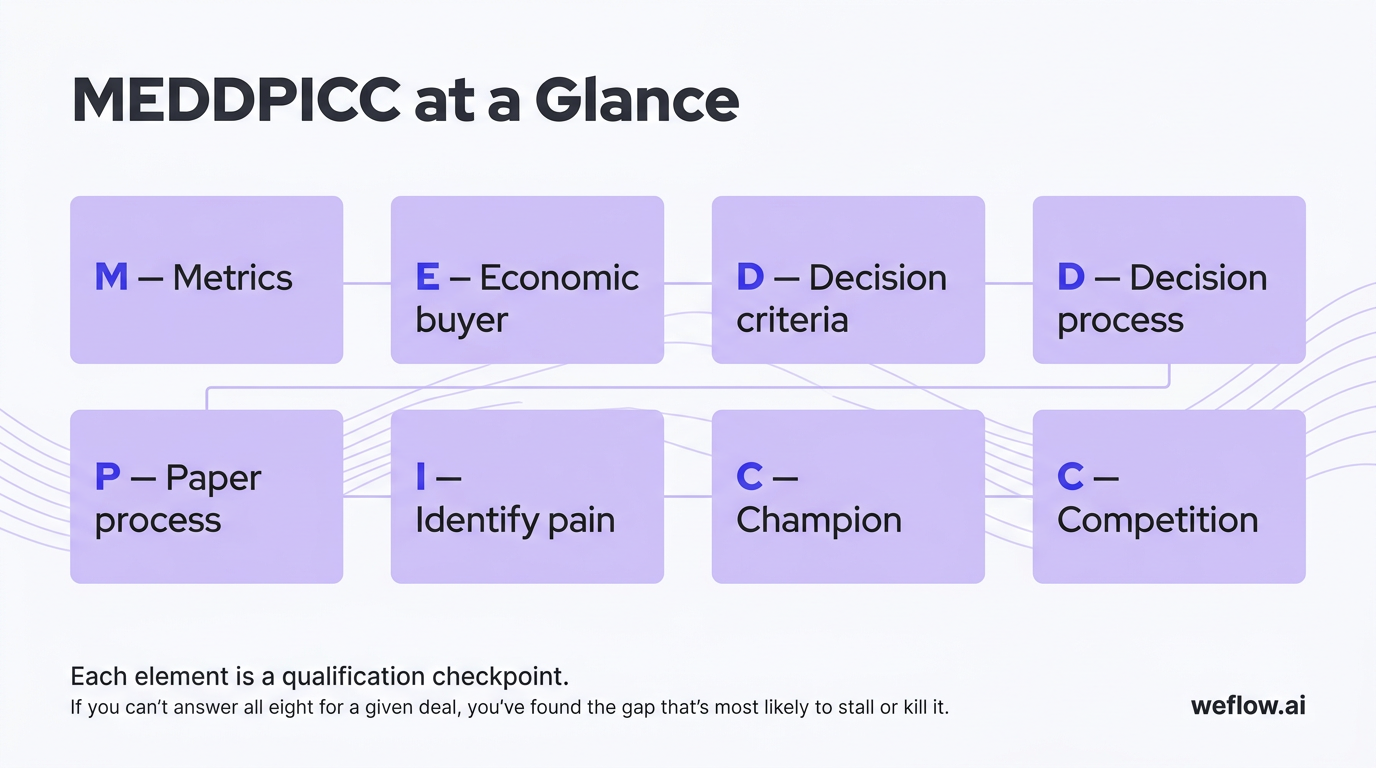
MEDDPICC is a B2B sales qualification framework that gives reps and managers a repeatable method for evaluating whether a deal is real, winnable, and worth pursuing. It breaks every opportunity into eight criteria—metrics, economic buyer, decision criteria, decision process, paper process, identify pain, champion, and competition—so teams can spot gaps early and focus pipeline time on deals that close.
Here’s what each letter stands for:
| Letter | Element | Definition |
|---|---|---|
| M | Metrics | The quantifiable business outcomes your solution delivers—revenue gained, costs reduced, time saved |
| E | Economic buyer | The person with discretionary budget authority who can approve or kill the deal |
| D | Decision criteria | The technical, financial, and vendor requirements the buyer uses to evaluate options |
| D | Decision process | The sequence of steps, stakeholders, and approvals the buyer follows to make a purchase |
| P | Paper process | The legal, procurement, and security review steps required to get a contract signed |
| I | Identify pain | The specific business problem driving urgency, plus the cost of doing nothing |
| C | Champion | An internal advocate with influence and a personal stake in your solution winning |
| C | Competition | Every alternative the buyer considers—other vendors, internal solutions, or staying with the status quo |
Each element functions as a qualification checkpoint. If you can’t answer all eight for a given deal, you’ve found the gap that’s most likely to stall or kill it.
MEDDIC vs MEDDPICC: what changed and why it matters
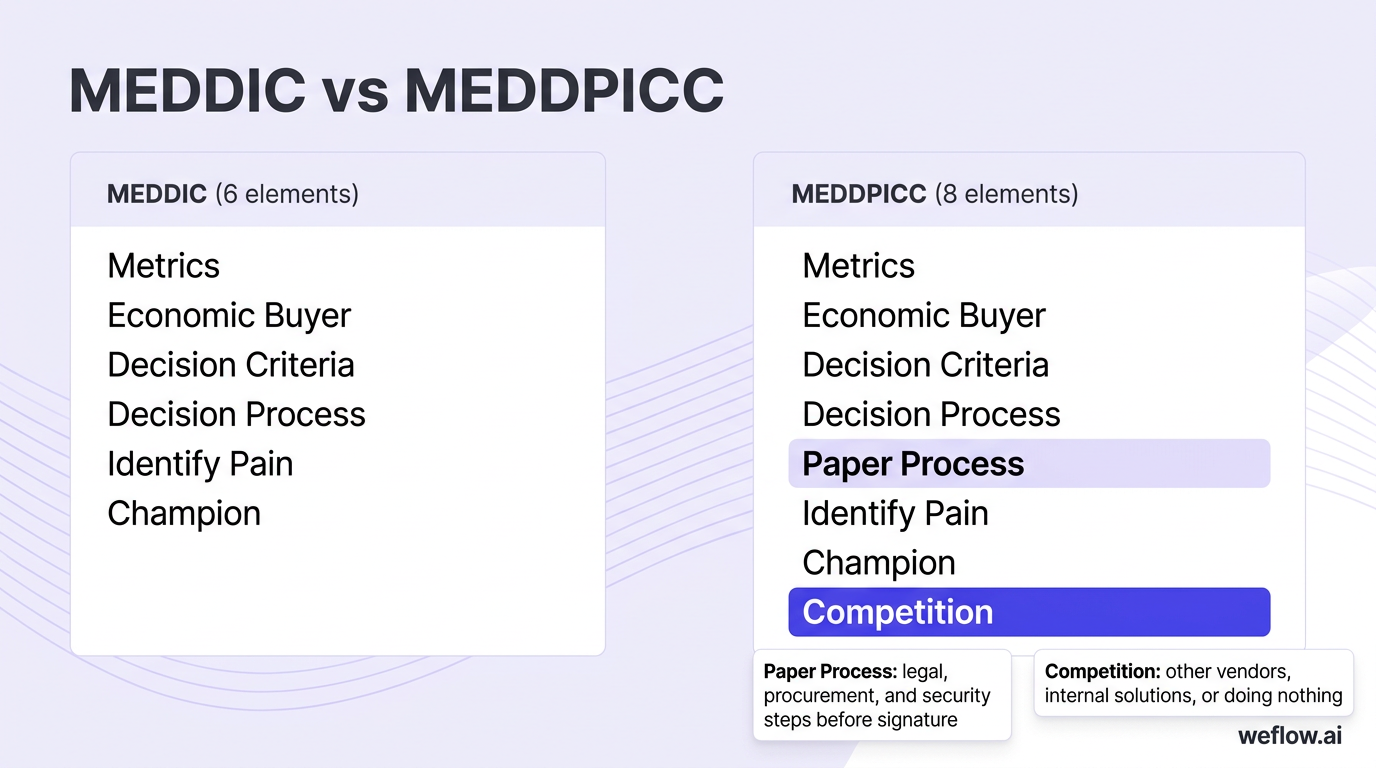
MEDDPICC builds on the original MEDDIC framework, developed at PTC in the mid-1990s by Jack Napoli and Dick Dunkel. MEDDIC helped PTC grow annual sales from $300 million to over $1 billion by giving the sales team a shared language for qualification. The original six elements—Metrics, Economic Buyer, Decision Criteria, Decision Process, Identify Pain, and Champion—covered the core of enterprise deal qualification.
Two additions turned MEDDIC into MEDDPICC:
| Framework | Elements |
|---|---|
| MEDDIC (6 elements) | Metrics, Economic Buyer, Decision Criteria, Decision Process, Identify Pain, Champion |
| MEDDPICC (8 elements) | Metrics, Economic Buyer, Decision Criteria, Decision Process, Paper Process, Identify Pain, Champion, Competition |
Why Paper Process was added: Enterprise deals don’t stall because a buyer says no—they stall because legal redlines the MSA, procurement adds a 30-day review cycle, or security sends a 200-question questionnaire nobody anticipated. Paper Process forces reps to map every post-verbal-yes step before committing a close date. Teams that track it report 15-25% fewer deals slipping from one quarter to the next.
Why Competition was added: Buyers in the 2020s rarely evaluate your solution in isolation. They’re comparing you against two or three vendors, an internal build option, and the default choice of doing nothing. The Competition element ensures reps understand what they’re up against, position against each alternative’s strengths, and prepare for objections they’ll face in the decision process. Without it, reps lose deals to competitors they didn’t know existed until the loss notice email.
Why use MEDDPICC? Key benefits for sales teams
MEDDPICC isn’t a theory exercise—it’s a pipeline hygiene tool. Teams that adopt it consistently see measurable improvements across five areas:
- Improved forecast accuracy: When every deal is scored against eight criteria, commit calls become data-driven instead of opinion-based. Organizations using structured qualification frameworks report forecast accuracy within 10% of actual, compared to 25-40% variance without one.
- Higher win rates: Reps who qualify rigorously spend time on deals they can win. Teams using MEDDPICC often see win rates increase by 15-30% within two quarters because they stop investing in deals missing critical elements like an identified champion or confirmed economic buyer.
- Shorter sales cycles: Knowing the decision process and paper process upfront eliminates late-stage surprises. Instead of discovering a 45-day security review in week 11, you plan for it in week 3. Average cycle reductions of 10-20% are typical.
- Larger average contract value: Metrics-led selling connects your solution to quantified business outcomes. When a rep walks into a negotiation with “$2.4M in projected pipeline recovery” instead of “our tool is great,” buyers anchor on the value, not the cost. Average deal sizes grow because pricing conversations happen in the context of ROI.
- Reduced deal slippage: The two most common reasons deals slip quarters—unknown procurement steps and weak champions—are explicit checkpoints in MEDDPICC. Teams that score Paper Process and Champion on every deal cut quarter-end slippage by 20-35%.
How to apply each step of the MEDDPICC framework (with questions)
What are metrics in MEDDPICC? Quantifying economic value for prospects
Metrics are the quantifiable business outcomes your solution delivers for the buyer. They turn a feature conversation into a financial one. The goal is to tie your solution to numbers the economic buyer already tracks—revenue, cost, time, risk.
Example: A mid-market SaaS company loses $1.8M annually because reps spend 8 hours per week on manual CRM updates instead of selling. Your solution automates that work, recovering 6 of those 8 hours. That’s $1.35M in recovered selling time—a metric the CRO can take to the CFO.
Discovery questions for metrics:
- What’s the cost of this problem on a monthly or quarterly basis?
- How do you measure success for this initiative internally?
- What KPIs does your executive team track that this project affects?
- If you solved this problem, what would the impact look like in 12 months?
- What’s the cost per rep-hour of the manual work you’re trying to eliminate?
- Have you built a business case yet, and what numbers are in it?
How to identify the economic buyer in MEDDPICC
The economic buyer is the person with discretionary budget authority—they can approve the purchase without needing someone else’s sign-off on the money. This isn’t always the most senior person involved; it’s the one who controls the budget line your deal draws from.
Tactical steps to find the economic buyer:
- LinkedIn and org charts: Look for VP-level or above titles in the department your solution serves. Cross-reference with the company’s annual report or press releases for budget ownership clues.
- ZoomInfo or similar tools: Use org chart data to map reporting structures. The economic buyer typically sits one or two levels above your day-to-day contact.
- Direct ask: In discovery, ask: “Who signs off on the budget for this project?” Don’t dance around it. Experienced buyers expect the question.
- Champion confirmation: Your champion should confirm who the economic buyer is and, ideally, facilitate an introduction.
Discovery questions for economic buyer:
- Who has final sign-off on the budget for this initiative?
- Has this person approved similar purchases in the past 12 months?
- What does their evaluation process look like—do they review proposals directly or delegate?
- Can we get 15 minutes with them before the proposal stage?
- Is there a budget allocated for this project, or does it need to be created?
MEDDPICC decision criteria: understanding what drives the buying decision
Decision criteria are the specific requirements the buyer uses to evaluate and compare solutions. They typically fall into three categories:
- Technical requirements: Integrations, security certifications, scalability, deployment model (cloud vs. on-premise), specific feature capabilities
- Financial requirements: Total cost of ownership, ROI timeline, pricing model (per-seat, platform fee, usage-based), budget constraints
- Vendor requirements: Company size, customer references in the buyer’s industry, support SLAs, implementation track record, data residency
Your job isn’t just to learn the criteria—it’s to influence them. If a criterion favors a competitor, you need to reframe the evaluation or add criteria where you win.
Discovery questions for decision criteria:
- What are the must-have requirements versus nice-to-haves for this evaluation?
- Who defined the evaluation criteria, and are they final?
- How heavily does pricing factor relative to capability?
- Are there specific security or compliance requirements (SOC 2, GDPR, HIPAA) that are non-negotiable?
- Have you built a scoring matrix, and can we see the categories?
How to map the decision process in enterprise sales
The decision process is the sequence of steps, stakeholders, and approvals the buyer follows from “we’re evaluating” to “we’ve chosen a vendor.” It answers three questions: who’s involved, what are the stages, and what’s the timeline.
In enterprise sales, this process is rarely linear. A typical B2B decision process might look like:
[banner type="download" url="https://www.weflow.ai/resources/cheat-sheets/meddpicc-sales-process-checklist" text="MEDDPICC Sales Process Checklist" subtitle="Score every deal in your pipeline before it lands in commit" button="Download checklist"]
- Initial evaluation by the project team (2-3 weeks)
- Technical proof of concept or pilot (3-4 weeks)
- Business case presentation to the economic buyer (1 week)
- Vendor selection committee review (1-2 weeks)
- Final approval and handoff to procurement
Mapping this early prevents the “just one more meeting” trap where deals drift because you didn’t know about step 4.
Discovery questions for decision process:
- Can you walk me through the steps between now and a signed contract?
- Who else needs to evaluate or approve this purchase?
- Is there a formal vendor selection committee, and who sits on it?
- What’s your target date for having a solution in place, and are there dependencies driving that date?
- Have you been through a similar buying process recently? How long did it take?
What is the paper process in MEDDPICC? (And why deals stall without it)
The paper process covers everything between “we picked you” and “the contract is signed.” That gap—often 3 to 8 weeks in enterprise sales—is where deals die quietly. It includes:
- Legal review: MSA redlines, liability caps, indemnification clauses, data processing agreements
- Procurement: Vendor onboarding forms, purchase order creation, payment terms negotiation, preferred vendor list requirements
- Security review: SOC 2 report review, penetration test results, data residency questionnaire, SSO/SAML requirements
- Finance: Budget allocation confirmation, multi-year discount approval, invoice routing setup
Reps who don’t ask about paper process until the “verbal yes” discover these steps too late to hit their close date. The fix: ask about it during discovery, not during negotiation.
Discovery questions for paper process:
- What does your legal and procurement process look like for a purchase of this size?
- How long does legal review typically take for new vendor agreements?
- Is there a security review process, and do you need a SOC 2 report or completed security questionnaire upfront?
- Who in procurement should I contact early so we’re not waiting on paperwork after you’ve made a decision?
- Are there any fiscal year deadlines that affect when the PO needs to be issued?
How to identify pain in MEDDPICC and quantify its business impact
Identify Pain means finding the specific business problem that creates urgency—and then attaching a dollar amount to it. Pain without a number is just a complaint. Pain with a number is a business case.
The two-part formula:
- Find the problem: What’s broken, slow, or missing?
- Quantify the cost of inaction: What does it cost to leave the problem unsolved for another 6-12 months?
Here’s the difference between a weak and strong pain angle:
| Approach | Weak angle | Strong angle |
|---|---|---|
| Problem statement | “Our CRM data isn’t great” | “42% of opportunity records are missing next steps, causing reps to drop follow-ups” |
| Impact framing | “We need better data” | “Incomplete pipeline data led to a $3.2M forecast miss last quarter” |
| Urgency driver | “We should fix this soon” | “The board reviews forecast accuracy next quarter—we need this solved by Q3” |
Discovery questions for Identify Pain:
- What’s the business problem that started this evaluation?
- How long has this problem existed, and what’s changed to make it urgent now?
- What does this problem cost you on a quarterly basis—in revenue, time, or headcount?
- What happens if you don’t solve this in the next 6 months?
- Who else in the organization feels the impact of this problem?
How to find and develop a champion in the MEDDPICC framework
A champion is an internal advocate inside the buyer’s organization who has influence over the decision and a personal stake in your solution winning. “Personal stake” is the key differentiator—a friendly contact who likes your product but doesn’t benefit personally from its success isn’t a champion. They’re a coach at best.
What a strong champion provides:
- Access to the economic buyer and other decision-makers
- Inside information on the decision criteria, competitive landscape, and internal politics
- Active selling on your behalf in meetings you’re not in
- Early warnings when the deal stalls, a competitor gains traction, or priorities shift
- Help building the internal business case with language that resonates with their leadership
Champions aren’t found—they’re developed. You build a champion by making them look good: giving them data, talking points, and business cases they can present internally as their own work.
Assessment questions for champion:
- Does this person have a personal stake in solving this problem (promotion, performance review, project ownership)?
- Can they get us a meeting with the economic buyer?
- Do they have influence over the evaluation criteria, or are they implementing someone else’s decision?
- Are they willing to share internal objections and competitive intelligence with us?
- Have they gone to bat for a vendor before in a similar process?
Competitive analysis in MEDDPICC: positioning against alternatives
Competition in MEDDPICC isn’t just about other vendors—it covers every alternative the buyer considers. That falls into three categories:
- Other vendors: Direct competitors being evaluated alongside you. These are the names on the shortlist.
- Internal solutions: The buyer’s own IT or engineering team building something in-house. This is common in organizations with strong technical teams who believe they can replicate your core functionality.
- “Do nothing”: The status quo. This is the most dangerous competitor because it requires zero budget, zero change management, and zero risk. Beating “do nothing” requires proving the cost of inaction exceeds the cost of change.
Tactical steps for competitive positioning:
- Ask your champion which alternatives are being evaluated and who’s sponsoring each
- Build a comparison matrix showing where you win and where competitors are stronger—be honest about tradeoffs
- Prepare objection responses for each competitor’s top 2-3 talking points
- Identify the evaluation criteria where you’re weakest and either reframe the criteria or mitigate with proof points
- Monitor for signs the buyer is leaning toward “do nothing”—decreasing urgency, delayed timelines, or the economic buyer going quiet
Discovery questions for competition:
- Who else is on the shortlist for this evaluation?
- Has anyone internally proposed building a solution instead of buying one?
- What would need to be true for you to decide not to make a change at all?
- Where do you see us versus the other options you’re evaluating?
MEDDPICC scorecard: how to score and track deal qualification
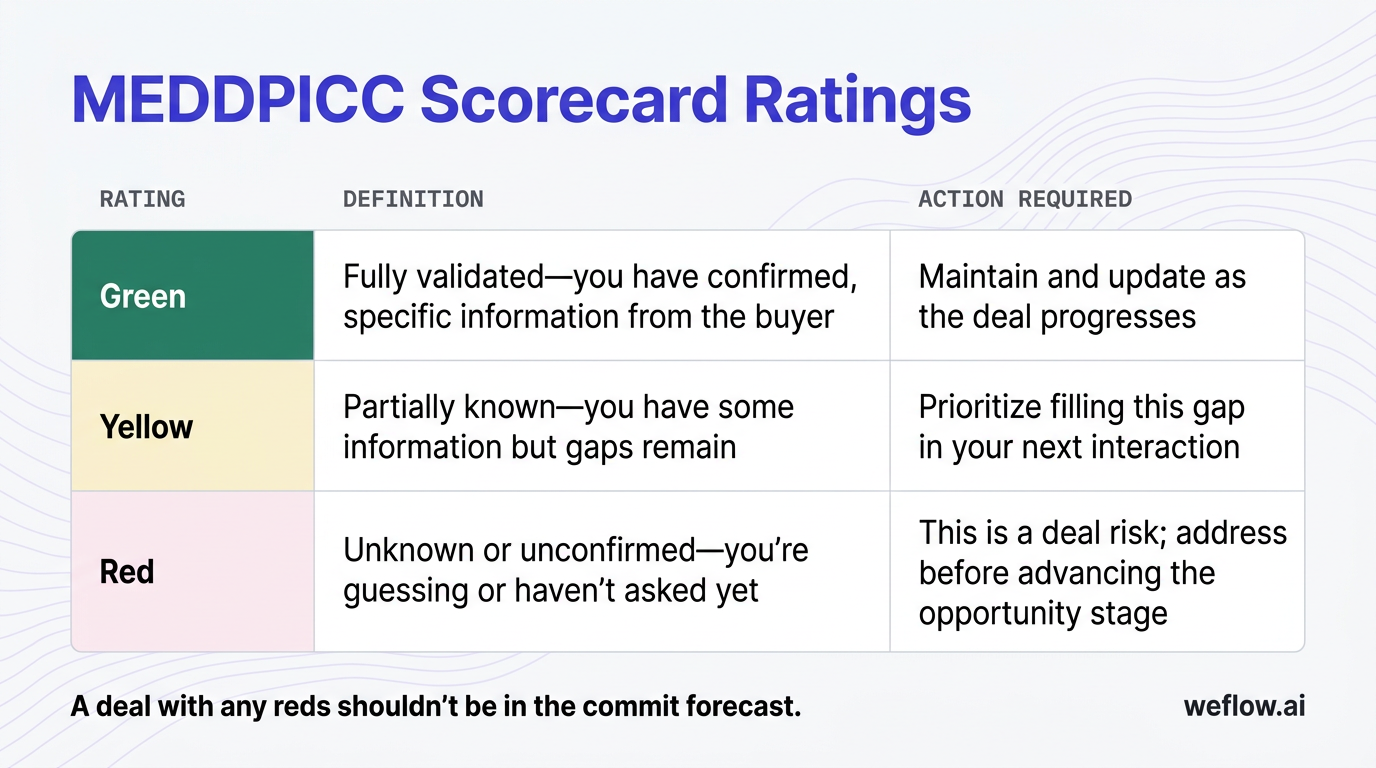
A MEDDPICC scorecard assigns a Red, Yellow, or Green rating to each of the eight criteria for every deal in your pipeline. The scorecard turns subjective “I think this deal is solid” into a visible, auditable qualification status that managers and reps can review together.
[banner type="download" url="https://www.weflow.ai/resources/cheat-sheets/sales-methodology-cheat-sheet" text="Sales Methodology Cheat Sheet" subtitle="Operationalize MEDDPICC in Salesforce without a six-month rollout" button="Get the cheat sheet"]
Here’s how the scoring model works:
| Rating | Definition | Action required |
|---|---|---|
| Green | Fully validated—you have confirmed, specific information from the buyer | Maintain and update as the deal progresses |
| Yellow | Partially known—you have some information but gaps remain | Prioritize filling this gap in your next interaction |
| Red | Unknown or unconfirmed—you’re guessing or haven’t asked yet | This is a deal risk; address before advancing the opportunity stage |
Here’s an example scorecard for a deal in Stage 3:
| Element | Rating | Notes |
|---|---|---|
| Metrics | Green | Buyer confirmed $1.2M annual cost of manual data entry; ROI model shared |
| Economic buyer | Green | VP Revenue Operations; met during week 2, confirmed budget authority |
| Decision criteria | Yellow | Technical requirements confirmed; financial criteria still being defined |
| Decision process | Yellow | Know the evaluation stages; vendor selection committee membership unclear |
| Paper process | Red | Haven’t asked about legal or procurement timelines yet |
| Identify pain | Green | Quantified: 35% of opportunities missing activity data, causing $3.2M forecast miss |
| Champion | Yellow | Director of Sales Ops is engaged and sharing info, but hasn’t introduced us to the EB yet |
| Competition | Red | Know they’re evaluating at least one other vendor; don’t know who or where we stand |
This deal has two reds—Paper Process and Competition—which means it shouldn’t be in a commit forecast until those gaps are closed.
CRM integration: Most teams implement MEDDPICC scorecards as custom fields on the Salesforce Opportunity object. Create a picklist field for each element (Red/Yellow/Green) and a long text field for notes. Add these to your opportunity page layout and make them required for stage progression past Stage 2 or 3. This gives managers pipeline-level visibility into qualification health without relying on rep updates during forecast calls.
How to implement MEDDPICC across your sales team
Rolling out MEDDPICC isn’t a one-day training event—it’s a behavior change that takes two to three quarters to fully embed. Here’s how to structure the implementation:
CRM setup
Build the infrastructure before you train anyone:
- Create eight picklist fields (one per MEDDPICC element) on the Opportunity object with Red/Yellow/Green values
- Add a long text field for each element to capture notes and evidence
- Configure validation rules to require MEDDPICC fields before advancing past Stage 2
- Build a dashboard showing MEDDPICC score distribution across the pipeline (how many deals have reds, by element)
Training program
- Start with a 90-minute workshop covering each element, real deal examples, and scoring criteria
- Follow with role-play sessions where reps practice discovery questions for each MEDDPICC element
- Provide a one-page reference card reps can use during calls
- Record training sessions for onboarding new hires
Coaching cadences
- Weekly 1:1s between managers and reps should include a MEDDPICC review of the rep’s top 3-5 deals
- Focus on the reds: “What’s your plan to turn this red into a yellow this week?”
- Track coaching conversations to identify patterns—if 60% of your team has Paper Process as a red, that’s a training gap, not an individual performance issue
Deal review structure
- Replace unstructured pipeline reviews with MEDDPICC-based deal reviews
- Every deal in the commit forecast must have zero reds and no more than two yellows
- Use the scorecard as the agenda for weekly deal reviews—walk through each element instead of asking “how’s this deal looking?”
Rollout timeline
- Weeks 1-2: CRM setup—build fields, dashboards, and validation rules. Get RevOps sign-off on the scoring definitions.
- Week 3: Training sessions—run the initial workshop for all reps and managers. Distribute the reference card.
- Week 4: Pilot phase—have managers and reps score their current pipeline using MEDDPICC. Identify common confusion points.
- Weeks 5-6: Coaching launch—begin weekly MEDDPICC-focused 1:1s. Run the first MEDDPICC-based pipeline review with each team.
- Weeks 7-8: Refinement—adjust scoring criteria based on team feedback. Update validation rules if they’re causing friction.
- Ongoing: Monthly reviews of MEDDPICC adoption metrics—field completion rates, scorecard accuracy versus outcomes, and deal progression patterns.
Expect the first quarter to feel uncomfortable. Reps will push back on the extra fields, and scorecards will be inconsistent. By the end of quarter two, teams that stick with it report that MEDDPICC becomes the default language for deal conversations—reps start using it without prompting.
MEDDPICC training and certification options
Formal training programs can accelerate adoption, but they’re not required to run MEDDPICC effectively.
External certification programs:
- MEDDICC.com: Offers structured certification courses for individual reps and team-wide programs. Their training covers the full MEDDPICC framework with practical exercises, deal application, and assessment. This is the most recognized certification in the space.
- MEDDIC Academy: Provides online courses and workshops focused on MEDDIC and MEDDPICC methodology. Useful for teams that want self-paced learning combined with instructor-led sessions.
Self-implementation approach: Many sales organizations implement MEDDPICC without external training by assigning a RevOps or enablement lead to build internal materials—scoring rubrics, discovery question banks, deal review templates, and coaching guides. This works well when you have experienced sales leaders who already understand qualification frameworks and can train their teams through pipeline reviews and coaching cadences. The tradeoff: slower initial adoption but lower cost and materials tailored to your specific sales process.
Frequently asked questions
What does MEDDPICC stand for?
MEDDPICC stands for Metrics, Economic Buyer, Decision Criteria, Decision Process, Paper Process, Identify Pain, Champion, and Competition. Each letter represents a qualification criterion that sales reps use to evaluate deal health and readiness to close.
What is the difference between MEDDIC and MEDDPICC?
MEDDIC has six elements; MEDDPICC adds two—Paper Process and Competition. Paper Process covers the legal, procurement, and security steps after a buyer says yes. Competition ensures reps track every alternative, including vendors, internal builds, and the status quo.
When should a sales team use MEDDPICC instead of MEDDIC?
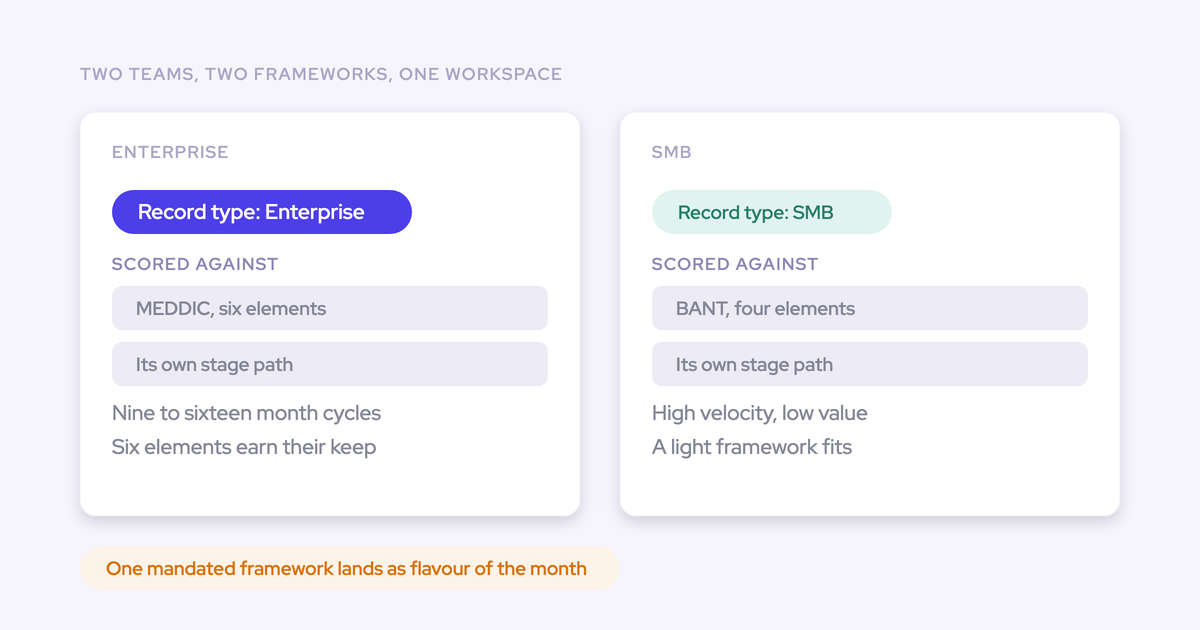
Use MEDDPICC when your sales cycle involves complex procurement, legal reviews, or competitive evaluations—which describes most enterprise B2B deals. If your average deal closes in under 30 days with a single decision-maker, MEDDIC’s six elements may be enough. For deals above $50K with multiple stakeholders, MEDDPICC’s additions pay for themselves in reduced slippage.
How do you identify the economic buyer in MEDDPICC?
Ask directly: “Who has final budget authority for this purchase?” Cross-reference with LinkedIn org charts and tools like ZoomInfo to confirm reporting structure. Your champion should validate who the economic buyer is and ideally introduce you before the proposal stage.
What is a champion in the MEDDPICC framework?
A champion is an internal advocate who has influence in the buying organization and a personal stake in your solution winning. They sell on your behalf in internal meetings, share competitive intelligence, and warn you when the deal is at risk. A friendly contact without personal motivation to see you win is a coach, not a champion.
How do you score deals using a MEDDPICC scorecard?
Assign each of the eight criteria a Red (unknown), Yellow (partially validated), or Green (fully confirmed) rating. Most teams implement this as picklist fields on the Salesforce Opportunity object. A deal with any reds shouldn’t be in the commit forecast—it has unresolved qualification gaps that could kill or delay the close.
Is MEDDPICC only for enterprise sales?
No, but it delivers the most value in complex B2B sales with multiple stakeholders, long sales cycles, and formal procurement processes. Mid-market deals with 60+ day cycles and two or more decision-makers benefit from MEDDPICC. For transactional sales with short cycles and single buyers, a lighter framework works better.
How long does it take to implement MEDDPICC across a sales team?
CRM setup and initial training take four to six weeks. Full behavioral adoption—where reps use MEDDPICC without prompting and scorecards are consistently accurate—takes two to three quarters. The biggest variable is coaching consistency: teams with managers who review MEDDPICC in every 1:1 adopt faster than teams that treat it as a one-time training event.
-p-1600.png)

.png)
-p-1600.png)
-p-1600.png)
-p-1600.png)