
Sales Qualification: Frameworks, Questions, and Process
Learn which sales qualification framework fits, what questions to ask, and how the process works.




Sales qualification separates interested leads from actual buyers — so your reps stop wasting cycles on deals that will never close. When qualification works, pipeline accuracy improves, forecast confidence increases, and reps spend time on opportunities that convert. When it doesn't, you're left with bloated pipelines, missed forecasts, and burned quota capacity.
What is sales qualification? (Definition and core criteria)
Sales qualification is the process of evaluating whether a prospect has the need, budget, authority, and timeline to buy your product. It's how sales teams separate tire-kickers from real buyers and prioritize deals that will actually close.
Every qualification framework — BANT, MEDDIC, CHAMP, or otherwise — evaluates some combination of five core criteria:
- Reason to buy: Does the prospect have a clear problem your product solves? No pain, no sale.
- Purchase timeline: Is there a defined event, deadline, or initiative driving a decision? Open-ended timelines signal low urgency.
- Budget: Does the prospect have allocated budget, or a realistic path to secure it?
- Authority: Are you talking to someone who can sign, or who can influence the signer?
- Mutual fit: Does the prospect fit your ideal customer profile? Even qualified buyers can be bad fits if they're outside your ICP.
Weak qualification happens when reps check one or two criteria and call it done. Strong qualification validates all five before advancing a deal to pipeline.
Why sales qualification matters for pipeline efficiency
Qualification is the filter that determines pipeline quality. Without it, reps chase deals that stall, forecasts miss, and RevOps spends more time cleaning data than enabling growth.
Here's what changes when qualification works:
| Benefit | Why it happens |
|---|---|
| Higher win rates | Reps focus on deals with real buying intent, not just interest |
| Shorter sales cycles | Qualified deals move faster because blockers are identified early |
| More accurate forecasts | Pipeline reflects reality, not optimism — fewer surprises at quarter end |
| Better rep productivity | Less time on dead-end deals means more time on winnable ones |
| Reduced cost per opportunity | Marketing and sales resources go toward prospects who can actually buy |
| Improved forecast confidence | Leadership can trust commit numbers because qualification is consistent |
The data backs this up: companies that excel at lead nurturing generate 50% more sales-ready leads at 33% lower cost (Forrester). That starts with qualification — knowing which leads are worth nurturing in the first place.
What makes a prospect qualified? (MQL vs. SQL vs. PQL)
Not all qualified leads are the same. The type of qualification determines who owns the lead and what happens next.
| Lead type | Definition | When it applies |
|---|---|---|
| MQL (Marketing Qualified Lead) | A lead that meets marketing's criteria for engagement — typically based on content downloads, webinar attendance, or form fills | Early-stage interest; lead hasn't spoken with sales yet |
| SQL (Sales Qualified Lead) | A lead that sales has validated as having real buying potential based on a conversation or discovery call | After initial sales contact; lead meets qualification criteria (pain, budget, authority, timeline) |
| PQL (Product Qualified Lead) | A lead that has used your product (free trial, freemium) and demonstrated buying intent through usage behavior | Product-led growth models; user has hit activation milestones or usage thresholds |
| CQL (Conversation Qualified Lead) | A lead qualified through a live conversation — chatbot, live chat, or phone — where intent was confirmed in real time | Inbound request; lead asked to speak with sales or requested a demo |
The handoff between MQL and SQL is where most qualification breaks down. Marketing passes leads that sales rejects as unqualified, or sales ignores leads that actually had potential. Clear qualification criteria — agreed upon by both teams — solve this.
3 levels of sales qualification: organization, opportunity, and stakeholder
Qualification happens at three levels. Skipping any one of them creates blind spots that stall deals or lead to losses.
| Level | What you're checking | Key questions |
|---|---|---|
| Organization | Does this company fit your ICP? | Right industry? Right size? Right tech stack? Right geography? |
| Opportunity | Is there a real deal here? | Is there a problem to solve? Budget to solve it? Timeline to act? |
| Stakeholder | Are you talking to the right people? | Who decides? Who influences? Who can block? Who signs? |
Organization-level qualification
Before spending time on a prospect, verify they match your ideal customer profile. This means company size, industry, geography, and tech stack. A prospect who's a perfect opportunity fit but operates in a segment you don't serve is still a bad lead.
Organization qualification typically happens before the first call — based on firmographic data, enrichment tools, or self-reported information from forms.
Opportunity-level qualification
This is where most qualification frameworks (BANT, MEDDIC, CHAMP) focus. You're validating that there's a real deal: a problem worth solving, budget to solve it, and urgency to act. Without all three, the opportunity isn't real — it's a conversation that won't convert.
Opportunity qualification happens during discovery. The questions you ask here determine whether this deal moves forward or stalls.
Stakeholder-level qualification
Even a real opportunity can die if you're not engaged with the right people. Stakeholder qualification maps the buying committee: who's the economic buyer, who's the champion, who's the evaluator, who can veto.
Enterprise deals fail more often because of stakeholder gaps than product gaps. Knowing who's in the room — and who isn't — is the difference between a closed deal and a surprise loss.
How the sales qualification process works (step by step)
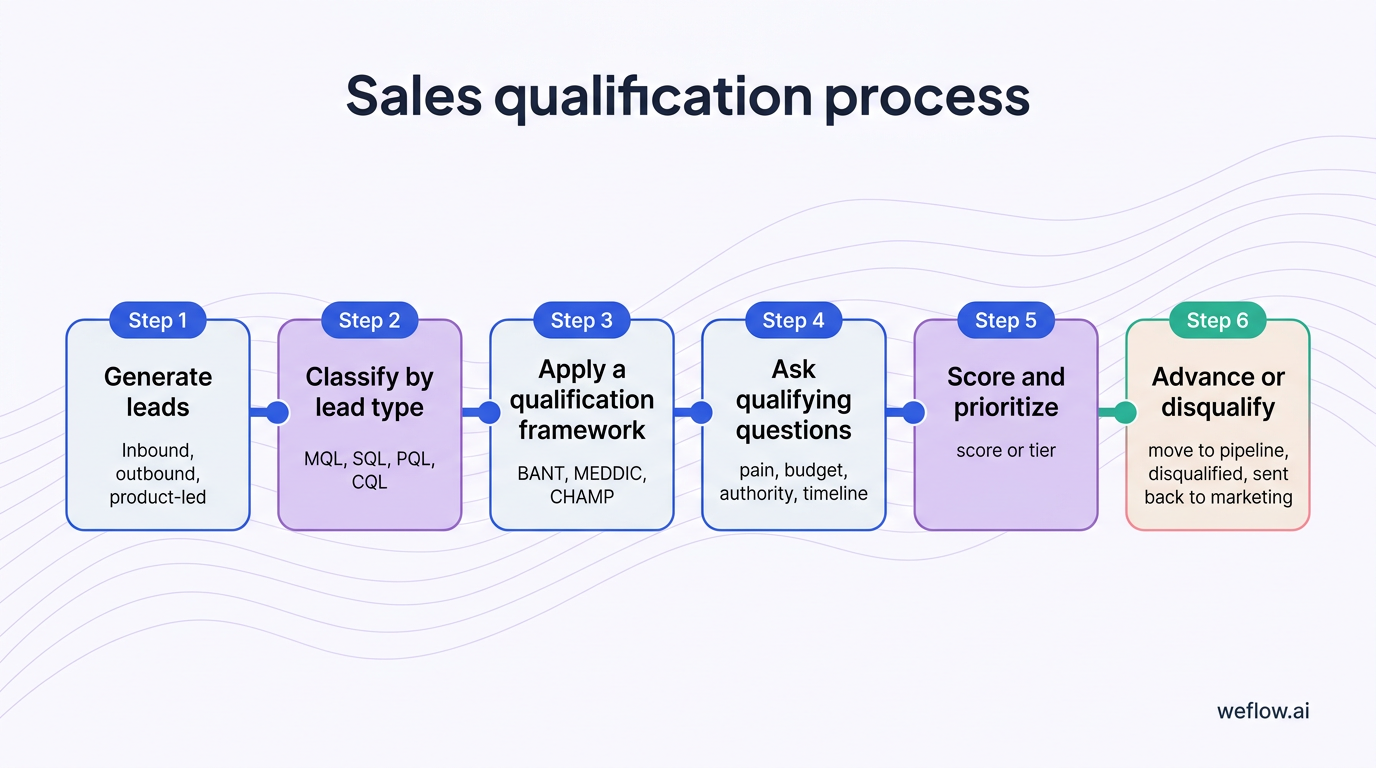
Sales qualification isn't a single moment — it's a process that runs from lead generation through deal close. Here's how it works:
- Generate leads: Inbound (marketing), outbound (SDR prospecting), or product-led (free trial signups). Every lead enters the funnel here.
- Classify by lead type: Is this an MQL, SQL, PQL, or CQL? The classification determines who owns the lead and what qualification happens next.
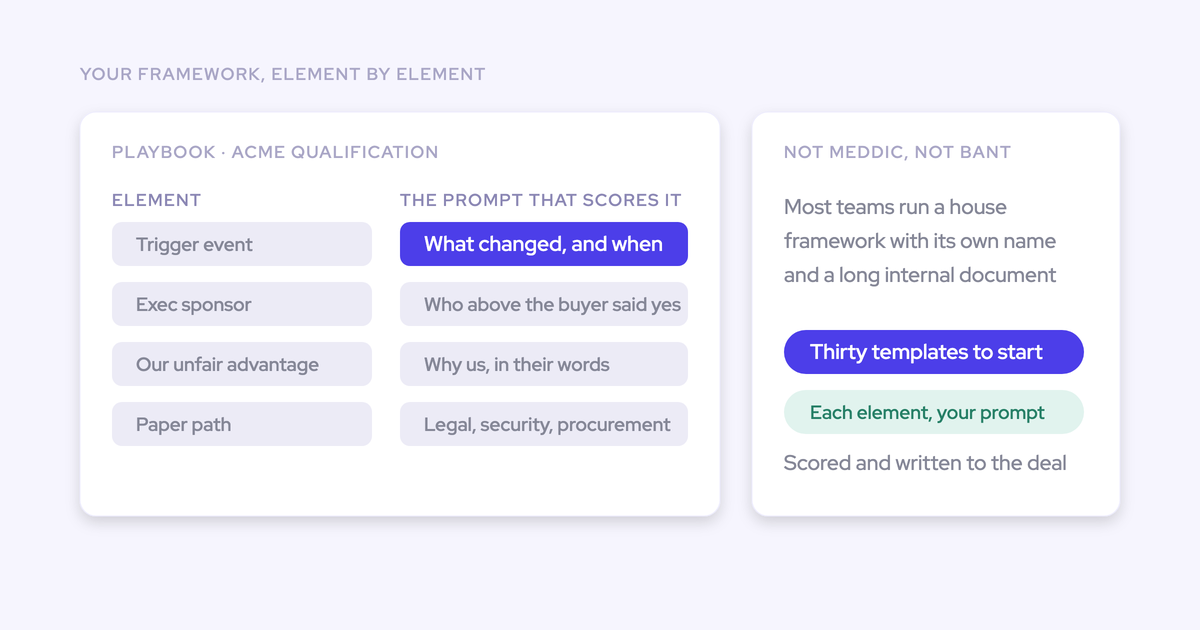
- Apply a qualification framework: Use BANT, MEDDIC, CHAMP, or your custom framework to evaluate the lead against defined criteria. This happens during discovery calls.
- Ask qualifying questions: Dig into pain, budget, authority, and timeline. The quality of your questions determines the quality of your qualification.
- Score and prioritize: Based on qualification answers, assign a score or tier. High-fit, high-intent leads get priority; weak leads get nurtured or disqualified.
- Advance or disqualify: Qualified leads move to pipeline with a clear next step. Unqualified leads get disqualified (with a reason logged) or sent back to marketing for nurturing.
The process should be consistent across the team. When reps qualify differently, pipeline quality varies, forecasts miss, and RevOps can't trust the data.
13 sales qualification questions to ask on every discovery call
The right questions surface the information you need to qualify — or disqualify — a deal. Here are 13 questions organized by what they reveal:
| Question | What it reveals | Qualification level |
|---|---|---|
| Pain and need | ||
| What problem are you trying to solve? | Whether there's a real pain point driving the conversation | Opportunity |
| What happens if you don't solve this problem? | The cost of inaction — higher cost = higher urgency | Opportunity |
| How are you handling this today? | Current state, workarounds, and pain severity | Opportunity |
| What have you tried before? Why didn't it work? | Past solutions, objections to anticipate, and decision patterns | Opportunity |
| Budget | ||
| Do you have budget allocated for this? | Whether budget exists or needs to be created | Opportunity |
| What's your typical investment range for a solution like this? | Budget range without asking for an exact number | Opportunity |
| What other priorities are competing for this budget? | Where you rank vs. other initiatives — and who you're competing against | Opportunity |
| Authority | ||
| Who else is involved in this decision? | The buying committee — who decides, influences, and can block | Stakeholder |
| What does your evaluation process look like? | How decisions get made, who's involved at each stage | Stakeholder |
| Who signs the contract? | The economic buyer — the person with final authority | Stakeholder |
| Timeline | ||
| When do you need this in place? | Deadline or go-live date — real urgency vs. vague interest | Opportunity |
| What's driving that timeline? | The compelling event behind the deadline | Opportunity |
| What could push this timeline back? | Risks to the deal — competing priorities, budget cycles, internal blockers | Opportunity |
Notice what's missing: no questions about features. Qualification is about whether the deal is real, not whether your product is a fit. Product fit comes after qualification confirms there's a deal worth pursuing.
Sales qualification frameworks compared: which one should you use?
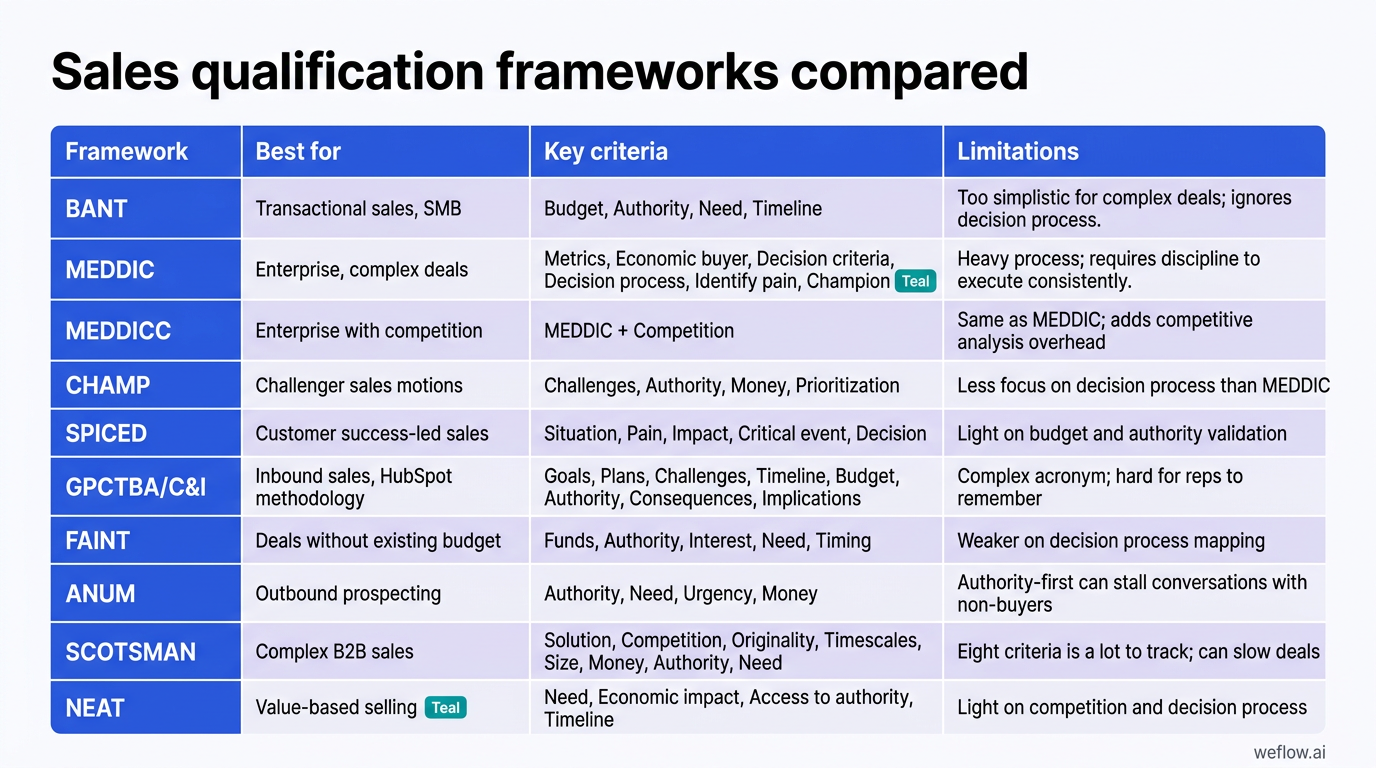
Different frameworks work for different sales motions. Here's how the major frameworks compare:
[banner type="download" url="https://www.weflow.ai/resources/cheat-sheets/sales-discovery-questions-checklist" text="Sales Discovery Questions Checklist" subtitle="Walk into discovery with questions that actually qualify the deal." button="Download checklist"]
| Framework | Best for | Key criteria | Limitations |
|---|---|---|---|
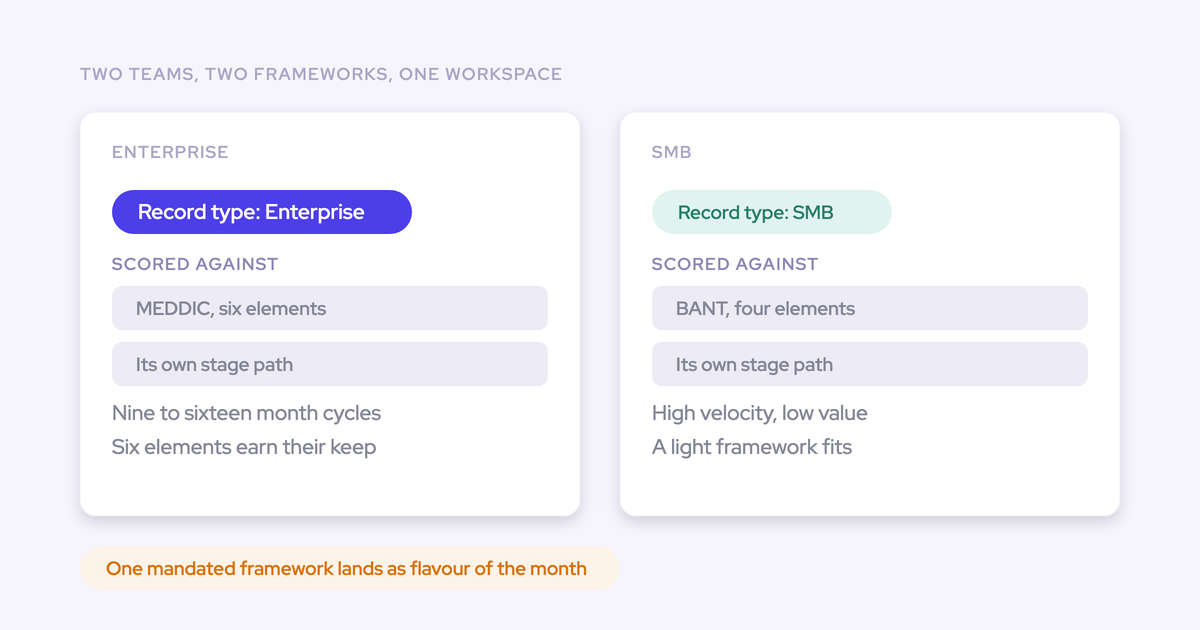
| BANT | Transactional sales, SMB | Budget, Authority, Need, Timeline | Too simplistic for complex deals; ignores decision process |
| MEDDIC | Enterprise, complex deals | Metrics, Economic buyer, Decision criteria, Decision process, Identify pain, Champion | Heavy process; requires discipline to execute consistently |
| MEDDICC | Enterprise with competition | MEDDIC + Competition | Same as MEDDIC; adds competitive analysis overhead |
| CHAMP | Challenger sales motions | Challenges, Authority, Money, Prioritization | Less focus on decision process than MEDDIC |
| SPICED | Customer success-led sales | Situation, Pain, Impact, Critical event, Decision | Light on budget and authority validation |
| GPCTBA/C&I | Inbound sales, HubSpot methodology | Goals, Plans, Challenges, Timeline, Budget, Authority, Consequences, Implications | Complex acronym; hard for reps to remember |
| FAINT | Deals without existing budget | Funds, Authority, Interest, Need, Timing | Weaker on decision process mapping |
| ANUM | Outbound prospecting | Authority, Need, Urgency, Money | Authority-first can stall conversations with non-buyers |
| SCOTSMAN | Complex B2B sales | Solution, Competition, Originality, Timescales, Size, Money, Authority, Need | Eight criteria is a lot to track; can slow deals |
| NEAT | Value-based selling | Need, Economic impact, Access to authority, Timeline | Light on competition and decision process |
BANT: Budget, Authority, Need, Timeline
The original qualification framework. BANT checks whether a prospect has the budget, decision authority, a genuine need, and a timeline to buy. It works for transactional sales with short cycles and simple buying committees.
Sample questions:
- Do you have budget allocated for this initiative?
- Who needs to sign off on this purchase?
- What's driving the timeline for making a decision?
MEDDIC: Metrics, Economic buyer, Decision criteria, Decision process, Identify pain, Champion
MEDDIC was built for enterprise sales. It goes deeper than BANT by mapping the decision process, identifying the economic buyer, and ensuring you have a champion who's selling internally on your behalf.
Sample questions:
- What metrics will you use to measure success?
- Who's the economic buyer — the person who can approve budget?
- Walk me through how decisions like this get made at your company.
MEDDICC: MEDDIC + Competition
MEDDICC adds a Competition element to MEDDIC. Use it when you're in competitive deals and need to understand who else is being evaluated and how you compare.
Sample questions:
- Who else are you evaluating for this?
- What criteria are you using to compare vendors?
CHAMP: Challenges, Authority, Money, Prioritization
CHAMP leads with challenges instead of budget. The idea: if you understand the prospect's challenges deeply, budget conversations follow naturally. Works well for challenger-style sales where you're teaching the prospect something new.
Sample questions:
- What's the biggest challenge you're facing right now?
- Where does solving this rank against your other priorities this quarter?
SPICED: Situation, Pain, Impact, Critical event, Decision
SPICED emphasizes the impact of pain and the critical event driving urgency. Common in customer success-led and land-and-expand sales motions.
Sample questions:
- What's the business impact of this problem today?
- Is there a specific event driving the need to solve this now?
GPCTBA/C&I: Goals, Plans, Challenges, Timeline, Budget, Authority, Consequences, Implications
HubSpot's framework. It's thorough — covering goals, plans, challenges, timeline, budget, authority, consequences of inaction, and implications of success. The downside: it's a lot to remember and execute consistently.
Sample questions:
- What are your goals for this quarter?
- What's your plan to achieve them?
- What happens if you don't hit those goals?
FAINT: Funds, Authority, Interest, Need, Timing
FAINT replaces 'Budget' with 'Funds' — acknowledging that not every deal has pre-allocated budget. Use it when selling to prospects who haven't budgeted for your category yet but have the funds to buy if you make the case.
Sample questions:
- How does your organization typically fund new initiatives?
- What would need to happen for this to become a funded priority?
ANUM: Authority, Need, Urgency, Money
ANUM leads with authority. The idea: don't waste time qualifying need and budget if you're not talking to someone who can buy. Common in outbound prospecting where you're breaking into new accounts.
Sample questions:
- Are you the person who makes decisions on tools like this?
- How urgent is solving this problem for your team?
SCOTSMAN: Solution, Competition, Originality, Timescales, Size, Money, Authority, Need
SCOTSMAN covers eight dimensions — including solution fit, competition, and deal size. It's thorough but heavy. Works for complex enterprise deals where you need to track multiple variables.
Sample questions:
- How does our approach differ from what you've seen elsewhere?
- What's the expected size of this deployment?
NEAT: Need, Economic impact, Access to authority, Timeline
NEAT focuses on need and economic impact. It's lighter than MEDDIC but still captures the essentials. Works for value-based selling where you're quantifying the cost of the problem.
[banner type="download" url="https://www.weflow.ai/resources/cheat-sheets/sales-methodology-cheat-sheet" text="Sales Methodology Cheat Sheet" subtitle="Pick one framework your team will actually use on every deal." button="Get the cheat sheet"]
Sample questions:
- What's the economic impact of this problem — in dollars or time?
- Do you have access to the decision-maker, or do we need to bring them in?
When to disqualify a prospect: a 5-point checklist
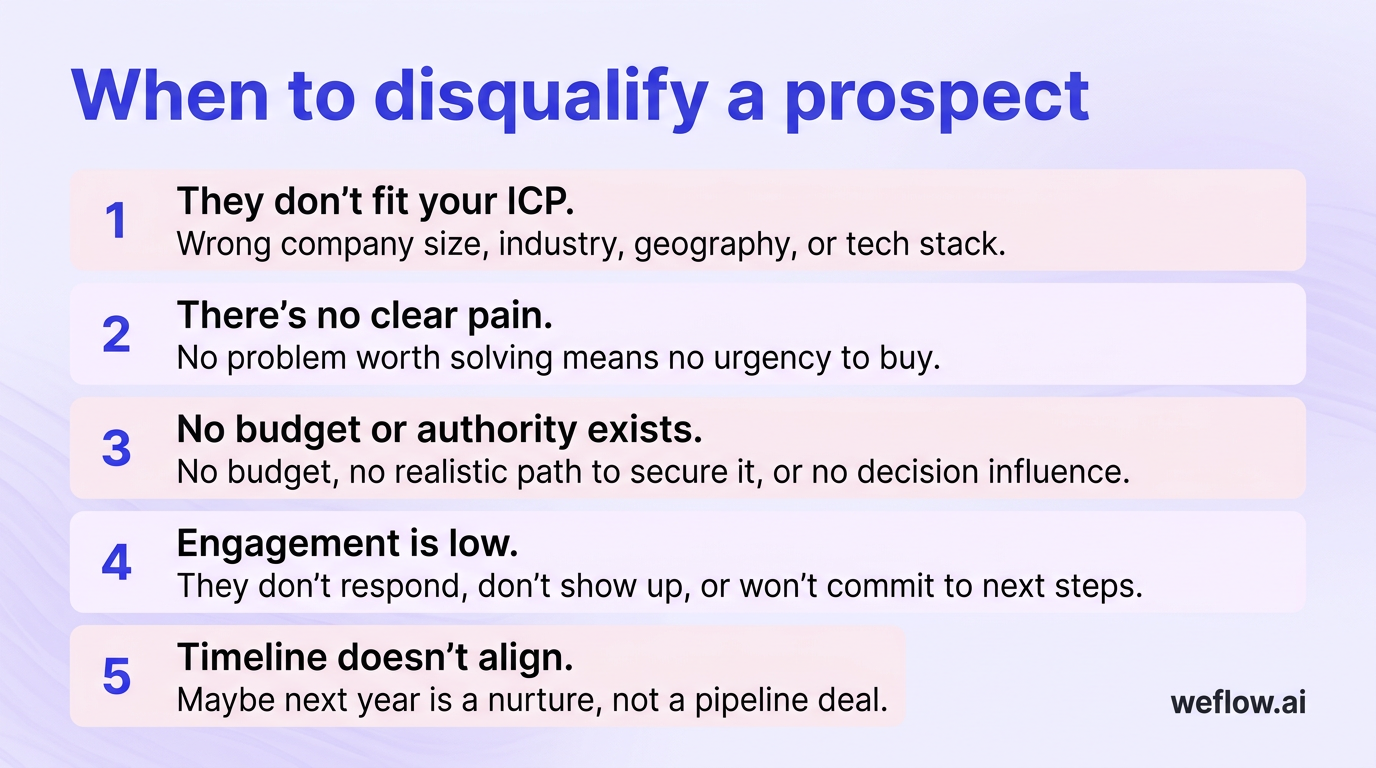
Qualification isn't just about finding good deals — it's about killing bad ones early. Disqualifying weak prospects protects rep time, improves forecast accuracy, and keeps your pipeline honest.
Disqualify a prospect if:
- They don't fit your ICP: Wrong company size, wrong industry, wrong geography, or wrong tech stack. Even if there's interest, the deal won't close or won't succeed post-sale.
- There's no clear pain: If the prospect can't articulate a problem worth solving, there's no urgency to buy. 'Nice to have' doesn't convert.
- No budget or authority exists: If there's no budget and no realistic path to secure it — or if you're not engaged with anyone who can influence the decision — the deal is stalled before it starts.
- Engagement is low: Prospects who don't respond, don't show up to meetings, or won't commit to next steps are telling you something. Low engagement signals low priority.
- Timeline doesn't align: A prospect who's 'maybe next year' isn't a deal — it's a nurture. Move them out of pipeline and into a marketing sequence.
Disqualification feels like losing, but it's actually winning. Every hour spent on a dead deal is an hour not spent on a winnable one.
How to score and prioritize qualified leads
Not all qualified leads are equal. Scoring helps you stack-rank opportunities so reps focus on the deals most likely to close.
Fit scoring measures how well a prospect matches your ideal customer profile:
- Company size, industry, geography
- Tech stack (e.g., do they run Salesforce?)
- Title and seniority of the contact
- Revenue or employee count
Behavioral scoring measures engagement and intent signals:
- Website visits, especially pricing and demo pages
- Content downloads and webinar attendance
- Email opens and replies
- Product usage (for PLG motions)
- Demo requests and meeting attendance
The best lead scoring combines both. A high-fit, high-engagement lead is a top priority. A high-fit, low-engagement lead needs nurturing. A low-fit, high-engagement lead is probably a bad fit — even if they're interested.
Most CRMs (including Salesforce) can automate lead scoring based on field values and activities. The key is keeping the scoring model simple enough that reps understand it and RevOps can maintain it.
How AI and automation are changing sales qualification
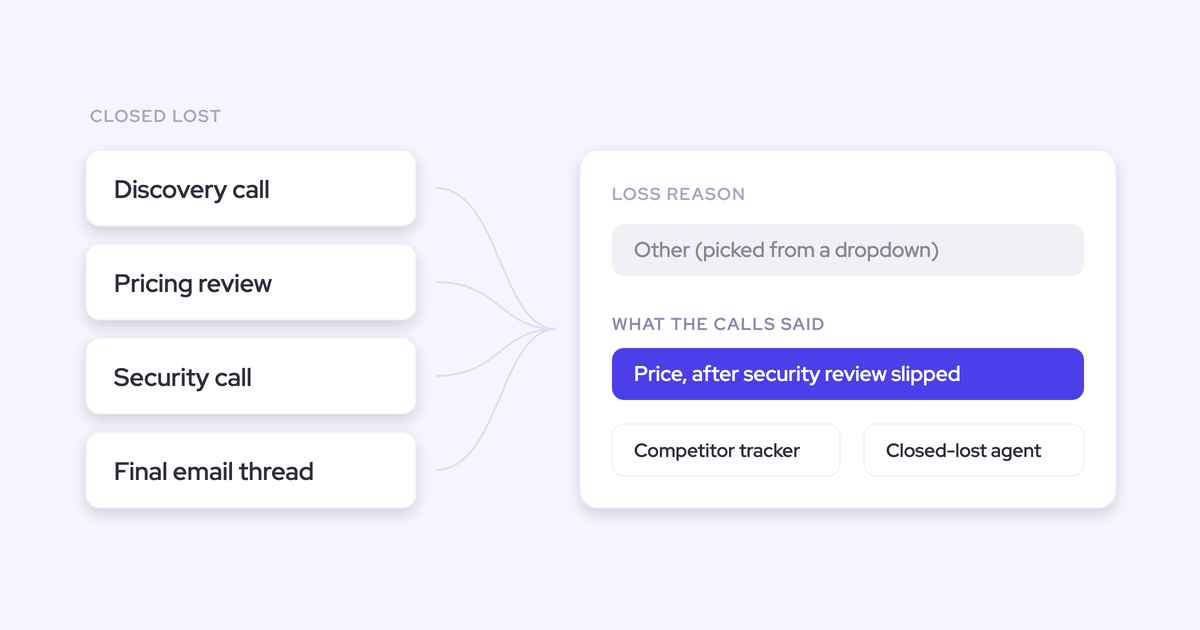
AI is shifting qualification from manual judgment to data-driven scoring. Predictive lead scoring models analyze historical win/loss data to identify patterns that predict conversion — and score new leads accordingly. Intent data platforms surface signals like content consumption and research behavior to flag prospects who are actively in-market. Automated lead routing assigns leads to the right rep based on territory, segment, or score — reducing response time and improving handoff quality.
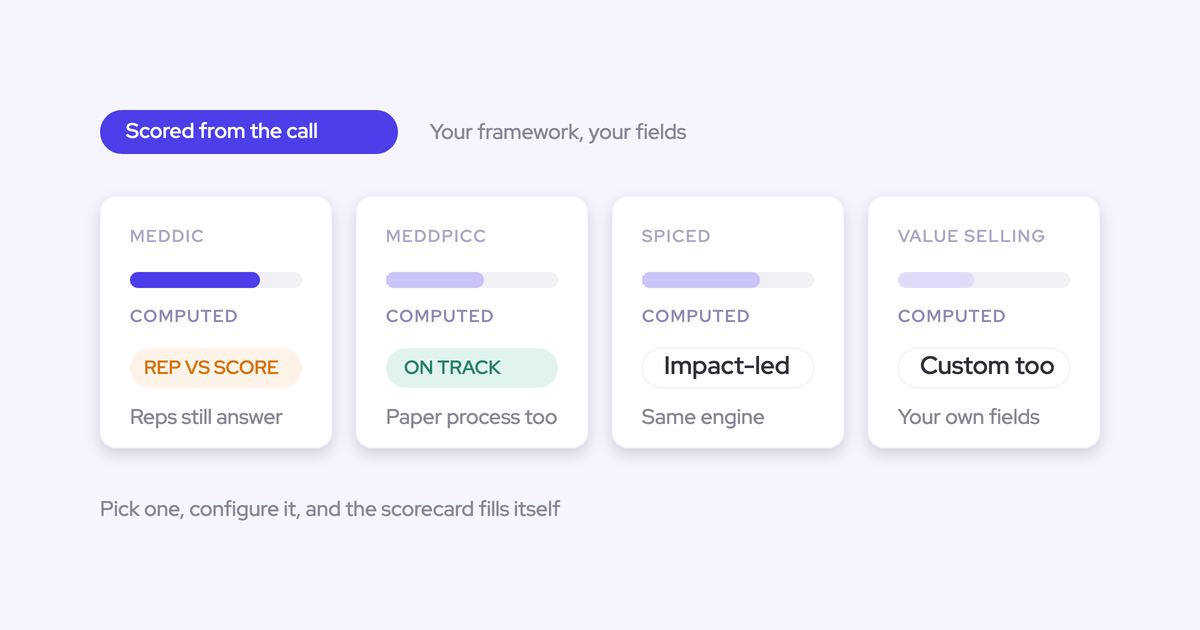
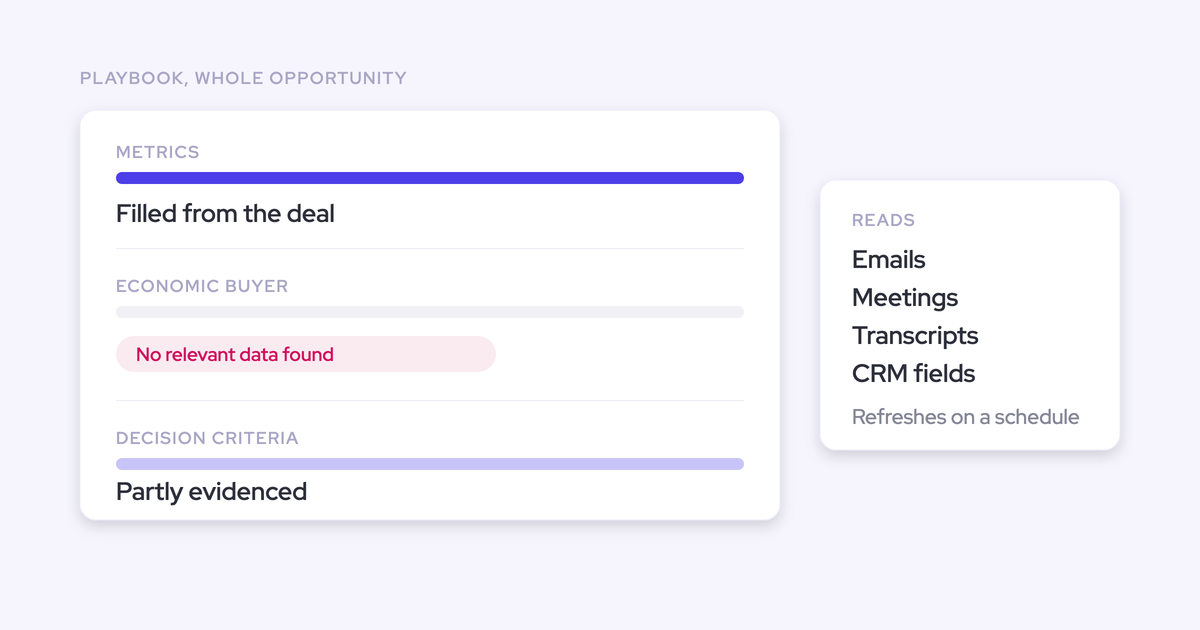
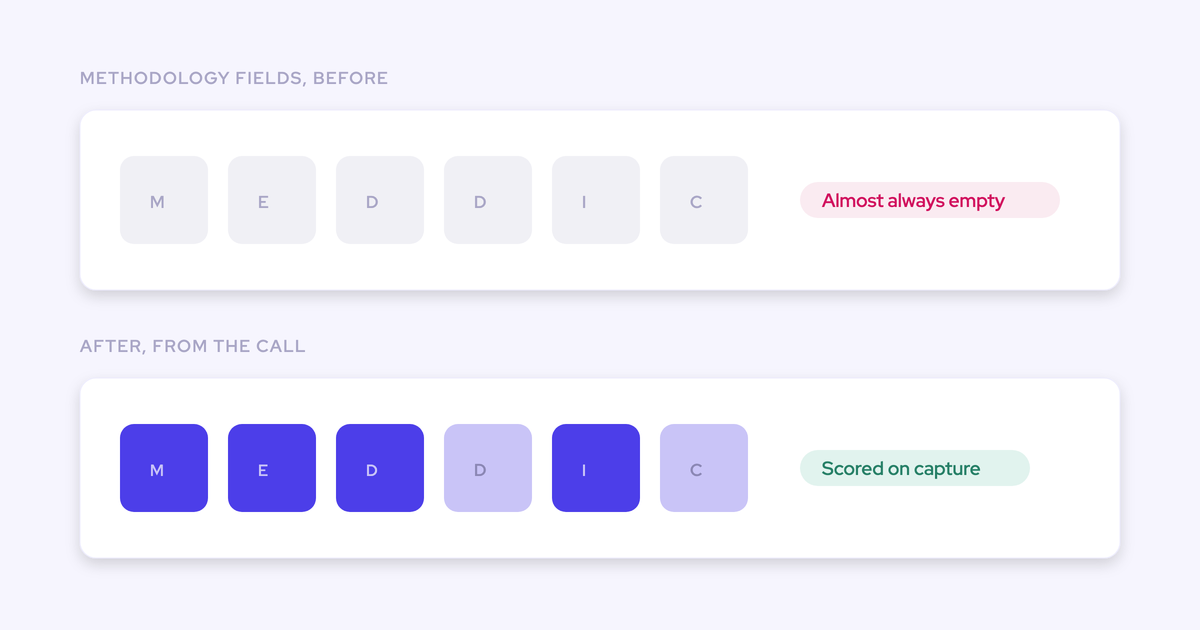
The biggest shift: AI can now capture and analyze conversations (calls, emails, meetings) to extract qualification signals automatically. Instead of reps manually updating MEDDIC fields after every call, AI listens and fills in the gaps. This improves data completeness, reduces rep admin time, and gives RevOps a more accurate picture of pipeline health. For Salesforce-based teams, conversation intelligence tools that write directly to CRM fields — not just store data in a separate system — deliver the most value.
Frequently asked questions
What is the difference between MQL and SQL?
An MQL (Marketing Qualified Lead) meets marketing's engagement criteria — they've downloaded content, attended a webinar, or filled out a form. An SQL (Sales Qualified Lead) has been validated by sales through a conversation and meets qualification criteria like budget, authority, and timeline. MQLs are handed from marketing to sales; SQLs have been accepted by sales as real opportunities.
Which framework is best for B2B enterprise deals?
MEDDIC (or MEDDICC) is the standard for enterprise B2B sales. It maps the decision process, identifies the economic buyer, and ensures you have a champion. For simpler deals, BANT or CHAMP work. For competitive deals, add the Competition element (MEDDICC).
What are the most important qualification questions?
Focus on three areas: pain ('What problem are you trying to solve?'), authority ('Who else is involved in this decision?'), and urgency ('What's driving the timeline?'). These three questions reveal whether there's a real deal worth pursuing.
When should you disqualify a prospect?
Disqualify when: they don't fit your ICP, there's no clear pain or urgency, no budget or authority exists, engagement is low, or the timeline doesn't align with your sales cycle. Disqualifying early protects rep time and improves forecast accuracy.
How do you score and prioritize qualified leads?
Combine fit scoring (ICP match) with behavioral scoring (engagement and intent signals). High-fit, high-engagement leads get priority. Use your CRM to automate scoring based on firmographics, titles, website activity, and content engagement.
What is the difference between BANT and MEDDIC?
BANT is simple: Budget, Authority, Need, Timeline. It works for transactional sales. MEDDIC is deeper: it adds Metrics, Economic buyer, Decision criteria, Decision process, and Champion. MEDDIC is built for complex enterprise deals where you need to navigate a buying committee and a multi-step decision process.
How can AI improve sales qualification?
AI improves qualification in three ways: predictive scoring (identifying which leads are most likely to convert based on historical patterns), intent signals (surfacing prospects actively researching your category), and conversation intelligence (automatically capturing qualification data from calls and emails so reps don't have to update CRM manually).
How many frameworks should a team use?
One. Pick a framework that fits your sales motion and enforce it consistently. Mixing frameworks creates confusion, inconsistent qualification, and unreliable pipeline data. If you're enterprise, use MEDDIC. If you're mid-market transactional, use BANT or CHAMP. Train the whole team on the same framework and hold them accountable.
Key takeaways: building a sales qualification process that scales
- Qualification is about pipeline quality, not volume. Fewer, better-qualified deals beat a bloated pipeline of weak opportunities.
- Use one framework consistently. Pick BANT, MEDDIC, or CHAMP based on your sales motion — then train and enforce it across the team.
- Qualify at all three levels. Organization (ICP fit), Opportunity (pain, budget, timeline), and Stakeholder (authority, buying committee).
- Disqualify fast. Every hour on a dead deal is an hour not spent on a winnable one. Kill bad deals early.
- Automate what you can. Use lead scoring, intent data, and conversation intelligence to reduce manual qualification work and improve data accuracy.
-p-1600.png)

.png)
-p-1600.png)
-p-1600.png)
-p-1600.png)