
Strategic Selling: The Miller Heiman Framework Explained
Learn how Miller Heiman Strategic Selling maps buyers, buying modes, and Blue Sheets for complex deals.



.png)

What is strategic selling? (the Miller Heiman framework explained)
Strategic Selling is a B2B sales methodology developed by Robert Miller and Stephen Heiman, first published in their 1985 book The New Strategic Selling (revised in 2005). The framework gives sales teams a structured way to navigate complex deals involving multiple stakeholders—each with different priorities, authority levels, and buying motivations.
The core principle: every deal should produce a win-win outcome. Strategic Selling treats each stakeholder’s perspective as a variable you must understand and address individually—not a single “decision-maker” you pitch once. It’s built for enterprise and mid-market B2B sales where deals involve four to 12 stakeholders, cycles run 60 to 180 days, and one misread on a buyer’s concerns can kill the opportunity.
The methodology rests on four pillars:
- Buyer type mapping — identifying every stakeholder and their role in the decision
- Buying mode analysis — understanding each stakeholder’s current mindset toward change
- Competitive position assessment — gauging where you stand relative to alternatives from each buyer’s perspective
- Personalized engagement — combining buyer type and buying mode to tailor your approach per stakeholder
The output of this analysis gets captured in the Blue Sheet—a deal planning document that serves as the single source of truth for your opportunity strategy. More on that below.
Strategic selling pros and cons: is it right for your sales team?
Strategic Selling works well in specific selling environments. Before adopting it, weigh the operational tradeoffs against your team’s deal complexity and resources.
| Advantage | Limitation |
|---|---|
| Maps every stakeholder’s role, concern, and influence—reducing the risk of getting blindsided late in the cycle by an unknown decision-maker | Requires time and discipline to maintain. Reps managing 30+ active opportunities will struggle to keep Blue Sheets current for every deal without CRM automation |
| Gives managers and leadership clear visibility into deal strategy, not just stage progression—useful for pipeline reviews and forecast calls | Resource-intensive for smaller deals. If your average contract value is under $20k or your sales cycle is under 30 days, the overhead may not justify the return |
| Forces reps to identify and address competitive threats early, before they surface as objections in final-stage negotiations | Doesn’t address messaging or challenger-style reframing. Strategic Selling maps the landscape—it doesn’t teach reps how to change a buyer’s thinking |
| Win-win philosophy builds long-term customer relationships, improving renewal rates and expansion revenue | Training and enablement take weeks to roll out properly. Reps need practice applying buyer type and buying mode analysis to real opportunities before it becomes instinct |
| Works across industries and deal types—any complex B2B sale with multiple stakeholders benefits from structured stakeholder analysis | Scales poorly without technology support. Tracking buyer types, buying modes, and competitive positions across dozens of deals requires CRM fields and automation—not just spreadsheets |
Strategic Selling pays off in environments with high deal values, long cycles, and multiple buyers. For transactional or single-threaded sales, lighter frameworks like SPIN or Challenger deliver more value per hour of rep effort.
The strategic selling process: a step-by-step guide
The Strategic Selling process breaks down into four steps. Each builds on the previous one, and the output feeds directly into your Blue Sheet.
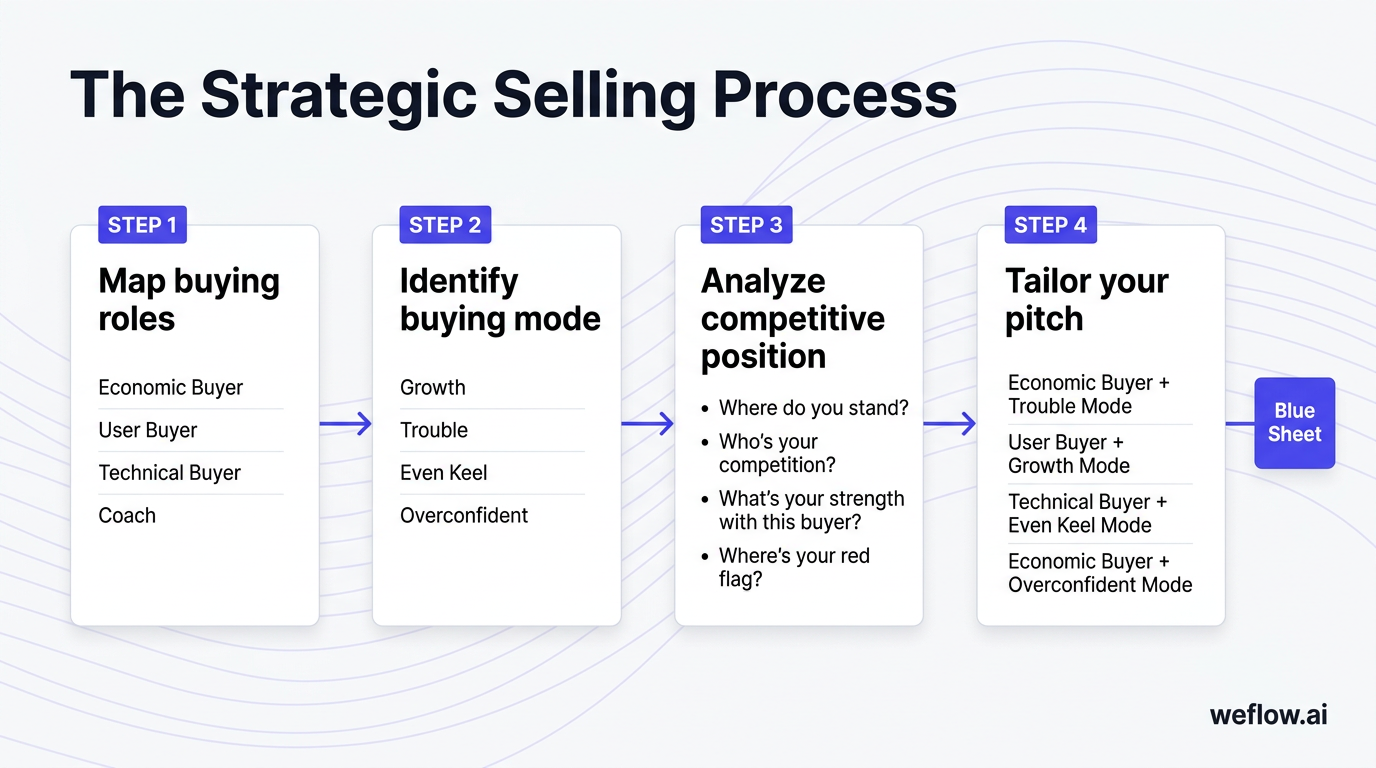
Step 1: Map buying roles using the four buyer types
Every complex deal involves four buyer types. Your first job is to identify each person in the account, assign them to a buyer type, and understand what drives their evaluation.
The Economic Buyer: final decision-maker with budget authority
The Economic Buyer has final approval authority and controls the budget—typically a VP, SVP, or C-level executive. There’s one Economic Buyer per deal, though they may delegate evaluation while retaining veto power. They care about ROI, organizational risk, and strategic alignment. Speak in business outcomes, not features. Lead with the business case and let your Coach help you get the meeting.
The User Buyer: end-users who evaluate daily impact
User Buyers work with your solution day-to-day—AEs, sales managers, RevOps analysts. There are usually multiple User Buyers, and their collective feedback carries weight with the Economic Buyer. They care about ease of use, workflow fit, and whether your solution saves time or creates more work. Show, don’t tell: give them trials, sandbox environments, and workflow-specific demos.
The Technical Buyer: gatekeepers of compliance and standards
Technical Buyers evaluate security, integration, compliance, and technical standards—IT, InfoSec, Legal, and Procurement. They can’t say yes to a deal, but they can say no. They care about API compatibility, data security, SSO/SAML support, and vendor certifications (SOC 2, GDPR). Provide documentation proactively. Delays at this stage kill more deals than pricing objections.
The Coach: your internal advocate
The Coach is your ally inside the account—someone who wants you to win and shares insider information about the decision process, timeline, and stakeholder dynamics. Your success benefits them personally: it solves a problem they care about, raises their internal visibility, or extends a prior working relationship. Identify your Coach early and validate that they have real organizational influence—not just enthusiasm.
| Buyer type | Role | Key concern | How to sell to them |
|---|---|---|---|
| Economic Buyer | Final approval, budget authority | ROI, strategic alignment, organizational risk | Lead with business outcomes and financial impact—not product features |
| User Buyer | Day-to-day user of the solution | Ease of use, workflow fit, time savings | Provide hands-on access; demo their specific workflows |
| Technical Buyer | Gatekeeper for compliance and standards | Security, integration, regulatory compliance | Share documentation proactively; don’t wait for the security review |
| Coach | Internal advocate guiding your deal | Your success = their success | Build trust early; validate they have real organizational influence |
Step 2: Identify each buyer’s mode (Growth, Trouble, Even Keel, Overconfident)
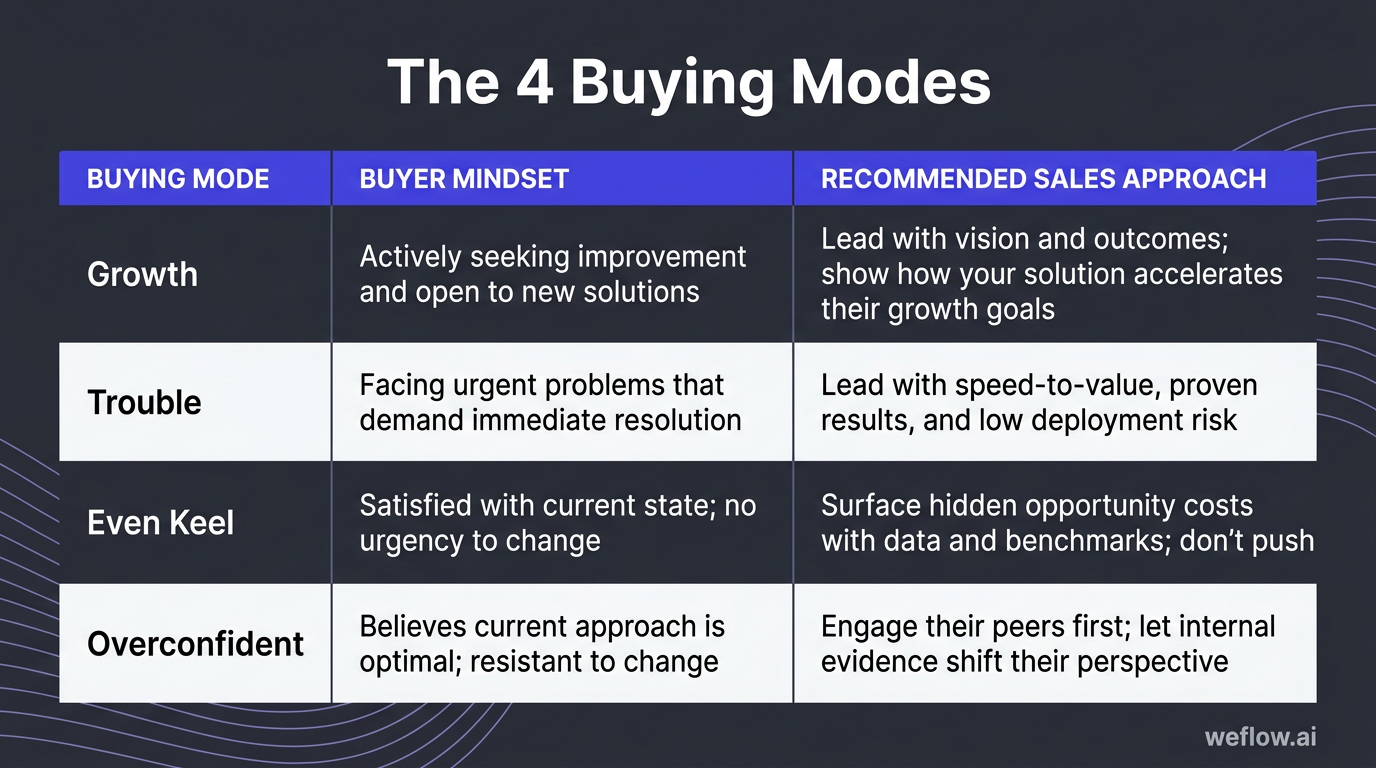
Once you’ve mapped the buyer types, the next step is understanding each person’s buying mode—their current mindset toward change. Two stakeholders can hold the same buyer type but operate in completely different modes, which means you need a different approach for each.
Growth Mode
Growth Mode buyers see an opportunity to improve—they want to grow revenue, expand markets, or build new capabilities. They’re receptive and willing to invest time in evaluation. Selling here is straightforward: show your solution delivers the growth outcome better than alternatives. Lead with vision, back it with specifics.
Trouble Mode
Trouble Mode buyers face an urgent problem—a failing system, a compliance deadline, lost deals, or leadership demanding results. They move fast but evaluate narrowly, choosing the solution that addresses their immediate pain with the least risk. Lead with speed-to-value and proven results in similar situations.
Even Keel Mode
Even Keel buyers are satisfied with the status quo. Things aren’t broken enough to justify switching. This is the hardest mode to sell into—you can’t push them. Surface a gap they haven’t noticed using data, benchmarks, or competitive intelligence. “You’re leaving $X on the table” works better than “our product is better.”
[banner type="download" url="https://www.weflow.ai/resources/cheat-sheets/strategic-selling-checklist" text="Strategic Selling Checklist" subtitle="Run multi-stakeholder deals without getting blindsided in the final stage" button="Get the checklist"]
Overconfident Mode
Overconfident buyers believe their current approach is optimal—they’re not just neutral (that’s Even Keel), they’re actively resistant to change. Direct selling rarely works. Engage their peers in Trouble or Growth Mode and let internal pressure shift their perspective. If the Economic Buyer is Overconfident, you need a Coach who can introduce evidence that challenges the status quo.
| Buying mode | Buyer mindset | Recommended sales approach |
|---|---|---|
| Growth | Actively seeking improvement and open to new solutions | Lead with vision and outcomes; show how your solution accelerates their growth goals |
| Trouble | Facing urgent problems that demand immediate resolution | Lead with speed-to-value, proven results, and low deployment risk |
| Even Keel | Satisfied with current state; no urgency to change | Surface hidden opportunity costs with data and benchmarks; don’t push |
| Overconfident | Believes current approach is optimal; resistant to change | Engage their peers first; let internal evidence shift their perspective |
Step 3: Analyze your competitive position
Assess your competitive position from each stakeholder’s perspective—not deal-level, but per-person. For each buyer, answer:
- Where do you stand? Are you the frontrunner, a strong contender, or an afterthought?
- Who’s your competition? It might be a direct competitor, an internal build option, or the status quo (doing nothing).
- What’s your strength with this buyer? Where does your solution align with what they specifically care about?
- Where’s your red flag? What concern, gap, or competitor advantage could turn this buyer against you?
Pressure-test your assumptions with qualifying questions. Ask your Coach: “If the decision were made today, where would we stand?” Ask User Buyers: “What would need to be true for you to recommend us internally?” Document every red flag—deals die from risks you missed, not competitive advantages you knew about.
Step 4: Tailor your pitch by buyer type and buying mode
Combine everything into a personalized engagement strategy per stakeholder. Every buyer needs a different version of your value proposition based on their role and mindset.
- Economic Buyer in Trouble Mode — Lead with risk mitigation and speed. “Here’s how we solve the immediate problem within 30 days, and here’s the cost of waiting.”
- User Buyer in Growth Mode — Lead with capability expansion. “Here’s what your team can do with this that you can’t do today.”
- Technical Buyer in Even Keel Mode — Lead with low disruption. “Here’s how the integration works with your existing stack—no rip-and-replace.”
- Economic Buyer in Overconfident Mode — Don’t pitch directly. Work through your Coach to surface data that challenges their assumptions.
For every stakeholder, define: what message they hear, who delivers it, and when. Put it in your Blue Sheet and update after every interaction.
What is the Blue Sheet in strategic selling?
The Blue Sheet is the central planning document in Strategic Selling—named after the original blue paper worksheets used in Miller Heiman training sessions. It’s the deal strategy equivalent of a project plan: a living document that captures everything your team knows (and doesn’t know) about an opportunity.
A Blue Sheet typically includes:
- Single sales objective — the specific outcome you’re selling (“secure a 12-month, 50-seat contract by Q3”—not “close the deal”)
- Stakeholder map — every buyer, their type, buying mode, and disposition toward your solution
- Competitive position — strengths and red flags per buyer, competitive threats, and the status quo alternative
- Win-results — what each buyer gains personally from choosing your solution
- Red flags and unknowns — knowledge gaps and unmitigated risks
- Action plan — next steps, owners, and timelines
Teams review the Blue Sheet before every major touchpoint—discovery calls, demos, proposals, negotiations. Managers use them in pipeline reviews to assess deal health beyond what a CRM stage tells them. The biggest challenge is maintenance: in spreadsheet format, Blue Sheets go stale within a week. Teams that succeed with Strategic Selling embed Blue Sheet fields directly into their CRM.
Strategic Selling vs. MEDDIC, Challenger, and SPIN: when to use each
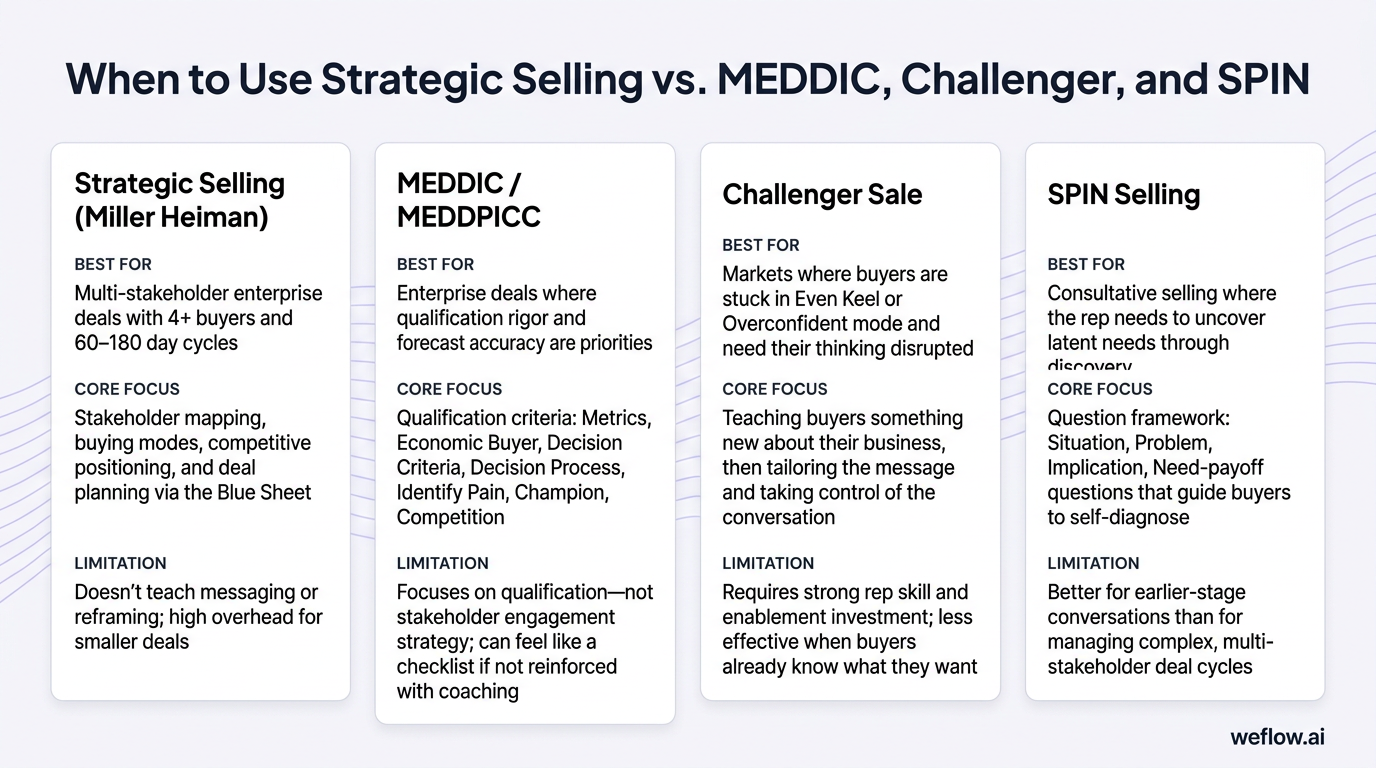
Strategic Selling isn’t the only methodology for complex sales—and it’s not always the right one. Here’s how it compares to three other widely adopted frameworks.
| Framework | Best for | Core focus | Limitation |
|---|---|---|---|
| Strategic Selling (Miller Heiman) | Multi-stakeholder enterprise deals with 4+ buyers and 60–180 day cycles | Stakeholder mapping, buying modes, competitive positioning, and deal planning via the Blue Sheet | Doesn’t teach messaging or reframing; high overhead for smaller deals |
| MEDDIC / MEDDPICC | Enterprise deals where qualification rigor and forecast accuracy are priorities | Qualification criteria: Metrics, Economic Buyer, Decision Criteria, Decision Process, Identify Pain, Champion, Competition | Focuses on qualification—not stakeholder engagement strategy; can feel like a checklist if not reinforced with coaching |
| Challenger Sale | Markets where buyers are stuck in Even Keel or Overconfident mode and need their thinking disrupted | Teaching buyers something new about their business, then tailoring the message and taking control of the conversation | Requires strong rep skill and enablement investment; less effective when buyers already know what they want |
| SPIN Selling | Consultative selling where the rep needs to uncover latent needs through discovery | Question framework: Situation, Problem, Implication, Need-payoff questions that guide buyers to self-diagnose | Better for earlier-stage conversations than for managing complex, multi-stakeholder deal cycles |
These frameworks aren’t mutually exclusive. Strategic Selling provides deal architecture, MEDDIC provides qualification rigor, Challenger provides the messaging approach, and SPIN provides the discovery method. Many high-performing sales orgs combine two or three.
Strategic selling example: mapping a multi-stakeholder SaaS deal
You’re an AE at a mid-market SaaS company selling a revenue intelligence platform to DataCorp, a 500-person B2B company running Salesforce. DataCorp’s CRO wants to improve forecast accuracy—their current process relies on manual Salesforce updates, and the CRO missed her board forecast by 18% last quarter.
Step 1: Map the buyers
- Economic Buyer — Sarah, CRO: Controls the budget. Reports to the CEO and board. Cares about forecast accuracy, pipeline visibility, and board-ready numbers.
- User Buyers — Marcus (sales manager) and his team of 12 AEs: Will use the platform daily. Marcus cares about pipeline inspection and rep coaching signals. The AEs care about reduced admin work.
- Technical Buyer — Priya, Director of Business Systems: Owns the Salesforce instance. Needs to evaluate integration depth, data model impact, API limits, and security certifications.
- Coach — James, Head of RevOps: Brought you into the deal. He’s been pushing internally for a revenue intelligence platform for six months. He has credibility with Sarah and a strong working relationship with Priya.
Step 2: Identify buying modes
- Sarah (Economic Buyer) — Trouble Mode: The missed forecast created board-level scrutiny. She needs a fix before next quarter’s board meeting.
- Marcus (User Buyer) — Growth Mode: Wants better deal visibility to coach reps and improve win rates. He’s excited about what a revenue intelligence platform could do for his team.
- Priya (Technical Buyer) — Even Keel Mode: The current Salesforce setup works. She’s concerned about adding another integration and the maintenance burden on her team.
- James (Coach) — Growth Mode: Sees this as a career-defining project. If it works, he’ll have built the data foundation the revenue org has been missing.
Step 3: Assess competitive position
[banner type="download" url="https://www.weflow.ai/resources/cheat-sheets/sales-methodology-cheat-sheet" text="Sales Methodology Cheat Sheet" subtitle="Pick the right framework for your deal size, cycle length, and buying committee" button="Get the cheat sheet"]
- Sarah: Frontrunner position—James pre-sold the concept. Red flag: she’s also heard of Gong and may request a comparison.
- Marcus: Strong position—your demo addressed his coaching workflow directly. No red flags.
- Priya: Neutral position—she hasn’t evaluated yet. Red flag: she’s protective of the Salesforce instance and skeptical of vendors that promise “native” integration without proving it.
- James: Strong advocate. No red flags—but verify he has the political capital to push through Priya’s concerns.
Step 4: Build the engagement plan
- Sarah: Executive briefing on forecast accuracy improvement—bring a case study from a similar company that reduced forecast error from 20%+ to under 5%. Timeline: this week.
- Marcus: Pilot with three reps to experience reduced admin burden firsthand. Timeline: next two weeks.
- Priya: Send security docs and Salesforce integration architecture before the technical review. Have your solutions engineer walk through data flow on standard Salesforce objects. Timeline: this week.
- James: Weekly check-in. Ask him to introduce you to Priya and keep Sarah updated on pilot results.
Every stakeholder has a buyer type, a buying mode, a competitive position assessment, and a specific next step. The deal moves forward because you’re managing four parallel conversations—not one generic sales cycle.
How to implement strategic selling with your CRM
Strategic Selling’s value compounds when the Blue Sheet lives inside your CRM. Here’s how to map Blue Sheet fields to Salesforce:
On the Contact record:
- Buyer Type (picklist) — Economic Buyer, User Buyer, Technical Buyer, Coach
- Buying Mode (picklist) — Growth, Trouble, Even Keel, Overconfident
- Competitive Preference (picklist) — Frontrunner, Neutral, Competitor-Leaning, Unknown
- Red Flags (text area) — freeform notes on concerns or risks associated with this stakeholder
- Win-Results (text area) — what this person gains personally from choosing your solution
On the Opportunity record:
- Single Sales Objective (text) — the specific deal outcome you’re targeting
- Competitive Threats (multi-select picklist) — active competitors in the deal
- Overall Competitive Position (picklist) — summary of where you stand across all buyers
- Key Unknowns (text area) — information gaps that need to be closed before advancing
The operational challenge is keeping these fields current. Reps update Salesforce when they remember—which means stakeholder data goes stale between pipeline reviews. Automated activity capture solves this by logging emails, meetings, and calls to the right Contact and Opportunity records without manual effort.
Weflow’s activity capture writes emails, meetings, and calls directly to Salesforce Task, Event, and EmailMessage objects—keeping stakeholder engagement data current without adding admin work for reps. Combined with pipeline inspection, your revenue team can review Blue Sheet strategy alongside real activity data: who on the buying committee has your rep talked to this week, and who’s gone dark? That’s the difference between a Blue Sheet that reflects reality and one that reflects what the rep remembers from three weeks ago.
Frequently asked questions
What is the Blue Sheet in strategic selling?
The Blue Sheet is Strategic Selling’s core deal planning document. It captures stakeholder mapping, competitive position, win-results, red flags, and the action plan. Teams review it before every major touchpoint to keep deal strategy aligned with reality.
What are the four buyer types in strategic selling?
The four buyer types are Economic Buyer (final approval and budget authority), User Buyer (day-to-day users who evaluate workflow impact), Technical Buyer (gatekeepers for compliance, security, and technical standards), and Coach (your internal advocate who shares insider intelligence and guides your deal strategy).
What is the difference between strategic selling and MEDDIC?
Strategic Selling focuses on stakeholder mapping and engagement strategy. MEDDIC focuses on deal qualification—determining whether an opportunity is worth pursuing. They complement each other: Strategic Selling tells you how to win; MEDDIC tells you whether you should be in the deal.
How does strategic selling differ from the Challenger Sale?
Strategic Selling maps the buying landscape—stakeholders, modes, competitive position. The Challenger Sale focuses on messaging—teaching buyers something new to reframe how they think. Many teams use both: Challenger for messaging, Strategic Selling for stakeholder management.
When should a sales team use strategic selling?
Strategic Selling fits complex B2B deals with four or more stakeholders, cycles longer than 60 days, and contract values above $20k. If your deals involve a single decision-maker or close in under 30 days, the overhead outweighs the benefits.
Can you use strategic selling with a CRM like Salesforce?
Yes—and you should. Blue Sheet fields map directly to custom picklists and text fields on Salesforce Contact and Opportunity records. The challenge is keeping data current. Automated activity capture eliminates the manual logging burden so stakeholder engagement stays accurate.
What are the main steps in the strategic selling process?
Four steps: (1) Map all stakeholders to the four buyer types—Economic Buyer, User Buyer, Technical Buyer, and Coach. (2) Identify each buyer’s mode—Growth, Trouble, Even Keel, or Overconfident. (3) Analyze your competitive position per buyer, flagging strengths and red flags. (4) Tailor engagement per stakeholder based on their type and mode.
-p-1600.png)

.png)
-p-1600.png)
-p-1600.png)
-p-1600.png)