
SPIN Selling Questions: Framework, Examples, and Stages
Learn SPIN selling questions, the framework, examples, and stages for better discovery calls.



.png)

SPIN selling questions: the framework that turns discovery calls into closed deals
SPIN Selling is Neil Rackham's question-based sales framework built on research analyzing 35,000+ sales calls. The acronym stands for four question types: Situation, Problem, Implication, Need-Payoff. Rackham's research showed that top-performing reps in complex B2B sales don't pitch harder—they ask better questions in a specific sequence that moves buyers from awareness to action.
For B2B sales reps and managers running six- and seven-figure deal cycles, SPIN remains one of the most practical frameworks for structuring discovery calls, qualifying deals, and building urgency without resorting to pressure tactics. This guide covers the full framework, 50+ ready-to-use questions organized by stage, real-world scenarios, and step-by-step instructions for crafting your own SPIN questions.
What is SPIN selling? (the framework behind 35,000+ sales calls)
SPIN Selling originated from a study led by Neil Rackham at Huthwaite International in the 1980s. The research team observed 35,000+ sales calls across 20+ countries and found that successful reps in large, complex deals followed a consistent questioning pattern. They asked questions that uncovered the buyer's situation, surfaced problems, explored the business consequences of those problems, and then guided the buyer to articulate the value of solving them. Rackham published the findings in SPIN Selling (1988), and the methodology has since been adopted by enterprise sales teams across SaaS, financial services, manufacturing, and professional services.
How the SPIN selling framework works: questions, stages, and sequence
SPIN Selling has two components: four question types that define what you ask, and four stages that define when you ask them. The question types don't map 1:1 to the stages—you'll use Situation and Problem questions primarily during investigation, but Implication and Need-Payoff questions can surface throughout the conversation as new information emerges.
SPIN question types: reference table
| Question Type | Purpose | When to Use | Example Question |
|---|---|---|---|
| Situation | Gather facts about the buyer's current environment, processes, and tools | Early in discovery—but limit these. Every Situation question costs the buyer's patience. | "How are your reps currently logging activity in Salesforce?" |
| Problem | Identify difficulties, frustrations, or gaps in the buyer's current state | After you have enough context to ask targeted questions—not generic ones | "Where do you see the biggest gaps in your pipeline data?" |
| Implication | Quantify the cost, risk, or downstream impact of the problem | After a problem is confirmed—this is where urgency gets built | "If pipeline data is incomplete, how does that affect your forecast accuracy at the end of the quarter?" |
| Need-Payoff | Get the buyer to articulate the value of solving the problem in their own words | Once implications are clear—let the buyer sell themselves on the solution | "If your team had real-time pipeline data without manual entry, how would that change your weekly forecast review?" |
The four stages of a SPIN selling call
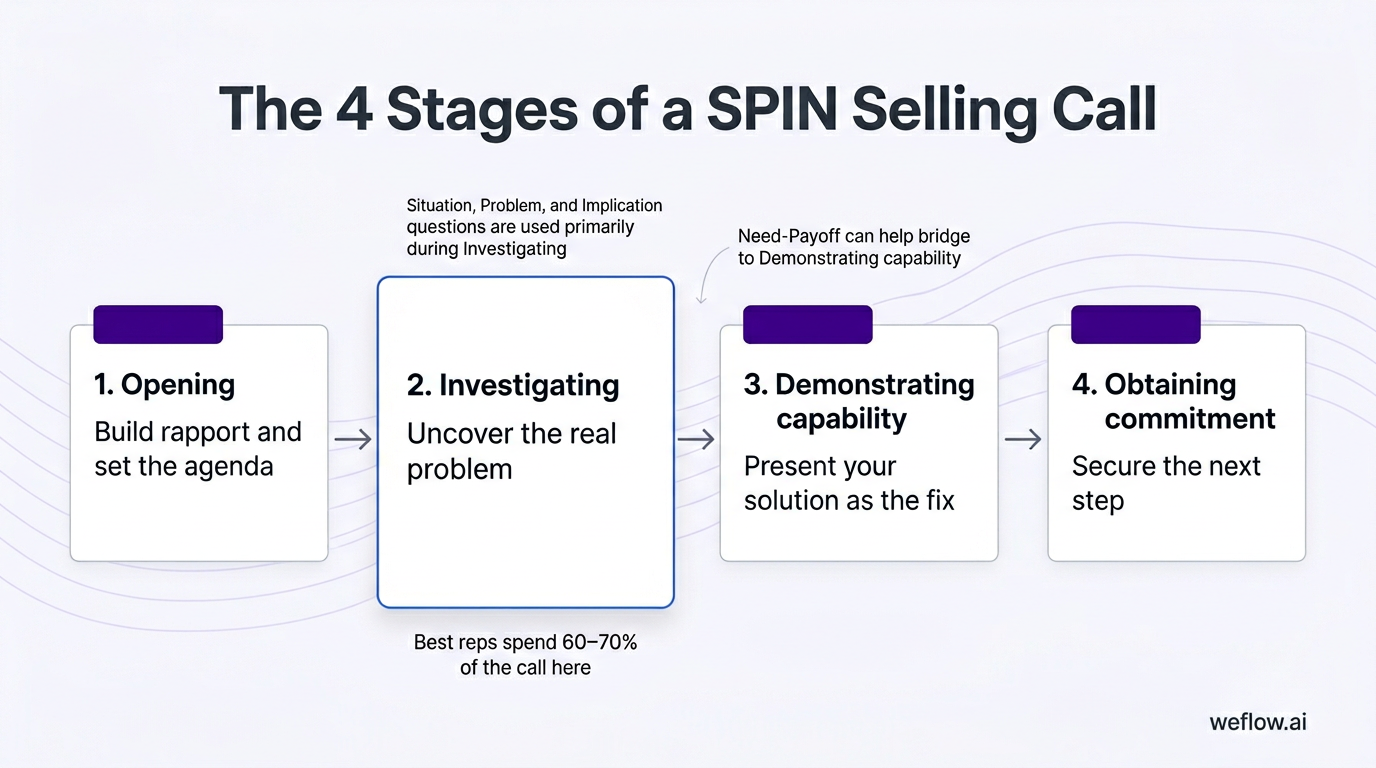
Stage 1: Opening — build rapport and set the agenda
The opening isn't about small talk. It's about establishing credibility and aligning on how the conversation will run. State who you are, why you're meeting, and what you'd like to cover. Then confirm the buyer's agenda. The goal is to earn the right to ask questions—not to pitch.
What good looks like: "I've done some research on your team's setup. I'd like to spend the first 20 minutes understanding how you're handling pipeline visibility today, and then we can see if there's a fit. Does that work?"
Stage 2: Investigating — uncover the real problem
This is where most of the SPIN framework lives. You're cycling through Situation, Problem, and Implication questions to build a complete picture of the buyer's pain. The best reps spend 60–70% of the call in this stage. They don't rush to demonstrate capability—they invest in understanding the problem deeply enough that the solution feels obvious.
What good looks like: You discover that the VP of Sales doesn't trust the forecast because reps update pipeline manually and inconsistently. The RevOps team spends two days each quarter cleaning data before board reporting. Three deals slipped last quarter because stage progression wasn't tracked accurately.
Stage 3: Demonstrating capability — present your solution as the fix
Only demonstrate after the investigation phase has surfaced clear, acknowledged problems. Map your capabilities directly to the problems the buyer confirmed. Don't run through a feature tour—show the three to four capabilities that address the specific pain points from Stage 2.
What good looks like (B2B SaaS example): You're selling a revenue forecasting tool. The buyer told you their reps don't update Salesforce, which means pipeline data is stale by the time the weekly forecast call happens. You show how your tool automatically captures deal activity from emails and meetings, writes it back to Salesforce, and gives the VP of Sales a real-time pipeline view without requiring any rep behavior change. You don't demo the reporting module, the admin panel, or the integrations marketplace—because those aren't the problems the buyer raised.
Stage 4: Obtaining commitment — secure the next step
In complex B2B sales, the goal is rarely to close in a single call. Obtaining commitment means securing a specific, measurable next step: a technical evaluation, a meeting with the economic buyer, a proof-of-concept timeline, or a decision date. Vague next steps ("let's circle back next week") are not commitment—they're stalls.
What good looks like: "Based on what you've shared, it sounds like getting real-time pipeline data into Salesforce without rep effort would solve the forecast accuracy problem and save your RevOps team two days per quarter. Would it make sense to schedule a technical review with your Salesforce admin next Tuesday?"
50+ SPIN selling questions organized by stage (with examples)
Situation questions to ask during discovery calls
Situation questions establish the factual baseline of the buyer's environment. Use them to understand processes, tools, team structure, and metrics—but use them sparingly. Rackham's research found that too many Situation questions bore the buyer because you're asking them to describe things they already know. Do your homework beforehand and use Situation questions only to fill gaps.
- How is your sales team currently structured—segments, regions, reporting lines?
- What CRM are you running, and which edition?
- How do reps currently log calls, emails, and meetings in your CRM?
- What does your sales process look like from first meeting to closed-won?
- How many reps are on the team, and how many deals does each manage at a time?
- What tools does your team use for pipeline management and forecasting today?
- Who owns the forecast process—sales leadership, RevOps, or both?
- How often do you review pipeline with your team?
- What does your current tech stack look like for sales engagement and intelligence?
- How are you measuring rep activity and engagement today?
- What's your average deal cycle length?
- How do you currently track deal progression through stages?
- Who are the main stakeholders involved in evaluating new sales tools?
- What's your budget cycle, and where are you in it?
Problem questions that reveal pain points and priorities
Problem questions surface dissatisfaction with the current state. You're looking for frustrations, inefficiencies, and gaps that the buyer may have accepted as normal. The best Problem questions are specific to the buyer's role and context—not generic prompts like "what keeps you up at night."
- Where do you see the biggest gaps in your pipeline data today?
- How confident are you in your current forecast accuracy?
- What happens when reps don't follow the defined sales process?
- How much time does your RevOps team spend cleaning or correcting CRM data?
- Are there deals that slip or stall without anyone noticing until it's too late?
- What's the biggest friction point for reps around CRM adoption?
- How often do you discover data quality issues during board or leadership reporting?
- Are there visibility gaps between what managers see and what's actually happening in deals?
- What manual processes does your team still rely on that you wish were automated?
Implication questions that quantify the cost of inaction
Implication questions are the engine of SPIN Selling. They take a confirmed problem and expand it—showing the buyer the full business impact of leaving it unsolved. This is where urgency gets created without pressure. When the buyer hears themselves describe a $500K forecast miss caused by incomplete pipeline data, the motivation to act comes from within.
- If your pipeline data is incomplete, how does that affect your quarterly forecast accuracy?
- What happens to deal velocity when reps spend time on manual CRM updates instead of selling?
- How much revenue has slipped in the last two quarters because of inaccurate stage data?
- When reps don't follow the sales methodology, how does that affect win rates across the team?
- What's the cost to your team when a deal stalls at a late stage and no one catches it?
- If your forecast is off by 15–20%, how does that affect hiring plans and resource allocation?
- How does inconsistent CRM data affect your ability to report to the board with confidence?
- What's the downstream impact on marketing when pipeline attribution data is unreliable?
- If new reps take six months to ramp, how much does that cost in missed quota?
- When managers can't see real-time deal health, how does that affect coaching quality?
- What's the risk to renewals and expansion if activity data gaps mean you miss early churn signals?
- How does data quality affect your ability to do territory planning or capacity modeling?
Need-Payoff questions that build urgency and justify the investment
Need-Payoff questions flip the conversation from problems to outcomes. Instead of you explaining why your product matters, the buyer articulates the value themselves—which creates stronger internal buy-in than any pitch deck. Use these after the implications are clear and the buyer understands the full scope of the problem.
- If your team had real-time pipeline data without manual entry, how would that change your forecast process?
- What would it mean for your board reporting if you could trust the numbers in Salesforce without a two-day data cleanup?
- If reps could spend an extra five hours per week selling instead of updating CRM, what impact would that have on quota attainment?
- How would your coaching change if you had automatic visibility into deal engagement and methodology compliance?
- What would it be worth to catch at-risk deals two weeks earlier than you do today?
- If you could reduce forecast error to under 10%, how would that affect your confidence in making growth investments?
SPIN selling questions in action: real-world scenarios
Scenario 1: Selling a revenue forecasting tool to a VP of Sales
Context: You're meeting with a VP of Sales at a 300-person B2B SaaS company. They run 40 AEs across two segments. Forecast accuracy is a known issue—the CEO called it out in the last all-hands.
Situation: "How does your team currently build the forecast each week? Is it a bottom-up roll-up from reps, or does leadership apply overlays?"
The VP explains that reps submit their own numbers in a spreadsheet, and the VP applies gut-feel adjustments before the board call.
Problem: "How often do the rep-submitted numbers match what actually closes?"
The VP admits there's usually a 20–25% gap between the submitted forecast and actual results. Reps are optimistic, and there's no data to challenge their calls.
[banner type="download" url="https://www.weflow.ai/resources/cheat-sheets/spin-selling-checklist" text="SPIN Selling Cheat Sheet" subtitle="Walk into your next discovery call with the right questions ready" button="Get the cheat sheet"]
Implication: "When the forecast is off by 20–25%, how does that affect your ability to plan headcount and territory assignments for the next quarter?"
The VP describes a situation where they hired four reps based on a forecast that came in 18% short. Those reps didn't have enough pipeline to work, and two churned within six months.
Need-Payoff: "If you had a forecasting model built on real deal activity—email engagement, meeting frequency, stage progression data—rather than rep self-reporting, how would that change the hiring conversation with your CEO?"
The VP says they'd be able to defend the number with data instead of intuition, and they'd have caught the shortfall earlier to adjust the hiring plan.
Scenario 2: Selling a pipeline management platform to a Head of RevOps
Context: A Head of RevOps at a mid-market fintech company running Salesforce Enterprise. They have 25 AEs and a two-person RevOps team.
Situation: "What does your pipeline review cadence look like? Are you running weekly inspections, and who's involved?"
The Head of RevOps says they do weekly pipeline reviews, but prep takes four to five hours because they have to pull data from Salesforce, cross-reference it with Gong call notes, and build a slide deck manually.
Problem: "What's the biggest data gap you run into when you're prepping for those reviews?"
They explain that activity data is the biggest problem. Reps don't log calls consistently, so the CRM shows deals with no recent activity even when the rep claims the deal is progressing.
Implication: "When deals show no activity in Salesforce but reps say they're active, how does that affect your team's ability to spot deals that are actually at risk versus deals that are just poorly documented?"
The Head of RevOps admits they can't distinguish between the two, which means some at-risk deals don't get flagged until they've already slipped. Last quarter, three deals worth $180K total slipped because no one caught the warning signs.
Need-Payoff: "If activity data—emails, meetings, calls—flowed into Salesforce automatically so your pipeline view reflected real engagement, how would that change the way you run those weekly reviews?"
They say it would cut prep time from five hours to under an hour and give managers the confidence to have data-driven deal conversations instead of relying on rep narratives.
Scenario 3: Selling CRM automation to an enterprise Sales Manager
Context: A frontline Sales Manager at a 2,000-person company running Salesforce. They manage 10 AEs and are responsible for a $4M quarterly target.
Situation: "How do your reps currently update deal information in Salesforce after customer calls?"
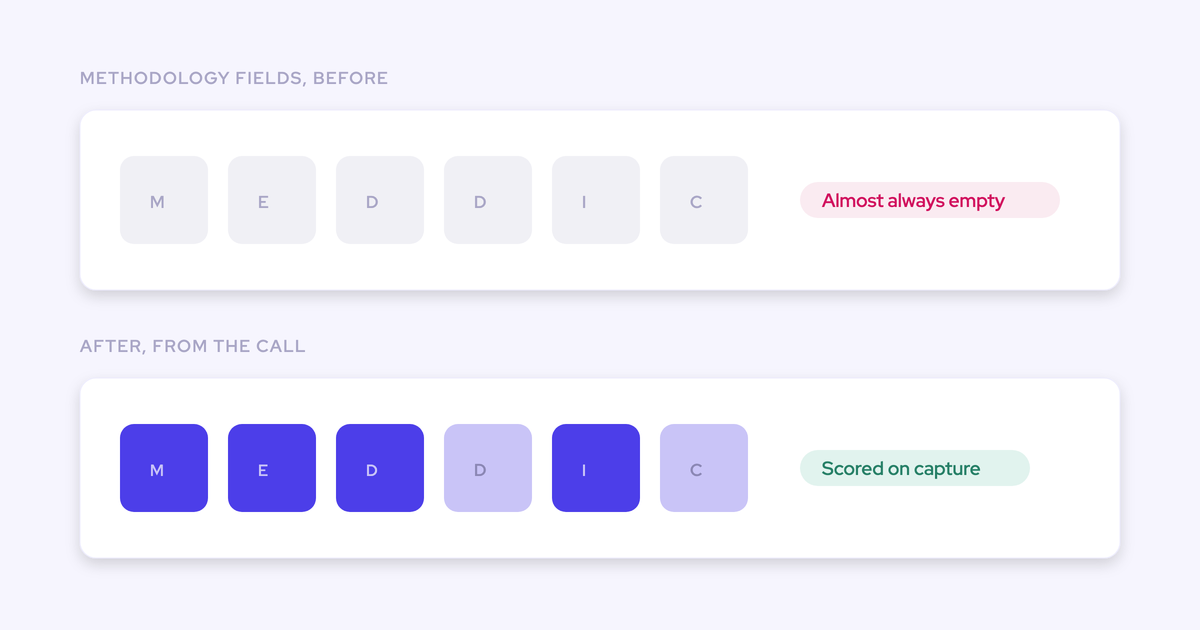
The manager explains that reps are expected to update MEDDIC fields and next steps after every call, but compliance is around 40%. Most updates happen in bulk on Friday afternoons.
Problem: "When 60% of deal updates are missing or delayed, how does that affect your ability to coach reps during the week?"
The manager says they end up in one-on-one Slack conversations asking reps for updates—which takes time and doesn't scale.
Implication: "If you're spending two to three hours per week chasing updates instead of coaching, what's the impact on your team's win rate and rep development?"
The manager estimates they have about half the coaching capacity they should, and two underperforming reps might have improved faster with more hands-on guidance.
[banner type="download" url="https://www.weflow.ai/resources/cheat-sheets/sales-methodology-cheat-sheet" text="Sales Methodology Cheat Sheet" subtitle="Pick the right framework for your deal motion without rereading four books" button="Get the cheat sheet"]
Need-Payoff: "If MEDDIC fields and deal updates were populated automatically from call recordings and emails, how would you use that extra coaching time?"
The manager says they'd run targeted coaching sessions on specific deal objections and pipeline gaps instead of administrative check-ins.
How to craft your own SPIN questions (step-by-step)
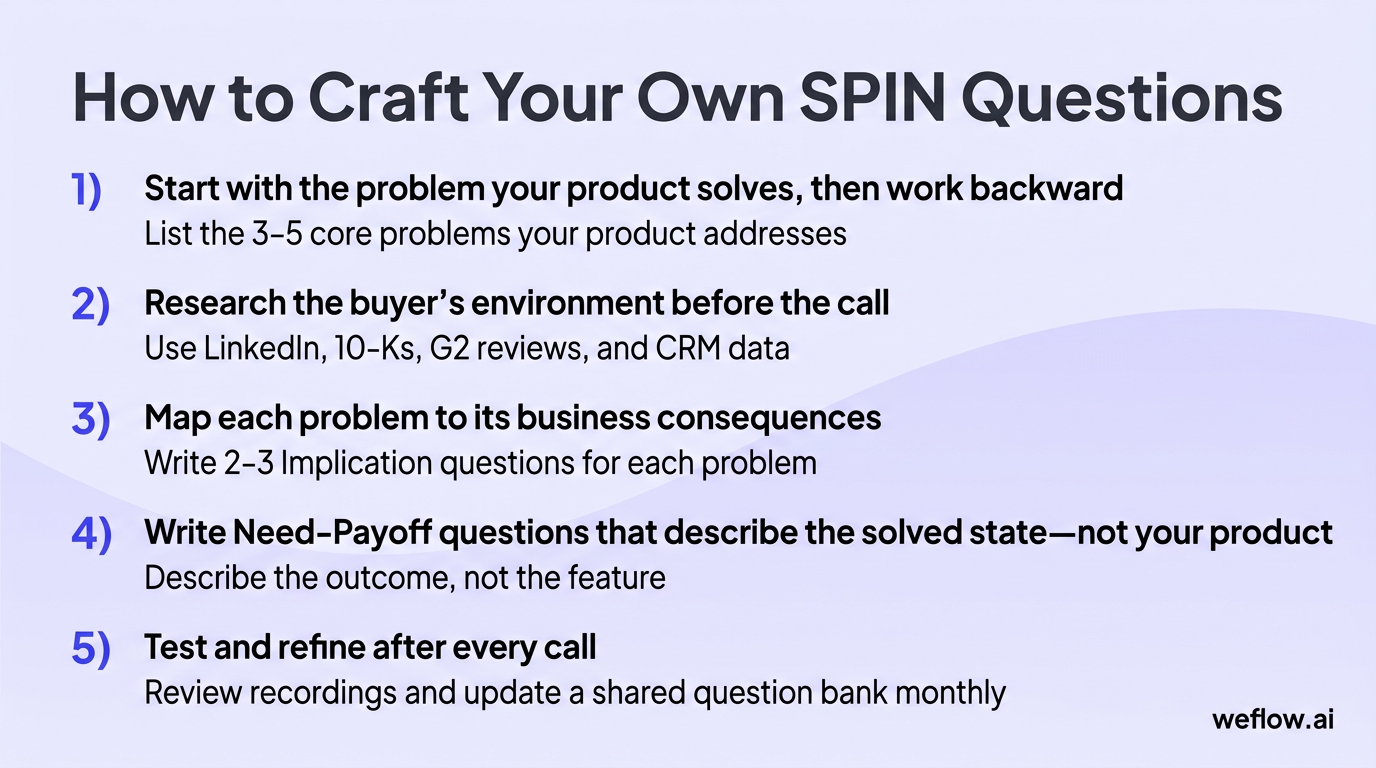
- Start with the problem your product solves, then work backward.
List the three to five core problems your product addresses. For each problem, write down the typical symptoms a buyer would experience. These symptoms become your Problem questions.
- Research the buyer's environment before the call.
Use LinkedIn, the company's 10-K or investor materials, G2 reviews of their current tools, and any existing CRM data to answer as many Situation questions as possible before you ask them. This lets you skip basic fact-gathering and jump to higher-value questions.
- Map each problem to its business consequences.
For every Problem question, write two to three Implication questions that explore the downstream effects. Think about impact on revenue, time, cost, team morale, customer experience, and strategic goals. The more specific the implication, the more urgency it creates.
- Write Need-Payoff questions that describe the solved state—not your product.
Need-Payoff questions should describe the outcome, not the feature. "If your pipeline updated automatically" is better than "If you used our automated CRM sync tool." Let the buyer connect the dots between the outcome and your product.
- Test and refine after every call.
Record your discovery calls (with permission) and review which questions generated the best responses. Questions that lead to buyer monologues—where they describe their pain in detail—are working. Questions that get one-word answers need reworking. Build a shared question bank with your team and update it monthly.
Common SPIN selling mistakes (and how to avoid them)
- Asking too many Situation questions. Rackham's data showed an inverse correlation between the number of Situation questions and call success. Every Situation question you can answer through research is one less question that wastes the buyer's time. Limit yourself to three to five Situation questions per call.
- Skipping Implication questions entirely. Most reps go straight from identifying a problem to pitching the solution. Without Implication questions, the buyer acknowledges the problem but doesn't feel the urgency to act. The problem feels like a mild inconvenience, not a business-critical issue.
- Turning Need-Payoff questions into leading questions. "Wouldn't it be great if you had a tool that does X?" isn't a Need-Payoff question—it's a pitch disguised as a question. Genuine Need-Payoff questions let the buyer define the value: "How would your process change if X were possible?"
- Following the question list like a script. SPIN is a framework, not a checklist. The best reps use it as a mental model for steering conversations, not as a rigid sequence they follow question by question. If the buyer volunteers a problem before you've finished Situation questions, follow that thread.
- Using SPIN on transactional deals where it doesn't fit. SPIN was designed for complex, multi-stakeholder sales with long cycles. If you're selling a $50/month tool with a two-day sales cycle, a full SPIN sequence will feel heavy and unnatural. Match the methodology to the deal complexity.
SPIN selling vs. other sales methodologies
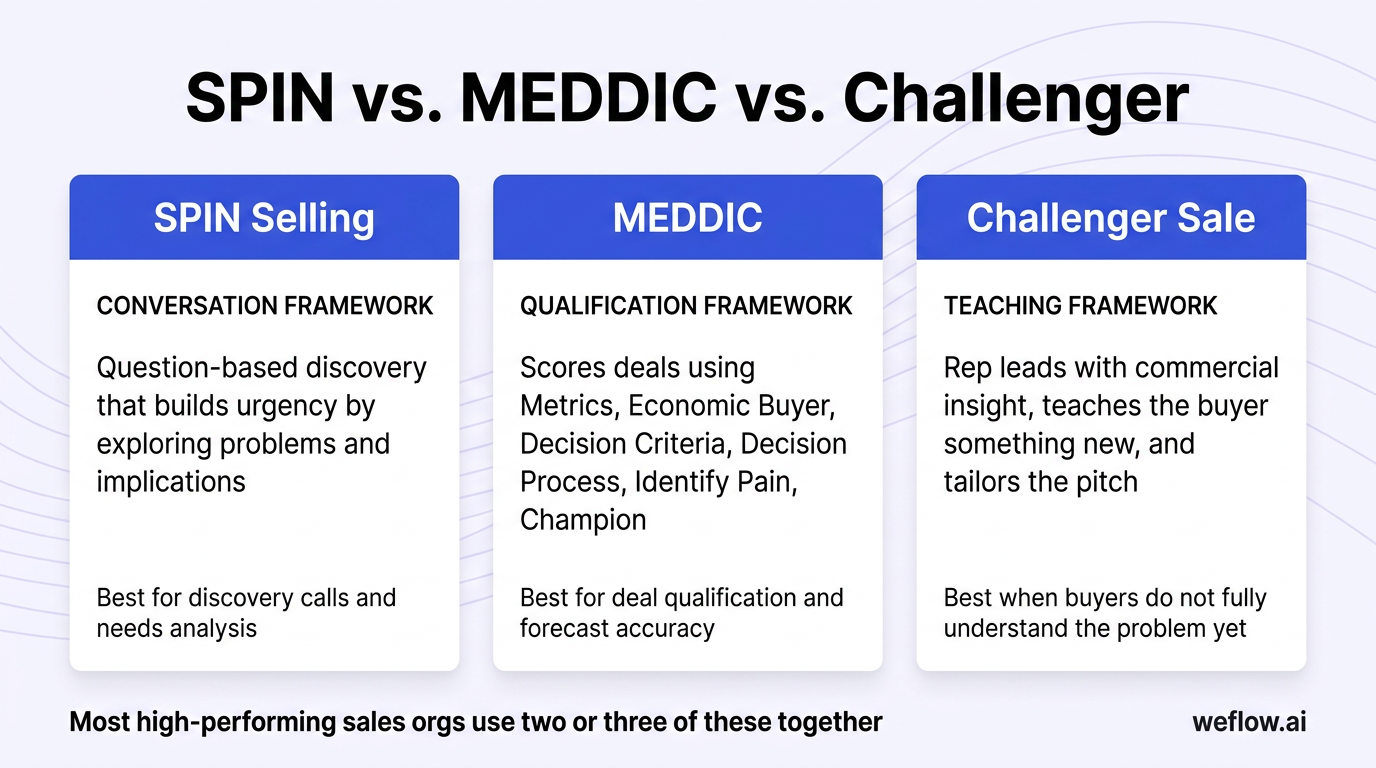
SPIN Selling isn't the only framework for complex sales—but it serves a different purpose than most alternatives. Here's how it compares to three other widely used methodologies.
| Methodology | Core Approach | Best For | Pairs Well With |
|---|---|---|---|
| SPIN Selling | Question-based discovery that builds urgency by exploring problems and their implications | Discovery calls, needs analysis, early-stage deal qualification in complex B2B sales | MEDDIC (for deal qualification), Challenger (for insight delivery after discovery) |
| MEDDIC | Qualification framework that scores deals on Metrics, Economic Buyer, Decision Criteria, Decision Process, Identify Pain, Champion | Deal qualification, pipeline inspection, forecast accuracy in enterprise sales | SPIN (for the discovery conversations that uncover MEDDIC inputs) |
| Challenger Sale | Rep leads with commercial insight, teaches the buyer something new, and tailors the pitch to the stakeholder | Deals where the buyer doesn't fully understand the problem yet, or where differentiation is hard | SPIN (Challenger teaches, then SPIN questions confirm the buyer's recognition of the problem) |
| Sandler Selling System | Buyer-led process where the rep acts as a consultant, qualifies hard upfront, and avoids "chasing" deals | Sales cultures that emphasize mutual qualification and avoiding unwinnable deals early | SPIN (Sandler's pain-finding step uses similar questioning techniques to SPIN's Problem and Implication questions) |
The key distinction: SPIN is a conversation framework—it tells you how to run a discovery call. MEDDIC is a qualification framework—it tells you whether a deal is worth pursuing. Challenger is a teaching framework—it tells you how to position your insight. Most high-performing sales orgs use two or three of these together rather than choosing one.
When to use SPIN selling (and when to choose a different framework)
Use SPIN when:
- You're selling complex B2B products with deal cycles longer than 30 days
- Multiple stakeholders are involved in the buying decision
- The buyer may not fully understand the scope of their problem
- Your product's value depends on the buyer's specific context and pain points
- You need to build urgency without high-pressure tactics
Consider a different approach when:
- The deal is transactional with a short sales cycle and a single decision-maker
- The buyer already knows exactly what they need and is comparing vendors on features and price
- You're in a market where the buyer doesn't recognize they have a problem—Challenger's teaching approach may be more effective for creating demand
Your next step: Pick five deals in your current pipeline. For each one, write two Implication questions and one Need-Payoff question based on the problems you've already identified. Use those questions in your next call and track whether they change the conversation's trajectory. That's the fastest way to see whether SPIN works for your sales motion.
Frequently asked questions about SPIN selling
What does SPIN stand for in sales?
SPIN stands for Situation, Problem, Implication, and Need-Payoff. These are the four types of questions that Neil Rackham identified as the pattern behind successful complex sales calls. Each question type serves a specific purpose in moving the buyer from awareness of a problem to commitment to solve it.
What is an example of a SPIN selling question?
An Implication question example: "If your forecast is off by 20% because pipeline data is stale, how does that affect your ability to plan headcount for next quarter?" This question takes a confirmed problem (inaccurate pipeline data) and explores its business impact (bad hiring decisions), which builds urgency to solve the root cause.
Is SPIN selling still effective in 2026?
Yes. The core principle—asking questions that help buyers understand and articulate their own problems—is more relevant than ever. B2B buyers in 2026 do more independent research before talking to sales, which means reps who just pitch features get tuned out. SPIN's question-driven approach meets buyers where they are and adds value the buyer can't get from a product page or demo video.
What is the difference between SPIN selling and the Challenger Sale?
SPIN focuses on uncovering the buyer's existing problems through questions. Challenger focuses on teaching the buyer something new about their business that reframes how they think about the problem. In practice, they complement each other: Challenger creates the "aha" moment, and SPIN questions confirm that the buyer recognizes the problem and feels urgency to act on it.
When should you use SPIN selling?
SPIN works best in complex B2B sales with deal cycles longer than 30 days, multiple stakeholders, and products where the value depends on the buyer's specific situation. It's less effective for transactional, single-call sales where the buyer already knows what they want and is comparing options on price.
How many questions should you ask in a SPIN selling call?
There's no fixed number, but Rackham's research suggests keeping Situation questions to three to five (do your research beforehand), spending most of the call on Problem and Implication questions, and using two to three Need-Payoff questions to close the loop. The total depends on call length—in a 30-minute discovery call, 10 to 15 well-chosen questions is typical.
What are the four stages of SPIN selling?
The four stages are: Opening (build rapport and set the agenda), Investigating (uncover problems using SPIN questions), Demonstrating Capability (map your solution to confirmed problems), and Obtaining Commitment (secure a specific next step). Most of the call should be spent in the Investigating stage.
Can SPIN selling be used with other sales methodologies?
Yes, and most high-performing sales teams do exactly that. SPIN pairs well with MEDDIC for deal qualification—SPIN discovery calls surface the inputs that populate MEDDIC fields. It also works alongside Challenger, where reps lead with commercial insight and then use SPIN questions to confirm the buyer's recognition of the problem. SPIN provides the conversation structure; other frameworks provide qualification criteria and strategic positioning.
-p-1600.png)

.png)
-p-1600.png)
-p-1600.png)
-p-1600.png)