
The Challenger Sales Model: Framework, Steps, and When to Use It
Learn the Challenger sales model framework, 5 steps, and when to use it in complex B2B sales.



.png)

The Challenger sales model is a B2B methodology built on CEB research across 6,000 sales reps that found relationship-building is the least effective approach in complex sales. Instead, top performers teach prospects something new, tailor their message, and take control of the conversation.
What is the Challenger sales model?
The Challenger sales model comes from The Challenger Sale, a 2011 book by Brent Adamson and Matthew Dixon based on research conducted by CEB (now Gartner). The study analyzed the attitudes and behaviors of thousands of B2B sales reps and found that they fall into five distinct profiles.
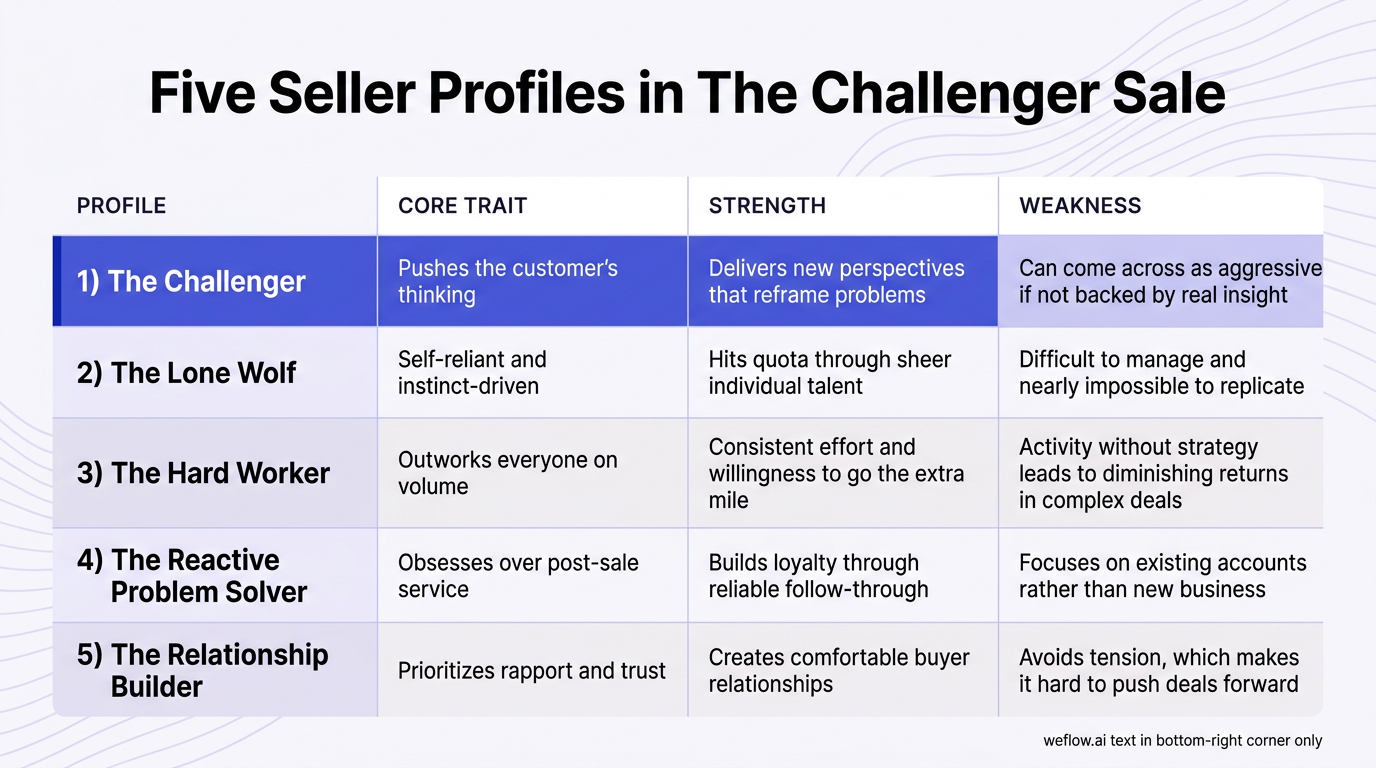
| Profile | Core Trait | Strength | Weakness |
|---|---|---|---|
| The Challenger | Pushes the customer's thinking | Delivers new perspectives that reframe problems | Can come across as aggressive if not backed by real insight |
| The Lone Wolf | Self-reliant and instinct-driven | Hits quota through sheer individual talent | Difficult to manage and nearly impossible to replicate |
| The Hard Worker | Outworks everyone on volume | Consistent effort and willingness to go the extra mile | Activity without strategy leads to diminishing returns in complex deals |
| The Reactive Problem Solver | Obsesses over post-sale service | Builds loyalty through reliable follow-through | Focuses on existing accounts rather than new business |
| The Relationship Builder | Prioritizes rapport and trust | Creates comfortable buyer relationships | Avoids tension, which makes it hard to push deals forward |
The research's most surprising finding: 40% of top-performing reps were Challengers, while Relationship Builders—the profile most sales orgs default to hiring—were the lowest-performing group in complex sales environments. In straightforward, transactional deals the difference between profiles was small. But as deal complexity increased, Challengers pulled ahead by a wide margin.
This doesn't mean relationships don't matter. It means that in complex B2B sales with multiple stakeholders, long evaluation cycles, and high switching costs, the ability to teach, differentiate, and maintain control of the buying process matters more than being likable.
Teach, tailor, take control: the core Challenger framework
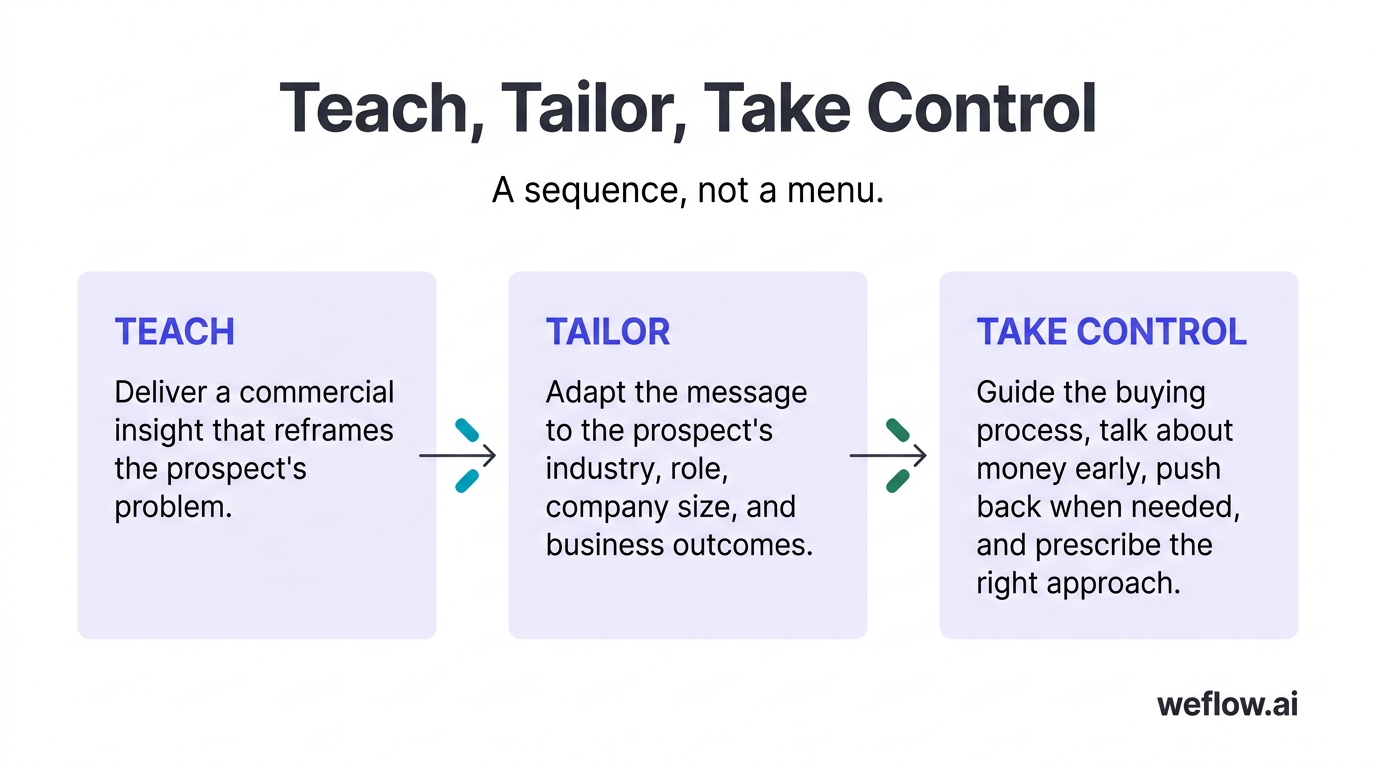
The Challenger approach rests on three skills—teach, tailor, take control—that work together as a sequence, not a menu. You lead with insight, adapt it to the person across the table, and guide the deal through to close.
Teach
Teaching in the Challenger context doesn't mean educating prospects about your product. It means delivering a commercial insight—a perspective the prospect hasn't considered that reframes how they see their own problem. The insight should make the prospect say "I hadn't thought about it that way," not "Tell me about your pricing."
For example: a rep selling supply chain software doesn't open with features. Instead, they show the prospect that their current supplier diversification strategy—which the prospect considers a strength—actually increases risk because it creates 40% more handoff points where errors compound. The prospect's "solution" is part of the problem. That's a commercial insight.
Tailor
A commercial insight that doesn't connect to the prospect's specific situation is just a TED Talk. Tailoring means adapting your message to the prospect's industry, role, company size, and the business outcomes they're personally measured on.
The same supply chain insight lands differently with a VP of Operations (who cares about throughput and error rates) than with a CFO (who cares about working capital tied up in redundant supplier contracts). Same underlying data, different framing, different emotional weight. Tailoring is the work of making your insight feel like it was built for one person.
Take control
Taking control means guiding the buying process—including the uncomfortable parts. That includes talking about money early, pushing back when a prospect asks for a discount before seeing a demo, and being willing to say "That's not the right approach for your situation" when a prospect pushes toward a solution that won't work.
This doesn't mean being combative. It means being confident enough in your diagnosis to prescribe. A doctor who agrees with everything the patient suggests isn't a good doctor. A Challenger rep who lets the prospect run the conversation is just a Relationship Builder with a better pitch deck.
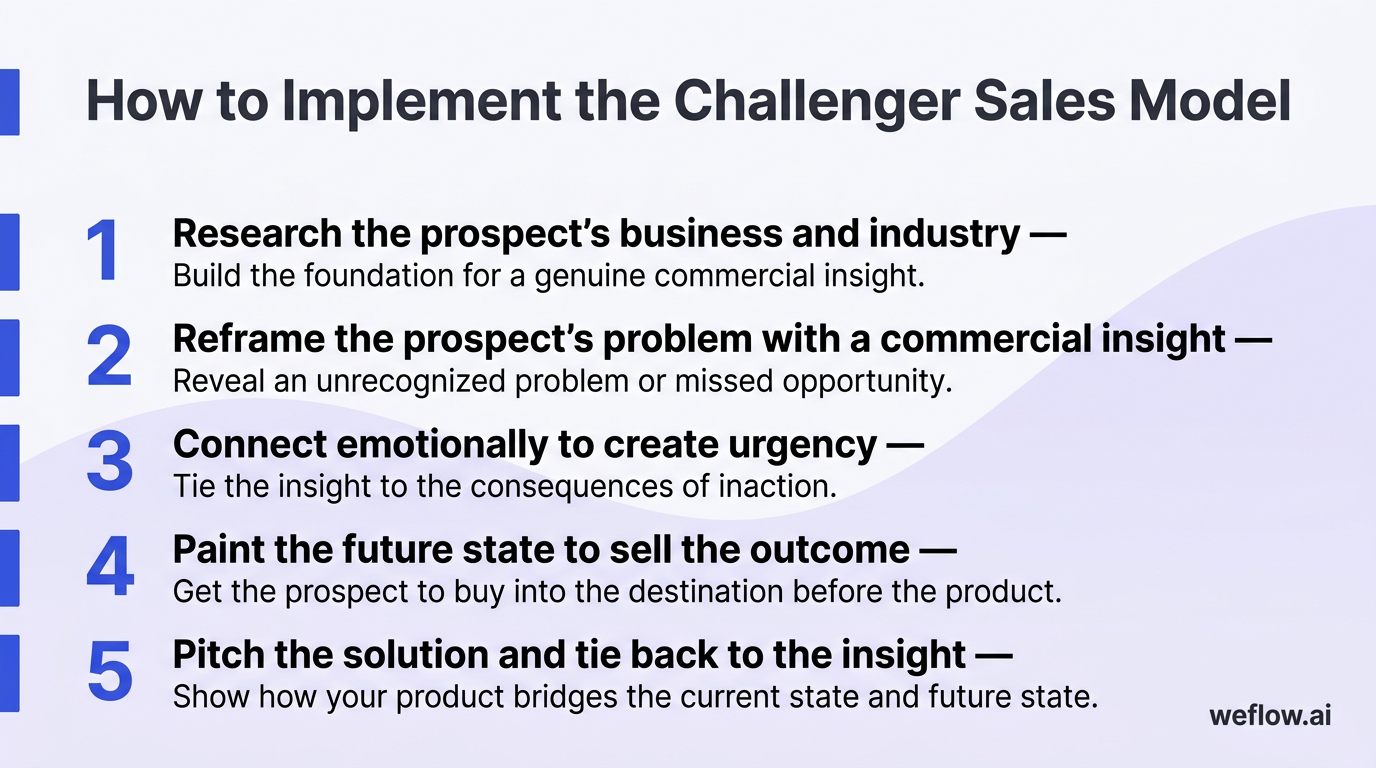
How to implement the Challenger sales model: 5 steps
Step 1: Research the prospect's business and industry
Challengers earn the right to teach by knowing more about the prospect's business than the prospect expects. This isn't a five-minute LinkedIn scan. It's sustained research across multiple sources that builds the foundation for a genuine commercial insight.
| Research Source | What to Look For | How It Helps |
|---|---|---|
| Earnings calls and investor presentations | Strategic priorities, stated risks, growth targets | Gives you the language executives use internally to describe their own challenges |
| Industry publications and analyst reports | Market trends, regulatory shifts, competitive pressure | Helps you identify problems the prospect may not have connected to their own business yet |
| Competitor materials and case studies | How competitors position against the prospect's company | Reveals blind spots—areas where the prospect's strategy may be vulnerable |
| Customer conversations and support data | Common complaints, feature requests, churn reasons | Surfaces operational pain that doesn't show up in public-facing content |
| Job postings from the prospect's company | New roles being hired, skills being sought | Signals organizational priorities and potential gaps in current capabilities |
The goal isn't to memorize facts about the company. It's to develop a hypothesis about a problem the prospect either doesn't see or underestimates—and to back that hypothesis with enough evidence to be credible.
Step 2: Reframe the prospect's problem with a commercial insight
A commercial insight isn't a new feature benefit or a clever statistic. It's a reframing of the prospect's current situation that reveals an unrecognized problem or a missed opportunity they haven't connected to their business outcomes.
Here's how reframing works in practice:
[banner type="download" url="https://www.weflow.ai/resources/cheat-sheets/challenger-checklist" text="Challenger Sales Questions Checklist" subtitle="Reframe a prospect's problem on the call instead of after it" button="Get the checklist"]
- Before: The prospect believes their 85% customer retention rate is a sign of product-market fit and focuses on new acquisition.
- Insight: Your research shows that their retained customers' average contract value has declined 22% over three years—they're keeping customers but losing revenue per account.
- Reframe: The real growth problem isn't acquisition. It's that existing accounts are quietly shrinking, and the retention metric is masking a revenue erosion pattern that will compound.
Notice what happened: the prospect's perceived strength (high retention) became the problem. That's the Challenger move. You're not finding fault—you're revealing something they couldn't see from inside their own data.
Step 3: Connect emotionally to create urgency
Data alone doesn't create urgency. People change behavior when they feel the consequences of inaction, not when they understand them intellectually. After you've reframed the problem, connect it to the personal and business stakes that matter to the person in front of you.
Using the retention example: "If that revenue erosion continues at the current rate, you're looking at a $4.2 million gap in three years—roughly the size of your entire expansion target. That means your team hits every new-logo goal and still comes up short on the board number. The effort is there, but the math doesn't work." Now the insight has weight. The prospect can see themselves in the scenario, and the cost of doing nothing has a number attached to it.
Step 4: Paint the future state to sell the outcome
Before you talk about your product, get the prospect to buy into the destination. What does their business look like when this problem is solved? What metrics improve? What work disappears?
This step exists because prospects don't buy products—they buy outcomes. If you jump from "here's your problem" to "here's our software," you've skipped the step where the prospect emotionally commits to change. The future state should be specific: "Your account management team flags at-risk revenue within 30 days of the first contraction signal. Expansion conversations start before renewal, not after. Your net revenue retention moves from 95% to 115% within four quarters." The prospect should be nodding before you name your product.
Step 5: Pitch the solution and tie back to the insight
Now—and only now—introduce your solution. The pitch should connect directly to the commercial insight and the future state. Every capability you mention should map to a piece of the problem you just reframed.
This isn't the place for a feature walkthrough. It's the place to show how your product is the bridge between the prospect's current (broken) state and the future they just agreed they want. Keep it tight: three to four capabilities that directly address the insight, with clear ties to the outcomes discussed.
Close with a concrete next step—a demo focused on their specific scenario, a pilot program, or a trial. The ask should feel like a natural extension of the conversation, not a hard close.
Challenger sales vs. other methodologies
| Methodology | Core Approach | Best For | Key Difference from Challenger |
|---|---|---|---|
| SPIN Selling | Uses a question sequence (Situation, Problem, Implication, Need-payoff) to guide prospects to self-discover their pain | Consultative selling where the prospect knows they have a problem but hasn't quantified it | SPIN uncovers existing pain through questions; Challenger introduces new pain the prospect hadn't recognized |
| MEDDIC | Qualification framework that maps Metrics, Economic Buyer, Decision criteria, Decision process, Identify pain, and Champion | Enterprise sales with long cycles and complex buying committees | MEDDIC qualifies and navigates deals; Challenger shapes the buying criteria before qualification begins |
| Sandler Selling | Puts the prospect in the driver's seat through upfront contracts and mutual qualification | Sales environments where prospects are used to being "sold to" and put up walls | Sandler avoids pressure by letting prospects self-qualify; Challenger applies constructive pressure through insight |
| Consultative Selling | Positions the rep as a trusted advisor who deeply understands the prospect's business | Relationship-driven sales where trust is the primary currency | Consultative selling builds trust through listening and understanding; Challenger builds trust through teaching and reframing |
| Solution Selling | Diagnoses pain points and maps product capabilities to those specific problems | Product-heavy sales where features map directly to known buyer needs | Solution Selling solves problems the prospect already knows about; Challenger surfaces problems the prospect hasn't identified |
These methodologies aren't mutually exclusive. Many sales orgs combine Challenger's teaching approach with MEDDIC's qualification rigor or SPIN's questioning techniques. The distinction is in the starting point: Challenger leads with insight rather than discovery, which works best when prospects don't know what they don't know.
When should you use the Challenger sales model? (And when to avoid it)
The Challenger approach works best when:
- You're selling complex B2B solutions with deal sizes above $50K and sales cycles longer than 60 days
- Multiple stakeholders are involved in the buying decision and need to be aligned around a common problem
- Prospects are overwhelmed with options and struggle to differentiate between vendors on features alone
- The status quo is your biggest competitor—prospects don't yet see why they need to change
- Your product solves a problem that prospects don't know they have or underestimate the cost of
- Buyers have already done extensive research and a basic needs assessment won't add value
Avoid the Challenger approach when:
- The sale is transactional with a short cycle—the buyer already knows what they want and just needs pricing and logistics
- Your reps lack deep industry expertise to credibly deliver commercial insights (teaching without substance backfires)
- The product is a commodity with minimal differentiation—there's no insight to deliver if every vendor solves the problem the same way
- The buying process is fully standardized (RFPs, procurement-led) and there's no room to reshape the conversation
- Your sales cycle is under two weeks and adding a teaching phase would slow down deals that would close anyway
Pros and cons of the Challenger sales model
Pros:
- Differentiates your reps from competitors who all run the same discovery-demo-proposal playbook
- Gives sales teams a repeatable structure (teach, tailor, take control) that can be coached and measured
- Works when the status quo is the real competitor—Challengers create urgency where none existed
- Backed by large-scale research (6,000+ reps) rather than anecdotal best practices
- Positions reps as experts rather than vendors, which builds long-term credibility with senior buyers
- Reduces reliance on discounting—when you've changed how the prospect thinks about the problem, price becomes less central
Cons:
[banner type="download" url="https://www.weflow.ai/resources/cheat-sheets/sales-methodology-cheat-sheet" text="Sales Methodology Cheat Sheet" subtitle="Pick the right framework for your deal size, cycle, and buying committee" button="Get the cheat sheet"]
- Requires deep industry knowledge that takes months to develop—you can't fake a commercial insight
- Not every rep can execute it. The research itself showed only 40% of top performers were natural Challengers
- The "take control" element can alienate prospects if the rep doesn't read the room well
- Developing commercial insights at scale is hard—most orgs struggle to create more than a handful of quality teaching pitches
- Less effective for simple, transactional sales where the buyer already knows what they need
- Can create internal friction if the org's culture is relationship-first and reps resist the shift to constructive tension
How to train your sales team on the Challenger method
Adopting the Challenger model isn't a one-day workshop. It requires sustained investment in three areas: knowledge, practice, and coaching.
Build industry knowledge first. Before reps can teach, they need something worth teaching. Invest in regular industry briefings, competitive intelligence updates, and structured research time. The best Challenger orgs dedicate two to four hours per week per rep to research and insight development—not as optional self-study, but as protected calendar time.
Practice through role-play. Commercial insights sound good on a slide. Delivering them to a skeptical VP who thinks they already understand their own business is a different skill. Run weekly role-play sessions where reps practice delivering insights, handling pushback, and maintaining control when the conversation gets uncomfortable. Record these sessions and review them as a team.
Coach to the framework, not just the outcome. Managers should evaluate reps on whether they delivered a genuine commercial insight, tailored it to the prospect's context, and maintained control of the buying process—not just whether the deal closed. A rep who closes a deal by discounting 30% hasn't used the Challenger method. A rep who loses a deal but delivered a sharp insight and held firm on pricing is building the right muscles.
Create a shared insight library. Don't expect every rep to develop insights from scratch. Build a central repository of commercial insights organized by industry, company size, and persona. Update it monthly with new data points and customer feedback. The best insights often come from post-call debriefs where a rep's reframe landed and the prospect's reaction confirmed it hit home.
Why the Challenger sales model works for complex B2B deals
Complex B2B buying has shifted. Gartner research shows the average deal now involves six to 10 stakeholders, and buyers spend only 17% of their total buying time meeting with sales reps. In that environment, the rep who simply builds rapport and asks good questions gets lost in the noise. The rep who teaches the buying committee something they didn't know—and gives them a framework for making the decision—becomes the one who shapes the deal. That's what the Challenger model does: it turns your sales team from one of many vendors into the source of the insight that drives the purchase.
Frequently asked questions
What is the Challenger sales model?
The Challenger sales model is a B2B sales methodology developed by Brent Adamson and Matthew Dixon based on CEB research across 6,000 sales reps. It's built on the finding that top-performing reps win by teaching prospects new perspectives, tailoring their message to individual stakeholders, and taking control of the buying process—rather than relying on relationship-building.
Does the Challenger sales method still work?
Yes, and the case has only gotten stronger since the book was published in 2011. B2B buying committees have grown larger, sales cycles have gotten longer, and buyers do more independent research before engaging a rep. All of these trends favor the Challenger approach—reps who bring new insight the buyer couldn't find on their own carry more influence than reps who simply respond to stated needs.
What are the three T's of Challenger selling?
Teach, tailor, take control. Teach means delivering a commercial insight that reframes the prospect's problem. Tailor means adapting that insight to the specific person's role, industry, and business drivers. Take control means guiding the buying process—including money discussions, timelines, and pushback—rather than following the prospect's lead.
What is the difference between Challenger selling and consultative selling?
Consultative selling starts with listening: the rep asks deep questions to understand the prospect's situation and then recommends a solution. Challenger selling starts with teaching: the rep arrives with a perspective the prospect hasn't considered and uses it to reshape how the prospect thinks about their problem. Consultative selling builds trust through understanding. Challenger selling builds trust through insight.
How is the Challenger sales model different from SPIN selling?
SPIN Selling uses a structured question sequence to help prospects discover and quantify pain they already feel. The Challenger model introduces pain the prospect didn't know existed. SPIN works well when the prospect has a known problem but hasn't built the business case to solve it. Challenger works when the prospect doesn't realize they have a problem in the first place.
Can any sales rep become a Challenger?
The CEB research found that while only 40% of top performers were natural Challengers, the behaviors can be learned. The key requirements are deep industry knowledge, comfort with constructive tension, and organizational support for developing commercial insights. Reps who struggle most with the transition are those who avoid conflict—the "take control" element is the hardest skill to coach.
When should you NOT use the Challenger sales model?
Avoid it in transactional sales where the buyer already knows what they want, in markets where your product is a commodity with no meaningful differentiation, and when your reps lack the industry expertise to deliver credible insights. A poorly executed Challenger pitch—where the "insight" is generic or wrong—does more damage than a standard consultative approach.
What are the five seller profiles in The Challenger Sale?
The five profiles are: the Challenger (teaches and pushes the customer's thinking), the Lone Wolf (follows instincts and resists management), the Hard Worker (outworks everyone on activity volume), the Reactive Problem Solver (focuses on post-sale service and reliability), and the Relationship Builder (prioritizes rapport and personal connection). Of these, Challengers made up 40% of top performers, while Relationship Builders were the lowest-performing group in complex sales.
-p-1600.png)

.png)
-p-1600.png)
-p-1600.png)
-p-1600.png)