
Conceptual Selling: Methodology, Questions, and Examples
Learn conceptual selling methodology, key questions, and examples for B2B sales teams.




Conceptual selling is a sales methodology created by Robert Miller and Stephen Heiman that focuses on selling the buyer's desired outcome rather than the product itself. Instead of pitching features, reps uncover what the buyer is trying to achieve and position their solution as the path to that result. For B2B sales teams running complex deals with multiple stakeholders, it's one of the most effective frameworks for aligning your sales process with how buyers actually make decisions.
What is conceptual selling? The Miller Heiman methodology explained
Conceptual selling is a buyer-centric sales methodology developed by Robert Miller and Stephen Heiman, first published in their book The New Conceptual Selling. The core premise: buyers don't purchase products—they purchase the concept of what the product will do for them. Every buyer enters a sales conversation with a mental picture of the outcome they want. Your job as a seller is to understand that picture and map your solution to it.
Miller and Heiman built this framework at the same firm that created Strategic Selling (now owned by Korn Ferry). While Strategic Selling focuses on navigating complex org charts and buying influences, conceptual selling zeroes in on the discovery conversation itself—how you ask questions, understand the buyer's concept, and present your solution in terms that match their mental model.
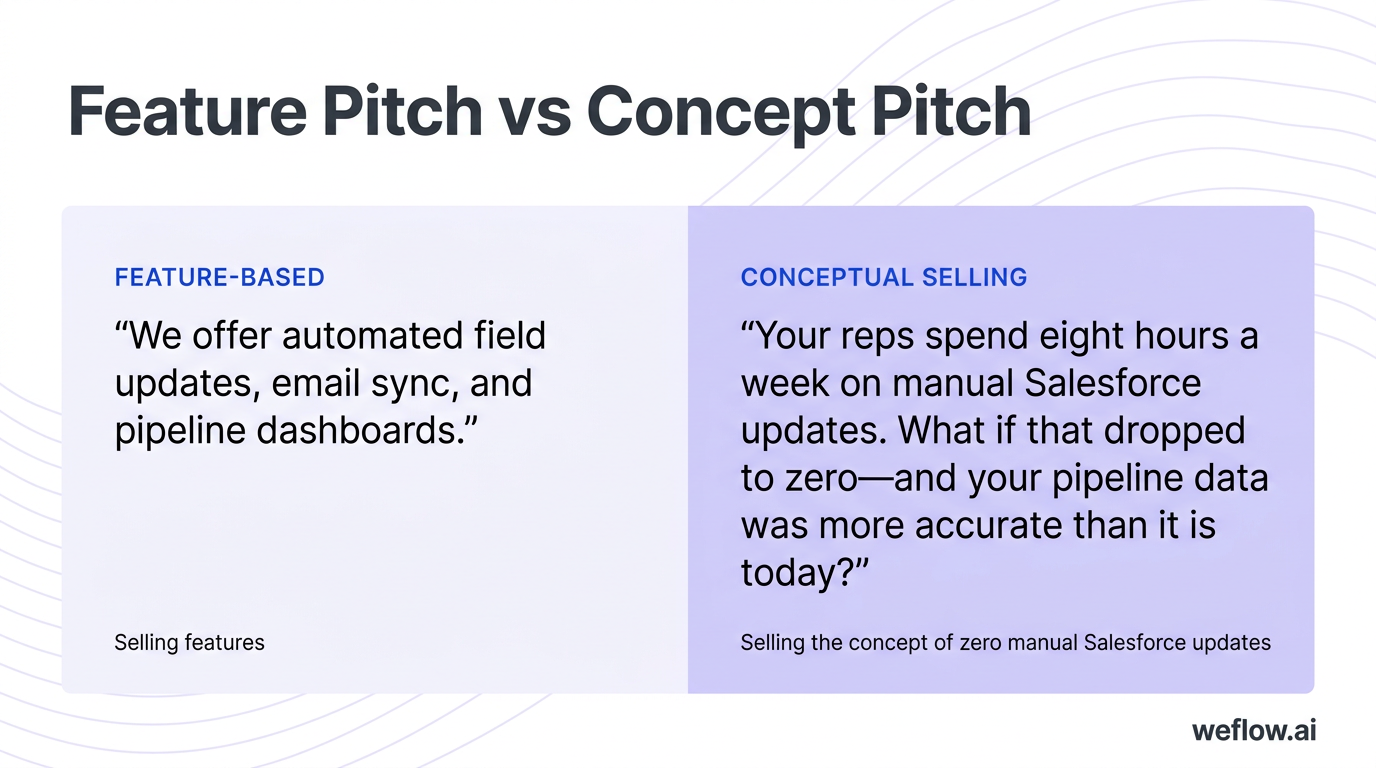
Here's the practical difference. Say you're selling a CRM automation platform. A feature-based pitch sounds like: "We offer automated field updates, email sync, and pipeline dashboards." A conceptual selling approach starts with the buyer's concept: "Your reps spend eight hours a week on manual Salesforce updates. What if that dropped to zero—and your pipeline data was more accurate than it is today?" You're selling the concept of "zero manual Salesforce updates" rather than a list of capabilities.
This distinction matters because B2B buyers—especially at the VP and C-level—don't evaluate features. They evaluate whether your solution solves a problem they care about, in a way they believe will work. Conceptual selling gives you a repeatable structure for having that conversation.
5 benefits of conceptual selling for B2B sales teams
Conceptual selling delivers specific, measurable advantages for B2B teams running complex sales cycles. Here's what changes when your team adopts this methodology:
- Deeper buyer understanding. Because conceptual selling requires you to uncover the buyer's mental model—not just their stated requirements—you surface needs that competitors miss. Reps who understand the buyer's concept can anticipate objections, align stakeholders, and tailor proposals that resonate at every level of the org.
- Shorter sales cycles. When reps align early with what the buyer is actually trying to achieve, there's less back-and-forth on scope, fewer stalled deals, and faster consensus among decision-makers. Buyers move faster when they feel understood—conceptual selling accelerates that feeling from the first discovery call.
- Higher average deal size. Reps selling the outcome rather than the product naturally expand the conversation to adjacent problems. A buyer whose concept is "trusted pipeline data for board reporting" is open to activity capture, forecasting, and analytics—not just the single feature they initially asked about. Conceptual selling opens cross-sell and upsell opportunities that feature-based pitches miss.
- Better conversion rates. When your pitch mirrors the buyer's own concept of what they need, you reduce the friction between "this sounds interesting" and "let's move forward." Deals that are concept-aligned from the start are less likely to stall at procurement or lose to "no decision."
- Stronger long-term relationships. Conceptual selling positions you as a partner who understands the buyer's business—not a vendor pushing a product. That perception carries into renewal conversations, expansion discussions, and referrals. Buyers remember who actually listened.
Limitations of conceptual selling (and how to mitigate them)
Conceptual selling isn't a fit for every deal or every team. Here are the three main limitations—and how to address each one.
| Limitation | Risk | Mitigation |
|---|---|---|
| Expectation mismatch between concept and product | If you sell an outcome your product can't fully deliver, you create a gap between the buyer's expectations and post-sale reality. This leads to churn, negative reviews, and damaged credibility. | Map every concept back to specific product capabilities during the sales process. Use a "concept-to-feature" checklist before presenting proposals. If there's a gap, address it transparently rather than hoping the buyer won't notice. |
| Requires advanced discovery skills | Junior reps or teams without formal training struggle to uncover the buyer's concept. Bad discovery leads to generic pitches disguised as conceptual selling—which is worse than a straightforward feature demo. | Invest in structured discovery training. Build question frameworks (see the five question types below) into your sales playbook. Role-play discovery calls weekly. Pair junior reps with senior sellers on complex deals until they can run discovery independently. |
| Time investment in complex discovery | Thorough concept-based discovery takes longer than a standard demo. For high-volume, transactional deals, this approach can slow down velocity without proportional return. | Reserve conceptual selling for deals above a defined threshold (e.g., $25k+ ACV or three-plus stakeholders). For smaller, simpler deals, use a lighter discovery framework and save the full conceptual approach for enterprise opportunities. |
Which sales teams should use conceptual selling?
Conceptual selling delivers the strongest results in environments where the buyer's problem is complex enough that outcomes matter more than features. These five use cases are the best fit:
- Service-based solutions. When you're selling consulting, implementation, managed services, or any offering where the deliverable is an outcome rather than a physical product, conceptual selling aligns naturally. Buyers of services already think in terms of results—your methodology should match that.
- Subscription and recurring revenue models. SaaS and subscription businesses live or die on retention. Selling the concept—not just the product—sets the right expectations from day one and reduces churn caused by misaligned buyer expectations. If your revenue depends on renewals, your sales motion should start with the buyer's long-term outcome.
- Enterprise sales with multiple decision-makers. When five to 15 stakeholders need to agree, feature comparisons create confusion. Each stakeholder has a different concept of what success looks like. Conceptual selling gives your champion a narrative that works across the buying committee—finance, operations, IT, and the end users all hear the same outcome story.
- Complex B2B products. If your product does 50 things but the buyer only cares about three, leading with all 50 features is a losing strategy. Conceptual selling forces reps to identify which three outcomes matter to this buyer and build the entire pitch around those. This is especially relevant for platforms with broad functionality—CRM, ERP, revenue intelligence, marketing automation.
- Consultative selling environments. If your reps act as advisors—diagnosing problems, recommending approaches, building custom proposals—conceptual selling is the natural methodology. It formalizes what good consultative sellers already do intuitively: start with the buyer's world, not your product catalog.
4 core principles of the conceptual selling framework
Miller and Heiman's framework rests on four principles. These aren't abstract philosophy—they're operational rules that shape every conversation your reps have with buyers.
- Sell the outcome, not the product. Every buyer has a concept—a mental picture of the result they want. Your job is to discover that concept and sell to it. A CRO whose concept is "forecast accuracy within 5% by next quarter" doesn't need to hear about your AI model's architecture. They need to hear how other CROs achieved that level of accuracy and what the path looked like. Features only matter when they connect directly to the buyer's concept.
- Align your sales process with the buyer's decision journey. Buyers don't follow your sales stages—they follow their own process for evaluating, validating, and committing. Conceptual selling requires you to map your process to theirs. That means asking where they are in their decision, who else needs to weigh in, and what would need to be true for them to move forward. Stop dragging buyers through your pipeline; walk alongside theirs.
- Structure every deal as win-win. Miller and Heiman were explicit about this: a deal where the buyer doesn't genuinely win is a loss for you too—just a delayed one. Win-win doesn't mean discounting or caving on terms. It means ensuring the buyer's concept is achievable with your solution, and being honest when it isn't. Deals closed on mismatched expectations generate churn, not revenue.
- Customize every pitch to the buyer's concept. No two buyers have the same concept, even if they're in the same industry buying the same category. The VP of Sales who wants "deal-level visibility for weekly forecast calls" has a different concept than the RevOps leader who wants "pipeline data accurate enough for board reporting." Conceptual selling prohibits one-size-fits-all decks. Every presentation, demo, and proposal should reflect what you learned in discovery about this buyer's specific concept.
How to implement conceptual selling: a step-by-step process
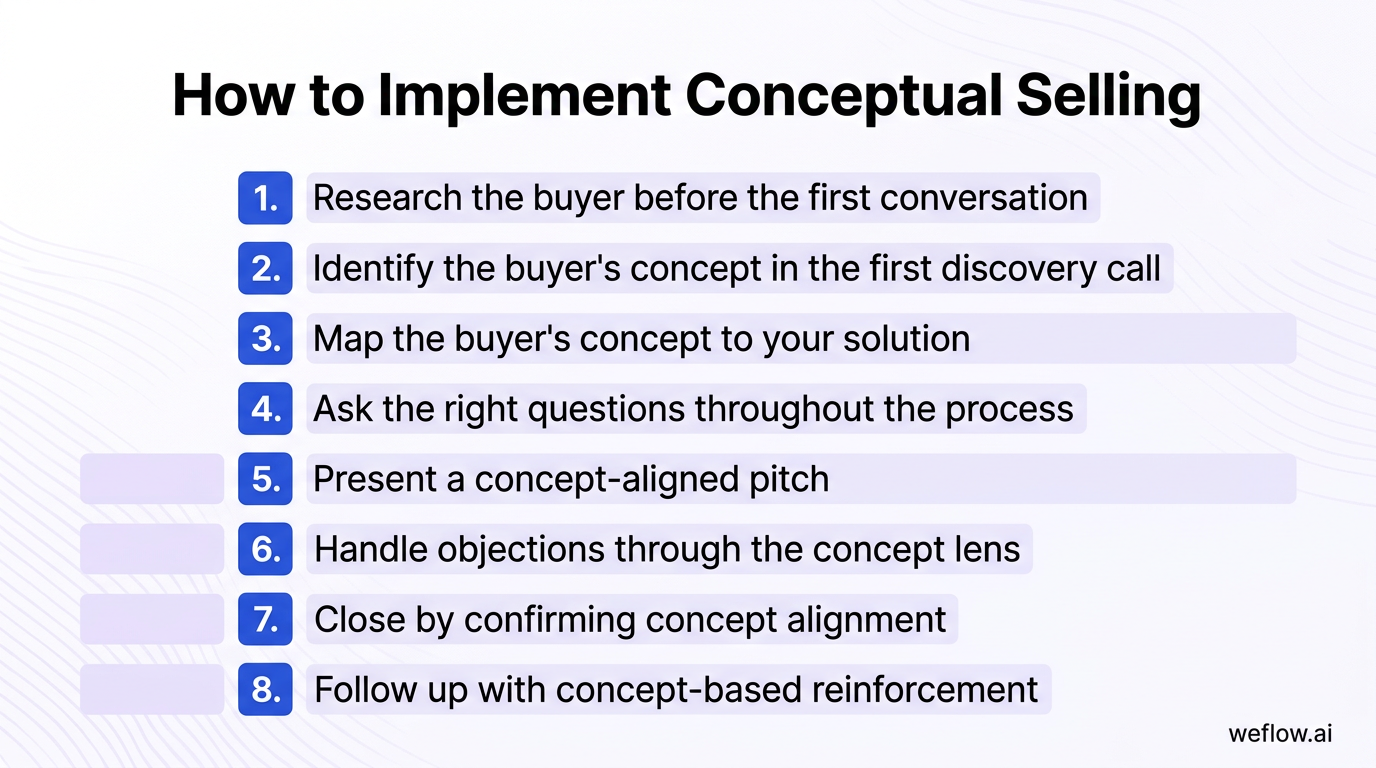
Here's a practical process for implementing conceptual selling across your team. Each step builds on the previous one.
- Research the buyer before the first conversation. Review the prospect's 10-K, recent earnings calls, LinkedIn posts from key stakeholders, and any public statements about strategic priorities. Look for signals about what outcomes they're pursuing—not just what tools they're evaluating. A CRO who just posted about "getting forecast accuracy under control" has given you their concept before you've even spoken.
- Identify the buyer's concept in the first discovery call. Use open-ended questions to uncover what the buyer is actually trying to achieve. Don't accept feature requests at face value—dig into why they want that feature. "We need better activity tracking" is a feature request. "Our pipeline data is unreliable and the board doesn't trust our forecast" is a concept. Keep asking "why" until you reach the outcome.
- Map the buyer's concept to your solution. Once you understand the concept, identify which specific capabilities in your product deliver that outcome. Build a clear, documented connection between "what the buyer wants" and "how we get them there." If there are gaps, note them now—not after the proposal is sent.
- Ask the right questions throughout the process. Use Miller and Heiman's five question types (covered in detail below) to confirm your understanding, gather new information, gauge attitudes, test commitment, and surface deal-breaking issues. Good questions do the selling for you—they help the buyer articulate their own concept and see your solution as the path to it.
- Present a concept-aligned pitch. Structure your presentation around the buyer's concept, not your product's feature list. Open with a summary of what you've heard ("You told us the core problem is X, and success looks like Y"). Walk through how your solution delivers that outcome. Use their language, reference their specific scenarios, and show them a future state that matches their mental picture.
- Handle objections through the concept lens. When objections arise, reframe them in terms of the buyer's concept. "Your price is too high" becomes "Let's revisit the outcome you described—what's the cost of not achieving that this quarter?" Objections are often signals that you haven't fully connected your solution to their concept. Go back to discovery before going to discounting.
- Close by confirming concept alignment. Before asking for the signature, confirm that the buyer's concept and your proposed solution are still aligned. Buying committees evolve, priorities shift, and new stakeholders emerge. A concept-aligned close sounds like: "Based on everything we've discussed, here's the outcome we're delivering and the path to get there—does this still match what you need?"
- Follow up with concept-based reinforcement. After the deal closes, your onboarding and customer success team should reference the original concept. "You bought Weflow because your pipeline data was unreliable and your board didn't trust the forecast. Here's how we're measuring progress toward that outcome." This creates continuity from sale to delivery and sets the stage for expansion.
The 5 types of conceptual selling questions (Miller Heiman framework)
Miller and Heiman defined five question categories that structure the discovery process. Each type serves a different purpose, and strong reps use all five in every deal.
[banner type="download" url="https://www.weflow.ai/resources/cheat-sheets/conceptual-selling-checklist" text="Conceptual Selling Checklist" subtitle="Run discovery calls that surface the buyer's real concept, not a feature wishlist" button="Get the checklist"]
| Question type | Purpose | Example questions |
|---|---|---|
| Confirmation questions | Verify your understanding of what the buyer has already told you. These prevent misalignment and show the buyer you're listening. | "Just to confirm—you mentioned that forecast accuracy is the top priority for your CRO this quarter. Is that still the case?" "You said your team spends roughly eight hours per week on manual Salesforce updates. Is that across all reps or just the enterprise segment?" |
| New information questions | Uncover facts, details, and context you don't yet have. These expand your understanding of the buyer's situation and concept. | "What does your current pipeline review process look like—who's in the room, how often, and what data do you rely on?" "How are you currently measuring activity completeness in Salesforce? Is there a report you use, or is it more of a gut check?" |
| Attitude questions | Surface the buyer's opinions, feelings, and personal stakes. These reveal what the buyer cares about beyond the official requirements. | "How do you feel about the accuracy of your current forecast—would you stake your next board presentation on those numbers?" "What's your personal take on why CRM adoption has been low with your sales team?" |
| Commitment questions | Test whether the buyer is ready to take the next step. These gauge momentum and surface blockers before they become deal-killers. | "If we can demonstrate that Weflow gets your pipeline data to 95%+ accuracy, what would the next step look like on your end?" "Who else on your team would need to see a demo before you could move to a pilot?" |
| Basic issue questions | Identify potential deal-breaking concerns early. These surface risks, objections, and misalignment before they derail the deal at the finish line. | "Is there anything about this approach that doesn't fit with how your team works today?" "What would make this a 'no' for you—even if everything else looks good?" |
Conceptual selling best practices: 5 tactics that close deals
These five tactics turn conceptual selling theory into closed revenue. Each one is specific enough to implement this week.
- Lead with active listening, not active pitching. In every discovery call, aim for a 70/30 ratio—the buyer talks 70% of the time. Take notes on their exact language and mirror it back. When a buyer says "I need my board to trust our numbers," don't translate that into your marketing language. Use their words in your follow-up: "You mentioned your board doesn't trust the numbers. Here's how we fix that." Reps who listen more close more.
- Build trust through personalized discovery. Generic discovery questions ("What keeps you up at night?") signal that you haven't done your homework. Before every call, prepare three to five questions specific to this buyer's company, role, and industry. Reference their recent earnings call, a LinkedIn post, or a competitive move in their market. Personalized discovery builds trust faster than any case study or ROI calculator.
- Find common ground early. People buy from people they trust, and trust starts with shared understanding. Find a point of connection—a shared challenge, a mutual contact, a common frustration with the status quo. If you've been in their shoes (managed a Salesforce instance, run a forecast call, dealt with low CRM adoption), say so. Authenticity isn't a tactic—it's the foundation of conceptual selling.
- Differentiate with concept-based storytelling. Instead of feature comparisons, tell stories about buyers with a similar concept. "We worked with a RevOps team of 12 who had the same problem—their pipeline data was 40% incomplete, and the CRO couldn't defend the forecast to the board. After six weeks, activity capture was running at 95%+ and the CRO presented with confidence for the first time in three quarters." Stories make concepts concrete and give buyers a mental model for what success looks like.
- Prioritize long-term relationships over short-term closes. If a buyer's concept doesn't align with what your product can deliver, say so. "Based on what you've described, I don't think we're the right fit for X—but we can solve Y, and here's a partner who handles X well." This sounds counterintuitive, but honesty builds the kind of trust that generates referrals and expansion deals. The deal you walk away from today often comes back as a bigger deal next year.
How conceptual selling compares to SPIN, Challenger, and MEDDIC
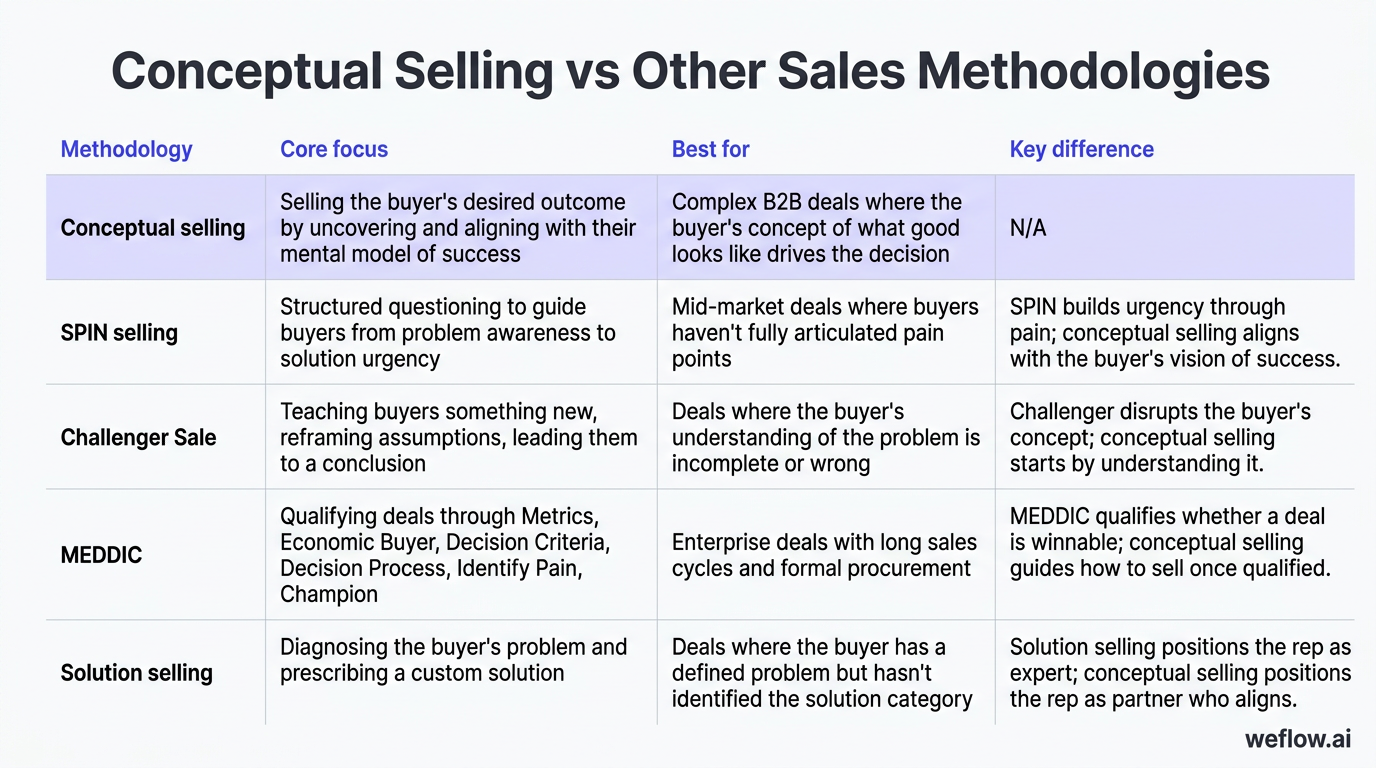
Each methodology has a different starting point and a different strength. Here's how conceptual selling stacks up against the other major frameworks B2B sales teams use.
| Methodology | Core focus | Best for | Key difference from conceptual selling |
|---|---|---|---|
| Conceptual selling | Selling the buyer's desired outcome by uncovering and aligning with their mental model of success | Complex B2B deals where the buyer's concept of "what good looks like" drives the decision | N/A (baseline) |
| SPIN selling | Structured questioning (Situation, Problem, Implication, Need-Payoff) to guide buyers from problem awareness to solution urgency | Mid-market deals where buyers haven't fully articulated their pain points | SPIN focuses on building urgency through pain—conceptual selling focuses on aligning with the buyer's existing vision of success. SPIN is more prescriptive about question sequencing; conceptual selling gives reps more flexibility in how they run discovery. |
| Challenger Sale | Teaching buyers something new, reframing their assumptions, and leading them to a conclusion that favors your solution | Deals where the buyer's current understanding of the problem is incomplete or wrong | Challenger starts by disrupting the buyer's concept—conceptual selling starts by understanding it. Challenger works when you know more than the buyer; conceptual selling works when the buyer already has a clear vision and needs a partner who shares it. |
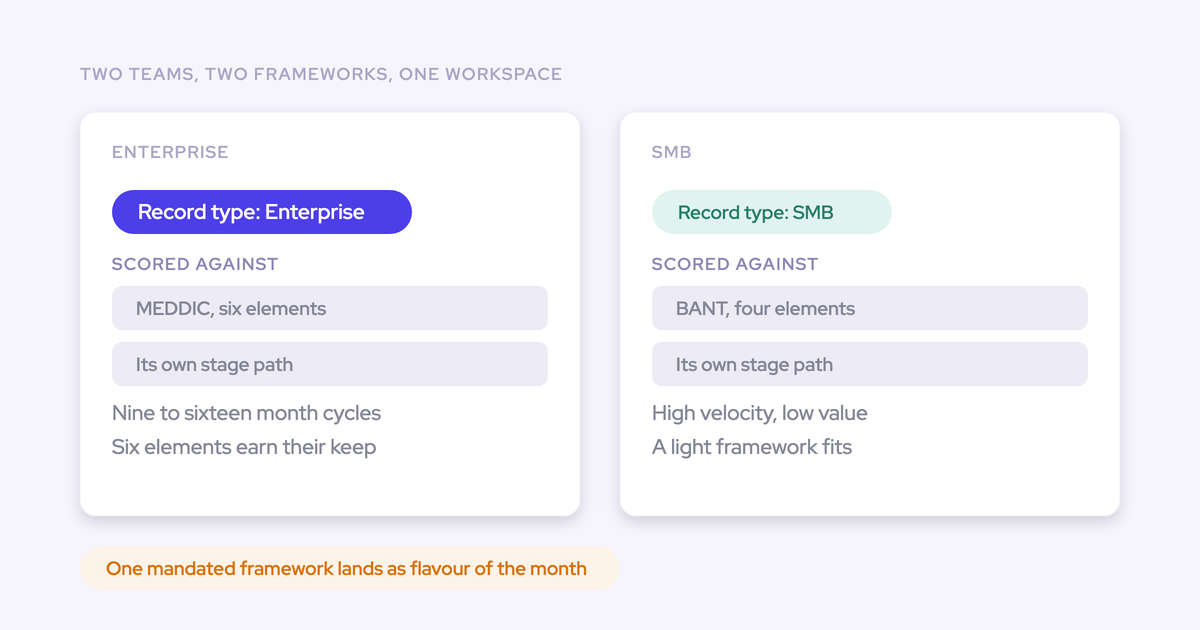
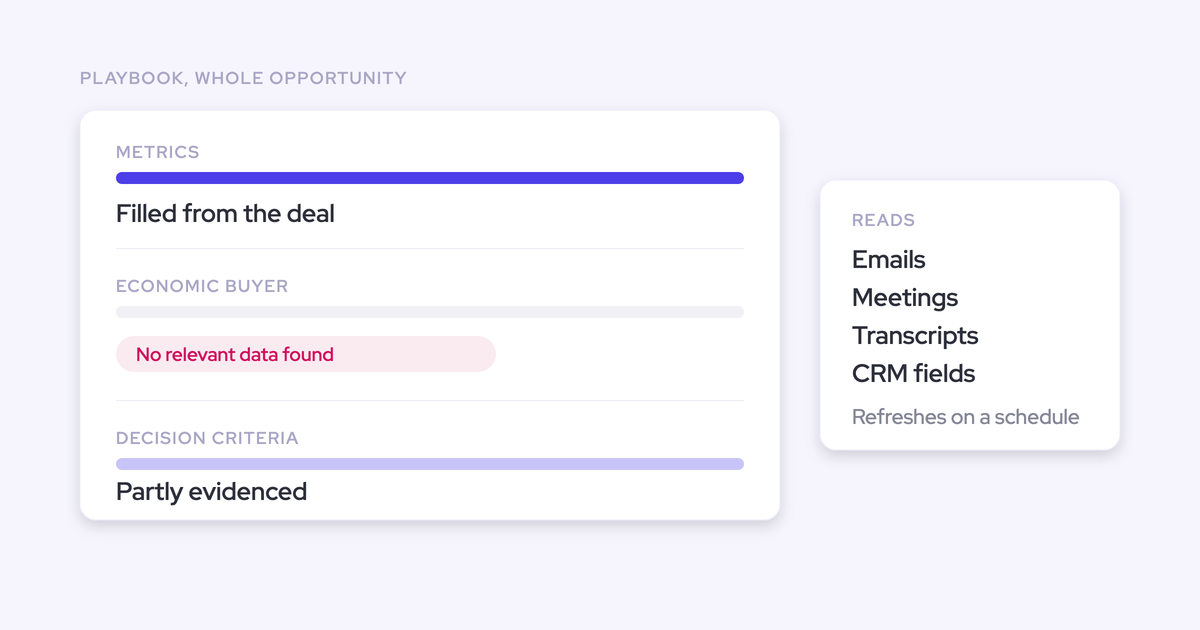
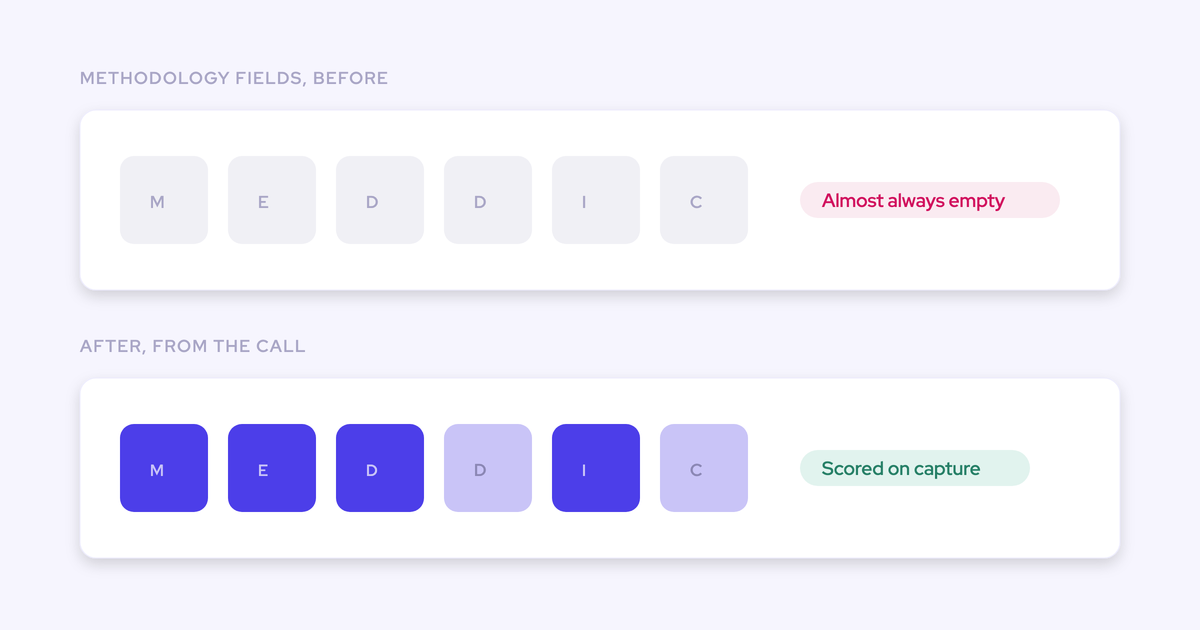
| MEDDIC | Qualifying deals through Metrics, Economic Buyer, Decision Criteria, Decision Process, Identify Pain, Champion | Enterprise deals with long sales cycles and formal procurement processes | MEDDIC is a qualification framework—it tells you whether a deal is winnable. Conceptual selling is a conversation framework—it tells you how to sell once you've qualified. Many teams use both: MEDDIC to qualify, conceptual selling to position. |
| Solution selling | Diagnosing the buyer's problem and prescribing a custom solution | Deals where the buyer has a defined problem but hasn't identified the solution category | Solution selling positions the rep as the expert who diagnoses and prescribes. Conceptual selling positions the rep as a partner who discovers and aligns. The difference is subtle but important: solution selling can feel like the rep is driving; conceptual selling keeps the buyer in the driver's seat. |
Conceptual selling in B2B SaaS: real-world examples
The gap between feature-based and concept-based positioning is clearest in B2B SaaS, where buyers are overwhelmed with similar-sounding products. These three examples show how conceptual selling changes the conversation.
Example 1: Selling a revenue intelligence platform
Feature-based pitch: "Our platform captures calls, syncs activities to Salesforce, provides conversation intelligence, and includes pipeline dashboards."
Concept-based pitch: "Your CRO told the board that forecast accuracy would be within 5% this year. Right now, your pipeline data is incomplete because reps aren't logging activities, and your forecast is built on gut feel. What if every call, email, and meeting automatically populated Salesforce—and your forecast was based on real data instead of rep estimates?"
Why this works: The buyer's concept is "forecast accuracy I can defend to the board." The concept-based pitch speaks directly to that outcome. Features become supporting evidence, not the headline.
Example 2: Selling a project management tool to a professional services firm
Feature-based pitch: "We offer Gantt charts, resource allocation, time tracking, client portals, and automated invoicing."
Concept-based pitch: "You mentioned that 30% of your projects go over budget because scope creep isn't caught until the monthly review. What if your project leads had real-time visibility into budget burn and could flag overruns the day they start—not 30 days later?"
Why this works: The buyer's concept is "catching budget overruns before they compound." Gantt charts and time tracking are means to that end—but they're not what the buyer is buying.
[banner type="download" url="https://www.weflow.ai/resources/cheat-sheets/sales-methodology-cheat-sheet" text="Sales Methodology Cheat Sheet" subtitle="Pick the right framework for each deal instead of forcing one motion across your pipeline" button="Get the cheat sheet"]
Example 3: Selling a sales engagement platform to an SDR team
Feature-based pitch: "We provide multi-channel sequencing, A/B testing, analytics dashboards, and CRM integration."
Concept-based pitch: "Your SDR team books 12 meetings per rep per month, but your target is 20. The bottleneck isn't effort—your reps are sending 200+ emails a week. The issue is that every rep is running their own playbook with no way to see what's working across the team. What if you could identify the top-performing sequences, roll them out to every rep, and get to 20 meetings without adding headcount?"
Why this works: The buyer's concept is "hit 20 meetings per rep without hiring." The concept-based pitch starts with their metric, diagnoses the structural problem, and presents the outcome—all before mentioning a single feature.
Frequently asked questions
Who created conceptual selling?
Robert Miller and Stephen Heiman created the conceptual selling methodology. They published it in The New Conceptual Selling, which became one of the foundational texts in B2B sales methodology. Miller and Heiman's consulting firm was later acquired by Korn Ferry, which now owns and continues to develop the methodology.
What are the 5 types of conceptual selling questions?
The five question types are: confirmation questions (verify what you've heard), new information questions (uncover facts you don't have), attitude questions (surface the buyer's opinions and feelings), commitment questions (test readiness to move forward), and basic issue questions (identify potential deal-breakers). Each type serves a specific purpose in the discovery process, and strong reps use all five in every deal.
How is conceptual selling different from SPIN selling?
SPIN selling uses a structured question sequence (Situation, Problem, Implication, Need-Payoff) to build urgency around the buyer's pain. Conceptual selling starts with the buyer's desired outcome—their concept of success—and builds the pitch around delivering that outcome. SPIN is more prescriptive about question order; conceptual selling gives reps more flexibility in how they structure discovery conversations.
Does conceptual selling work for B2B SaaS companies?
Yes—conceptual selling is especially effective for B2B SaaS because buyers in this space are overwhelmed by feature parity. When five competitors offer similar capabilities, the rep who sells the outcome rather than the feature list stands out. It's particularly strong for SaaS companies selling to enterprise buyers where multiple stakeholders need to align on a shared concept of success before a deal closes.
When should you not use conceptual selling?
Conceptual selling isn't the right fit for high-volume, transactional sales where the buyer already knows what they want and just needs pricing and logistics. If your average deal size is under $10k and the sales cycle is under two weeks, the time investment in deep discovery doesn't pay off. It's also harder to execute without experienced reps—teams with mostly junior sellers should invest in discovery training before adopting conceptual selling fully.
Can conceptual selling be combined with other sales methodologies?
Yes, and most high-performing sales teams do exactly that. The most common combination is MEDDIC for deal qualification and conceptual selling for positioning and discovery. MEDDIC tells you whether a deal is winnable; conceptual selling tells you how to win it. You can also layer in Challenger techniques when the buyer's concept is based on incomplete information and needs to be reframed before you can align with it.
What is the difference between conceptual selling and solution selling?
Solution selling positions the rep as an expert who diagnoses the buyer's problem and prescribes a solution. Conceptual selling positions the rep as a partner who discovers the buyer's existing concept of success and aligns the solution to it. The difference is in who drives: solution selling puts the rep in the driver's seat as the diagnostic authority, while conceptual selling keeps the buyer in control of defining what success looks like. In practice, conceptual selling tends to produce stronger buyer buy-in because the solution feels like their idea, not something that was sold to them.
-p-1600.png)

.png)
-p-1600.png)
-p-1600.png)
-p-1600.png)