
Question-Based Selling: Methodology, Question Types, and Examples
Learn question-based selling: QBS methodology, 4 question types, examples, and when to use it.




What is question-based selling? (Thomas Freese's QBS methodology explained)
Question-based selling (QBS) is a sales methodology built on a simple premise: the person asking the questions controls the conversation. Developed by Thomas Freese and detailed in his book Secrets of Question-Based Selling, QBS gives reps a structured framework for using strategic questions to uncover needs, build credibility, and guide prospects toward a buying decision. Freese didn't build this in a classroom—he built it while consistently hitting 200% of quota as an individual contributor, then codified the approach so other reps could replicate it.
The core idea separates QBS from generic "ask more questions" advice. Freese argues that most sellers ask too many questions too early, before they've earned the right to probe. QBS sequences questions deliberately: start by establishing credibility and curiosity, then earn permission to dig deeper, then use what you've learned to frame your solution in the prospect's own language. The method treats every question as a tool with a specific purpose—not filler to keep the conversation moving.
QBS works because it aligns with how buyers actually make decisions. Prospects don't buy because a rep delivered a great pitch. They buy because they've articulated their own pain, quantified the cost of inaction, and connected your solution to a business outcome they care about. QBS puts the prospect in that position by design.

The four types of QBS questions (and when to use each)
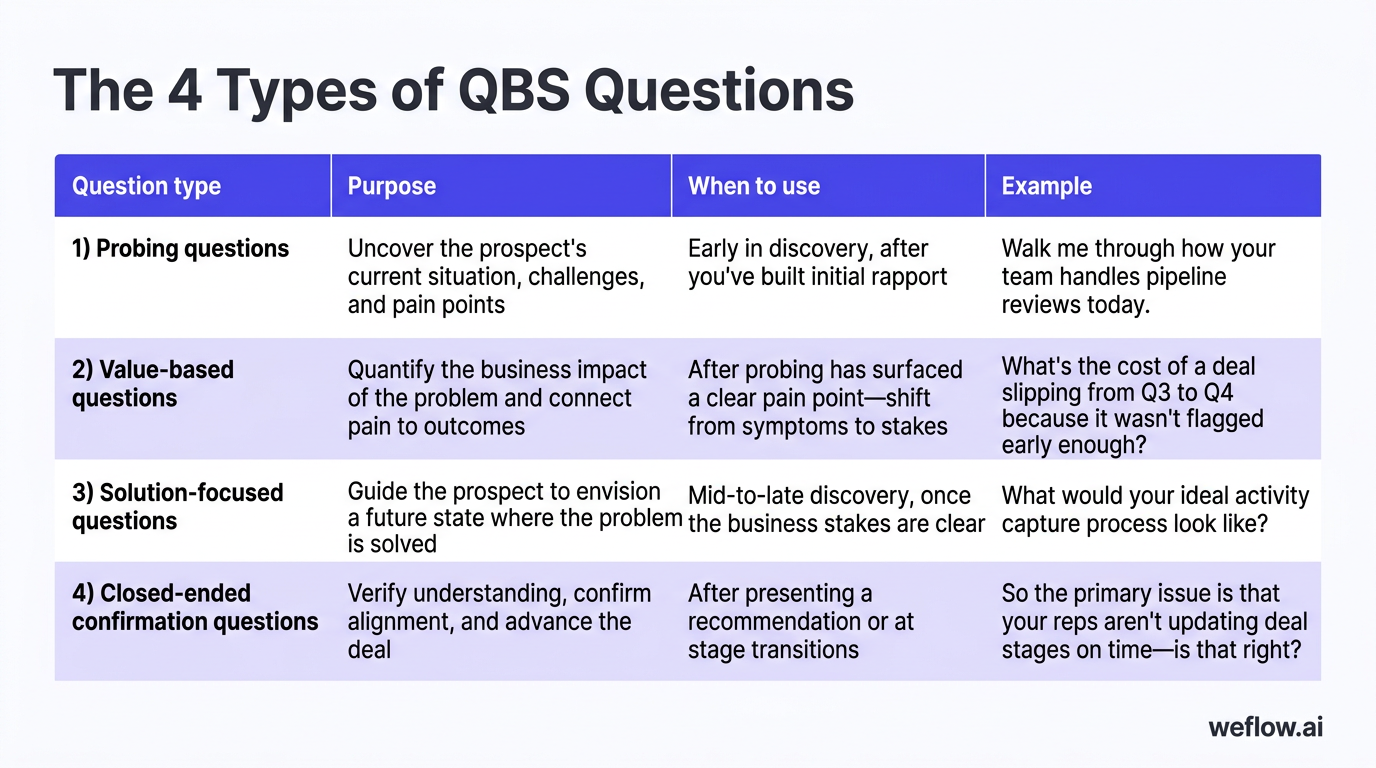
Not all questions do the same work. QBS organizes questions into four categories, each designed for a specific moment in the sales process. Using the right type at the right time is what separates QBS from a generic discovery call script.
| Question type | Purpose | When to use | Example questions |
|---|---|---|---|
| Probing questions | Uncover the prospect's current situation, challenges, and pain points | Early in discovery, after you've built initial rapport |
|
| Value-based questions | Quantify the business impact of the problem and connect pain to outcomes | After probing has surfaced a clear pain point—shift from symptoms to stakes |
|
| Solution-focused questions | Guide the prospect to envision a future state where the problem is solved | Mid-to-late discovery, once the business stakes are clear |
|
| Closed-ended confirmation questions | Verify understanding, confirm alignment, and advance the deal | After presenting a recommendation or at stage transitions |
|
Probing questions: map the current state
Probing questions do the heavy lifting in early discovery. They're open-ended, non-threatening, and designed to get the prospect talking about their world—not yours. The key is specificity. "Tell me about your challenges" is too broad. "Walk me through what happens when a rep closes a deal—who updates what, and where?" gives you a concrete picture you can work with. Good probing questions also signal competence. When you ask about specific workflows, the prospect recognizes you understand their domain.
Value-based questions: connect pain to business stakes
Once you've identified a problem, value-based questions force the prospect to quantify it. This is where discovery shifts from "that's annoying" to "that's costing us $500K a year in slipped deals." These questions are the bridge between a nice-to-have and a must-fix. They also give you the language you'll need when the deal reaches the economic buyer—because that person cares about dollars, not workflows.
Solution-focused questions: paint the future state
Solution-focused questions let the prospect sell themselves. Instead of saying "our product does X," you ask "if X were solved, what would change?" The prospect articulates the value in their own words—which is more persuasive than anything you could script. These questions also surface buying criteria you might not have anticipated. When a prospect says "the first thing I'd do is rebuild our pipeline coverage report," they're telling you exactly what success looks like for them.
Closed-ended confirmation questions: lock in alignment
Confirmation questions are the smallest category but they prevent the most costly mistakes. A well-timed "Is that right?" after summarizing the prospect's pain does two things: it proves you were listening, and it gives the prospect a chance to correct course before you build a proposal on a wrong assumption. These questions also create micro-commitments that keep the deal progressing—each "yes" makes the next "yes" easier.
Pros and cons of question-based selling
| Pros | Cons |
|---|---|
| Deeper engagement: Prospects talk more, share more, and feel heard—which builds the kind of trust that shortens evaluation cycles. | Risk of over-questioning: Reps who don't read the room can make discovery feel like an interrogation. Questions need to flow naturally, not follow a rigid script. |
| Trust-driven retention: Deals closed through QBS tend to stick. When buyers articulate their own pain and connect it to your solution, they're less likely to churn or second-guess the decision. | Poor fit for transactional sales: If you're selling a $50/month tool with a self-serve signup, QBS adds friction that doesn't match the buying motion. It's built for considered purchases. |
| Shorter sales cycles: Counterintuitively, spending more time on discovery often compresses the overall cycle. Fewer surprises at the proposal stage, fewer stalled deals, fewer "we need to loop in one more stakeholder" delays. | Requires skill and practice: QBS isn't something you teach in a one-hour enablement session. Reps need to develop the judgment to know which question type to use, when to push deeper, and when to back off. |
| Higher rep productivity: Reps spend time on deals that are genuinely qualified, because QBS surfaces misalignment early. Fewer wasted proposals, fewer dead-end demos. | Can get stuck in discovery: Some reps become so comfortable asking questions that they never transition to presenting a solution. QBS requires discipline to know when you've learned enough and it's time to recommend. |
The bottom line: QBS is a high-ceiling methodology for complex B2B sales. It rewards reps who are genuinely curious about the prospect's business and punishes reps who treat it as a checkbox exercise. If your average deal size is above $25K and involves multiple stakeholders, QBS is worth the investment in training. If you're running a high-volume, low-touch sales motion, the return won't justify the effort.
Question-based selling vs. SPIN, Sandler, and consultative selling
| Methodology | Core mechanism | Best for | Key limitation |
|---|---|---|---|
| Question-based selling (QBS) | Sequenced question types that build credibility before probing, then connect pain to business outcomes | Complex B2B sales where prospects are skeptical or guarded; deals requiring multi-stakeholder buy-in | Steeper learning curve than more prescriptive frameworks; relies on rep judgment to adapt question flow |
| SPIN Selling | Four-stage question sequence: Situation, Problem, Implication, Need-Payoff | Structured enterprise sales where reps need a repeatable formula; teams new to consultative approaches | Can feel mechanical if followed too rigidly; less emphasis on building rapport and earning the right to ask |
| Sandler Selling System | Buyer-seller dynamic management through the "pain funnel" and upfront contracts | Sales environments where prospects frequently stall, ghost, or play games; deals with entrenched procurement processes | Confrontational techniques can backfire with collaborative buyers; requires significant cultural buy-in from the team |
| Consultative selling | Positioning the rep as a trusted advisor who diagnoses before prescribing | Long-cycle enterprise deals with high trust requirements; industries where domain expertise is a differentiator | Broad philosophy with less tactical structure; reps may struggle to operationalize without a specific question framework |
Pick QBS over the others when your reps are selling into skeptical or well-researched buyers who resist traditional discovery. QBS's emphasis on earning the right to ask—by leading with credibility and curiosity—makes it effective where SPIN's more formulaic approach can feel scripted. If your team already runs a defined methodology like Sandler or SPIN, QBS isn't necessarily a replacement. Many teams layer QBS's question-sequencing principles on top of their existing framework to improve discovery quality without overhauling their entire sales process.
How to implement question-based selling: a step-by-step process
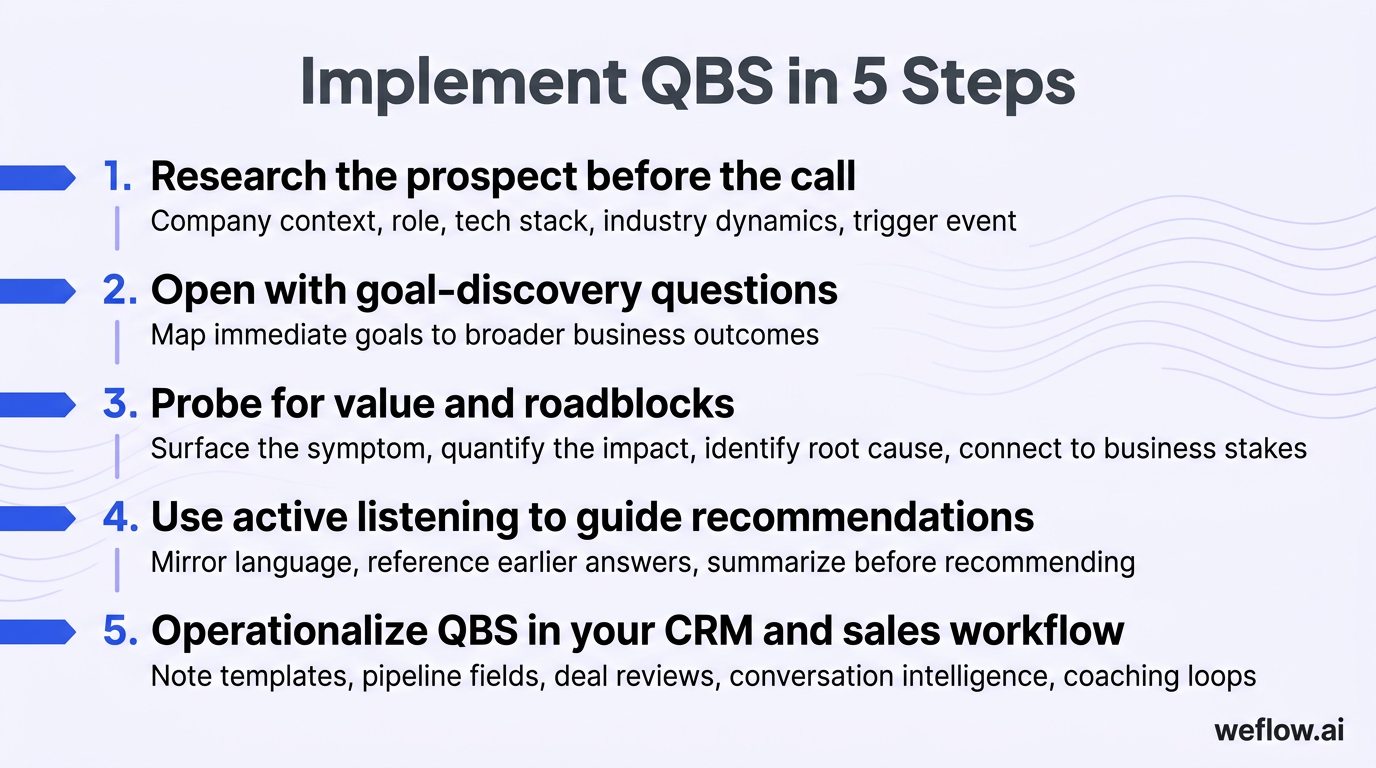
Step 1: Research the prospect before the call
QBS doesn't start when you open the Zoom link. It starts with 10 minutes of focused research that shapes every question you'll ask. Here's a pre-call checklist:
[banner type="download" url="https://www.weflow.ai/resources/cheat-sheets/question-based-selling-checklist" text="Question-Based Selling Checklist" subtitle="Run discovery calls that quantify business impact before you pitch" button="Get the checklist"]
- Company context: Annual revenue, headcount, recent funding, earnings call themes, hiring patterns (are they scaling sales or cutting?)
- Prospect's role: Title, tenure, LinkedIn activity, recent posts or comments that signal priorities
- Tech stack: What CRM are they running? Do they already have conversation intelligence, forecasting tools, or activity capture in place? Check job postings and review sites for clues.
- Industry dynamics: What's happening in their market that creates urgency? Regulatory changes, M&A activity, competitive pressure?
- Trigger event: Why are they talking to you now? New leadership, missed targets, board pressure, contract renewal with a competitor?
This research doesn't just inform your questions—it signals to the prospect that you've done your homework. When you reference something specific about their business in your first question, you've already differentiated yourself from every other rep who opens with "So, tell me about your biggest challenges."
Step 2: Open with goal-discovery questions
The first three minutes of a discovery call determine whether the prospect engages or mentally checks out. QBS prescribes opening with questions that map the prospect's immediate goals to broader business outcomes—not questions about pain.
Start here:
- "What are you hoping to accomplish this quarter, and how does [area your product addresses] fit into that?"
- "When you agreed to this call, what were you hoping to learn or evaluate?"
- "If this conversation goes well, what would the next step look like on your end?"
These questions accomplish two things. First, they give you the prospect's success criteria—you now know what "good" looks like from their perspective. Second, they set a collaborative tone. You're not interrogating; you're aligning on a shared agenda.
Step 3: Probe for value and roadblocks
Once you understand the prospect's goals, shift from surface-level pain to business stakes. This is where most reps stop too early. They hear "we have bad CRM data" and jump to the demo. QBS keeps you in the question seat longer.
Follow this progression:
- Surface the symptom: "How is incomplete pipeline data affecting your forecast accuracy today?"
- Quantify the impact: "What's the gap between your forecasted number and actuals over the last two quarters?"
- Identify the root cause: "Is the data gap driven by reps not updating deals, or by the system not capturing activity automatically?"
- Connect to business stakes: "When your forecast is off by 15%, how does that affect your board conversation and resource planning?"
This sequence takes the prospect from "we have a problem" to "this problem is costing us real money and credibility." That's the difference between a deal that stalls at stage two and one that accelerates through the pipeline.
Step 4: Use active listening to guide recommendations
The most common failure mode in QBS isn't asking bad questions—it's not doing anything with the answers. Active listening in QBS means three things:
- Mirror their language: If the prospect says "our forecast is a fantasy," use that phrase back. "You mentioned your forecast feels like a fantasy—let me show you how other RevOps teams have closed that gap."
- Reference earlier answers: "You said earlier that reps spend about five hours a week updating Salesforce. Our customers typically cut that to under 30 minutes. Here's how."
- Summarize before recommending: "Let me make sure I have this right: your top three priorities are forecast accuracy, reducing rep admin time, and getting real-time pipeline visibility for your weekly call. Did I miss anything?"
When you weave the prospect's own words into your recommendation, it doesn't feel like a pitch. It feels like a logical conclusion they arrived at themselves. That's the goal.
Step 5: Operationalize QBS in your CRM and sales workflow
QBS fails when it lives only in a training deck. To make it stick, build it into the systems your reps already use every day.
[banner type="download" url="https://www.weflow.ai/resources/cheat-sheets/sales-discovery-questions-checklist" text="Sales Discovery Questions Checklist" subtitle="Walk into discovery with questions that surface real pain, not vague pleasantries" button="Download checklist"]
- Note templates: Create a standard discovery note template with sections for each QBS question type (probing, value, solution-focused, confirmation). Reps fill it out during or right after every call. This makes QBS the default format, not an afterthought.
- Pipeline field requirements: Add required fields tied to QBS outcomes—"Business impact identified (yes/no)," "Success criteria confirmed (yes/no)," "Key stakeholders mapped." Deals can't advance past stage two without these fields completed.
- Deal review cadences: In weekly pipeline reviews, managers should ask: "What did you learn from your QBS questions this week?" and "What business impact did the prospect quantify?" This reinforces the methodology and surfaces coaching opportunities.
- Conversation intelligence: Tools like Weflow can automatically capture call notes, log activity to Salesforce, and flag deals where key discovery fields are missing. Instead of relying on reps to manually log QBS insights, the system captures the conversation and populates the CRM record—so managers can review what was actually discussed, not just what the rep remembered to type.
- Coaching loops: Review recorded calls monthly with a QBS scorecard. Did the rep ask all four question types? Did they quantify business impact? Did they confirm alignment before presenting? Score each call and track improvement over time.
Question-based selling examples: sample questions by sales stage
Discovery stage
These questions map the prospect's current situation and begin surfacing pain. Keep them open-ended and specific to the prospect's role.
- "Walk me through your current sales process from first meeting to closed-won. Where do deals typically get stuck?"
- "How does your team track deal progress today—through Salesforce fields, spreadsheets, or something else?"
- "What does your pipeline review meeting look like? Who's in the room, and what data do you rely on?"
- "If you could fix one thing about how your team manages pipeline, what would it be?"
- "What triggered your decision to evaluate new tools right now?"
Qualification stage
These questions determine whether the deal is real—budget, authority, timeline, and urgency. QBS frames qualification as a natural conversation, not an interrogation.
- "You mentioned forecast accuracy is a top priority. How is that measured internally, and who's accountable for improving it?"
- "What's your timeline for making a decision? Is there a specific event driving that—like a board meeting, a contract renewal, or a fiscal year deadline?"
- "If we can demonstrate the impact you described, what does your evaluation process look like? Who else would need to be involved?"
- "Have you tried to solve this before? What happened, and what would need to be different this time?"
- "What would 'no decision' cost you over the next two quarters?"
Proposal and close stage
These questions confirm alignment, surface remaining objections, and move the deal to a decision. They're shorter and more direct.
- "Based on everything we've discussed, does this proposal address your three top priorities—forecast accuracy, rep productivity, and pipeline visibility?"
- "Is there anything in this proposal that doesn't match what you expected, or anything we missed?"
- "You mentioned earlier that getting your VP of Sales aligned is key. What would they need to see to feel confident proceeding?"
- "If we can resolve [specific remaining concern], are you ready to move to a pilot or implementation timeline?"
- "What does your internal approval process look like from here, and how can we help you build the internal case?"
Frequently asked questions
What is question-based selling?
Question-based selling is a sales methodology that uses strategically sequenced questions to uncover buyer needs, quantify business impact, and guide prospects toward a purchase decision. It was developed by Thomas Freese and emphasizes earning the right to ask deeper questions by establishing credibility first.
Who created question-based selling?
Thomas Freese created question-based selling and documented it in his book Secrets of Question-Based Selling. Freese developed the methodology while consistently achieving 200% of his sales quota, then formalized the approach to help other sales professionals replicate his results.
What types of questions are used in question-based selling?
QBS uses four question types: probing questions (to understand the current situation), value-based questions (to quantify business impact), solution-focused questions (to help the prospect envision a better future state), and closed-ended confirmation questions (to verify alignment and advance the deal). Each type serves a specific purpose at a specific stage.
How is question-based selling different from SPIN Selling?
Both methodologies rely on structured questions, but they differ in philosophy. SPIN follows a rigid four-step sequence (Situation, Problem, Implication, Need-Payoff) that works well for reps who need a repeatable formula. QBS places more emphasis on earning the right to ask by building credibility first, and gives reps more flexibility to adapt their question flow based on the conversation. QBS tends to perform better with skeptical or well-researched buyers.
When should you NOT use question-based selling?
QBS isn't a good fit for transactional, low-touch sales. If your product is under $5K, your sales cycle is under a week, or buyers can self-serve, the QBS framework adds unnecessary friction. It's designed for considered B2B purchases with multiple stakeholders, longer evaluation cycles, and deal sizes that justify the time investment in deep discovery.
What are the best question-based selling questions for discovery calls?
The highest-impact discovery questions are specific and business-outcome-focused. Start with "Walk me through how your team handles [relevant process] today" to map the current state. Then shift to "What's the business impact when [specific problem] happens?" to quantify the stakes. Avoid generic openers like "Tell me about your challenges"—they signal you haven't done your homework.
How do you implement question-based selling in a sales team?
Start with training on the four question types and run role-play sessions. Then build QBS into your daily workflow: create discovery note templates organized by question type, add pipeline fields that require reps to document business impact before advancing deals, and review recorded calls in coaching sessions using a QBS scorecard. The teams that make QBS stick are the ones that embed it into their CRM process, not just their training materials.
Key takeaways: making question-based selling work for your team
- QBS is a sequencing discipline, not a question list. The value isn't in the individual questions—it's in asking the right type at the right time and earning the right to go deeper before you probe.
- Quantify business impact before you pitch. Deals accelerate when the prospect has said "this is costing us $X" in their own words. Value-based questions are the most underused and highest-impact tool in the QBS framework.
- Build QBS into your systems, not just your training. Note templates, required pipeline fields, and deal review cadences make QBS the default behavior. Without operational reinforcement, it fades within 90 days.
- Active listening is the differentiator. Reps who mirror the prospect's language and reference earlier answers close at higher rates than reps who ask great questions but deliver generic pitches.
- Know when QBS doesn't fit. Transactional sales, self-serve products, and short buying cycles don't benefit from deep discovery. Apply QBS where the deal complexity justifies the investment.
-p-1600.png)

.png)
-p-1600.png)
-p-1600.png)
-p-1600.png)