

12 Conceptual Selling Questions for Sales Discovery Calls [Cheat Sheet]
Learn 12 conceptual selling questions to qualify discovery calls and uncover buyer goals, risks, and timing.



Conceptual selling helps reps understand how a buyer sees the problem, what outcome they want, and what could stop the deal from moving. Instead of jumping into product features, the rep learns the buyer’s priorities, internal pressure, and decision logic first.
This cheat sheet turns that approach into 12 practical discovery questions you can use on live calls. For RevOps leaders and Sales Ops managers, it also creates a cleaner qualification process—one that produces better notes, better Salesforce data, and fewer late-stage surprises.
[banner type="download" url="https://www.weflow.ai/resources/cheat-sheets/conceptual-selling-checklist" text="Conceptual Selling Questions Cheat Sheet" subtitle="25 sales discovery question prompts organized by goal and buying stage." button="Download now"]Current state questions: map buyer goals and roadblocks
Start by establishing the buyer’s baseline. You need to know what they’re trying to achieve, what is getting in the way, and what the current problem already costs them in time or money.
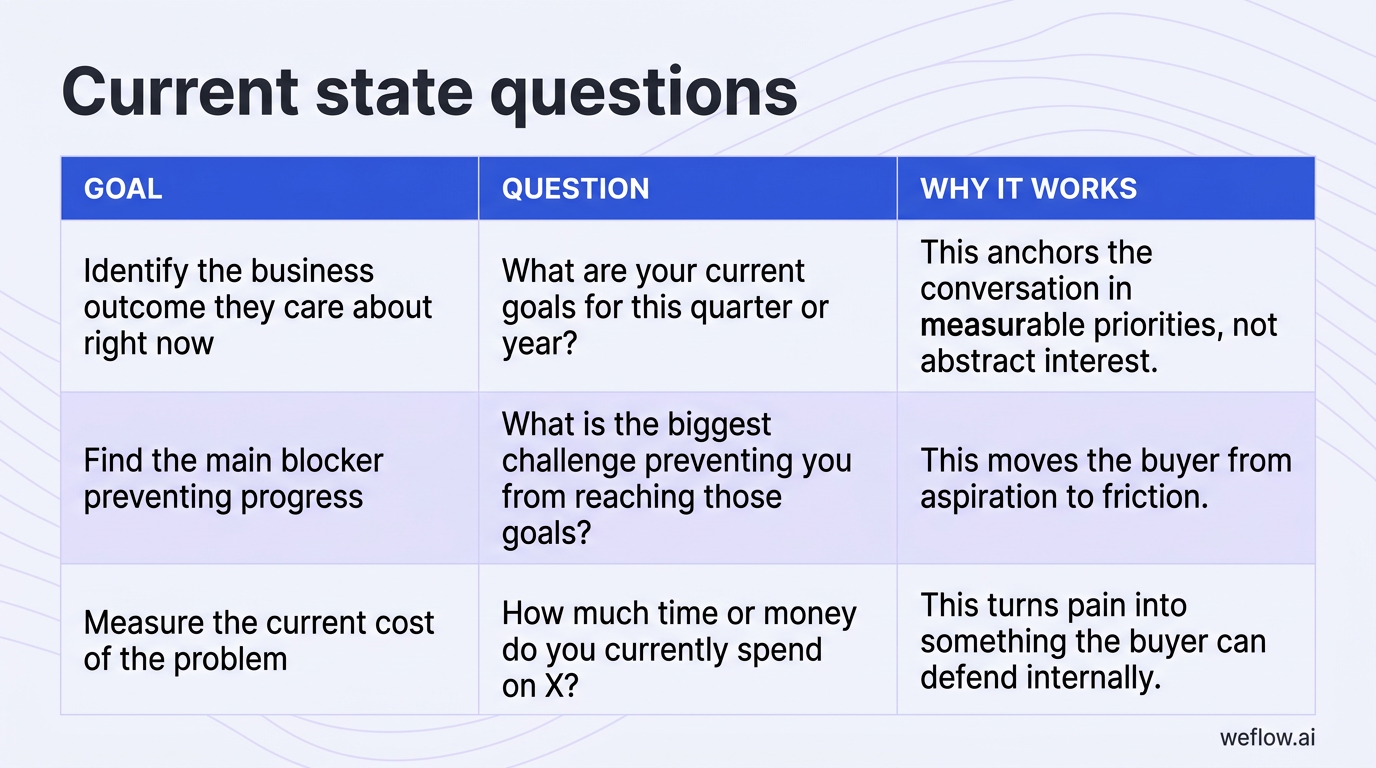
| Goal | Question | Why it works |
|---|---|---|
| Identify the business outcome they care about right now | What are your current goals for this quarter or year? | This anchors the conversation in measurable priorities, not abstract interest. It also gives the rep language they can mirror in later demos, proposals, and Salesforce opportunity notes. |
| Find the main blocker preventing progress | What is the biggest challenge preventing you from reaching those goals? | This moves the buyer from aspiration to friction. If the answer is clear, the rep can tie the solution to a defined gap instead of pitching a broad set of capabilities. |
| Measure the current cost of the problem | How much time or money do you currently spend on X? | This turns pain into something the buyer can defend internally. Time drain, headcount cost, lost productivity, or missed revenue all help build a stronger business case. |
Before a rep discusses features, they need a specific business goal to attach them to. If the buyer says their priority is improving forecast accuracy, cutting CRM admin time, or increasing pipeline coverage, the rep can position the solution against a visible metric instead of hoping the buyer connects the dots on their own.
Identify primary goals and focus areas
- Use “What are your current goals for this quarter or year?” early in discovery to find the buyer’s active priorities, not a generic strategic wish list.
- Listen for company-level KPIs such as revenue attainment, pipeline coverage, or forecast accuracy versus individual goals such as saving time, improving team productivity, or fixing reporting gaps.
- If the buyer names multiple goals, ask which one carries the most pressure this quarter. That forces prioritization and gives the deal a clearer business case.
- Capture the exact wording. If the buyer says, “We need cleaner Salesforce data before the board meeting,” that phrase should show up later in your recap and proposal.
Pinpoint challenges blocking goal achievement
Callout: A surface-level challenge sounds like, “Our team spends too much time updating CRM.” A root-cause challenge sounds like, “Activity data is incomplete in Salesforce, so managers inspect stale opportunities and our forecast error rate stays high.” The first describes frustration. The second tells you what has to change.
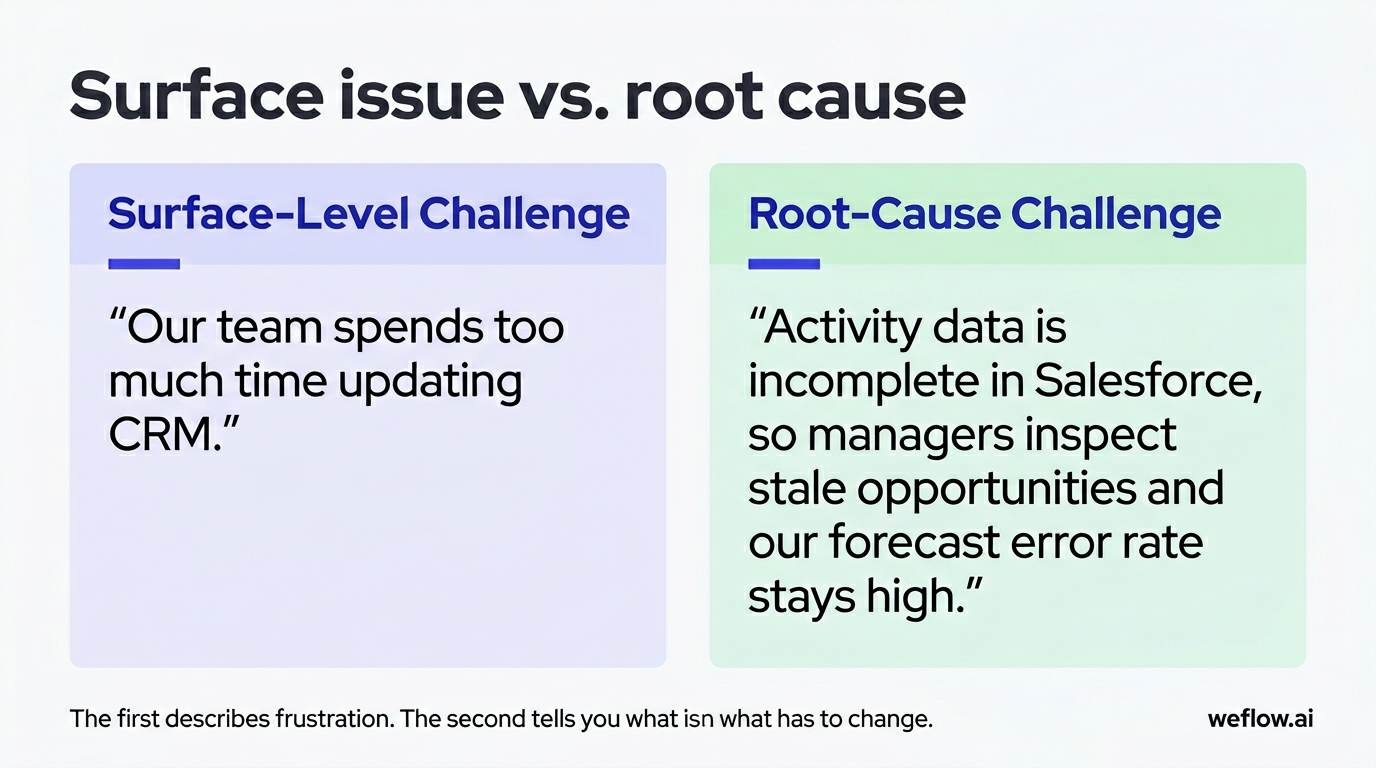
When you ask “What is the biggest challenge preventing you from reaching those goals?”, connect the answer back to the goal they just named. If the goal is faster sales execution, but the blocker is poor process compliance, the opportunity is not only speed—it is process enforcement, cleaner stage progression, and more reliable inspection data.
Quantify current investments and resource drain
“How much time or money do you currently spend on X?” helps the buyer translate a problem into cost. Time cost matters when teams lose hours to manual updates, duplicate data entry, or fixing broken handoffs. Financial cost matters when the issue affects headcount, consultant spend, or missed revenue. Once the buyer quantifies the drain, your ROI case becomes easier to prove because it is based on their math, not yours.
Market context questions: benchmark threats and past failures
Current pain is only part of discovery. You also need to understand what is happening around the buyer and what they have already tried, because both shape urgency and skepticism.
- External threats: Ask “Who do you see as your biggest competitors? What are they currently doing better than you?” to understand market pressure, perceived gaps, and the reason the buyer feels urgency now.
- Internal history: Ask “What solutions have you already tried? What level of success did you find?” to avoid pitching a path they have already rejected or half-implemented.
Knowing what did not work matters as much as knowing what the buyer wants. If a previous vendor failed because adoption was low, implementation dragged on, or the Salesforce write-back was too shallow, the next proposal has to address that directly.
Assess competitive threats and market position
- Use the competitor question to uncover where the buyer feels exposed—speed, pricing, market coverage, sales execution, customer retention, or data visibility.
- Listen for emotionally charged phrases such as “they move faster than we do” or “their managers have better visibility.” Those usually point to a stronger internal case for change.
- Tie the threat back to business impact. If competitors inspect deals more effectively, the buyer may need better qualification data, cleaner activity capture, or more consistent use of Salesforce fields.
Reps can use this pressure to build a business case for change without leaning on fear. The goal is not to dramatize competition. It is to show how fixing the current process helps the buyer close a visible gap.
Review past solutions and historical success
Ask “What solutions have you already tried? What level of success did you find?” to stop yourself from replaying a failed plan. Some buyers have tried to solve the problem with process training, another tool, a Salesforce customization, or manual workarounds. Each failed attempt leaves residue—extra scrutiny from finance, lower internal confidence, or a stronger need for proof. A useful transition phrase here is: “That helps. It sounds like the issue was not the priority itself, but the way the solution was implemented. Can we look at what would need to be different this time?”
Change readiness questions: gauge urgency and buying criteria
This is where reps often get happy ears. A buyer can sound interested, ask smart questions, and still have no intent to change. These questions help you test whether the deal is real, how fast it could move, what the buyer will optimize for, and what could stall it.
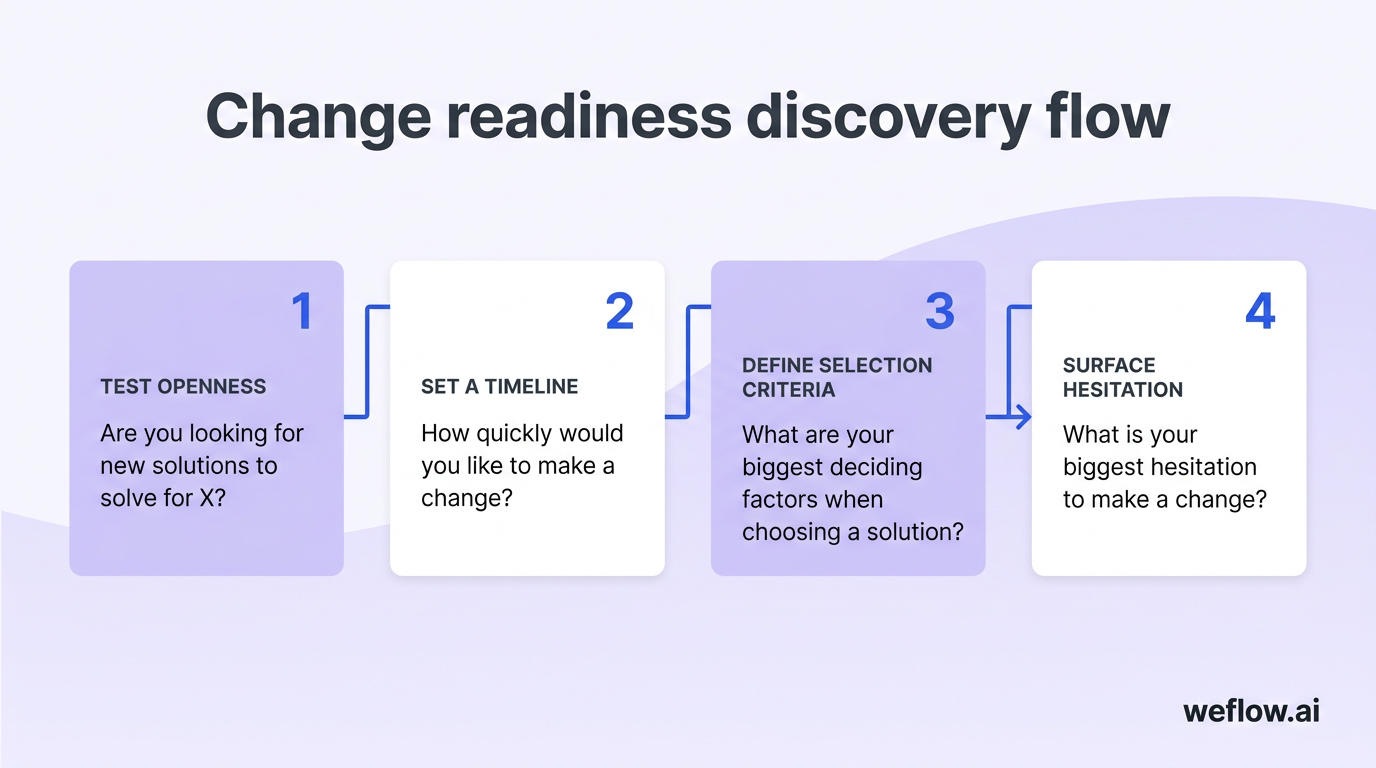
- Test openness: Ask “Are you looking for new solutions to solve for X?” to tell the difference between research and active buying.
- Set a timeline: Ask “How quickly would you like to make a change?” to gauge urgency and forecast the opportunity realistically.
- Define selection criteria: Ask “What are your biggest deciding factors when choosing a solution?” so the deal is shaped around their buying logic, not your default pitch.
- Surface hesitation: Ask “What is your biggest hesitation to make a change?” before that hesitation appears as a late-stage objection.
Test openness to switching products or services
Callout: A buyer who says “We’re always looking at options” is not necessarily in market. A buyer who says “Yes, we need to replace this before Q3 planning” is. If the answer is vague, has no deadline, and avoids ownership, treat it as passive browsing until the buyer proves otherwise.
The question “Are you looking for new solutions to solve for X?” sounds simple, but it is one of the fastest ways to protect sales time. It tells you whether the account is exploring ideas, pressure-testing an incumbent, or actively building a shortlist.
Establish timelines for implementing new solutions
“How quickly would you like to make a change?” gives the rep a timeline they can test against real buying steps. Tie that answer back to the goals raised earlier. If the buyer wants the issue fixed before the next quarter starts, work backward from the desired go-live date: procurement, security review, stakeholder alignment, implementation, training, and first measurable result. That creates a more accurate forecast than a rep-owned close date in Salesforce.
Uncover core priorities driving the final choice
- Budget: What level of spend is realistic, and what cost needs to be justified internally?
- Productivity: Will the solution save time, reduce admin work, or improve rep and manager workflows?
- Ease of use: Will adoption be high without heavy change management or constant admin cleanup?
- Implementation effort: How much systems work, field mapping, training, and rollout support will the buyer accept?
- Proof and trust: What evidence matters most—customer stories, security documentation, ROI modeling, or references?
When you ask “What are your biggest deciding factors when choosing a solution?”, do not stop at the list. Rank it. If ease of use matters more than price, the demo should show workflow simplicity first. If implementation effort matters most, the proposal should focus on deployment speed, integration footprint, and who owns what.
Surface hesitations blocking the switch
“What is your biggest hesitation to make a change?” gives the buyer room to tell the truth without forcing them into a defensive position. A simple framework works well here: validate the concern, confirm the impact, and ask what would reduce the risk. For example: “That makes sense. If implementation effort is the concern, how are you evaluating the tradeoff between change management and fixing the current issue?” This keeps the conversation grounded instead of argumentative.
Buying process questions: secure alignment and close gaps
Once the need is clear and the timing feels real, the rep has to help the buyer navigate the purchase. These questions shift discovery from diagnosis to deal execution.
| Process stage | Question | Desired outcome |
|---|---|---|
| Future state planning | What would you do if your goals were achieved? What does your next step look like? | Expand the discussion from the immediate fix to the longer-term value of solving the problem well. |
| Stakeholder mapping | Who is involved in the decision making process? | Identify the buying committee, likely blockers, and who needs a tailored message before the deal can close. |
| Confidence building | What additional information do you need to be confident in making a decision? | Equip the champion with the proof, internal documents, and answer set needed to move the deal forward. |
These questions turn the rep from a seller into a buying advisor. That matters because many deals do not fail on product fit—they fail because the buyer cannot align stakeholders, justify the spend, or answer open questions inside their own process.
Map future steps after achieving current goals
Ask “What would you do if your goals were achieved? What does your next step look like?” to understand what success unlocks for the buyer after the first win. If better qualification leads to stronger forecast accuracy, the next phase might be cleaner territory planning, tighter manager inspection, or broader process standardization. This question does not only increase deal size. It also helps position the relationship as part of a longer operating model, which supports retention and future expansion.
Identify stakeholders in the decision process
- Use “Who is involved in the decision making process?” to move beyond your day-to-day contact and map the full approval path.
- Look for economic buyers, technical reviewers, security or legal contacts, and the team that will own rollout after signature.
- If the buyer says, “It’s mostly just me,” test that assumption. Most B2B purchases still require budget, systems, or executive signoff.
- Multi-thread early. Single-threaded deals are exposed because one internal contact rarely controls budget, timing, and final approval on their own.
Fill information gaps to build buyer confidence
Callout: Ask “What additional information do you need to be confident in making a decision?” before you leave discovery. Common follow-up assets include case studies, security documentation, ROI calculators, implementation plans, reference calls, and sample business cases. The goal is not to send more content. It is to send the exact content the champion needs for the next internal conversation.
FAQ
What is conceptual selling in B2B sales?
Conceptual selling is a discovery approach focused on how the buyer defines their problem, desired outcome, and path to change. Instead of leading with a pitch, the rep first learns the buyer’s internal priorities, risks, and decision criteria, then builds the sales conversation around that context.
How do conceptual selling questions differ from SPIN?
SPIN follows a structured sequence of Situation, Problem, Implication, and Need-payoff questions. Conceptual selling is more centered on the buyer’s perception of the issue, their buying logic, and the internal alignment needed to move forward. In practice, SPIN is often more linear, while conceptual selling is more focused on diagnosis, fit, and decision dynamics.
When should reps ask conceptual selling questions?
These questions belong mainly in discovery and qualification, before a formal demo or proposal. Reps can also reuse them in later stages when a deal stalls, a new stakeholder joins, or the original problem statement no longer matches the buyer’s behavior.
How many discovery questions should reps ask?
Most calls work better with four to six high-impact questions than a full list of 12. Pick the questions that fit the stage of the deal, then follow the buyer’s answers instead of running discovery like a script. Depth matters more than volume.
-p-1600.png)

.png)
-p-1600.png)
-p-1600.png)
-p-1600.png)
