

Gap Selling: Framework, Questions, and Implementation Guide
Learn the Gap Selling framework, key discovery questions, and how to implement it on your sales team.



.png)

A complete guide to gap selling: framework, questions, and implementation
Gap selling is a problem-centric sales methodology where the seller identifies the distance between a prospect's current state and their ideal future state—then positions their solution to close that gap. Instead of leading with features or pitching product, gap sellers diagnose business problems first, quantify the cost of staying put, and help buyers see why change is worth the effort.
The methodology was created by Keenan (first name: Jim, but he goes by Keenan), CEO of A Sales Growth Company and author of Gap Selling: Getting the Customer to Yes. His core argument: buyers don't buy products. They buy the outcome of moving from where they are to where they want to be. The seller's job is to make that gap visible, measurable, and urgent.
This guide breaks down the framework, the question types, how to implement gap selling on a B2B sales team, and when it's the right methodology versus alternatives like SPIN or Challenger.
What is gap selling? Definition, origin, and core framework
Gap selling reframes the sales conversation around the buyer's problem—not the seller's product. The methodology is built on a simple premise: the bigger the gap between where a buyer is today and where they need to be, the more motivated they are to buy.
Keenan introduced the framework in his 2018 book Gap Selling: Getting the Customer to Yes, published through A Sales Growth Company. The book argues that most sales training teaches reps to pitch and handle objections. Gap selling teaches reps to diagnose problems and quantify impact—so buyers sell themselves on the need for change.
The framework has three components:
- Current state — where the prospect is today, including the problems they're experiencing and the business impact of those problems
- Future state — the outcomes the prospect wants to achieve
- The gap — the measurable distance between the two, which determines buying urgency and willingness to pay
When the gap is small, buyers don't move. When the gap is large and clearly defined, price objections shrink and decision timelines compress. The seller's job is to widen the gap by helping buyers see problems they didn't know they had and outcomes they didn't know were possible.
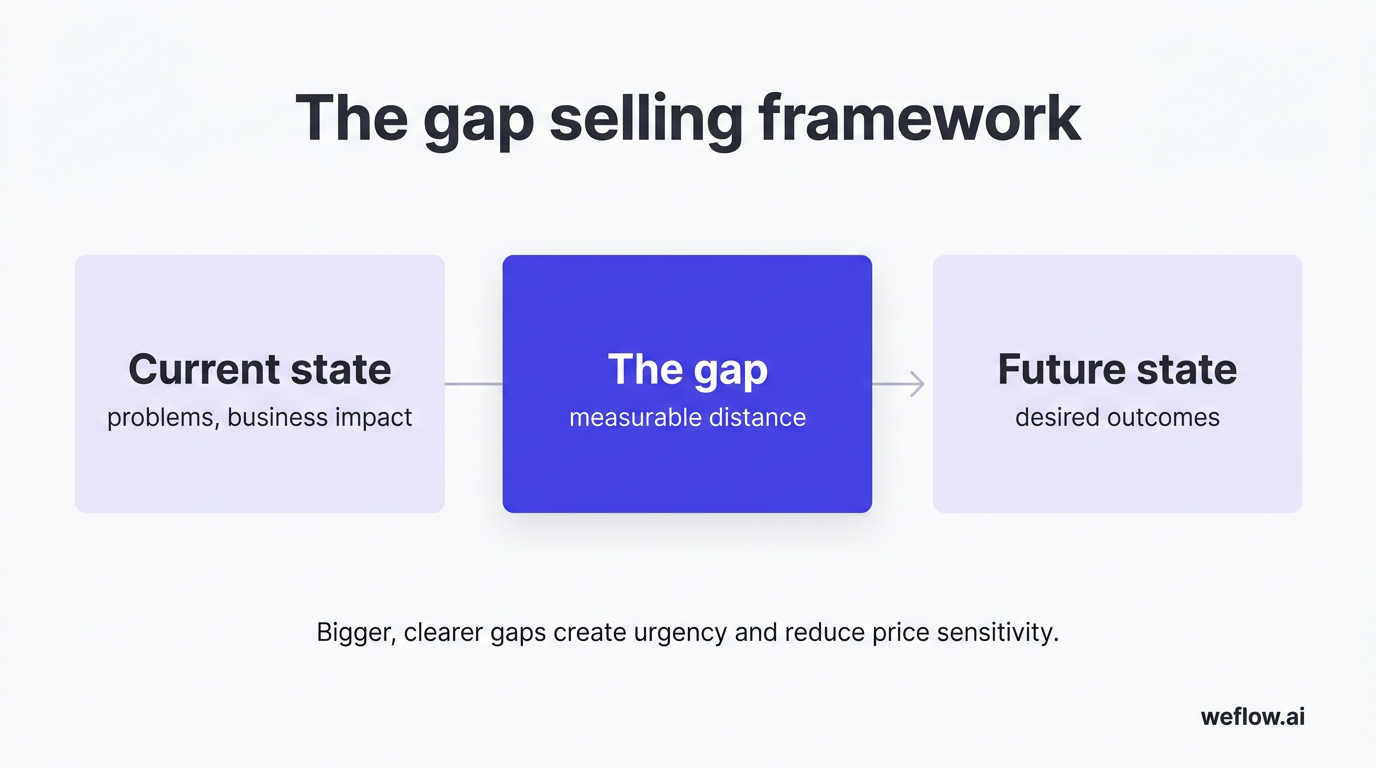
The three components of the gap selling framework
Current state — where the prospect is today
Current state discovery is where most of the work happens in gap selling. Keenan defines five elements that reps must uncover before they can size the gap or position a solution:
- Environment — the literal facts about the prospect's situation. What tools do they use? How big is the team? What does their process look like? What's their tech stack? This is the "what is" layer—no judgment, just facts.
- Problem — the specific issues or challenges the prospect is dealing with. Not abstract pain—concrete problems. "Reps spend four hours a week on manual CRM updates" is a problem. "We need better efficiency" is not.
- Impact — the business consequences of those problems. Lost revenue, missed targets, wasted time, employee turnover, compliance risk. Impact turns a "nice to have" into a "need to fix."
- Root cause — why the problem exists. Is it a process gap? A technology limitation? A people issue? Root cause matters because it determines whether your solution actually fixes the problem or just masks it.
- Emotion — how the prospect feels about the situation. Frustration, fear, embarrassment, urgency. Emotion drives action. A prospect who's intellectually aware of a problem but emotionally detached from it won't buy.
Most reps stop at the problem layer. Gap sellers go deeper—into impact, root cause, and emotion—because that's where buying motivation lives.
Future state — the ideal outcome
The future state is what the prospect's world looks like after the problem is solved. This isn't a product demo—it's a picture of business outcomes.
Reps need to uncover:
- What does success look like in measurable terms? (Revenue gained, time saved, risk eliminated)
- What changes in their day-to-day operations?
- What becomes possible that isn't possible now?
- Who benefits—and how do they benefit specifically?
The future state has to come from the buyer, not the seller. If you're telling the prospect what their future state should be, you're pitching. If the prospect is describing their own ideal outcome, you're selling.
The gap — measuring the distance
The gap is the distance between where the prospect is today and where they want to be. It's the core of the entire methodology. A wider gap means stronger buying motivation, higher willingness to invest, and faster decision-making.
To size the gap, evaluate three dimensions:
| Dimension | What it measures | Example |
|---|---|---|
| Cost of inaction | What happens if the prospect does nothing? Revenue loss, competitive disadvantage, ongoing waste, growing risk. | "Every quarter you miss forecast by 15% costs you $2M in board credibility and delayed hiring decisions." |
| Effort and risk of change | What does it take to get from current state to future state? Implementation time, internal disruption, learning curve. | "Deploying in two weeks with zero workflow disruption for reps versus a six-month implementation." |
| Projected value of the future state | What's the measurable upside of reaching the future state? Revenue, time, risk reduction, efficiency gains. | "Forecast accuracy within 5% gives your CRO numbers they can defend to the board." |
When the cost of inaction is high, the effort of change is low, and the projected value is clear—the gap is at its widest. That's when deals close fast and price becomes secondary to outcome.
The four types of gap selling questions
Keenan's question framework gives reps a structured approach to discovery. The four question types build on each other—start with probing, move through process and provocation, then validate understanding.
Probing questions — uncover the current state
Open-ended questions designed to map the prospect's environment, problems, and impact. These are your "tell me about" and "walk me through" questions.
- "Walk me through how your team tracks pipeline today—from opportunity creation to forecast submission."
- "What happens when a deal stalls at stage three? How do you identify it and what's the escalation process?"
- "How much time do your reps spend on CRM data entry each week?"
- "What's your current forecast accuracy, and how does leadership react when it misses?"
The goal is gathering facts without leading the witness. Let the prospect describe their reality. Take notes on every element: environment, problem, impact, root cause, and emotion.
Process questions — understand how things work
These questions dig into workflows, handoffs, and operational mechanics. They expose inefficiencies the prospect may have normalized.
- "After a discovery call, what's the process for updating the CRM record? Who does it and when?"
- "How does your forecast roll up from rep to manager to CRO? What manual steps are involved?"
- "When a new rep joins, how long before they're following your sales process consistently?"
- "What happens to meeting notes and call recordings after the call ends? Where does that data live?"
Process questions reveal gaps between how things should work and how they actually work. That delta is often where the biggest problems hide.
Provocation questions — challenge assumptions
Provocation questions push the prospect to see problems they've been overlooking or underestimating. These are the questions that widen the gap.
- "You mentioned forecast accuracy is around 70%. What would it mean for your board's confidence if that number were 90%?"
- "If reps are spending four hours a week on CRM updates, that's 200 hours per rep per year. What would your team do with that time back?"
- "You said deal reviews happen weekly. How many deals have you lost between reviews because risk signals weren't visible?"
- "What's the actual cost of a missed forecast to your organization—not just the number, but the downstream decisions it delays?"
Provocation questions aren't combative. They're clarifying. You're helping the prospect do math they haven't done, see patterns they've missed, and connect problems to business outcomes they care about.
Validation questions — confirm and build agreement
Validation questions ensure you've understood the prospect correctly and create mutual agreement on the problem, impact, and desired outcome.
- "So if I'm hearing you right, the main issue is incomplete CRM data leading to unreliable forecasts—and that's costing you credibility with the board. Is that accurate?"
- "It sounds like the root cause is manual data entry that reps skip when they're busy. Does that match your assessment?"
- "If you could get forecast accuracy to 90%+ without adding admin burden to reps, would that solve the primary problem?"
- "Based on what you've described, the gap here is between your current 70% forecast accuracy and the 90%+ your board expects. Does sizing it that way feel right?"
Validation questions do two things: they confirm your understanding (so you don't propose the wrong solution) and they get the prospect to verbally commit to the problem and desired outcome. That verbal commitment is the foundation for everything that follows.
How to implement gap selling: a step-by-step strategy
Problem-centric mindset
Gap selling requires a shift in how reps think about their role. Most reps are trained to position products. Gap sellers are trained to diagnose problems.
The shift looks like this: instead of preparing a demo with features mapped to personas, a gap seller prepares by researching the prospect's likely problems. Before the first call, they've formed a hypothesis about the prospect's current state, the problems they're probably experiencing, and the business impact of those problems. The discovery call tests that hypothesis—not pitches a product.
This means reps need to know their buyer's business as well as they know their own product. If you're selling to sales leaders, you should understand pipeline metrics, forecast methodologies, and common operational bottlenecks. If you're selling to RevOps, you should know what breaks in CRM data quality and why. The product conversation comes after the problem is fully understood—never before.
Gap selling in action: a B2B SaaS example
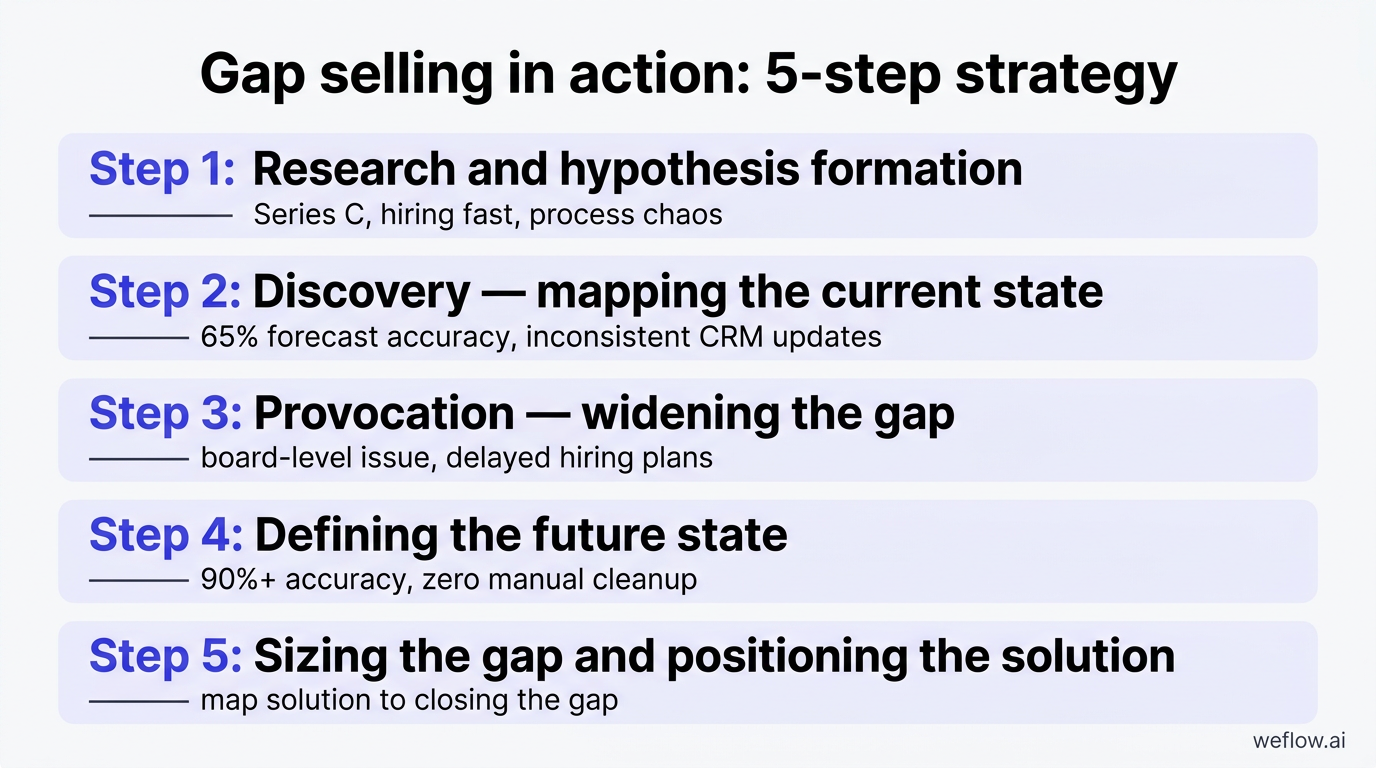
Here's how gap selling plays out in a real B2B deal. Imagine you're selling a revenue intelligence platform to a mid-market SaaS company with 50 AEs.
Step 1: Research and hypothesis formation
Before the call, you look at the company's public information. They've raised a Series C. They're hiring aggressively. Their Glassdoor reviews mention "process chaos" and "too many tools." Your hypothesis: they're scaling fast, CRM data quality is breaking down, and forecast accuracy is suffering.
Step 2: Discovery — mapping the current state
On the discovery call with the VP of Sales Ops, you use probing and process questions:
- "How does your team track deal progress from first meeting to close?"
- "What's your current forecast accuracy, and how has it changed as you've scaled?"
- "Walk me through what happens after a rep finishes a customer call."
You learn: forecast accuracy is at 65%. Reps update CRM inconsistently. The VP of Sales Ops spends two days per month manually cleaning pipeline data before board reporting. Two forecast misses in the last four quarters.
Step 3: Provocation — widening the gap
You push deeper with provocation questions:
- "Those two forecast misses—what decisions did leadership delay as a result?"
- "If your VP of Sales Ops is spending two days a month on data cleanup, what strategic work isn't getting done?"
- "You're adding 20 reps this year. If CRM adoption is already inconsistent at 50 reps, what happens at 70?"
The VP of Sales Ops admits the CEO has flagged forecast accuracy as a board-level issue. Hiring plans for Q3 were delayed because leadership didn't trust the revenue projections. The ops team is reactive instead of strategic.
Step 4: Defining the future state
You ask: "If you could design your ideal outcome, what does forecast reporting look like six months from now?"
The answer: 90%+ forecast accuracy. Zero manual data cleanup. Board reports generated in hours, not days. Reps who follow the sales process without being chased.
Step 5: Sizing the gap and positioning the solution
Now you have both sides of the gap:
| Dimension | Current state | Future state |
|---|---|---|
| Forecast accuracy | 65% | 90%+ |
| Monthly data cleanup | Two days of ops time | Zero manual cleanup |
| Board reporting | Multi-day, low-confidence | Same-day, defensible numbers |
| Rep CRM compliance | Inconsistent, declining with scale | Automatic, process-enforced |
The cost of inaction: continued forecast misses, delayed hiring, two days of ops capacity wasted monthly, and growing data debt as the team scales. That's the gap. Your solution presentation maps directly to closing it—not to a feature list.
Gap selling vs. SPIN, Challenger, and value selling
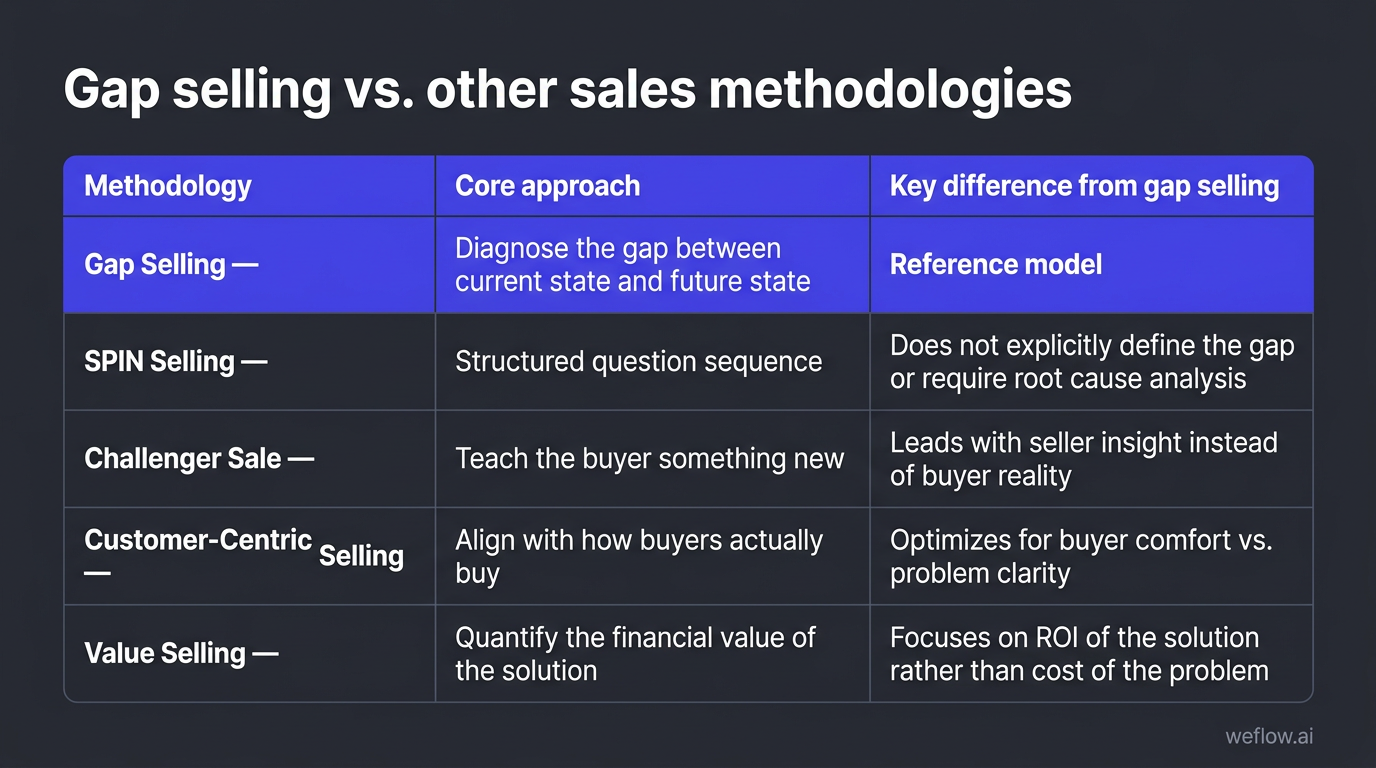
Gap selling isn't the only discovery-heavy methodology. Here's how it compares to the alternatives most B2B teams consider:
| Methodology | Core approach | Discovery style | Best for | Key difference from gap selling |
|---|---|---|---|---|
| Gap Selling | Diagnose the gap between current state and future state; position solution to close it | Deep current-state diagnosis across five elements (environment, problem, impact, root cause, emotion) | Complex B2B deals with multi-stakeholder buying, long sales cycles, and high-value outcomes | — |
| SPIN Selling | Move through Situation, Problem, Implication, Need-payoff questions in sequence | Structured question flow; implication questions build urgency | Consultative B2B sales where reps need a repeatable question framework | SPIN provides a question sequence; gap selling provides a diagnostic framework. SPIN doesn't explicitly define the "gap" or require root cause analysis. |
| Challenger Sale | Teach the buyer something new, tailor the message, and take control of the conversation | Insight-led; rep brings a provocative point of view rather than asking purely open-ended questions | Deals where the buyer doesn't fully understand their own problem or where differentiation is low | Challenger leads with the seller's insight. Gap selling leads with the buyer's own reality. Challenger is top-down; gap selling is bottom-up. |
| Customer-Centric Selling | Align the sales process with how buyers actually buy; support rather than pressure | Collaborative; focuses on buyer's goals and decision process | Organizations that want to reduce aggressive sales tactics and build trust-based relationships | Customer-centric selling optimizes for buyer comfort. Gap selling optimizes for problem clarity. Gap selling can feel more challenging because it pushes buyers to confront uncomfortable truths. |
| Value Selling | Quantify the financial value of the solution relative to the investment | ROI-focused; builds a business case around hard numbers | Deals that require CFO sign-off, formal business case justification, or procurement-driven evaluation | Value selling focuses on the ROI of the solution. Gap selling focuses on the cost of the problem. Gap selling starts earlier in the conversation—before the buyer is even evaluating solutions. |
The methodologies aren't mutually exclusive. Many teams combine gap selling's discovery framework with Challenger's insight delivery or value selling's ROI quantification. Gap selling is strongest as the discovery and diagnostic layer—the foundation that other methodologies can build on.
Is gap selling right for your sales team?
Gap selling works best when the sale is complex enough to justify deep discovery and the buyer's problem is big enough to create a meaningful gap.
Gap selling fits when:
- Complex B2B deals with multiple stakeholders. When three or more people are involved in the buying decision, each with different priorities, gap selling helps you build a shared understanding of the problem across the buying committee.
- Long sales cycles (60+ days). Gap selling's discovery process takes time. In a 90-day enterprise cycle, that investment pays off because a well-diagnosed problem leads to faster consensus and fewer late-stage objections.
- High-value solutions ($50K+ ACV). When the deal size justifies deep discovery, gap selling helps you build the business case that gets budget approved. The gap becomes the justification for the investment.
- Problems the buyer hasn't fully quantified. If your buyers know something is wrong but can't articulate the full impact, gap selling is designed for that exact scenario.
- Competitive deals where differentiation is hard. When products look similar on a feature comparison, the seller who best understands the buyer's specific problem wins. Gap selling shifts the conversation from features to fit.
Gap selling doesn't fit when:
- Transactional or commodity sales. If the buyer knows what they need and is comparing prices, deep discovery adds friction without adding value. A rep selling $500/month software with a 14-day sales cycle doesn't need to map five elements of current state.
- Single-threaded, low-complexity deals. When one person makes the decision and the problem is obvious, gap selling's depth is overkill. A simpler consultative approach works better.
- Inbound-heavy, product-led motions. If buyers are already educated and coming to you with a specific solution in mind, a full gap selling discovery can feel condescending. Meet them where they are.
- Early-stage startups with undefined ICP. Gap selling assumes you know your buyer's typical problems well enough to form hypotheses. If you're still figuring out product-market fit, you need customer development, not a sales methodology.
If your team sells complex B2B solutions with long cycles and multi-stakeholder buying committees, gap selling gives you a structured way to run discovery that builds urgency and differentiates on problem understanding—not product features.
Frequently asked questions
What is gap selling?
Gap selling is a sales methodology created by Keenan that focuses on identifying the distance between a buyer's current state (their problems and business impact) and their desired future state (the outcomes they want). The seller's role is to make that gap visible and position their solution as the bridge. It's a problem-first approach—product features come after the problem is fully diagnosed.
How is gap selling different from SPIN selling or Challenger Sale?
SPIN selling provides a structured question sequence (Situation, Problem, Implication, Need-payoff) but doesn't explicitly map the gap between current and future state. Challenger Sale leads with the seller's insight to teach the buyer something new. Gap selling starts with the buyer's reality and builds the case for change from the bottom up through deep current-state diagnosis across five elements: environment, problem, impact, root cause, and emotion.
What are the three components of the gap selling framework?
The three components are current state (where the prospect is today, including problems and business impact), future state (the measurable outcomes they want to achieve), and the gap (the distance between the two). The gap determines buying urgency—wider gaps create stronger motivation to act and reduce price sensitivity.
What types of questions should you ask in gap selling?
Keenan defines four question types: probing questions (open-ended questions to map the current state), process questions (questions about how things actually work day to day), provocation questions (questions that challenge assumptions and reveal hidden costs), and validation questions (questions that confirm understanding and build mutual agreement on the problem).
When should you use gap selling vs. another methodology?
Gap selling fits complex B2B deals with long sales cycles, multiple stakeholders, and high-value outcomes—where deep discovery creates competitive advantage. For transactional sales, commodity purchases, or product-led motions where buyers are already educated, a lighter approach like SPIN or straightforward consultative selling is more appropriate. Many teams combine gap selling's discovery framework with elements of other methodologies.
How do you calculate or measure the gap?
Size the gap across three dimensions: cost of inaction (what happens if the buyer does nothing—lost revenue, wasted time, growing risk), effort and risk of change (implementation complexity, disruption, learning curve), and projected value of the future state (measurable outcomes like revenue gained or time saved). When the cost of inaction is high and the effort of change is low, the gap is at its widest and the deal is most likely to close.
Does gap selling work for SaaS sales?
Gap selling is a strong fit for B2B SaaS deals, particularly in mid-market and enterprise segments where sales cycles are 60+ days and deal values justify deep discovery. SaaS buyers often have quantifiable problems (time wasted on manual processes, inaccurate reporting, tool sprawl) that map well to gap selling's current-state framework. For PLG or self-serve SaaS motions with short sales cycles, gap selling's depth adds more friction than value.
-p-1600.png)

.png)
-p-1600.png)
-p-1600.png)
-p-1600.png)
