
Value Selling Framework: What it Is and How to Use It
Learn what a value selling framework is and how to use it to quantify ROI and win deals.




Value selling framework: what it is and how to use it in 2026
Buyers don't pay for features. They pay for outcomes—fewer hours wasted, more revenue captured, lower risk on the forecast. A value selling framework shifts your entire sales conversation from what your product does to what it changes for the buyer. Here's how to build one and use it on your next call.
What is a value selling framework?
A value selling framework is a sales methodology that positions measurable business impact as the primary reason to buy. Instead of walking a prospect through a feature list, you quantify the gap between where they are today and where they could be—then attach a dollar figure to that gap.
Four core principles drive it:
- Buyer research before outreach. You study the prospect's business, tech stack, and pain points before you ever open a slide deck. You're looking for the two or three metrics they care about most—pipeline coverage, forecast error rate, rep productivity—and building your pitch around those numbers.
- Discovery questions that expose real pain. Generic questions get generic answers. Value-oriented discovery digs into the financial and operational cost of the status quo. "How many hours per week do your reps spend on manual CRM updates?" tells you more than "What are your biggest challenges?"
- Value quantification. You turn qualitative pain into hard numbers. If a prospect's reps spend five hours a week on manual data entry and you can cut that to 30 minutes, that's 4.5 hours back per rep per week. Multiply by headcount and hourly cost, and you've got a dollar figure the CFO can evaluate.
- Outcome-focused messaging. Every touchpoint—email, demo, proposal—frames your product in terms of what changes for the buyer, not what the product contains.
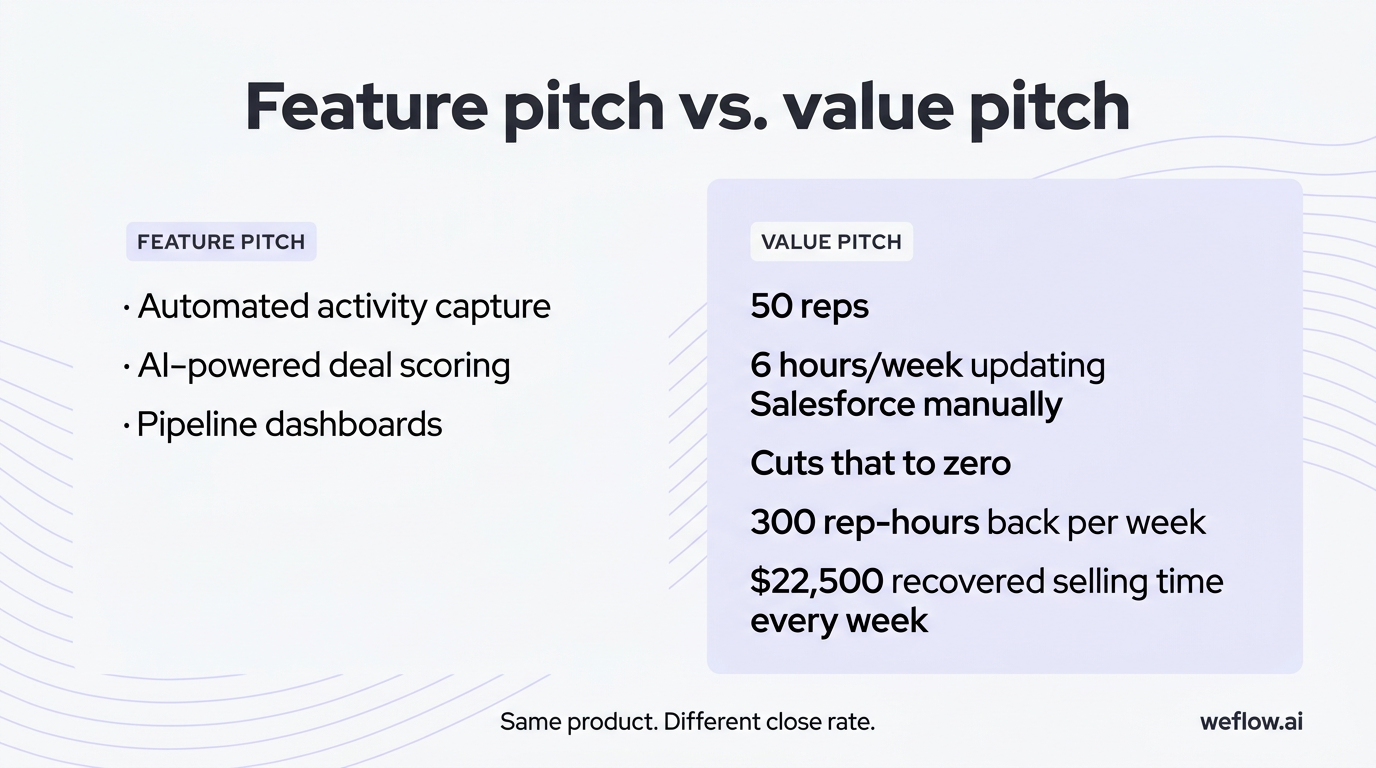
Example: You're selling a CRM platform to a mid-market sales org with 50 reps. Feature pitch: "We offer automated activity capture, AI-powered deal scoring, and pipeline dashboards." Value pitch: "Your reps spend six hours a week updating Salesforce manually. Our platform cuts that to zero—300 rep-hours back per week. At $75/hour, that's $22,500 in recovered selling time every week." Same product. Different close rate.
Value selling vs. solution selling: what's the difference?
Both methodologies go deeper than feature pitching, but they start from different places and end up in different conversations.
| Dimension | Value selling | Solution selling |
|---|---|---|
| Focus | Measurable business outcomes (revenue gained, costs reduced, time saved) | Solving a specific operational problem the buyer has identified |
| Messaging | Leads with ROI, dollar impact, and before/after metrics | Leads with diagnosis of the problem and how the product addresses it |
| Metrics | ROI calculations, cost savings, revenue lift, time-to-value | Feature fit, use case coverage, implementation feasibility |
| Buyer relationship | Trusted advisor who quantifies business impact across stakeholders | Consultant who maps requirements to capabilities |
| Best for | Complex B2B deals with multiple stakeholders and long sales cycles | Technical buyers evaluating specific capability gaps |
Solution selling asks "What problem do you have?" and maps features to it. Value selling asks "What's this problem costing you?" and attaches a number to the fix. The strongest reps blend both—but leading with value wins more deals at higher ACVs.
Why value selling outperforms feature-based pitching
Feature pitching forces the buyer to do the mental math. Value selling does it for them—and frames the decision in terms the economic buyer cares about:
- It builds trust faster. When you show up with research on the buyer's business and quantify their specific pain, you're a peer, not a pitch machine. Buyers trust reps who understand their world before asking for a demo.
- It increases deal size. Value-framed deals command higher ACVs because the buyer sees the purchase as an investment with measurable returns. When you can show $500K in annual savings, a $100K contract feels like a bargain.
- It reduces churn. Customers who bought based on expected outcomes hold you accountable—and when you deliver, they renew. Feature buyers churn the moment a competitor ships a shinier feature list.
- It generates referrals. A buyer who sees real ROI becomes your best marketing channel. The results speak for themselves.
- It builds consensus across buying committees. Gartner reports that complex B2B deals involve six or more stakeholders. Finance wants ROI, ops wants efficiency, IT wants security. A value framework gives you the language to speak to each of them with the metrics they care about.
How to build a value selling framework in five steps
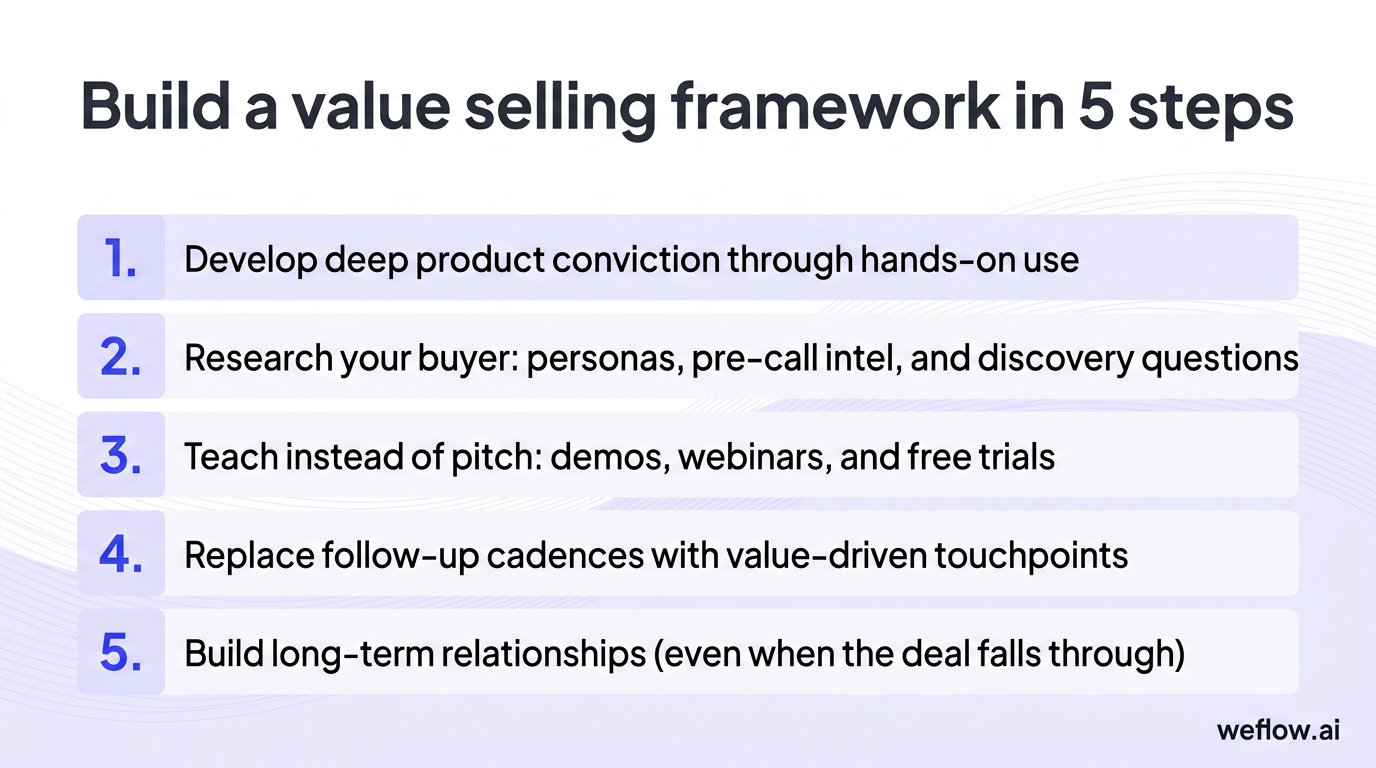
1. Develop deep product conviction through hands-on use
You can't sell value you haven't experienced. Use your own product daily. Document three to five workflows where it changes how you work—not theoretically, but in your actual day.
Run a product value audit to map hands-on experience to buyer-facing talking points:
| Question | Your answer | How this helps the buyer |
|---|---|---|
| What's the single workflow that saves me the most time? | (Fill in based on your product) | Quantify time saved; multiply by buyer's team size |
| What data do I now have that I didn't before? | (Fill in based on your product) | Frame as visibility or risk reduction the buyer lacks today |
| What manual task has the product eliminated? | (Fill in based on your product) | Calculate cost of that manual work at the buyer's scale |
| What decision can I make faster or more accurately? | (Fill in based on your product) | Connect to the buyer's decision cadence (weekly forecast, board report) |
| Where would I feel the pain if I lost access tomorrow? | (Fill in based on your product) | This is your strongest value prop—the thing they can't go back from |
The audit forces you to move from product knowledge to product conviction. There's a difference between knowing a feature exists and knowing what it feels like when it's gone.
2. Research your buyer: personas, pre-call intel, and discovery questions
Value selling starts before the call. Build three to five buyer personas—not marketing personas with stock photos, but operational profiles that describe what each stakeholder cares about, what metrics they track, and what language they use.
Pre-call research checklist:
- LinkedIn profile review. Check the prospect's role, tenure, and recent posts. A VP Sales three months into the role has different priorities than one who's been there three years.
- Mutual connections. Ask your network for context on the prospect's priorities and decision process.
- Company news. Earnings calls, press releases, funding rounds, leadership changes in the last 90 days. These signal what the org is focused on.
- Tech stack. Use BuiltWith, G2 Stack, or job postings to map current tools. If they're on Salesforce Enterprise with Gong, you already know their investment level and pain points.
- Industry pain points. Research the prospect's vertical. A fintech company facing regulatory pressure has different priorities than a SaaS company optimizing for PLG.
Discovery question bank (organized by SPICED stages):
| SPICED stage | Discovery question |
|---|---|
| Situation | Walk me through how your team updates Salesforce after calls today. How long does that take per rep per day? |
| Pain | What happens when CRM data is incomplete at the end of the quarter? How does that affect your forecast accuracy? |
| Impact | If your reps got back five hours a week from manual data entry, what would they do with that time? How much pipeline could that generate? |
| Critical event | Is there a board meeting, QBR, or planning cycle driving the timeline for this decision? |
| Decision | Who else needs to sign off on this? What criteria will they use to evaluate the options? |
Every discovery question should connect back to a metric you can quantify later. If the answer isn't quantifiable, dig deeper until it is.
3. Teach instead of pitch: demos, webinars, and free trials
The best value sellers teach, not pitch. When you teach a buyer something useful about their own business, you earn trust a slide deck never will:
[banner type="download" url="https://www.weflow.ai/resources/cheat-sheets/value-selling-checklist" text="Value Selling Checklist" subtitle="Walk into your next call with a buyer's dollar figure ready, not a feature list" button="Get the checklist"]
| Method | Best for | Value selling tip |
|---|---|---|
| Live demo | Mid-funnel prospects who've expressed interest and shared pain points | Build the demo around the buyer's actual data or scenario. Show their pipeline, their team size, their metrics—not a generic instance. End with: "Based on what you told me, here's the dollar impact." |
| Webinar | Top-of-funnel education and thought leadership for a broad audience | Teach a framework or methodology, not your product. A webinar on "How to run a forecast call that actually predicts revenue" positions you as an expert. Mention your product only in context of the workflow. |
| Free trial | Technical evaluators who want to validate claims with hands-on testing | Define success criteria before the trial starts. "By day 14, you should see X activity capture rate and Y hours saved per rep." Give them a scorecard so they can measure value, not just explore features. |
| Assessment / audit | Prospects who aren't sure they have a problem yet | Offer a free pipeline health check or CRM data quality audit. Show them what they're missing—and what it costs—before you ever talk about your product. |
The pattern: deliver insight the buyer didn't have before the conversation. That earns the next meeting.
4. Replace follow-up cadences with value-driven touchpoints
"Just checking in" and "Wanted to circle back" tell the buyer you have nothing new to offer. Every outreach should deliver something the buyer can use—whether they buy or not.
- ROI calculator. Send a personalized spreadsheet with projected savings based on their discovery numbers. "Based on your 60-person team and five hours per week of manual CRM updates, here's the first-year impact."
- Relevant case study. Not your best case study—the most relevant one. Match industry, team size, and use case. "Your team reminded me of [Customer X]. Same Salesforce setup, 40% reduction in forecast error within 90 days."
- Personalized assessment. Pull public data (earnings calls, job postings, tech stack) and share an observation. "I noticed you're hiring three RevOps analysts—that usually signals a data quality problem. Here's a framework that works at your scale."
- Industry benchmark. Share data the buyer can't get on their own. "We analyzed pipeline velocity across 200 mid-market SaaS companies. Here's where your segment falls—and where the top quartile sits."
The test: remove your product name from the email. Is the content still useful? If yes, you're doing value selling. If no, you're doing product marketing.
5. Build long-term relationships (even when the deal falls through)
Not every deal closes. But a prospect who experienced genuine value during your sales process—useful research, a helpful framework, a personalized assessment—will remember you and refer you.
When a deal doesn't close:
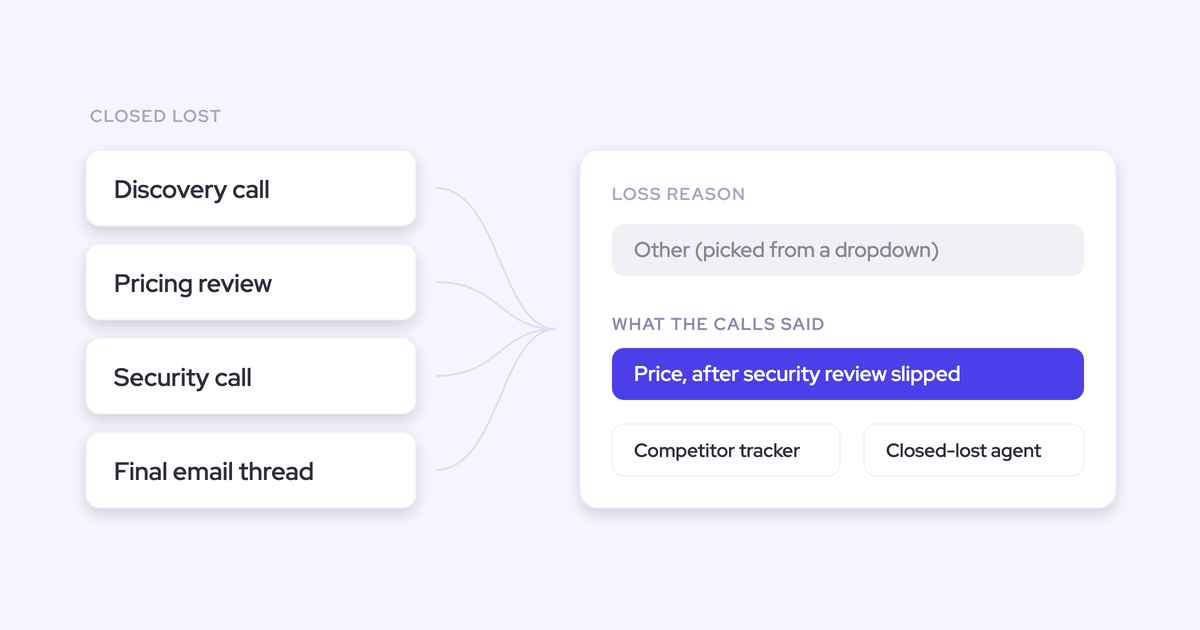
- Ask what changed. Understand the real reason. Budget? Timing? Chose a competitor? Each answer informs your next deal.
- Ask for a referral. "Even though we're not the right fit right now, is there anyone in your network who's dealing with the same CRM data challenges? I'd love to share the research we put together." Most reps never ask. Most prospects will say yes if they had a good experience.
- Stay in touch with value. Add them to a quarterly email with useful content—not product updates, but industry benchmarks, frameworks, and research they can use in their role.
One VP of Sales who didn't buy but respects your process will introduce you to three who might.
How to quantify value: ROI, cost savings, and business impact
Value quantification is where most reps struggle—and where the best separate themselves. Three steps:
- Identify the buyer's key metrics. Find the two or three metrics they track and report on. For a CRO: forecast accuracy and pipeline coverage. For RevOps: data completeness and report turnaround. For AEs: hours on admin versus selling.
- Calculate the delta. Use the buyer's own numbers to calculate the gap between current state and the outcome your product delivers. Don't default to industry averages when you have their data.
- Present as ROI. Frame the delta as a return on their investment.
Simple ROI formula:
ROI = ((Value gained - Cost of investment) / Cost of investment) x 100
Worked example:
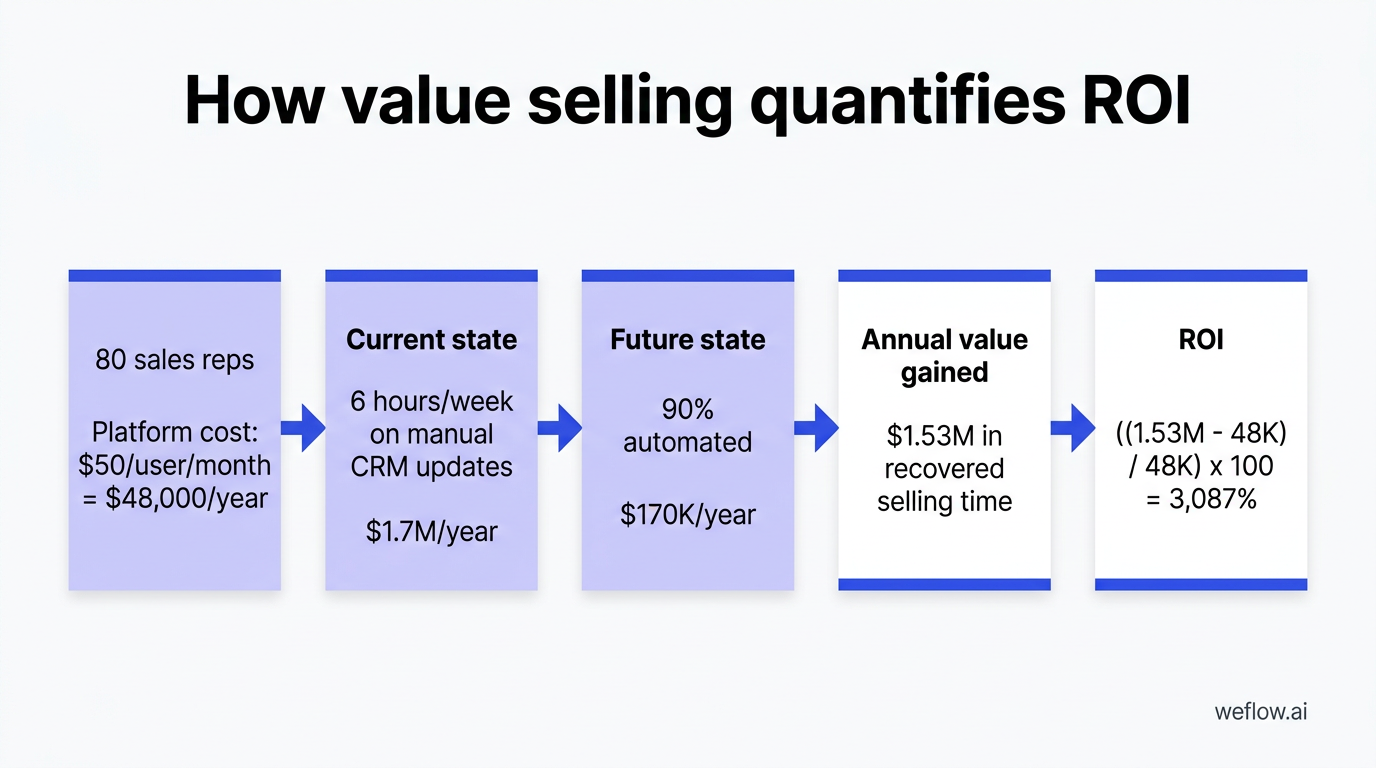
A mid-market SaaS company with 80 sales reps is evaluating a revenue intelligence platform priced at $50/user/month ($48,000/year).
- Current state: Reps spend an average of six hours per week on manual CRM updates. At a blended cost of $70/hour, that's $420/rep/week, or $1.7M per year across the team.
- Future state: The platform automates 90% of CRM data entry, reducing manual time to 36 minutes per week. New cost: $170K/year.
- Annual value gained: $1.7M - $170K = $1.53M in recovered selling time.
- ROI: (($1.53M - $48K) / $48K) x 100 = 3,087%
That's the number you put in front of the CFO. For every dollar spent, $31 back in rep productivity—before counting the pipeline impact of recovered selling hours.
Value selling examples: B2B SaaS scenarios
Here's how value selling plays out in three common B2B selling situations:
Scenario 1: CRM automation platform
[banner type="download" url="https://www.weflow.ai/resources/cheat-sheets/spiced-sales-checklist" text="SPICED Discovery Checklist" subtitle="Run discovery that surfaces quantifiable pain instead of vague challenges" button="Download checklist"]
A RevOps leader at a 200-person SaaS company is evaluating tools to fix poor CRM data quality. The feature pitch highlights automated activity capture and real-time sync. The value pitch: "Your forecast missed by 18% last quarter because 40% of opportunities have incomplete activity data. Our platform captures 95%+ of activity automatically. Based on your pipeline and win rate, closing that data gap should tighten forecast accuracy by 10-15 points—your CFO gets a number they can plan around."
Scenario 2: Marketing automation platform
A demand gen leader is comparing marketing automation tools. The feature pitch lists email sequences and lead scoring. The value pitch: "Your team spends 12 hours a week on manual segmentation—that's $150K/year in labor. Our platform cuts campaign build time to under two hours per week, recovering $125K in team capacity. Plus, better targeting typically drives a 25% lift in MQL-to-SQL conversion. At your volume, that's 400 additional qualified opportunities per year."
Scenario 3: Revenue intelligence tool
A CRO needs to cut new hire ramp time. The feature pitch showcases call recording and coaching scorecards. The value pitch: "Your ramp time is 9.5 months—two months over target. Managers spend six hours a week listening to calls and still cover only 15% of conversations. Our platform analyzes every call and surfaces coaching moments that correlate with closed-won deals. Companies at your scale cut ramp time by 30-45 days. At your ASP, one month of faster ramp is worth $2.4M in annual pipeline."
Common value selling mistakes to avoid
- Using generic ROI numbers instead of the buyer's data. Industry averages are a starting point, not a closing tool. If you haven't gathered the prospect's metrics in discovery, your value case reads like a marketing brochure. Use their numbers.
- Skipping discovery and jumping to the value pitch. You can't quantify value you haven't uncovered. Reps who rush past discovery project value onto the buyer instead of reflecting it back. The buyer knows the difference.
- Overcomplicating the math. A three-tab spreadsheet with 40 assumptions loses the buyer. The strongest value cases use simple arithmetic: hours saved x cost per hour x team size. If you need a finance degree to follow it, simplify.
- Forgetting value in follow-up. Value selling isn't a phase—it's the entire deal cycle. If your follow-up emails revert to "checking in," you've lost the value frame.
- Never validating value post-sale. If you promise $500K in savings and never prove it, you've undermined the renewal conversation. Build a 90-day value review into your CS handoff.
Frequently asked questions
What's the difference between value selling and solution selling?
Value selling leads with measurable business impact—ROI, cost savings, revenue lift—and attaches dollar figures to the buyer's pain. Solution selling leads with problem diagnosis and maps capabilities to requirements. Value selling wins larger deals because it speaks the language of economic buyers and CFOs, not just technical evaluators.
How do you quantify value in a sales conversation?
Start in discovery by asking questions that surface specific metrics: hours on manual tasks, error rates, revenue targets, team size. Calculate the delta between current state and the outcome your product delivers. Present as ROI: value gained minus cost of investment, divided by cost of investment. Use the buyer's own numbers whenever possible.
What are the core principles of value selling?
Four principles: deep buyer research before outreach, discovery questions that expose quantifiable pain, value quantification that turns pain into dollar figures, and outcome-focused messaging across every touchpoint. The common thread is specificity—generic value claims don't work. The numbers have to be real and tied to the buyer's business.
When should you use value selling instead of feature-based selling?
Use value selling when the deal involves multiple stakeholders, a long sales cycle, or an economic buyer who cares about ROI more than feature specs—that's most B2B enterprise and mid-market deals. Feature-based selling works for transactional, single-user purchases where the buyer is comparing specs. But even then, leading with outcomes shortens the decision cycle.
What are common value selling mistakes?
The most common: using generic industry ROI numbers instead of the buyer's actual data, skipping discovery and jumping to a canned value pitch, overcomplicating the ROI calculation with too many assumptions, and failing to validate the promised value after the deal closes. The fix for all of them is the same—do the research, ask the questions, and keep the math simple.
How does value selling work in B2B SaaS?
In B2B SaaS, value selling means quantifying business impact using the buyer's own metrics—hours saved, revenue recovered, error rates reduced, ramp time shortened. The SaaS model makes this easier because you can measure impact within weeks of deployment. Tie capabilities to outcomes the buyer already tracks, and the value case writes itself from their existing data.
What discovery questions should I ask for value selling?
Ask questions that surface numbers, not opinions. "How many hours per week does your team spend on manual CRM updates?" beats "What are your biggest challenges?" Follow the SPICED framework: Situation (how things work today), Pain (what's broken and what it costs), Impact (what fixing it would mean), Critical Event (what's driving the timeline), Decision (who decides and how). Every answer should give you a data point for your value calculation.
Key takeaways: implementing value selling on your next call
Value selling isn't a six-month rollout. It's a mindset shift you can apply to your next conversation: research the buyer's business, ask discovery questions that surface quantifiable pain, and frame every talking point around measurable outcomes.
Before your next call, write down three business outcomes your prospect cares about. Frame every talking point around those outcomes. That's value selling in practice.
-p-1600.png)

.png)
-p-1600.png)
-p-1600.png)
-p-1600.png)