
Target Account Selling: Framework, Steps, and KPIs
Learn the target account selling framework, launch steps, and KPIs that show if TAS is working.




What is target account selling (TAS) and why does it win larger deals?
Sales teams that focus on a defined set of high-value accounts close 38% more revenue than teams that spray outreach across an undifferentiated prospect list. That number comes from SiriusDecisions research on account-based revenue strategies, and it tracks with what most B2B revenue leaders already suspect: when you concentrate effort on the right accounts, win rates go up, deal sizes grow, and forecast accuracy improves.
Target account selling (TAS) is a B2B sales methodology where revenue teams identify 50 to 200 high-value accounts and pursue them with personalized, multi-stakeholder campaigns. Instead of working thousands of loosely qualified leads, TAS sellers research each account's buying committee, map decision-makers by role, and build outreach that addresses the specific business problems that account faces.
TAS is cross-functional by design. Sales owns the account relationships and deal execution. Marketing creates account-specific content, runs targeted ads, and warms contacts before sales engages. Customer success contributes expansion intelligence from existing accounts that match the ideal customer profile (ICP). RevOps provides the data infrastructure, scoring models, and pipeline reporting that keeps everyone aligned. When all four functions operate against the same account list with shared goals, the result is a coordinated revenue engine rather than isolated teams running separate playbooks.
The methodology works because large B2B deals involve five to 11 decision-makers, each with different priorities and evaluation criteria. A one-size-fits-all email sequence can't address a CFO's budget concerns, a VP of Engineering's integration requirements, and an end user's workflow friction in the same message. TAS forces sellers to build role-specific engagement plans for every stakeholder, which is why it consistently outperforms volume-based selling on deals above six figures.
Why target account selling? 5 benefits that impact pipeline and revenue
1. Higher win rates through focused engagement
When sellers research an account's org structure, competitive landscape, and strategic priorities before making contact, initial conversations start at a higher level. TOPO research shows account-based strategies produce 30 to 50% higher win rates compared to territory-based selling, primarily because sellers engage multiple stakeholders simultaneously rather than relying on a single thread.
2. Increased average contract value (ACV)
TAS naturally pushes sellers toward larger deals. When you've mapped the full buying committee and understand pain points across departments, the conversation expands beyond a single use case. A deal that starts as a pilot for one team becomes a multi-department rollout because the seller identified adjacent needs during account research. Teams running TAS programs report 20 to 40% higher ACV compared to non-targeted pipeline.
3. More predictable pipeline and revenue forecasting
Volume-based pipelines are noisy. Thousands of loosely qualified opportunities make it hard to distinguish real deals from dead weight. TAS pipelines are smaller by design, so every opportunity gets consistent inspection. When you're tracking 100 accounts instead of 5,000 contacts, your forecast is built on deals where you know the buying committee, the timeline, and the decision criteria.
4. Shorter sales cycles on qualified accounts
This sounds counterintuitive since TAS requires more upfront research. But sellers who've already mapped stakeholders, identified a champion, and prepared role-specific messaging don't waste weeks finding the economic buyer. They enter the account with a plan, engage the right people from the start, and avoid the recycling loop where deals stall because a critical stakeholder wasn't brought in early enough.
5. Stronger customer retention and expansion
The deep account knowledge sellers build during the sales process transfers to customer success, improving onboarding and time-to-value. Accounts sold through a multi-stakeholder process have broader internal advocacy, which reduces churn risk. And because TAS sellers maintain relationships across the buying committee, they're better positioned to spot expansion opportunities.
When should your sales team switch to target account selling?
TAS isn't right for every organization. It requires investment in data, research, and cross-functional coordination that doesn't make sense if your average deal is $5,000 and your sales cycle is two weeks. Here's when the switch makes sense:
- Complex deals: Buying committees with five to 11 decision-makers across multiple departments.
- Six-figure-plus ACV: The personalization TAS requires needs deal sizes that justify the investment.
- Subscription or recurring revenue: TAS is built for long-term relationships, not transactional sales.
- Long-term partnership model: Your GTM depends on landing accounts and growing them over years.
Prerequisites before starting:
- Centralized CRM with clean data. A single source of truth for account intelligence, activity history, and pipeline status. If your Salesforce instance has duplicates and incomplete fields, fix that first.
- Defined ICP criteria. Documented firmographic, technographic, and behavioral attributes for your ideal customer.
- Internal alignment. Sales, marketing, and CS operating against the same account list with shared goals. If marketing targets one set of companies while sales prospects another, you don't have a TAS program.
Target account selling vs. account-based marketing: what's the difference?
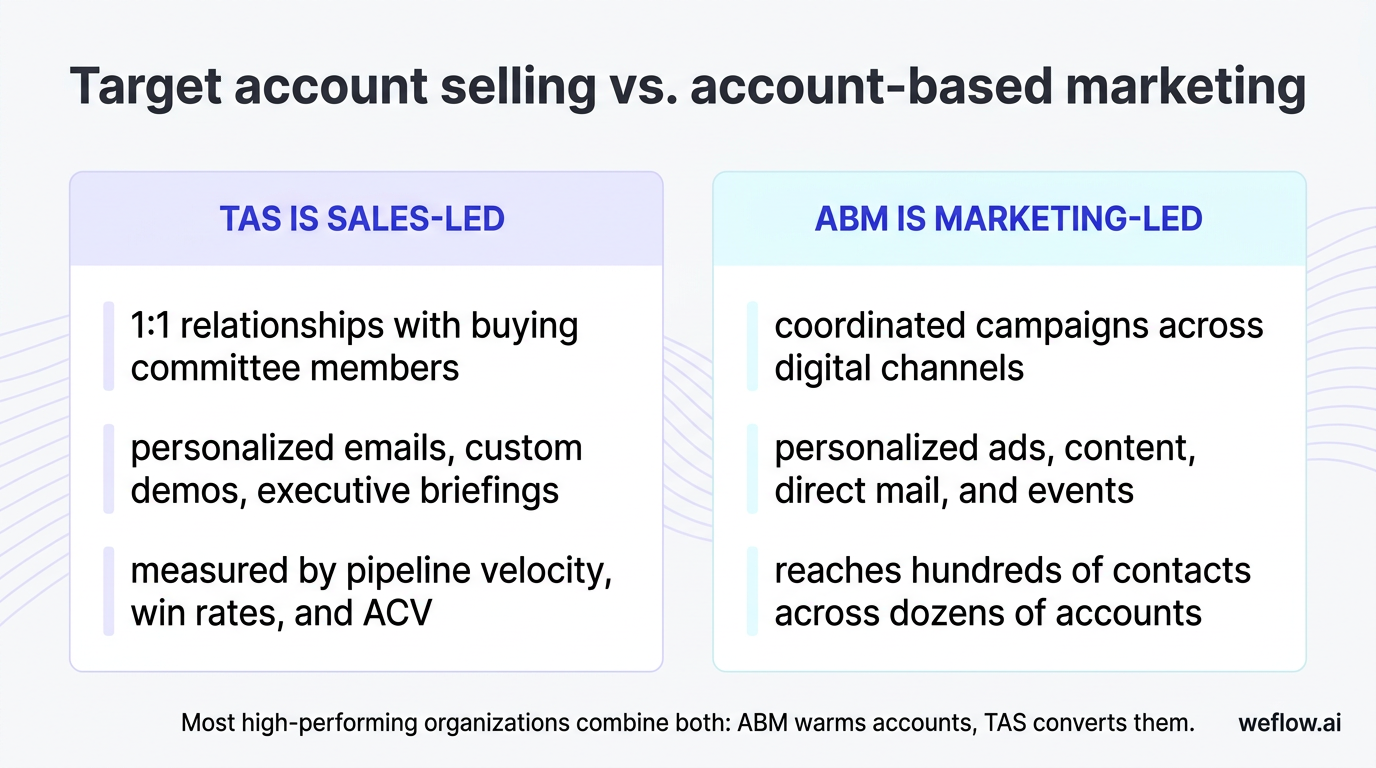
TAS is sales-led. Individual sellers own specific accounts and build 1:1 relationships with buying committee members through personalized emails, custom demos, executive briefings, and multi-threaded conversations. TAS lives in the deal cycle and is measured by pipeline velocity, win rates, and ACV.
ABM is marketing-led. Marketing teams run coordinated campaigns across digital channels, targeting accounts with personalized ads, content, direct mail, and events. ABM operates at broader scale: where a seller might engage five to 10 people at one account, ABM campaigns reach hundreds of contacts across dozens of accounts.
[banner type="download" url="https://www.weflow.ai/resources/cheat-sheets/sales-methodology-cheat-sheet" text="B2B Sales Methodology Cheat Sheet" subtitle="Pick the right framework for your deal size and buying committee before you build the playbook" button="Get the cheat sheet"]
In practice, most high-performing organizations combine both. Marketing runs ABM to warm target accounts and generate engagement signals. Sales uses those signals to prioritize outreach and open conversations with buying committee members who've already interacted with brand content.
The 6-step target account selling framework
Step 1: Build a data-driven ideal customer profile (ICP)
Your ICP is the foundation of every TAS decision. Start by analyzing your best existing customers for shared firmographic, behavioral, and technographic attributes.
| Attribute | What to look for |
|---|---|
| Industry | Verticals that produce the highest win rates and shortest sales cycles |
| Company size | Employee count range where your solution delivers the most value (e.g., 200 to 5,000) |
| Annual revenue | Revenue range that correlates with budget authority ($50M to $1B) |
| Technology stack | Platforms that indicate fit (e.g., Salesforce Enterprise, HubSpot, Marketo) |
| Funding status | Recent funding rounds, IPO prep, or PE backing that signals growth investment |
| Geographic presence | Markets where your product is strongest and support exists |
| Organizational structure | Presence of champion roles (VP of RevOps, CRO, Director of Sales Ops) |
| Growth signals | Hiring activity, new offices, M&A, or leadership changes |
| Pain indicators | Negative reviews of current tools, job postings for roles your product replaces |
Nine ICP discovery questions to ask your best customers:
- What problem were you solving when you first evaluated our product?
- What trigger event moved you from "aware of the problem" to "actively searching"?
- Who else was involved in the buying decision, and what did each person care about?
- What tools or processes were you using before, and where did they fall short?
- How did you justify the budget internally? What metrics did you present?
- What was your biggest concern during evaluation, and what resolved it?
- How long did evaluation and procurement take from start to signature?
- What specific results have you seen since implementing?
- If you described our product's value in one sentence to a peer, what would you say?
Step 2: Map the buying committee and create role-based personas
B2B buying committees include five to 11 decision-makers. Each has a different role, different evaluation criteria, and different objections. TAS sellers map every member before crafting outreach.
- Champion: Internal advocate who sells your solution inside the org and provides access to other stakeholders.
- Economic buyer: Budget authority who signs the contract. Cares about ROI, total cost of ownership, and strategic alignment.
- Technical evaluator: Assesses integration with existing infrastructure and security requirements.
- Blocker: Opposes the purchase due to competing priorities, attachment to current solutions, or politics.
- End user: People who'll use the product daily. Their adoption determines expansion or churn.
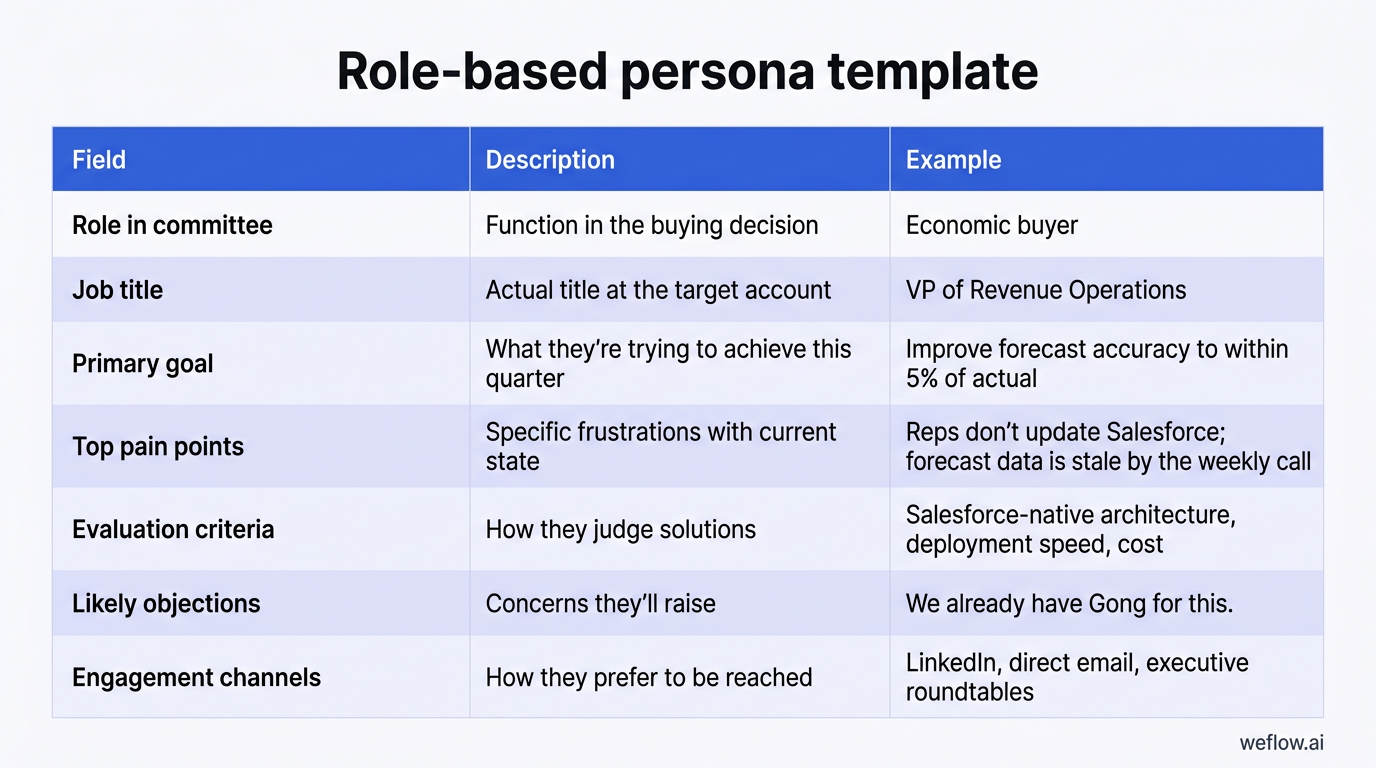
| Field | Description | Example |
|---|---|---|
| Role in committee | Function in the buying decision | Economic buyer |
| Job title | Actual title at the target account | VP of Revenue Operations |
| Primary goal | What they're trying to achieve this quarter | Improve forecast accuracy to within 5% of actual |
| Top pain points | Specific frustrations with current state | Reps don't update Salesforce; forecast data is stale by the weekly call |
| Evaluation criteria | How they judge solutions | Salesforce-native architecture, deployment speed, cost |
| Likely objections | Concerns they'll raise | "We already have Gong for this." |
| Engagement channels | How they prefer to be reached | LinkedIn, direct email, executive roundtables |
Step 3: Score and prioritize your target account list
Not every ICP-matching account deserves the same effort. Scoring separates high-priority targets from accounts that fit the profile but aren't ready to buy.
Tools for building your target account list: LinkedIn Sales Navigator, 6sense, Bombora, ZoomInfo, and Demandbase. Each provides different signals: org charts, intent data, content consumption patterns, firmographic enrichment, and advertising integration.
Keep the list at 50 to 200 accounts. Fewer than 50 and you don't have enough coverage. More than 200 and personalization quality drops.
Four scoring criteria:
- ICP fit: How closely does the account match across firmographic, technographic, and organizational attributes?
- Intent signals: Is the account researching your category, reading relevant content, or visiting your site?
- Timing: Leadership changes, funding rounds, fiscal year planning, or competitor contract renewals.
- Relationship strength: Existing contacts, a champion from a previous company, or warm introductions.
Step 4: Design multi-touch, personalized outreach campaigns
Every touchpoint should be designed for the recipient's role, pain points, and buying stage. Multi-touch means coordinating across email, calls, content, events, LinkedIn, and direct mail. Different stakeholders respond to different channels: a CRO engages with an executive briefing invitation while a Director of Sales Ops responds to a technical teardown.
Campaign planning checklist:
- Identify target buying committee members and their current stage
- Select channels based on persona preferences
- Build a timeline with touchpoints mapped to specific weeks
- Define metrics: response rates, meetings booked, multi-threading progress, pipeline created
- Create role-specific messaging for each persona
- Set up tracking to measure engagement by role
Step 5: Align sales, marketing, and customer success around target accounts
Shared account plans and dashboards. Every target account needs a plan that includes ICP score, buying committee map, engagement history, deal stage, and next steps. This plan lives in the CRM where all teams can access it. Revenue teams that build shared dashboards showing account engagement across sales, marketing, and CS touchpoints make better decisions about where to focus effort.
Coordinated messaging. When a buyer hears one narrative from sales, sees a different message in a marketing email, and gets a third pitch from CS, trust erodes. Align on account-specific messaging so every touchpoint reinforces the same value proposition.
[banner type="download" url="https://www.weflow.ai/resources/cheat-sheets/strategic-selling-checklist" text="Strategic Selling Checklist" subtitle="Map every stakeholder so deals don't stall when your champion goes quiet" button="Get the checklist"]
Handoff protocols and feedback loops. Define when marketing hands an engaged account to sales, how sales shares deal intelligence with CS for onboarding, and how CS feeds expansion signals back. Document these, automate where possible, and review regularly.
Step 6: Measure TAS performance with the right KPIs
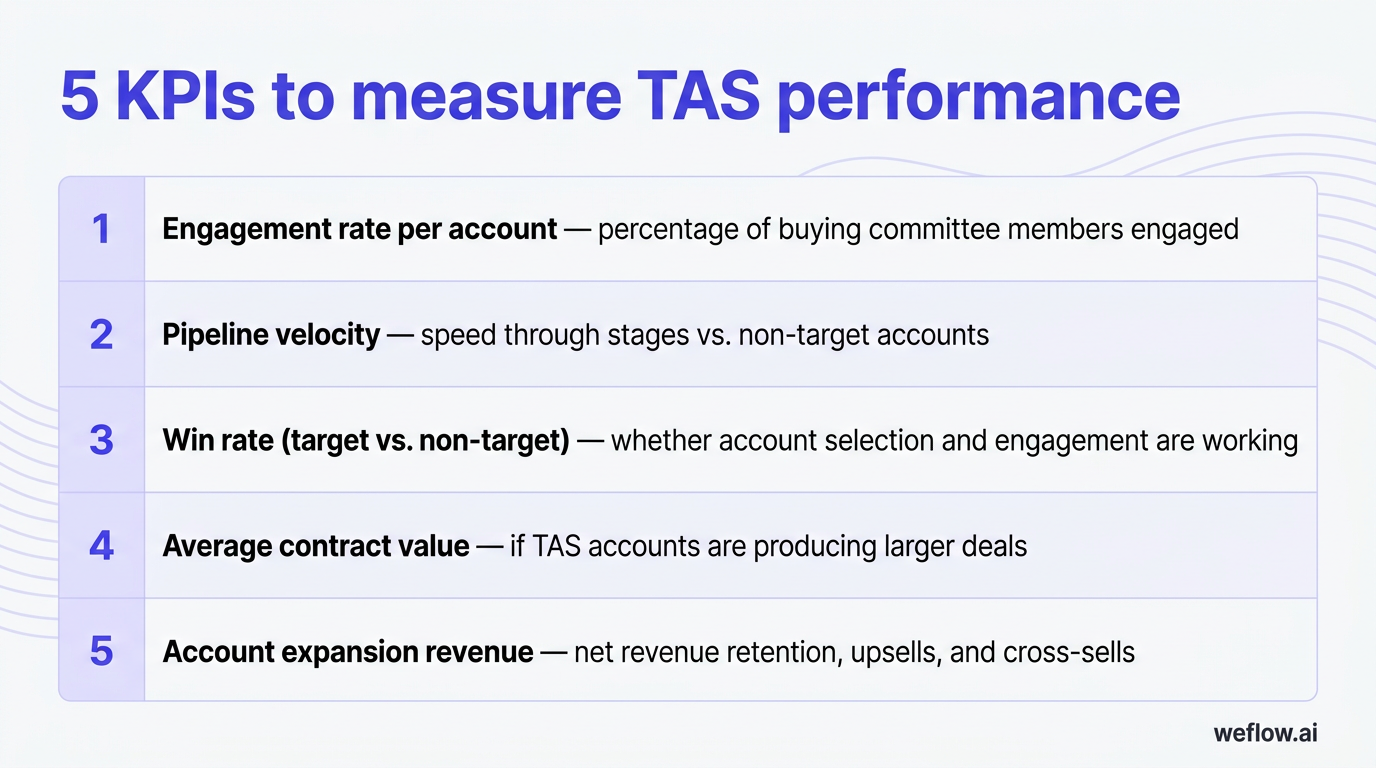
- Engagement rate per account: What percentage of buying committee members have engaged with your outreach? This tells you if you're multi-threading or relying on a single contact.
- Pipeline velocity: How fast are target accounts moving through stages compared to non-target accounts?
- Win rate (target vs. non-target): The clearest indicator of whether your account selection and engagement are working.
- Average contract value: If TAS accounts aren't producing larger deals, revisit your selection criteria.
- Account expansion revenue: Net revenue retention, upsells, and cross-sells within TAS accounts over time.
Tools and technology that power target account selling
CRM (Salesforce) as the system of record. Account plans, buying committee maps, deal stages, activity history, and pipeline data all need to live in one place. If your CRM data is incomplete or stale, every downstream TAS activity suffers: scoring models produce bad rankings, forecast calls rely on guesswork, and managers can't inspect deals with confidence.
Intent data platforms. 6sense, Bombora, and ZoomInfo provide signals showing which accounts are actively in-market. Intent data turns a static ICP list into a dynamic priority queue based on real buyer behavior. The difference between calling an account that matches your ICP and calling one that's actively researching your category is the difference between cold outreach and timely outreach.
Sales engagement platforms. Sequencing tools coordinate multi-touch outreach at scale while maintaining personalization. They track engagement by contact and account, so sellers see which buying committee members are responding.
Conversation intelligence and activity capture. TAS generates high interaction volume across multiple stakeholders per account. Without automated capture, critical deal intelligence gets lost between what reps remember and what they log. Weflow, a Salesforce-native revenue AI platform, captures emails, meetings, and calls automatically and writes them back to Salesforce records. RevOps teams get complete pipeline visibility without relying on manual updates, and sellers spend time on account engagement instead of data entry. That's what makes TAS execution sustainable at scale: activity data is always there, always accurate, and always in Salesforce where the full team can act on it.
Frequently asked questions
What is target account selling?
Target account selling is a B2B sales methodology where revenue teams focus on 50 to 200 high-value accounts, pursuing each with personalized, multi-stakeholder engagement. Sellers research buying committees, map decision-makers, and tailor outreach to specific roles and pain points rather than running broad-based prospecting.
How is target account selling different from account-based marketing (ABM)?
TAS is sales-led, focusing on 1:1 seller engagement with buying committee members. ABM is marketing-led, running coordinated campaigns across digital channels at broader scale. Most B2B organizations combine both: marketing warms accounts through ABM, and sales converts them through TAS.
What types of companies benefit most from target account selling?
B2B companies with complex sales cycles, six-figure-plus deal sizes, and five or more stakeholders in purchasing decisions. Typical industries include SaaS, financial services, professional services, and healthcare technology. Subscription-based revenue models get the most value because TAS builds relationships that drive retention and expansion.
How do you build a target account list for TAS?
Analyze your best existing customers to define your ICP across firmographic, technographic, and behavioral attributes. Then use intent data platforms like 6sense, Bombora, or ZoomInfo to find accounts matching your ICP that are actively researching your category. Keep the list at 50 to 200 accounts.
What metrics should you track to measure TAS performance?
Five core metrics: engagement rate per account, pipeline velocity, win rate for target vs. non-target accounts, average contract value, and account expansion revenue. Comparing TAS pipeline performance against your general pipeline validates whether your account selection approach is working.
How many stakeholders should you engage in a target account?
B2B buying committees typically include five to 11 decision-makers. Effective TAS programs engage at least three to five stakeholders per account: the champion, economic buyer, technical evaluator, and key end users. Multi-threaded deals close at higher rates because they survive champion turnover and internal objections.
What tools do sales teams need for target account selling?
Start with Salesforce as the system of record, intent data platforms for account prioritization, and sales engagement platforms for multi-touch sequencing. Activity capture tools like Weflow automate CRM data entry that otherwise creates gaps in pipeline visibility. The goal is a connected stack where every interaction is captured and accessible to the full revenue team.
-p-1600.png)

.png)
-p-1600.png)
-p-1600.png)
-p-1600.png)