
How to Track MEDDIC and SPICED Adherence Across Every Recorded Call, Automatically
Learn how to track MEDDIC and SPICED adherence across every recorded call, deal, and rep.


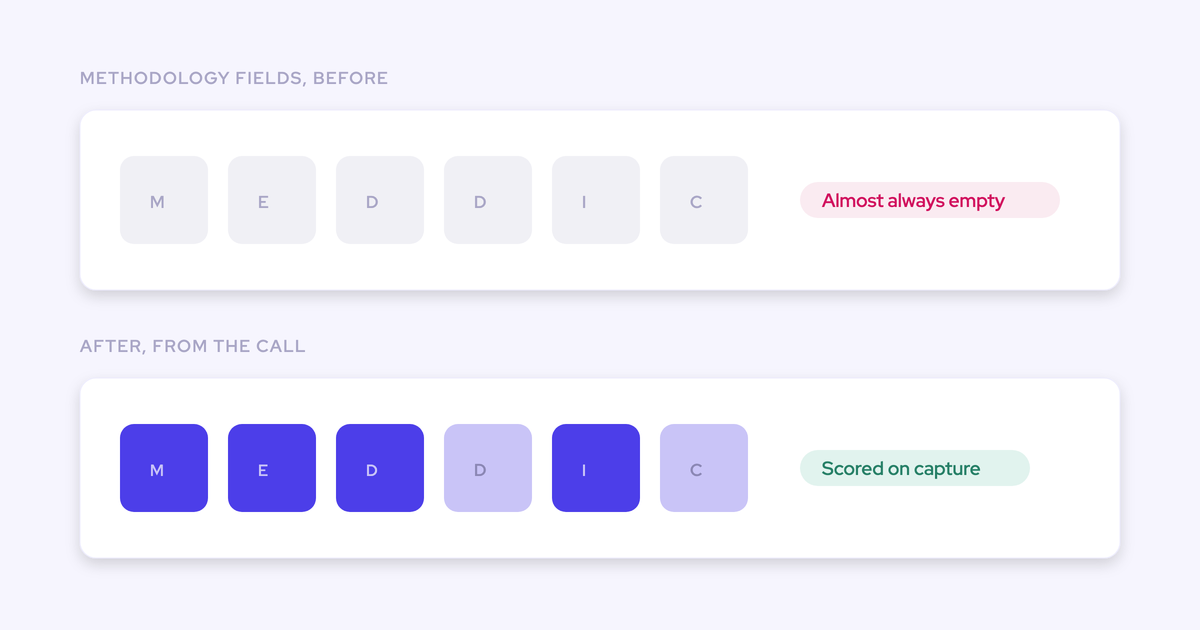

Nobody can tell you whether the methodology is actually being used, and the reason has never been rep discipline. Measuring adherence costs more than the answer is worth. Somebody has to read the calls, join them to the records, and write the queries, and no RevOps team has that person sitting idle.
That changes when the scoring happens on its own: every recorded call scored against the framework you configured, every opportunity scored from the full record behind it, and every rep tracked across their deals over months.
The scores land in Salesforce fields you own, which is where they start driving deal execution instead of sitting in someone else's dashboard.
This article walks through that measurement system layer by layer. Including the honest part: which bits of the org-wide view are native, and which bits you assemble yourself.
Why mandates and per-call summaries can't measure adherence
You're weighing two paths right now. Enforce the fields harder, or lean on the conversation intelligence tool you already pay for. Both produce something, and neither produces adherence.
Mandated fields measure data entry, not qualification quality
A field completion rate tells you reps typed something. It tells you nothing about whether the deal is qualified.
Put a validation rule on the Metrics field and completion goes to 90%. Then you open the field and read this:
If the metrics comes back and says they have 50,000 staff, that is a metric, but it's not relevant to what we're looking at in our sales process.
Filled, valid, useless. Managers learn to ignore the fields and go back to asking in the review, which is exactly where you started, except now you've spent rep goodwill getting there.
| What the completion metric says | What it actually measures |
| "Most opportunities have MEDDIC populated" | Most reps cleared a validation rule |
| "Adoption is up since the mandate" | Typing is up since the mandate |
| "This deal is qualified" | Someone wrote a sentence in a text box, at some point, from memory |
The failure is structural, not behavioral. A rep doing the job well spends the day talking to customers, so the CRM is what gets left. Every additional field you mandate gets filled badly or not at all.
Per-call scores don't roll up to deals, reps, or teams
Adherence is an account-, rep-, and team-level question, and per-call tooling answers a call-level one.
Credit where it's due: Gong invented this category and has the deepest conversation analytics in it. Gong can also summarize a methodology across every call on an account, which is genuinely the view a manager on a long cycle needs, and any tool that only summarizes single calls feels like a downgrade against it.
What Gong doesn't do is close the loop into your CRM.
It doesn't auto-populate MEDDIC or other methodology fields from transcripts, so the field update stays manual after a rep reads the insights. Trackers detect that a methodology topic was mentioned; they don't weight it against your own win, slip and loss data. Teams that want the weighted score on the opportunity build it separately with RevOps and IT.
So here's what a per-call view can't answer, no matter how good the per-call analysis is:
- Which open deals above $50k have no evidenced economic buyer, across the whole pipeline.
- Whether this rep is consistently weak on decision process, or just had one bad discovery call.
- Whether two managers running the same framework are coaching it to the same standard.
- Whether adherence in EMEA is trending up or down over two quarters.
Each of those needs a join across calls, emails and records, and that join has always been a manual analyst job. That's the capacity problem, and it's why the framework gets mandated, trained, and then never inspected again.
What a working adherence measurement system looks like
Methodology adherence becomes measurable when three things are true at once: the evidence is extracted from conversations instead of typed by reps, scoring runs at every level the question gets asked (the call, the deal, and the rep over months), and the output lands in CRM fields your team owns and someone actually inspects.
Take any one away and you're back to a slide. The requirements in full:
- Extraction, not enforcement. The qualification conversation already happened. The evidence sits in emails, meetings and transcripts, and the field should be written from that, with the rep correcting rather than authoring.
- Three levels of scoring, not one. The call answers "was the methodology applied here." The deal answers "is this actually qualified." The rep over months answers "where is this seller consistently weak."
- Full population, not a sample. A manager reviews a handful of calls a week. Coaching built on that is anecdote with a scorecard attached.
- Output in fields you own. If the score lives in a vendor's interface, you now have two versions of the truth and still no answer in the place the deal review happens.
- Someone inspects it. A score nobody looks at has automated the paperwork and left the problem exactly where it was.
It's fairly easy to pick a sales methodology or qualification framework. It's really hard to operationalize it because it's a big change management effort.
— Janis Zech, CEO and Co-founder, Weflow (RevOps Lab)
Richard Harris makes the harder version of the point: if MEDDIC isn't working because nobody's coaching it, NEAT won't rescue you either. Measurement doesn't replace the coaching. It gives the coaching something to aim at.
How Weflow scores methodology adherence at three levels
Weflow is the Revenue AI Orchestration platform for sales, customer success, and RevOps teams, and methodology scoring runs across three of its layers at once: the call, the opportunity, and the rep over time.
| Level | What it reads | The question it answers | Where the score lands |
| Call | The transcript of one recorded meeting | Was the methodology applied in this conversation? | A coaching scorecard on the recording, plus Salesforce field writes from the transcript |
| Opportunity | Every email, meeting, transcript and CRM field on the deal | Is this deal actually qualified? | Your Salesforce methodology fields, and the playbook panel on the deal board |
| Rep over months | Every scored call and deal for that seller | Where is this rep consistently weak? | Scorecard insights by user, team and time period |
Every recorded call scored against your configured methodology
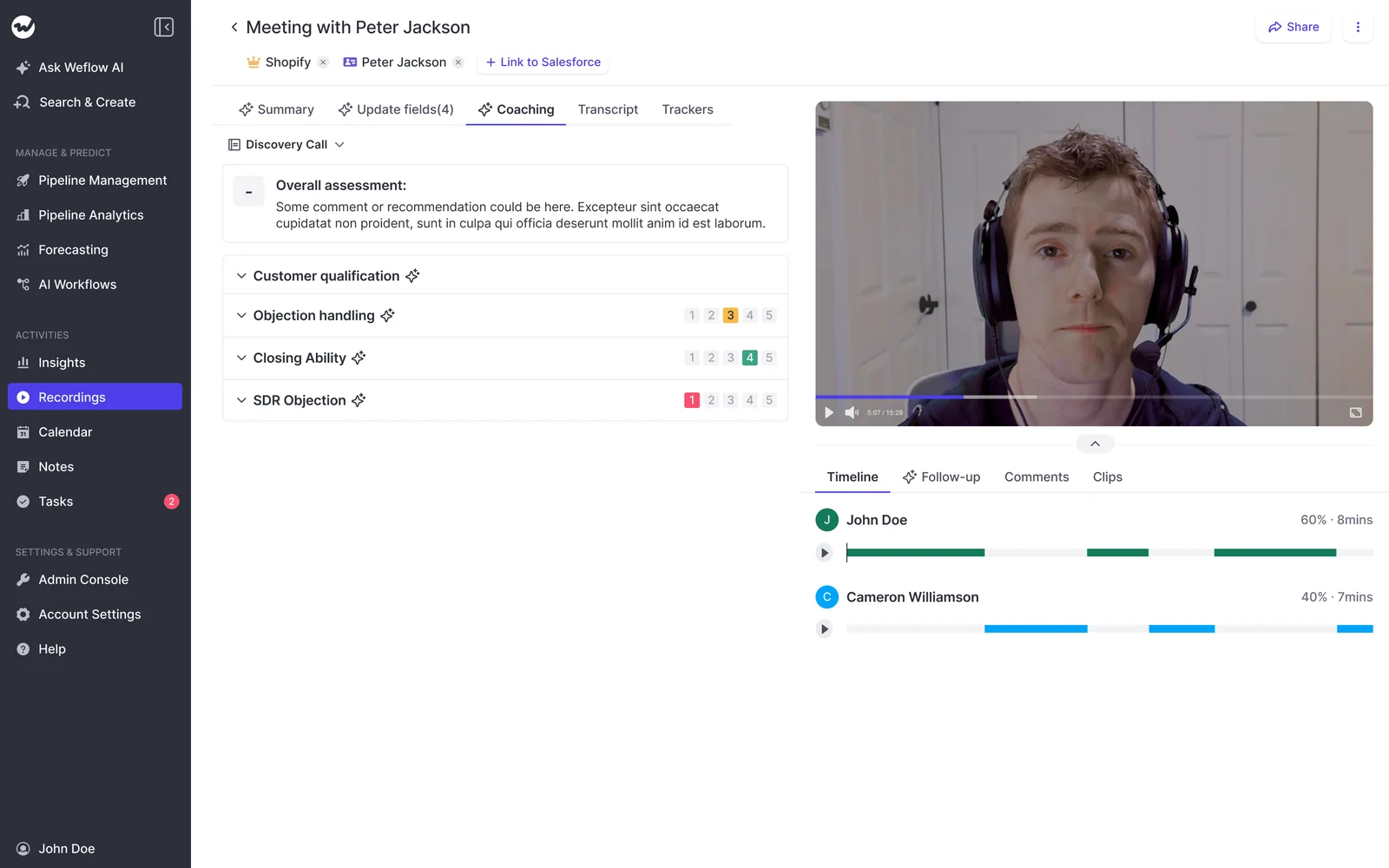
Weflow scores every recorded meeting automatically against the methodology configured for that team, producing a coaching scorecard for the rep and a structured agenda for the manager.
That's the difference between a sample and a population. A manager who reviews four calls a week is coaching on the four calls they had time for. When all of them are scored, you can watch how one rep's economic buyer identification has moved over months and open the specific calls behind the number.
Two details that matter in practice:
- The rep gets feedback within minutes of the call ending, with no manager in the loop.
- Coaching templates are assigned per team, with rating or free-form output and your own prompts, and a manager can override any score.
Every opportunity scored from emails, meetings, and transcripts
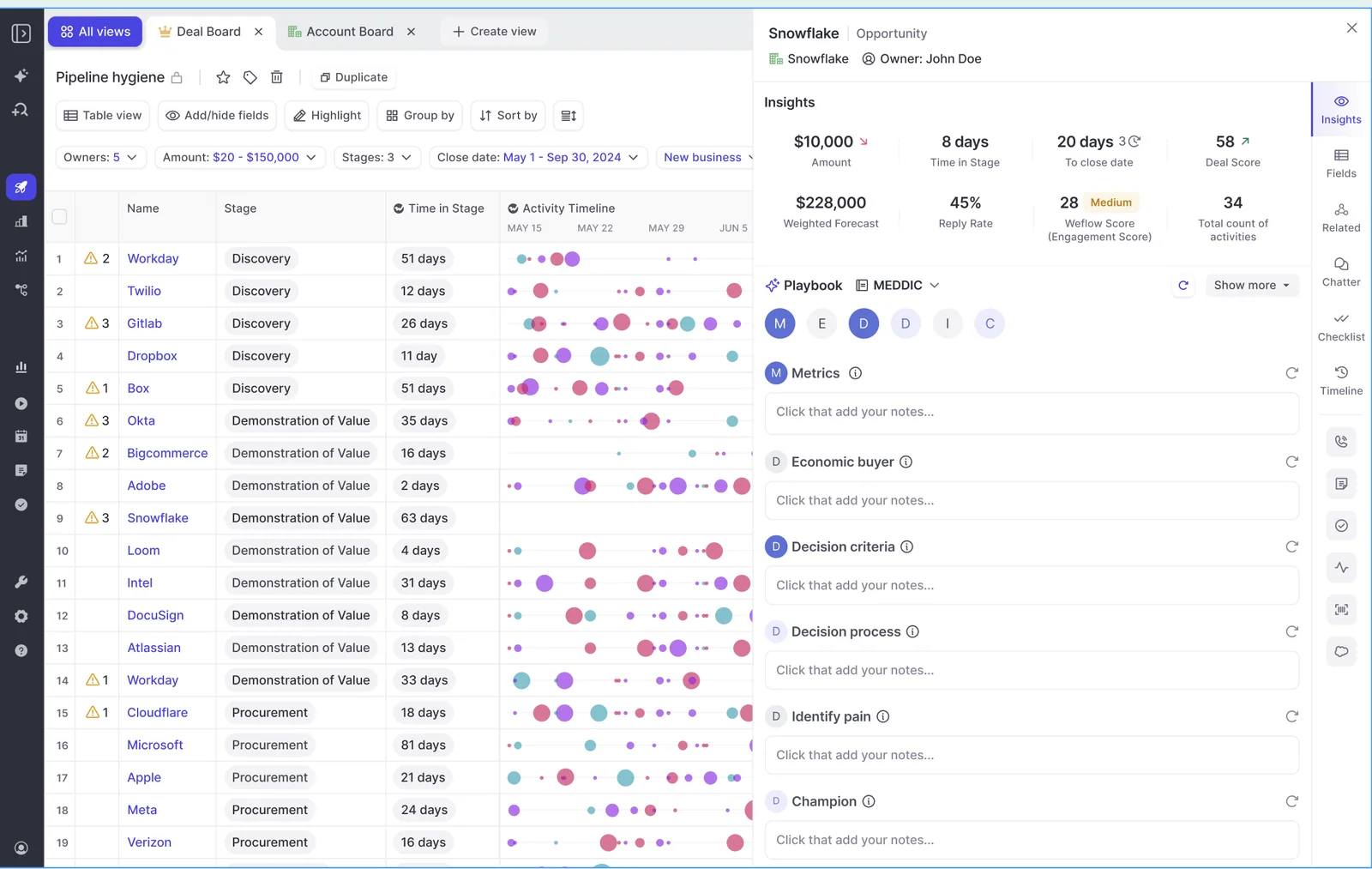
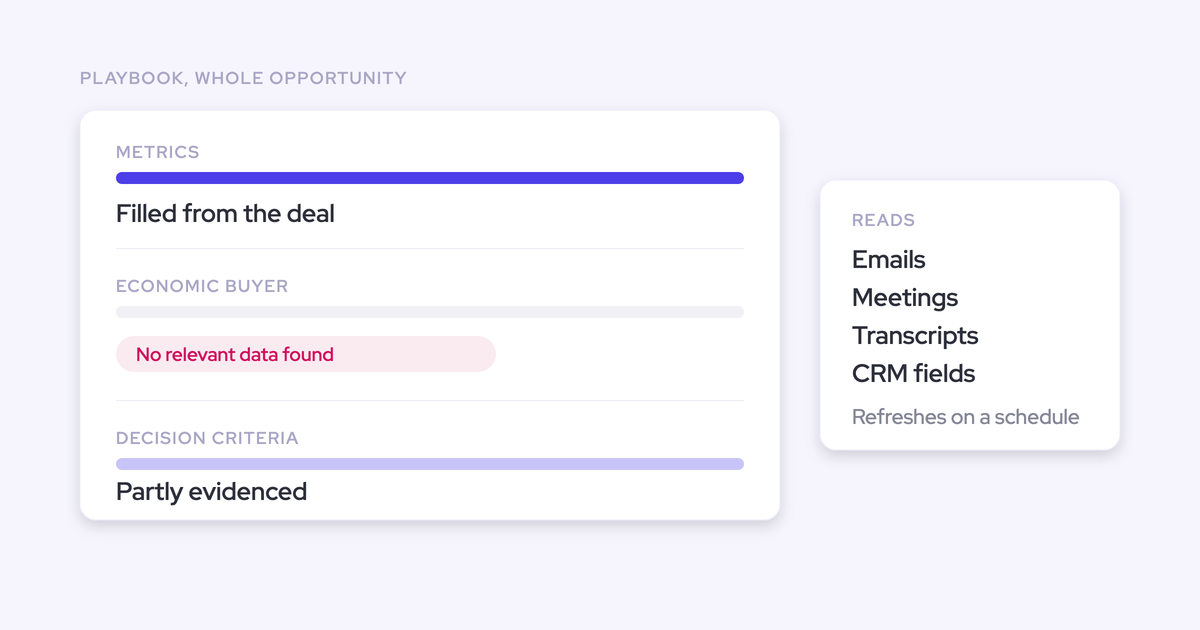
An AI Playbook in Weflow scores a whole opportunity against your methodology by reading every email, meeting, transcript and CRM field on the deal, then writes the result back to the corresponding Salesforce fields.
This is the layer above field auto-fill, and it's what makes the score hard to game. A rep can't pass a methodology check by filling in a box, because the playbook is bound to the record, not to the field.
What it reads on a single deal:
- Email threads, including the budget signal buried in a reply nobody logged.
- Meetings and recorded transcripts across the whole cycle, not just the last good call.
- The CRM fields already on the opportunity, and the activities attached to it.
The output is a per-letter status with a specific recommendation: the metrics are named but not quantified, the economic buyer is still unidentified. Where nothing supports a criterion, it says so rather than inventing something plausible. It refreshes on a schedule, and a rep can type their own notes into the same panel.
That's also what turns it from a coaching score into a forecast signal. A deal forecast to close this month with no identified economic buyer is now a filterable row, not a feeling in a deal review.
Every rep tracked across their deals over months
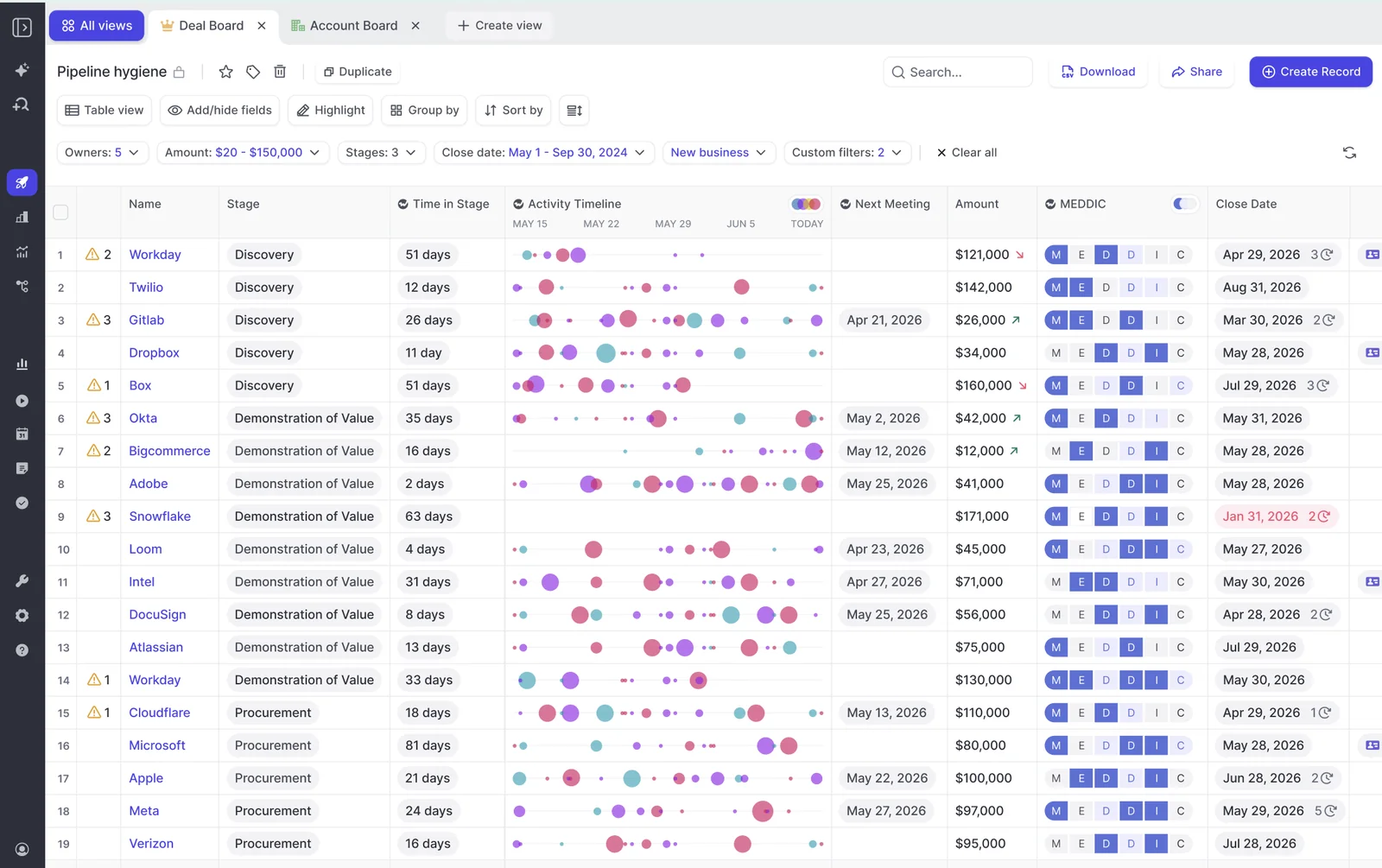
Rep-level scoring is where adoption stops being a training-attendance number and becomes something you can inspect.
You can see that a seller scores well on metrics and economic buyer every single time, and poorly on decision process and champion, month after month. That's a coachable gap. It also makes ramp measurable for a new hire, because you're watching one line move rather than asking their manager how they're getting on.
And because the scores roll up per rep and per team, the manager variance shows up as data instead of as a rumor.
The truth is someone can look at one document and the other person can look at the same document and interpret that differently. And so even though you said, hey, we've created a unified way of understanding how we look at our customers and how we evaluate deals and we break it down to modular components, every manager looks at it differently, they coach differently, and then the outcomes become different.
— Julien Cerutti, VP of Global Revenue Strategy at Meltwater (RevOps Lab)
That divergence is the thing enablement cannot fix with another training session, because the words were never the problem. Instrumentation is the only counter.
How to build the pipeline-wide adherence view in Salesforce
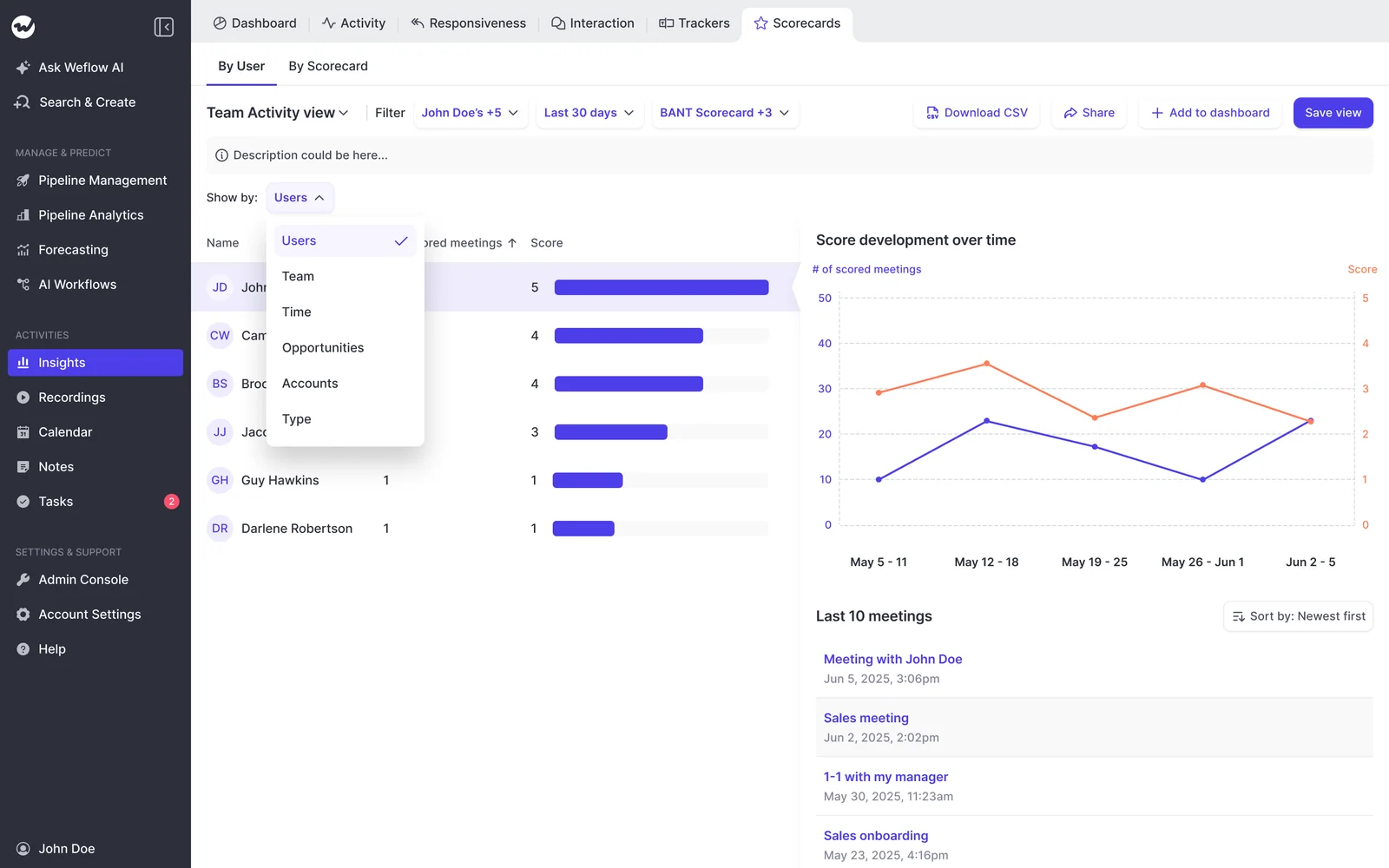
The org-wide picture is assembled from those three layers. Some of it is a report you build once, some of it is a question you ask in plain language, and one part of it is genuinely manual. All three below.
Report on deals missing qualification from fields you own
Because Weflow writes the scores into your own Salesforce fields, the pipeline-wide adherence view is a report in your reporting stack, not a dashboard in a vendor's product.
This is the question managers actually ask:
Once the fields are populated from the conversations, that's a standard Salesforce report. Useful cuts:
- Open deals closing this quarter, above your size threshold, with no evidenced economic buyer.
- Average qualification score by manager, by region, by segment.
- Deals that advanced a stage while the decision process field stayed empty.
- New-hire deals scored against the team average, month by month.
The scores are also usable by everything else you've already built: validation rules, flows, your BI tool, your own agents. That only works because the value is a picklist or a number rather than a paragraph of narrative, which is worth checking with any vendor you evaluate.
Ask adherence questions in plain language with Ask Weflow AI
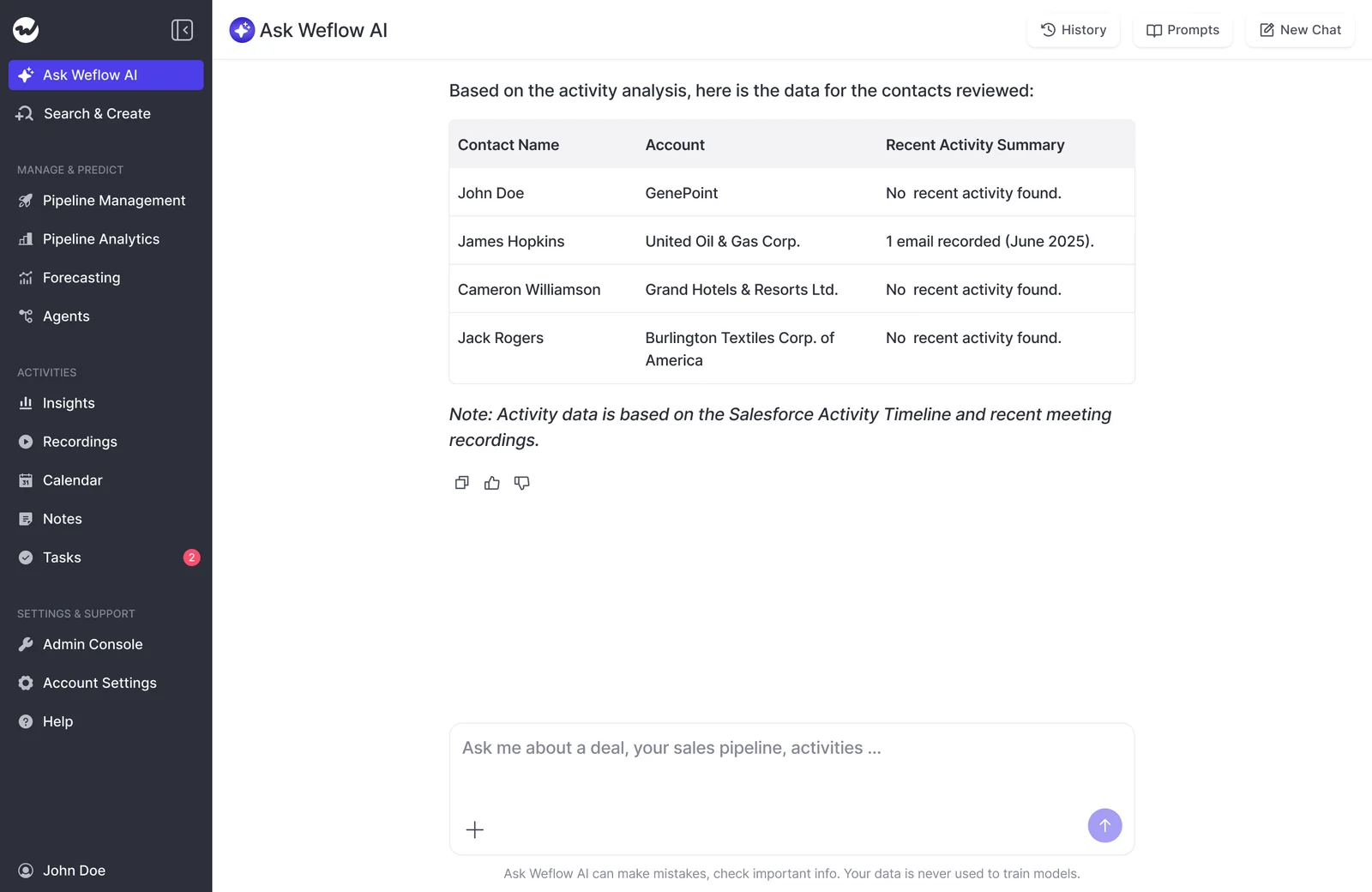
Ask Weflow AI turns "is anyone using MEDDIC" into a question anyone on the team can ask, reading across transcripts, CRM fields and activity history together.
One customer has an intern running exactly this as a capstone project: analytics on what the sellers are doing, and where they are or aren't using MEDDIC. That's the real shift. Not a better scorecard, but a question cheap enough to ask monthly instead of once a year when someone finally has capacity.
Questions that work:
- "Which reps are applying MEDDIC, and on which deals?"
- "On the enterprise deals closing this quarter, where is the decision process undocumented?"
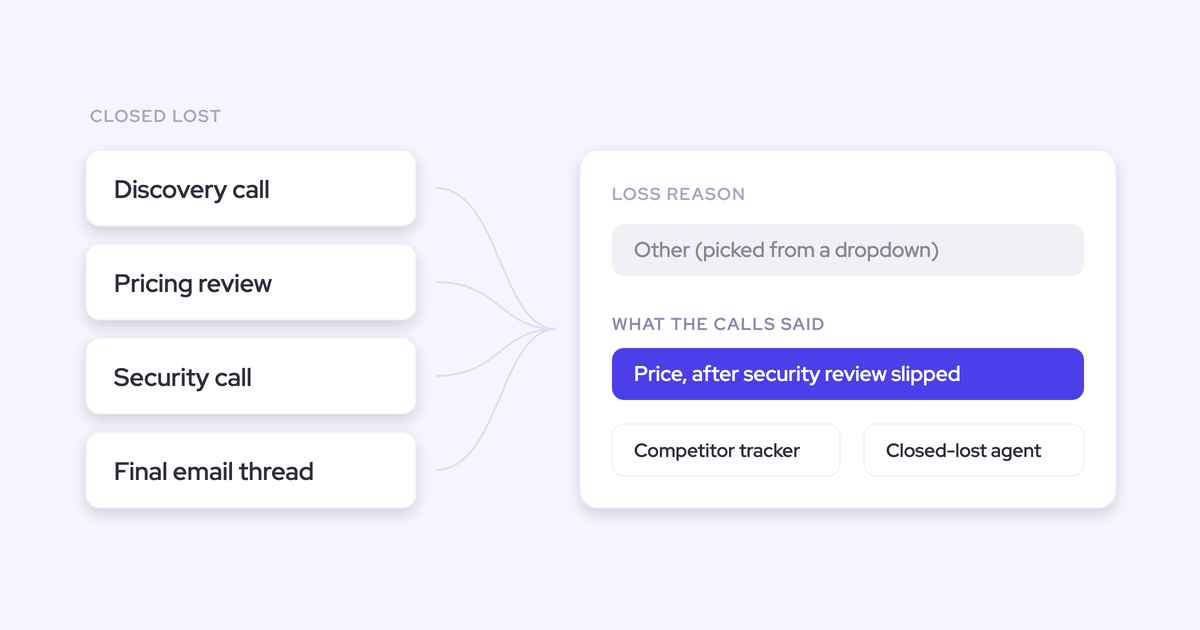
- "What did customers say about pricing on the deals we lost last quarter?"
Where the team-wide view is assembled, not native
There is no single button in Weflow that scores a whole team's pipeline in one pass.
A predefined playbook evaluates one record at a time, an account or an opportunity, never a set of them. Running it at account level is the broader option, because the account pulls in everything attached to it. But if you want the team view, you generate each record and read across the board, then report on the fields underneath.
Say it plainly: the org-wide picture is built from layers. Gong can natively summarize a methodology across every call on an account, and a team used to that view should know they're assembling something here rather than opening one report. What you get in exchange is that the scores are in your Salesforce, reportable alongside everything else you own.
How to track adherence for a custom or house framework
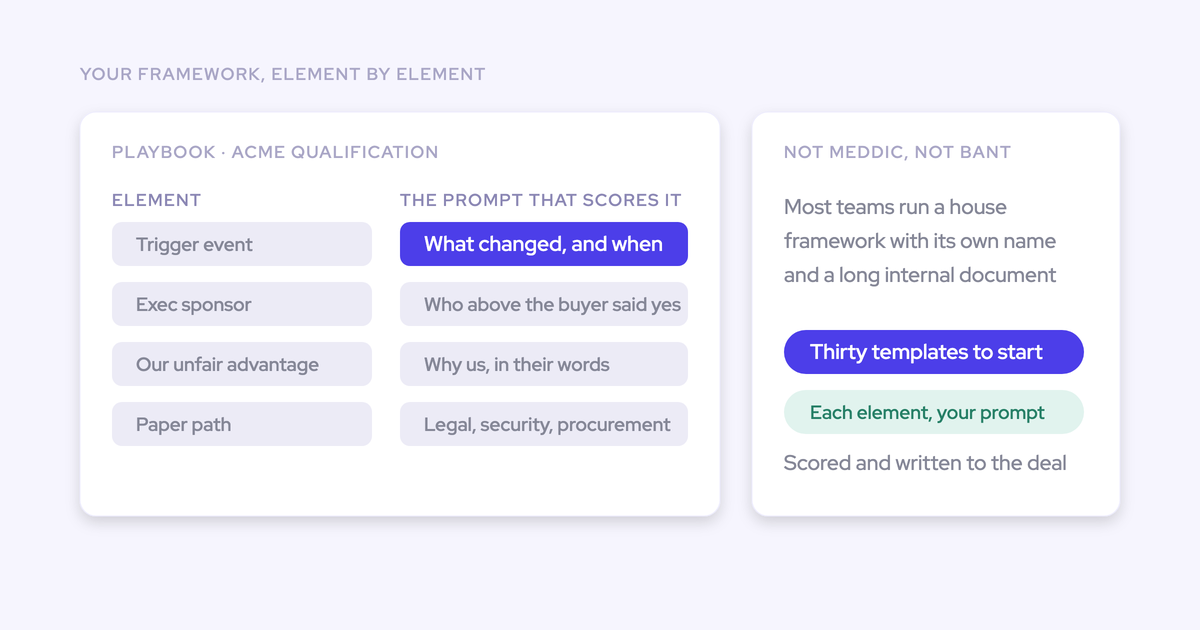
Most teams don't run MEDDIC out of the box. They run something with their own name on it, their own stages, and a long internal document defining it.
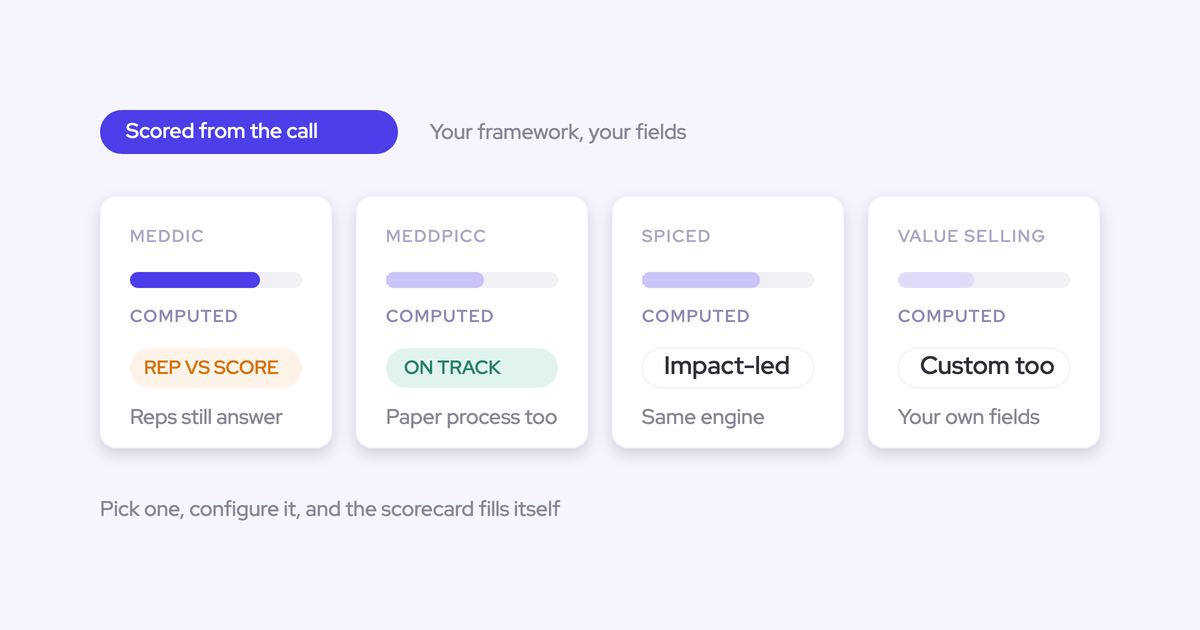
A rough mapping onto a standard model is worse than nothing here, because it produces a score people argue with in the review. Weflow ships around thirty methodology templates and lets you map your own prompt to each element, so a proprietary framework is encoded exactly like a standard one rather than approximated.
How a house framework gets mapped:
- Name the elements, using the language your managers already use in deal reviews.
- Map each element to the Salesforce field the review already reads off, including the checkbox beside it.
- Write the prompt per element, with your definition of what qualifies and what doesn't.
- Assign the template to the team that runs it.
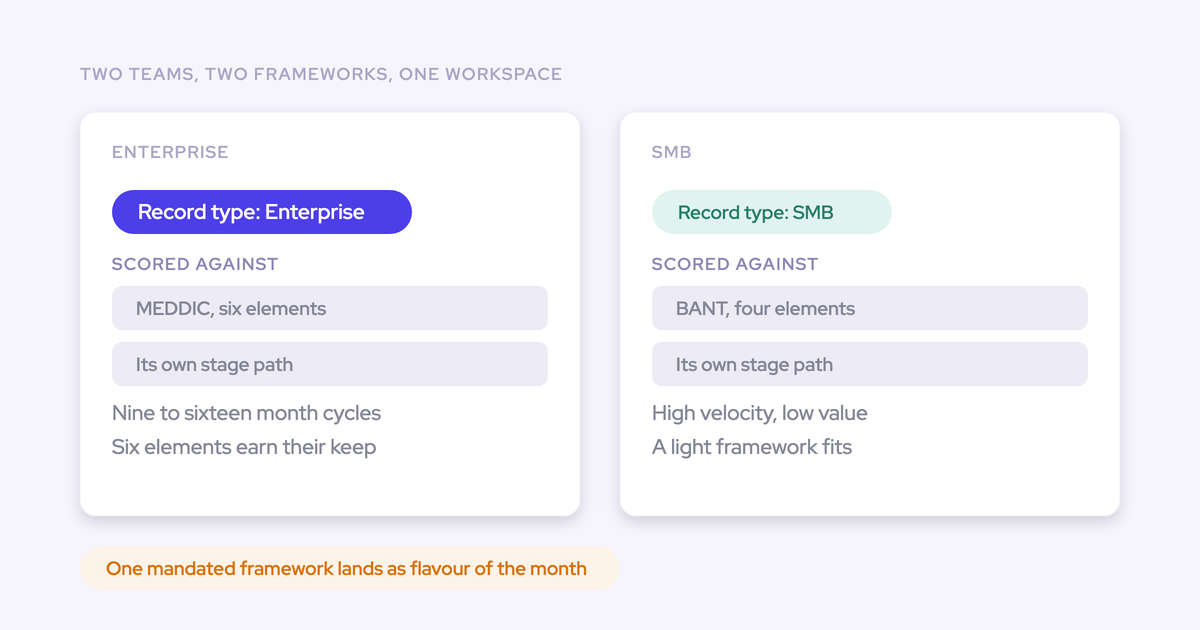
Because the methodology is a set of prompts against fields rather than a hardcoded model, one org can run BANT on transactional deals, MEDDIC on enterprise, and a house framework in a third team, each scored against its own template.
How to stop plausible-but-wrong AI methodology scores
The failure mode to design against isn't the AI failing. It's the AI being confidently wrong, because a wrong-but-valid score is the one that quietly destroys trust in the whole system.
Write your definitions and exclusions into the prompts
A methodology field gets filled with something plausible and wrong unless the prompt is told what does not count.
We've watched a Champion field name the customer's own internal employee until the prompt was told to exclude internal people. We've watched a Metrics field return company headcount. Neither is really a model failure. It's an unstated requirement, and the requirement is usually tacit knowledge nobody has written down.
| What the untuned prompt returns | What the tuned prompt returns |
| Metrics: "50,000 staff" | Metrics: a quantified cost figure tied to a specific stakeholder and date |
| Champion: an internal colleague named on the thread | Champion: named buyer-side advocate, with the evidence they advocated internally, or an explicit "no evidence found" |
Weflow ships more than 250 pre-built prompts as a starting point, and accuracy still depends on how well each one is written for your business. Picklists and multi-selects in particular only work when the allowed values are engineered into the prompt.
So budget for it. Rolling out automated adherence tracking is partly a project to articulate your methodology precisely for the first time, and that's not wasted work. It's the same articulation your managers have been coaching without.
Make reps answer the questions, then pressure-test them
The sharpest objection to all of this is that autofilling the framework removes the reasoning the framework existed to force. It's a fair objection, and the fix is a split rather than a compromise.
In an agentic workflow, like I said, you don't have to fill out anything. The score automatically comes from conversations and activities logged in Salesforce, and your champion's a three or it's a two. But there is that deal inspection thing where there are questions, and I do want them to reflect.
— Julien Cerutti, VP of Global Revenue Strategy at Meltwater (RevOps Lab)
The AI computes the score from the evidence. The rep still answers the qualification questions in their own words, in the same panel. The gap between the two is the coaching moment, and it's the most useful thing on the deal review agenda.
I've created a deal inspection bot. Right? It knows why we win, why we lose, why we slip. It knows our scoring methodology that's all weighted, and it's a MEDDIC and SPICED coach, and it will give you a score, which a rep can say, hey, my champion's a three. I got this, this, and this, and it'll say, your champion isn't a three. You don't have these things. So it's actually pressure testing, which was a big thing I focused on in designing that.
— Julien Cerutti, VP of Global Revenue Strategy at Meltwater (RevOps Lab)
In Weflow, a rep can override any playbook field, and the override itself gets evaluated for plausibility against the deal. Extraction removes the typing. It doesn't remove the thinking, and a rollout that lets it should expect reps to go back to defending deals rather than interrogating them.
How to roll out adherence tracking on an existing pipeline
Day one is where this system can quietly under-deliver. New deals start filling in, the demo looked great, and the pipeline you actually wanted scored sits blank for a month while you wonder what went wrong.
Two deliberate steps fix it.
Regenerate open deals so day-one pipeline isn't blank
Predefined AI Playbooks in Weflow re-evaluate every three hours, but only for opportunities created or changed after the playbook was configured. Opportunities that predate it stay empty until someone regenerates them.
That gap is invisible unless you look for it, and it isn't offered in the setup flow. Plan the pass explicitly:
- Configure the playbook and the field mapping before you announce anything to the team.
- Pick the slice you care about first: open deals, current quarter, above your size threshold.
- Regenerate those records, either one at a time or by asking us to run a batch in the backend.
- Then show managers the board, once it's populated with deals they recognize.
Import historical calls so the trend starts with history
Weflow imports and reprocesses an existing recording library at migration, including libraries in the thousands of recordings, and Gong call history is migrated at no charge with enough metadata to restore the link between each call and its Salesforce account.
That link is the whole point. A pile of undifferentiated recordings is close to worthless; history that's still attached to its accounts is queryable and scoreable on the same terms as calls recorded after the switch.
Which means your adherence trend line starts with two years of history instead of at zero, and your win-loss analysis can run over the deals you already lost rather than waiting for new ones.
Walk through the product yourself, no call required.
Frequently asked questions about methodology adherence tracking
Does automatic field writing overwrite what reps already typed?
Only if you configure it to. Weflow can run in review mode, showing the current Salesforce value beside the AI-suggested value so the rep accepts, edits or rejects each one before anything is written, or in fully automatic mode where the writes happen without review. On deal-level playbooks, a rep can override any field, and the override is evaluated for plausibility against the deal. Start in review mode on the fields your reps already maintain by hand, because once a rep watches their own note vanish they stop maintaining the field at all.
Can different teams run different methodologies at the same time?
Yes. Coaching templates and AI Playbooks are assigned per team, so you can run BANT on the transactional team, MEDDIC on enterprise, and a house framework in a third, each scored against its own template. Per-team templates can also write to different Salesforce objects, which is what lets customer success and onboarding run their own qualification structure instead of inheriting the sales one.
Do adherence scores punish reps on late-stage calls?
Not when meeting type is detected. Weflow recognizes whether a call was a discovery, a demo or a closing conversation, so a different set of field updates and a different summary can apply to each. Without that, you're running one prompt set across every call and failing a negotiation conversation for not asking discovery questions, which is the fastest way to get managers to dismiss the score.
Which Salesforce field types can adherence scores write to?
Picklists, number fields, date fields and multi-select fields, on standard and custom objects alike, not just free text. Lookup relationship fields are the exception. That distinction is what makes the scores chartable and usable by validation rules: a narrative in a text field can't be grouped or filtered, a picklist value can. Weflow's writes also respect your validation rules, field dependencies and permissions rather than going around them.
What does methodology adherence tracking cost per rep?
Weflow Conversation Intelligence is $39 per user per month billed annually, and includes the AI coaching scorecards, AI field updates from transcripts, the 250+ prompt library, Mobile Copilot, Ask Weflow AI and Agent Builder. Deal-level playbooks sit with Deal Intelligence, and Revenue AI Business bundles both at $59 per user per month. There's a 10-user minimum, no platform or implementation fees, no usage-based AI charges, and unlimited view-only licenses, so leadership and enablement can read the adherence view without consuming a paid seat.
-p-1600.png)

.png)
-p-1600.png)
-p-1600.png)
-p-1600.png)