
Weflow AI Playbooks: Scoring the Whole Opportunity Against Your Methodology, Not One Call
Learn how Weflow AI Playbooks score whole opportunities vs single-call scores for MEDDIC.


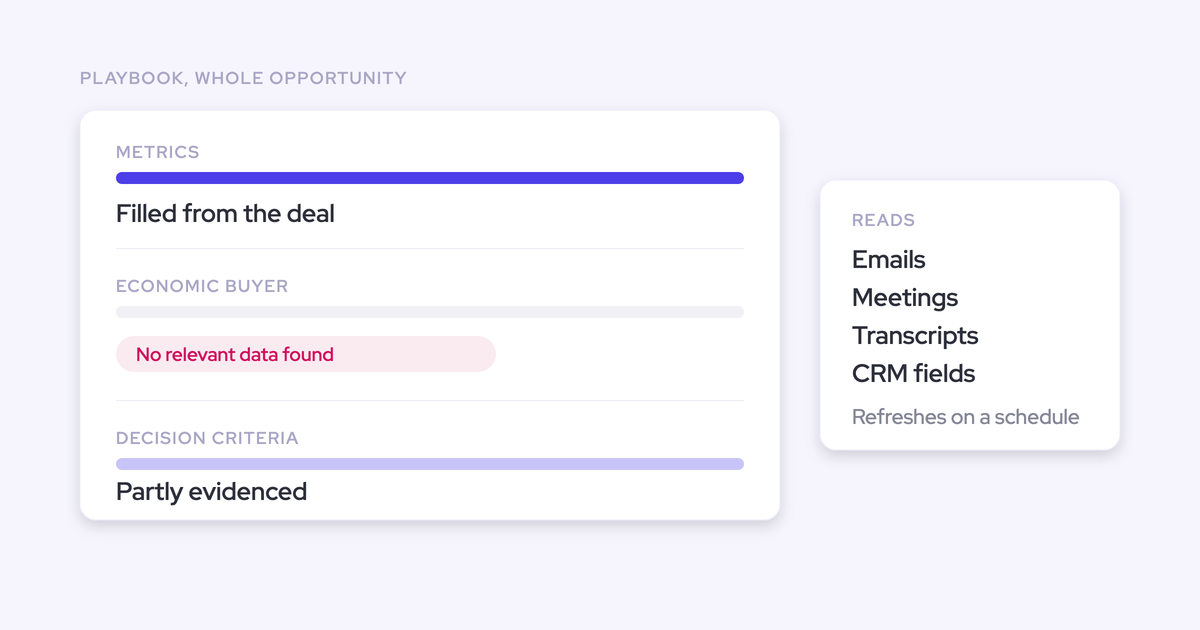

The qualification score you're reading today was computed from one conversation. But the evidence for qualification is scattered across months: the budget signal sits in an email, the champion showed up on a call in week three, the compelling event was mentioned in a meeting nobody wrote up. None of it reached a field.
So the summary tells you the last call went well. It can't tell you the deal is hollow. That's not a quality problem with the summary, it's the wrong unit: a per-call check scores a conversation, and qualification happens across an opportunity.
This piece covers how a score bound to the whole opportunity actually works in Weflow, how the scorecard becomes yours to define, why it graduates from a coaching score into a forecast signal, and the four constraints worth planning for before you roll it out. AI Playbooks sit inside Weflow Conversation Intelligence and AI Field Updates. Weflow is the Revenue AI Orchestration platform for sales, customer success, and RevOps teams.
Why a per-call AI summary isn't a qualification score
A per-call summary reads one conversation, and no deal is qualified in one conversation. That single structural fact is why a deal can look clean on its last call and be missing an economic buyer entirely.
If you manage 8 to 15 reps running MEDDIC, you have three options today and all three break somewhere:
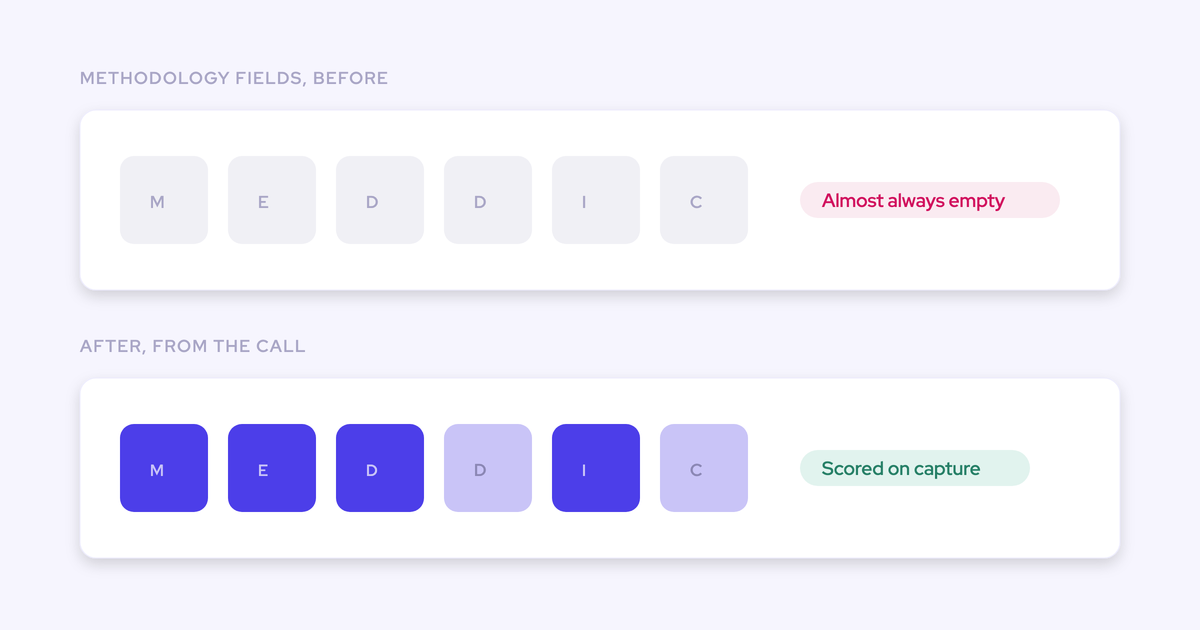
- Hand-filled methodology fields. They're empty, or worse, they're filled with something that clears the validation rule and tells you nothing. A metrics field that returns the customer's headcount is a number, and it's not a metric of value.
- Per-call AI summaries. They're accurate about the call and structurally blind to the deal. Gong does aggregate a methodology summary across every call on an account, which is genuinely the right instinct and the thing managers miss when they leave it.
- Building the score yourself. Gong's trackers detect whether methodology topics came up on a call, but they don't produce the weighted score on the Salesforce opportunity. Teams that want that artifact build it in Salesforce with RevOps and IT, which means the thing you coach and forecast on has to be engineered.
In our prospect's words:
If the metrics comes back and says they have 50,000 staff, that is a metric, but it's not relevant to what we're looking at in our sales process.
Then there's the scale problem underneath all of it. Opening opportunities one at a time to find the weak ones stops working past a few reps, so the deals with the least scrutiny end up being the ones nobody got to.
What scoring the whole opportunity against a methodology means
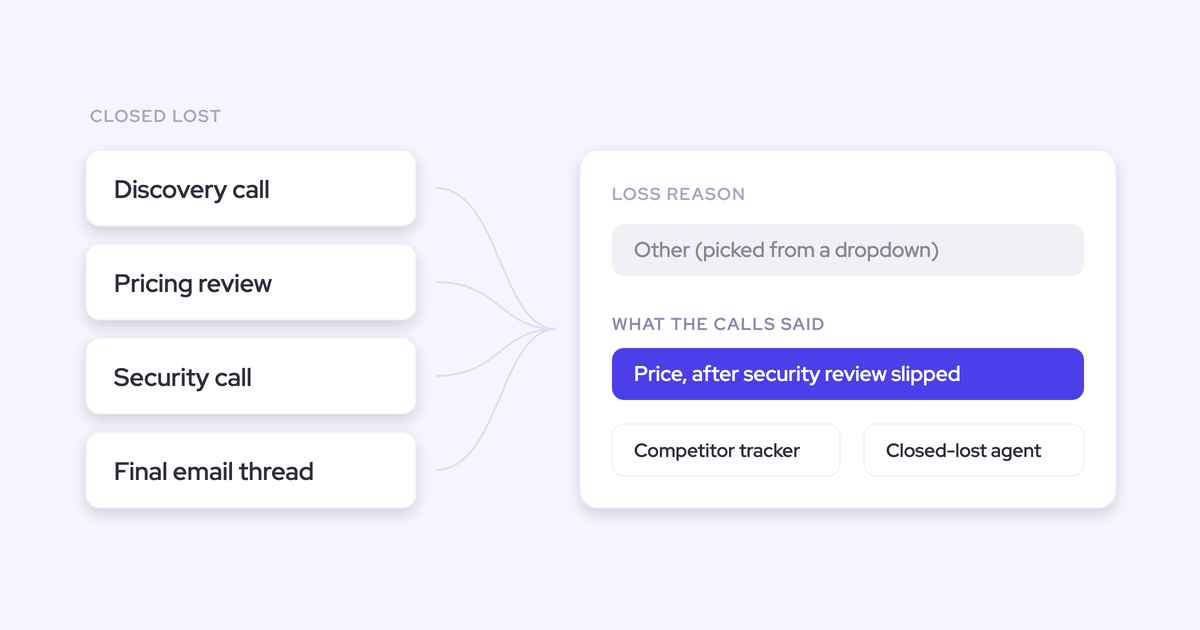
Whole-opportunity methodology scoring reads every email, meeting, transcript and CRM field on a single opportunity together, returns a status per methodology element, refreshes as the deal moves, and states explicitly where no evidence supports an element.
Two of those four matter more than people expect. The refresh, because a score computed once at the end of a discovery call is stale by the second demo. And the explicit gap, because a manager will not trust a score that always has an answer.
| Per-call AI summary | Whole-opportunity methodology score | |
| What it reads | One transcript | Every email, meeting, transcript and CRM field on the opportunity |
| What it scores | The conversation | The opportunity |
| Missing evidence | Absent from the call looks the same as absent from the deal | Named as a gap on the deal, per element |
| Freshness | Fixed at the moment the call ended | Re-evaluates as the deal moves |
| What you can run on it | Follow-up and call coaching | Deal review and forecast inspection |
How Weflow AI Playbooks score a deal against MEDDIC
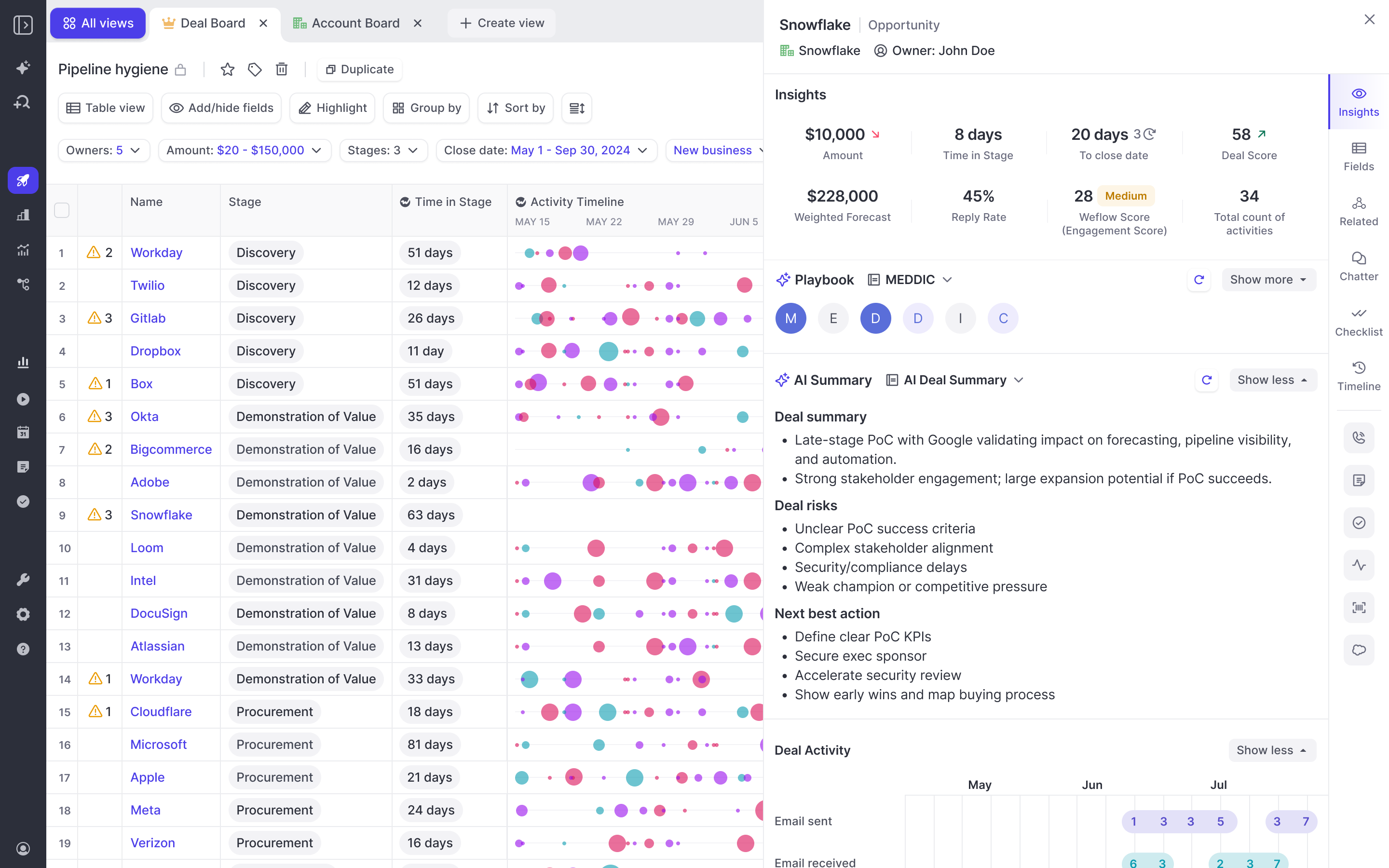
A Weflow AI Playbook is that class made concrete: one status per methodology element, derived from the whole deal record, with a next-step recommendation attached. Four things about how it behaves are what make it usable in a deal review.
The playbook is bound to the record, not a field
A Weflow AI Playbook reads the whole CRM record, the activities, meetings, recordings and emails alongside the existing Salesforce fields, and refreshes every few hours.
That's the difference from field-watching automation. It isn't checking whether a box got filled. It's answering the qualification question from whatever evidence exists on the deal, wherever that evidence happened to land.
So the champion your rep identified on a call in week three counts, even though nobody typed it anywhere. And the "confirmed budget" someone pasted into a text field counts for nothing if the correspondence doesn't support it.
When nothing supports a criterion, the score says so
Where no evidence on the deal supports a criterion, the playbook states it, for example that no relevant data on the economic buyer was found.
That sounds like a small behavior. It's the one that decides whether a manager uses the thing.
A system that always produces an answer teaches you to discount all of its answers, because you can't tell the confident ones from the invented ones. A system that says "nothing here supports this" hands you the deal review agenda directly: the gap is the conversation. Six letters filled and one blank is more actionable than seven letters of plausible prose.
Rep overrides are checked against the deal
Reps can override any element on the playbook. The override is then evaluated for plausibility against the deal's own record rather than accepted at face value.
This matters because reps game whatever clears the rule, and every manager reading this has watched it happen. When the score is derived from the whole record, passing it requires the qualification to have actually occurred and left a trace, in an email, a meeting, or a call.
Where the score sits: beside the deal board
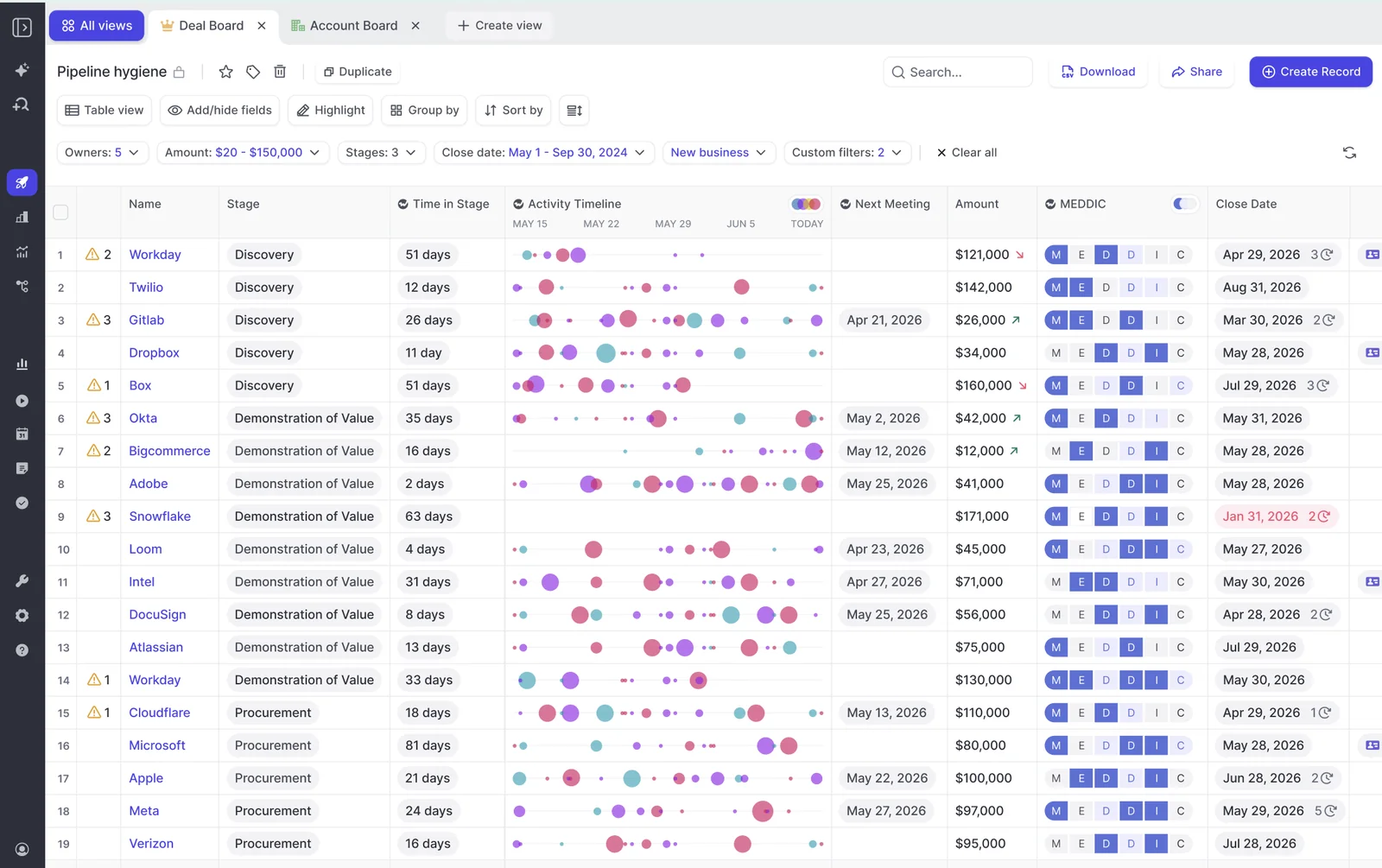
Per-letter status sits in the playbook panel beside the deal board, next to amount, time in stage, days to close date, deal score, weighted forecast, reply rate and the engagement score. You read what's evidenced and what's missing in the same place you run the pipeline, and reps can type their own notes into the same panel.
One buyer described the version of this they missed most from their old stack:
Same instinct. The difference is where it lands and who defines the rubric.
Encoding MEDDPICC, SPICED, or a homegrown framework
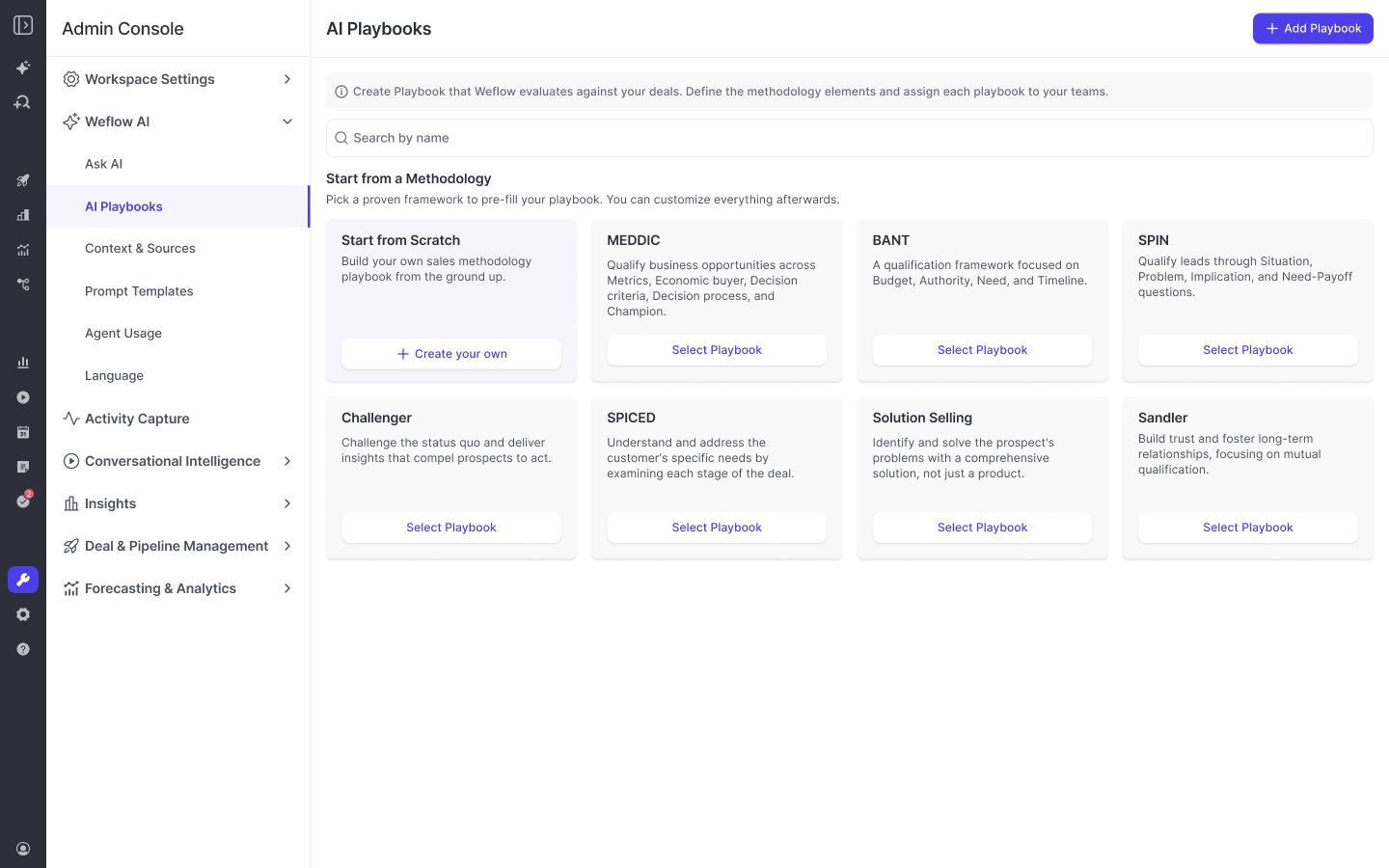
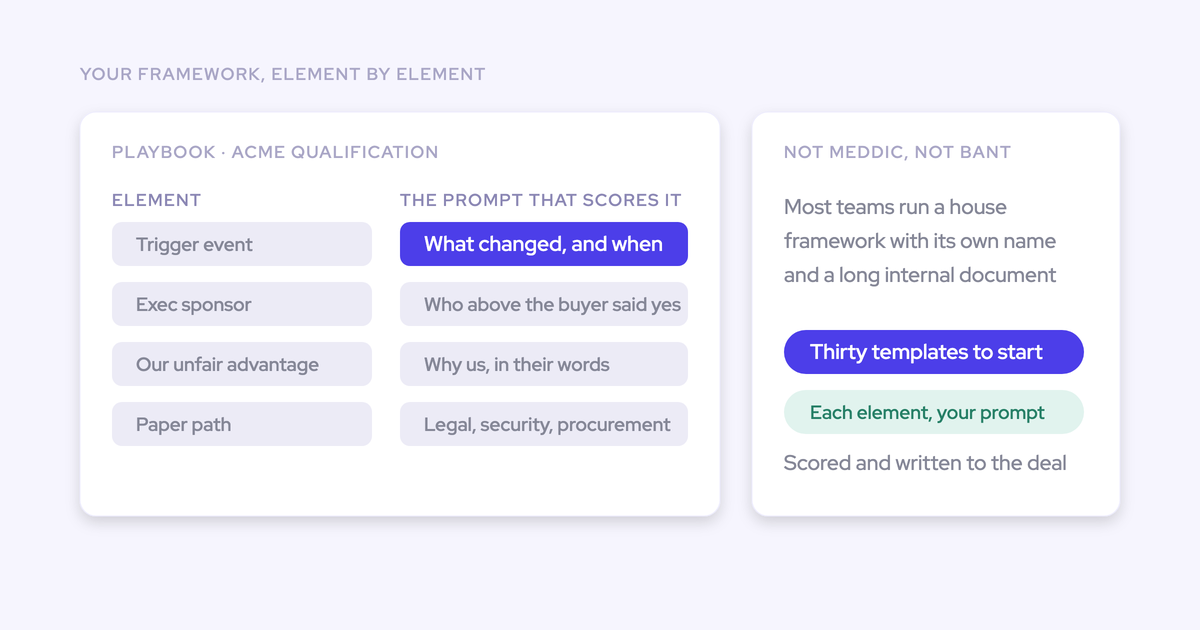
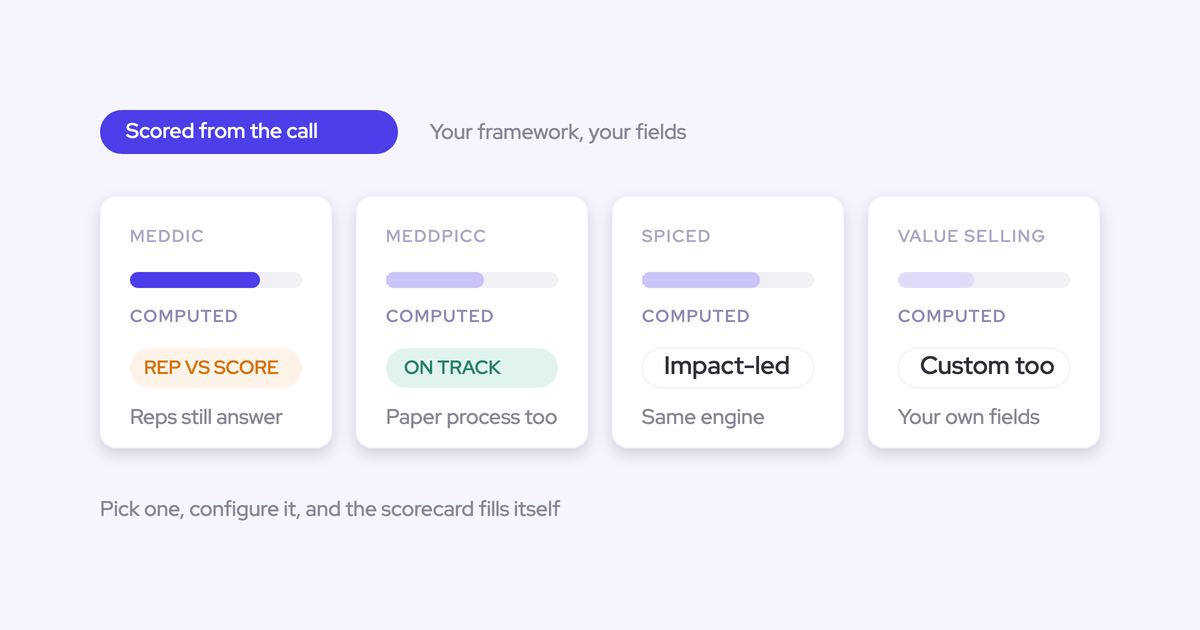
The scorecard is yours. Weflow ships around thirty sales methodology templates, and because the methodology is a set of prompts mapped to elements rather than a hardcoded rubric, a team can define its own framework element by element.
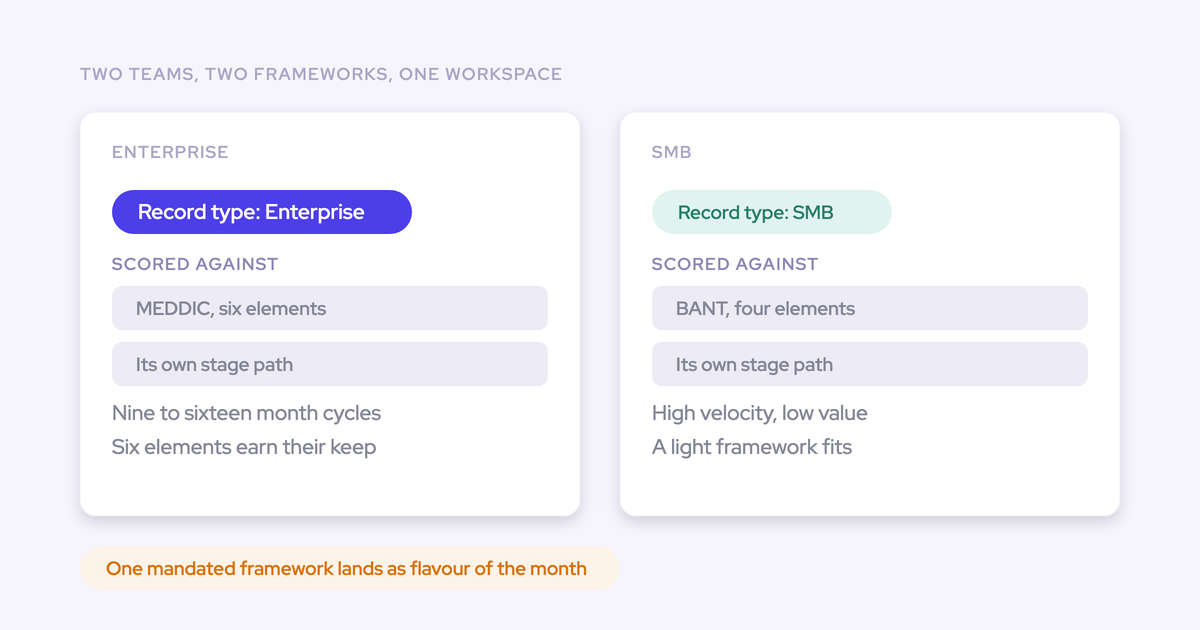
Playbooks are assigned per team, so one org can run BANT on the transactional motion and MEDDIC on enterprise at the same time.
Now the part vendors skip. Encoding an element is not a five-minute configuration job, because a prompt fills a field with something plausible unless you tell it what doesn't count.
We've seen a champion field name the customer's own employee, and a metrics field return company headcount. Neither is a model failure. Both are unstated requirements.
Defining an element in practice means writing down three things:
- The element itself, in the words your team already uses in deal reviews.
- The prompt: what evidence counts as satisfying it.
- The exclusions: what looks like evidence and isn't, such as an internal stakeholder standing in for a champion.
That third one is usually tacit knowledge nobody has written down, which is why rolling this out is partly a project to articulate your own methodology.
It's fairly easy to pick a sales methodology or qualification framework. It's really hard to operationalize it because it's a big change management effort.
— Janis Zech, Co-founder and CEO, Weflow
Three levels of scoring: the call, the deal, the rep
The same methodology scoring runs at three levels, and most teams only think about the middle one.
| Level | Question it answers | Where you use it |
| The call | Did this conversation cover what it needed to? | Call coaching and follow-up |
| The opportunity | What's evidenced on this deal and what's missing? | Deal review and forecast inspection |
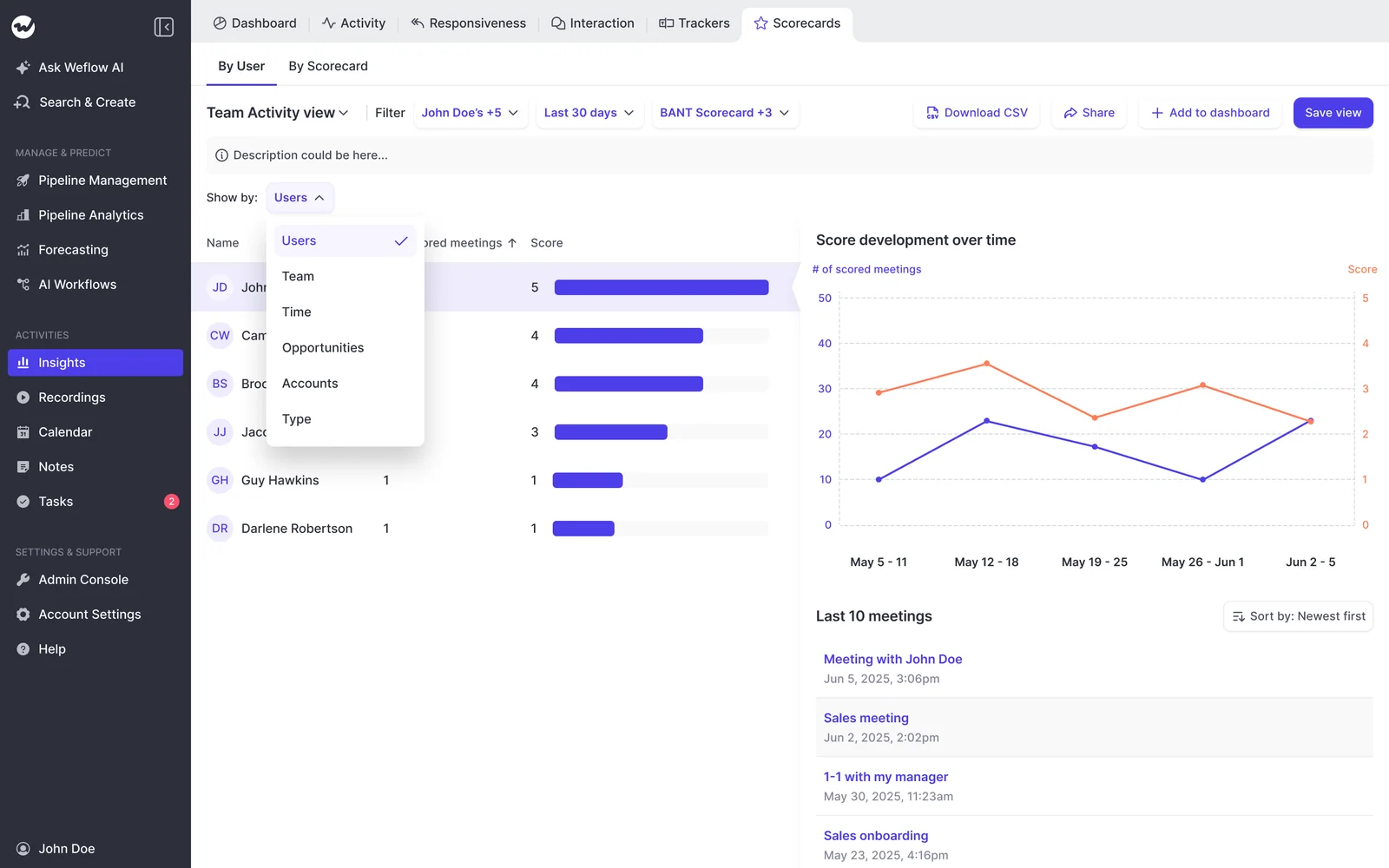
| The rep | Where is this seller consistently strong and consistently weak, across every deal over months? | One-on-ones and ramp measurement |
The rep level is the one that changes coaching, because it turns anecdote into a trend. Instead of pulling a random call sample, you can see that a seller scores well on metrics and economic buyer and poorly on decision process and champion identification, and coach the specific weakness. For a new hire, the same view is what makes ramp measurable rather than felt.
How a whole-deal score becomes a forecast signal
Take this out of the coaching conversation and into the forecast call. That's where it earns its cost.
A score a rep can pass by filling a field is a compliance metric. A score derived from every email, meeting and transcript on the deal is evidence, and evidence belongs in the forecast.
The specific thing it surfaces is the one that ruins quarters: a deal forecast to close soon with no identified economic buyer. That's not a coaching note. That's a number you're about to commit and shouldn't.
Because the playbook panel sits next to the weighted forecast and the deal score on the same board, the comparison is right there. Weflow's AI projection also reads deal health against the sales methodology among its signals, so a large deal that's being poorly worked gets projected down rather than carried at face value.
Run it once and your forecast call changes shape. You stop asking reps how confident they feel and start asking why a commit deal has three letters with no evidence behind them.
Four constraints to plan for before rollout
These are workflow constraints, not scoring accuracy problems, and each has a working answer. You'll hit all four in month one, so it's better to hear them now.
| Constraint | What it means in practice | How teams handle it |
| Playbook scores are Weflow fields, not Salesforce fields | You can see a deal's per-letter status in Weflow and can't put it in the Salesforce dashboard or the Power BI report your board reads. Weflow fields are marked with a W in the interface. | Build an agent that writes the assessment into a custom Salesforce field you create. It works, and it has to be built. The W marker is the quickest way to tell what will reach a report. |
| Generation is triggered by hand | Each evaluation consumes tokens, so playbooks aren't run continuously across the whole pipeline. The board is only as current as the last person who pressed regenerate. | Make regenerating part of the deal-review ritual, the afternoon before pipeline review rather than ad hoc. |
| A playbook evaluates one record at a time | An opportunity or an account, never a set of them. There's no single pass that scores a whole team's pipeline. | Generate the records that matter, this quarter and above a size threshold, then read per-letter status across the deal board. Account level is the wider option, since the account pulls in everything attached to it. |
| Opportunities that predate the playbook stay empty | Predefined playbooks re-evaluate every three hours, but only for opportunities created or changed after the playbook was configured. Your existing pipeline, which is what you actually wanted scored, stays blank, and nothing in the setup flow tells you. | Regenerate record by record, or ask Weflow to run a batch in the backend. Either way, plan it into week one instead of discovering it in week three. |
Does automating the score remove the rep's thinking?
It can, and it's the right objection to raise. The value of a qualification framework was never the field. It was the rep sitting with the question and confronting what they don't know about the deal.
Remove the data entry carelessly and you remove the reflection with it, which lands you back where you started: the framework as a form to satisfy.
The design that holds is a split. The AI computes the score from the evidence. The rep still answers the qualification questions in deal inspection. Then you pressure-test one against the other.
The gap between what the rep believes and what the record supports is the coaching moment, and it's a better one than either half alone. What you've added is a second reading of the deal that doesn't depend on the person who most wants the deal to be real.
FAQ: whole-deal methodology scoring with Weflow AI Playbooks
Can I see missing qualification across my whole pipeline at once?
Not in one pass. A Weflow AI Playbook evaluates one record at a time, an opportunity or an account, so there's no single command that scores an entire team's pipeline. The team view is built by generating the records that matter and reading per-letter status across the deal board, which works well when you filter to this quarter above a size threshold.
Can Playbook scores be reported on in Salesforce dashboards or BI?
Not natively. Playbook scores are Weflow fields, marked with a W in the interface, rather than Salesforce fields, so a Salesforce dashboard or a BI tool can't read them directly. The working path is an agent that writes the assessment into a custom Salesforce field you create, which puts the score into your reporting layer but is a build.
How often does an AI Playbook refresh its score?
Predefined playbooks re-evaluate every three hours, for opportunities created or changed after the playbook was configured. Everything else refreshes when someone regenerates it by hand, which is why teams fold regeneration into their deal-review cadence.
What happens to opportunities that existed before the playbook?
They stay empty until somebody regenerates them. New deals start filling in while the existing pipeline stays blank, and nothing flags it during setup. Clear it by regenerating record by record, or ask Weflow to run a batch in the backend, and plan for it in your rollout week rather than after.
Can a rep game the score by filling in a field?
No. The score is derived from the whole opportunity record, the emails, meetings, transcripts and fields together, so filling a box doesn't move it. A rep can override an element, and the override is evaluated for plausibility against the deal rather than taken at face value.
What does Playbook scoring cost in tokens or usage?
Nothing extra. Weflow's pricing is seat-based with AI usage bundled in, so no consumption charge lands on your invoice. Weflow Conversation Intelligence is $39 per user per month billed annually. The token cost of generating a playbook is Weflow's, which is the reason generation is hand-triggered rather than run continuously across every deal in the org.
-p-1600.png)

.png)
-p-1600.png)
-p-1600.png)
-p-1600.png)