
MEDDIC vs MEDDPICC vs SPICED vs Value-Based Selling: Which Sales Methodology Should You Score Deals On?
Decide which sales methodology to score deals on: MEDDIC, MEDDPICC, SPICED, or value-based selling.


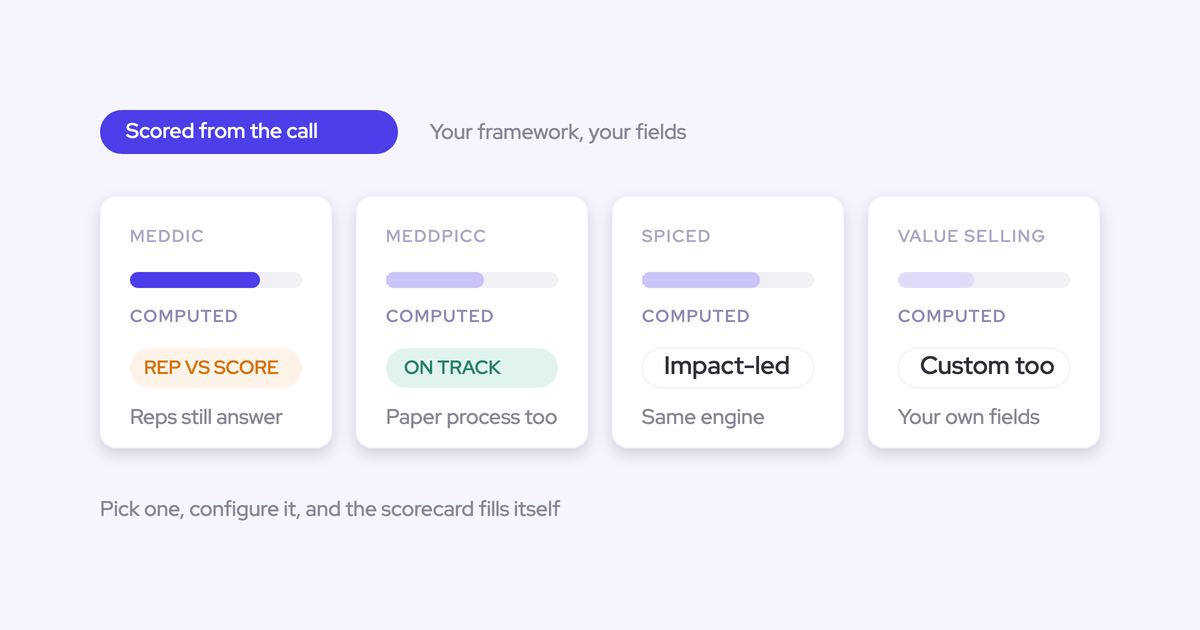

Short answer first: all four work. MEDDIC and MEDDPICC are built for complex cycles where procurement and competition decide the outcome. SPICED is built to carry past the close into onboarding and renewal. Value-based selling is weaker as an inspection checklist and stronger at forcing a quantified business case.
So you pick on your motion, not on the acronym.
The comparison below gives you what each one measures, element by element, and when a manager should choose which.
Every framework in this article works when it's scored and coached, and none of them works when it's announced and left alone. The comparison that actually changes your numbers isn't MEDDIC against SPICED. It's a methodology that lives on a slide against one that gets scored on every call and every deal and shows up in the review where you run deal execution.
MEDDIC vs MEDDPICC vs SPICED vs value-based selling at a glance
The four differ on what they measure and how far into the customer journey they reach. They don't differ on whether they work.
| Framework | What it really measures | The motion it fits | What a scorecard on it checks | Scope |
| MEDDIC | Whether the deal is qualified: real pain, real money, real access to the person who signs | Complex B2B cycles with a buying committee and a business case | Per-element evidence: a named economic buyer, quantified metrics, documented decision criteria and steps | Sales cycle only, up to close |
| MEDDPICC | The same six checks plus how the deal gets through procurement and past the alternatives | Enterprise deals with legal, security and purchasing review, and named competitors | Everything MEDDIC checks, plus who owns the paper process, what the steps are, and who else is in the deal | Sales cycle, heaviest at late stage |
| SPICED | Whether you understand the customer's situation and the impact of fixing it, in language that stays useful after the sale | Recurring-revenue businesses where retention matters as much as new logos and CS speaks the same framework | Is there a critical event, is the impact quantified, is the decision path known | Whole customer journey, pre and post sale |
| Value-based selling | Whether the seller has built a quantified value case in the buyer's own numbers and had it agreed | Teams selling an outcome against the status quo, an incumbent, or a cheaper alternative | Is there a value hypothesis, is it in the customer's metric, has the customer signed off on the number | Sales cycle plus renewal justification |
One note before the definitions. SPICED, as taught in the Winning by Design framework, gets chosen over MEDDIC on architecture rather than on discovery quality: the fields it leaves behind are read by onboarding, customer success and product marketing, so the same rollout that lifts win rates can also lift retention. MEDDIC is scoped to the sales cycle and stops at the close.
What each methodology measures, element by element
Every element is a specific, inspectable question about a deal. That's what makes it scoreable, and it's the test to apply to your own house framework too.
The MEDDIC elements, one sentence each
- Metrics: the quantified business outcome the customer expects, expressed in their numbers rather than in your ROI deck.
- Economic buyer: the person with the authority and the budget to approve the spend, and how much real access you have to them.
- Decision criteria: the technical and business requirements the customer will judge every vendor against, documented and confirmed back.
- Decision process: the sequence of steps, approvals and dates that gets from "we like it" to a signature.
- Identify pain: the specific problem, its root cause, and what it costs the customer if nothing changes.
- Champion: someone inside the account with influence who argues for you when you're not in the room.
Two of these are where scorecards usually go wrong. Economic buyer collapses into a name in a field, which tells you nothing, so track access to authority instead of identity: access is a spectrum, it moves through the cycle, and there's usually more than one authority figure. Champion can't be inferred from email volume either. A busy contact and a champion look identical in activity data and behave completely differently at quarter end.
What MEDDPICC adds: paper process and competition
- Paper process: the steps after the yes, meaning legal review, security review, procurement, vendor onboarding and signature routing, with an owner and a duration for each.
- Competition: who else is being considered, including the incumbent, the status quo, and the internal build.
Enterprise teams add these two because that's where their deals actually die. A six-week security review nobody mapped is the single most common reason a committed deal slips a quarter, and it's invisible in MEDDIC. If your deals close without a procurement gate, MEDDPICC gives you two more fields to leave empty.
The SPICED elements, one sentence each
- Situation: where the customer is today, their business, their stack, their current numbers.
- Pain: the problem they feel and the root cause underneath it.
- Impact: what measurably changes if the pain is solved, quantified.
- Critical event: the date or trigger that makes doing nothing more expensive than doing something.
- Decision: who decides, against what criteria, through what steps.
Notice that SPICED asks about the buyer's world in four of five elements. That's the whole-journey framing: a CS manager can read the same fields at renewal and know what the customer bought and why.
What value-based selling checks on every deal
- Value hypothesis: a stated, pre-meeting view of what this customer stands to gain, specific enough to be wrong.
- The buyer's metric: the value expressed in a number the customer already reports on internally, not one you invented for the business case.
- Agreement: explicit confirmation from the buyer that your number is their number.
Value-based selling is a principle set rather than an acronym, which is exactly why teams struggle to score it. There are fewer discrete boxes and more judgment. It also has the sharpest teeth on the question every framework gets wrong.
"If I'm trying to figure out someone's budget, that's not about them, that's about me. If I'm doing MEDDIC and I'm talking about metrics, I have to be mindful: their metrics or my metrics? We want to understand their metrics in terms of the way they need to buy and building that trust so that they feel seen, heard, and understood. So if you're not careful, too much of the discovery is built around the information your seller's leadership team wants to know because they think that's what's going to help them improve the forecast."
— Richard Harris, sales advisor, trainer, and founder of The Harris Consulting Group
Which sales methodology should you pick for your team?
Three questions settle it: how complex is the buying process, does the framework need to survive past the close, and can your reps say the words out loud to a customer without sounding like a form.
| Framework | Choose it if | Skip it if |
| MEDDIC | Cycles run a quarter or longer with four or more stakeholders, and your losses trace to weak qualification rather than weak closing | Deals close in a few calls with one decision maker; you'll add six fields and inspect none of them |
| MEDDPICC | Procurement, legal or security review sits between the yes and the signature, and you lose competitive bake-offs you didn't know you were in | You have no procurement gate and no named competitors, in which case the extra two letters are overhead |
| SPICED | Retention carries as much of the number as new business, and you want onboarding and CS reading the same fields the AE filled | You sell one-off contracts with no post-sale motion to inherit the data |
| Value-based selling | You're displacing an incumbent or the status quo and the deal is won or lost on a business case | You need a stage-gate inspection framework; VBS on its own gives managers less to inspect against |
| Your own house framework | It already has a name people use in deal reviews, and the elements are written down with real definitions and exclusions | It exists only as a doc nobody has opened since onboarding, in which case adopt a standard one and stop maintaining a custom rubric |
A house framework is a legitimate answer, not a compromise. Most teams we talk to aren't running MEDDIC or BANT out of the box at all. They run something with its own name, its own stages and a long internal document behind it.
And if you already run a framework that isn't landing, don't swap it. Diagnose it first. If MEDDIC failed because nobody coached it and the fields never got filled, SPICED will fail the same way in the same quarter, and you'll have burned your credibility for nothing.
"I'm not a rip and replace guy. I don't come in and say, "Oh, you've got MEDDIC, rip it out." Well, why is MEDDIC working for you? Have you done that analysis? Because if MEDDIC's not working because you're not coaching and you haven't built the right pieces, what makes you think that NEAT's going to be any better?"
— Richard Harris, sales advisor, trainer, and founder of The Harris Consulting Group
Why the scorecard matters more than the framework
The failure mode is identical across all four frameworks, which should tell you the framework isn't the variable.
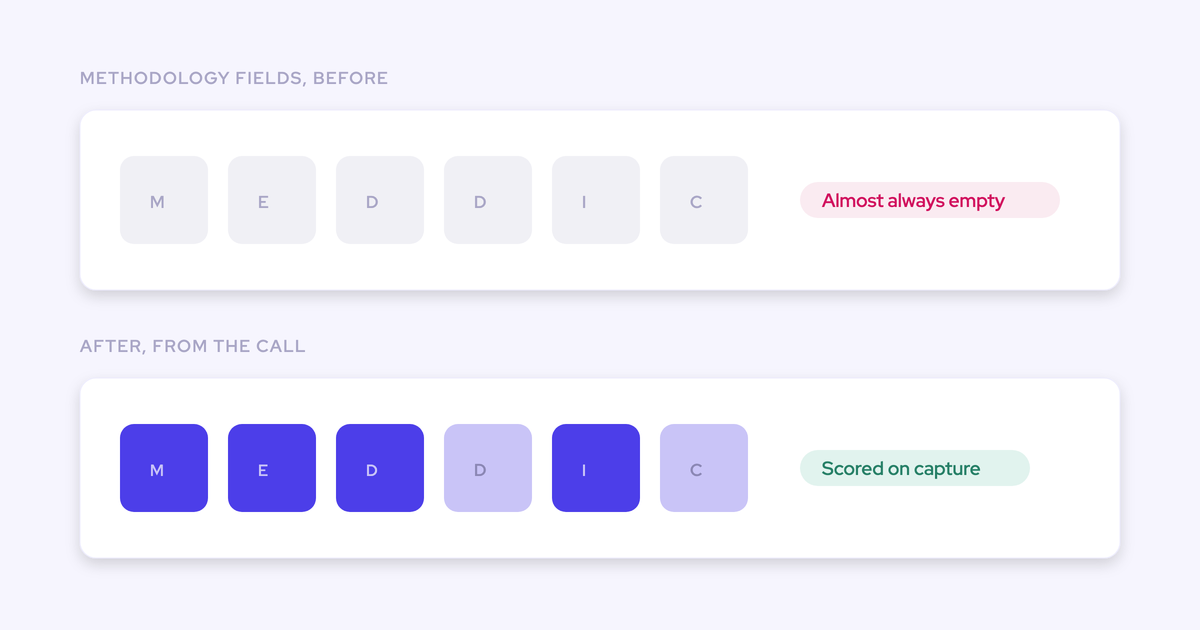
Across the Salesforce orgs Weflow connects to, the methodology fields are almost always empty before anything is automated. Not partly filled. Empty. The company chose the framework, trained on it, built the fields, and then nobody typed into them, so there's nothing to coach against and no way to compare one rep to another.
"I always say, like, choosing a sales methodology is easy, implementing it is really, really, really hard."
The second failure is quieter and worse, because it survives a successful rollout. Two managers read the same playbook and coach it two different ways.
"The truth is someone can look at one document and the other person can look at the same document and interpret that differently. And so even though you said, hey, we've created a unified way of understanding how we look at our customers and how we evaluate deals and we break it down to modular components, every manager looks at it differently, they coach differently, and then the outcomes become different."
— Julien Cerutti, VP of Global Revenue Strategy at Meltwater
A deal called qualified in one region wouldn't survive a review in another. The scores aren't comparable, the conversion gaps aren't explainable, and the org is unified on paper and fragmented in execution.
So the deciding question for you isn't which acronym. It's whether you can score every call and every deal against whatever you choose, see the gap per rep and per manager, and coach to it.
One more thing worth doing before you roll anything out: pull a sample of your own won, slipped and lost deals and find out which elements actually predict your outcomes. When teams run that analysis properly, the three outcomes usually land on three different variables. Deals are won on the strength of the champion, they slip on a missing decision process, and they're lost on decision criteria nobody documented. Weight your scorecard on your own data and reps argue with it far less, because it stops being a borrowed playbook and starts being a description of their market.
Per-call coaching scorecards vs per-deal playbooks
This is the distinction most tools blur and most buyers only discover halfway through a demo. It's also the question managers ask us most directly.
| Per-call coaching scorecard | Per-deal (or per-account) playbook | |
| What it scores | The rep's execution on one conversation | The opportunity, or the account, against the methodology |
| What it reads | That single transcript | Every call, email, meeting, related record and CRM field on the deal |
| What the manager does with it | Coaches a behavior and watches a trend line per rep over months | Runs the deal review off evidence, and treats gaps as forecast risk |
| What it can't tell you | Whether the deal is actually qualified | Which rep behavior on which call created the gap |
You need both, and for different jobs. A methodology score generated one call at a time is close to useless on a deal that ran across a dozen conversations and a hundred emails, because reading it means opening twelve recordings and stitching the picture together by hand. Nobody does that, so the scores pile up unread.
Per-call scoring earns its place somewhere else: on the rep. Manual review caps coaching at whatever a manager can listen to, which is a small and biased sample, usually whichever call they happened to sit in on. Score every call and adherence becomes a trend instead of an anecdote.
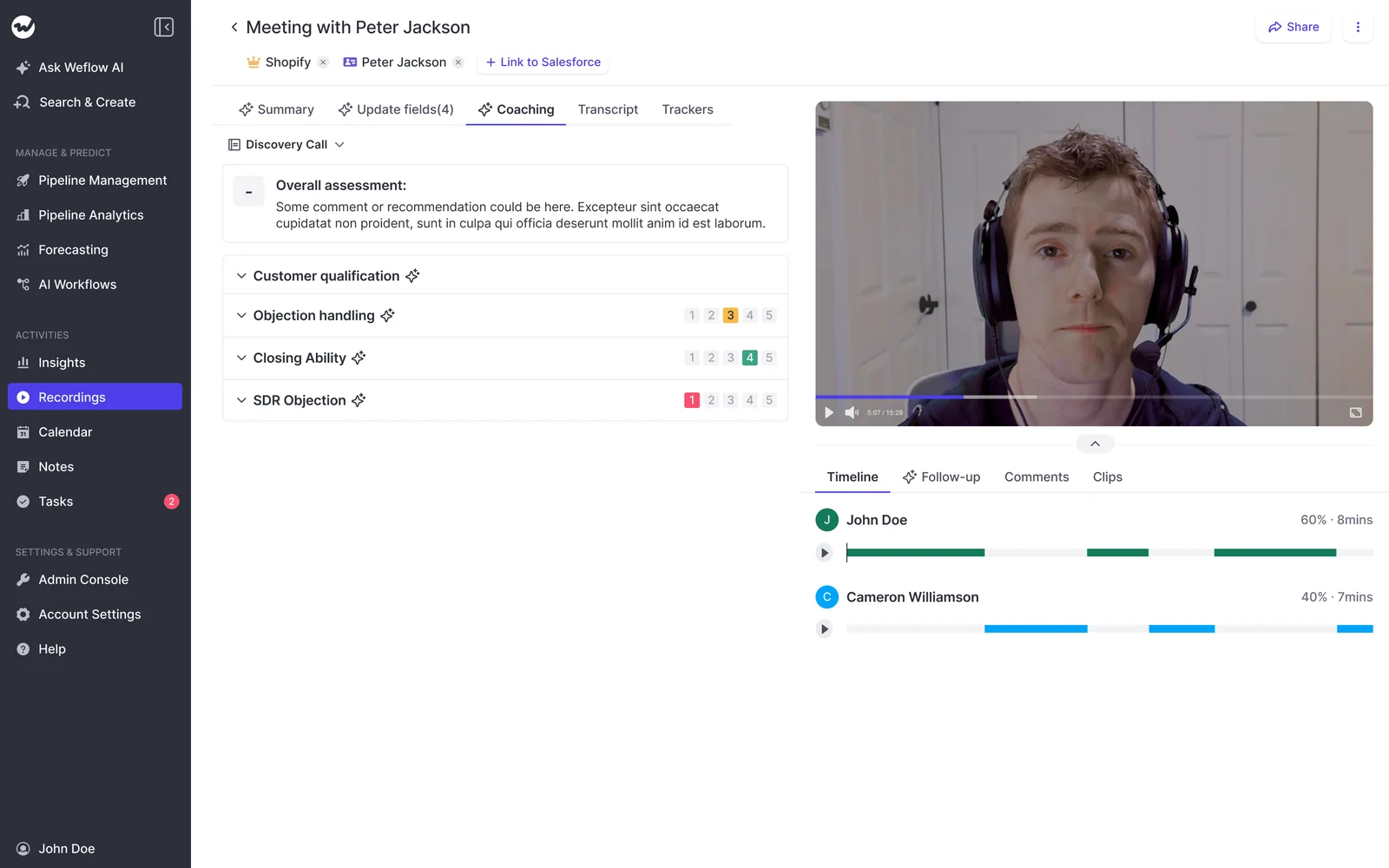
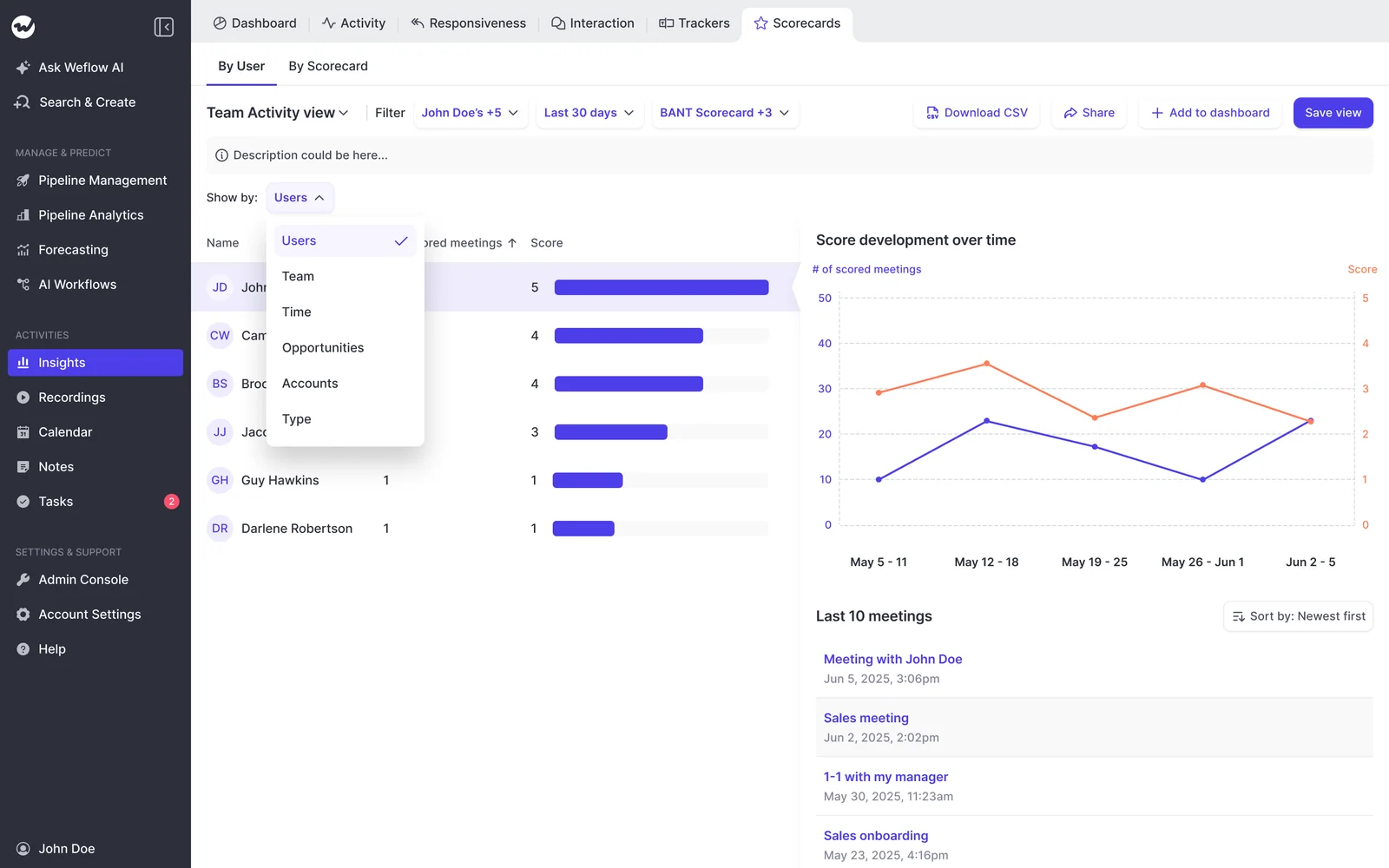
That's what makes reps comparable. You can see how one rep's economic buyer identification has moved over six months, and open the specific calls behind the score.
Worked example: a MEDDPICC deal scored from its calls
Here's what a scored deal reads like. The deal below is invented; the shape of the output isn't.
| Element | Status | Evidence | Gap and coaching action |
| Metrics | Strong | Buyer quantified 30 hours a month of manual reporting on the discovery and technical calls | Cost of doing nothing never stated. Get it into the business case. |
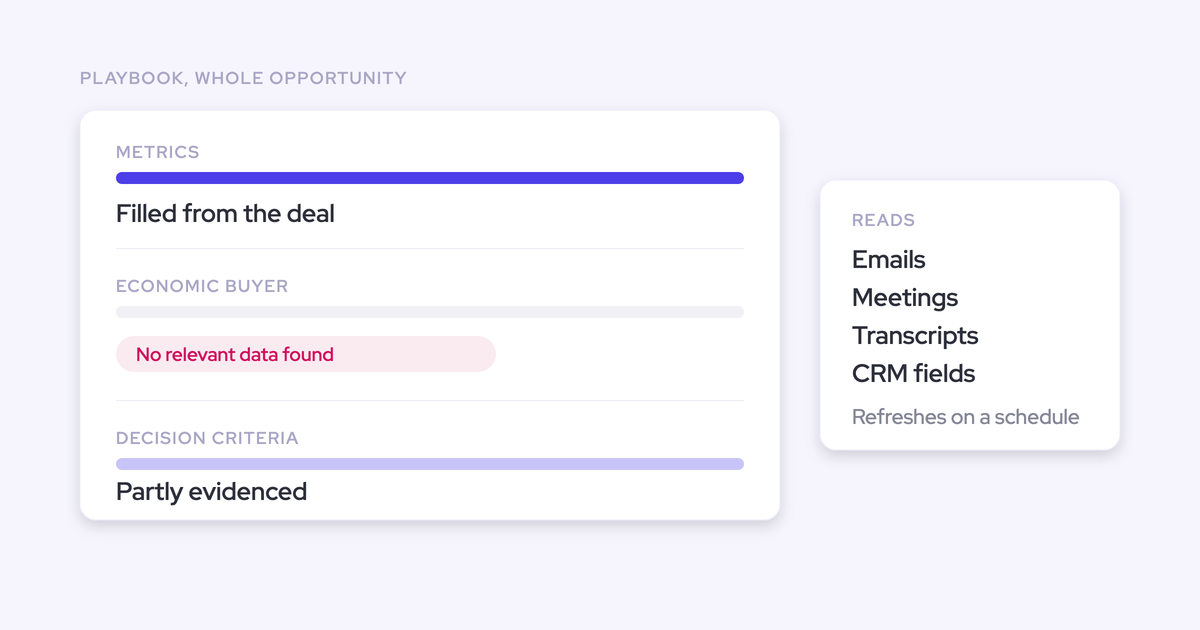
| Economic buyer | No data found | Nothing across 9 meetings and 61 emails. CFO named once in an email, never on a call | Deal is committed for this quarter with no access to power. Champion routes an intro this week or the date moves. |
| Decision criteria | Partial | Requirements discussed on the technical call, never confirmed in writing | Send the criteria list back and ask the buyer to confirm it. |
| Decision process | Weak | Close date set; no approval steps documented on any activity | Map the steps backwards from the date with the champion. |
| Identify pain | Strong | Named on discovery, repeated by two stakeholders on separate calls | None. |
| Paper process | No data found | Security review mentioned once, no owner, no timeline | The likeliest reason this slips. Get the owner and the duration. |
| Champion | Partial | One contact replies inside a day; no evidence of internal selling | Test it: will they take your call, will they get you to the economic buyer. |
| Competition | Evidenced | Incumbent named on two calls, pricing compared on one | Build the switching-cost argument before the commercial conversation. |
Read the "no data found" rows first. They're the whole value of the artifact. A checkmark tells you a rep talked about something; an explicit absence tells you what to do on Monday, and it's the line a rep can't argue with, because it's read off nine meetings rather than off your memory of one.
"If you are in the last stage of the opportunity but get a CRM score of forty or fifty percent, then there are big red flags of, okay, is it really happening, or is it just a hygiene topic, or did you miss key parts. We measure the MEDDPICC score based on what is in the system and how mature the rep is with the opportunity."
How Weflow scores any methodology in your Salesforce fields
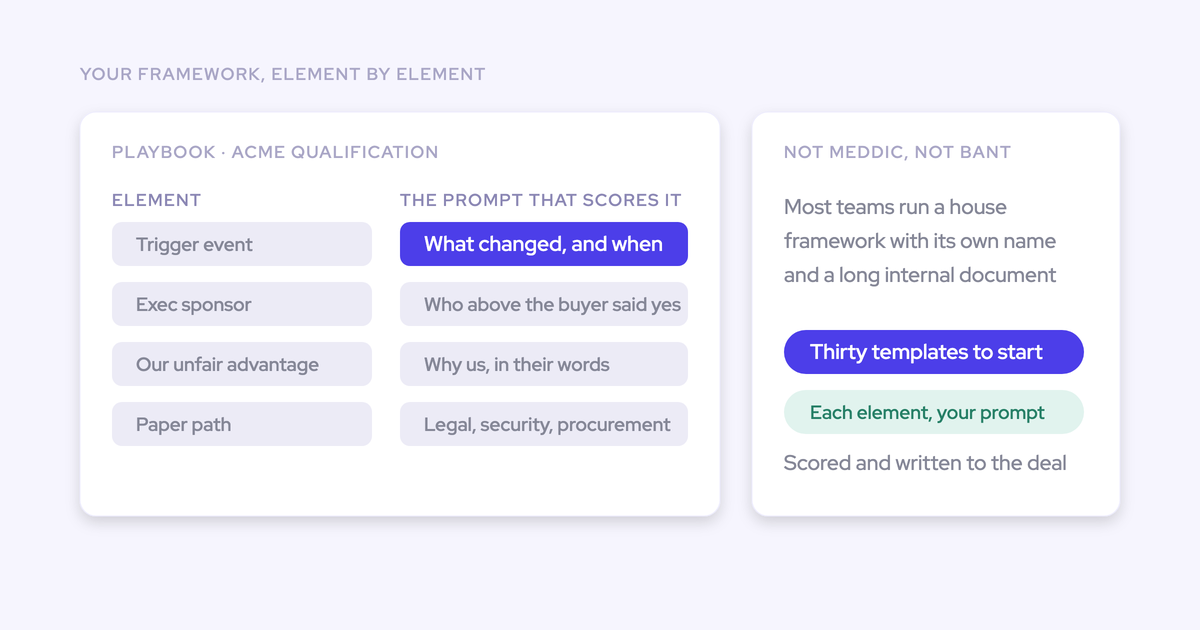
Weflow is the Revenue AI Orchestration platform for sales, customer success, and RevOps teams, built for Salesforce teams. For methodology scoring, the design decision that matters is this: a methodology in Weflow is a set of prompts mapped to fields, not a hardcoded list of frameworks.
Weflow ships around thirty methodology templates covering MEDDIC, MEDDPICC, SPICED, BANT, Challenger, SPIN, Sandler and Command of the Message, plus 250-plus pre-built prompts and unlimited templates. You can also throw all of that away and write your own.
Custom and house frameworks, encoded like standard ones
Because each element is just a named field plus a prompt, a proprietary framework gets encoded exactly like a standard one. REACT, CDOCI, value-based selling, whatever your internal doc calls it. Same mechanics, same output.
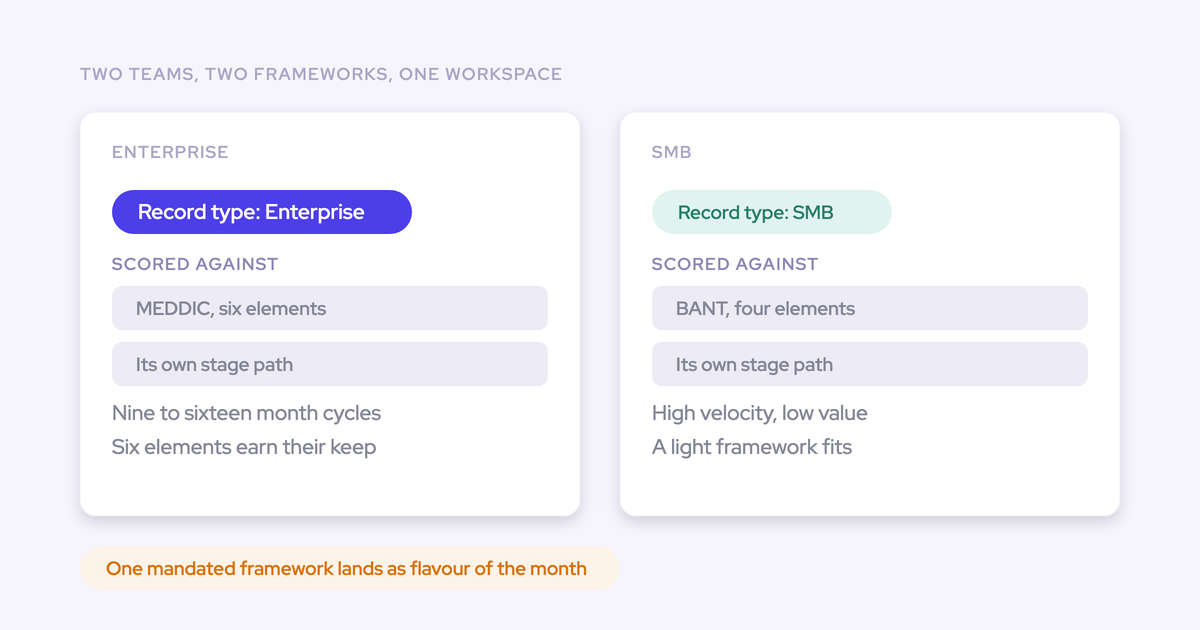
One org can run BANT on transactional deals and MEDDIC on enterprise, assigned to different teams, with different scorecards per team and per call type and a manager override on any score.
Credit where it's due: this isn't Weflow's alone. Attention writes scorecard criteria as free natural language, so any framework can be expressed. Momentum ships custom competency prompts and conditions them on CRM fields. Gong's AI Deal Reviewer ships seven pre-built playbooks and lets you build one from scratch. If the only thing you need is a custom rubric, several tools will give you one.
Scores land in the fields your deal review reads
This is where the tools genuinely diverge, and it's the question worth pressing hardest on a demo.
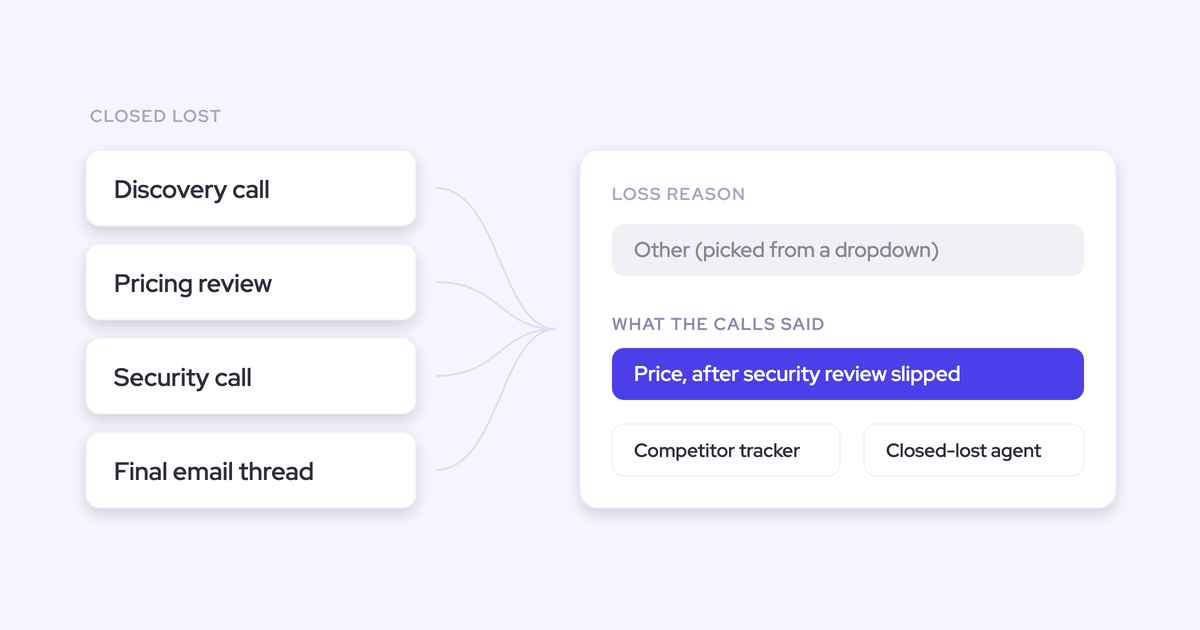
Teams that run a methodology already have the fields in Salesforce: a note or text field per criterion with a checkbox beside it. The deal review reads off exactly those fields. When a tool scores the methodology inside its own interface, the score sits where nobody looks, your fields stay empty, and now you have two versions of the truth and still no answer in the room where the review happens.
Weflow's AI Playbooks read every email, meeting, transcript and CRM field on the opportunity, refresh every few hours, write the per-element result back into the corresponding Salesforce fields, and return a next-step recommendation. Not only free text: picklists, number fields, date fields, multi-select fields and custom objects. Before writing a picklist, Weflow reads the field's allowed values and matches its output against them, so it never writes a value the field rejects.
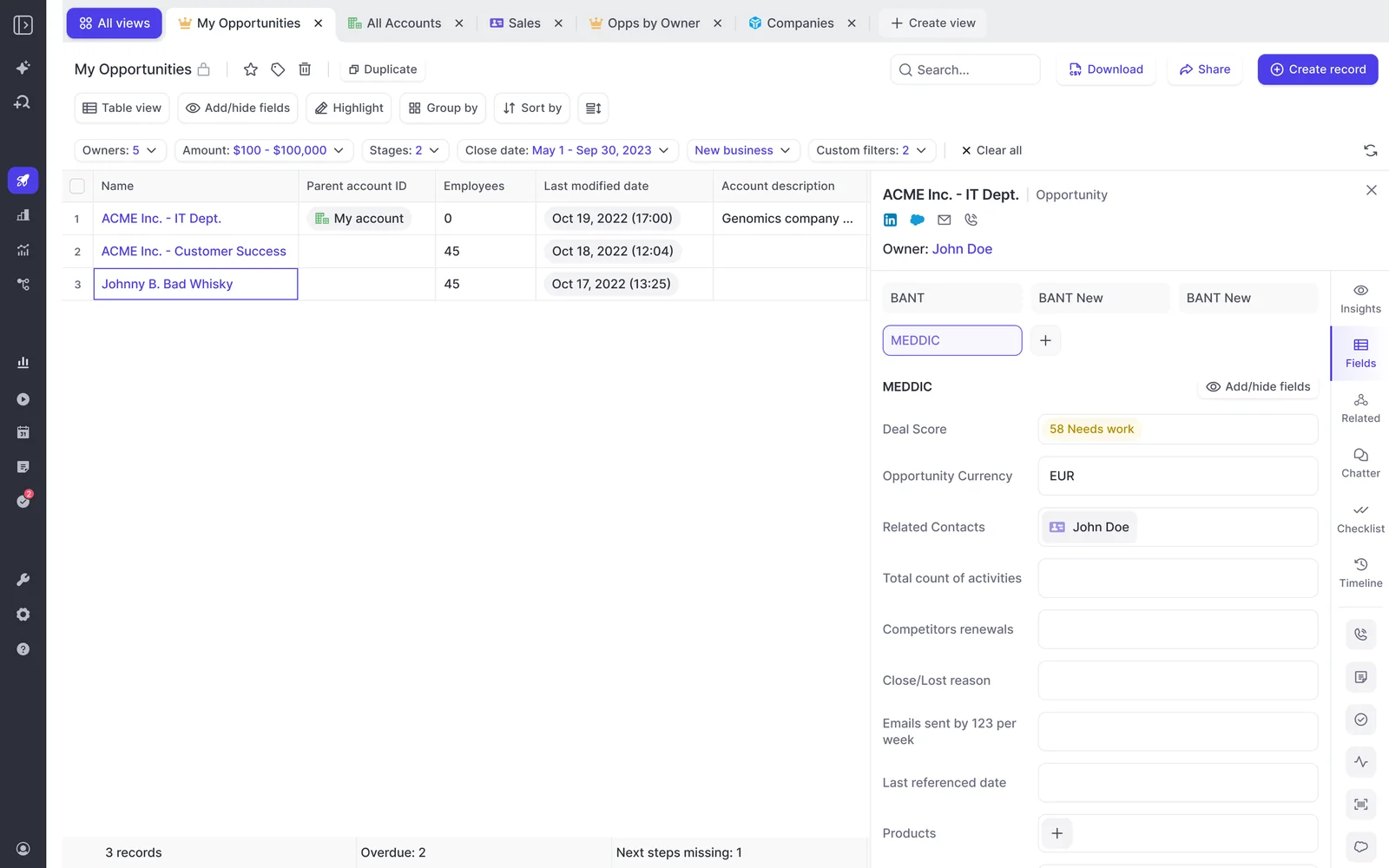
Blacklane runs at 96% of MEDDIC fields populated in Salesforce. That's the number to hold any vendor to, because it's the one that decides whether your deal review has anything to read.
Where competitors sit, honestly:
- Gong: AI Deal Reviewer syncs playbook status and notes two ways with the opportunity record and aggregates a methodology view across every call on an account, which is real and useful. What it doesn't do is auto-populate your own MEDDIC fields from the transcript, and it doesn't produce the weighted methodology score on the opportunity, so teams that want one build it in Salesforce with RevOps and IT.
- Momentum: writes MEDDPICC and SPICED elements into their own Salesforce fields from calls, emails and dials. Genuinely the closest to this on write-back.
- Clari Copilot: no AI field updates into Salesforce fields and no methodology scorecards, and Clari gives managers no view for inspecting how multiple opportunities score against a methodology.
- Avoma: custom coaching scorecards auto-assigned by call type and live MEDDIC prompts during the call, with a dashboard tracking whether managers actually coach. Strong on the rep layer.
The right scorecard for the right meeting type
A renewal shouldn't be scored on the discovery rubric, and this is where a single global scorecard falls apart in practice.
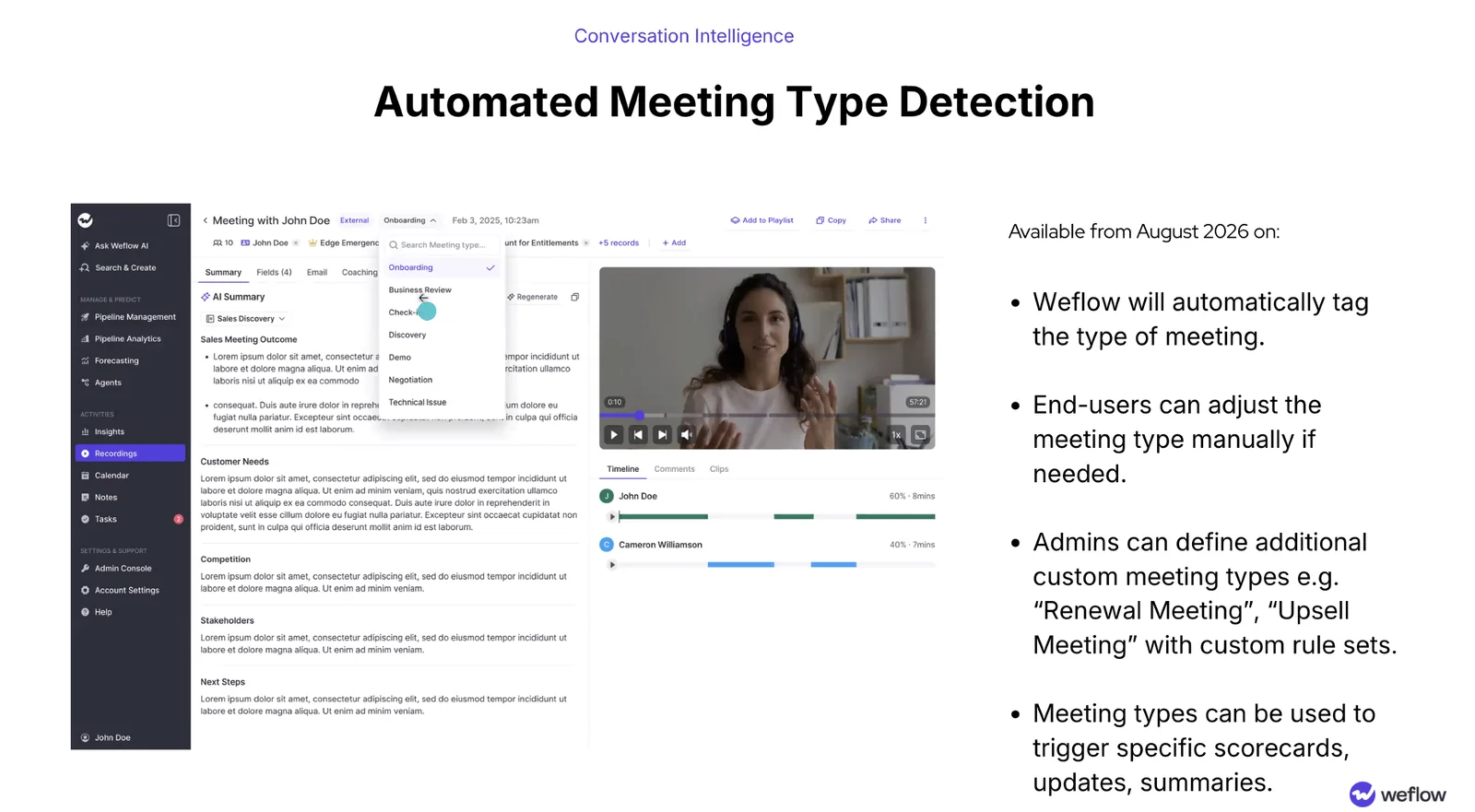
Weflow tags each recorded meeting with its type automatically, from a set including onboarding, business review, check-in, discovery, demo, negotiation and technical issue. Admins can define their own types with their own rules, like renewal or upsell. The type then triggers the matching scorecard, field updates and summary, and a rep can override the tag when the AI reads a call wrong.
What it takes to keep scorecards trustworthy
Four things we'd rather you hear now than discover in month three.
- Somebody has to own it. Activity capture largely runs itself. A per-team, per-prompt scorecard system does not. Without a named internal owner, templates go stale, output degrades, and people stop trusting the scores. We've seen this at large enterprise accounts, where finding the person to do the work is genuinely hard.
- Existing pipeline needs a backfill. Predefined AI Playbooks re-evaluate every three hours, but only for opportunities created or changed after the playbook was configured. At rollout the board fills in for new deals while the pipeline you actually wanted scored stays blank until someone regenerates it.
- Your prompts have to carry your definitions, including the exclusions. Left unspecified, a champion field will happily name one of your own employees and a metrics field will return the customer's headcount. Writing the prompts is partly a project to articulate what your methodology actually means.
- Coverage isn't 100%. Recording coverage typically runs between 60 and 80 percent of eligible meetings, with a reason listed for every skipped one. Plan the scorecard around that, and use the recording health dashboard to separate a bot that wasn't admitted from a real error.
FAQ: scoring sales methodologies with AI
What happens when the AI fills a field with something plausible but wrong?
It happens, and the classic case is a metrics field returning the customer's headcount.
That's the worst outcome available: you've paid for the automation and managers go back to asking reps anyway. The fix is definitions and exclusions written into the prompt, tested against real past calls before rollout, not hope. Ask any vendor what happens when their AI is confidently wrong, rather than when it fails.
Will automated field updates overwrite what a rep already typed?
Not without the rep seeing it. Weflow's AI field updates show the current CRM value beside the suggested value, so a rep can accept, edit or reject each one and write them back in a single click. Fully automatic mode exists and some teams use it for specific fields. We'd start with the review loop, because the first time a rep watches their own note disappear they stop maintaining the field at all, and you end up with an automated field nobody corrects and nobody believes.
Who should own the scorecard configuration?
One named person, usually in RevOps or enablement, with the templates assigned per team. Their job is the prompts, the field mappings, and a quarterly read of whether the output still matches how the team sells. Skip this and the scorecards decay quietly, which reads as a product failure and is actually an ownership failure.
Does automated scoring stop reps from thinking through their deals?
It can, and this is the real tension in the category. The point of a qualification framework was never the field. It was the rep sitting with the question and confronting what they don't know.
"In an agentic workflow, like I said, you don't have to fill out anything. The score automatically comes from conversations and activities logged in Salesforce, and your champion's a three or it's a two. But there is that deal inspection thing where there are questions, and I do want them to reflect. And so I feel like I'm gonna have to hit some wall or I have some time where I'm gonna have to think about what does that balance look like in the future."
— Julien Cerutti, VP of Global Revenue Strategy at Meltwater
The design answer is a split. Let the machine compute the score from the evidence, and keep a deal inspection step where the rep still answers the questions in their own words. Then pressure-test their answer against the computed one. In Weflow, a rep can override any playbook field and type notes into the same panel, and the override itself gets evaluated for plausibility against the deal. The gap between what the rep believes and what the data says is the coaching moment.
Can the same methodology score renewals and customer success accounts?
Yes, in two ways. AI Playbooks attach to the account object as well as the opportunity, so they score against everything on the account rather than one deal, which is what renewals and CS need when the work spans several opportunities and the data that matters sits on the account. And custom meeting types like renewal or business review trigger their own scorecard, so a renewal conversation isn't graded on discovery criteria.
How much does AI methodology scoring cost?
Weflow Conversation Intelligence is $39 per user per month, billed annually. That includes AI coaching scorecards, AI field updates into Salesforce, unlimited recordings and transcripts, free view-only licenses (up to one per recording license), Mobile Copilot, Ask Weflow AI and Agent Builder. Revenue AI Foundation, which adds Activity & Contact Capture, is $49 per user per month. No platform fees, no implementation fees, no usage-based charges, ten-user minimum.
Weflow publishes those prices. Gong doesn't, which buyers notice:
Take the framework and go score something
Pick on your motion: MEDDPICC if procurement decides your deals, SPICED if retention carries your number, your own framework if it already has a name people use. Then spend your energy on the part that actually determines whether it survives, which is scoring every call and every deal against it and coaching to the gap.
If MEDDPICC is where you're landing, start from the checklist rather than a blank page: download the MEDDPICC Sales Process checklist.
-p-1600.png)

.png)
-p-1600.png)
-p-1600.png)
-p-1600.png)