Coaching Scorecards Compared: Weflow vs Gong vs Momentum, and What Each One Charges For
Decide between Weflow, Gong, and Momentum coaching scorecards: setup, call triggers, and pricing



Every conversation intelligence vendor on your shortlist now claims AI coaching. None of them answers the question you're actually trying to settle: is the scorecard yours to define, per call type and per team, and which package does it sit in?
That second half is where evaluations go sideways.
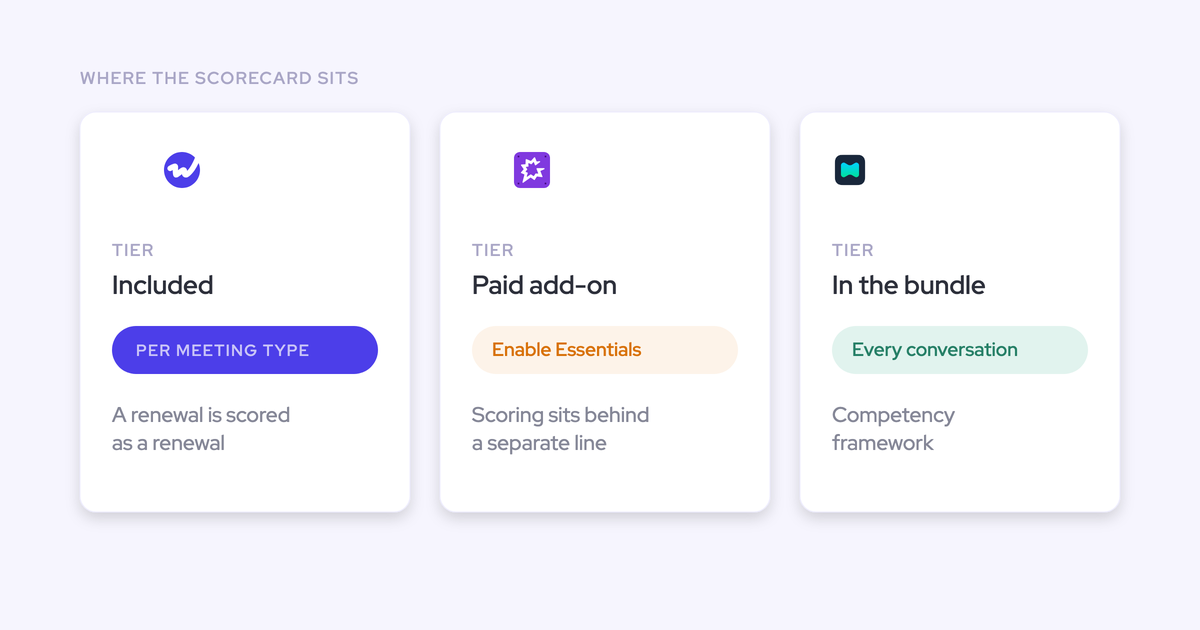
Gong puts scorecards, call scoring and coaching-metrics reporting inside the paid Enable Essentials add-on, bought on top of a Gong Foundation licence.
Momentum's coaching only comes through Salesforce packaging, so evaluating it means opening an Agentforce conversation.
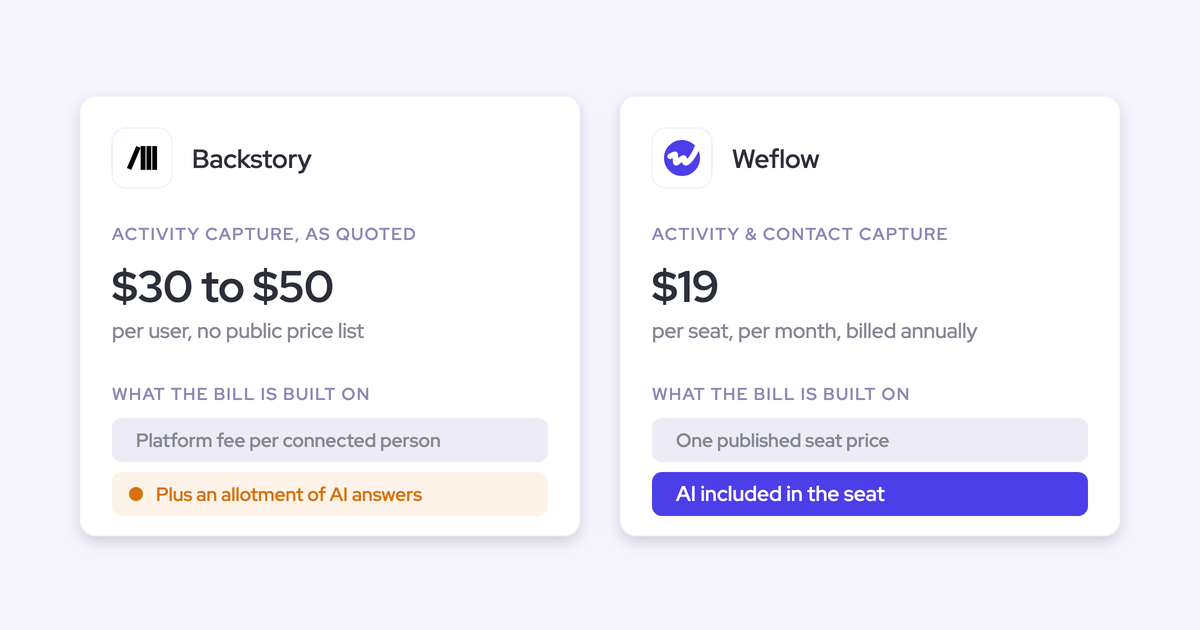
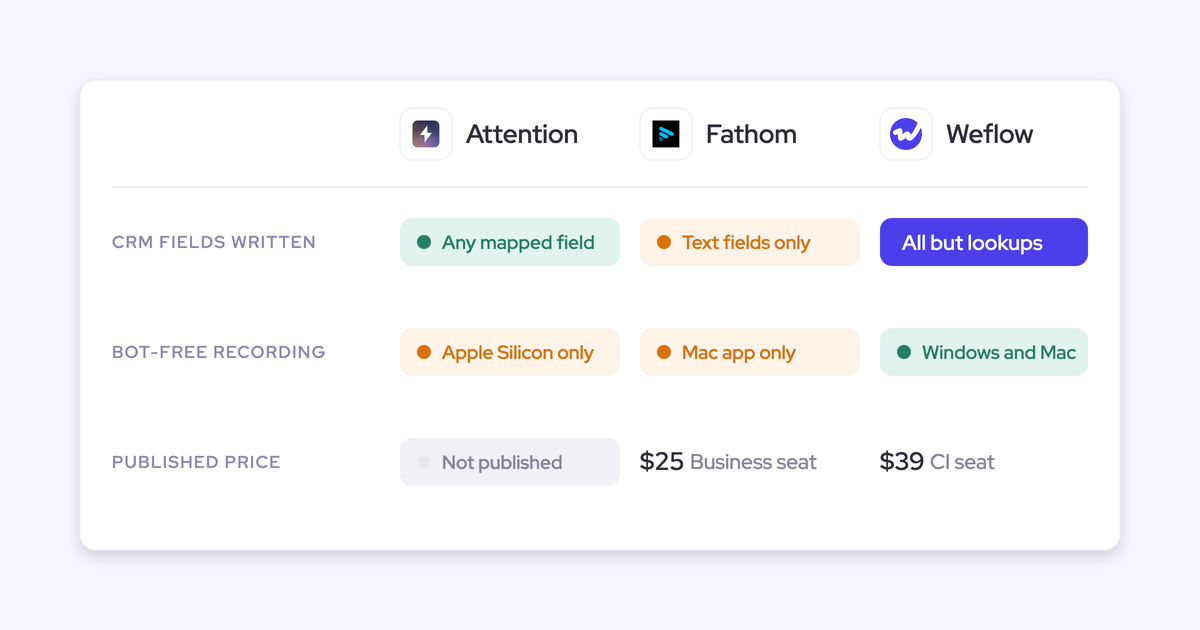
Weflow includes automatic scoring in the Conversation Intelligence + AI Field Updates seat at $39 per user per month. Three completely different commercial shapes behind the same headline feature.
This comparison is built on configurability and packaging, not coaching depth. Where Gong and Momentum win, we say so plainly, because you've demoed both and you'll spot a strawman in a second.
Weflow vs Gong vs Momentum: coaching scorecards at a glance
| Dimension | Weflow | Gong | Momentum |
|---|---|---|---|
| Where scoring sits in the package | Included in Conversation Intelligence, $39 per user per month billed annually | Scorecards, call scoring and coaching-metrics reporting sit in the paid Enable Essentials add-on, on top of a mandatory Gong Foundation licence | Sold only inside Salesforce packaging: the Agentforce 1 Sales Edition bundle, or as an add-on to Agentforce for Sales |
| Is every call scored automatically | Yes, every recorded meeting is scored against the team's configured methodology | AI Call Reviewer handles automated call review and requires an Enable Essentials or Enable licence | Yes, every recorded call is scored 0 to 2 per competency, with written feedback per score |
| Who defines the scorecard | You do. Prebuilt MEDDIC, MEDDPICC and Challenger templates you can edit or replace, plus your own prompts | Configurable, inside the coaching application you've bought | You do. Prebuilt competencies plus custom prompts you write |
| What decides which scorecard runs on a call | The auto-tagged meeting type: discovery, demo, negotiation, business review, or a custom type an admin defines such as renewal | Set up inside Enable; Gong doesn't publish how call-type triggering works, so ask for it live | CRM conditions: stage, deal size, or any custom field on the record |
| Per-team assignment | Coaching templates are assigned per team, with rating or free-form output | Not published; a demo question | Achieved through CRM conditions rather than a team-level template assignment |
| Score trend over time | Three levels: single call, whole opportunity, and rep across every deal over months | Coaching-metrics reporting, in the same add-on | Per-rep competency trend plotted over time, plus a written coaching brief per rep |
| Does the score reach the CRM | Coaching templates sync to Salesforce fields where those fields exist | Gong doesn't produce the weighted methodology score on the opportunity; teams that want one build it in Salesforce with RevOps and IT | Pushes coaching data back to the CRM for reporting |
| Metered AI on top of the seat | None. Unlimited recordings, transcripts and AI processing in the seat price | Credits: 2,000 per paid core seat per year, pooled company-wide. Call analysis and coaching draw nothing; AI Trackers, the MCP server and API workflows meter | Not published. The AI-dependent features Momentum documents require an AI licence |
Two rows carry the decision. The first is what decides which scorecard runs on a call, because that's the difference between a score you act on and a discovery rubric applied to a renewal. The second is where scoring sits in the package, because that's the number that shows up in the quote and not on the website. The rest of this article unpacks both.
Why sales managers compare Weflow, Gong, and Momentum on call scoring
Transcription stopped being a differentiator. Every tool in this category transcribes well, and buyers say so in the first five minutes of a demo. So the fight moved to what happens after the transcript exists: whether the call gets scored, who wrote the rubric, and whether the output is data anyone else in the business can read.
You already know why you want this. Coaching lands on whichever call you happened to sit in on, one rep gets three hours of attention and the rest get none, and nobody can say whether the team is getting better or just busier. The part that's genuinely hard to research is the packaging. Three things vendor pages consistently won't tell you:
- Whose scorecard it is. "Configurable" on a marketing page can mean you edit weights inside a fixed template, or it can mean you write the prompt.
- Which call types it adapts to. A single rubric applied to every conversation produces scores your reps will dismiss within a month, and they'll be right to.
- Which tier it sits in. Coaching is a common place to gate, and the gate usually appears in the quote rather than on the pricing page.
That last one is why evaluations drag. One buyer told us plainly:
We had our third call with Gong because they refused to tell us pricing until now.
Can you set a different scorecard per call type and team?
All three tools can score a call. They differ fundamentally in what triggers the scorecard, and that's the capability question, because a discovery rubric run against a renewal conversation produces a score nobody should act on.
Once a manager sees one of those, they stop trusting the whole board.
Weflow's answer first, then Momentum's, which is genuinely comparable, then Gong's.
Weflow: the meeting type triggers its own scorecard
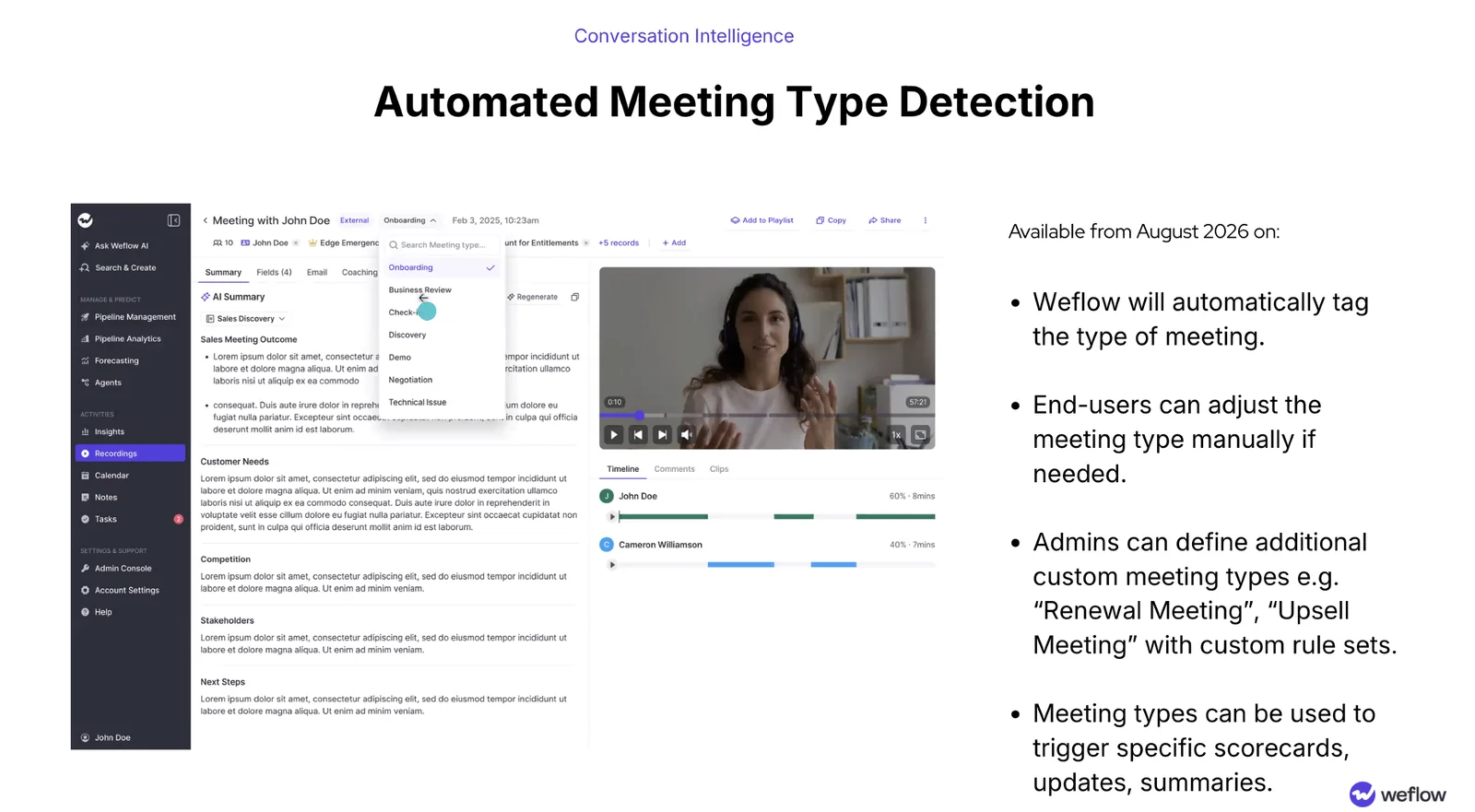
Weflow tags each recorded meeting with its type automatically, from a set covering onboarding, business review, check-in, discovery, demo, negotiation and technical issue. The tag sits on the recording next to the internal or external marker, and an end user can override it from a picker when the AI reads a call wrong.
The type is what makes the scoring meaningful: a meeting type can trigger its own scorecard, its own field updates and its own summary. A renewal isn't scored with the discovery rubric.
What you configure:
- The meeting types themselves. Admins define additional types with their own rule sets, so a renewal meeting or an upsell meeting exists in the vocabulary your company actually sells in.
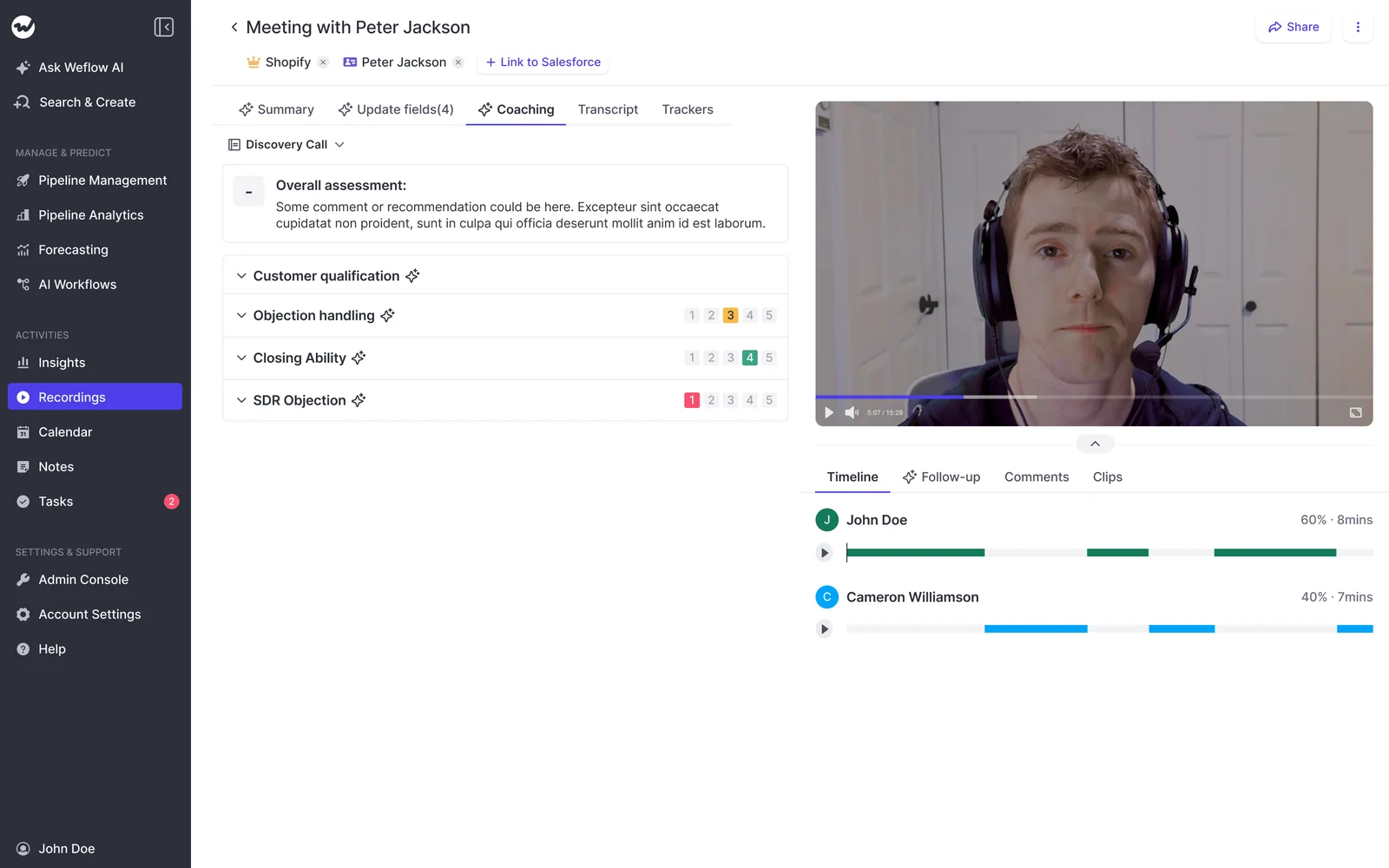
- Per-team assignment. Coaching templates are assigned per team, so the enterprise AEs and the SDRs aren't scored against the same thing.
- Rating or free-form output. A 1 to 5 rubric across configurable dimensions, or narrative feedback, per template.
- The rubric itself. Prebuilt MEDDIC, MEDDPICC and Challenger templates you can edit, replace, or ignore in favor of your own prompts.
Momentum: CRM conditions decide which competencies score a call
The Momentum Coaching Agent scores every recorded call on a three-point scale per competency: 0 for not exhibited, 1 for exhibited at the expected level, 2 for excelled. Each score carries written feedback naming what the rep did well, what to improve, and examples pulled from the conversation.
Which competencies run against which calls is decided by CRM conditions rather than by a person. Discovery competencies only on early-stage opportunities, negotiation only on late-stage, different competencies by deal size, or any custom field as the condition. Momentum ships prebuilt competencies and lets you write more with custom prompts.
That's per-call-type configurability, driven off the record instead of the conversation. It's a defensible design choice: the CRM already knows the stage, and you already maintain it.
Momentum's catch isn't capability. It's packaging, and it sits in the next section.
Gong: scorecards are configured inside the Enable Essentials add-on
Gong has scorecards, call scoring and coaching-metrics reporting, and they're configurable. The condition is that they sit in the paid Enable Essentials add-on rather than in the base seat.
Gong is sold as a mandatory core licence plus optional applications. Gong Foundation is the core; Enable Essentials, Forecast Essentials, Gong Forecast, Gong Engage and Data Cloud are bought on top, and no application can be purchased without Foundation.
So a team evaluating Gong for coaching gets quoted Foundation plus Enable, and a team evaluating it for forecasting gets quoted Foundation plus Forecast.
You can see the same line drawn inside Gong's own agent catalogue. AI Call Reviewer and AI Trainer both require an Enable licence, while other agents sit on Foundation or on any plan.
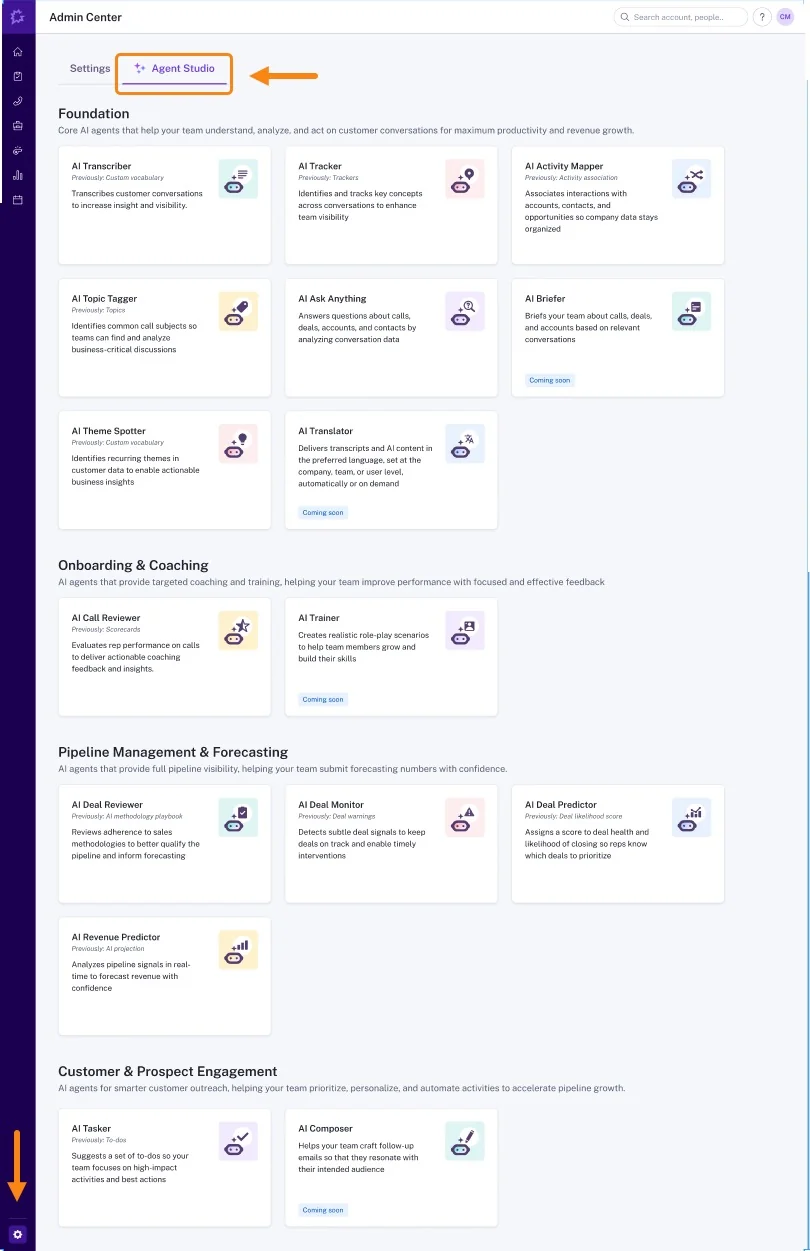
At Gong, the capability question and the packaging question are the same question. That's not a criticism of the scorecards, which are mature. It's the reason you can't answer "is the scorecard mine" without also answering "what am I buying."
What call scoring costs in Weflow, Gong, and Momentum
Same headline capability, three commercial shapes.
| Tool | What you buy to get scoring | What's metered on top |
|---|---|---|
| Weflow | Conversation Intelligence, $39 per user per month billed annually, 10-user minimum. Scoring, recording, transcription, AI field updates, Mobile Copilot, Ask Weflow AI and Agent Builder are in the seat. Unlimited view-only licenses at no cost. | Nothing on the scoring path. Unlimited recordings, transcripts and AI processing. Agent Builder is priced per workspace above the 25 included actions a month. |
| Gong | Gong Foundation, the mandatory core licence, plus the Enable Essentials add-on for scorecards, call scoring and coaching-metrics reporting. Seats are assigned per application. | Credits. Each paid core seat contributes 2,000 credits a year to a pool shared company-wide, resetting each contract year. Call analysis and coaching run on the seat; question-based AI Trackers, the MCP server and API-based AI workflows draw credits. Purchased top-ups expire at the end of the term. |
| Momentum | Salesforce packaging only: the Agentforce 1 Sales Edition bundle (Momentum plus Agentforce for Sales plus Slack Enterprise+ on one licence), or Momentum as an add-on to Agentforce for Sales. No standalone route. | Not published. The AI-dependent features Momentum documents, including Smart Quarantine and pre-meeting consent, require an AI licence and have to be switched on by a Momentum representative. |
For a coaching-led rollout, the packaging shape matters more than the list price.
Gong's credit model is worth understanding rather than fearing. Coaching itself doesn't meter, and Gong is explicit that credits attach to AI running continuously or at scale. But because the pool is company-wide rather than per person, heavy use by a few people spends the allowance everyone else depends on, and you can't size the pool to the teams that need it without buying more seats.
Momentum's shape is the one that changes who makes the decision. There's no route to buying the layer on its own, so a sales manager who wants configurable call scoring is now sitting in a Salesforce platform negotiation, and the call belongs to whoever owns that contract.
Buyers have learned to read for exactly this:
We want to make sure that you have predictable pricing, and it is very, very hard to achieve in the age of AI.
Weflow publishes its prices on the website and prices AI usage into the seat. Discounts happen on contract size, not on which door you came through.
Where Gong and Momentum are the stronger choice
There are teams that should not pick Weflow, and the honest way to run an evaluation is to know which one you are before the demo.
Gong: deeper conversation analytics and a standalone enablement suite
Gong invented this category and still has the deepest conversation analytics in it: 96+ language transcription, and account-level methodology summaries across every call on an account rather than call by call. If you've been using that account view, anything that only summarizes single calls will feel like a downgrade.
Gong also has enablement product that Weflow doesn't claim to match.
AI Trainer runs simulated customer conversations against personas generated from your own recorded calls, in sessions of 5 to 30 minutes with a configurable difficulty level, and evaluates each attempt with the same scorecards used on live calls. Reps can repeat a session before submitting a final attempt, and managers track completion and skill trends.
If you're buying an enablement platform, not scoring that writes to your CRM, weigh Gong seriously. Price it with Enable Essentials in the quote from call one.
Momentum: per-rep competency trends and written coaching briefs
Momentum's coaching artifact is strong, and it's the part most comparisons skip. Beyond the per-call scores, it produces a per-rep quantitative trend across methodology-shaped competencies (discovery excellence, technical discovery, prescription, firm future commitment, each MEDDPICC element), plotted over time next to talk ratio, win ratio, conversation count and won amount.
Then it writes a brief in four parts: what's working, where the rep is getting stuck, the performance patterns visible across calls, and the priority areas with the specific questions the rep should be asking. That's a coaching document a manager can walk into a one-to-one with.
It also runs on top of an existing recorder. Momentum integrates natively with Gong, Chorus, Clari Copilot, Attention and Salesloft Conversation Intelligence, plus seven dialers. If you're not switching recorders and you're already committing to Agentforce, that combination is hard to argue against.
The ceiling is the same design: on someone else's recorder it inherits that recorder's transcription quality and language coverage.
Where Weflow pulls ahead: automatic scoring that reaches Salesforce
Weflow is the Revenue AI Orchestration platform for sales, customer success, and RevOps teams, and on coaching its edge isn't depth of analytics. It's the combination: every recorded meeting scored automatically against the methodology you configured, in the base seat, at three levels, with a human able to correct the score, and the output landing in Salesforce as data your reports can read.
None of those four is remarkable alone. Together they're the difference between a coaching tool and a coaching habit.
Every recorded meeting is scored, at three levels
Weflow scores methodology adherence at three levels: a single call, a whole opportunity, and a rep across every deal they've worked over months.
The rep level is the one that changes a manager's week. What each level tells you:
- Single call. Where a specific conversation went wrong, with the transcript behind it, so feedback comes with the moment attached.
- Opportunity. Whether the qualification picture holds up across the whole deal, not just the call you happened to open.
- Rep over months. A trend line. You can see that a seller scores consistently well on metrics and economic buyer and consistently poorly on decision process and champion identification, then coach that gap instead of reviewing calls at random.
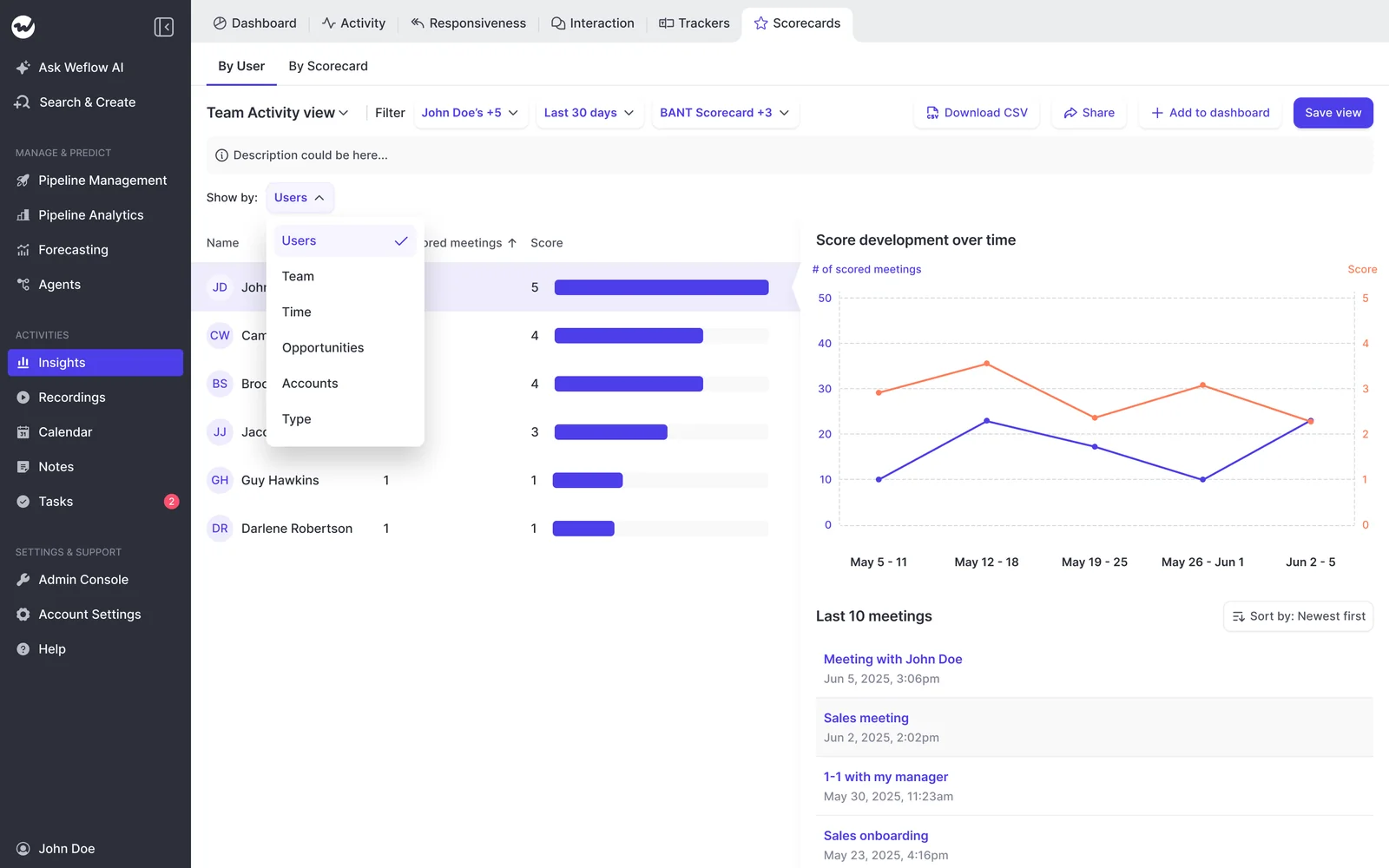
That's also what makes ramp measurable. A new hire's score development over their first two quarters is a number, not a feeling, and you find out in month two rather than at their first QBR.
One honest limit: Weflow doesn't score individual sellers when several reps are on the same meeting, and it doesn't do live in-call prompts. Scoring is post-call.
Managers can override the score, and reps see their own
A score nobody trusts is worse than no score. If the AI is confidently wrong once and nothing can be done about it, managers quietly go back to asking.
So there are two correction points. A manager can override the score on any call. And the meeting-type tag that decides which scorecard ran is user-correctable from a picker, which matters because a wrong tag is the most likely reason a score looks absurd.
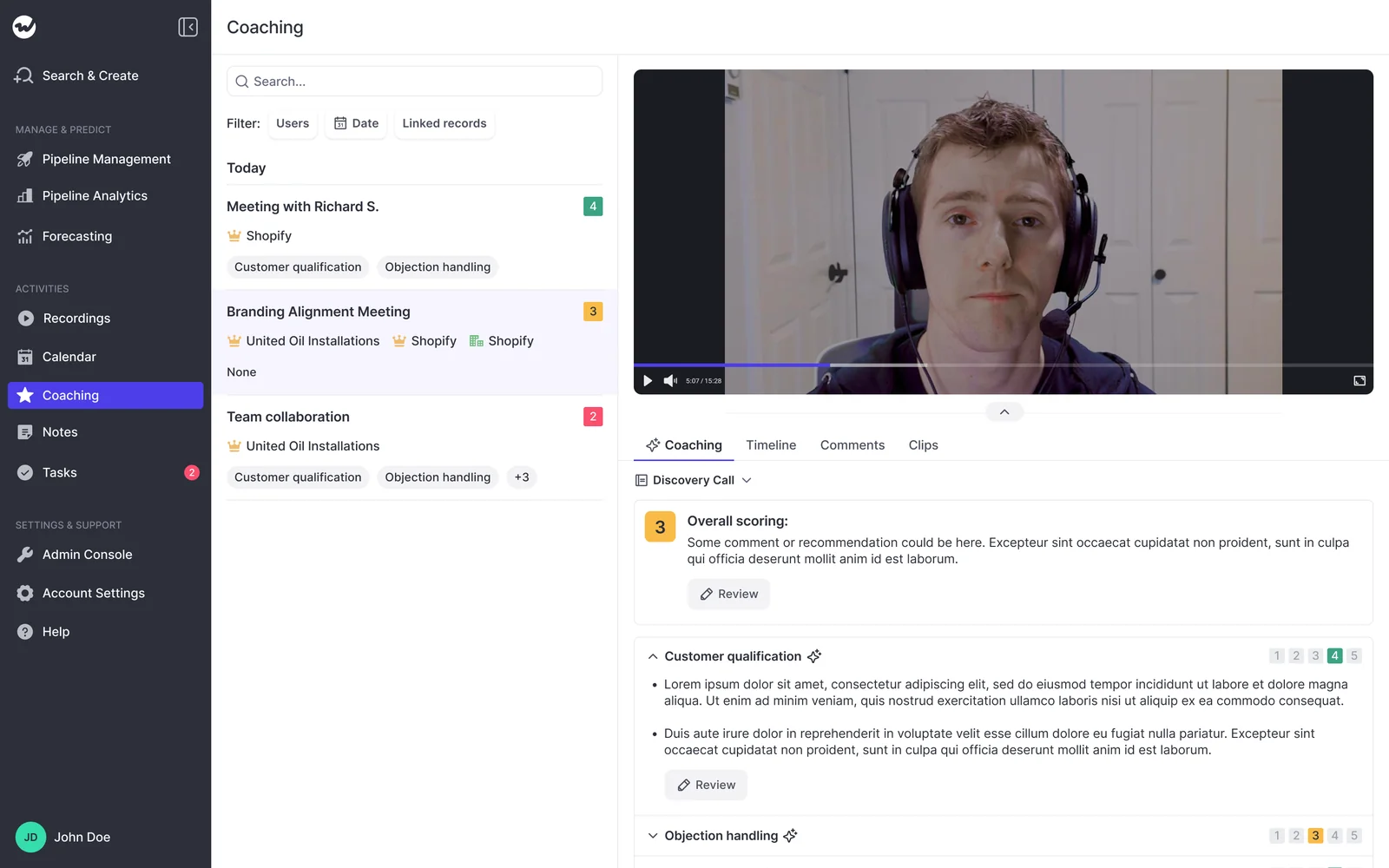
The adoption half matters as much. The rep gets their feedback immediately, without a manager in the loop, which is what turns scoring into something they use on Tuesday rather than something that happens to them in a review. Reps have thanked precisely zero managers for buying them an oversight tool.
Scorecard templates sync to Salesforce fields
Weflow's coaching templates sync to Salesforce when the corresponding fields exist there, so the score becomes a column your Salesforce reports and your BI stack can read rather than a metric living in a coaching UI.
The condition is real and worth naming: somebody has to create those fields. That's a Salesforce admin job, usually half an hour, and it's the step that decides whether coaching data is reportable or not.
The related honest caveat: Weflow's deal warnings and AI Playbook scores are Weflow fields, not Salesforce fields, so those specific ones don't reach a Salesforce dashboard without an agent writing them into a field you create. Weflow fields are marked with a W in the interface, which is the fastest way to tell what will and won't show up in a report.
Choose Weflow if, choose Gong if, choose Momentum if
Choose Weflow if:
- You want every recorded meeting scored automatically, against your methodology, without buying a separate coaching tier.
- You need different scorecards per call type and per team, with a renewal never scored on the discovery rubric.
- You want the score reportable in Salesforce alongside everything else the business reads.
- You need a per-seat price you can defend to finance, with no consumption charge sitting on top.
- You run on Salesforce. Weflow works exclusively with Salesforce, so if you're on HubSpot or Dynamics this decision is already made for you.
Choose Gong if:
- You're buying enablement-platform breadth, including role-play training scored against the same scorecards as live calls.
- Account-level methodology views across every call on a long enterprise cycle are central to how your managers work.
- You can get Foundation plus Enable Essentials approved, and you're comfortable managing a company-wide credit pool.
Choose Momentum if:
- You're already committing to Agentforce and Salesforce packaging, and the coaching spend rides along with a decision you're making anyway.
- You're not changing recorders, and you want a scoring and field-writing layer on top of Gong, Chorus, Clari Copilot or Salesloft.
- You want CRM conditions, rather than conversation type, to decide which competencies score a deal.
- The per-rep written coaching brief is the artifact your managers will actually use.
See how Weflow captures activity, updates Salesforce fields from calls, and rolls up your forecast. Book a 30-minute demo.
Frequently asked questions about AI coaching scorecards
Can Weflow score recordings imported from Gong, Salesloft, or Fathom?
Yes. Weflow imports and extracts data from the recordings and transcripts held in the conversation intelligence platform you're leaving, pulling them through that platform's API, at no extra cost and in about one to two weeks depending on volume.
The imported history stays searchable, so a question about how an objection was handled last quarter still answers after the move, and coaching doesn't restart from zero at the cutover. Teams that have migrated before, and had to dump their old recordings into a shared drive, tend to treat this as the deciding detail rather than a nice-to-have.
What happens when the AI scores a call wrong?
A manager overrides the score, and the meeting-type tag that selected the scorecard can be corrected from a picker by any user.
The reason this matters more than accuracy claims: a methodology field can be filled correctly and still be worthless, and a score nobody can inspect or fix is how a coaching rollout dies in month two. What we hear from buyers is a version of the same probe every time, and it's the right one to ask us:
If the metrics comes back and says they have 50,000 staff, that is a metric, but it's not relevant to what we're looking at in our sales process.
Does Clari offer coaching scorecards?
Clari has conversation intelligence, and evaluators who've used it consistently describe it as transcription-level with the coaching layer missing. What Clari Copilot does give a manager is comparative call metrics: talk-to-listen ratio and longest monologue ranked per rep against a team average. Useful, but it's a different artifact from a methodology scorecard.
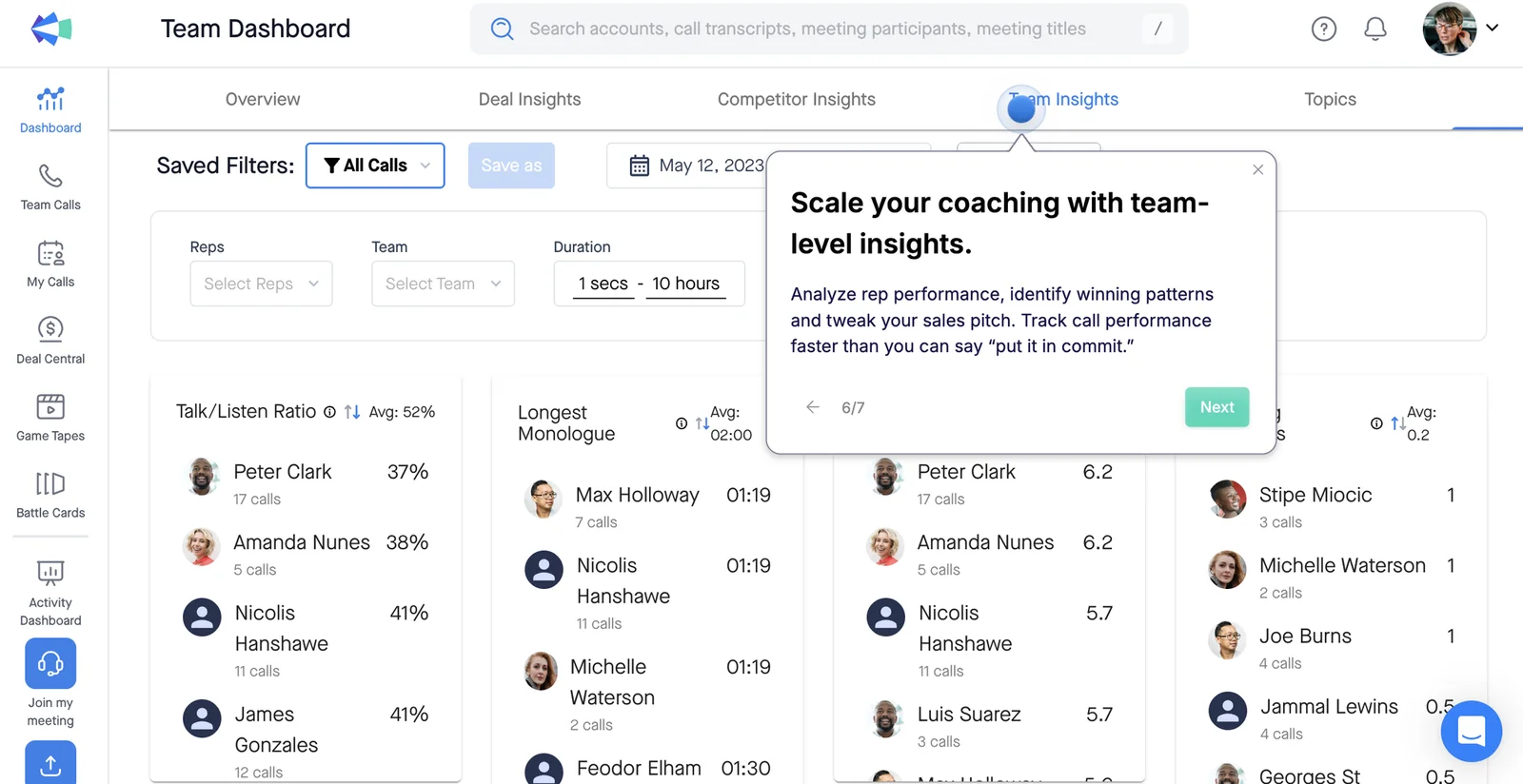
That's why this comparison is three-way and not four. If Clari is on your list for forecasting, keep it there and score elsewhere.
Can you buy Momentum's coaching without an Agentforce commitment?
No. Momentum is sold inside Salesforce packaging only, either in the Agentforce 1 Sales Edition bundle or as an add-on to Agentforce for Sales, with no standalone route to the capture and field-writing layer.
Practically, that means a coaching evaluation turns into a Salesforce platform conversation, and the decision moves up to whoever owns that contract. Worth knowing before you spend three weeks building the case.
Will reps read automatic call scoring as monitoring?
They will if you launch it as a manager dashboard. Talk ratio, longest monologue, hours in meetings and email response time are exactly what a manager wants and exactly what makes the person being measured go cold.
Two things prevent it. The rep gets their own score and feedback immediately, without a manager in the loop, so the first thing scoring does for them is useful rather than judgmental. And Weflow lets an admin assign Insights dashboards to profiles, so the SDR board and the manager board are different boards, released on different days, in different sessions.
Sequence the audiences deliberately and scoring lands. Ship every rep-level metric to everyone on day one and you've bought a surveillance tool, whatever the product actually does.