What Gong, Clari and Weflow Charge To Ask AI a Question About Your Calls
Learn how Gong, Clari, and Weflow price AI questions about calls and MCP access: credits, quotas, or seats.



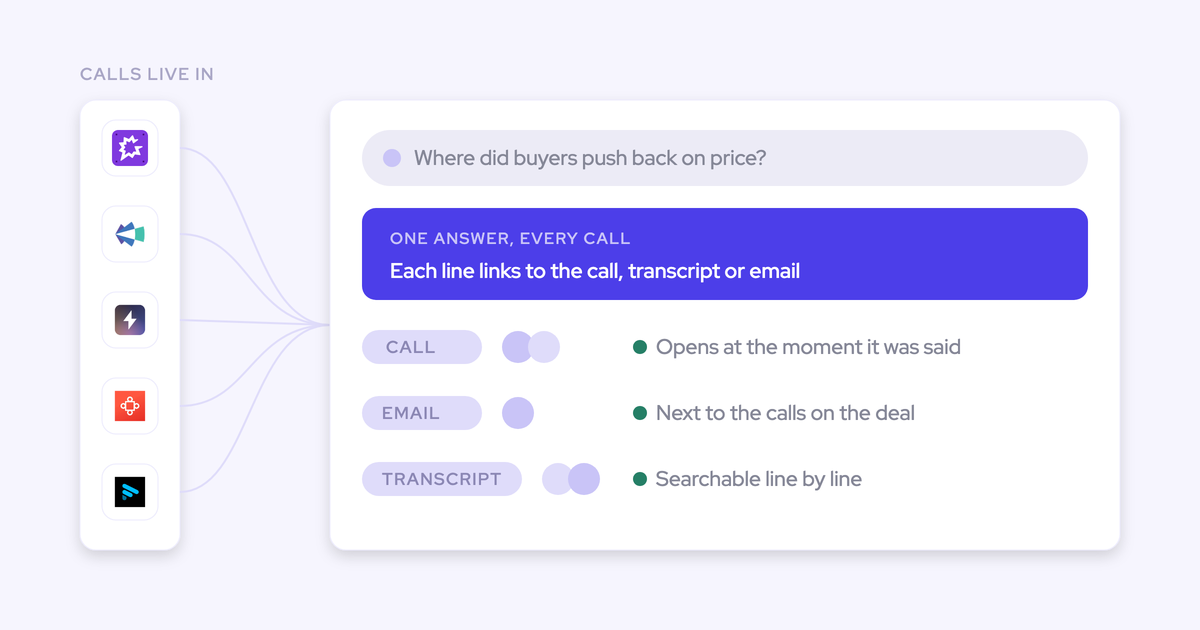
Ask AI a question about your own calls and deals. That one action is priced three completely different ways across the shortlist you're holding, and no pricing page lays the three mechanics side by side.
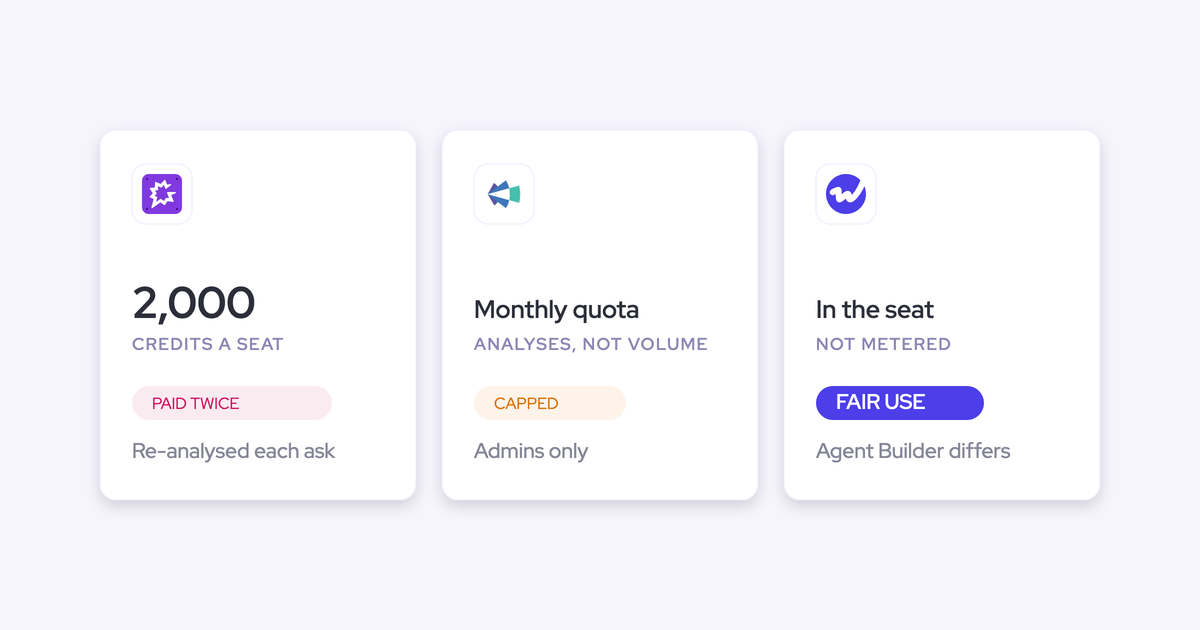
Gong meters it in credits drawn from a company-wide pool that stops when it empties. Clari meters AI Themes as a monthly quota of runs. Weflow includes it in the seat. The daily version of this is unglamorous: a manager or RevOps lead asking what changed on an account before deal reviews, ten times a week, across a group you've been told to grow.
This piece shows each meter plainly, including Weflow's own. A comparison that hides its own meter isn't one you can take to a CFO.
Gong credits vs Clari quotas vs Weflow seats at a glance
| Dimension | Gong | Clari | Weflow |
| What's metered | Question-based AI Trackers, the MCP server, and API-based AI workflows. Manual in-product AI is not metered | Copilot AI Themes analyses | Agent Builder actions only. Ask Weflow AI, AI summaries and AI field updates are included in the seat |
| Metering unit | Credits, priced by volume of data processed: 1 credit per call over 10 minutes, 0.5 per shorter call, 0.1 per email | A monthly quota of runs, counted per analysis regardless of how many calls it spans | Agent actions per workspace, above a free 25 actions a month included in every plan |
| Where the allowance sits | A single company-wide pool. Each paid core seat contributes 2,000 credits a year; the pool resets each contract year | Per company, per month, with the remaining allowance shown in the product before a run | Per workspace for agents. No allowance to manage for Ask AI |
| What happens at the limit | Processing stops. API and MCP requests return errors, AI Trackers stop processing new calls and emails, automated briefs stop generating | Runs are capped for the month until the quota resets | Ask AI keeps answering under fair use. Agents stop at the tier boundary until you buy the next tier |
| Does the external assistant path draw the meter | Yes. Every MCP and API request consumes credits, and the same brief is free when generated by hand in the Gong interface | Not documented as a metered MCP path | No. The read-only MCP connector carries no per-request meter |
| Is pricing published | Quoted. A mandatory Gong Foundation licence plus separately purchased applications | Quote-based | Published on weflow.ai: $19 to $39 per product, $49 to $79 per bundle, per user per month |
Read the Weflow column honestly and you'll see two different answers in it. Ask AI and the MCP connector are in the seat. Agent Builder is consumption-priced, with published tier boundaries. That's the whole concession, and it sits in the table rather than three sections down.
Why the same AI question is priced three different ways
Gong's price level was set when transcription was genuinely expensive. Inference and transcription costs have since collapsed, and the incumbents had a choice: fold AI into the seat everyone already pays for, or sell it as a metered layer on top.
Most of them chose the layer. It protects margin, and it keeps the processing inside the vendor's platform instead of being pulled out into somebody's assistant. Gong says this part out loud: credits are framed as the alternative to raising seat prices for everyone, and as a way to keep large-scale AI processing in Gong rather than exporting conversation data to an external AI tool.
That's a defensible vendor position. It's also the reason your invoice grows exactly as the rollout you're being measured on succeeds. This is the objection we hear first on almost every pricing call:
Nobody says the AI is bad. They say they can't defend the line item.
How Gong credits meter AI questions about your calls
Gong meters automated and programmatic AI in credits drawn from a company-wide pool. Two mechanics decide what that means for your bill.
First, the pool is shared. Each paid core seat contributes 2,000 credits a year, and they all land in one balance for the whole company rather than 2,000 per person. Fifty paid seats gives you 100,000 credits a year, and a handful of heavy users can consume the allowance everyone else depends on.
Second, you can't size the pool to the teams that actually need AI without buying more seats. Purchased top-up credits expire at the end of the contract term and don't roll over, so over-buying is money lost rather than banked.
Credits are counted by data volume, not by question
Gong prices credits against the underlying corpus, not the request. A call longer than ten minutes costs one credit, a call of ten minutes or less costs half a credit, and each email costs a tenth of a credit.
Run the arithmetic on a real account. A question that reaches 40 long calls and 200 emails draws 60 credits. The same question asked narrowly, over last month only, might draw five. You cannot look at the question and predict the cost, because the cost lives in the data behind it.
The dividing line is automation and access method, not capability:
- Metered: question-based AI Trackers, the Gong MCP server, and API-based AI workflows.
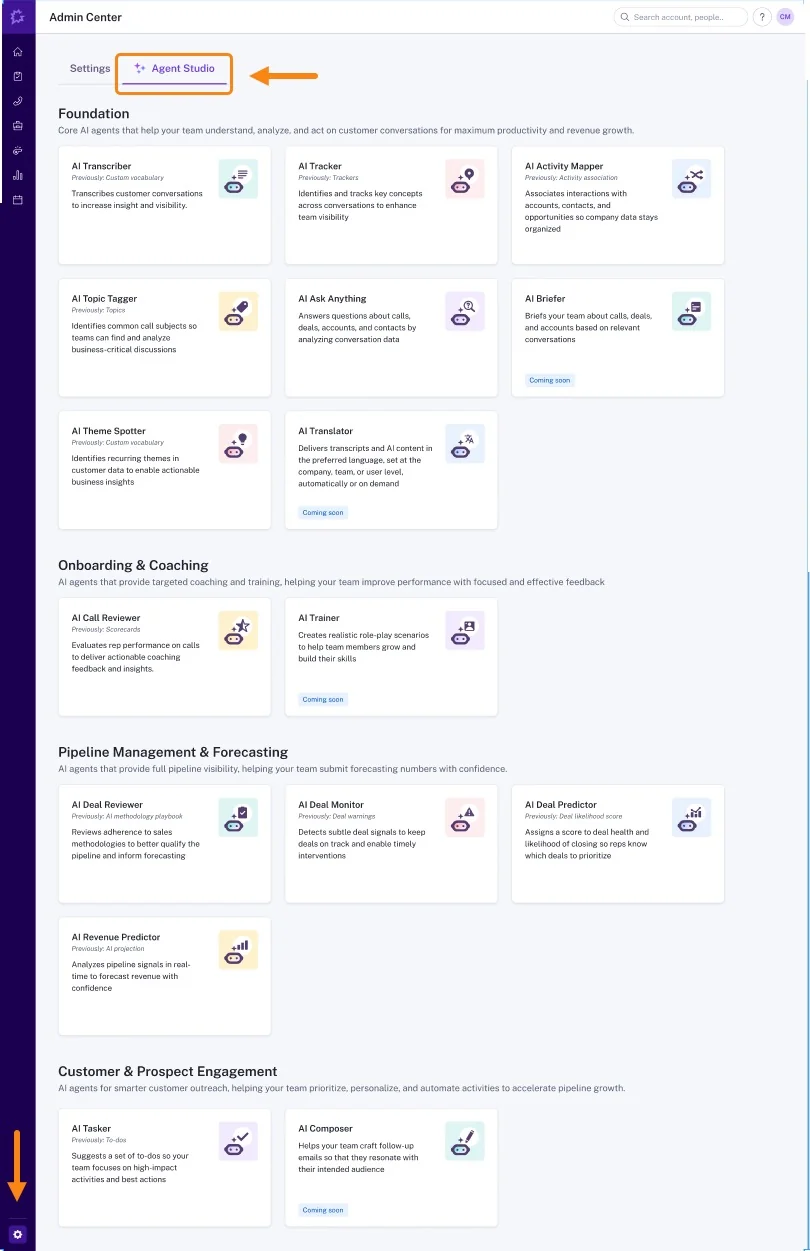
- Included in the seat: calls and call analysis, conversation insights, deal intelligence, forecasting, coaching, revenue and deal predictions, and Agent Studio agents a person opens and runs by hand.
- Never metered: viewing data that has already been processed.
Gong's own guidance is that AI Tracker configuration has the largest effect on consumption, and its recommended remedy is to unpublish trackers that no longer provide value and filter the rest by team, user, account type or deal stage. That's a sensible tip. It also turns the breadth of what you track across conversations into a budget decision.
Gong's Agent Studio, below, is the catalogue those manually run agents come from, and running them by hand is the path that stays inside the seat.
What stops when the Gong credit pool empties
It stops. It doesn't degrade. That distinction is the single most consequential operational fact in this comparison, because the failure lands on your integrations before anyone in the product notices.
- Admins get threshold emails as the balance runs down.
- At zero, API and MCP requests return an error. Whatever you built on that path stops answering.
- AI Trackers stop processing new calls and emails. Automated briefs stop generating.
- Data already processed stays viewable, so the product still looks fine to most users.
- Add credits and API and MCP calls resume automatically. AI Trackers have to be resumed by hand.
So you can restore the balance mid-quarter and still have trackers sitting idle because nobody remembered step five. If your forecast prep or your exec brief runs through an automation, that's the week it silently stops being right.
How Clari meters AI Themes as a monthly quota
Clari meters Copilot AI Themes as a monthly quota of analyses rather than by the volume of data processed, and shows the remaining allowance in the product before a run starts. This is drawn from Clari's release documentation, so treat it as the published mechanic rather than a contract term you should assume applies to your specific agreement.
The visible allowance is genuinely the better design. You know where you stand before you spend, which is more than credits give you.
But the counting unit flips the incentive completely:
| Gong credits | Clari AI Themes quota | |
| What you're charged for | Every call and email the question touches | Each run, whatever it spans |
| What that rewards | Narrowing the question to the smallest useful scope | Batching questions into the largest possible scope |
| What you can see before you spend | Nothing that predicts the cost | The remaining allowance for the month |
| The shared consequence | The number of questions a company can ask of its own conversations is capped | |
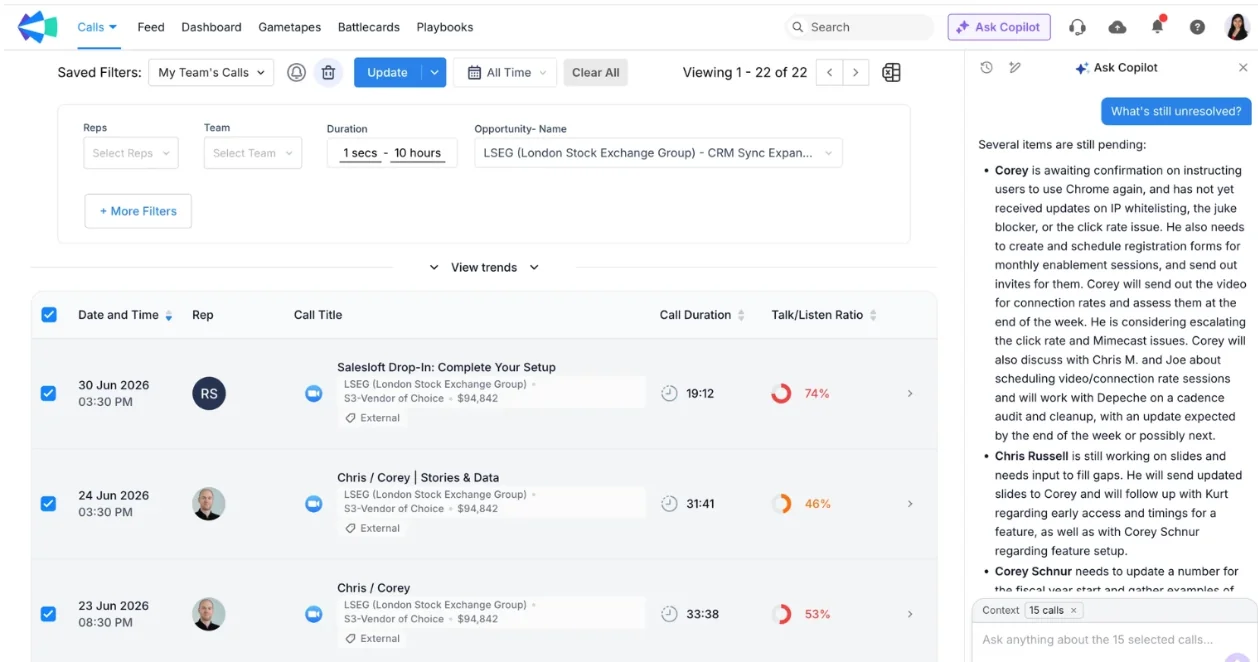
Clari's Ask Copilot has its own scope boundary in daily use too. A chat spans the calls you selected, shown as a context chip on the panel, so portfolio-level questions get assembled from batches rather than asked once.
One more thing worth knowing before you price Clari on this axis: Clari's Ask AI draws on limited data sources and can't produce artifact outputs like a PDF or a CSV. If the point of asking is to hand something to a leader, that matters as much as the quota does.
What Weflow includes in the seat and what it meters
Weflow is the Revenue AI Orchestration platform for sales, customer success, and RevOps teams, and its pricing rule is one line: everything is per seat except Agent Builder, which is the only consumption-priced product.
That split is a design decision, not a promotion. Metering the one component that genuinely consumes tokens at scale keeps the variable cost bounded, and it means nobody has to ration access to the AI features that produce daily value.
We want to make sure that you have predictable pricing, and it is very, very hard to achieve in the age of AI.
— Philipp Stelzer, Co-founder and Chief Product Officer, Weflow
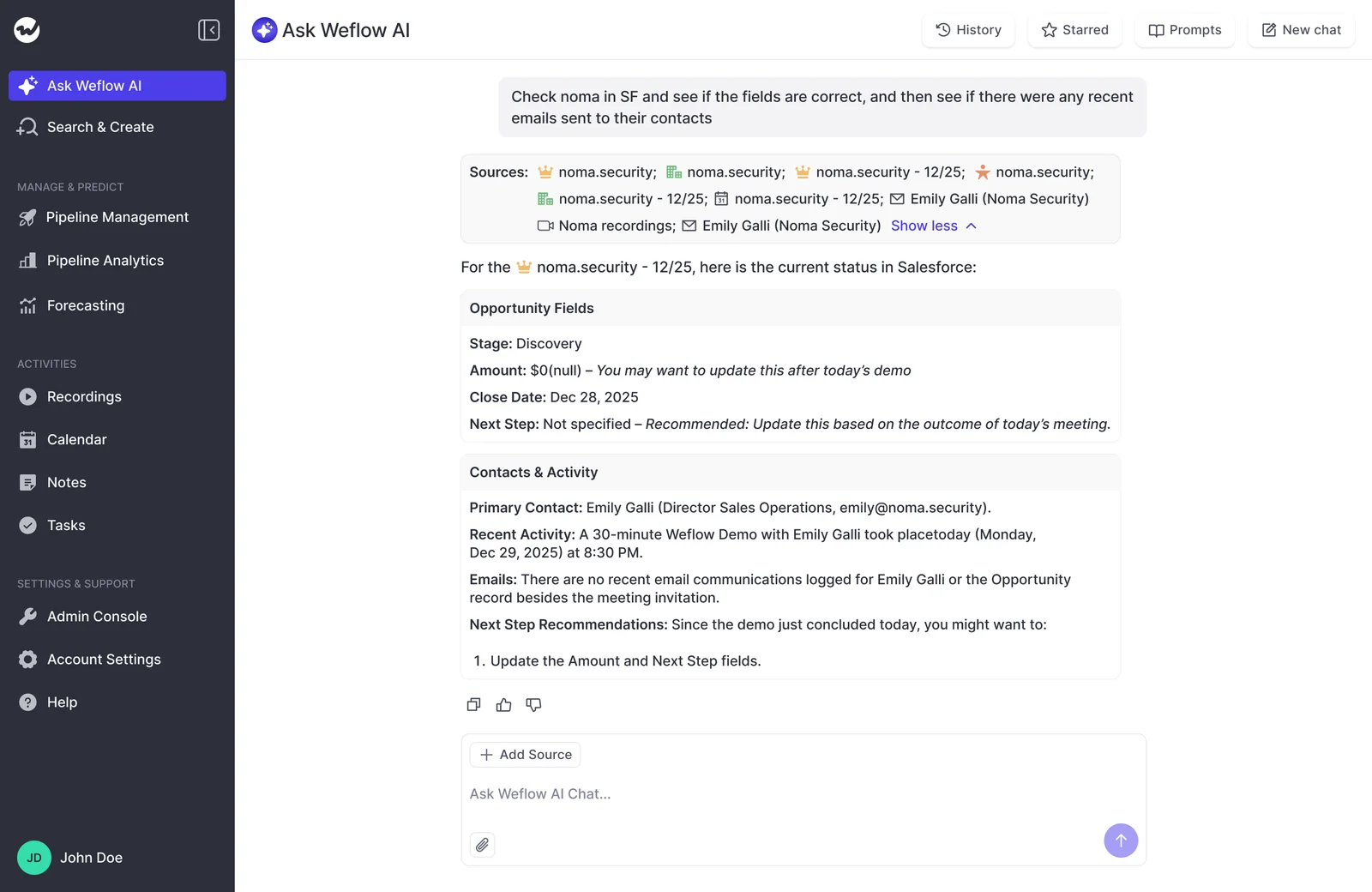
Ask Weflow AI carries no usage meter under fair use
Ask Weflow AI isn't metered or priced separately. It comes with every Weflow product and bundle, governed by a fair use policy no customer has yet reached.
What sits inside the seat:
- Recordings and transcripts, with no caps.
- AI templates, AI summaries and AI field updates written to Salesforce.
- Ask Weflow AI prompts, with no per-query pricing and no allowance to watch.
- The read-only MCP connector, with no per-request meter.
- Unlimited view-only licenses, so stakeholders who only need to read don't consume a paid seat.
The practical effect is that the awkward conversation never happens. Nobody decides which managers get to ask questions this quarter.
Ask Weflow AI answers across Salesforce records, captured emails, meetings and call transcripts, and it cites the sources it used, so a leader can click through to the exact call or email behind an answer.
Where Weflow meters: Agent Builder tiers and the token ceiling
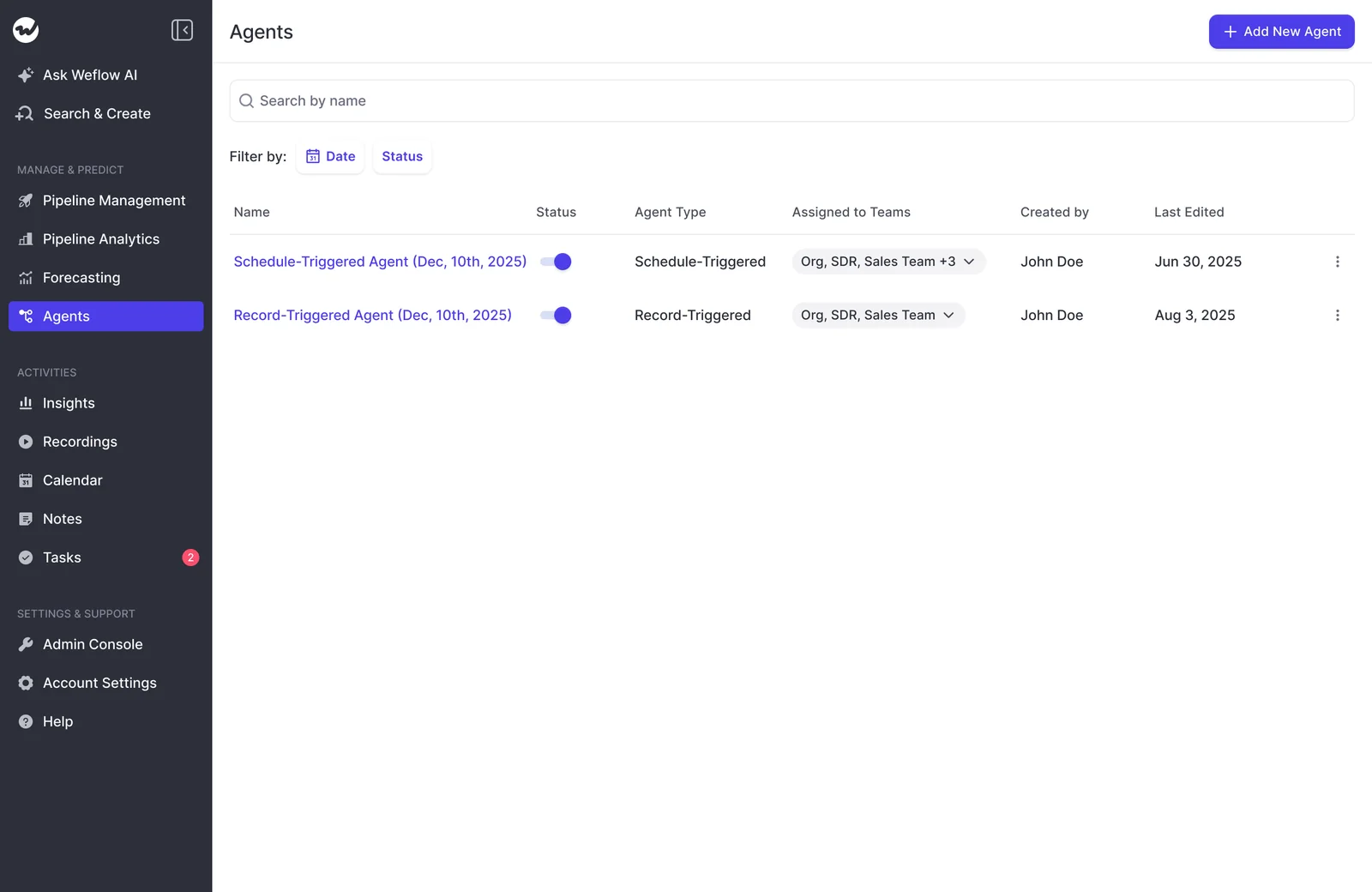
Agent Builder is priced per workspace, not per user, above a free allowance included in every Weflow plan and bundle.
| Tier | Included agent actions | Price |
| Free | 25 agent actions per month | Included in every plan and bundle |
| Growth | 500 agent actions per month | $299 per month |
| Scale | 2,500 agent actions per month | $999 per month |
| Enterprise | Custom | Custom package |
The boundaries are hard and published. You can't drift past a tier without deciding to buy the next one, which is what a finance function actually wants from a meter.
The second limit is a ceiling rather than a charge. Ask Weflow AI answers within one million tokens for a single query. AI agents have no equivalent per-run ceiling.
So the practical rule is this: a question about a deal, an account, a filtered board or a quarter belongs in the chat, and a question that sweeps the entire book of business, every closed-lost deal in a year, every account in a region, belongs in an agent. That's the point where Weflow's pricing turns from flat to metered, and it's better to know it now than to find it in month three.
MCP access: what Gong charges and Weflow includes
This is where the two models diverge hardest, and it's the path this buyer feels personally. The person connecting Claude or ChatGPT to revenue data is now usually an executive with an assistant, not a developer with a script.
Gong charges credits on every MCP and API request. Weflow includes the MCP connector in the seat. Same act, two cost behaviors.
| Gong MCP server | Weflow MCP connector | |
| Cost per request | Draws credits from the shared pool. The same brief is free when generated by hand in the Gong interface | No per-request meter, included in the seat |
| What it returns | AI-generated insights only. Raw transcripts, message bodies and activity lists are never returned | Playbook output, call summaries, transcripts (admin toggle) and forecast calls |
| Scope of a request | Three tools: ask_account, ask_deal, generate_brief. Each works on one named record at a time | Forecast data for a close-date period, scoped to the requester or their team hierarchy |
| Write access | Read-only. Cannot create, update or delete in Gong or the CRM | Read-only |
| What it takes to connect | A paid Gong seat plus a paid tier of the assistant (Claude Pro, Max, Team or Enterprise; ChatGPT Plus, Pro, Business, Enterprise or Edu; Microsoft Copilot with the right extensibility). Free Gong collaborator accounts can't connect at all | An admin switches the connector on per workspace and users paste a URL as a custom connector |
Why asking Gong the same question twice costs twice
Every Gong MCP or API request analyzes the underlying calls and emails from scratch. There's no caching of an answer across requests.
Ask about an account, read the answer, then ask the obvious follow-up, and Gong re-analyzes the same corpus and charges again. Briefs compound it further: each open-ended section runs its own separate analysis of the selected conversations, so a richer brief costs more than a thinner one.
That's the mechanic that matters, because iterative questioning is how people actually use an assistant. Nobody asks one perfect question. They ask six, narrowing as they go, and the cost multiplies linearly with their curiosity.
There's a second inversion worth naming. The same brief is free by hand in the Gong interface and metered through the API or MCP server, so automating a task makes it more expensive, not less. The cost of Gong AI rises specifically as you try to wire Gong into the rest of your stack.
One more thing to check before you sign: registration type and authorization context are both locked once a Gong MCP integration is submitted. Getting either wrong means deleting the integration and having every connected user reconnect.
What Weflow's MCP connector reaches and what admins control
Weflow's MCP connector is read-only, official, and reaches playbooks, call summaries, transcripts and forecast calls from Claude, ChatGPT and other assistants. Free to query doesn't mean ungoverned.
The controls an admin holds:
- Enable MCP Connector turns the endpoint on per workspace.
- Allow transcript access is a separate toggle. With it off, a connected assistant sees AI summaries but never the verbatim transcript.
- A connected user list shows every person who has attached an assistant, with their email and connection date, so nobody discovers it later.
On the forecast side, a request is scoped by close-date period and by "me" or "team". For each rep in scope it returns weighted and unweighted pipeline, closed-won amount and count, win rate, average deal size, average contract value, average sales cycle length, coverage ratio, gap to forecast, and the opportunity IDs behind those numbers. It also returns the most recently submitted forecast call alongside the live pipeline total and the delta between them, which is the question a forecast call exists to settle.
Two honest boundaries. A per-rep breakdown is capped at 25 owners, so a large org gets aggregate answers unless the question narrows to a team. And "team" follows the configured reporting hierarchy, which resolves to every active user in the company if no hierarchy has been configured. Check that before you point an assistant at it.
Where Gong and Clari are the stronger choice
Gong invented this category and still has the deepest conversation analytics in it, plus transcription across 96+ languages and a sales engagement product Weflow doesn't have. If your team's value comes from analytics depth on conversations, or you run a multilingual org where transcription breadth is the gate, Gong earns its price and you should stay. Gong's compliance posture is also complete: SOC 2 Type II, ISO 27001, 27017, 27018 and 27701, Data Privacy Framework certification. Any comparison implying otherwise is wrong and checkable.
Clari's enterprise roll-up motion is more mature at very large rep counts, and its pipeline waterfall, pacing view and quarter-over-quarter comparison are the three things teams genuinely use every week. If you're running a formal forecast across a thousand-plus sellers and those views are load-bearing, an honest replacement lands at roughly 80% of the configuration you've accumulated over years, and the missing 20% is exactly the custom pieces you built. That gap is real. Price it before you move.
What each platform costs and where pricing is public
Pricing transparency is itself a comparison dimension, and it's the one that decides how many calls you sit through before you can build a model.
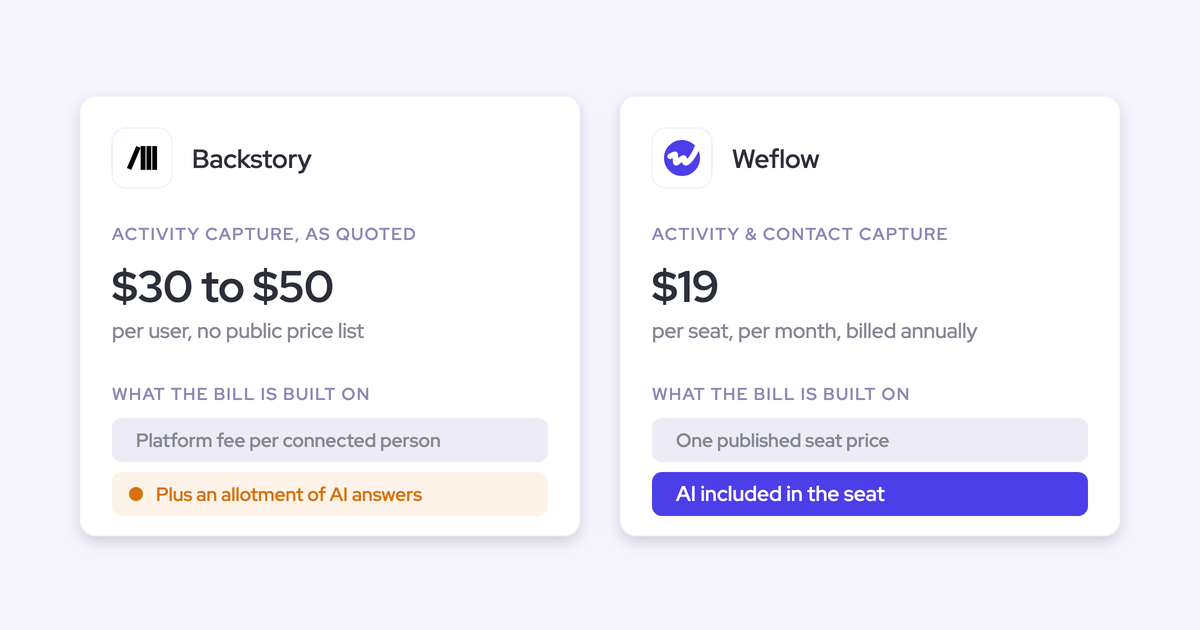
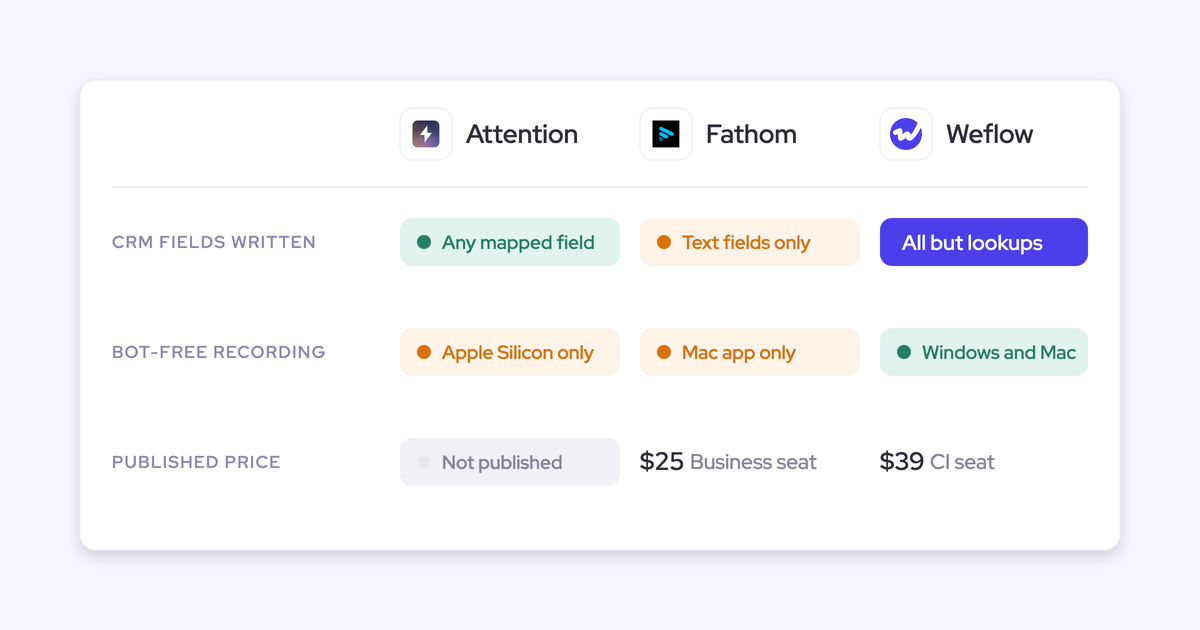
Weflow publishes its prices. All list prices, per user per month, billed annually:
| Product or bundle | Price | What's included |
| Activity & Contact Capture | $19 | Ask Weflow AI, Agent Builder Free tier |
| Weflow Conversation Intelligence | $39 | Mobile Copilot, Ask Weflow AI, Agent Builder Free tier |
| Deal Intelligence & Forecasting | $39 | Ask Weflow AI, Agent Builder Free tier |
| Revenue AI Foundation | $49 | Activity & Contact Capture + Conversation Intelligence |
| Revenue AI Business | $59 | Foundation plus Deal Intelligence |
| Revenue AI Enterprise | $79 | Business plus AI-powered Forecasting |
No platform fees, no implementation fees, minimum 10 users. Volume discounts start to bite around 30 to 40 seats, and multi-year terms carry 10% for two years and 20% for three.
Gong is quoted, and the structure of the quote matters as much as the number. Gong Foundation is a mandatory core licence, and Enable Essentials, Forecast Essentials, Gong Forecast, Gong Engage and Data Cloud are applications bought on top of it. No application can be purchased without Foundation.
Seats are then assigned per application, not per person. Someone who needs conversation intelligence and deal functionality consumes a Foundation seat and a Forecast Essentials seat, so the cost of one human is the sum of every application they touch. That's the arithmetic that decides whether you can put 260 people on capture and 20 on forecasting, or whether everyone pays the intelligence price.
Clari is quote-based too. And getting to a number takes a while:
We had our third call with Gong because they refused to tell us pricing until now.
Teams switching from Gong to Weflow typically land at around half of what they were paying, and the reason is the cost base rather than a thinner product. Gong's pricing was set when transcription was expensive. The same capability can be built materially cheaper today.
When to choose Gong, Clari or Weflow
Choose Gong if:
- Conversation analytics depth is the outcome you're buying, and your team works inside Gong's interface rather than pulling data into their own assistants.
- You need transcription across a wide language set, or you want conversation intelligence and sales engagement from one vendor.
- Your AI usage is deep but narrow: a few people, running things by hand in the product, where the manual path stays free and the credit pool never gets tested.
Choose Clari if:
- You're rolling up a forecast across a thousand-plus reps and the maturity of that motion outweighs everything else.
- The pipeline waterfall, pacing and quarter-over-quarter comparison are the views your leadership reads, and years of configuration sit behind them.
- A visible monthly allowance you check before a run is a control your team can live inside comfortably.
Choose Weflow if:
- You're rolling AI out to a widening group and need the bill to stay flat while adoption grows, because the alternative is rationing who's allowed to ask questions.
- Executives are connecting Claude or ChatGPT to revenue data, and you don't want every follow-up question to draw a meter that re-analyzes the same calls from scratch.
- You want the conversation data landing in native Salesforce objects your own reporting and automations already read, rather than in a vendor's cloud.
- You can accept one metered component, Agent Builder, with published tier boundaries, and a one-million-token ceiling that pushes whole-book-of-business questions into an agent.
FAQ: Gong credits, Clari quotas and Weflow fair use
Is Weflow's fair use policy a hidden usage cap?
No. Fair use governs Ask Weflow AI, recordings, transcripts and AI templates, and no Weflow customer has reached it. The real limits in Weflow are published and hard: Agent Builder tiers above the free 25 actions a month, and the one-million-token ceiling on a single Ask AI query. If you want to know where Weflow charges, those two are the whole answer.
What happens when Gong credits run out mid-quarter?
Processing stops rather than degrades. API and MCP requests return errors, AI Trackers stop processing new calls and emails, and automated briefs stop generating. Data already processed stays viewable. When you top the balance up, API and MCP calls resume automatically, but AI Trackers have to be resumed by hand, so a company can restore its balance and still have trackers sitting idle.
Do unused Gong credits roll over to the next year?
No. The pool resets at the start of each contract year, and purchased top-up credits expire at the end of the contract term. Unused spend is lost rather than banked, which means over-buying to be safe has a cost of its own.
Can migrated call history still be queried by AI?
Yes. Weflow imports and extracts recordings and transcripts from the conversation intelligence platform you're leaving, pulling them through that platform's API, at no extra cost and in about one to two weeks depending on volume. The imported history stays searchable, so a question about how an objection was handled last quarter still answers after the move.
What do Weflow's Agent Builder tiers cost?
Agent Builder is priced per workspace, not per user. The Free tier with 25 agent actions a month is included in every Weflow plan and bundle. Growth is $299 a month for 500 agent actions, Scale is $999 a month for 2,500 agent actions, and Enterprise is a custom package.
What are Weflow's minimum seats and contract terms?
Minimum 10 users, billed annually, with list prices published on weflow.ai. Volume discounts apply based on contract size and start to matter around 30 to 40 seats, and multi-year terms carry 10% for two years and 20% for three. There's a 14-day free trial, and for evaluations a trial can't cover, a three-month paid pilot written as the first three months of a multi-year agreement with an opt-out at the end.