Does Salesloft forecast renewals and expansion, or only new bookings?
Learn whether Salesloft forecasts renewals and expansion or only new bookings, and where Weflow fits.


Partly, and the answer depends on which layer you mean. Before the Clari merger, Salesloft forecast one metric: bookings. Today Salesloft's forecasting is Clari Forecast, sold as a separately priced Forecasting add-on. Its account-based forecasting can represent existing-customer revenue. Its AI Forecast covers new business only, and you measure accuracy by exporting forecast history to a BI tool.
A renewal and expansion forecast needs four things a bookings roll-up doesn't give you:
- its own date field
- its own stage path and targets
- its own model
- measured accuracy
This article checks each of those on both tools.
Weflow is the Revenue AI Orchestration platform for sales, customer success, and RevOps teams. It's built for Salesforce teams, and we built Weflow Deal Intelligence & Forecasting to run a separate forecast for each revenue motion. We'll also say plainly where Clari Forecast is the better fit. Throughout, we assume you keep Salesloft Cadence for your SDRs.
Can Salesloft forecast renewals and expansion today?
Salesloft can represent renewal and expansion revenue, but only one of its four forecasting layers, account-based forecasting, is built for existing-customer revenue. That layer was designed for variable or consumption revenue.
| Layer | What Salesloft / Clari Forecast does | What it means for renewals and expansion |
|---|---|---|
| Roll-up submission | Every user submits their own number up a hierarchy that drills eight levels deep. Managers with permission submit on behalf of reps. | Renewal owners can submit a number. The roll-up follows the Salesforce hierarchy, and leaders see only the level directly below them. |
| Account-based forecasting (Pace) | Each account carries a read-only machine-predicted Pace number that sellers adjust with an override and a comment, on account segments an admin configures. | Covers existing-customer revenue at the account level. It's built for variable or consumption revenue. |
| AI Forecast | Predicts new business deals closing in the current quarter, from your own Salesforce history. | Renewal and expansion get no AI prediction. |
| Forecast accuracy | Admins export a Forecast History Report of two years of submitted forecasts as a CSV. | You match it against attainment in a BI tool. There's no accuracy measure in the product. |
All four layers sit behind the Forecasting add-on, which Salesloft prices separately.
What changed when Clari Forecast became Salesloft's forecasting
The merger gave Salesloft a forecasting product that can represent existing-customer revenue. It didn't turn renewals into a forecast that runs like your new-business one.
Legacy Salesloft forecast bookings as a direct roll-up of opportunity amount. One team that left Salesloft for Clari described it this way:
"When we moved from Sales Loft to Clari, one of the reasons was with Sales Loft you could only forecast one metric. We could only do bookings, but we couldn't do churn or renewals or other things very well."
Salesloft and Clari merged in December 2025 and have operated as one brand, Salesloft, since 1 September 2026. Clari Forecast continues as the platform's forecasting product line.
Two things carried over from before the merger:
- Separate products. The engagement layer and the forecast layer arrived as separate products with their own data models. Clari had already grown by acquisition, and none of those products was rewritten onto a common foundation.
- Who it was deployed on. Clari was mainly a sales leadership tool, rolled out to AEs and their managers and rarely across account management and customer success.
That second point is why renewals so often stayed "the next thing on the list." We hear versions of this on calls with Clari customers:
"Some of the teams are using Clari forecasting but when we talk to the renewals team right now it's just in Salesforce again just was never implemented."
| Aspect | Legacy Salesloft forecasting | Salesloft since 1 September 2026 |
|---|---|---|
| What it forecasts | Bookings, one metric, rolled up from opportunity amount | An opportunity-based forecast, plus account-based Pace for existing-customer revenue |
| Renewals and churn | Not handled well, per a team that left for Clari over it | Represented through account-based forecasting, designed for variable or consumption revenue |
| Forecasting product | Salesloft's own bookings forecast | Clari Forecast, sold as the Forecasting add-on on Advanced or Elite |
| Relationship to engagement | Built by Salesloft alongside Cadence | A separate product with its own data model, joined through the merger |
What a renewal and expansion forecast needs to stand alone
A renewal and expansion forecast only works when it has four components of its own. Without each one, something specific breaks:
- Its own date field. Renewals run on renewal due date, not close date. Index them on close date and you forecast the wrong set of deals for the quarter.
- Its own stage path and targets. When new, expansion and renewal share one pipeline and one quota, a missed quarter can't tell you which motion missed. Renewals hitting while new logos collapse looks identical in the roll-up to the reverse.
- Its own model. Renewals often sit in early stages and still close around 95% of the time. Stage probabilities set for new business badly underweight them.
- Measured accuracy. Without forecast-versus-actual per motion, nobody can say how good the renewal number has ever been.
The date field is the one RevOps leaders raise first:
"When I'm doing the renewal forecast, I don't care what my close date is. What I want to track is renewals that are due in this quarter and how we are doing against those."
Weflow and Clari Forecast side by side on renewal forecasting
The two tools diverge most on four things: per-motion setup, AI coverage of renewals, native accuracy tracking and price transparency. Clari Forecast leads on account-level forecasting, account and activity snapshots, and warehouse sync.
| Capability | Weflow | Clari Forecast (Salesloft) |
|---|---|---|
| Multiple forecast types | Parallel forecast setups per motion, each with its own amount field, date field, stage path, cadence and targets. No consumption forecasting. Targets are amounts only. | An opportunity-based forecast plus account-based Pace for existing-customer revenue, on admin-configured segments. Built for variable or consumption revenue. |
| Forecast submissions and roll-ups | Baseline and best case tied to named deals, versioned, with manager overrides logged with a rationale. Submission is web-app only and isn't written to Salesforce fields. | Roll-ups up to eight levels deep, managers submit on behalf of reps, and Quick Submit updates a whole quarter in one action. Leaders see only the level below them, and the roll-up follows the Salesforce hierarchy. |
| AI forecast prediction | A separate model per forecast setup returns a low, mid and high range. It needs six months of history and is ready 48 to 72 hours after import. It doesn't yet adjust for ramping reps. | New business closing this quarter only. Requires four quarters with 50+ closed deals each, and Salesloft switches it on after reviewing the data. RevOps teams report 12 to 18 months before it's useful. |
| Forecast accuracy tracking | Built in per rep, manager and team, against a field the admin chooses, with no setup. | Partial. Week-by-week forecast call history sits in the product. Accuracy itself is a CSV export matched against attainment in BI. |
| Opportunity snapshots | Every opportunity every few hours, powering the waterfall, push counts and period-over-period views. A 12-month Salesforce import covers history, and custom fields depend on Salesforce field history tracking. | Time Series Data Hub snapshots opportunity, account and activity data, plus a week-by-week history of forecast calls and fields. |
| Integrations with other tools | Partial. Salesforce, Gmail, Google Calendar, Outlook, Zoom, Teams, Meet, Slack and the Outreach dialer, plus API feeds to Tableau and Looker. No native Snowflake, Databricks or BigQuery connector. | The Unified Revenue Data Layer syncs Salesforce, Dynamics, Snowflake, Databricks, Gmail, DocuSign, ZoomInfo and LinkedIn. Recording covers Zoom, Teams, Meet and Webex. |
| Access from AI assistants (MCP) | An official read-only connector returns playbooks, call summaries, transcripts, forecast calls and per-rep pipeline metrics. Admin toggle plus a separate transcript toggle. Per-rep breakdowns cap at 25 owners. | Partial. The Salesloft MCP server is read-only, in beta, behind the Agentic add-on, with no raw transcripts or cadences. Clari Forecast has its own MCP server for forecast data and snapshots, and the Copilot server reaches call data only. |
| Raw data access outside the tool | The REST API bulk-exports transcripts, metadata, scores and signals as JSON or CSV, and recordings export to your own storage. Forecast submissions stay in Weflow. | Forecast history exports as CSV, and the data layer syncs to Snowflake and Databricks. |
| Pricing | Published. Weflow Deal Intelligence & Forecasting is $39 per user per month, and bundles cost $49, $59 and $79. Billed annually, 10-user minimum. | Partial. No seat prices published. Advanced and Elite packages, with Forecasting as a paid add-on, quoted through Talk to Sales. |
How Salesloft and Clari Forecast handle renewal revenue
Clari Forecast is a mature forecasting product with real strengths. Here's how each capability shows up for a renewal forecast.
Account-based forecasting sits beside the opportunity forecast
Salesloft's account-based forecasting gives each existing-customer account a read-only, machine-predicted Pace number. Sellers adjust it with an override amount and a comment, on account segments an admin configures.
It runs beside the opportunity-based forecast rather than replacing it. Salesloft designed it for variable or consumption revenue.
For a renewal forecast, that makes it a strong fit when you think in accounts and usage. It's a different shape from a renewal pipeline of opportunities with their own stages.
Roll-ups go eight levels deep, but leaders see one level down
Clari Forecast's submission hierarchy drills eight levels deep, and managers with the right permission can submit on behalf of reps. Buyers also benchmark replacements against its Quick Submit, which updates every month and week of a quarter in one action.
The cost is visibility. A leader sees what each direct report submitted but not what the reps underneath said, so you can't see where in the hierarchy a renewal number changed. The roll-up also follows the Salesforce hierarchy, so a renewal team with different reporting lines has to fit that structure.
AI Forecast predicts only new business closing this quarter
Salesloft's AI Forecast scores each open new-business deal high, medium or low and adds the AI-weighted pipeline to closed won. Renewal and expansion get no AI prediction.
To qualify, a team needs:
- four preceding quarters with at least 50 closed opportunities each
- an average of at least 10 open opportunities per day in the current quarter
- an engineering review of its data, after which Salesloft switches it on per team
Teams without it see a weighted pipeline based on stage probabilities, the same weighting that underweights early-stage renewals. RevOps teams we talk to also say Clari's projection takes 12 to 18 months before they find it useful.
You measure accuracy by exporting forecast history to BI
Clari Forecast keeps a week-by-week history of every forecast call next to historical CRM totals, so you can watch a renewal number move through the quarter.
The accuracy measure itself lives outside the product. Admins export a Forecast History Report as a CSV, load it into a BI tool and match it against attainment. For renewals, that means someone on your team owns that pipeline of spreadsheets.
Time Series Data Hub snapshots pipeline, accounts and activity
This is a real strength. Clari's Time Series Data Hub snapshots opportunity, account and activity data automatically, so you can see every pipeline change and every slipped deal over time.
It's what makes the "where are we at day 35 compared with day 35 of last quarter" comparison possible. That question can't be answered from Salesforce reporting alone.
The data layer reaches Dynamics, Snowflake and Databricks
Salesloft's Unified Revenue Data Layer syncs revenue data across Salesforce, Microsoft Dynamics, Snowflake, Databricks, Gmail, DocuSign, ZoomInfo and LinkedIn. Recording covers Zoom, Teams, Meet and Webex.
If your renewal analysis already lives in a warehouse, that native sync saves you a build. Deals and Forecast themselves still run only on Salesforce.
Salesloft's MCP server is in beta and needs an add-on
The Salesloft MCP server is read-only and in beta, and it requires the Agentic add-on. It covers accounts, people, opportunities and call summaries, with no raw transcripts and no cadences.
Clari Forecast has its own MCP server that gives Claude and ChatGPT live forecast data and historical snapshots. A Clari admin switches it on in Clari Studio, and users need a Claude or ChatGPT Business or Enterprise subscription. The Copilot MCP server reaches call data only.
Forecast history exports as CSV and data syncs to warehouses
Raw access to Clari Forecast data comes through two routes: the Forecast History Report CSV and the data layer's sync into Snowflake and Databricks. For a renewal forecast, that's enough to rebuild the view in BI. It's also what you end up doing to measure accuracy.
How Weflow forecasts renewals and expansion next to Salesloft
You keep Salesloft Cadence for engagement. Weflow takes over the forecast layer, and here's how each capability works for renewals and expansion.
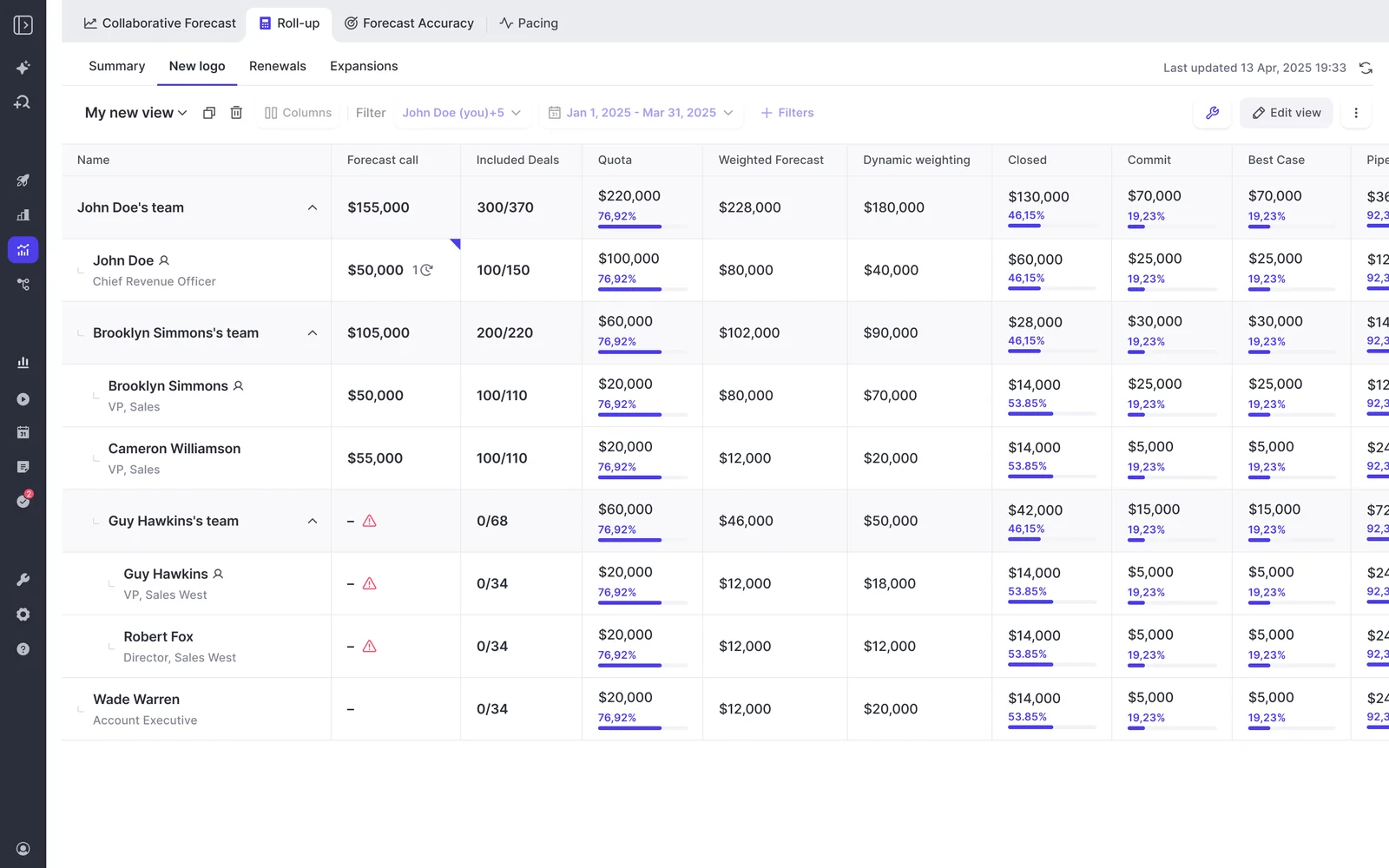
We run a separate forecast setup for each revenue motion
Weflow runs several forecast setups in parallel, one per motion, and each one is built on its own Salesforce amount field and its own date field. A renewal setup can be indexed on a contract or renewal date field instead of close date.
| What you set | Per motion (new business, renewal, expansion) |
|---|---|
| Amount field | Any opportunity currency field, not only standard Amount |
| Date field | Close date for new business, a renewal or contract date for renewals |
| Stage path | Each Salesforce record type keeps its own stages and forecast-category mapping |
| Roll-up | Independent per record type, with its own tab plus a combined view |
| Targets | Per-motion targets and one combined quota, both at once |
| Cadence | Its own submission deadlines, resubmission rhythm and lock |
| Object | The opportunity, or opportunity product line items for multi-year deals that book across periods |
The per-motion tabs plus the combined quota view answer "which motion missed." Weflow also has a renewal view that tracks contract end dates and fires a configurable renewal-kickoff milestone ahead of expiry.
Two limits matter here:
- Weflow doesn't offer consumption forecasting.
- Targets are amounts only, not logo or deal counts.

Reps call renewals as a baseline and best case on named deals
In Weflow, each rep submits a baseline and a best case. They can enter a total or select the specific opportunities behind each figure, and add a comment.
Here's how the rest of the roll-up works:
- Every submission is versioned, so you can see whether a renewal call moved during the quarter or never moved at all.
- Managers override at deal or total level, and each override is timestamped, attributed and logged with a rationale.
- A manager submitting for the team can pick any rep's deals.
The limits: you get two numbers, not a three-case churn view. Submission happens in the web app only, not from a phone or chat tool.
Weflow projects renewals from your own renewal history
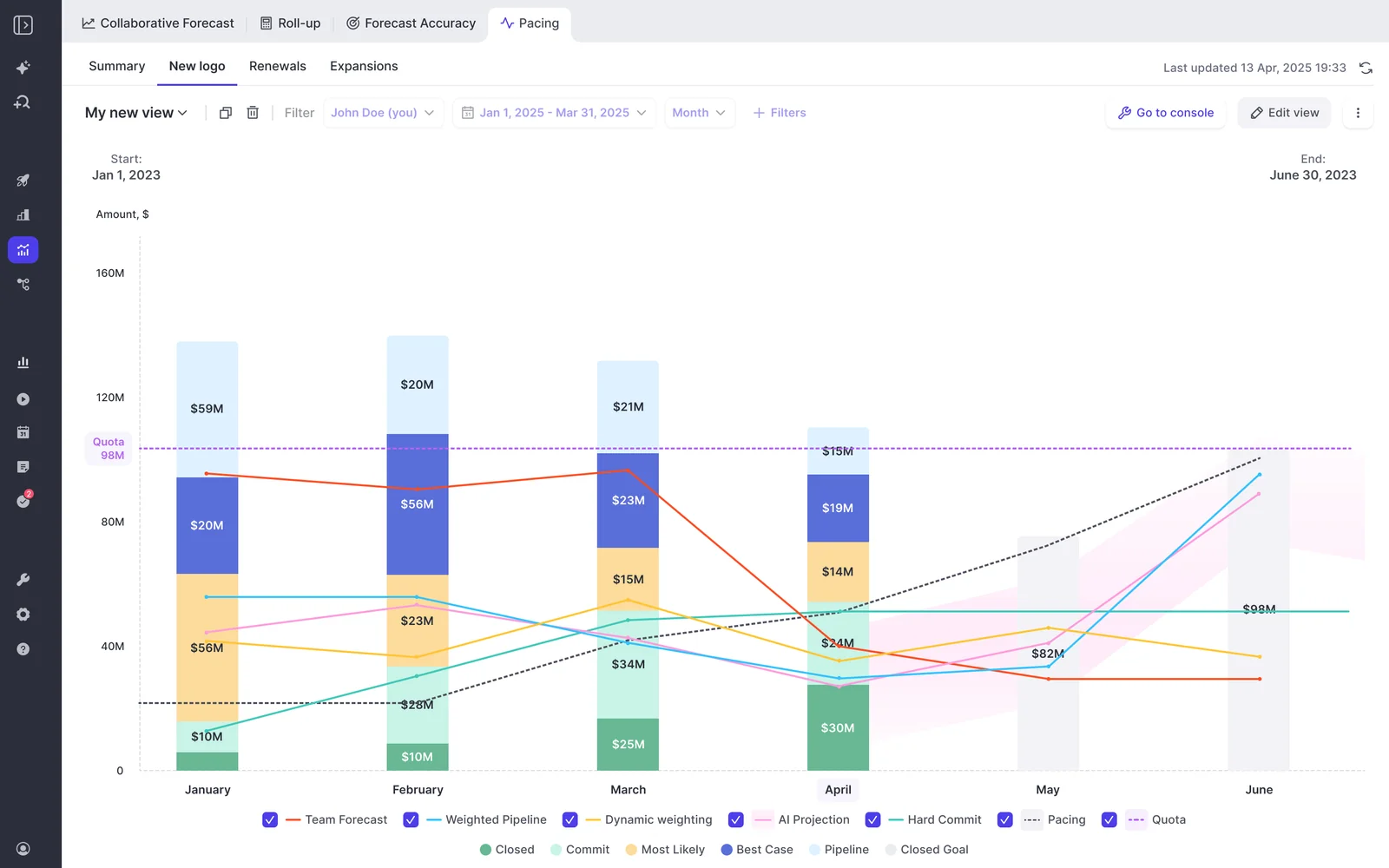
Weflow builds a separate AI model for each forecast configuration, so your renewal forecast is projected from renewal history and your new-business forecast from new-business history.
How the projection works:
- It reads more than fifty deal signals and returns a low, mid and high range.
- It needs six months of history. The Salesforce import at install brings in twelve months by default, so the first projection is ready within 48 to 72 hours.
- When it isn't confident in a range, it shows none and says why.
The weighted forecast fixes the early-stage renewal problem. Weflow recalculates each stage's win rate per motion from a rolling window, such as the last 90 or 180 days. A renewal sitting in stage one weights at the rate renewals actually close.
One limit: the projection doesn't yet adjust for ramping reps, so read a new hire's line with that in mind.
Weflow tracks renewal forecast accuracy without setup
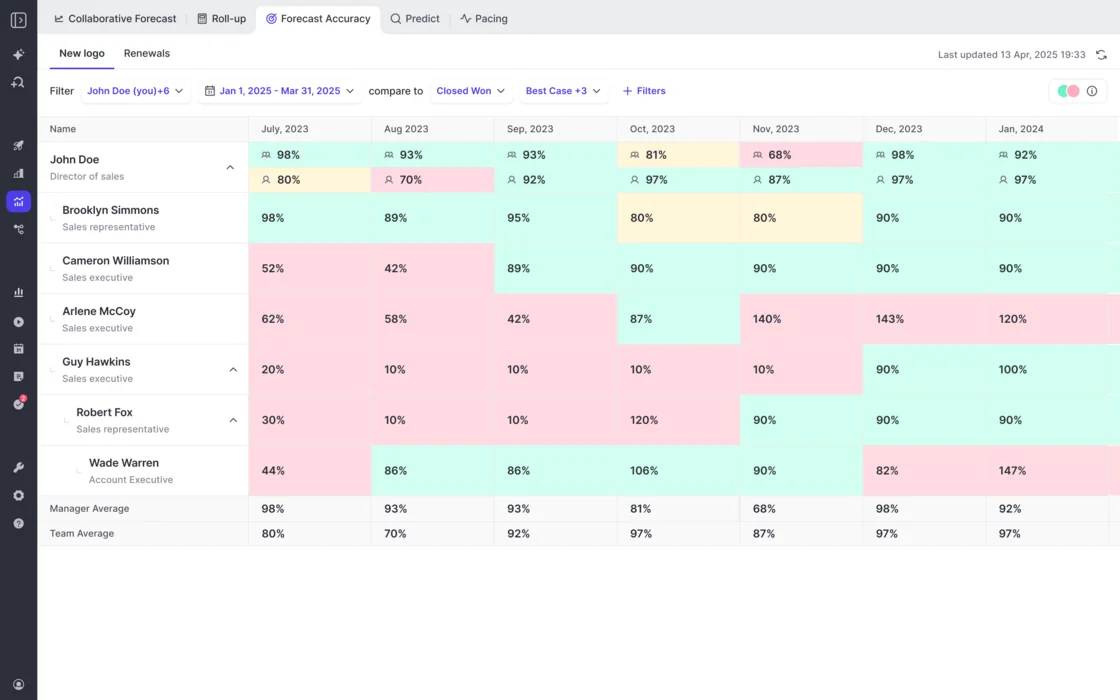
Weflow tracks forecast accuracy per period for every rep, manager and team, against a field your admin chooses, such as Closed Won. Every customer on the Forecasting module gets it without switching anything on.
Locked submissions make this work. Once a renewal call is fixed at a point in time, Weflow compares it with the outcome. You see who consistently sandbags and who's consistently optimistic, with no CSV export.
Weflow snapshots every opportunity every few hours
Weflow snapshots every opportunity every few hours. Those snapshots power the pipeline waterfall, close-date push counts and period-over-period views.
History before rollout comes from a 12-month Salesforce import. For custom fields, that imported history depends on Salesforce field history tracking having been enabled.
Weflow runs next to Salesloft Cadence without duplicate activity
Weflow does no sequencing, so it doesn't overlap with Cadence. Compatibility mode handles email: Weflow waits about ten seconds, checks each message for Salesloft's tracking pattern, and skips anything Salesloft already logged.
Our native integrations are Salesforce, Gmail, Google Calendar, Outlook, Zoom, Teams, Meet, Slack and the Outreach dialer. Weflow has no native Snowflake, Databricks or BigQuery connector, so warehouse teams move data through our API.
Weflow's MCP connector returns forecast calls and pipeline metrics
Weflow's official MCP connector is read-only. An admin switches it on per workspace, with a separate toggle for full transcripts.
It returns forecast calls plus per-rep pipeline metrics such as weighted pipeline, win rate, coverage and gap to forecast, with the opportunity IDs behind them. Per-rep breakdowns cap at 25 owners, so a large org gets aggregate answers unless you narrow the question to a team.
Forecast data lives in Weflow and reaches BI through the API
Forecast submissions, targets and roll-ups live in Weflow and aren't written to any Salesforce field. That's the exception in our product, since activity, transcripts and field updates all land in Salesforce.
BI and warehouse teams pull the roll-up through our public API, and submitted forecast calls are readable through the MCP connector. The weighted forecast and AI projection run off CRM data with no rep input.
What forecasting costs on Salesloft versus Weflow
Weflow publishes its prices. Salesloft publishes its package structure but no seat price for the Forecasting add-on: clari.com/pricing and salesloft.com/pricing both lead to a Talk to Sales booking page.
| Aspect | Salesloft (Clari Forecast) | Weflow |
|---|---|---|
| Pricing model | Two packages, Advanced and Elite, with paid add-ons on top | Per seat, with AI usage included. Agent Builder is the only consumption-priced product. |
| Published list price | None for seats or the Forecasting add-on | Weflow Deal Intelligence & Forecasting $39. Weflow Revenue AI Foundation $49, Weflow Revenue AI Business $59, Weflow Revenue AI Enterprise $79, per user per month |
| Where forecasting sits | The Forecasting add-on, on top of Advanced or Elite | Weflow Deal Intelligence & Forecasting standalone, or Weflow Revenue AI Enterprise. Weflow Revenue AI Business has Deal Intelligence without the forecasting layer. |
| What costs extra | Forecasting, Account Agent, Coaching Agent and Dialer add-ons. MCP comes with the agent add-ons. | Agent Builder beyond the free 25 actions a month: $299 for 500 actions, $999 for 2,500. No implementation fees. |
| Contract terms | Not published | 12-month term, 10-user minimum, no mid-term seat reduction. Seats can be reassigned when someone leaves. |
If you already run Weflow Activity & Contact Capture and Weflow Conversation Intelligence, we package the expansion into forecasting at roughly $10 more per user per month. That's designed for exactly the team that can't get a second forecasting contract past the CFO.
Where we'd tell you to stay on Clari Forecast
Clari Forecast is the better fit in these situations:
- You forecast renewals by logo. Weflow's forecasting is built on opportunities, with no account-level board that rolls renewal work up by customer. Clari's account module and Salesloft's account-based forecasting do this.
- Your existing-customer revenue is usage- or consumption-based. Weflow doesn't offer consumption forecasting. Salesloft's account-based Pace model was designed for exactly that revenue.
- You run a very large roll-up hierarchy. Clari's enterprise roll-ups at 1,000+ reps are more mature than ours.
- You need warehouse sync out of the box. Salesloft syncs natively to Snowflake and Databricks. We route through an API.
Three Weflow limits also matter before you move, whatever you decide about Clari:
- You forecast churn as a best, middle and worst case. Weflow captures two numbers, a baseline and a best case.
- Your targets are logo counts. Weflow targets are amounts only.
- Your rule is that every forecast number lives in a Salesforce field. Weflow keeps submissions in Weflow, so roll-up submission breaks that rule.
When to keep Salesloft Cadence and move the renewal forecast
If you run new logo, expansion and renewal as distinct deal-based motions on Salesforce, keep Salesloft for engagement and move the forecast layer. The Forecasting add-on is the line that goes, and Cadence stays.
Here's how the work splits:
| Job | Where it runs |
|---|---|
| Sequencing and cadences for SDRs | Salesloft Cadence |
| Dialer calls | Salesloft Dialer |
| Email Salesloft already logs | Salesloft, with Weflow compatibility mode skipping duplicates |
| New business forecast | Weflow, on close date |
| Renewal forecast | Weflow, on your renewal or contract date field |
| Expansion forecast | Weflow, with its own targets beside the combined quota |
| AI projection per motion | Weflow |
| Forecast accuracy | Weflow, without a BI export |
| Salesloft Forecasting add-on | Switched off |
FAQ: Salesloft renewal forecasting and switching the forecast layer
Does Salesloft set up renewal forecasting, or does our RevOps team?
Both, depending on the layer. Your admin configures the account segments that account-based forecasting runs on. Salesloft switches AI Forecast on per team after an engineering evaluation of your data.
In Weflow, your admin configures forecast setups, cadences, quotas and targets in the admin console. Technical setup takes 30 to 45 minutes, and teams reach full time-to-value in one to three weeks.
Can Salesloft forecast renewals by renewal date instead of close date?
Clari can't compare two date fields relative to each other, so views that depend on one date falling after another get hard-coded by quarter. Those views have to be rewritten each quarter.
Weflow indexes each forecast setup on whichever date field you choose. A renewal setup runs on renewal or contract date while new business stays on close date.
Does account-based forecasting replace an opportunity-based renewal forecast?
No. Salesloft's account-based forecasting sits beside the opportunity-based forecast, and Salesloft designed it for variable or consumption revenue. If your renewals are opportunities with their own stages, account-based Pace is a separate view.
How much history does an AI renewal forecast need?
Weflow needs six months of history per forecast configuration. The Salesforce import brings in twelve months by default, so the renewal projection is ready within 48 to 72 hours.
Salesloft's AI Forecast needs four quarters with at least 50 closed deals each, and it covers new business only.
How does Weflow log activity when renewal and expansion share an account?
Weflow prefers the opportunity where the contact holds an opportunity contact role. On accounts running a renewal and an expansion in parallel, the primary contact role is usually copied onto both, so that signal points at each of them.
The fix is configuration: separate lanes, one for the renewals team and one for everyone else, filtered on opportunity type or a close-date threshold.
Can we bring our Clari forecast history into Weflow?
Yes. Forecast calls your team submitted in Clari import into Weflow from Clari's API or a CSV.
The forecast setup itself gets rebuilt as Weflow forecast configurations. Opportunity history comes from Salesforce, so the AI projection doesn't wait on the import.
How do we avoid paying for two forecasting tools at once?
Start where you don't overlap. Land on Weflow Activity & Contact Capture and Weflow Conversation Intelligence, which sit outside your forecasting renewal.
Then expand into forecasting for roughly $10 more per user per month, timed to your Forecasting add-on decision. It also means the forecast runs on complete activity and call data from day one, which is what forecast accuracy depends on.
Who should own the renewal forecast so it doesn't stall again?
Name an internal owner before you sign, ideally someone who sits between RevOps and the renewal team. Tools without an owner stall on adoption even when every licence is assigned.
Admin self-service helps that owner keep the forecast current. In Weflow, adding a renewal target or changing a cadence is an admin setting, so it doesn't wait on a professional services ticket.