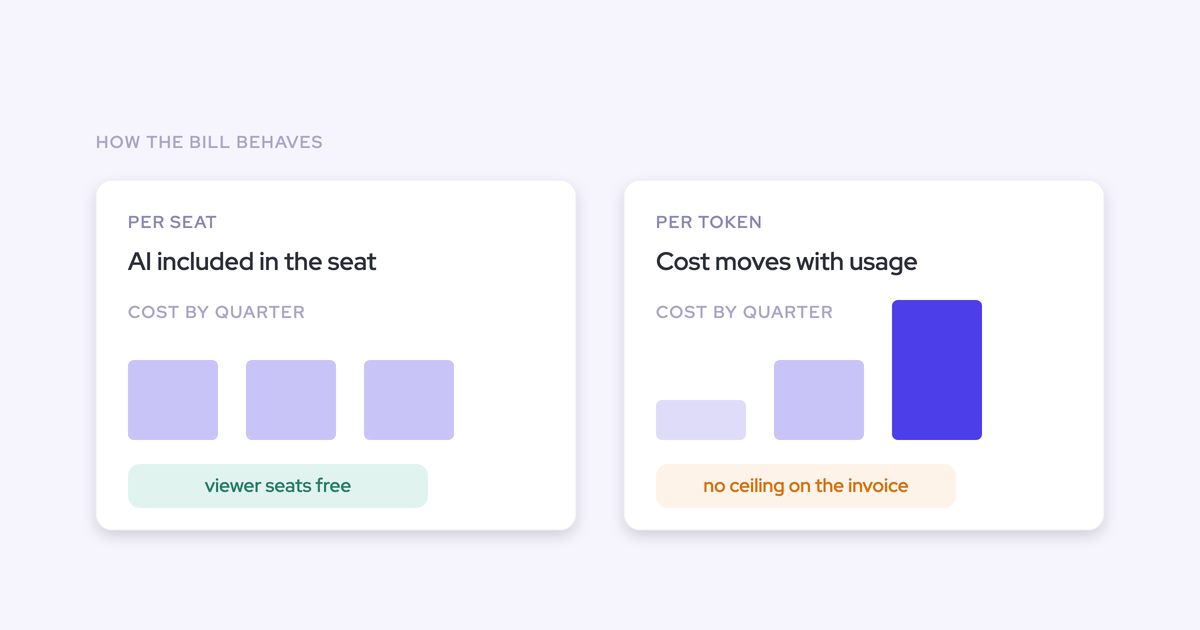

Two pricing models dominate revenue AI right now, and both fail the same buyer from opposite directions. A flat per-seat price charges full freight for the dozens of VPs, managers and RevOps people who open a dashboard on Monday and never log in again. Token-based AI pricing does the opposite damage: the invoice grows exactly as adoption succeeds, so the thing you bought the platform to achieve is the thing that blows the budget.
The people who genuinely live in a revenue platform are the reps and CSMs doing deal execution work every day. On most seat lists we see, they're the minority. Everyone else consumes output.
So this is a piece about contract structure, not features. What each model actually costs you as team composition and usage change, what a structure has to look like to get through finance, and how Weflow prices against those criteria, including the one place where Weflow does meter.
What seat-based and token-based pricing mean in revenue AI
Seat-based pricing charges a fixed price per licensed user, regardless of how much that user does with the tool. Token-based pricing, also called consumption or metered pricing, charges by AI usage measured in tokens, actions or credits, regardless of how many people are licensed.
The difference that matters in procurement isn't the unit. It's who carries the risk that usage turns out different from the plan.
| Seat-based | Token-based | |
| What you pay for | A licensed user, whether they work in the tool daily or never open it | AI consumption: tokens, actions, credits, agent runs |
| What's predictable | The annual total, known at signature | Nothing after the first invoice |
| What moves the bill | Headcount changes only | More users, more prompts, more automations, more success |
| Who carries usage risk | The vendor | You |
| Where it overcharges you | On the people who only consume output | On exactly the teams adopting fastest |
Most contracts on the market now are hybrids, and that's the part buyers get caught by. A per-seat number gets approved, then the AI arrives as a separate metered line on top of it.
Why RevOps buyers should vet pricing models before features
Because adoption and pricing have become the same question. A RevOps leader who has already paid for a tool the reps didn't use isn't asking what the product does first. They're asking who actually logs in.
We hear the arithmetic done out loud on calls, and it's never flattering to the incumbent:
That's the shelfware conversation, and it ends renewals. Forty seats kept alive as a background data feed is a full per-seat price for plumbing.
The second thing driving this is a bad memory of an itemized invoice. Budget gets approved on a per-seat number, then recording, storage, conversation intelligence and AI consumption show up as separate lines. Buyers who've been through that once now build the RFP to prevent it.
The questions that come before the demo:
- How many of your users log in weekly, at accounts our size?
- What is included in a seat, and what is charged separately?
- Which components are metered, and is there a ceiling?
- Will future AI features cost extra? Put it in writing.
- What does a read-only seat cost?
The unstated worry behind all of it is a vendor whose pricing model changes the moment AI becomes the product, leaving you renegotiating from inside a two-year term. A vendor who is vague here gets marked down on total cost before anyone looks at the product.
Where per-seat pricing overcharges: read-only seats and shelfware
One price for everyone charges full freight for people who never work in the tool. On a typical mixed population, that's a third of the contract buying value nobody collects.
The reps live in the platform. Leadership, managers, RevOps and product consume it, and they're counted in dozens.
What happens next is the part vendors don't model. The buyer cuts the viewer licenses to get the number down, and leadership ends up outside the system that runs the forecast. Then the weekly forecast call goes back to being a spreadsheet somebody assembles by hand.
Sales engagement platforms taught this lesson to a whole generation of RevOps teams. Sequencing gets bought for the BDR team, capture happens to work, the whole go-to-market org gets licensed, and most of those seats end up using two or three percent of what the product does.
Where the flat model quietly overcharges:
- Viewer seats at full price. A VP who reads one dashboard a week costs the same as an AE running eight discovery calls a day.
- Shelfware as a data feed. Seats nobody opens, kept live because switching them off breaks activity flowing into the CRM.
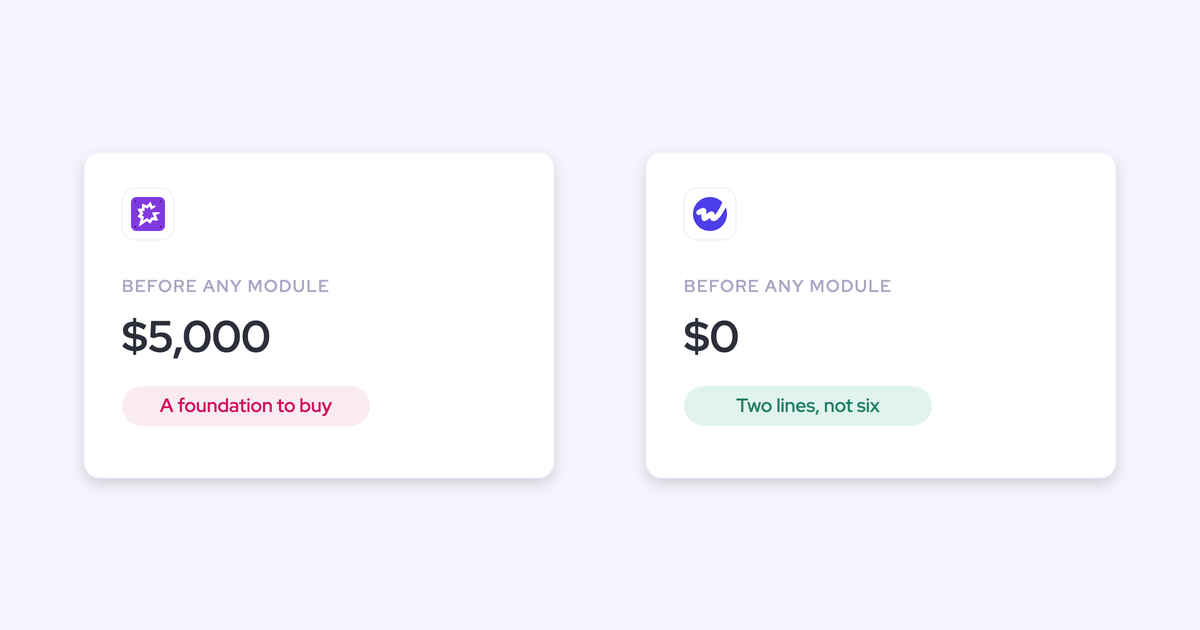
- Modules bundled into a foundation you can't opt out of. Gong's pricing starts from a high-priced foundation that has to be bought before any module is added, so you can't put most of your seats on a cheap capture tier and a few on the expensive intelligence tier.
- No way down. Seats are opex, and cutting opex is often the reason the team got smaller in the first place.
That last one is the question buyers now ask before signature, and they ask it plainly:
Why token-based AI pricing punishes the adoption it's funding
When AI meters, the invoice grows exactly as adoption succeeds, and somebody inside your company has to own that risk personally. Nobody volunteers.
So access gets restricted to a handful of people who can be trusted not to experiment. That is the opposite of a rollout. The tool never gets the usage that would prove its value, and every internal conversation about extending it becomes a cost conversation instead of a value one.
Finance closes the loop from the other side. An unpredictable line item is harder to defend than a larger predictable one, which is why "it depends on usage" is a reason to say no that has nothing to do with your product.
Some teams have already paid for the lesson before launch:
Here's what the same contract looks like at two points in the year under a meter.
| Month one, pilot group | Month nine, full rollout | |
| Seat line | Fixed, known at signature | Fixed, known at signature |
| AI line | Small, easy to wave through | Moves with every new user and every new workflow |
| Forecastable annual total | Yes | No |
| The internal conversation | "Let's see what it can do" | "Who really needs access to this?" |
| Who explains the variance | Nobody yet | You, to finance |
Two things made this the default rather than the exception. Legacy leaders set high seat prices when transcription was genuinely expensive, then bolted consumption pricing for AI on top of the existing seat, so the seat is a known annual number and the AI line is open-ended. Salesforce Agentforce went further and prices AI by tokens outright, with the data stored outside the CRM.
Credit where it's due: metering is honest engineering economics. Agents that read thousands of records and call models repeatedly do cost real money, and a vendor pretending otherwise is either capping you invisibly or pricing the risk into everyone's seat. The mistake is spreading the meter across the surfaces people use every day.
What a revenue AI pricing structure needs to survive finance
The structure that gets approved differentiates price by who consumes what, and confines metering to the one place it's genuinely justified. Hold any vendor, including us, against these seven.
- Differentiated seat types. Full seats for people who work in the tool, free or near-free seats for people who only read output. This is the direct fix for paying a rep's price for a dashboard watcher.
- Daily-use AI inside the seat. Summaries, field updates and ask-anything queries have to be unmetered, or your team learns to ration the features that drive adoption.
- Metering confined to genuinely usage-heavy products. Quarantine the variable cost in one line item instead of letting it float across the platform.
- A visible meter and a hard ceiling. Usage should stop at a tier boundary that someone has to explicitly buy past, so the conversation happens before the bill rather than after it.
- Published numbers. If you can't model the contract without a sales call, you can't compare it to the incumbent renewal sitting on your desk.
- Flexibility as composition shifts. Teams change shape every quarter. A structure that only supports growth is a structure that punishes you in the year you need to spend less.
- Modularity that matches a wave rollout. Pay for what's live now, expand into the next product when the next wave lands.
The buyer sentence that sums this up is one we hear almost verbatim, repeatedly:
How Weflow prices revenue AI: seats included, agents metered
Weflow is the Revenue AI Orchestration platform for sales, customer success, and RevOps teams, and it's priced per seat everywhere except one product.
Agent Builder is the only consumption-priced part of Weflow, because agents running scheduled work across thousands of records are the only thing in the platform that genuinely consumes tokens at scale. Everything else, including the AI surfaces people touch daily, sits inside the seat.
That split is deliberate. It means the variable cost is one quarantined line with a named ceiling, not a percentage of the contract nobody can forecast.
Full seats vs free viewer seats, reallocated quarterly
Weflow has two seat types, and only one of them costs money.
| Full seat | Viewer / analytics seat | |
| Who it's for | Reps, CSMs, AMs and managers who work deals in the platform | Leaders, managers, RevOps, product, enablement who only consume output |
| What it includes | Recording, conversation intelligence, coaching, pipeline and forecasting, depending on the product or bundle | Recordings, summaries, transcripts, pipeline views and analytics, read-only |
| Cost | Per user per month, billed annually | Free, unlimited |
Seats reallocate between the two types quarterly, as team composition shifts. A manager who moves into a pure reporting role stops consuming a full seat at the next quarter boundary, and the seat goes to whoever replaced them in the field.
Practically, it means the "do we cut the leadership licenses" argument never starts. Your CRO, your board-reporting analyst and the product manager who wants to know what customers said about pricing all get access without touching the paid seat count.
AI included in the seat vs what Weflow Agent Builder meters
Here's the split, stated plainly, because this is the line every RFP now asks a vendor to itemize.
| Included in the seat, no metering | Metered |
| Ask Weflow AI Pro, on every product and bundle | Agent Builder actions, priced per workspace |
| Unlimited recordings and transcripts | |
| AI summaries and follow-up email drafts | |
| AI field updates into Salesforce | |
| AI coaching scorecards and deal signals | |
| AI templates and prompts, unlimited | |
| Unlimited view-only licenses |
Ask Weflow AI isn't priced separately or metered. It ships with all three standalone products and all three bundles, governed by a fair use policy no customer has reached.
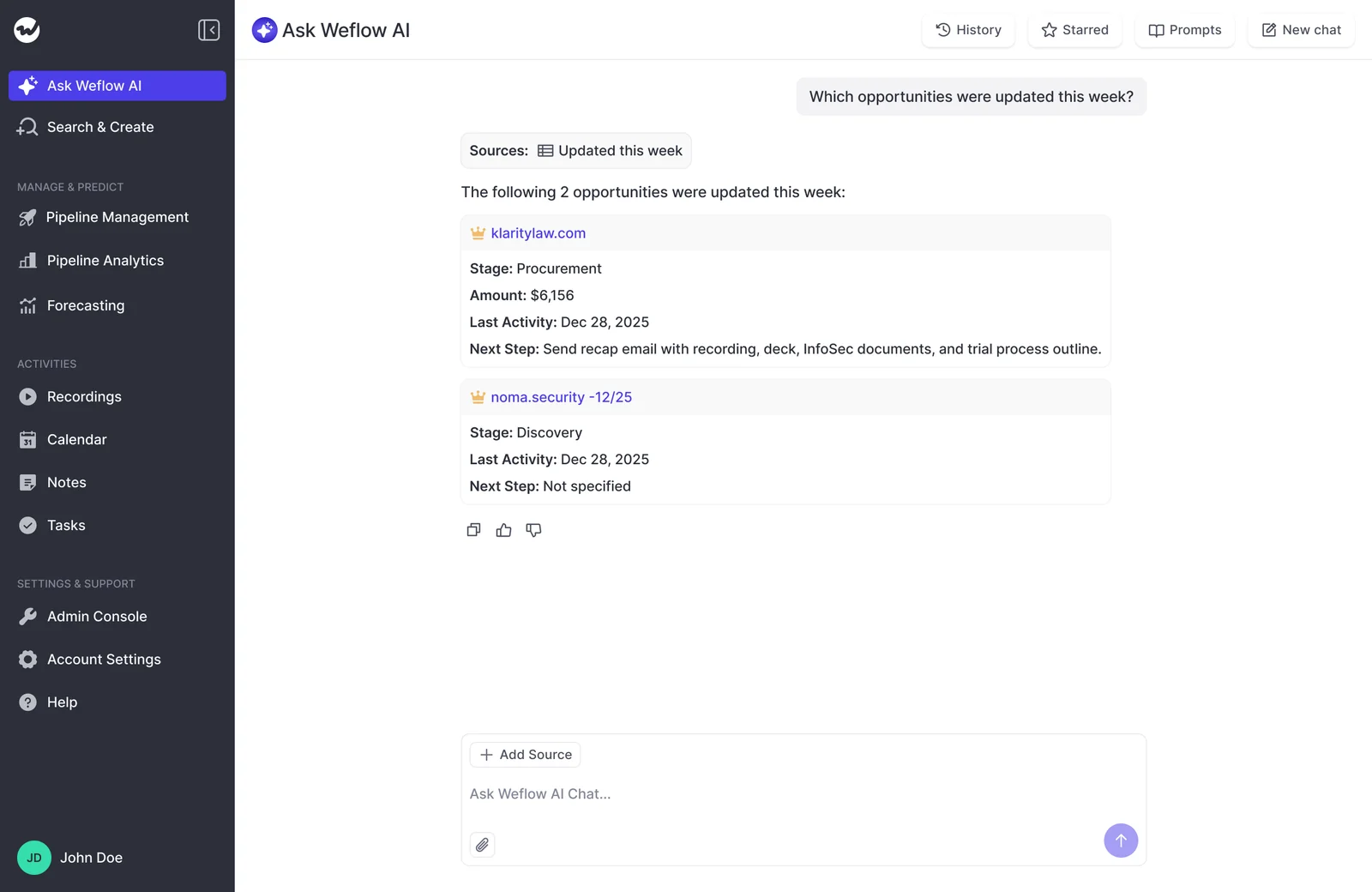
Agent Builder is the honest exception. It's priced per workspace rather than per user, in tiers with named action limits:
- Free: 25 agent actions per month, included in every Weflow plan and bundle
- Growth: $299 per month for 500 agent actions
- Scale: $999 per month for 2,500 agent actions
- Enterprise: custom package
Two things make that survivable for finance. The tiers are hard boundaries rather than an open meter, so crossing one is a purchase somebody makes on purpose. And because it's per workspace, adding 40 more users to the platform doesn't multiply the agent line.
Transparent Weflow pricing: standalone products and bundles
Weflow has list prices for three standalone products and three bundles, so you can model the contract before you talk to anyone. All prices are per user per month, billed annually.
| Plan | Price | What it covers |
| Weflow Activity & Contact Capture | $19 | Auto-sync of emails, meetings and contacts into Salesforce, activity insights and reports |
| Weflow Conversation Intelligence | $39 | Recording, transcription, AI summaries, AI field updates, coaching scorecards, Mobile Copilot |
| Weflow Deal Intelligence & Forecasting | $39 | Deal grids, 50+ AI deal signals, pipeline analytics, roll-up forecasting, forecast accuracy tracking |
| Revenue AI Foundation | $49 (save 16%) | Activity & Contact Capture + Conversation Intelligence |
| Revenue AI Business | $59 (save 17%) | Foundation + Deal Intelligence: boards, AI deal and account scoring, warnings, buying committee intelligence. No pipeline analytics or forecasting |
| Revenue AI Enterprise | $79 (save 19%) | Business + the full pipeline analytics and forecasting layer |
Every plan and bundle includes Ask Weflow AI Pro and Agent Builder on the Free tier.
The reason the modularity matters is blocked renewals. If a CFO has already signed a forecasting contract, you cannot buy a second one, so you start on the capability the team doesn't own and expand later for $10 to $20 per user per month rather than opening a new procurement cycle for a forecasting tool at $100 to $200 per user per month.
On discounts: volume tiering applies, with the meaningful breakpoint starting around 30 to 40 seats. Multi-year terms take 10% off for two years and 20% off for three. There are no platform fees and no implementation fees.
Contract terms to know: minimums, billing, reallocation limits
The fine print, before you find it in a redline:
- Minimum 10 users. Below that, Weflow isn't the right purchase.
- Annual billing, on terms of twelve months or longer. Monthly billing isn't offered, and the better pricing sits on multi-year.
- Quarterly seat-type reallocation is not a right to reduce your licence count. It moves seats between full and viewer as your team changes shape. It does not shrink the contract mid-term. If a break clause or a right to hand back a percentage of licenses at renewal is your hard requirement, name it in the RFP and negotiate it, because you should not assume it.
- Agent Builder is consumption-priced. A team running heavy agent automation carries a variable line there. Weflow's answer is a visible meter and hard tier boundaries, not "no metering anywhere."
- Trial and pilot options exist for evaluations a demo can't settle. There's a 14-day free trial with guided onboarding, and for forecasting evaluations that need a full cycle, a three-month paid pilot that is contractually the first three months of a multi-year agreement with an opt-out at the end of it. Real exit, small bill.
- Not FedRAMP certified. If you're a US government contractor with that mandate, this isn't a fit, and no pricing structure fixes it.
Pricing questions to put in writing before you sign
Every risk above turns into a written question. These are vendor-agnostic. Send them to us and to whoever we're up against.
- Itemize what's in a seat and what is charged separately. Because the invoice you don't want is the one that arrives with recording, storage, conversation intelligence and AI consumption on separate lines after a per-seat number was approved.
- What does a read-only or viewer seat cost, and what can it do? Because a third of your names only consume dashboards, and you shouldn't be choosing between paying full price for them and locking leadership out.
- Which components are metered, in what unit, and what's the ceiling? Because "it depends on usage" is not something finance can approve.
- Will future AI features be subject to additional fees? Get it in writing. Pricing models change fastest when AI becomes the headline product.
- Are recordings, transcripts, storage and AI processing capped in any way? Because an invisible cap is a meter you find out about in month seven.
- Where does volume discounting start, and what's the multi-year structure? So you can tell whether the price improves at the seat count you're actually going to hit.
- Can we pay for live seats in a phased rollout rather than the full planned count on day one? A vendor who insists on all seats at signature has never run a wave deployment across business units with separate P&Ls.
- What happens if the team shrinks? Ask for the mechanism explicitly: break clause, a right to reduce a percentage at renewal, or a short opt-out window. Assume nothing.
- Model it against the incumbent in real dollars, including the AI line. A seat-plus-consumption contract and a fully bundled seat price look similar in month one and diverge sharply by month nine.
Those questions get answered fastest live, against your own numbers and your own seat mix. See how Weflow captures activity, updates Salesforce fields from calls, and rolls up your forecast. Book a 30-minute demo.
FAQ: seat vs token pricing for revenue AI
Is Ask Weflow AI usage metered or capped?
No. Ask Weflow AI Pro is included with all three standalone products and all three bundles, with no metering and no per-prompt charge. Usage sits under a fair use policy that no Weflow customer has yet reached, so the conversation about who is allowed to ask questions never happens.
What happens when Agent Builder hits its action limit?
Usage stops at the tier boundary. Every Weflow plan includes the Free tier at 25 agent actions per month, and moving to Growth ($299 per month, 500 actions) or Scale ($999 per month, 2,500 actions) is an explicit purchase rather than an overage. That's the difference between a ceiling and a meter: you decide to cross it, and you know the price before you do.
Do recording, transcripts, and storage cost extra in Weflow?
No. Recordings, transcripts, AI templates and prompts are included in the seat with no usage caps, and there are no platform or implementation fees. If you're moving off another conversation intelligence tool, Weflow imports the existing recordings and transcripts through that platform's API at no extra cost, typically in one to two weeks depending on volume, so your call history doesn't stop dead at the cutover.
Where does volume discounting start on Weflow seats?
Volume tiering applies, and the meaningful breakpoint starts around 30 to 40 seats. Multi-year terms carry 10% off for two years and 20% off for three. Published prices are list prices, and final pricing is quoted, so a deployment of a few hundred seats lands well below the numbers on the pricing page.
How does Weflow pricing fit a phased, wave-based rollout?
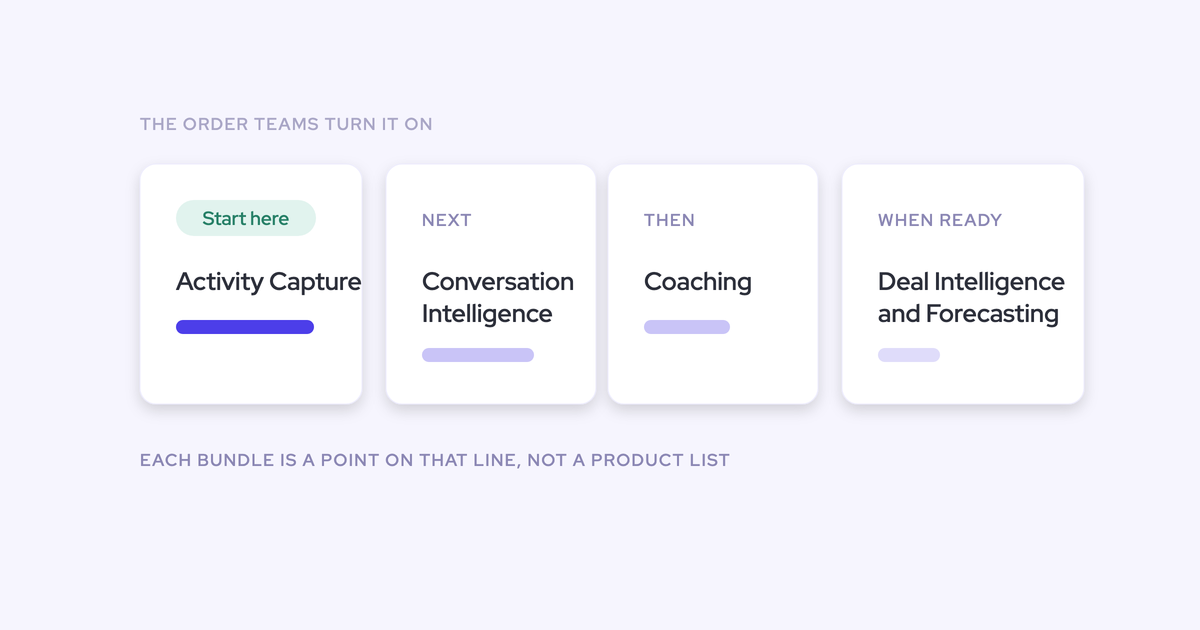
Buy the product the current wave needs, not the platform your third wave will need. Most teams start on Activity & Contact Capture and Conversation Intelligence, because those make a rep's life easier without asking anything of them, then add Deal Intelligence and forecasting once that's stuck. Unlimited free view-only licenses mean leadership can watch wave one without consuming paid seats, and quarterly reallocation handles the composition shift between waves. The floor to be aware of is the 10-user minimum on annual billing.