Revenue AI Orchestration vs Revenue Intelligence: What Actually Changed
Learn how Revenue AI Orchestration differs from Revenue Intelligence and what changed in the data layer.




Every revenue intelligence deck you've seen this year claims the same AI feature set. Call summaries, deal scoring, an assistant you can chat with, agents. The feature grid is useless for telling these vendors apart.
The convergence is real at the feature layer and it never happened at the architecture layer, which is the layer that decides whether your data is duplicated across three vendor clouds or sitting in one record your own reporting can read.
That gap is what the phrase revenue AI orchestration is supposed to name. Weflow is the Revenue AI Orchestration platform for sales, customer success, and RevOps teams, so we have an obvious stake in the label sticking.
Which is why this piece hands you the test rather than the pitch: one question that separates a genuinely unified platform from acquired apps sharing a brand, and four honest paths if you already own the old category, including the two that don't involve replacing anything.
Why every revenue intelligence tool now looks the same
The convergence is structural, not coincidental. It's the predictable output of a category built before the model wave, grown by acquisition, and then hit by a cost collapse that made the same features cheap for everyone at once.
The chain runs in this order:
- Pre-AI foundations. First-generation revenue intelligence was databases and dashboards. Capture the activity, roll it up, render it. AI arrived later and got bolted onto that shape.
- Growth by acquisition. Clari bought Wingman in 2022 and rebranded it Copilot, added Groove in 2023, and merged with Salesloft on 3 December 2025 under CEO Steve Cox, creating a business of roughly $450 million in ARR across more than 5,000 customers. Four applications, four data models, four release cycles.
- The cost collapse. Transcription and inference got dramatically cheaper. Gong set its pricing when transcription was expensive; today the same capability carries a structurally lower cost base.
- Feature convergence. Once transcription and extraction were cheap, every vendor shipped summaries, scoring, and an assistant. The grid flattened.
- Fragmented data. None of it changed where the data lived. It stayed in vendor clouds, and inside acquisition-built suites it stayed in separate products that don't read each other.
Step five is the one you feel. Clari's forecasting product and Clari Copilot don't talk to each other, so call data doesn't inform the forecast even though both came on the same invoice. Customers who own both end up piping transcripts into a separate AI workspace and feeding the output back to the CRM by hand.
Credit where it's due. Gong invented conversation intelligence and still has the deepest conversation analytics in the category, including methodology summaries across every call on an account rather than call by call. Clari's enterprise roll-ups above a thousand reps are more mature than anything a challenger ships. Those are real, and neither one fixes the data layer.
The other half of what you're feeling is the pace. When the AI everyone else shipped doesn't arrive in the tool you already own, the reason is usually that the module in question was acquired near the point its innovation stopped.
What is revenue AI orchestration?
Revenue AI orchestration is an architecture, not a feature set: one unified data layer that capture, intelligence, and action all read and write, with the data landing in the customer's own CRM rather than the vendor's cloud.
The architecture has three named layers, and they only work in order:
- System of truth. The complete record of what actually happened: emails, meetings, contacts, calls, transcripts, CRM fields, all joined to the same account and opportunity.
- System of intelligence. What gets inferred from that record: deal health, methodology coverage, risk, coaching, the forecast call.
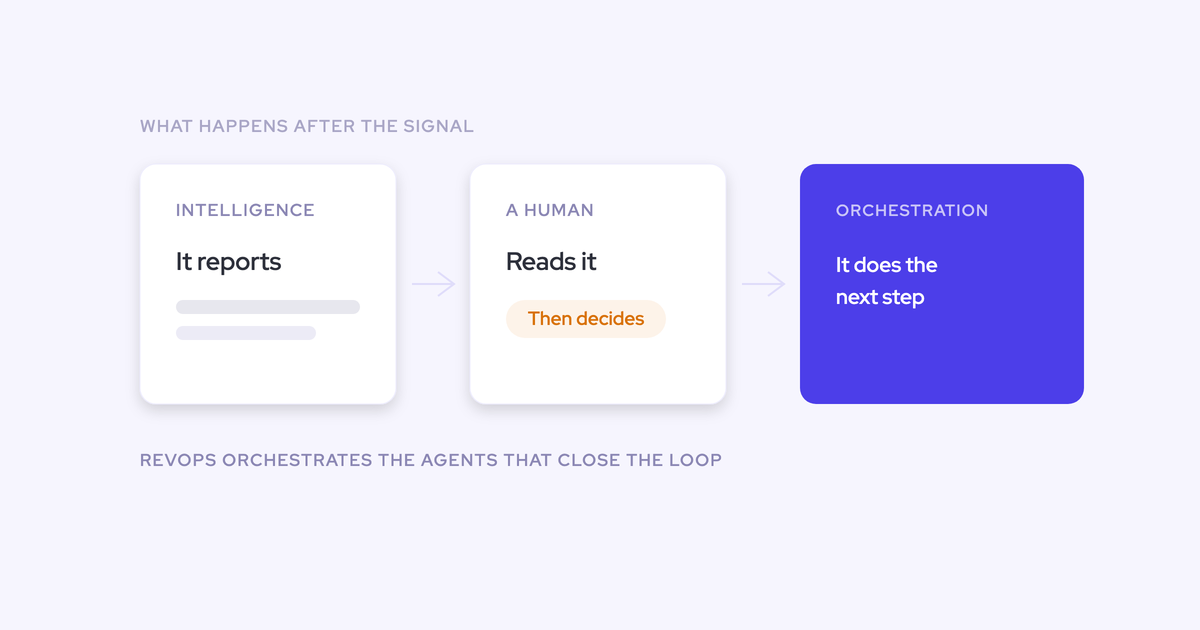
- System of action. What gets done about it: a field write, a nudge to the owner, a drafted follow-up, an agent run. Whether a human or an agent takes the action stays your governance decision.
"The killer use case is taking unstructured data, structuring it, and just basically bringing different context data together so that you have a system of truth, a system of intelligence, and a system of action. And whether the action is then taken by an agent or by a human is a decision that you need to make."
Janis Zech, CEO and Co-founder of Weflow
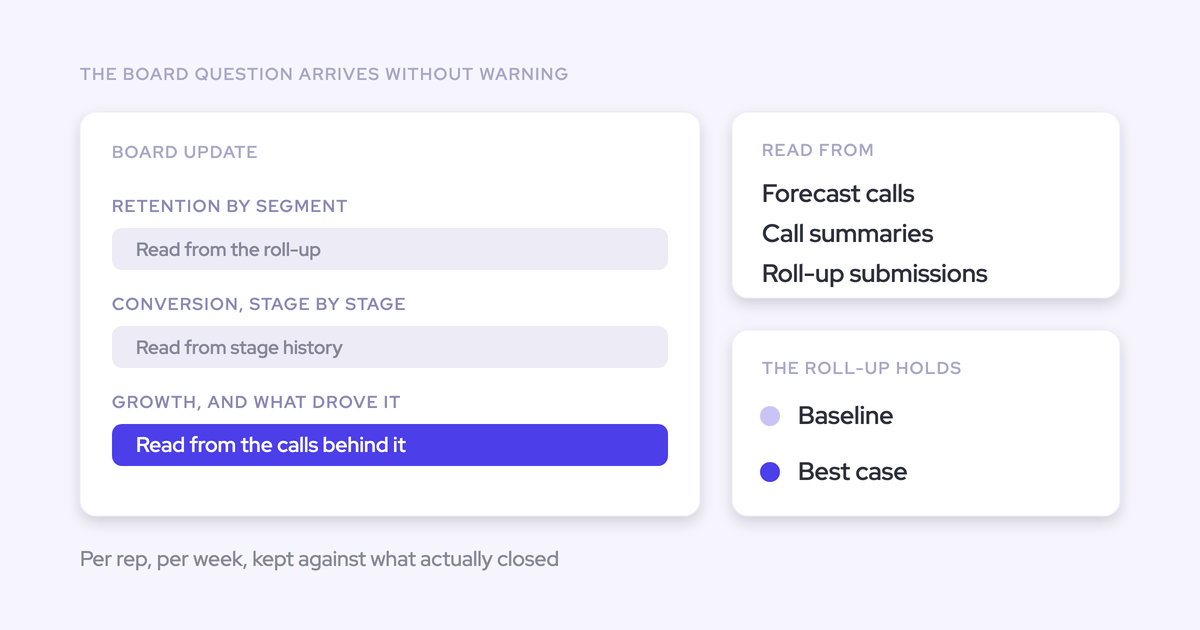
The reason the layers matter is that the bottleneck moved. Analysis is solved and commoditized: any team can get a recording, a transcript, and a competent summary for very little money.
What's still unsolved is unification and action, which is exactly what a category built as databases and dashboards was never architected to do. Intelligence bought on top of data that was never captured has no foundation under it, and an agent reasoning over an incomplete record just returns fluent guesses.
Revenue intelligence vs revenue AI orchestration: the architecture gap
The two categories diverge on five things, and features aren't one of them.
| Dimension | Revenue intelligence (first generation) | Revenue AI orchestration |
|---|---|---|
| Where the data lives | The vendor's cloud, mirrored to the CRM at best. Leaving means leaving the history behind. | Native CRM objects you own, written as it happens, readable by your own reports and automations. |
| How the products relate | Separate applications sharing a brand and an invoice. Conversation intelligence and forecasting often can't read each other. | One platform where every product reads and writes the same record, so a call outcome reaches the deal without a manual join. |
| How the AI arrived | Added on top of a pre-AI database once the model wave hit. | Built with AI in the extraction path from the start: transcript to structured field, not transcript to text box. |
| What sits between modules | A BI tool or an AI workspace where RevOps rebuilds the join by hand every cycle. | Nothing. The join is the shared data layer. |
| What the output is | A dashboard a human still has to read, interpret, and act on. | An action on the record: a field updated, an owner nudged, a follow-up drafted, an agent run on a schedule. |
| Who can change it | Professional services. A new quarterly target or a changed roll-up is a ticket, and it's billed. | Your admin, in the console, with templates and mappings you configure. |
The overlay problem shows up in small, expensive ways. Clari can't calculate a field, so any derived metric has to be built as a Salesforce formula field first. It also can't compare two date fields relative to each other, so a view that needs contract start date to fall after close date gets hard-coded by quarter and quietly stops being correct when the calendar moves.
You end up creating Salesforce fields whose only purpose is to make a column in another tool possible. That's CRM debt created by the reporting layer.
The one question to ask every revenue AI vendor
Ask this: do your products read one data layer, and does that data live in my CRM or your cloud? A vendor with six integrated products and a vendor with six acquired products look identical on a feature grid and behave completely differently in production, and the difference only surfaces after you've signed.
Then verify it in the demo rather than taking the answer. Checks that work:
- Name the Salesforce object each product writes to, out loud, in the session. If two products can't name the same object, they aren't sharing a data layer.
- Ask whether the forecasting product can filter on a field the conversation intelligence product produced. Ask them to do it live.
- Ask what happens when Wednesday's call contradicts what Monday's call wrote into a field. Gong's AI, for example, offers no control over overwrite versus append, so the CRM holds whichever answer arrived last, which is worse than an empty field for anything a routing rule depends on.
- Ask whether AI write-back covers custom objects and respects validation rules, field dependencies, and role hierarchy. Gong's AI writes back to standard objects only.
- Ask who changes the forecast roll-up when you reorganize next year: your admin, or their professional services team on a two-week turnaround.
- Ask whether the capture engine and the notetaker both write the meeting. If they do, you get two meeting records for one customer conversation, and meetings per rep is double counted from day one.
One more signal, and it's the cheapest to read. When every vendor claims everything, the credible ones name their own edges first. A vendor that's equally good at everything has told you nothing you can check.
Four paths for teams that already own revenue intelligence
There are four honest paths here, and the right one is decided by your renewal position and your constraints, not by which category has the newer name. Three of them are legitimate answers even if you fully agree with the architecture argument above.
Renew the incumbent and stay put
Staying is the right call more often than vendors admit. If a private equity sponsor has standardized the tool across the portfolio, the decision wasn't made in your company and you won't win that fight in year one.
The second case is a mature forecast. Getting a forecasting tool genuinely running takes twelve to eighteen months of hierarchy agreement, field building, and roll-up reconciliation, and an honest evaluation of any replacement lands at roughly 80% of what you have. The missing 20% is the specific stuff you built over time: splits, dual date logic, one particular roll-up.
When it doesn't fit: when your actual complaint is the data layer. Renewing changes nothing underneath, and next year you'll be having this same conversation with a year less runway.
Coexist: keep the incumbent, own the data layer
This is the partial move, and it's the one most locked-in teams should make. Clari reads activities from Salesforce, so you can run a separate capture infrastructure that writes clean activity and contacts into the CRM, and Clari consumes better data than it had before. The incumbent gets more accurate and you own the layer underneath it.
It also clears the internal blocker that kills consolidation pitches.
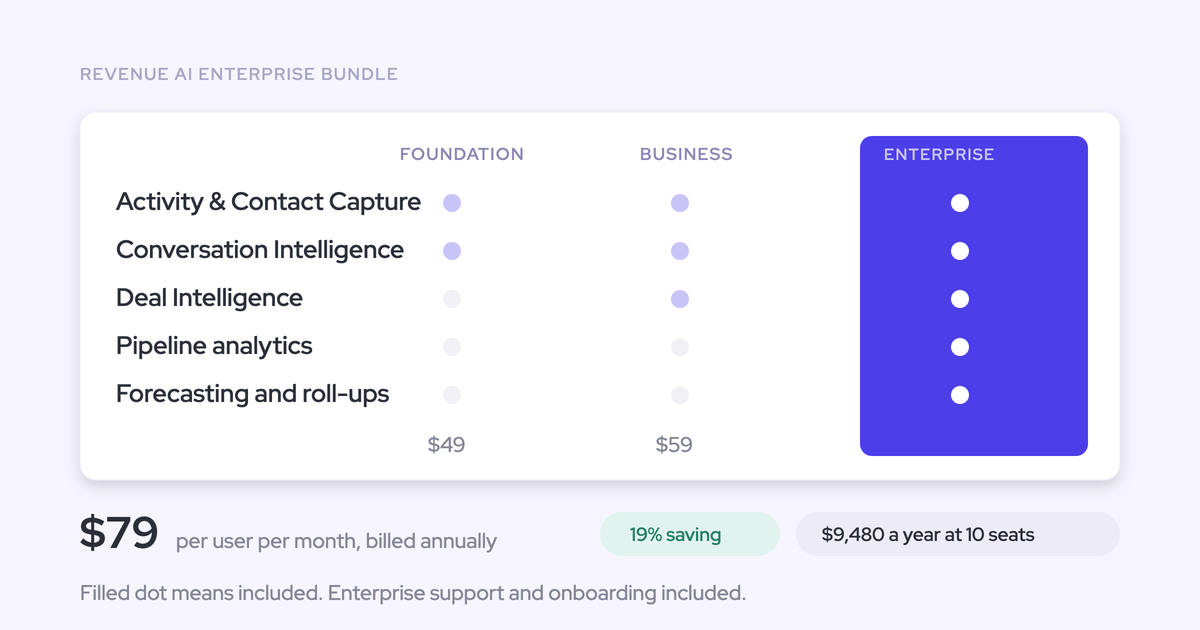
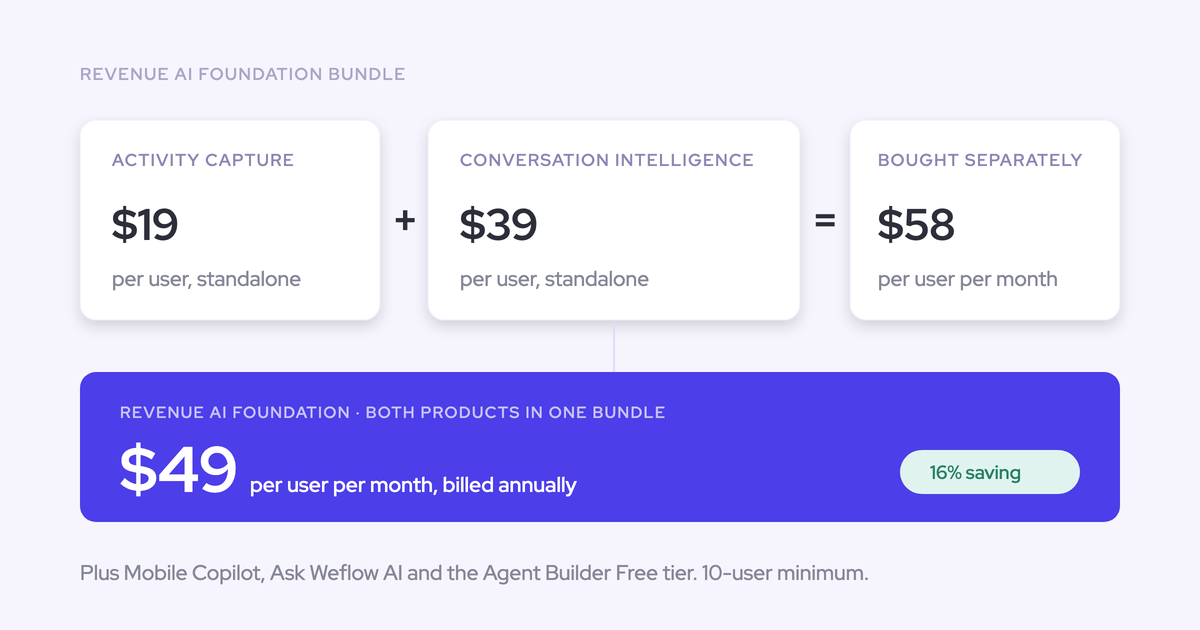
Capture isn't a second forecasting line item, so it doesn't collide with a signed contract. Weflow Activity & Contact Capture starts at $19 per user per month, or $49 bundled with Weflow Conversation Intelligence as Revenue AI Foundation, which is a number that clears internally without a new procurement cycle.
The implementation note that matters: run one capture engine, not two. Turning on both the incumbent's capture and a new one duplicates activity in Salesforce, and the duplication poisons exactly the reporting you're doing this for. Coexistence works. Parallel capture doesn't.
Consolidate onto a revenue AI orchestration platform
Nobody rips out a platform because they're bored with it. They do it at renewal, because that's the month they have leverage. If your renewal is within two quarters and capture, conversation intelligence, and forecasting are all in play, this is the window.
What makes it approvable internally isn't the product argument. A tool swap competes against your own delivery backlog, not against the incumbent vendor, so it stalls the moment it arrives as a co-project needing RevOps hours during a busy quarter.
The version that gets signed sounds like: this vendor has migrated customers off the incumbent before, it runs as a managed service on a fixed timeline, it solves a pain we already have, here's the price. Weflow implementations run in three phases and typically complete in two to three weeks, with the technical setup a single session with your Salesforce and mail admins.
Handle the archive up front, because it's the real hostage. Recordings from Gong, Chorus, Jiminny and others import via an API key and get re-linked to the right Salesforce records automatically, with our own lookup matching where the provider's API doesn't carry the association. A Gong migration takes about a week. Activity backfills up to 24 months as standard, up to three years on request.
When it doesn't fit: mid-contract, or when the accumulated forecast configuration is genuinely the thing the business runs on.
Build your own stack with AI coding tools
The weekend rebuild is real and it deserves a straight answer rather than a flinch.
The prototype isn't the hard part any more, and pretending otherwise insults the reader. The hard part is ownership: the data model, opportunity snapshotting, permissions, hierarchy roll-up, the integrations, all of it staying correct while you also run the business. You're not comparing build cost to license cost, you're comparing owning a second product to owning none.
Where it fits: engineering-heavy teams with a narrow internal reporting need, and extensions rather than platforms. A Salesforce flow, an Apex customization, a dashboard nobody else depends on. Where it stops fitting is the day the thing you built has users, an on-call expectation, and a backlog.
How to choose between staying, coexisting, consolidating, and building
Five criteria decide this: renewal timing, who standardized the incumbent, how mature your forecast configuration is, whether the data layer is your actual complaint, and your appetite for maintenance.
| Your situation | Best-fit path | The reason |
|---|---|---|
| Contract locked for 9+ months, sponsor or leadership standardized the incumbent | Coexist and own the capture layer | No collision with a signed line item, and the incumbent gets better data while you build the foundation you'll need either way. |
| Renewal within two quarters, capture and conversation intelligence both weak | Consolidate at renewal | Renewal is the only month you have leverage, and one platform on one data layer removes the manual join between modules. |
| Mature forecast the business runs on, no complaint about the data underneath | Renew and stay put | Parity lands around 80%, and switching on forecasting alone trades a working process for a lateral move. |
| Engineering-heavy team, one narrow internal reporting gap | Build, and keep it narrow | An extension is cheap to own. A platform rebuild becomes a second product with a maintenance bill. |
| Already prototyped a replacement and liked it | Buy the data layer, build extensions on top | The prototype proved the requirement, not the roadmap. Buying the capture and intelligence layer leaves your team building what's specific to you. |
Whichever row you're in, the first move is the same: own the unified data layer in your CRM before you buy another intelligence layer. It's the one piece every path needs, the one thing the old category structurally cannot give you, and the precondition for any AI output you'd actually trust.
And don't make this decision on forecasting parity. That axis is a counterweight, never the reason. The decision gets made on what the incumbent can't do at all, which is almost always turning conversations into structured CRM data the rest of the stack can read.
How Weflow is architected for revenue AI orchestration
Weflow instantiates the three layers on one data layer in your own Salesforce objects, built in-house as one platform rather than assembled from acquisitions. Here's how it maps, and where it doesn't hold up yet.
System of truth. Weflow Activity & Contact Capture syncs emails, meetings, and contacts to the right Salesforce records, creates missing contacts, and sets opportunity contact roles. Weflow Conversation Intelligence records and transcribes the conversation and writes the summary onto the meeting activity that already exists, so you don't get two meeting records for one customer call.
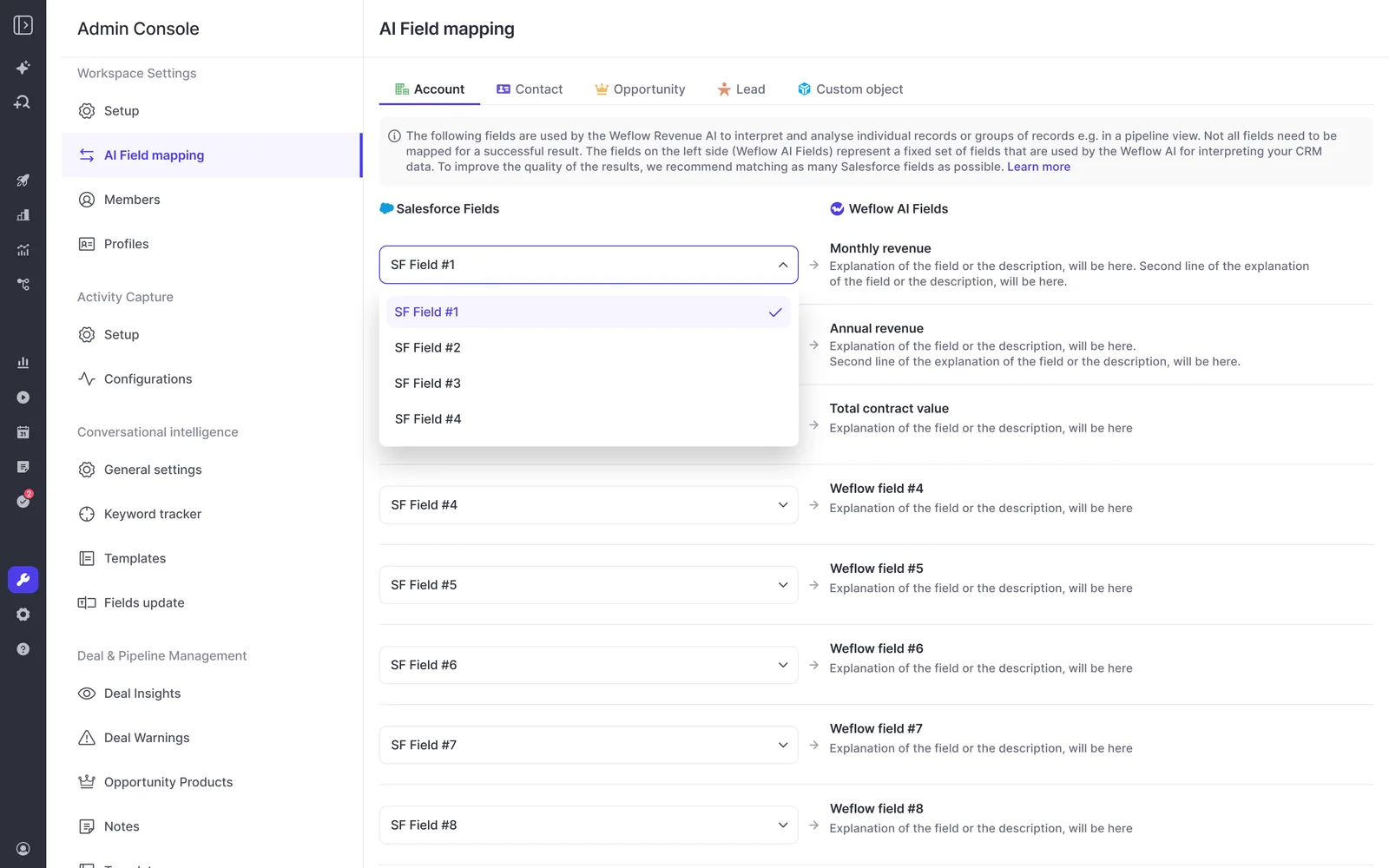
System of intelligence. AI Field Updates extract structured data from transcripts and write it into specific Salesforce fields, including custom objects, with MEDDIC, MEDDPICC, SPICED, BANT and custom methodologies covered by 250+ pre-built prompts. Validation rules, field dependencies, permissions and role hierarchy are respected as they are, and admins map the fields themselves rather than filing a ticket.
Because those writes land on the record, Weflow Deal Intelligence & Forecasting reads what the call produced without anyone rebuilding the join in a BI tool. That's the whole architectural claim in one sentence, and it's the one to test in a demo rather than believe here.
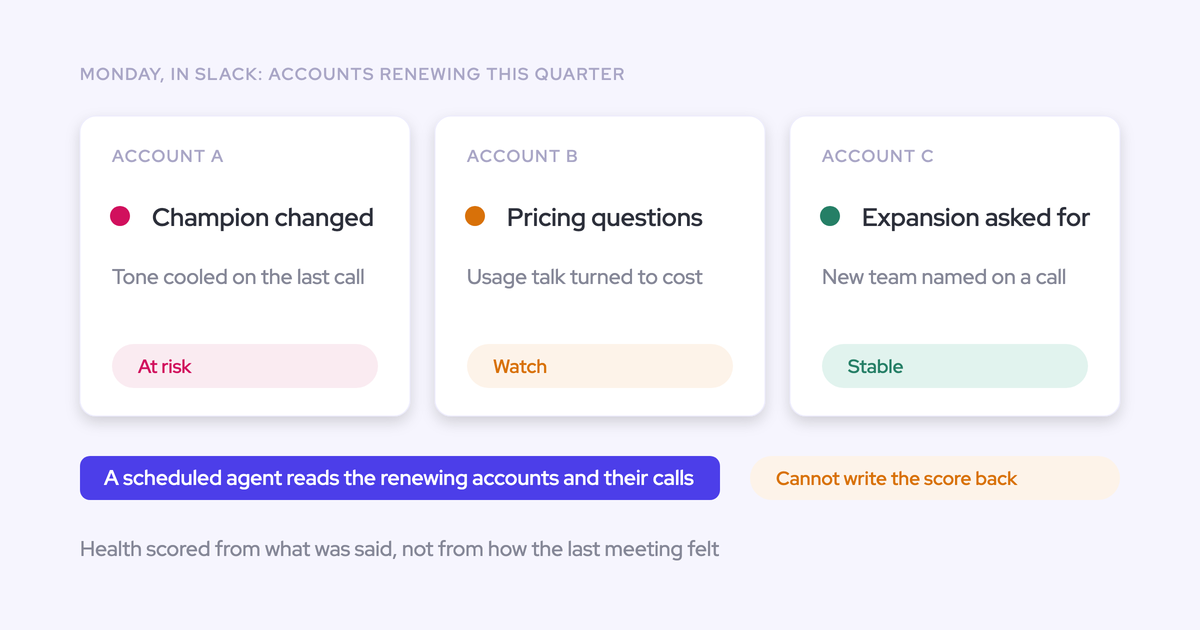
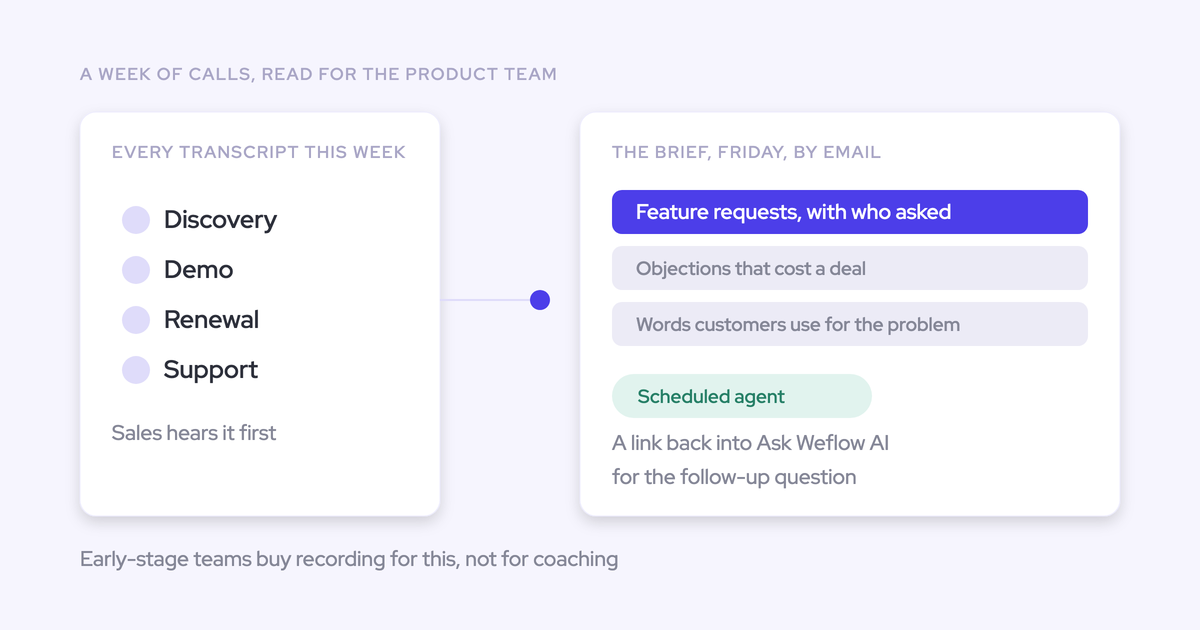
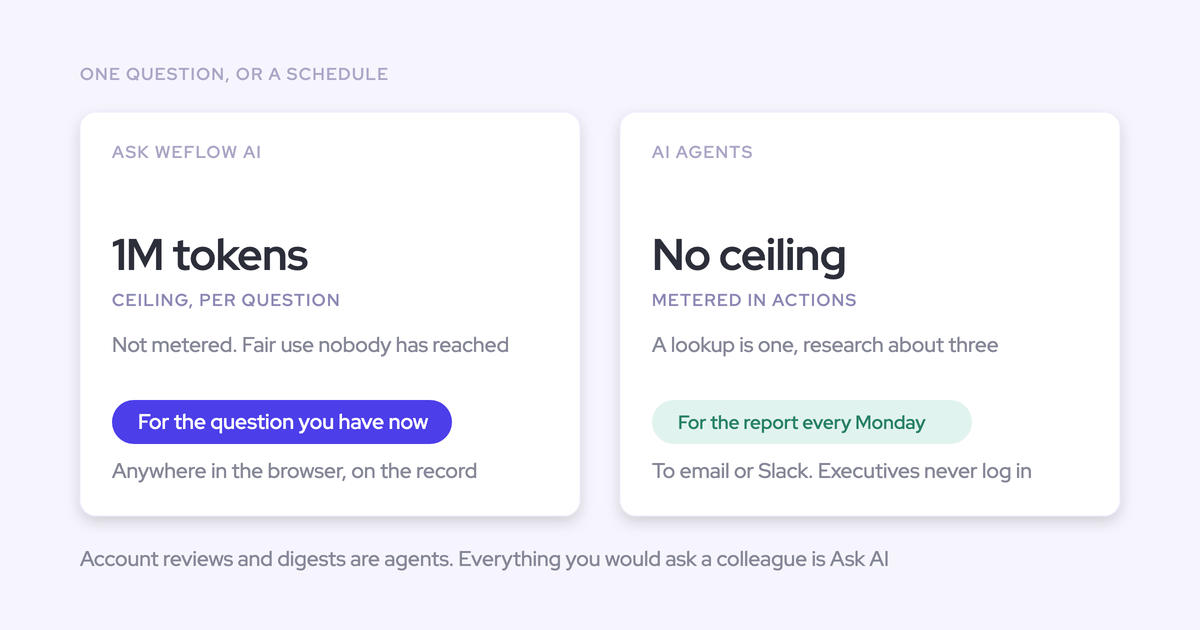
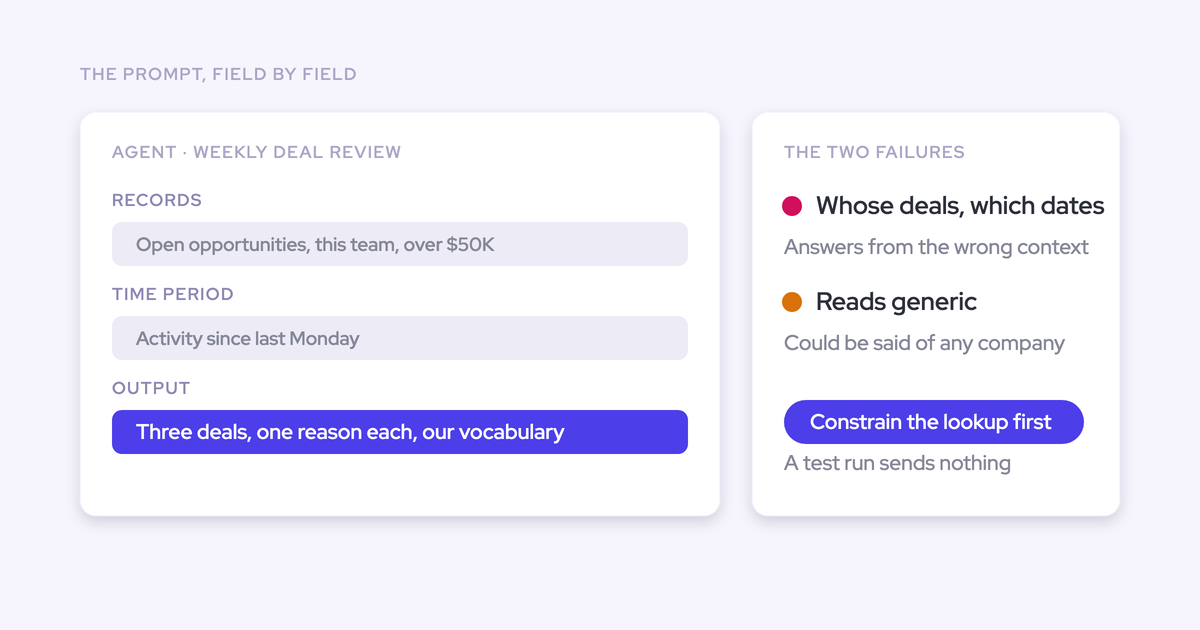
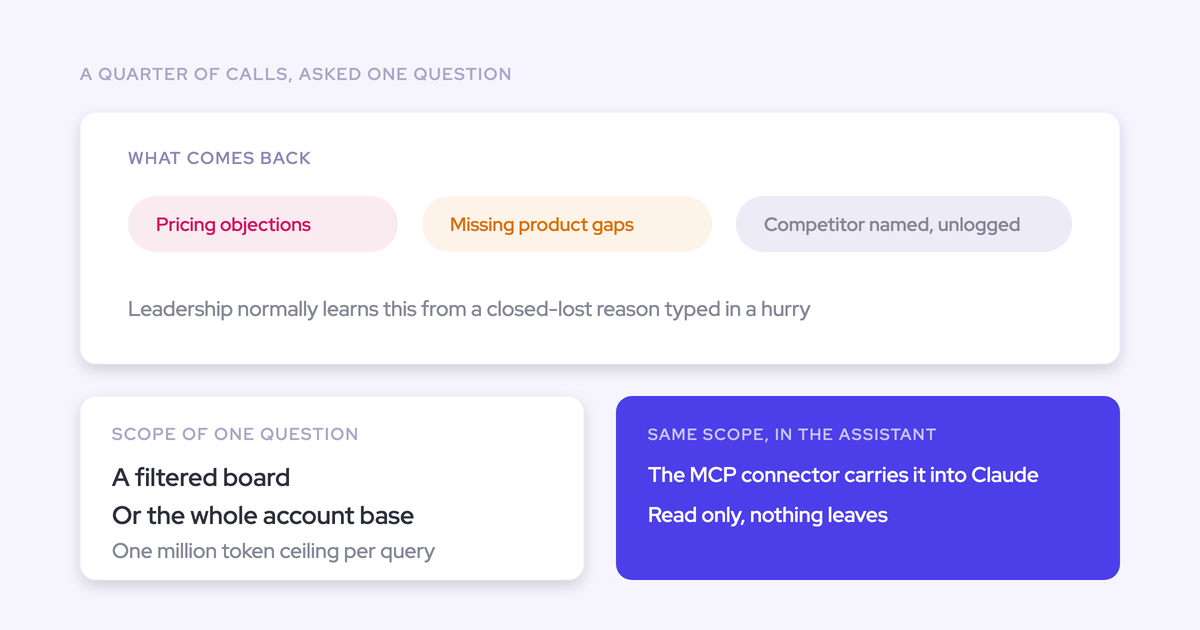
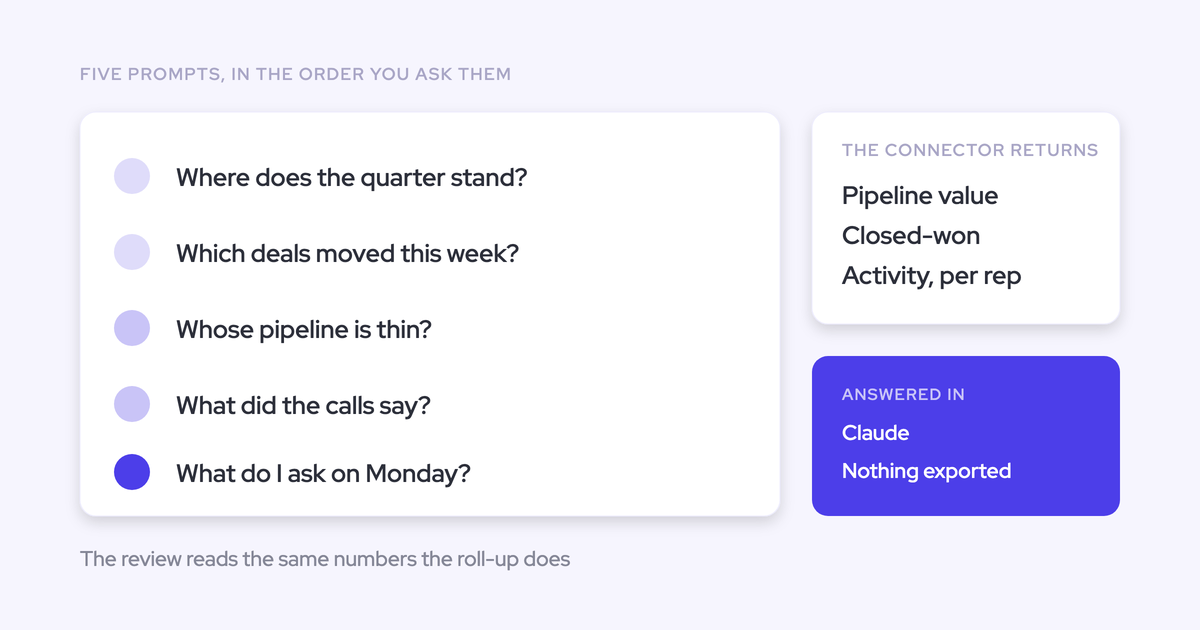
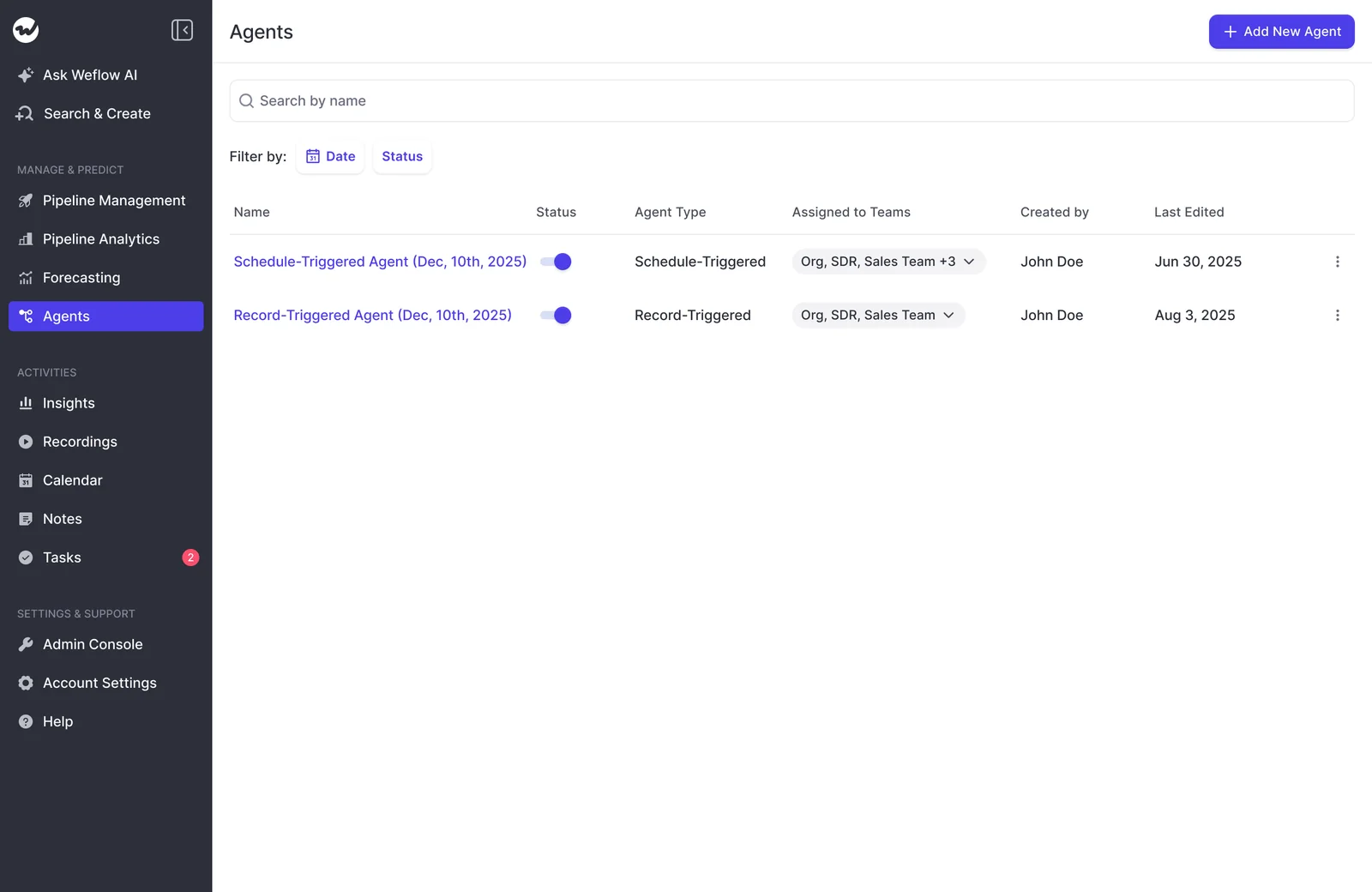
System of action. Agent Builder runs scheduled and record-triggered agents over live Salesforce lookups: a Monday pipeline pass that names the deals needing action and pre-writes the follow-up, a risk scan before the forecast call, a monthly closed-lost analysis read from the conversations instead of the reason-code dropdown.
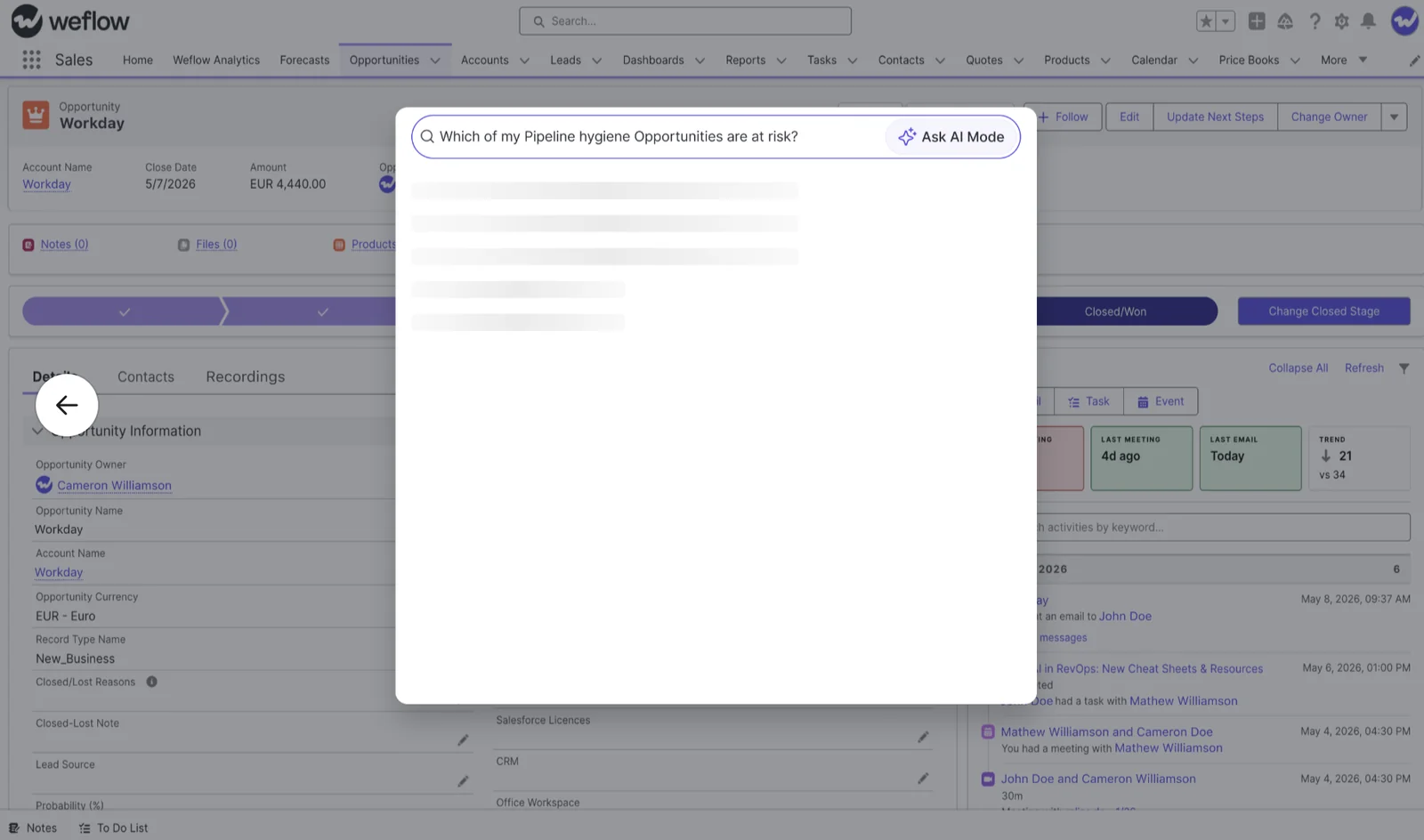
Ask Weflow AI runs inside the Weflow Chrome extension, which means it's available on the Salesforce record page itself. A rep asks a question of their own data without opening a second tool.
Now the edges, because the architecture claim is only checkable if we name them.
- Agent Builder is our newest product and the least mature of the set. Capture, conversation intelligence, deal intelligence and forecasting are established; data-driven action orchestration isn't fully solved yet, by anyone.
- Forecasting is a counterweight, not the wedge. If you're running a mature Clari forecast, expect parity, not an upgrade, and judge us on the intelligence layer instead.
- We don't have Clari's pipeline flow view. We match pacing and waterfall; flow is a real gap in a head-to-head.
- Weflow works only with Salesforce. That's a permanent boundary, not a roadmap item, and it's what makes writing everything into your own object model possible.
"We weren't buying conversation intelligence. We were buying a unified data layer that the entire go-to-market motion could run on, and a partner who understood that distinction."
Scott Jones, SVP of GTM Revenue Intelligence & Enablement at KORE Wireless
You've just been handed a test to run on every vendor in this category, including us. Walk through the product yourself, no call required.
FAQ about revenue AI orchestration
Is revenue AI orchestration just a new name for revenue intelligence?
No, and the difference is checkable. Revenue intelligence analyzes revenue data and shows it to you in the vendor's interface; revenue AI orchestration unifies capture, intelligence, and action on one data layer that lives in your CRM and acts on the record. If a vendor uses the new label while its conversation intelligence product still can't feed its forecasting product, that's a rebrand.
What happens to years of Gong or Clari recordings if you switch?
They come with you. Weflow imports existing recordings, transcripts and metadata from Gong, Chorus, Jiminny and others using only an API key, and re-links them to the right Salesforce account, opportunity or contact automatically, running our own lookup matching where the provider's API doesn't carry the association. A Gong migration takes about a week, and libraries in the thousands of recordings get reprocessed so the history stays searchable and scoreable under the new system.
Can you keep your forecasting tool and still fix the data layer?
Yes. Clari reads activities from Salesforce, so running Weflow Activity & Contact Capture underneath it means the forecasting tool consumes cleaner data than it had before. The one caveat: turn off the incumbent's capture. Two capture engines writing the same activity into Salesforce creates duplicates, and duplicated meetings break the per-rep and per-opportunity reporting you bought both tools to get.
Do reps have to work outside Salesforce with an orchestration platform?
They shouldn't have to, and this is the fear worth taking seriously: a second daily destination means reps ask which system is the real one, and you lose both. Weflow writes into native Salesforce objects and puts Ask Weflow AI, insights, summaries and playbooks into the Chrome extension, so it's available on the Salesforce record page. Nothing depends on a rep installing something or connecting their own mailbox, because anything that depends on rep setup behavior doesn't happen.
Does the agent and orchestration layer actually work yet?
Partly, and anyone claiming otherwise is selling. Scheduled and record-triggered agents over CRM and conversation data work today for recurring plays like pipeline passes, risk scans and closed-lost analysis, especially when the record lookup is narrowed to a stage, a date window or a team before the agent runs. Full autonomous action is not there.
"The reality we also see is that the hype cycle is very high and the deployment is still nascent."
Janis Zech, CEO and Co-founder of Weflow
What does revenue AI orchestration cost compared to legacy revenue intelligence?
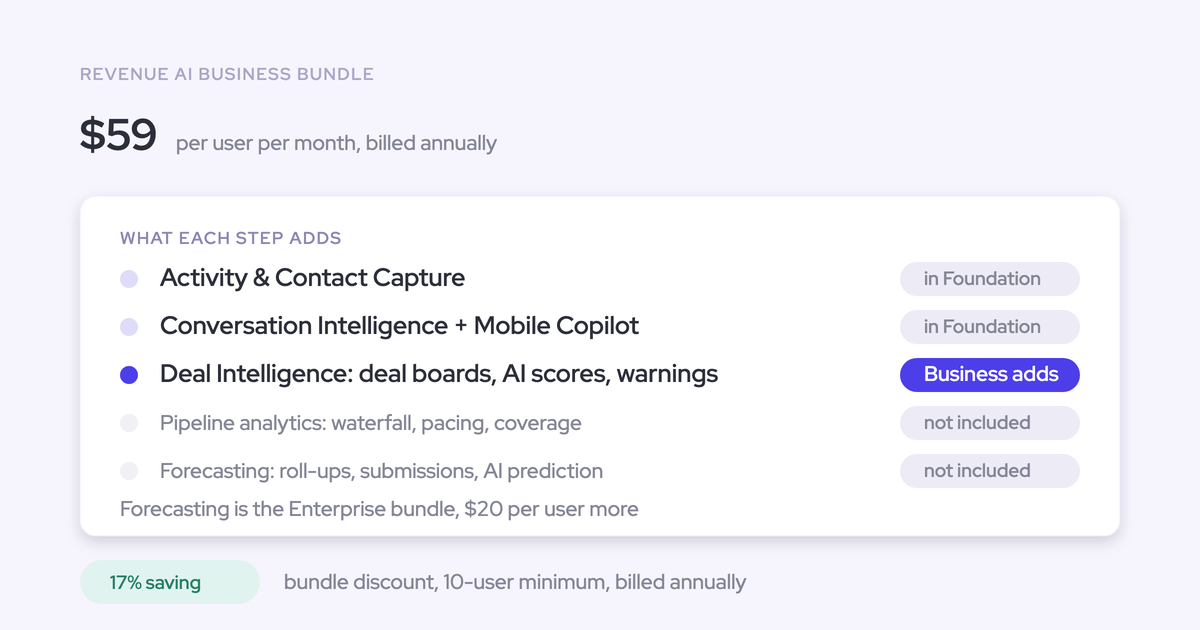
The cost base is different because the products were built after transcription and inference collapsed in price, so the pricing reflects today's costs rather than 2016's. Weflow's standalone products are $19 per user per month for Activity & Contact Capture and $39 each for Conversation Intelligence and Deal Intelligence & Forecasting, with bundles at $49, $59 and $79, billed annually with a 10-user minimum.
Gong, for comparison, starts at about $1,600 per seat per year for Foundation, adds a $5,000 annual platform access fee, prices coaching and forecasting as separate add-ons, and has introduced consumption pricing for AI on top of the seat.
That last part is the one to watch in your own contract. Weflow prices everything per seat with AI usage included, and meters only Agent Builder, which is per workspace and starts free with 25 agent actions a month. A budget that grows exactly as adoption succeeds is how teams end up rationing the AI they bought.