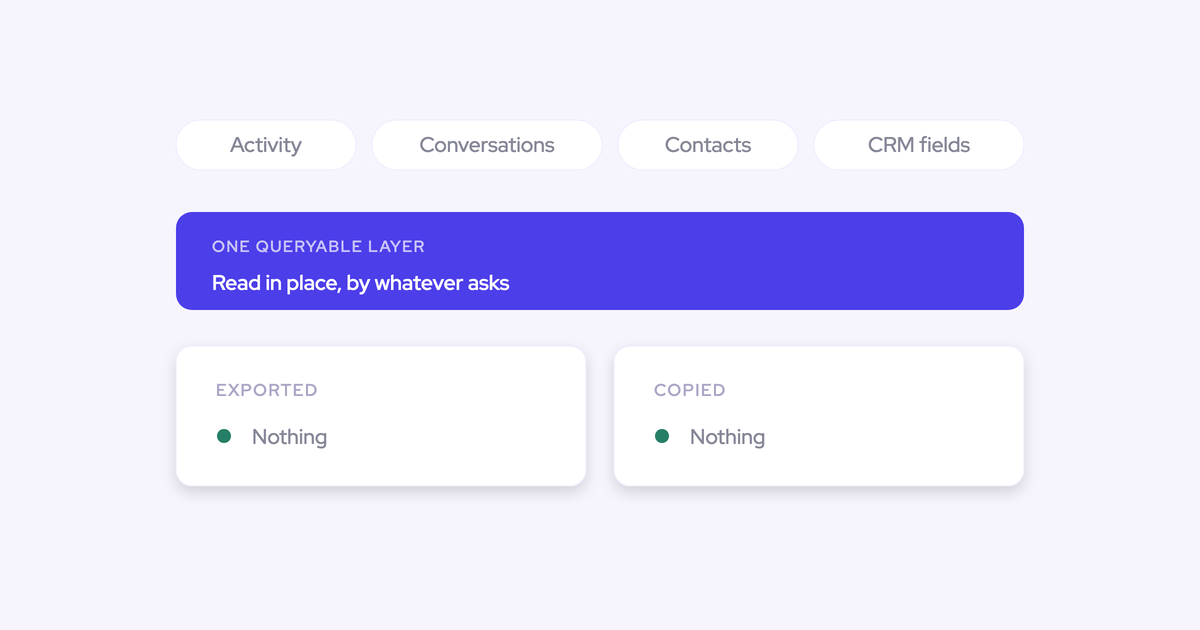

How to query Salesforce revenue data from Claude or ChatGPT without exporting it


Querying Salesforce revenue data from Claude or ChatGPT means your own AI reading revenue data that already lives in your Salesforce, through an API you can call. No CSV export, no warehouse round trip, no vendor chat window sitting in the middle.
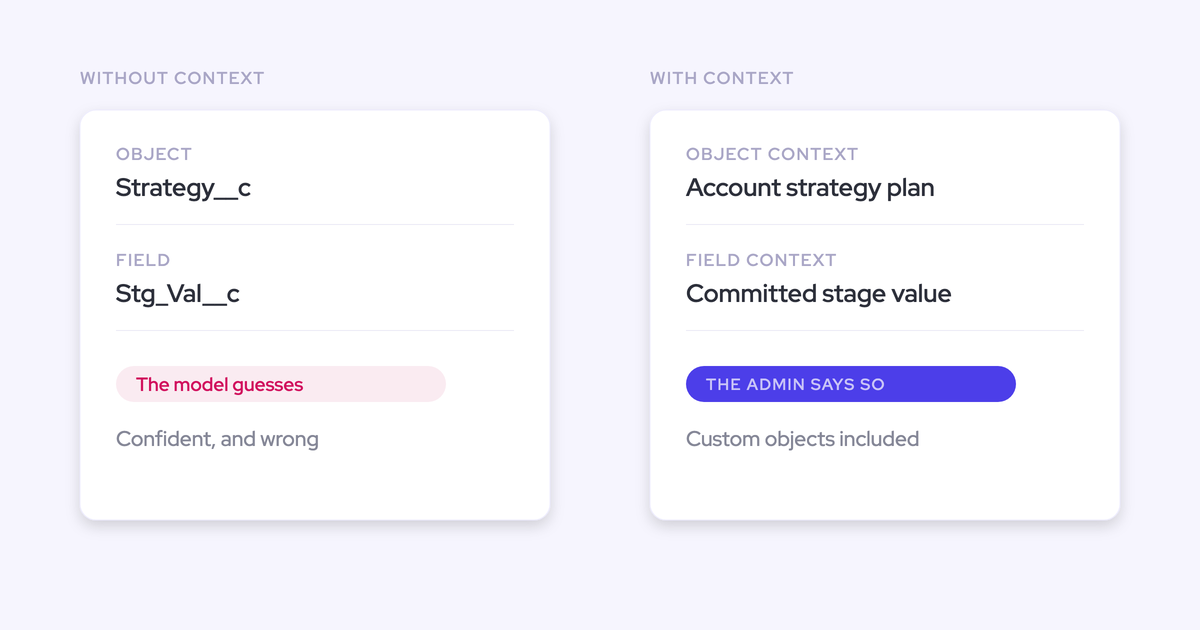
You've probably already tried the direct version. Wire Claude to Salesforce, ask it which deals slipped and why, and get back something confident and wrong. That's not a connector problem. It's that the data underneath the question isn't there: the emails sit in inboxes, the transcripts sit in a notetaker's cloud, and the CRM carries twenty amount fields nobody has reconciled since 2023.
So the question on your vendor matrix is really two questions, and most vendors only answer the first: is the data reachable from my AI, and is it complete enough to be worth querying. This piece answers both, including the honest line between your own Claude and Ask Weflow AI.
Why pointing Claude straight at Salesforce doesn't work
Because Salesforce on its own doesn't hold the evidence your question needs. The model reads what's there, fills the gaps with inference, and hands you a paragraph that sounds like an answer.
Here's what's actually missing in a typical org:
- Most email. Teams relying on the Salesforce Outlook add-in or Gmail extension log somewhere between 24% and 52% of activities. The add-in is built for outgoing mail, so the replies, the strongest proof a deal is alive, are the part that never lands.
- Activity that isn't a real record. With Einstein Activity Capture, activity appears in the timeline but isn't stored in the core Salesforce database. You can't build custom reports on it, you can't read it in a flow, and you can't export it to Looker or Power BI.
- The conversations. Transcripts and call scores usually live in the notetaker's or the conversation intelligence vendor's own schema, in their cloud. Nothing your AI points at Salesforce can see them.
- The richest fields. Salesforce long text fields aren't queryable through the API. Whatever context a rep did type is a dead end for any report, flow, or model downstream.
- The numbers themselves. Twenty or thirty amount fields, the forecast in a spreadsheet, and no field history on the calculated field you actually forecast on.
Point an LLM at that and you get a fluent read of a third of the record.
If you could just hook Claude into Salesforce and it gives you the truth. I mean, in theory, if it's a system of truth, it should be able to do it. But the reality is it just doesn't work. And so I think you have to be really good at the data foundation, your custom data structure, like the quality of the data, and then also the consolidation unification. That is basically the infrastructure.
Meanwhile your reps have already built their own version of this. They pull the transcript out of the recorder, paste it into whatever assistant they like, and drop the output in a channel.
Three people redo the same analysis, none of it reaches the CRM or the forecast, and nobody can find it again next quarter. That's not reps being sloppy. It's what people do when the data isn't unified at the source.
What makes revenue data queryable from your own AI
Revenue data is queryable from your own AI when two things are true at once: an external agent can reach it without a human exporting anything, and what it reaches is complete enough that the answer is right.
Openness alone is table stakes. Plenty of tools have an API and still return nothing useful, because the API exposes a thin, half-filled version of reality. Three architectural properties decide it, and most tools fail at least one. Run any vendor against them, including us.
Revenue data stored in native Salesforce objects you own
Where the data physically lands decides who is allowed to query it. Data written into your own Salesforce objects is reachable by anything you point at your Salesforce: your agents, your BI tool, your LLM, a flow an admin built on a Tuesday.
| Question | Data in the vendor's cloud | Data in your Salesforce objects |
| Can your own AI query it? | Only through the vendor's UI or whatever they expose | Yes, it's your org's data |
| Can a Salesforce flow read it? | No | Yes, it's a native record |
| Can your warehouse pull it with record IDs? | Needs reconciliation to their schema | Carries the Salesforce IDs already |
| What happens at renewal? | The history is leverage against you | The history stays in your CRM |
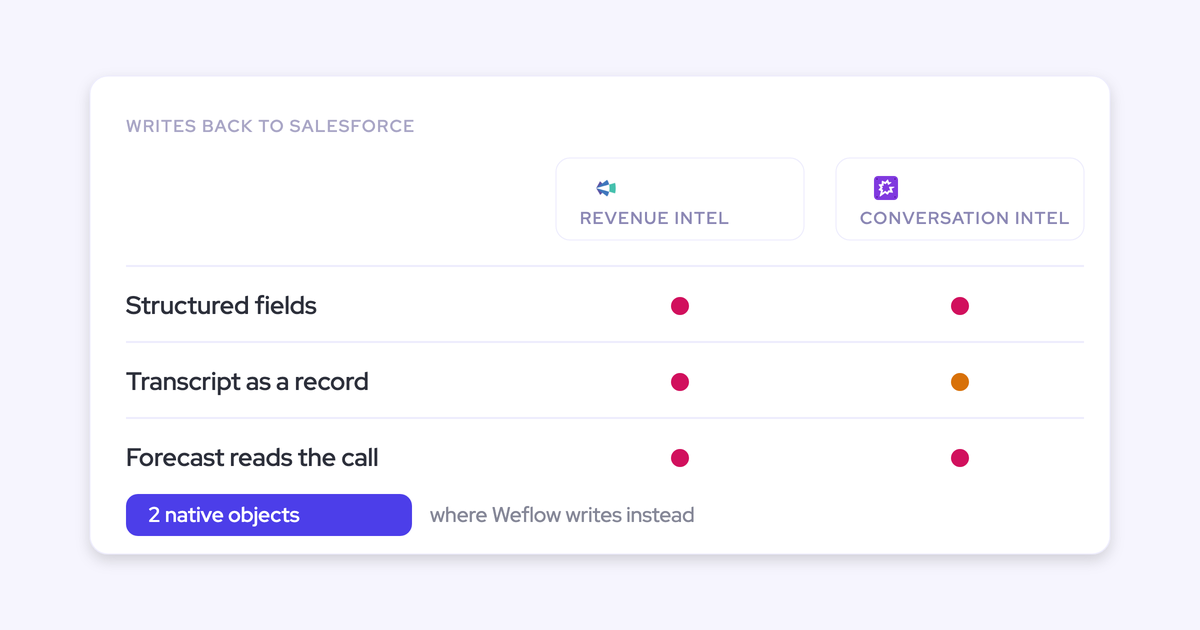
Gong does log activity to Salesforce, so this isn't binary and it's not the reason teams leave. The line is depth and ownership: Gong maps captured emails and meetings into its own data structure, and the conversation layer, the transcripts and the scores, lives in Gong. Any agent you build on your Salesforce is missing exactly that layer.
Clari has the same shape from a different direction. Its forecasting product and its conversation intelligence product don't talk to each other, so customers end up piping transcripts into a separate AI workspace and feeding conclusions back to the CRM by hand.
Procurement teams have caught up with this faster than most vendors have. They now ask for the export format, the retention and destruction terms, and the transition hours committed at no cost, before signature. A vague answer reads as a red flag, and it should.
A unified data layer, not half-filled CRM fields
This is the half of the test nobody answers, and the reason your raw-Claude experiment failed. Partial data is worse than no data for AI querying, because an incomplete record still produces a confident answer.
Reliably, I really mean, you know, you wanna have, like, ninety nine percent or more of those activities stored in your CRM so you can run reports on it, automations, flows, and so on.
Below that threshold, every missing email could be the one that changes the conclusion. A unified layer has to combine:
- Emails sent and received, mapped to the opportunity rather than dumped on the account
- Meetings as one record each, so recording a call doesn't create a second meeting
- Transcripts and call outcomes as structured content, not a summary blob in one long text field
- Contacts and opportunity contact roles, created without a rep remembering to add them
- The CRM fields themselves, which are the thin part, not the whole picture
The evidence for a deal lives in the emails, the meetings, and the calls. It does not live in the fields reps typed at 6pm on a Friday. That's why a prompt that reads only CRM fields returns the thing your team already didn't trust.
An API your own agents and warehouse can call
This is the literal line on the matrix, and it separates a system of record you can build on from another dashboard.
Do you guys have an MCP with Claude as well? Because a lot of our team uses that.
We have our own agentic solution framework here internally that we've built, and the interface to that is a chat bot where we ask it anything about Salesforce. So we might end up creating a Weflow agent internally.
Write the requirements down before you take vendor calls:
- An endpoint an external agent can query, and a straight answer on MCP connector status
- Conversation data and transcripts exposed, not only CRM fields
- Batch extraction into your warehouse or lakehouse, not one record at a time
- Exported rows carrying the CRM record IDs, so your data team can join them to product usage
- Permissions that follow the user, so querying doesn't become a data leak
That last one gets skipped in evaluations and then blocks the rollout. A feed nobody can reconcile costs more to clean than it saved.
How Weflow makes revenue data queryable from Claude and ChatGPT
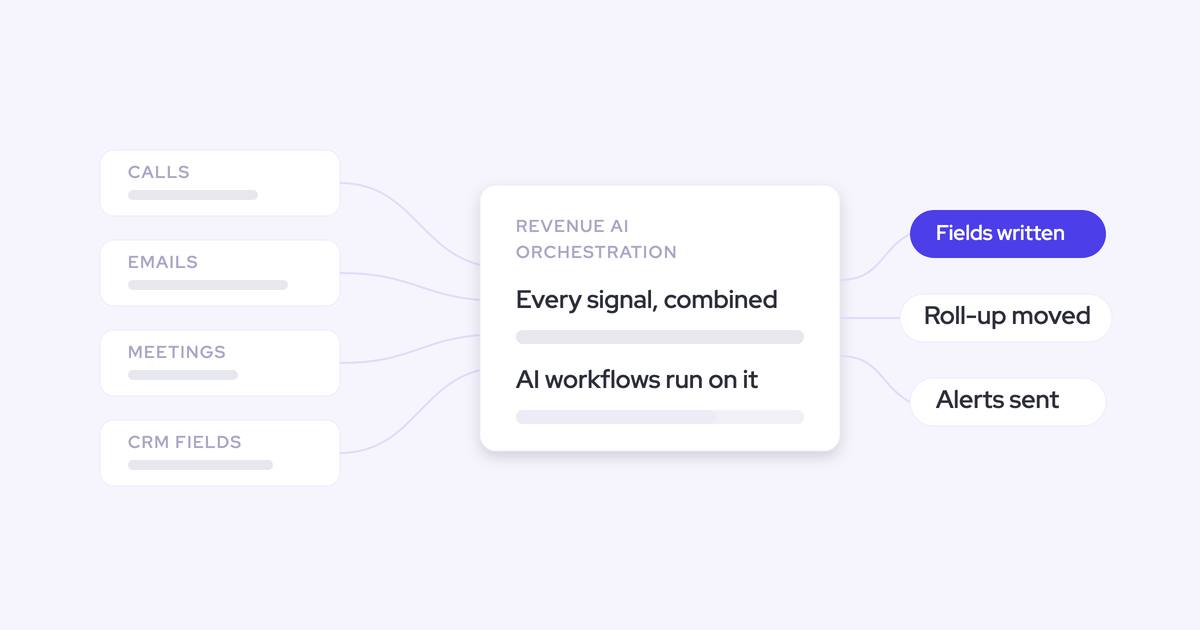
Weflow is the Revenue AI Orchestration platform for sales, customer success, and RevOps teams, built for Salesforce teams. It answers the three requirements by architecture rather than by integration list.
| Requirement | How Weflow answers it |
| Reachable outside the vendor | The managed package writes activity, contacts, transcripts, summaries and AI field updates into native Salesforce objects (Task, EmailMessage, Event, Contact) and custom objects. Anything you point at your Salesforce reaches it. |
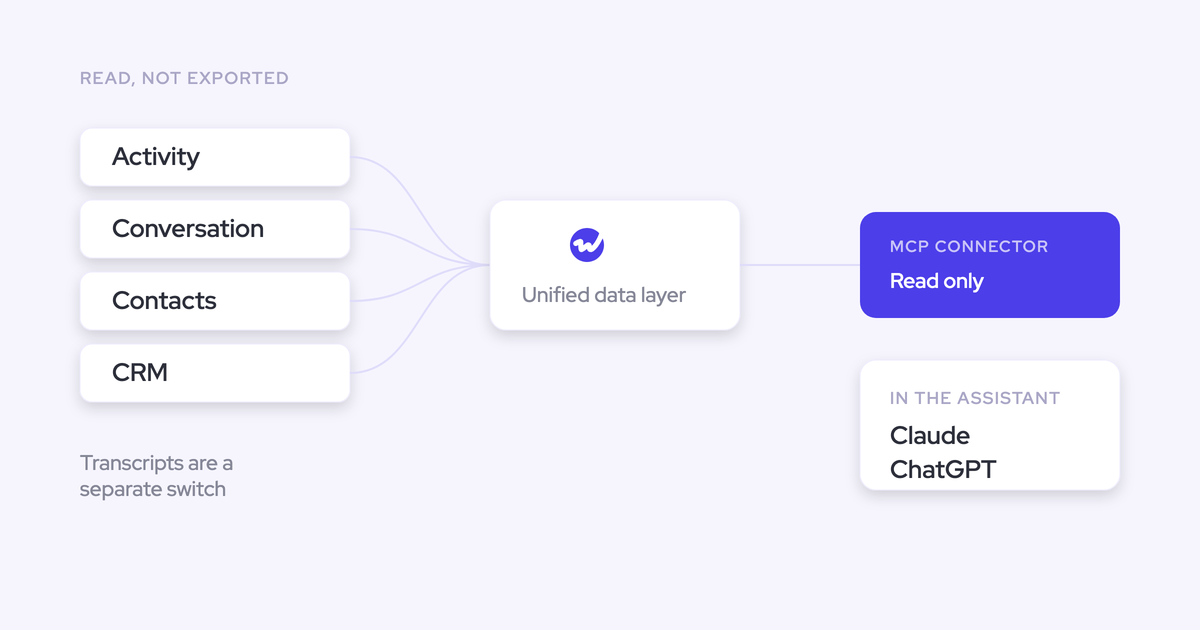
| Complete enough to be worth querying | The Unified Data Layer combines activity, conversation, contact and CRM data into one queryable layer. Capture runs server-side rather than through a rep's add-in, and up to two years of historical email and meetings can be backfilled. |
| An endpoint your agents can call | Weflow's public API exposes the data, including conversation data and transcripts, for querying inside Claude, ChatGPT and your own agent framework. Recordings are exported through the API to your own cloud storage. |
The capture foundation is the part that makes the querying return real answers. Around 99% of customer interactions landing in Salesforce is what your direct Claude-to-Salesforce experiment was missing, and no connector fixes it.
Now the honest part, because you'll ask on the call anyway.
Buyers specifically ask for an MCP server. Today Weflow gives you public API access plus native-Salesforce reachability, not a confirmed turnkey MCP connector. Fireflies, a notetaker, does ship one, and that's a genuine point in their column. Confirm the exact connector scope and the roadmap with us directly rather than taking a blog post's word for it.
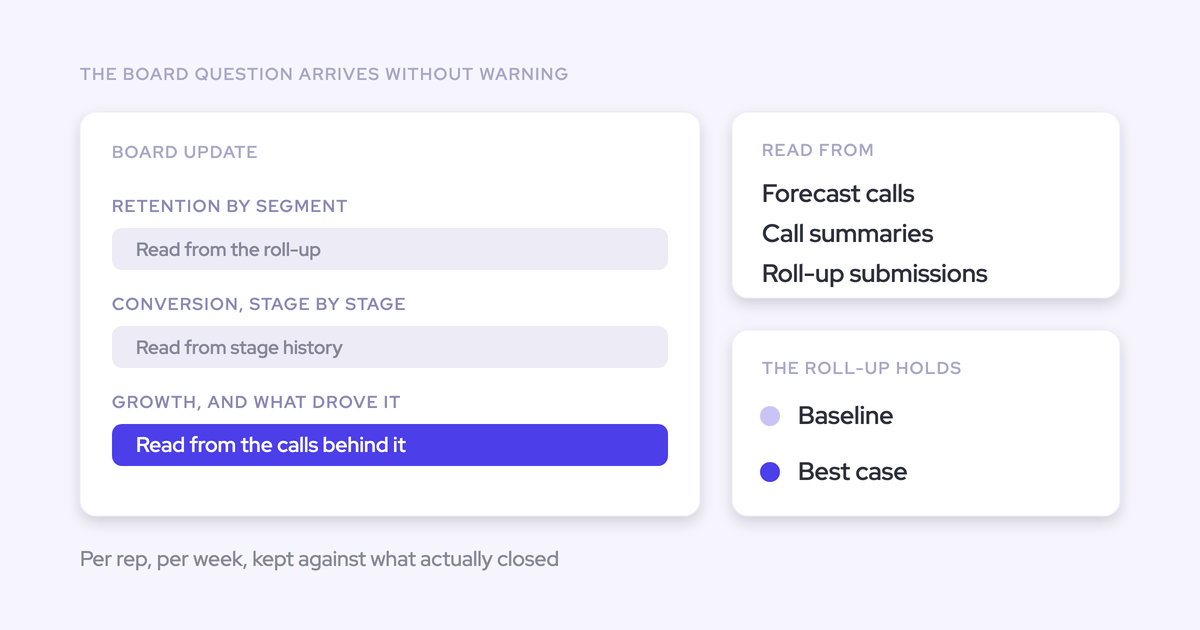
One more limit worth knowing: forecast submissions, targets and roll-up data live in the Weflow application rather than in Salesforce. Everything else we write lands in the CRM, but if you want the roll-up in your BI tool, you pull it through the public API.
When to use Ask Weflow AI vs your own Claude
They're complements with a clean dividing line. Ask Weflow AI is the path with no wiring; your own Claude on the API is the path when revenue data has to meet the rest of the company's data.
What are we going to get in Claude that we can't get in Ask Weflow AI.
| Dimension | Ask Weflow AI | Your own Claude or ChatGPT via the API |
| Setup | None, it ships with every plan | Your team wires and maintains the integration |
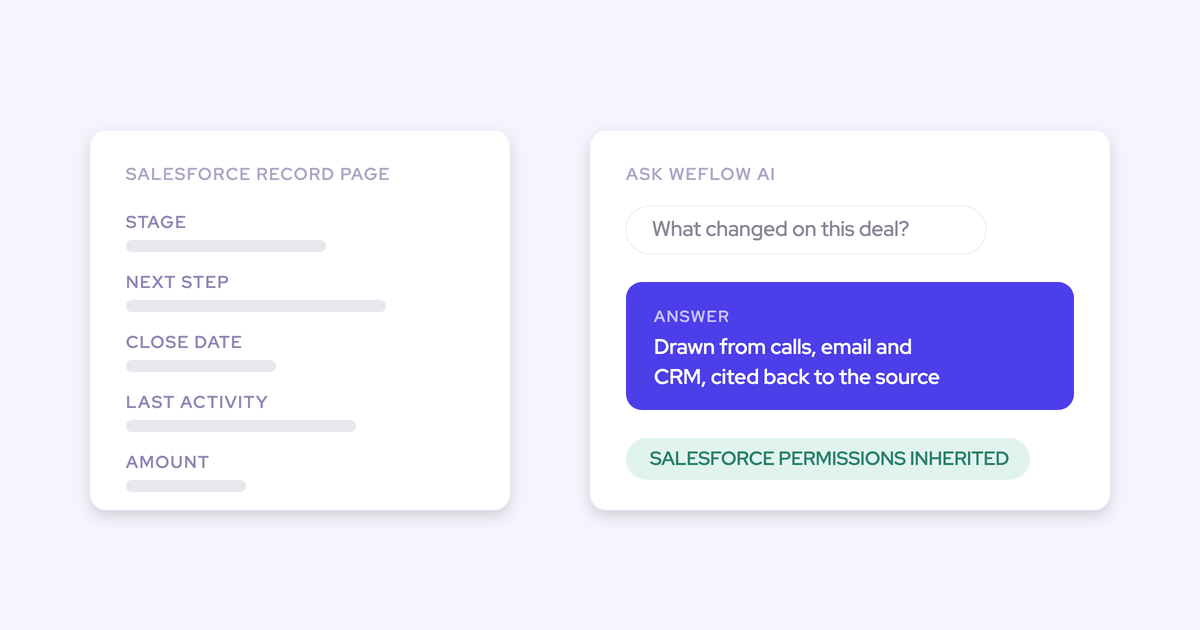
| Permissions | Authenticates with the user's Salesforce token and inherits Salesforce permissions | Whatever your integration user and framework enforce |
| Traceability | Cites back to the exact call, email or field behind the answer | Depends entirely on what you build |
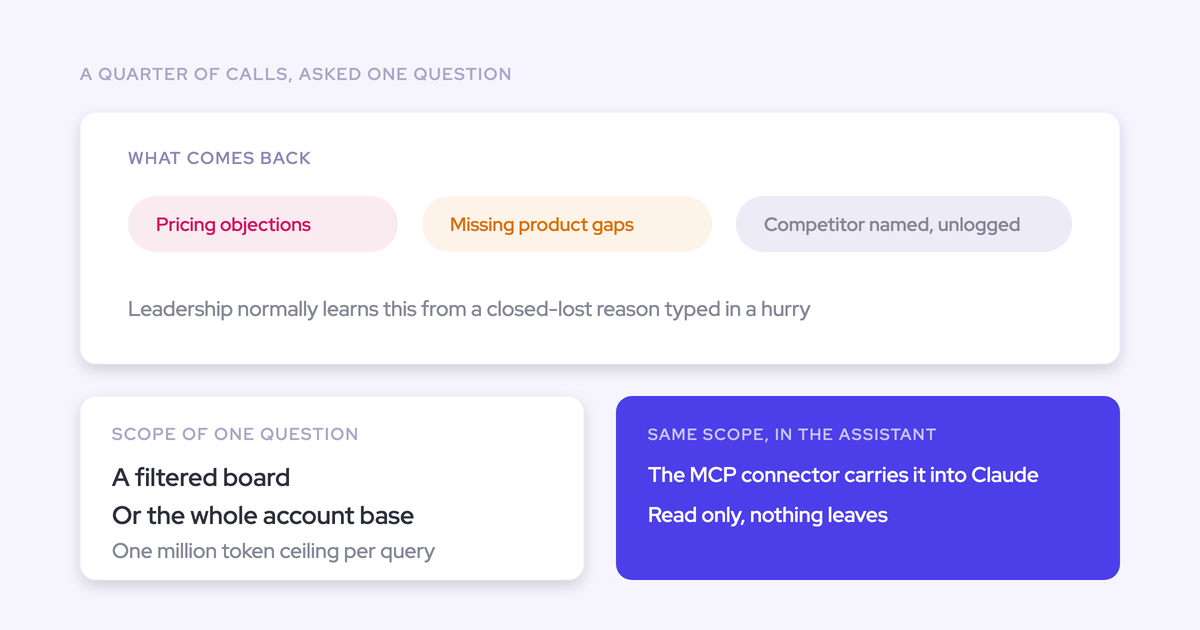
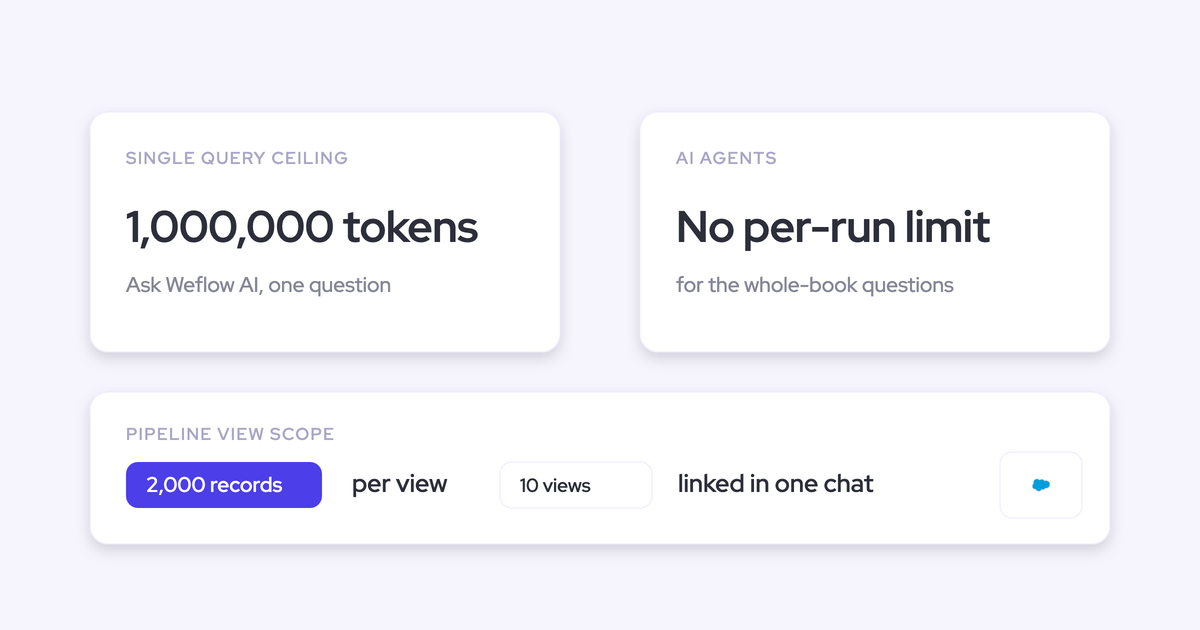
| Scope of a question | A single call, a deal, a filtered deal board, an account, or the whole system | Anything the API returns, joined however you like |
| Data it can join | Conversation, activity, contact and CRM data | The above plus product usage, billing, support, your own models |
| Where it runs | In the Weflow interface | In the chat window your company standardized on |
| Cost model | Included, seat-based, no usage caps or token metering | Your AI vendor's consumption pricing |
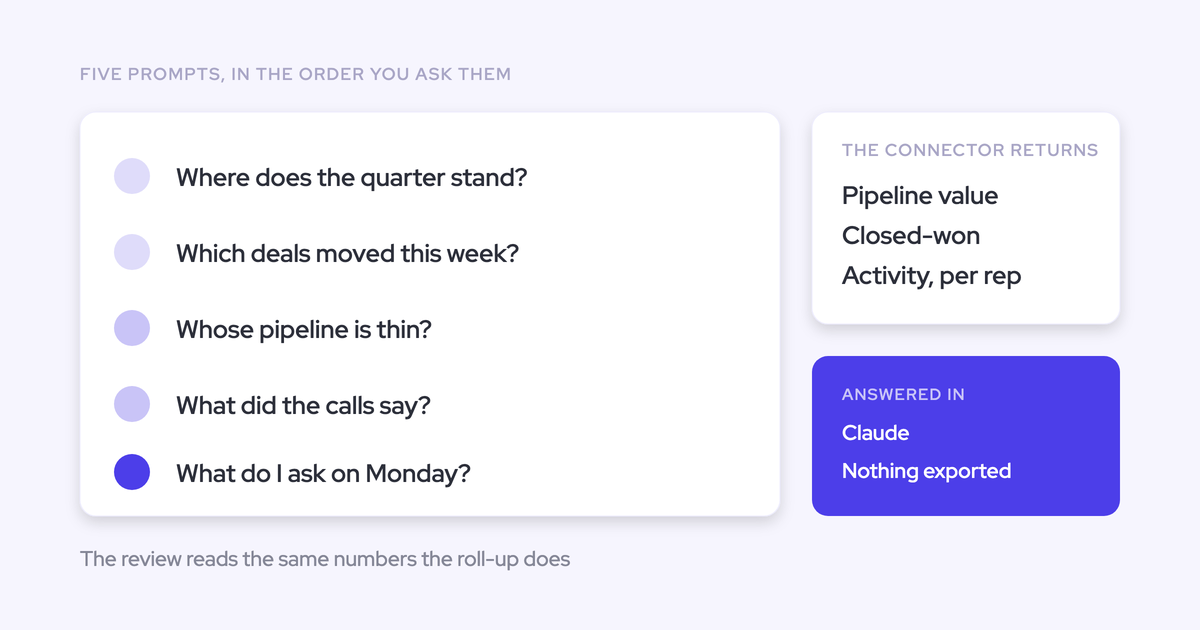
Use Ask Weflow AI for the revenue questions a manager asks between meetings: which deals are missing methodology information, which competitors came up in the last six months, what closed-lost deals have in common. Ask Weflow AI Pro is included in every Weflow plan and bundle, so nobody has to model token spend before switching it on.
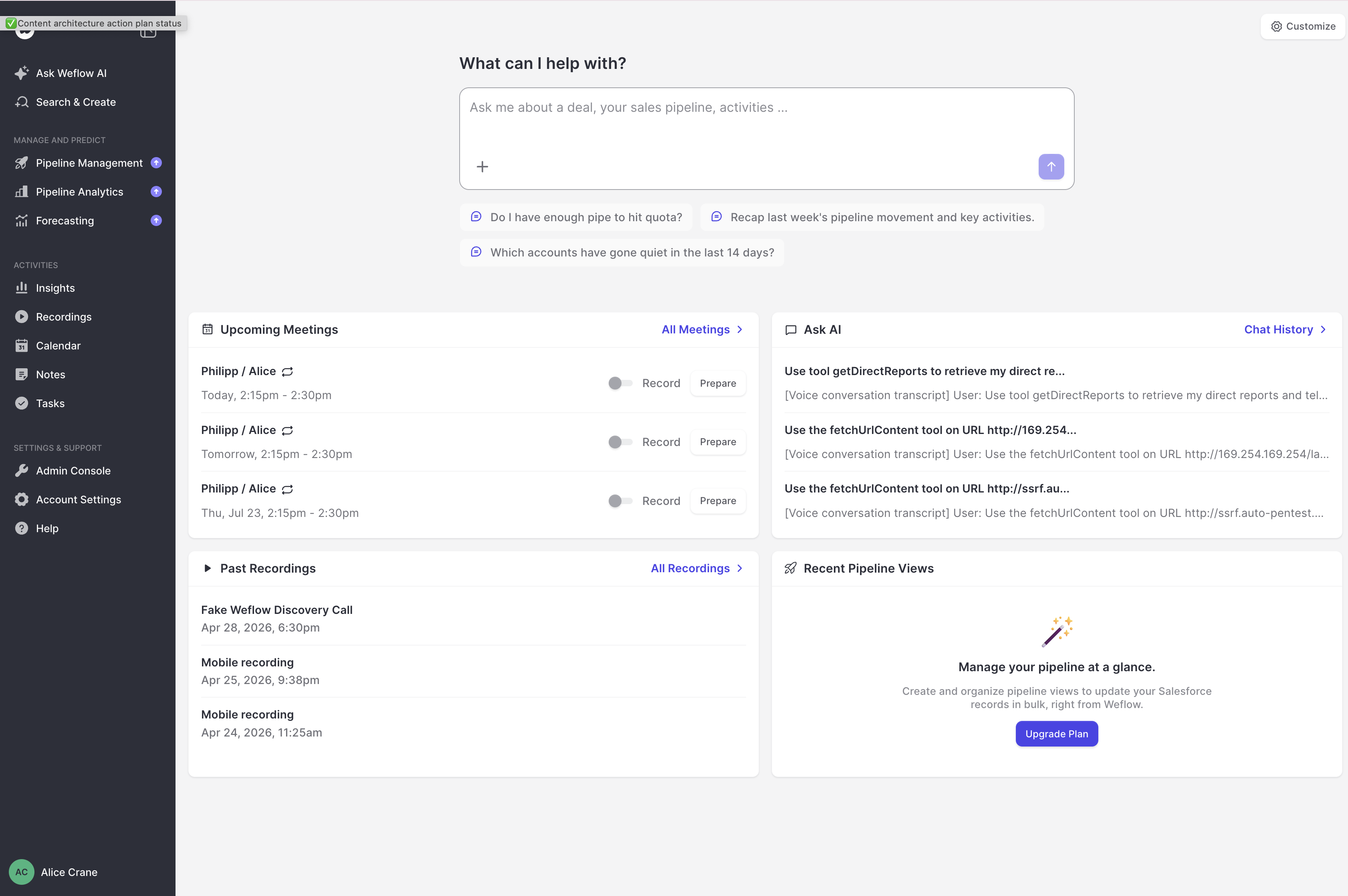
The traceability is the piece teams notice after go-live rather than in the demo.
I love being able to go right to the call, transcript or email and see where something was said that the AI is referencing.
— Scott Jones, SVP of GTM Revenue Intelligence & Enablement at KORE Wireless

Use your own Claude when the question crosses the boundary of revenue: joining pipeline to product usage, feeding your predictive models, running the query inside the agent framework your engineering team already built.
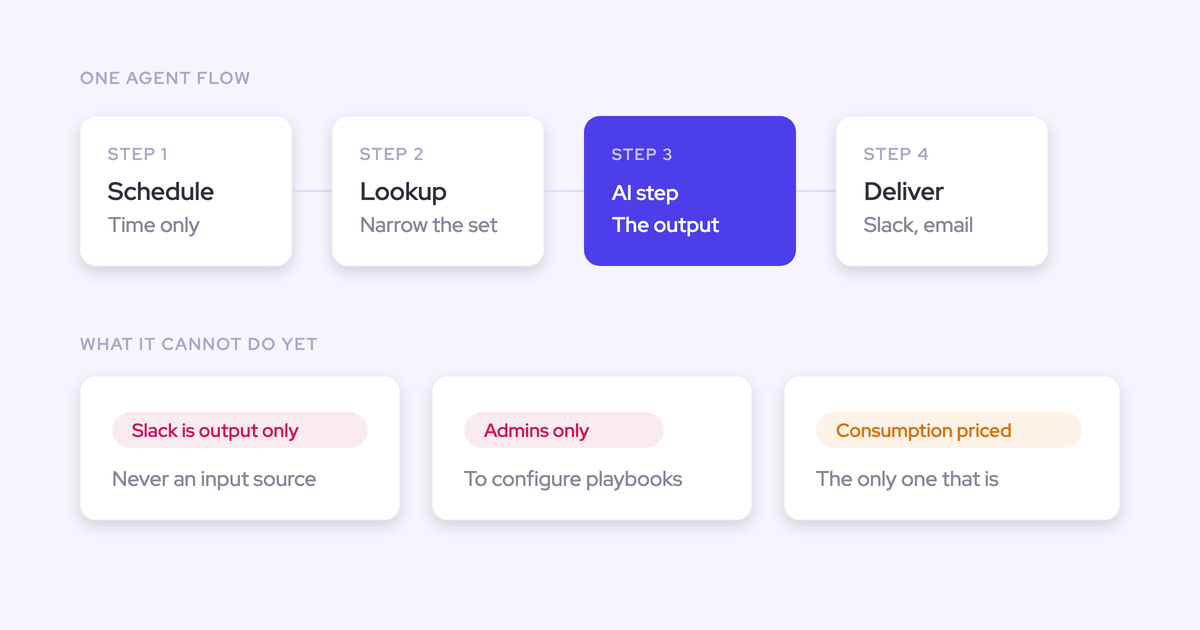
And the limits, plainly. Ask Weflow AI runs in the Weflow interface, not embedded inside Salesforce, and there's no timeline for that. Slack access is in build. If your hard requirement is that reps never leave the Salesforce record page, that's a real gap today.
FAQ: querying revenue data from Claude and ChatGPT
Does Weflow have an MCP server or an API?
Weflow exposes a public API today, and it can be queried from Claude, ChatGPT and a custom agent framework, including conversation data and transcripts. A turnkey MCP connector is a different claim and we're not making it here. Ask us for the current connector scope and roadmap on a call.
Do Salesforce permissions apply when you query through Ask Weflow AI?
Yes. Ask Weflow AI authenticates with the user's Salesforce token and inherits Salesforce permissions, so a rep sees what they'd see in the CRM. There's no separate Weflow identity to provision or deprovision either, because sign-in runs through your Salesforce authentication and whatever SSO your org already enforces.
Can we extract Weflow data into our own warehouse?
Yes, two ways. Activity, contacts, transcripts, summaries and AI field updates are native Salesforce records, so your existing Salesforce-to-warehouse pipeline already carries them, with the record IDs your data team needs to reconcile and join. The public API covers extraction directly, including conversation data, and meeting recordings are exported through it to your own cloud storage rather than stored in Salesforce.
Who owns the data if we leave Weflow?
You do, and you did from day one, because it was written into your Salesforce as it was captured. The activity history, the contacts, the transcripts and the summaries stay in your CRM when the contract ends. That's the structural difference from a tool that holds its own copy: nothing to migrate back, nothing to lose.
Is Ask Weflow AI included in pricing or metered?
Included. Ask Weflow AI Pro comes with all three standalone products and all three Revenue AI bundles, and pricing is seat-based with AI usage bundled in. Recordings, transcripts, AI templates and Ask Weflow AI prompts have no usage caps and no token metering.
Does this work if our Salesforce data is a mess today?
Messy Salesforce data is the starting condition for almost every rollout, not a prerequisite you have to clear first. Capture is what builds the complete layer: emails and meetings land server-side without a rep clicking anything, contacts get created against existing accounts, and up to two years of historical activity can be backfilled so in-flight deals don't look dead on day one. Fix the capture, then point your AI at it.
See how Weflow captures activity, updates Salesforce fields from calls, and rolls up your forecast. Book a 30-minute demo.