Build vs Buy for Revenue AI: Why Vendor Lock-In Looks Different in 2026
Decide build vs buy for revenue AI in 2026 using 5 tests for vendor lock-in and data reachability




A RevOps leader told us on a call that he'd rebuilt Clari with Claude on his flight home from California, and now he was trying to figure out build versus buy.
If that's roughly where you are, prototype working, vendor demo booked, neither option feeling safe, this article is for you.
The two fears you're holding, build it and drown in tech debt, or buy it and get locked in just as the landscape shifts again, reduce to one question: who owns your revenue data, and can your own AI reach it.
Why build vs buy for revenue AI feels unwinnable right now
You know you can build the first version. We hear it verbatim on sales calls: "On my plane ride home from California last week with Claude, I rebuilt Clari how I would want it in Salesforce."
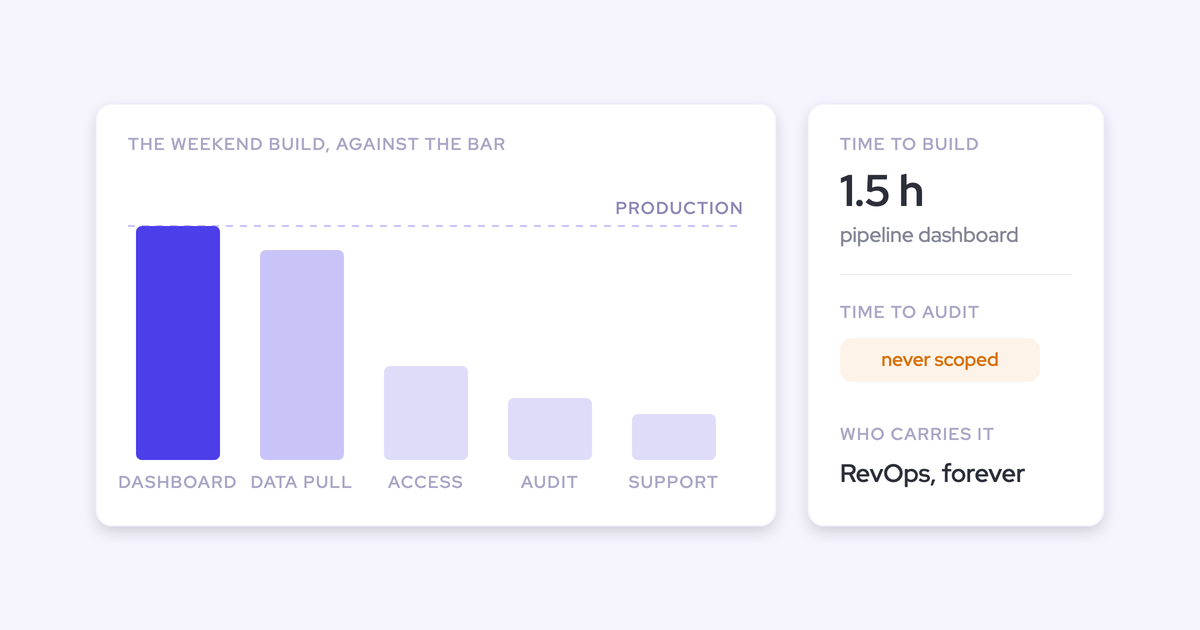
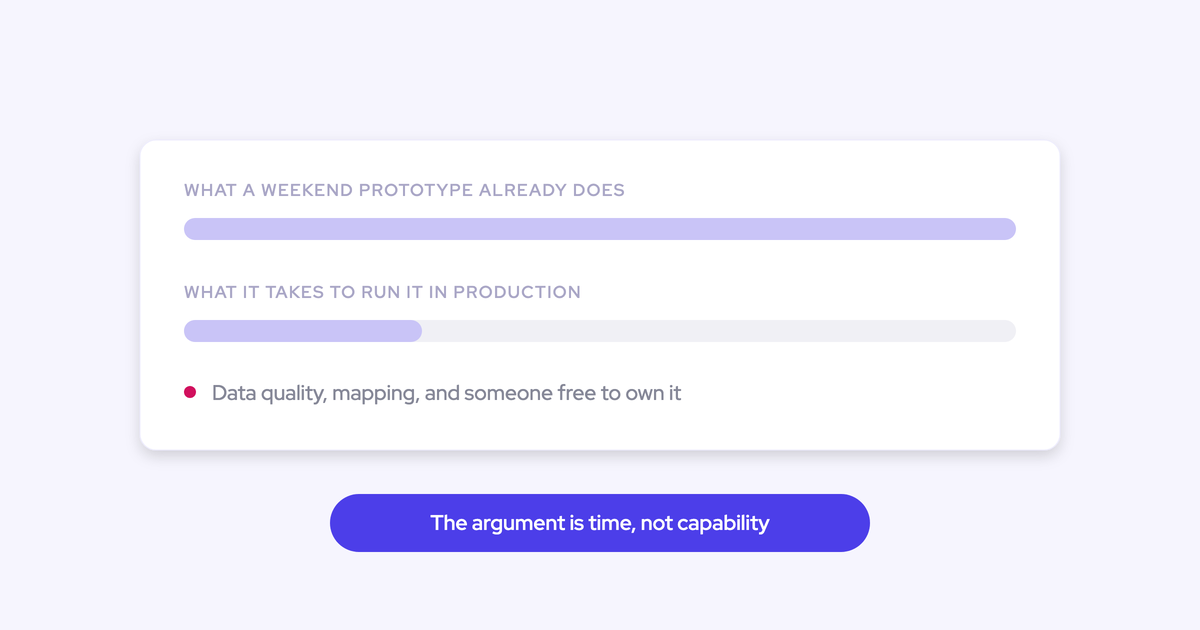
Claude and coding agents collapsed the cost of v1 to a weekend, which means every vendor price now reads like a tax on something you could own.
You also know what happens after v1, because you've lived both failure modes.
The internal tools that got started and abandoned: "so far we haven't built anything other than we wasted a lot of time."
And the purchases that became shelfware: the Clari Copilot bought without an internal owner, where years later the licenses are all paid for and nobody opens the thing.
Then there's the fear that freezes the whole decision, stated to us exactly like this:
We get locked into a vendor and as the AI landscape is changing so quickly, in six months our position may change as to our ability to build in-house.
| Risks if you build | Risks if you buy |
| Tech debt nobody budgeted for | Data in a vendor cloud you can't reach |
| No owner after you leave or change roles | No owner after the champion who bought it leaves |
| Governance and audit exposure | Renewal leverage against you, history held hostage |
| Maintaining it forever with a team of three | Paying forever for something reps stopped opening |
Read the two columns again. They're the same column. Both describe revenue data that ends up somewhere your company can't govern, can't query, and can't take with it. That's the actual risk, and it has a name.
Vendor lock-in in 2026 is data reachability, not contract length
Vendor lock-in in 2026 is measured by data reachability: whether your revenue data is queryable by your own AI, your own warehouse, and your own agents, or trapped behind a vendor's chat window.
Contract length and switching cost were the old measures. They described a world where the tool was the asset.
In revenue AI, the data is the asset, and the tool is how it gets captured and structured.
The shift shows up on real vendor matrices.
Buyers now put a line on the evaluation sheet that didn't exist a year ago: is there an endpoint an external agent can query, and if not, when does it ship. That line separates a system of record the company can build on from another dashboard.
Why the line exists: your company has already standardized on a corporate Claude or ChatGPT license, or an agent framework it built itself, and that's where people actually work.
A revenue tool whose data can't be reached from there is dead data behind one more login.
One technical buyer put it to us plainly:
I want transcripts available through API so we can attach it to whatever Claude skills we want.
| Old lock-in model | Data-reachability model |
| How long is the contract? | Where does the data physically land? |
| What does switching cost? | Can our warehouse and agents query it without the vendor? |
| How painful is migration? | What do we still hold the day the contract ends? |
| Applies only to vendors | Applies to vendors and to your own build |
An internal build with no documentation, no access controls, and one person who understands it fails the reachability test on the ownership dimension just as hard as a closed vendor cloud.
The data-reachability test: five questions for any revenue AI decision
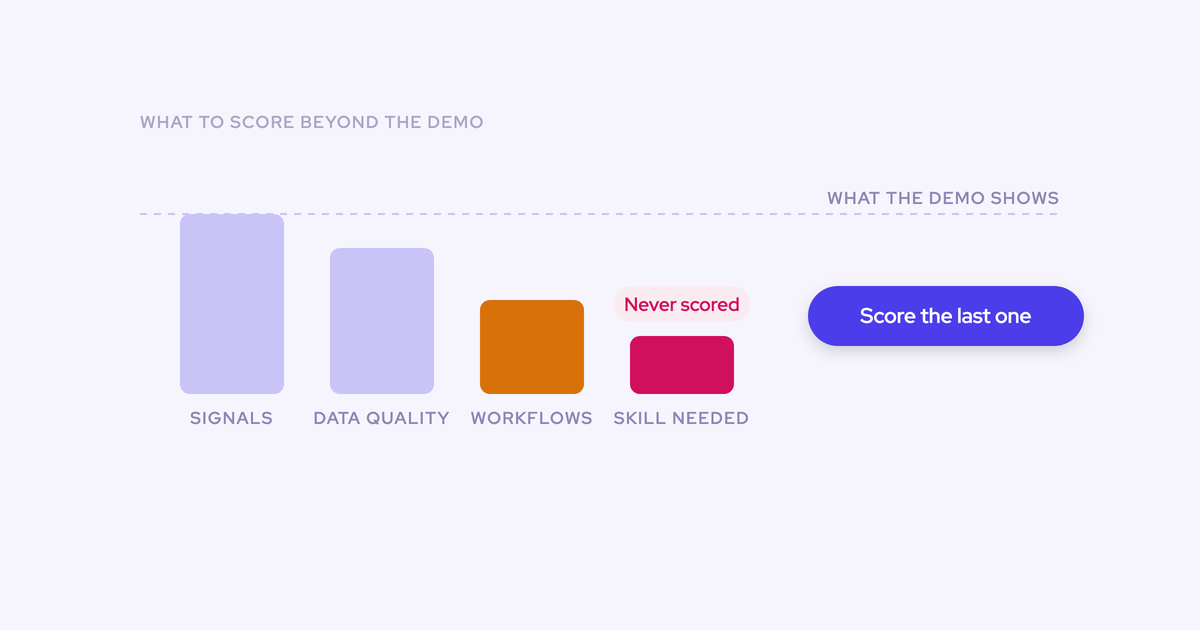
Five questions separate a system of record you can build on from another dashboard, and they apply equally to the vendor in your demo and to the prototype on your laptop. Put them on the matrix and score both.
Does the data land in CRM objects you own?
Pass: activity, contacts, and the structured output of conversations get written to native objects in your Salesforce, so they survive every vendor decision including the decision to leave.
Data written to your own objects is yours the day it lands.
Data that lives only in the vendor's cloud is a hostage, and you find out what it costs at renewal, when the price goes up and years of history back the vendor's position instead of yours.
A failing answer sounds like "everything's in our platform, and you can always export."
An export you'd have to request, reformat, and re-map to CRM records is a different thing from data that never left your CRM.
Can your warehouse pull it in bulk, with CRM record IDs attached?
Pass: the analytics team can batch-extract into the lakehouse and reconcile every row to a CRM record.
Data teams ask this before they ask anything else, because they plan to join revenue data with product usage and run their own models on it.
A feed nobody can reconcile costs more to clean than it saved.
A failing answer sounds like "our dashboards cover most reporting needs."
The tool becomes a blocker the exact day the data team wants the data, and that day always comes.
Can your own AI agents query it from outside the tool?
Pass: a live API your corporate Claude or agent framework can call today, and an honest, dated answer on MCP. The vendor's own in-product AI doesn't count here.
The question is whether the data enters the AI workflows your company is standardizing on, or stays trapped behind the vendor's chat box where only the revenue team will ever see it.
A failing answer sounds like "we have AI built in."
That answers a question you didn't ask.
What leaves with the contract at termination?
Pass: export format, retention and destruction terms, and transition assistance documented before signature, in the contract, not in a follow-up email.
Procurement teams who've been burned now ask for exactly this, and they read a vague answer as a red flag on everything else the vendor said.
The strongest possible answer to this question is structural: nothing needs to leave, because the data was written to your CRM all along.
A vendor who can say that has nothing to negotiate with at renewal except the product, which is how it should be.
Can you build your own layer on top of it?
Pass: the thing you buy exposes its data well enough that your team can build its own analysis, agents, and workflows on top of it in six months.
This is the question that resolves the "in six months we might build it ourselves" fear, because a buildable-on purchase keeps that option open instead of foreclosing it.
The decision stops being permanent when what you buy is a foundation rather than a destination.
A failing answer sounds like a closed schema, a UI-only product, and a roadmap you're supposed to wait for.
| Question | What a pass looks like | What a fail sounds like |
| Data in CRM objects you own? | Written to native Salesforce objects as it's captured | "It's all in our platform, you can export" |
| Bulk extraction with record IDs? | Batch API into the lakehouse, rows reconcile to CRM records | "Our dashboards cover that" |
| External agents can query it? | Live API today, dated MCP answer | "We have AI built in" |
| What leaves at termination? | Export, destruction, and transition terms in the contract | "We'll work with you on that" |
| Can you build on top? | Your own agents and analysis run on its data in six months | "That's on our roadmap" |
When building your own revenue AI tooling is the right call
Building is a legitimate choice at the right stage, and anyone who tells you otherwise is selling something. The honest version of the build case, and the honest version of where it breaks, both come down to the same test you just read.
The build case: early stage, no certifications, limited blast radius
For an early-stage company with real engineering capacity and no certification obligations, an AI-built tool is cheap leverage and a defensible decision.
This is our own founders' position, argued at length on our podcast episode on build versus buy, and it's stage-dependent, not ideological.
Build wins when:
- You hold no certifications an auditor will test the tool against. No SOC 2 Type II, no ISO, no HIPAA.
- The blast radius is contained. The tool sits beside the CRM, not in the path of billing or customer data.
- Engineering capacity is real, meaning someone owns maintenance as a job, not as a favor.
- What you need is genuinely a thin feature, the kind of single-purpose tool AI now reproduces cheaply.
If you're prototyping the analysis layer yourself, do it well.
Our Claude for RevOps cheat sheet is the reference we point prototyping buyers to, because a sharper prototype makes for a sharper evaluation of anything you might buy instead.
Where weekend builds break: audits, ownership, and the data foundation
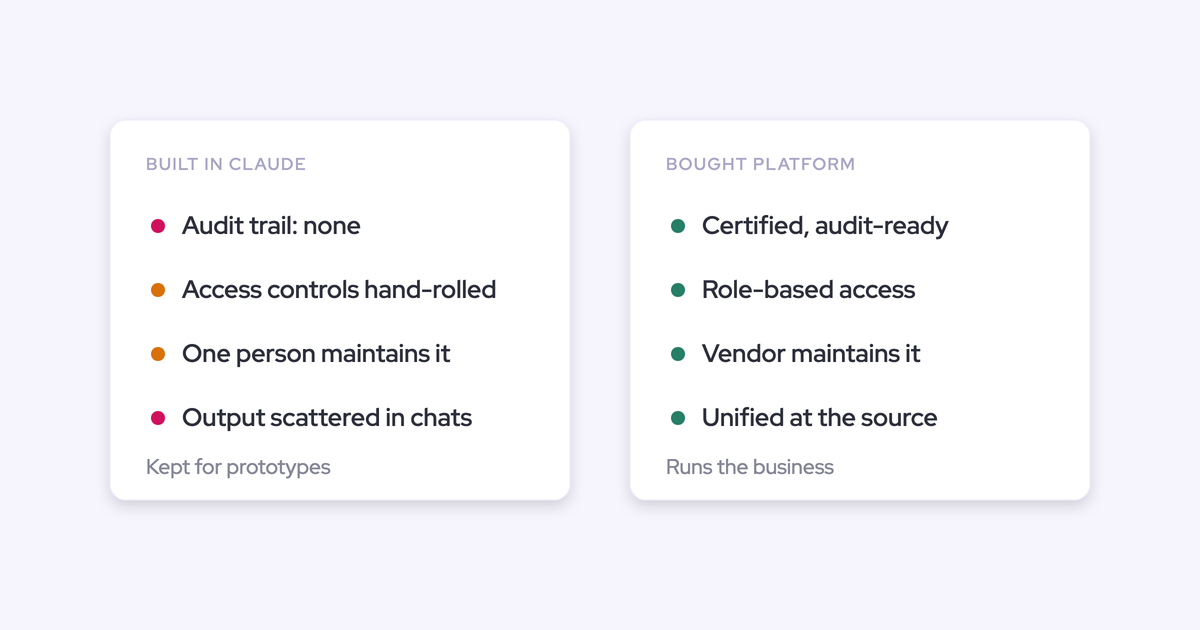
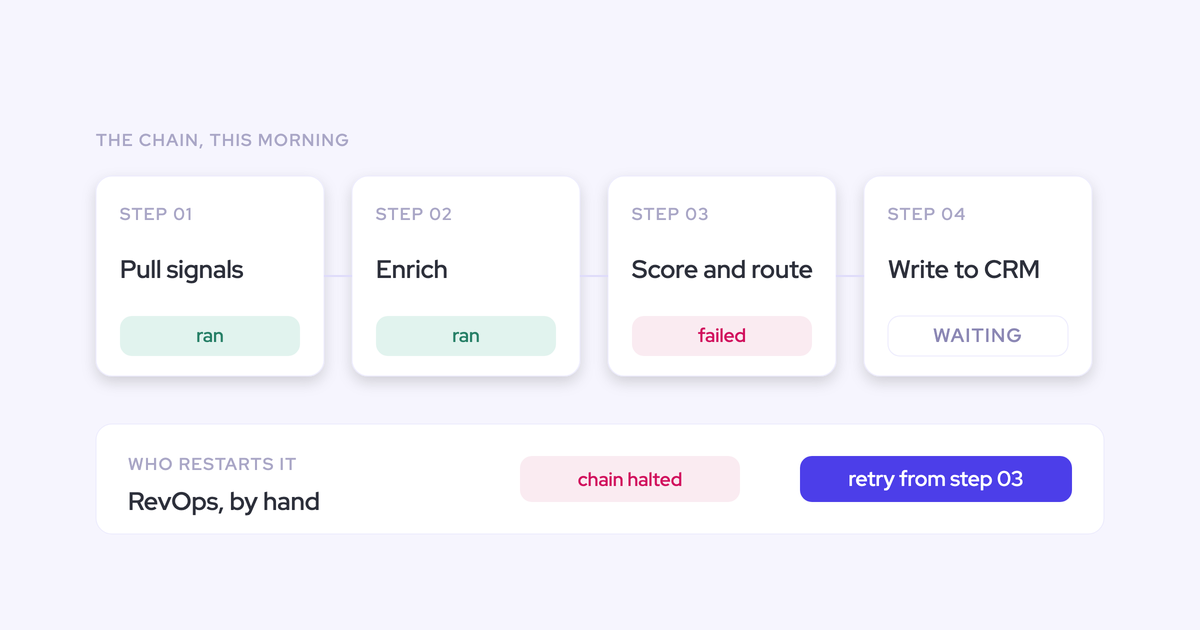
The build doesn't break at v1. It breaks at maintenance, and maintenance is where a company running real revenue can't put a hand-built tool in the path of its CRM and then explain the access controls, the tech debt, and the governance to an auditor.
Operators who've tried say it without bitterness: more power to you if you can run the business and carry that technical debt and apply the governance, but most teams of three can't, which is why "so far we haven't built anything other than we wasted a lot of time" is the sentence we hear after the enthusiasm fades.
There's a second break point, and it usually arrives first.
Philipp Stelzer, Weflow's co-founder and CPO, describes it from having seen hundreds of Salesforce setups:
"If you could just hook Claude into Salesforce and it gives you the truth. I mean, in theory, if it's a system of truth, it should be able to do it. But the reality is it just doesn't work. And so I think you have to be really good at the data foundation, your custom data structure, like the quality of the data, and then also the consolidation unification. That is basically the infrastructure."
Philipp Stelzer, Co-founder and CPO of Weflow
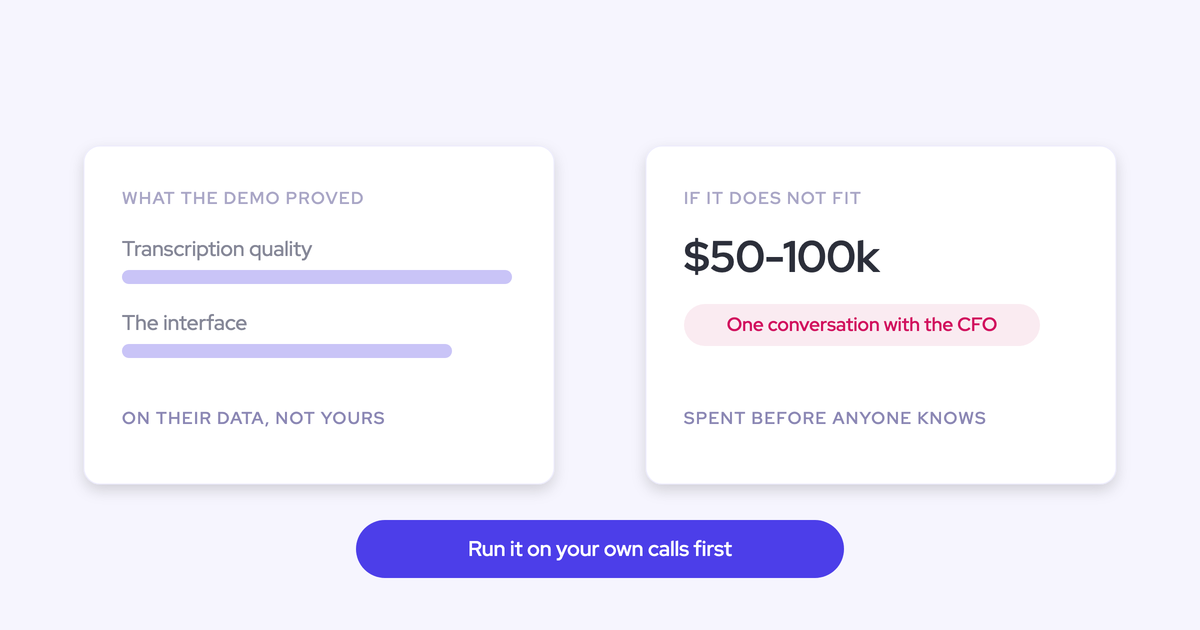
Your prototype demoed well because you asked it questions you already knew the answers to. Point it at production Salesforce, where half the meetings were never logged, fields sit empty, and the same account exists three times, and it answers confidently from bad data. The hard part of revenue AI was never the model. It's capture, mapping, and unification, and that's a permanent operational commitment, not a weekend.
Run the build through the five questions and the score is honest: it passes on CRM ownership only if you built the capture pipeline, which is the part nobody prototypes. It fails on ownership continuity the day you change roles. A governance-free build and a closed vendor fail the same test, just in different rows.
Where bought revenue tools fail the same test: closed clouds and hostage data
Buying solves the problem builds can't, governance, certifications, an accountable vendor, and the first generation of revenue tools proved that buying can fail the reachability test anyway. You've likely lived some of these patterns. They deserve to be named specifically.
Gong built the deepest conversation intelligence product in the category, and that's real. But Gong maps captured emails and meetings into its own data structure and doesn't write that activity back into your Salesforce. Everything downstream inherits the choice: reporting, warehouse models, and any agent you build on Salesforce is missing the conversation and activity layer entirely, and the history built up over years lives in Gong's system, not yours.
Clari's roll-up mechanics at enterprise scale are genuinely strong. But Clari's forecasting product and its conversation intelligence product don't share data with each other, so customers who own both end up piping transcripts out to an AI workspace and hand-feeding insight back to the CRM, which is exactly the fragmentation two products from one vendor were supposed to remove. Configuration is its own lock-in: changing a forecast call, a quarterly target, or even the columns in a view routes through Clari's professional services team, billed, on their timeline.
| Lock-in pattern from the last generation | Reachability question it fails |
| Activity mapped into the vendor's schema, never written back to Salesforce | Does the data land in CRM objects you own? |
| Insight available only inside the vendor's UI and chat | Can your own agents query it from outside? |
| Acquired products that don't share data with each other | Can you build your own layer on top? |
| Config changes gated behind billed professional services | Can you build your own layer on top? |
| Years of history leaving with the contract at renewal | What leaves at termination? |
None of this argues against buying. It argues against buying a closed cloud, which is a different thing, and the five questions are how you tell them apart in a demo.
The way out of the binary: buy the data layer, keep the option to build
The move that dissolves build-versus-buy is to split the stack into three layers and decide each one separately: a system of truth, a system of intelligence, and a system of action. The truth layer, capturing every email, meeting, and conversation and structuring it into your CRM, is permanent infrastructure with a compounding maintenance burden. Buy it. The intelligence and action layers are where the AI landscape is actually shifting every six months. Keep those open, and your six-month fear stops being a fear, because a landscape shift becomes an opportunity to rebuild a layer, not a reason to regret a contract.
This only works if the truth layer you buy passes all five reachability questions. That's the configuration Weflow was built to be.
How Weflow keeps your revenue data reachable by Claude and your own agents
Weflow's anti-lock-in argument is structural, not contractual. The Unified Data Layer combines activity, conversation, contact, and CRM data, and writes the structured output into native Salesforce objects you own: emails, meetings, and contacts against the right records, call summaries and methodology fields onto the opportunity itself. Leaving Weflow doesn't take your activity history or your field writes with it, because they never lived anywhere else.
The public Weflow API exposes recordings, transcripts, scores, and deal insights to Claude, ChatGPT, Cursor, and whatever agent framework your company runs. That's the exact "can my own agents reach it" line on your matrix, and it's live today. The honest part of that answer: an MCP server and native connectors are coming next, not shipped yet, so if your evaluation requires MCP on day one, ask us for the timeline and hold us to it.
Scored against the test:
| Question | Weflow's answer |
| Data in CRM objects you own? | Yes. Activity, contacts, and conversation-derived fields written to native Salesforce objects. |
| Bulk extraction with record IDs? | Yes. The data sits in Salesforce, so it flows through the warehouse pipes you already run, reconciled to your own record IDs. |
| External agents can query it? | Yes, via the public API today. MCP and native connectors are coming, not shipped. |
| What leaves at termination? | Nothing that matters. The structured data is already in your Salesforce. |
| Can you build on top? | Yes. The API and the Salesforce data are the surface your own agents and analysis run on. |
Real buyers make the purchase on exactly these terms. Scott Jones, SVP of GTM Revenue Intelligence & Enablement at KORE Wireless, put it this way after evaluating Gong and choosing Weflow:
"We weren't buying conversation intelligence. We were buying a unified data layer that the entire go-to-market motion could run on, and a partner who understood that distinction."
Scott Jones, SVP of GTM Revenue Intelligence & Enablement, KORE Wireless
The full KORE Wireless story covers the five-phase rollout behind that quote, from activity capture through forecasting.
What building on top of a unified data layer looks like in practice
Janis Zech, Weflow's CEO, frames the architecture the way this buyer already thinks:
"The killer use case is taking unstructured data, structuring it, and just basically bringing different context data together so that you have a system of truth, a system of intelligence, and a system of action. And whether the action is then taken by an agent or by a human is a decision that you need to make."
Janis Zech, CEO and Co-founder of Weflow
Notice what that last sentence keeps in your hands. Human-or-agent is a governance choice you make, per workflow, not a default the product imposes. That's the same posture the reachability test demands.
Concretely, six months after buying the layer, the build option looks like this. Your own analysis runs in your corporate Claude against the API, using prompts like the ones in our Claude prompts for RevOps workflows.
Your own agent workflows in Agent Builder run on the same data: a scheduled flow that pulls every Commit and Best Case deal each Monday, assesses forecast risk, writes an at-risk flag back to a Salesforce field, and emails the roll-up to your CRO. Y
ou authored that automation. It runs on infrastructure you bought, against data you own.
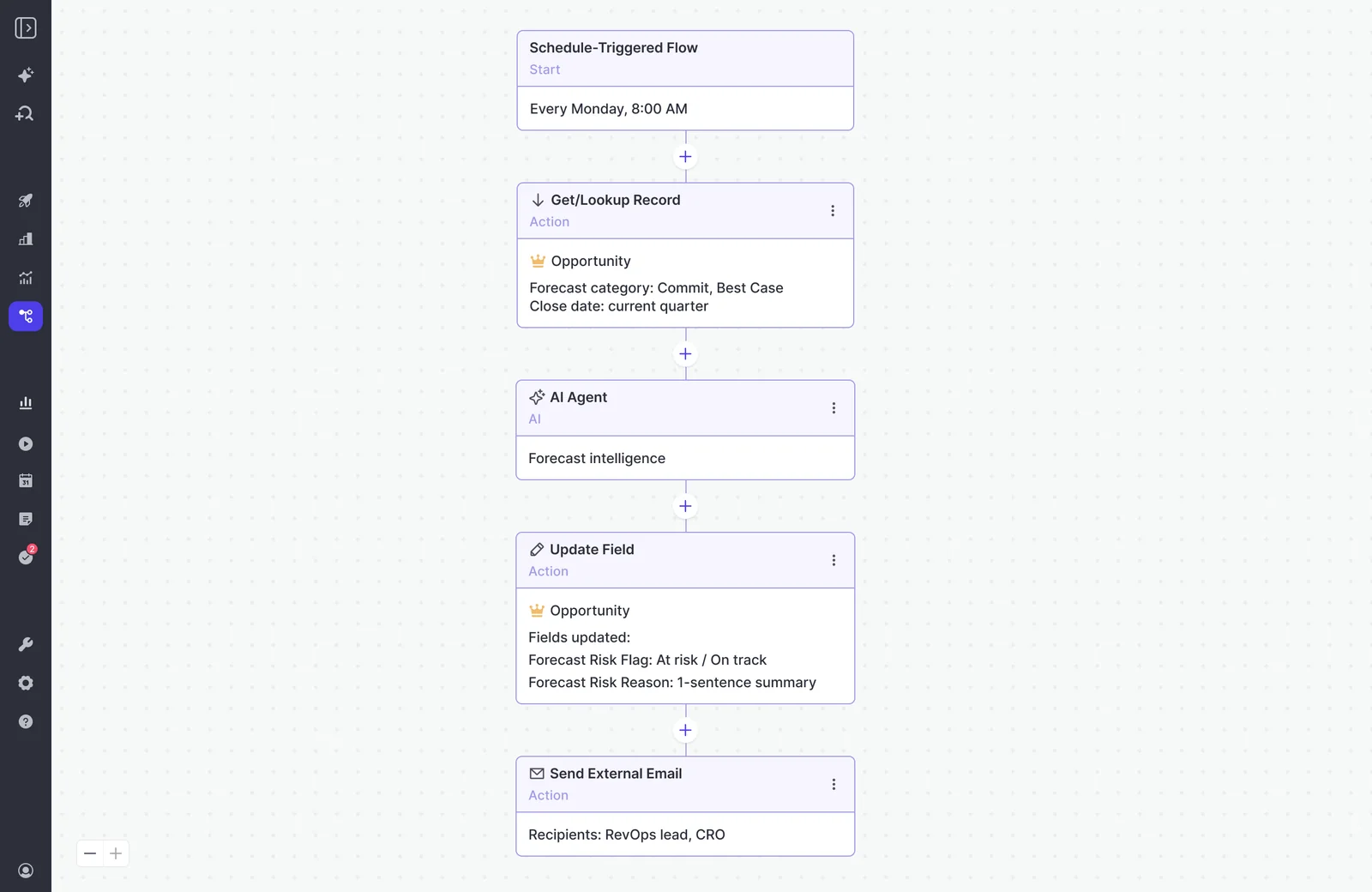
That's the buy-plus-build configuration that survives the six-month fear. If the landscape shifts and you want to rebuild the intelligence layer with whatever ships next spring, the data underneath it is in your Salesforce and behind an API.
You lose nothing by having bought the plumbing.
What buying costs a RevOps team of three
The real price of buying is implementation and adoption load, not license, and it's the dimension where the last generation left the deepest scars.
A prospect who had run both incumbents told us: "Implementation was really easy. And a lot of it's self serve compared to Clary and Gong." That difference is the whole budget question for a three-person team, because your team is the resource that can't be bought back.
Weflow's technical setup is 30 to 45 minutes with your Salesforce admin and your Google Workspace or Microsoft admin, with full time-to-value in two to three weeks, most of it spent on your business logic: AI templates, forecast cadences, warning rules.
There are no implementation fees.
Rollout is admin-side by design: capture is switched on centrally, teams are built dynamically from your Salesforce user logic, and a rep starts capturing activity without installing anything or ever signing in. That matters because reps will not do the setup step, ever, and a tool that depends on them doing it is shelfware with extra steps.
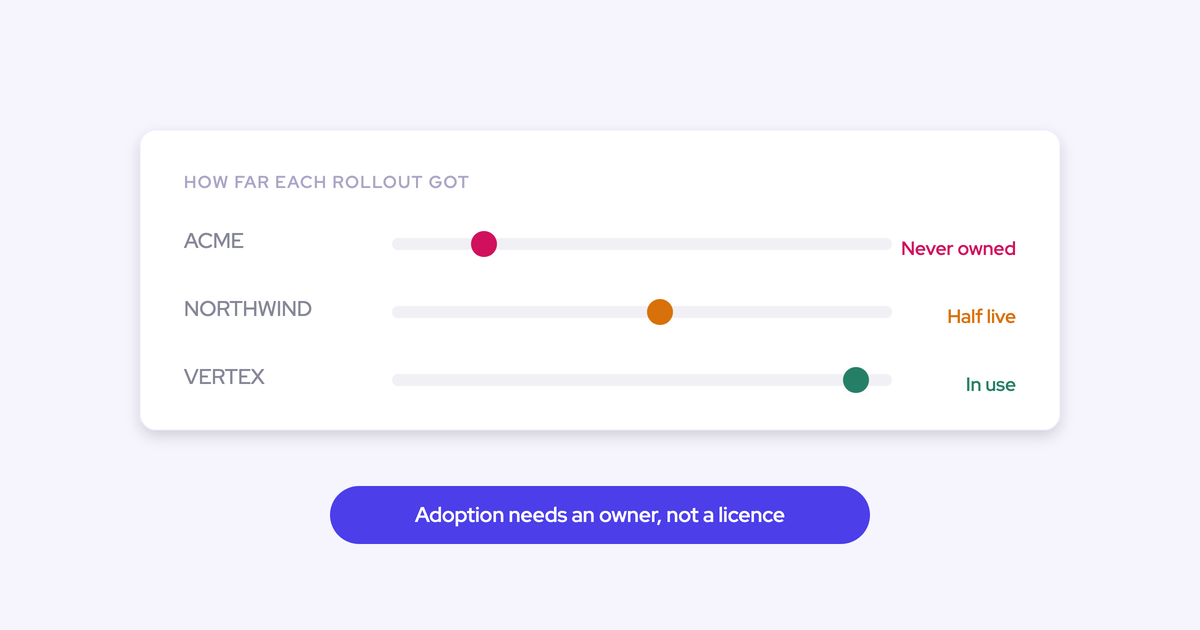
Shelfware has one root cause, and it's not the product: a purchase with no internal owner. Avoid it deliberately:
- Name the internal owner before the contract is signed, not after the kickoff call.
- Make adoption measurable from week one: who's connected, who's recording, which fields are getting written.
- Keep rollout admin-side. Anything that requires rep behavior change gets phased in after the data is already flowing.
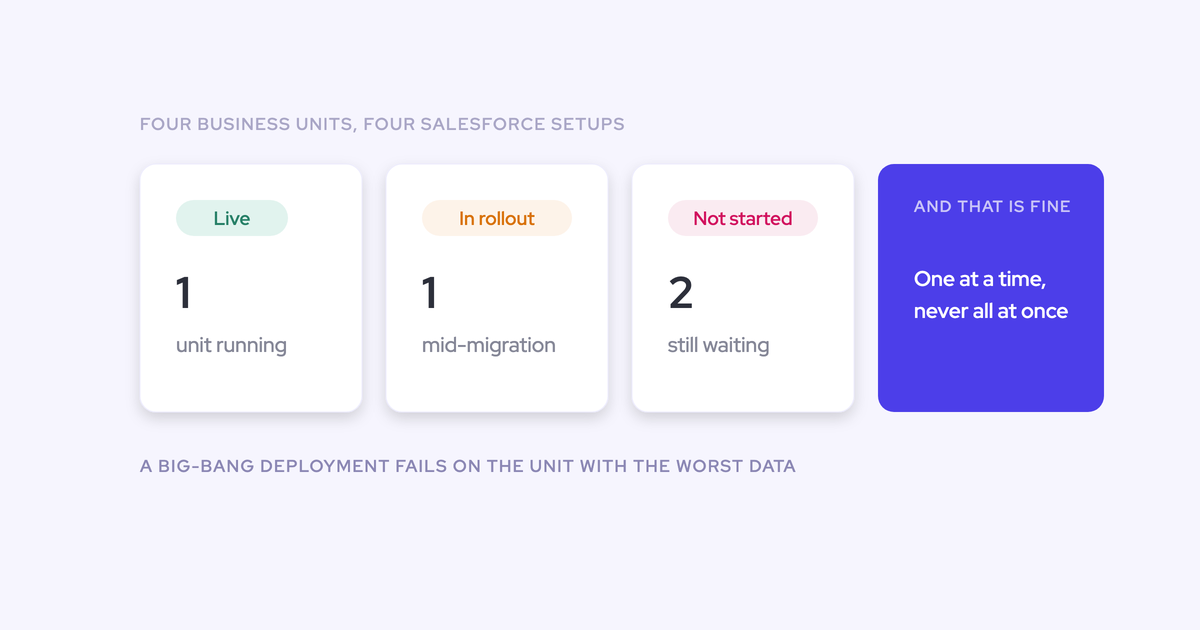
- Start phased. Pilot with a subset of users in a quiet quarter rather than dropping a change on the sales org mid-push.
On license cost: Weflow's Activity & Contact Capture starts at $19 per user per month, and the Revenue AI bundles run $49 to $79 per user per month, billed annually with a 10-user minimum. Price that against the fully loaded cost of the build, which is the maintenance, not the weekend.
FAQ
What data can we extract from Weflow via the API?
The public Weflow API exposes recordings, transcripts, scores, and deal insights, queryable from Claude, ChatGPT, Cursor, or your own agent framework. Activity, contact, and field data doesn't need the API at all, because Weflow writes it into native Salesforce objects, so your warehouse pulls it through the Salesforce extraction pipes you already run, with your own record IDs on every row.
Is there an MCP connector for our corporate Claude?
Not yet. The public API is live today and your corporate Claude can query Weflow data through it now. An MCP server and native connectors are coming next. If MCP is a gate for your evaluation, ask us for the current timeline on the call and score us on the answer.
What happens to our data if we leave Weflow?
The structured data is already in your Salesforce, so there's nothing to repatriate. Activity history, contacts, conversation-derived field values, summaries, and next steps live in native Salesforce objects you own, and they stay there whether or not you keep paying us. That's a property of the architecture, not a clause you have to negotiate.
Can we start while we're mid-contract with our current forecasting tool?
Yes, and this is the standard path. Start with Activity & Contact Capture at $19 per user per month, which replaces Einstein Activity Capture rather than colliding with your forecasting line item, so the CFO isn't asked to pay for two forecasting tools at once. The data foundation builds from day one, and you expand into deal intelligence and forecasting at your incumbent's renewal.
How do we price the fully loaded cost of building in-house?
Price the years, not the weekend. The v1 your prototype represents is the cheap part; the real line items are permanent maintenance ownership, governance and access controls, audit preparation if you carry SOC 2, ISO, or HIPAA obligations, the capture pipeline that keeps the data foundation clean, and the single-owner risk of what happens when the builder changes roles. If those numbers are small at your stage, building may genuinely win. If they're not, the prototype is showing you the demo price, not the cost.
How should we assess a revenue AI vendor's viability over three years?
Ask mid-demo, not at procurement: how big is the team, who funds the company, what shipped in the last twelve months, and who staffs your rollout and support. Buyers who bet on a vendor that couldn't support them remember exactly how it ended, so treat a defensive answer as data.
Then apply the hedge this article is about: if the data lands in your own Salesforce and stays reachable by your own AI, vendor risk is a product risk, not an existential one, because the asset survives the vendor.
If you're taking the five reachability questions into your next round of demos, bring them to ours first. Book a 30-minute demo and see how Weflow captures activity, updates Salesforce fields from calls, and rolls up your forecast, then score us against the test line by line.