What Buyers Object To When Evaluating Revenue AI: Patterns From Sales Call Objections
Learn the revenue AI objections buyers raise on sales calls: build vs buy, Agentforce, data ownership.


Buyers who hesitate on revenue AI rarely doubt the AI. When we group the objections buyers raise on our own sales calls, almost all of them come back to three questions:
- Who owns the data?
- Who maintains the thing after go-live?
- Will the cost stay predictable?
The two most common alternatives to buying are building it in Claude and switching on Salesforce Agentforce. Both stall at the same place: getting every email, meeting and call onto the right Salesforce record.
Your hesitations probably sit in one of these clusters: building it yourself, using what you already pay Salesforce for, lock-in, bad CRM data, rep adoption in a pilot, tools nobody owned, security depth, and AI pricing with a second number. For each one we show what sits behind it and what resolves it. Sometimes the honest answer is "build it," "wait" or "keep what you have."
We're the vendor on the other side of these calls. Weflow is the Revenue AI Orchestration platform for sales, customer success, and RevOps teams, built for Salesforce teams. So we'll be plain about where we fit and where we don't. If you want the product view first, here's AI-powered deal execution with Weflow.
Buyers object to ownership, upkeep and cost, not the AI
Across the objections on Weflow's sales calls, buyers almost never question whether the AI works. They question who owns the data, who keeps it running, and whether the bill stays predictable.
If your hesitations sound like the left column, you're in good company.
| What buyers worry about | What it comes down to |
|---|---|
| "We could build this ourselves in Claude" | Upkeep: who maintains the build, and who handles capture and mapping |
| "We already paid for Agentforce and Einstein" | Cost and upkeep: justifying spend to procurement while the native rollout stalls at the admin |
| "We'll get locked in while AI changes every six months" | Ownership: whether the data leaves with the contract |
| "Our CRM data is already bad" | Ownership: another source of bad data and a second place to work |
| "Reps won't use it in a short pilot" | Upkeep: change management with a sales team that has seen this before |
| "The last tool nobody owned after go-live" | Upkeep: who configures it once the vendor leaves the room |
| "Security wants every SOC 2 document" | Ownership: where data sits, which model sees it, who can access it |
| "There's no budget line, and AI pricing has a second number" | Cost: a consumption charge nobody can forecast |
The build path and the Agentforce path look like separate decisions. They aren't. Both end up on the same unanswered question about capture, which we unpack below.
How we grouped the objections from our sales calls
The core dataset is objections buyers raised on Weflow's recorded sales calls. Here's how we handled it:
- Source: objections from Weflow's recorded sales calls with revenue teams evaluating revenue AI.
- Scope: buyers at the evaluation stage, before a shortlist, where "don't buy" was still on the table.
- Grouping rule: we clustered objections by what the buyer was worried about, not by the product feature they asked about.
- Anonymization: no buyer or company is named. Quotes from buyers appear verbatim and unattributed.
- Supporting sources: RFP and security-questionnaire requirements, guests on our RevOps Lab podcast, and Weflow staff observations appear where they sharpen a point. We label them as supporting sources and don't count them as call objections.
- No count: we publish patterns, not a tally. The clusters reflect what comes up repeatedly, not a statistical sample.
Should we build it, switch on Agentforce, or wait?
Each of these paths is a respectable answer. Each also carries a cost buyers tend not to price until they're halfway down it. These are the three "don't buy" options we hear most, and the questions that decide whether they hold up.
When buyers say they'll build it themselves in Claude
The build instinct is right about one thing: a prototype is nearly free now. The parts nobody prices are maintenance, capture, mapping and audit.
"On my plane ride home from California last week with Claude, I rebuilt Clari how I would want it in Salesforce. And so then I happened to be talking about that and I saw you guys online and I was like, looks like they went and did this already. So I'm kind of trying to figure out build versus buy."
Prospect, Weflow sales call
| The build objection | |
|---|---|
| What buyers say | We have Claude and an MCP connection to Salesforce. A colleague, or we ourselves, already rebuilt part of the stack. Why buy anything? |
| What's behind it | A working prototype costs nothing to try and needs no procurement cycle. What it hasn't been asked to do yet is read every mailbox, map activity to the right deal, and keep running while the people who built it go back to their day jobs. |
| What resolves it | Build and buy aren't exclusive. Buy the capture, then build your own agents on top through Weflow's public API and MCP connector. |
Give the build its due. If you're an early-stage company with little oversight and no certifications to protect, hacking it together is a legitimate call. The blast radius is small and the leverage is real.
The economics change once you hold SOC 2, GDPR or similar obligations. Then an uncertified home-built tool sits in the path of your CRM and your customer data, and someone has to explain it to an auditor. Navin Persaud put it plainly on our podcast:
"More power to you if you can figure it out and run a business and maintain that technical debt, if you can apply governance and compliance."
The hidden cost shows up in who does the building. In-house builds are staffed by existing employees whose own work slips, and they're never finished. One team on our calls that built calls-to-MEDDPICC extraction in a general assistant got the fields filled. It still had no view of how reps worked, so there was nothing to coach from.
The build doesn't have to be the losing option, though. Customers build agents in Claude, ChatGPT or their warehouse over Weflow data at no extra charge. Only actions inside Weflow Agent Builder are metered.
When buyers say they already paid for Agentforce and Einstein
Evaluating Salesforce Agentforce is often a procurement step the buyer has to pass, not the product they expect to run. And the deployment keeps stalling at the admin.
"I'll likely have to justify why we would be looking at a third party tool to do some of these if we already have purchased Einstein and Agent Force."
Prospect, Weflow sales call
"We've bought into Salesforce, Agent Force and all their AI. From my own perspective, it's been incredibly challenging to deploy. It feels like we're getting stuck at the administrator all the time."
Prospect, Weflow sales call
| The "we already paid for it" objection | |
|---|---|
| What buyers say | We pay a lot for Salesforce. Procurement wants to know why we can't switch on what's already there. |
| What's behind it | A fair question with a fuzzy answer. The sales agents sit outside the seat price on most editions, and the capture foundation underneath has an unclear roadmap. |
| What resolves it | A written, like-for-like comparison you can attach to the business case, covering cost, where the data lives, and what happens to capture. |
Start where procurement starts: what you've paid for and never switched on. That audit is worth doing, and sometimes it closes the gap. If it does, keep what you have.
If it doesn't, put these points in writing, because nobody in the approval chain sees your demo:
- What's in the seat. On Salesforce's Core and Advanced editions, Agentforce for Sales is an add-on from $125 per user per month, and the sales agents are sold separately. Only Max at $550 includes them.
- What deployment costs. Buyers tell us partner or professional-services quotes for Agentforce deployment run into the hundreds of thousands of dollars, on top of the licence.
- What happens to capture. Teams on Einstein Activity Capture and Einstein Conversation Insights now hear about Momentum with Agentforce and can't get a straight answer on what that means for their existing setup.
- Who updates the fields. Einstein Conversation Insights doesn't write values it hears on a call into opportunity fields itself. You build a Flow or buy Agentforce for Sales.
When buyers worry about lock-in while AI changes every six months
Lock-in fear is a fear that the data leaves with the contract, and that the vendor goes quiet after the sale.
"We get locked into a vendor, and as the AI landscape is changing so quickly, in six months our position may change as to our ability to build in house."
Prospect, Weflow sales call
| The lock-in objection | |
|---|---|
| What buyers say | If we sign now, we can't build in-house later. And if the vendor gets acquired or shrinks, we're stuck. |
| What's behind it | They've watched a vendor hold the activity history, transcripts and scores hostage at renewal. Some have also lived through support going quiet after a merger or a small vendor that couldn't staff them. |
| What resolves it | Your data stays in your Salesforce, your own agents can query it, and exit terms get agreed before signing. |
Weflow writes captured emails, meetings, contacts and AI field values onto Salesforce records you own and already report on. If you build in-house later, your agents read that data through Weflow's MCP connector or public API. The connector reaches playbook output, call summaries, transcripts and forecast calls.
In RFPs we answer (a supporting source, not a call objection), procurement now asks for the export format, the destruction terms and the transition support committed at no extra cost. That's the right instinct. Put it in the contract, whoever you pick.
One case where we'd tell you to stay put: a private equity sponsor has standardized Clari across the portfolio. Displacing it is a political fight you won't win in year one.
"The PE firm really loves Clari. They've been using it for years. So they like the visual. I try to approach it like would you be interested in changing that? And that was kind of a non starter."
Prospect, Weflow sales call
Coexist instead. Clean capture written into Salesforce makes the incumbent better, and it leaves the door open for later.
Why Claude builds and Agentforce rollouts both stall on capture
Dashboards and agents are the easy part, because they work on data that's already in Salesforce. Getting every email, meeting and call onto the right contact, account and opportunity is the part internal builds and native deployments underestimate. It's also the part teams building most of their own stack still buy.
We see this pattern across the build conversations on our calls. One team replacing Clari rebuilt its forecast views quickly. Another had built its own meeting recorder and hadn't started on mapping recordings to Salesforce at all.
| The work | Claude build | Salesforce Agentforce path |
|---|---|---|
| Forecast views and dashboards | Handles it well. The data is already in Salesforce, so it's mostly presentation. | Handles it well through Salesforce's own reports. |
| Questions and agents over CRM data | Handles it through MCP. Buyers tell us it's read-only today, with write-back still being scoped. | Handles it with Agentforce for Sales, an add-on below the Max edition. |
| Reading every mailbox and calendar at volume | Left to your team: a server-side connection to the mailbox and a write path back into the CRM. | Einstein Activity Capture, with an open roadmap question since Momentum. |
| Mapping activity when there are several open deals | Left to your team, plus an interface where a human can see and correct the mapping. | Depends on the capture layer underneath. |
| Writing call content into fields | Works per call. Summaries can miss what the call was about. | A Flow your admin builds, or Agentforce for Sales. |
| Troubleshooting when something doesn't log | Left to whoever built it. | Left to your admin, where buyers say deployment keeps stalling. |
| Permissions and audit | Left to your team to govern and certify. | Inherits Salesforce's model. |
Our co-founder Philipp has spent more time than most watching teams try the shortcut:
"If you could just hook Claude into Salesforce and it gives you the truth. I mean, in theory, if it's a system of truth, it should be able to do it. But the reality is it just doesn't work."
Claude reasons well over whatever you give it. Salesforce Agentforce acts on whatever sits in your org. Neither one puts the activity there.
That's the job Weflow Activity & Contact Capture and Weflow Conversation Intelligence do: they capture emails, meetings, contacts and calls and write them onto the right Salesforce records. Then your Claude agents and your Salesforce reports both run on complete data.
Will another tool make our Salesforce and reps worse?
These objections come from scar tissue about adoption and data quality, not from doubts about the product. Buyers have inherited half-used tools, watched a rollout frustrate a whole field team, and paid for licences nobody opened. They assume it'll happen again unless someone shows them why it won't.
When buyers say their CRM data is already bad
The fear is a second source of bad data and a second place reps work.
"We just produce a lot of bad data. So we didn't want to add this onto another source of bad data."
Prospect, Weflow sales call
"My only concern is that I feel like we're just moving from one CRM to another here."
Prospect, Weflow sales call
| The bad data objection | |
|---|---|
| What buyers say | The team can't keep Salesforce updated as it is. Another tool makes it more complicated. |
| What's behind it | Reps won't do setup steps, and every rep-dependent tool has failed before. They also picture reps asking which system is the real one. |
| What resolves it | Capture that lands on the Salesforce records you already own, switched on centrally by an admin, with nothing for reps to install. |
Bad data is usually the argument for capture, not against it. Reps don't hand-log activity, so the CRM runs on what they remembered. Weflow Activity & Contact Capture writes emails, meetings and contacts onto your existing Salesforce records, so Salesforce stays the system of record and there's no second database to reconcile.
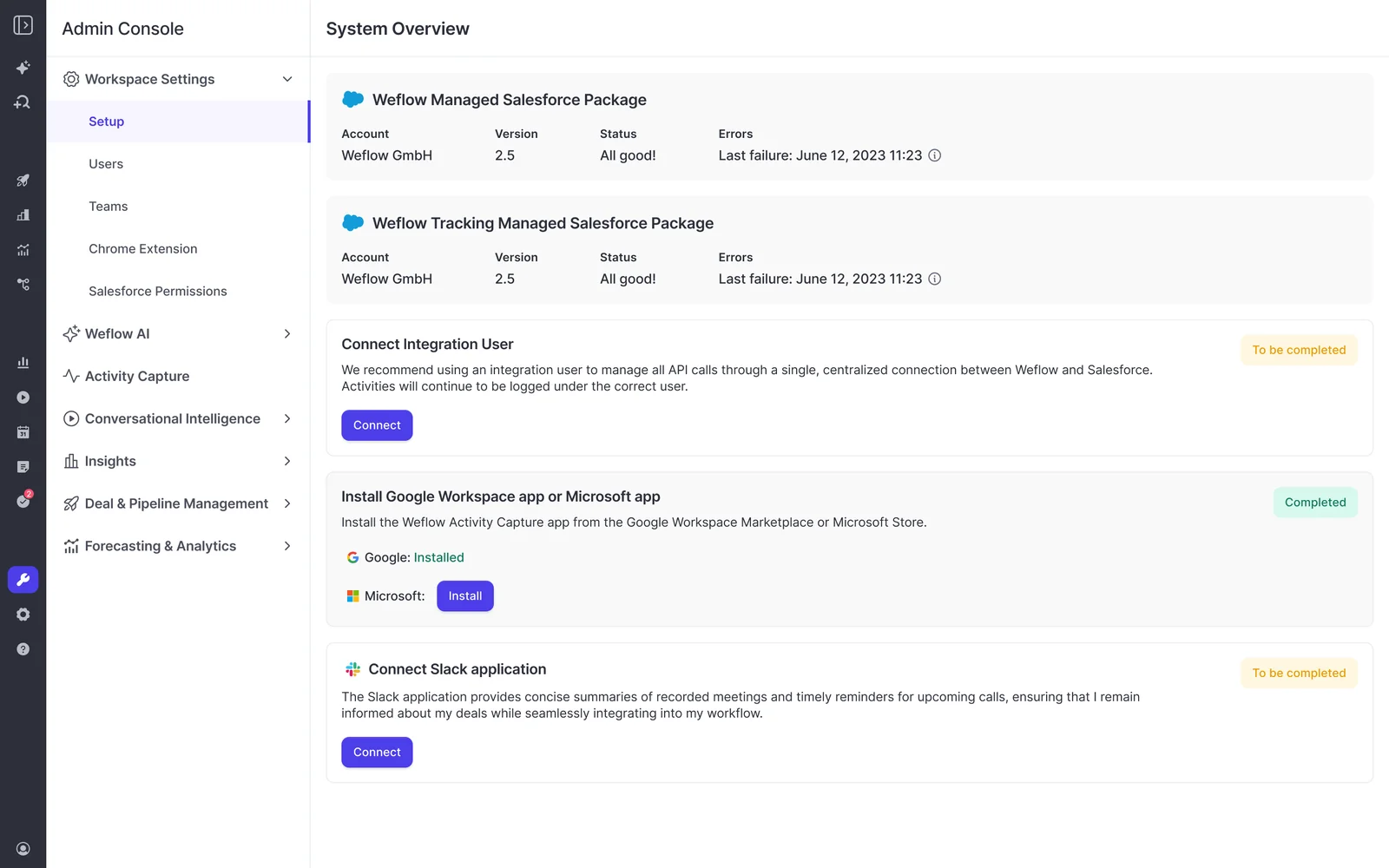
The setup sits with your admins, not your reps. Your Salesforce admin and your Google Workspace or Microsoft admin connect Weflow server-side.
You also don't need perfection to win this one. One buyer told us exactly where the bar sits for an AI-filled field:
"If it is only 90% accurate, then I will take it, I will work with it."
Prospect, Weflow sales call
The comparison isn't AI against a perfect rep. It's AI against an empty field.
There's one limit to plan for. Post-sale calls, like implementation calls and escalations, can attach to an unrelated opportunity when a participant holds a contact role somewhere. If your customer success team records calls, scope their capture to the account or to renewal opportunities, and write their field templates for the account object.
When buyers doubt reps will use it in a short pilot
A conversation intelligence pilot with reps who've never been recorded becomes a vote on being recorded, not a test of the product. And peak quarters are off-limits for good reason.
"Sales team adoption is absolute key. In a four to six week pilot I have concerns about how much usage we can get."
Prospect, Weflow sales call
"We can't make any changes to the sales guys process in Q3 because our Q3 is by far the most important quarter of the year. So I sort of have to leave the sales guys alone. But in Q4 I would like to test out a solution with a subset of users."
Prospect, Weflow sales call
| The pilot objection | |
|---|---|
| What buyers say | A four-to-six-week pilot won't get enough usage, and we can't touch the sales process in our biggest quarter. |
| What's behind it | They've seen a tool rolled out to a whole field team at once, and it frustrated everybody. |
| What resolves it | A phased rollout that asks nothing of reps first, scheduled outside the peak quarter. |
Treat the parts of the platform differently. Capture trials cleanly because it asks nothing of the rep. Recording calls is a leadership decision about how the team runs, so make it as one and back it with enablement, instead of putting it to a four-week vote.
KORE Wireless ran this as five phases, with Weflow owning onboarding from start to finish:
- Weflow Activity & Contact Capture
- Weflow Conversation Intelligence
- Coaching
- Deal intelligence
- Forecasting
"I made a deliberate choice to let Weflow own end-to-end onboarding rather than pull my team off revenue-generating work. That's exactly the kind of partnership leverage I was looking for."
Scott Jones, SVP of GTM Revenue Intelligence & Enablement, KORE Wireless
When buyers remember a tool nobody owned after go-live
Past tools failed because nobody internal owned the configuration, and nobody included the sales leaders who had to use them.
"We never had a proper business owner for copilot which resulted like in the situation we're at no adoption."
Prospect, Weflow sales call
| The shelfware objection | |
|---|---|
| What buyers say | We bought a forecasting tool, half-implemented it, and now RevOps rebuilds the dashboard on raw Salesforce data anyway. |
| What's behind it | No named owner, a purchase made top-down without the sales leaders, and every configuration change sent as a ticket to the vendor. |
| What resolves it | A named internal owner, sellers who see the tool before it's chosen, and configuration your admin can do without vendor tickets. |
Capture largely runs itself. Conversation intelligence doesn't: per-team prompts, scorecards and field mappings go stale without an owner, and the output degrades until people stop trusting it.
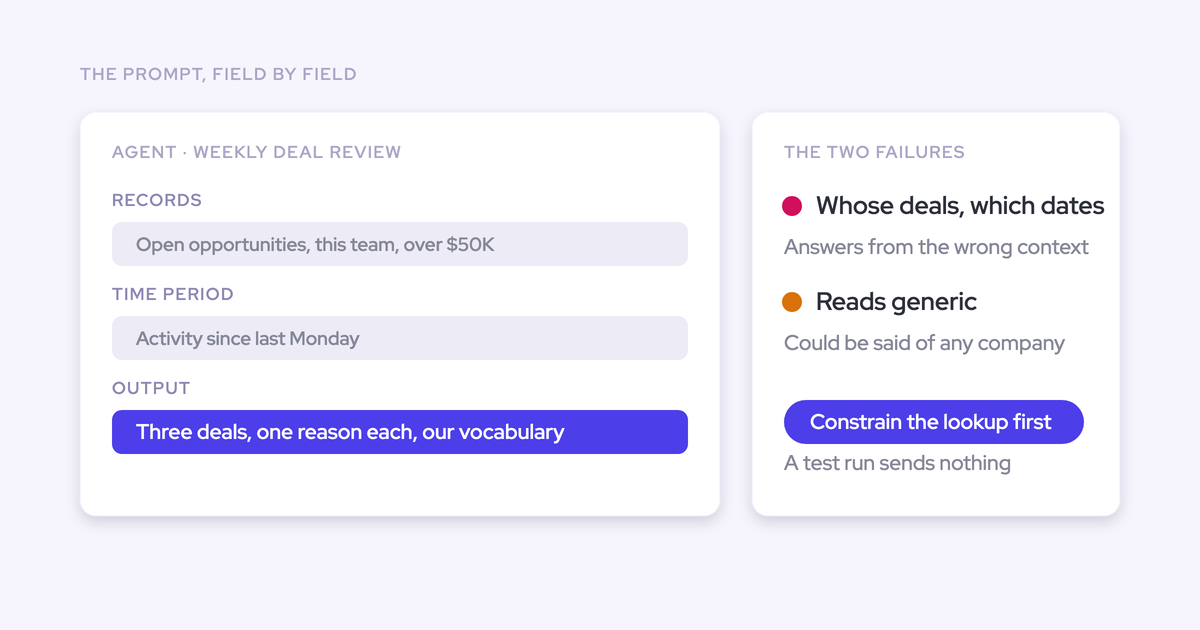
In Weflow, your admin handles that work in the admin console, including Context and Sources, where you tell the AI what each Salesforce object and field means. That's also how it learns your vocabulary, so summaries use your product and competitor names instead of generic phrasing.
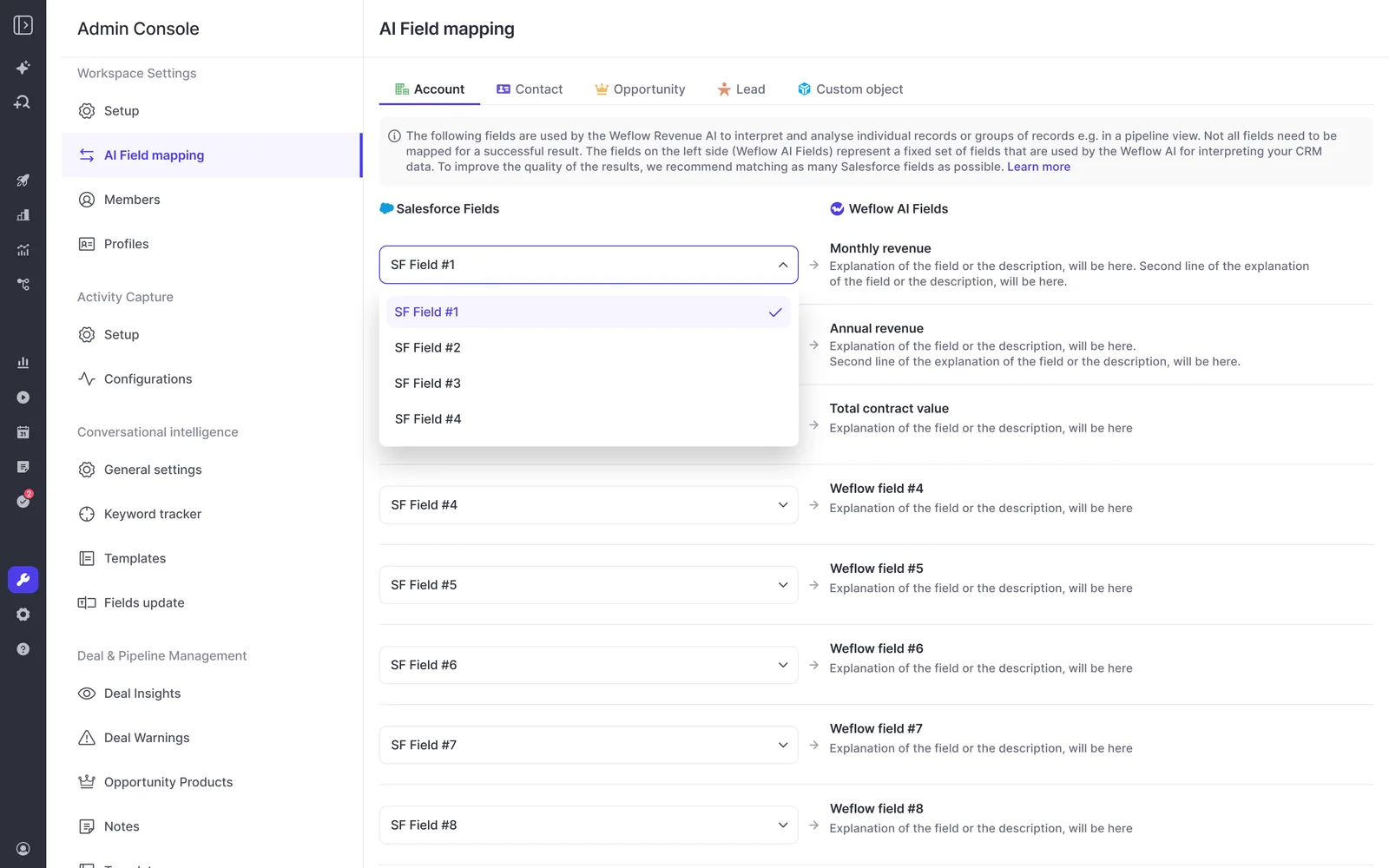
Before you sign anything, with any vendor:
- Name the internal owner of the configuration.
- Show sellers a day-in-the-life demo, not the buying-committee demo.
- Watch an admin change a forecast or template setting live, without a support ticket.
- Bring the first-line sales leaders in before the decision, not after it.
What security, finance and procurement need before they approve
These gates now come before the demo, and they reward exact answers over checklists. A vague answer here ends the evaluation regardless of how good the product looked.
When security wants every SOC 2 document, in depth
Approval boards want depth: which model, where the data sits, how long it's retained, and who can see what.
"The issue is not the number of red flags. The issue is the extent of the information the approval board is looking for."
Prospect, Weflow sales call
"French law has some specific regulations and we have a lot of people in France. So they are kind of concerned about keeping customer data longer than 90 days, or 30 days even."
Prospect, Weflow sales call
| The security depth objection | |
|---|---|
| What buyers say | Security wants every SOC 2 document before we go anywhere near AI. |
| What's behind it | Some have had pipeline data stolen. Others answer to EU retention rules. All of them now ask which model sits behind the feature. |
| What resolves it | Exact claims, a named model provider, and residency that follows a system security has already approved. |
Here's what you can hand your security team today:
| What reviewers ask | What Weflow can state today |
|---|---|
| Which certifications do you hold? | SOC 2 Type II and GDPR compliance. |
| What about ISO 27001? | A commitment with a target date of December 2026, not a certification Weflow holds today. |
| Which model sees our data? | Third-party foundation models, primarily Google Gemini. Weflow doesn't run a model of its own. |
| Does the model provider keep our data? | Zero Data Retention for AI processing. |
| Is our data used for training? | No. Customer data is never used to train AI models. |
| Where is our data stored? | In the region of your Salesforce org, so a European org keeps its Weflow data in Europe. |
| And video recordings? | Weflow holds them and streams them back, because Salesforce is a poor place for large files. |
| Who can see what? | Weflow inherits Salesforce permission sets, field-level security and role hierarchy. |
| What isn't inherited? | Restrictions done through list views or Lightning component visibility. An admin rebuilds those with centrally assigned views. |
| Can external assistants reach our transcripts? | Only if an admin enables MCP and, separately, transcript access. The console lists every connected user. |
When there's no budget line and AI pricing has a second number
Buyers read AI pricing for the consumption charge on top of the seat, because that's the number that makes a budget indefensible.
"With each of these platforms, there's also that component of credits, like different pricing structures."
Prospect, Weflow sales call
| The budget objection | |
|---|---|
| What buyers say | This wasn't in the plan, I'll have to find budget, and I can't forecast the AI part of the bill. |
| What's behind it | They've watched a well-loved metered feature quietly double a contract by month end. |
| What resolves it | A flat seat price, published openly, with metering confined to one product. |
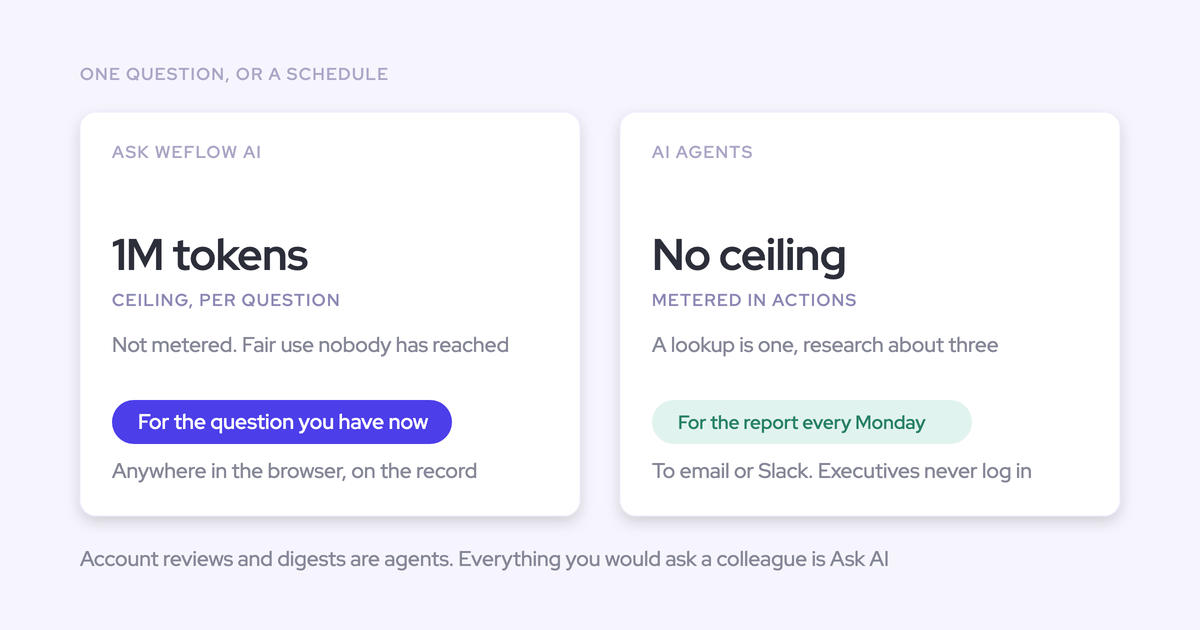
Every Weflow seat includes the AI people use daily: Ask Weflow AI, AI summaries and AI field updates. Recordings and transcripts aren't capped either, and nobody has to ration who asks questions. Ask Weflow AI runs under a fair use policy no customer has reached yet.
Weflow Agent Builder is the only consumption-priced product, priced per workspace rather than per user. Its usage shows up in the Agent Usage view of the admin console.
| Product or bundle | List price | What it covers |
|---|---|---|
| Weflow Activity & Contact Capture | $19 per user per month | Emails, meetings and contacts synced to Salesforce |
| Weflow Conversation Intelligence | $39 per user per month | Recording, transcripts, summaries, AI field updates, coaching |
| Weflow Deal Intelligence & Forecasting | $39 per user per month | Pipeline management, deal signals, forecasting |
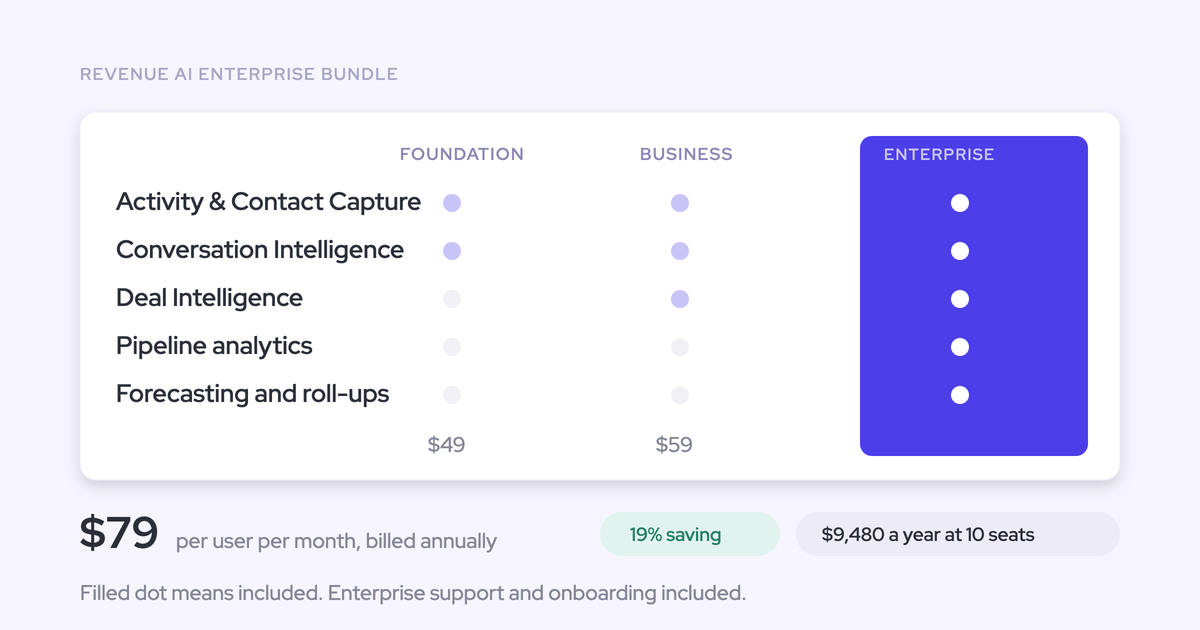
| Revenue AI Foundation | $49 per user per month | Activity & Contact Capture plus Conversation Intelligence |
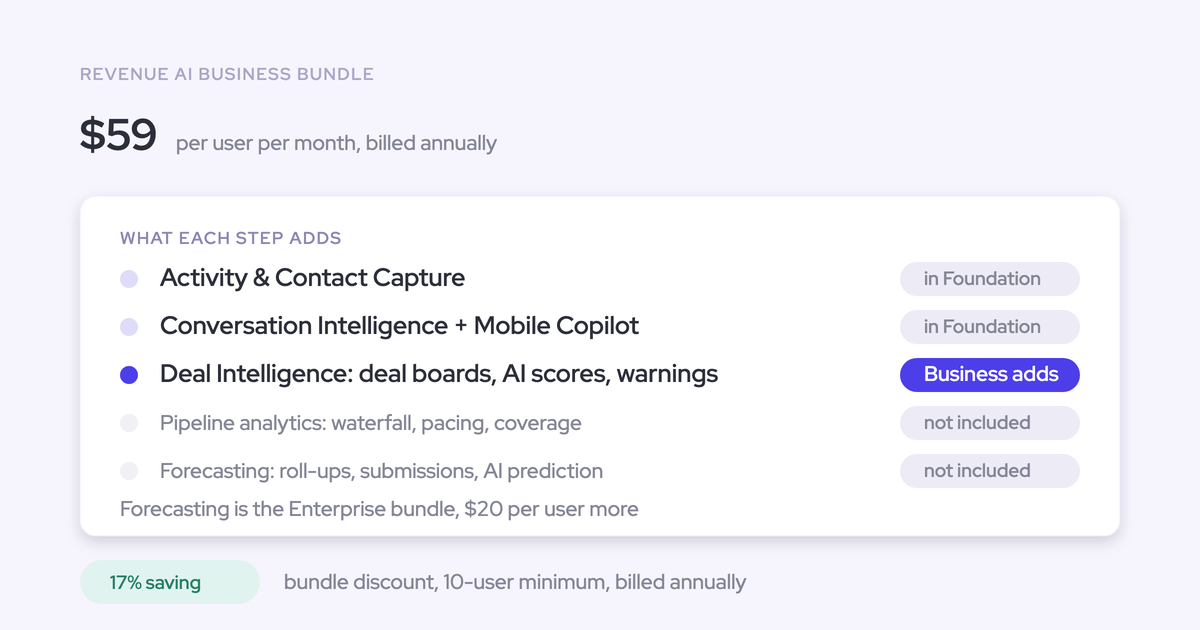
| Revenue AI Business | $59 per user per month | Foundation plus Deal Intelligence, without forecasting |
| Revenue AI Enterprise | $79 per user per month | All Weflow products, including Forecasting |
| Weflow Agent Builder Free | Included | 25 agent actions per month, in every plan |
| Weflow Agent Builder Growth | $299 per month | 500 agent actions |
| Weflow Agent Builder Scale | $999 per month | 2,500 agent actions |
| Weflow Agent Builder Enterprise | Custom | Custom package |
| Terms | Minimum 10 users, billed annually | Ask Weflow AI Pro included in every plan |
If the money isn't in this year's plan, you have options. Some buyers on our calls route the purchase through a separate AI budget, which often carries lighter scrutiny and faster sign-off. The security review happens either way.
Who in the buying committee raises which objection
The objections divide by who carries them. Knowing which argument goes to whom saves you a lot of meetings.
| Role | Objection they raise | What they need to see | Their part in the decision |
|---|---|---|---|
| RevOps | Can we build it? Will it add bad data? | The build priced with maintenance, and capture landing on existing Salesforce records | Evaluates and runs the process |
| CRO | Will I get the view I show the board? | The forecast view they'll open, since many CROs don't work in Salesforce | Decides |
| Finance | Can I forecast this bill? | Seat pricing and a cap on the metered part | Holds the budget |
| Security | Which model, where, who can access it? | Exact trust claims and a named model provider | Gates approval |
| Procurement | Why not what we already pay for? What happens at exit? | A written Agentforce comparison and exit terms | Gates approval |
| Sales managers and reps | Why are we doing this? | A day-in-the-life demo and a rollout that asks little of them first | Decide whether it gets used |
This segmentation is qualitative. It reflects who raises what on our calls, not a count by role.
Where Weflow isn't the right answer for your stack
Every vendor sounds the same until one tells you what it doesn't do. Here's our list:
- No sequencing or dialing. Weflow doesn't run cadences or dial. Keep Outreach, Salesloft or Apollo, and run Weflow alongside them in compatibility mode.
- Salesforce only. Weflow works exclusively with Salesforce. If you run HubSpot, Dynamics or Pipedrive, we're not your tool.
- No saved views through the API or MCP. An external agent can't ask for a deal board by name. It rebuilds the filter from the raw records.
- Ask Weflow AI doesn't read your internal knowledge systems. Process docs, product guides and ticketing stay outside it. Keep your general assistant for those and reach Weflow from it through MCP.
- A PE-standardized Clari. Coexist with it rather than fight it. Capture writes clean activity into Salesforce, which Clari then reads.
- An early-stage team with little oversight. If you have no certifications to protect and someone enjoys building, hack it together and revisit when an auditor starts asking questions.
What we'd put in your revenue AI business case
A defensible business case answers the ownership, maintenance and cost questions before anyone in the approval chain asks them. Spencer Hardey's rule is the right place to start:
"I am a fan of before I immediately go out and try to purchase a solution to solve something, I really wanna make sure that I understand the problem the company's facing, have definitions and success metrics with all the stakeholders."
Here's the order we'd write it in, the way a budget committee reads it:
- The problem and success metrics, agreed first. Get every stakeholder on the same definitions, and do one manual pass to set the baseline any tool has to beat.
- The build option, priced with maintenance. Count the people pulled off their own work, the mailbox connection, the mapping interface and the write-back, not only the prototype.
- The capture question, answered. Say who puts every email, meeting and call onto the right Salesforce record, and how often it fails.
- The Agentforce comparison, in writing. Cover what's in your edition, what's an add-on, what deployment costs, and what happens to your capture layer.
- The rollout phases and a named owner. Capture first, then conversation intelligence, with the internal configuration owner named before the contract.
- The security answers. Certifications, model provider, residency, retention and permissions, stated exactly.
- The cost cap and exit terms. Show what's flat, what's metered and where the meter stops, plus the export and destruction terms you've agreed.
If you own "the AI strategy" now and want a working document to build from, grab our FREE RevOps AI Orchestrator Cheatsheet.
How to cite these revenue AI buyer objection patterns
The finding in one line: buyers evaluating revenue AI rarely object to the AI itself; their objections center on who owns the data, who maintains the tool, and whether the cost stays predictable, and the build-in-Claude and Salesforce Agentforce paths both stall on capturing activity onto the right Salesforce records.
The source is objections raised by buyers on Weflow's recorded sales calls, grouped by theme, with buyers anonymized. RFP and security-questionnaire requirements, RevOps Lab podcast guests and Weflow staff observations appear as separately labeled supporting sources, not as call objections.
Suggested citation:
Weflow, "What Buyers Object To When Evaluating Revenue AI: Patterns From Sales Call Objections." Based on objections from Weflow's recorded sales calls, grouped by theme, buyers anonymized.
FAQ: evaluating revenue AI before you buy
What does revenue AI cost all in, and can the AI bill grow with adoption?
Weflow's products start at $19 per user per month and bundles run $49 to $79, with a 10-user minimum and annual billing. Ask Weflow AI, AI summaries and AI field updates are included in the seat, so heavier use doesn't change that number. The only metered product is Weflow Agent Builder, sold in fixed monthly tiers per workspace, starting with 25 free actions in every plan.
Can we fund a revenue AI tool from the AI budget?
Many buyers on our calls do exactly that when the purchase wasn't in this year's plan. An AI line item often moves faster with fewer approvals than a sales-software purchase. The security review still applies, so have the answers ready either way.
How long does a Weflow rollout take, and in what order?
Technical setup takes 30 to 45 minutes with your Salesforce admin and your Google Workspace or Microsoft admin. Full time to value runs one to three weeks, mostly spent configuring AI templates, forecast types, quotas, warning rules and pipeline views. KORE Wireless went live in five phases: capture, conversation intelligence, coaching, deal intelligence, then forecasting.
Should we run a pilot during our peak sales quarter?
No. Leave the sales team alone in the quarter that matters most and test with a subset of users afterward. Start with Weflow Activity & Contact Capture, which asks nothing of reps, and treat call recording as a leadership decision rather than a four-week vote.
Can our own Claude agents read Weflow data, and what can't they see?
Yes. Weflow's read-only MCP connector and public API give Claude, ChatGPT or your warehouse access to playbook output, call summaries, transcripts and forecast calls, at no extra charge. Admins enable MCP per workspace and decide separately whether transcripts are reachable. Saved views aren't exposed, so an external agent rebuilds those filters from the records.
What happens to our data if we leave Weflow?
Captured emails, meetings, contacts and AI field values live on your Salesforce records, so they stay in your org when the contract ends. Video recordings are the exception: Weflow holds them and streams them back. Agree the export and destruction terms in the contract before you sign, as you would with any vendor.
How does Weflow coexist with Agentforce, Einstein, Clari or Gong?
Weflow writes into Salesforce, so tools that read your Salesforce data work on a fuller record. Two capture tools on the same inbox compete over the same emails, so run one capture layer at a time. With a PE-standardized Clari, coexist and let it read cleaner activity. KORE Wireless evaluated Gong and chose Weflow, and teams that switch from Gong capture 30 to 35% more emails and meetings.
Who owns Weflow configuration internally, and how much ongoing work is it?
Name one owner, usually in RevOps or the Salesforce admin team. Capture largely runs itself once it's on. Conversation intelligence templates, scorecards and field mappings need that owner to keep them current, and they change them in the admin console without filing vendor tickets.
How often do reps override automatic activity mapping?
We don't publish an override rate, and no vendor we know of does. Reps can change any mapping, and AI playbooks evaluate a rep's field override for plausibility against the deal. The way to size the workload is a trial on your own Salesforce data, which our 14-day free trial is built for.
Does Weflow replace our sequencing and dialing tool?
No. Weflow doesn't do sequencing or dialing. Keep Outreach, Salesloft or Apollo, and Weflow runs alongside them in compatibility mode so activity doesn't log twice.