Can Salesforce Momentum Replace Gong or Clari Copilot? How It Runs on Top of an Existing Call Recorder
Learn when Salesforce Momentum replaces Gong or Clari Copilot vs. running on your recorder.


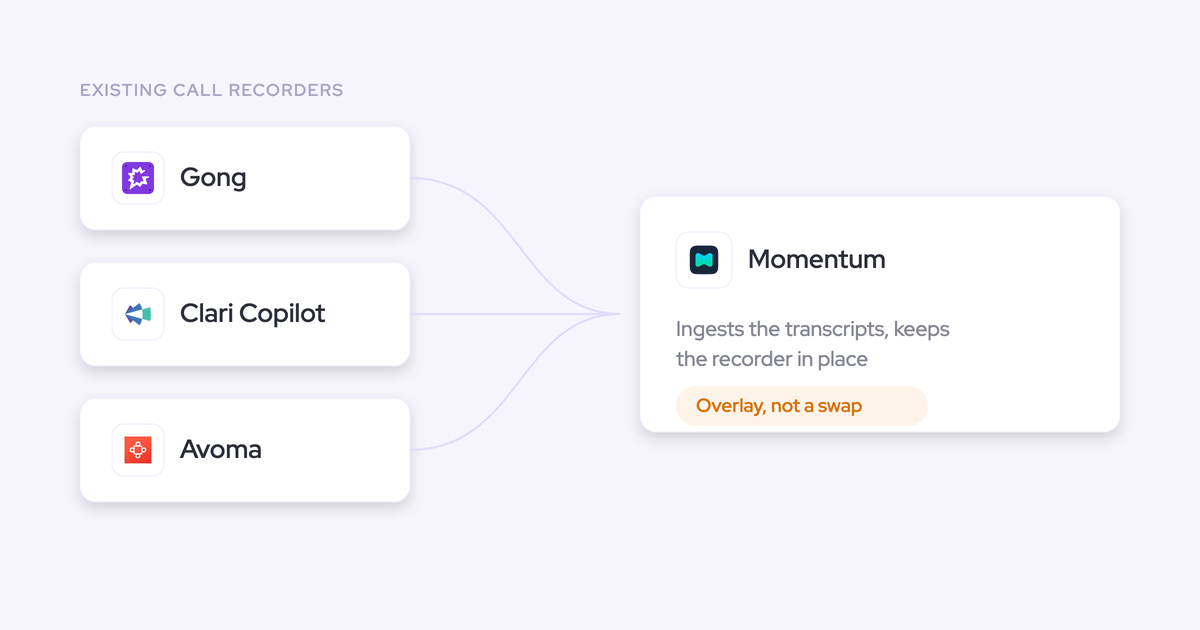

Momentum can replace Gong or Clari Copilot, but only in one of the two ways it deploys.
Salesforce bought Momentum and now calls it the data foundation beneath Agentforce: a layer that captures conversations, structures them, and acts on that data inside Salesforce.
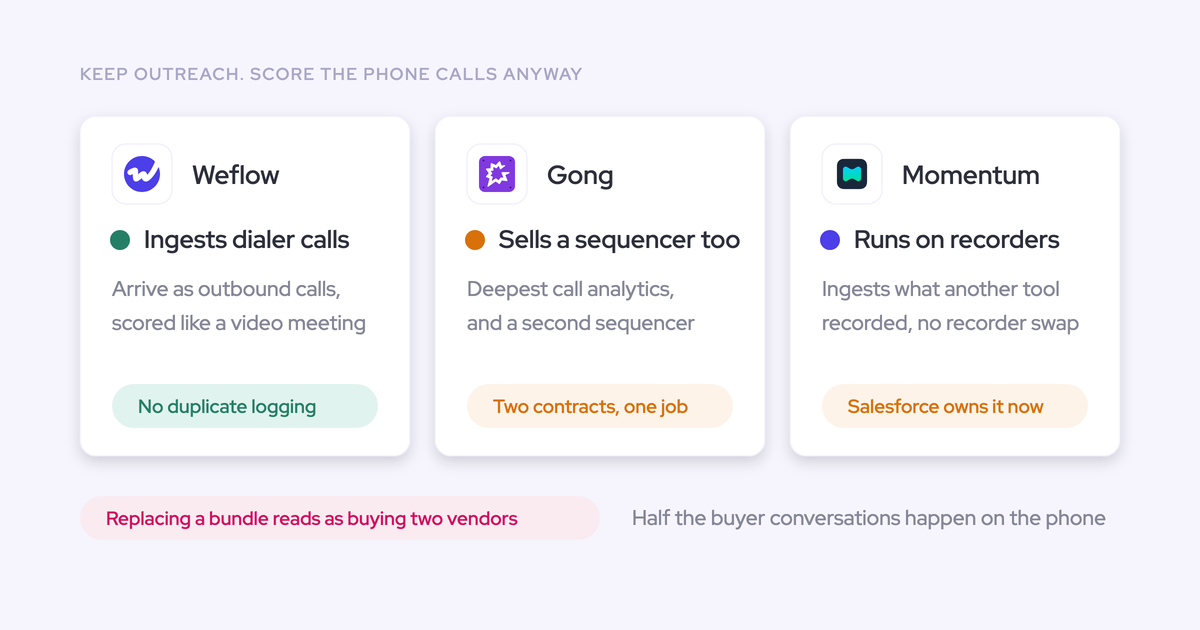
In its original and still-live shape, Momentum ingests transcripts your existing recorder produces: Gong, Clari Copilot, Avoma. It acts on them, it doesn't replace them.
In the other shape, Momentum's own recorder is the source and the incumbent can actually be switched off.
One of those consolidates. The other adds a line item to a stack you were trying to shrink. Both route you into an Agentforce commercial conversation.
Here's how to tell which one you'd end up with.
What is Salesforce Momentum after the acquisition
Momentum is a Salesforce-owned layer that captures unstructured conversation data from third-party channels like Zoom and Google Meet and feeds it into Agentforce 360 and Slack.
Salesforce positions it in three layers: capture and ingest, structure and context, execute and orchestrate. The claim is deliberately not "better recorder." It's the precondition for everything agentic Salesforce sells, with general availability aimed at Dreamforce.
The part that matters for a team standardized on Salesforce: Momentum is now the stated future of call recording and activity capture inside Salesforce. Asked in Salesforce's own Momentum webinar what the acquisition means for Einstein Activity Capture and Einstein Conversation Insights, the answer was written plainly:
Momentum will be the future of call recording and activity capture at SFDC. More to come about this at Dreamforce.
No migration path. No end-of-life date. No pricing consequence.
So if you standardized on EAC because it was native and included, "native" just moved. The native path now runs through a separately packaged product sold with Agentforce, not through the capture engine already switched on in your org. That's the shift underneath every conversation you're about to have.
Momentum's two deployment shapes: overlay or replacement recorder
There are two ways Momentum lands in a stack, and they produce opposite outcomes on the only question your CFO cares about: what gets switched off.
| Overlay on your existing recorder | Momentum as the recorder | |
|---|---|---|
| What records the call | Gong, Clari Copilot, Avoma or whatever you run today | Momentum's own capture on Zoom, Teams and Google Meet, with a bot for platforms it doesn't integrate with natively |
| What Momentum does | Ingests the transcript, writes Salesforce fields, triggers automations, posts clips into Slack | Captures, transcribes, structures, writes fields, coaches, and orchestrates from its own source data |
| What you keep paying for | Your recorder's full contract, plus Momentum, plus the Agentforce packaging | Momentum inside the Agentforce packaging |
| What you can switch off | Nothing | The incumbent recorder |
| What you inherit | Your incumbent's transcription quality and language coverage | Momentum's own coverage, including 100+ languages |
| Consolidation outcome | One more line item | One line item removed, one added |
Both shapes are real. Momentum sells both. The reason nobody draws this line for you is that the marketing frame is the same either way.
How Momentum overlays Gong, Clari Copilot, and Avoma
In overlay mode, Momentum reads the transcripts your incumbent recorder already produces and acts on them. That was its original shape and it's how many of its first customers adopted it.
The work happens above the recorder. Momentum extracts structured data from someone else's transcript, writes it onto the Salesforce opportunity as MEDDPICC and SPICED fields, next best action, last meeting summary, and pushes moments into Slack for a human to approve.
We hear this shape described exactly this way on calls:
We're in a sales cycle with Momentum as a tool that we would use to just populate data against Salesforce fields and write to Slack for having a human in the loop approval of changes to Salesforce records.
That's a genuinely useful layer. It's also, structurally, a layer. Nothing underneath it goes away.
What you still pay your recorder for in overlay mode
The overlay doesn't absorb a single thing your incumbent bills for. Gong or Clari Copilot keeps doing all of it:
- Recording every call and joining every meeting.
- Transcription and language detection, which is now Momentum's input.
- Storing the recordings and the historical library.
- Its own analytics, trackers, clips and coaching surfaces, which your team is already trained on.
- The seats. Every rep who needed a license still needs one.
Your renewal doesn't get smaller because Momentum arrived. It stays exactly where it was, and it becomes a dependency: the layer above it only works while you keep paying for the layer below.
The overlay inherits your recorder's transcription and language coverage
This is the consequence nobody puts on the slide. Momentum's 100-plus language support applies when Momentum's own recorder is the source. In overlay mode, you get whatever your incumbent captured.
Same for dialects, same for accent handling, same for anything the incumbent already struggles with. Momentum can only reason over the text it's handed.
So if your evaluation of Momentum was partly about coverage, an overlay deployment doesn't buy you that coverage. It buys you a better use of the coverage you already have.
The overlay bill: recorder, Momentum, and Agentforce at once
In overlay mode, Momentum adds a line item rather than removing one. You pay your existing recorder, you pay for Momentum, and you pay for the Agentforce packaging Momentum is sold inside.
Three concurrent invoices where the pitch promised consolidation. That's the math to run before the bundle conversation opens, because it's very hard to walk back once the Salesforce contract owner is in the room.
What changes when Momentum becomes the recorder
When Momentum's own recorder is the source, the consolidation story becomes real: capture, transcription, field-writing and coaching all move onto Momentum, and the incumbent can go.
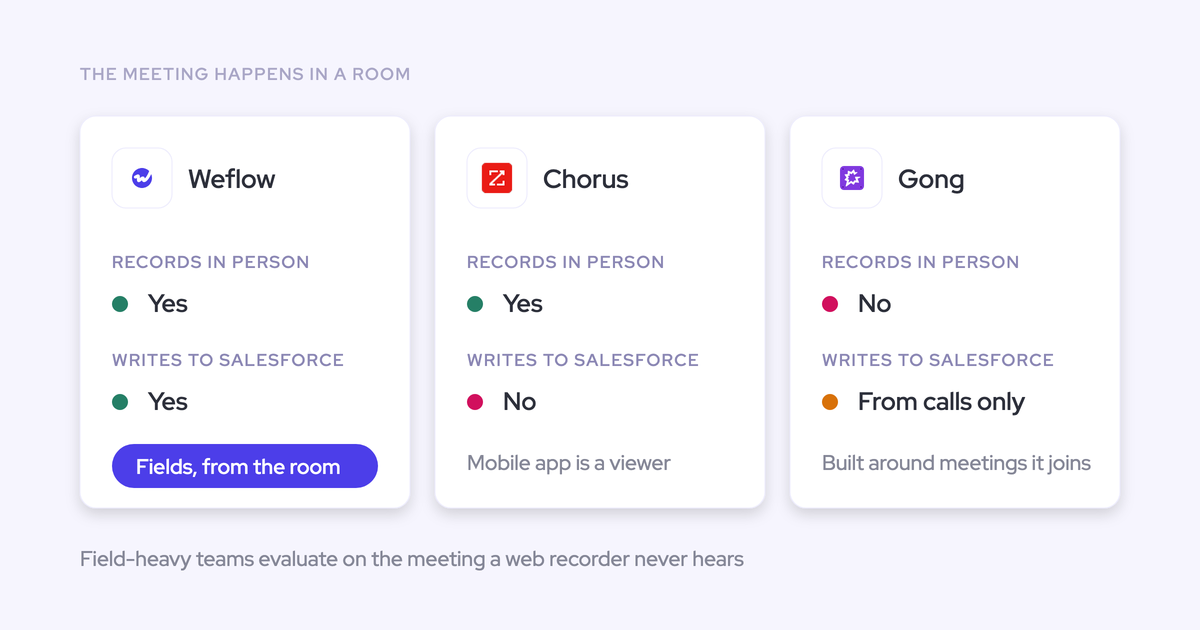
Momentum captures natively on Zoom, Microsoft Teams and Google Meet, sends a named bot into platforms it doesn't integrate with directly, and ingests telephony, email and SMS alongside. Nobody presses record.
Then it writes structured methodology output straight onto the Salesforce opportunity. Each MEDDPICC element in its own field, SPICED, the Three Whys, a next best action, plus custom fields you defined, drawn from calls, emails and dials together.
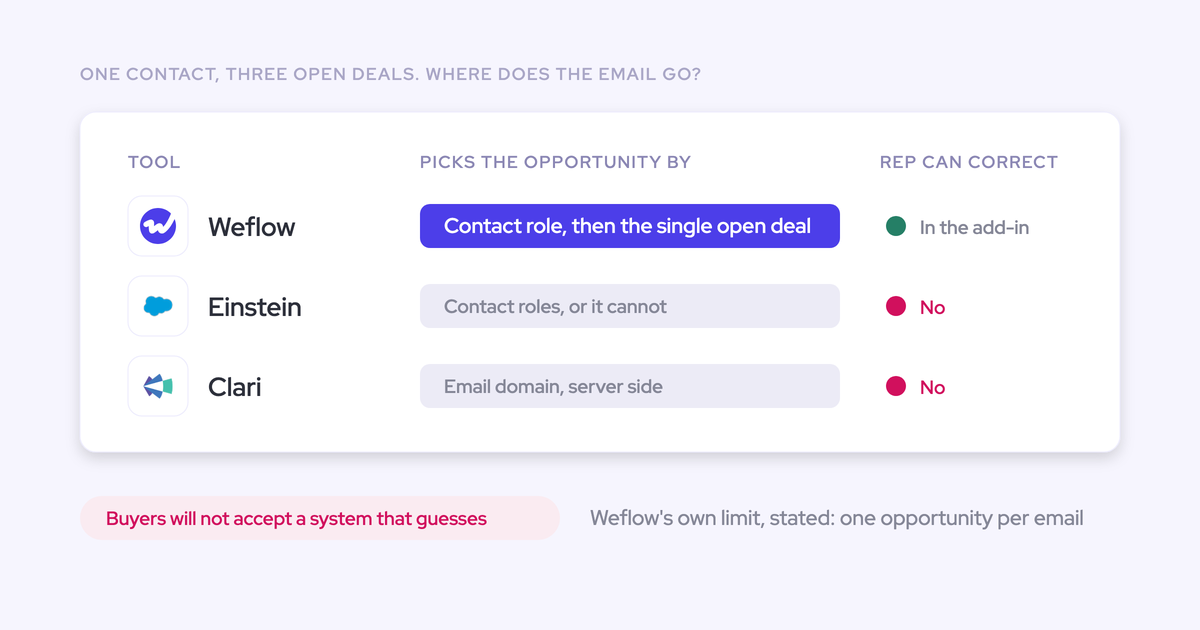
One thing to check in a demo: Momentum picks which opportunity to update by matching external attendee emails to contacts, deriving the account, then choosing the open opportunity with the most opportunity contact roles among the attendees. Where contact roles aren't maintained, every open opportunity scores zero and the tie-break falls to whichever record was touched most recently. That's the record a rep updated last, not the one the meeting was about.
Migration and the retro-pilot across historical calls
Momentum migrates years of historical recordings out of an incumbent recorder as a service its team delivers over a couple of days, rather than something you run self-serve. The stored video volume is why.
The more interesting half is the retro pilot. Create a Salesforce field today, and Momentum can populate it in batch across every past conversation, including calls that happened years before the field existed.
One customer used it to find multi-location restaurants across three years of calls and build a segment for a product that didn't exist when those calls happened. That turns a call archive into a queryable dataset for questions nobody thought to ask at the time, and it's a genuinely differentiated capability. Weflow doesn't do that today.
Where Momentum is genuinely strong: Slack walls, append-mode writes, consent
Momentum does several things well that are worth naming plainly:
- Slack clip walls. Momentum cuts ten to fifteen second clips out of recorded calls automatically and posts them into Slack channels grouped as walls: a wall of love, a wall of competitor mentions, a wall of product feedback. Nobody selects the moment. A competitor named on a call reaches the leadership team the same day.
- Append-mode field writes. Momentum can append to a Salesforce field instead of overwriting it, timestamping each entry so a rep's own text survives. That's what makes automatic field writing safe to switch on where reps already maintain qualification fields by hand. The cost is length, since an appended field grows on every interaction.
- Native consent handling. Consent lives inside the recorder, with a customizable consent page, a right-to-be-forgotten mechanism, and recording that stops automatically when a participant declines. That's the cleanest answer to the works-council objection that kills automatic recording in Europe before a trial starts.
- Coaching that measures the rep. Every conversation is scored against a configurable competency framework, each MEDDPICC element on a nought-to-two scale, plotted per rep over time alongside a written coaching brief.
- The platform pull. If your org has already committed to Agentforce, Momentum is the native path. That gravity is real and you shouldn't pretend otherwise in an internal debate.
Kyle Norton, CRO at Owner.com and a Momentum customer, makes the case for this layer better than Salesforce's own marketing does:
You got to eat your vegetables. You got to do the basics. You have to get the basics in place or else you just get sloppy outputs. And that means a tool like Momentum, which is going to capture information from every call, every email, put it into a structured format in your CRM so that you can report on it, understand it.
— Kyle Norton, Chief Revenue Officer, Owner.com
He's right about the principle. The question this article is about is which vendor gets you there without leaving the old one running underneath.
What Momentum does not cover today: Service Cloud, forecasting
Even the replacement shape doesn't consolidate everything. Two limits matter for a Salesforce-standardized org.
Momentum works with Sales Cloud only today. Support for other clouds, including Service Cloud, is under development, and the Salesforce Voice integration is still being built. So a support or success organization can't use it yet, and the promise that every customer conversation lands in one place stops at the handover to post-sales.
Momentum also doesn't forecast. If you're paying Clari for the roll-up, adopting Momentum doesn't touch that contract. Your forecast stack stays exactly where it is.
How Momentum pricing works inside the Agentforce bundle
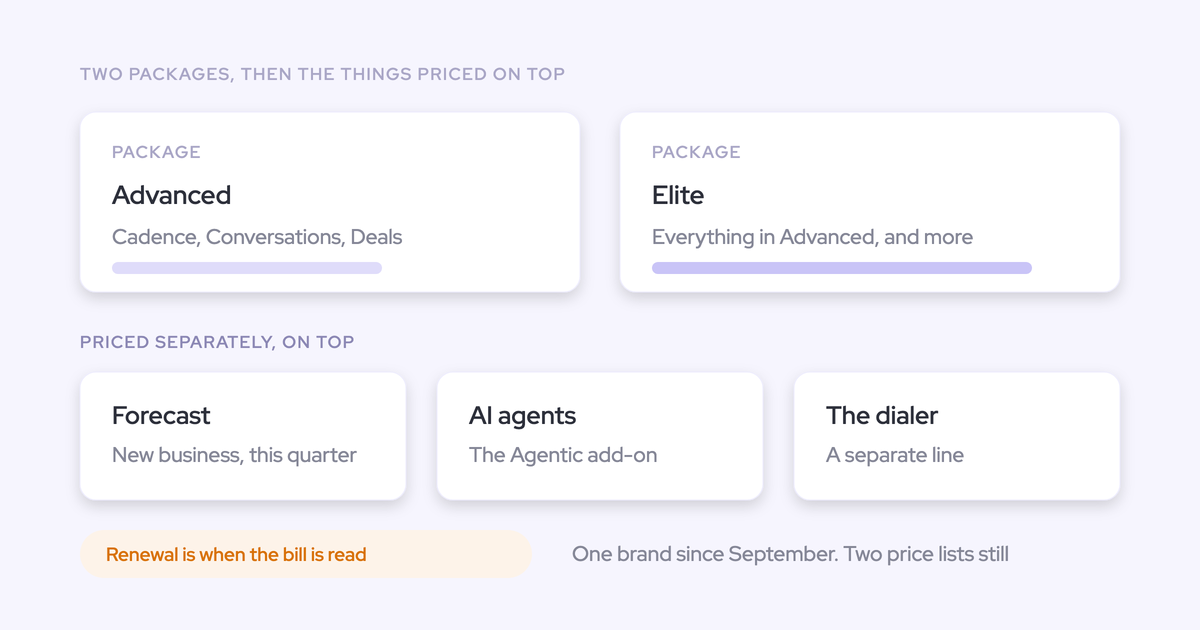
Momentum cannot be bought on its own. It comes inside the Agentforce 1 Sales Edition bundle, which carries Momentum, Agentforce for Sales and Slack Enterprise+ on a single license, or as an add-on to Agentforce for Sales.
There is no route to buying the capture and field-writing layer by itself. A team that wants conversation capture writing into Salesforce and nothing more is buying an agent platform to get it.
That changes the evaluation more than the price does. You're not pricing a tool anymore, you're pricing a bundle, and the decision moves up to whoever owns the Salesforce contract. The renewal timing that governs it is the Salesforce one, not your recorder's.
If you were hoping to pilot a capture layer inside your own budget line this quarter, that route doesn't exist here.
How Weflow consolidates the recorder instead of stacking on it
Consolidation is real only when one platform replaces the recorder, brings the archive with it, and leaves the data in objects you own. Weflow is the Revenue AI Orchestration platform for sales, customer success, and RevOps teams, and that architecture is the whole point of it.
The honest frame before the detail: Weflow is Salesforce-only, so it's not an option if any part of your GTM runs on another CRM. It's a smaller vendor than Salesforce, which some buyers weight heavily and are right to ask about. And it doesn't have Momentum's Slack clip walls or its back-fill of a brand-new field across three years of past calls, though new trackers do get applied retroactively across your recording history.
What it does have is the switch-off story.
Weflow's own recorder switches the incumbent off
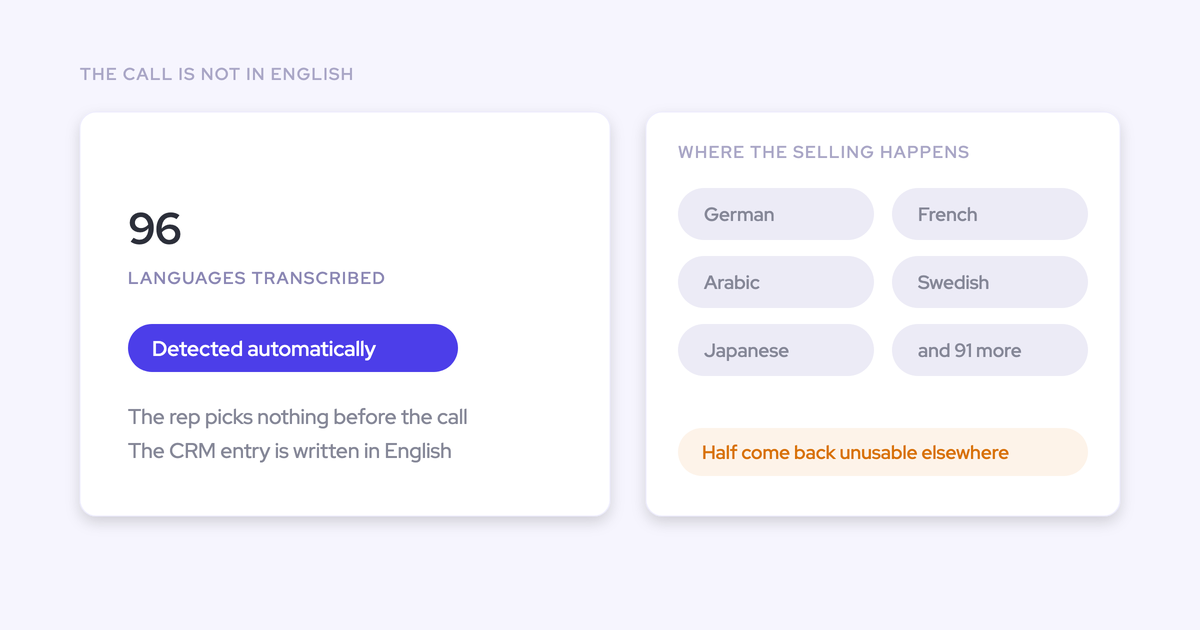
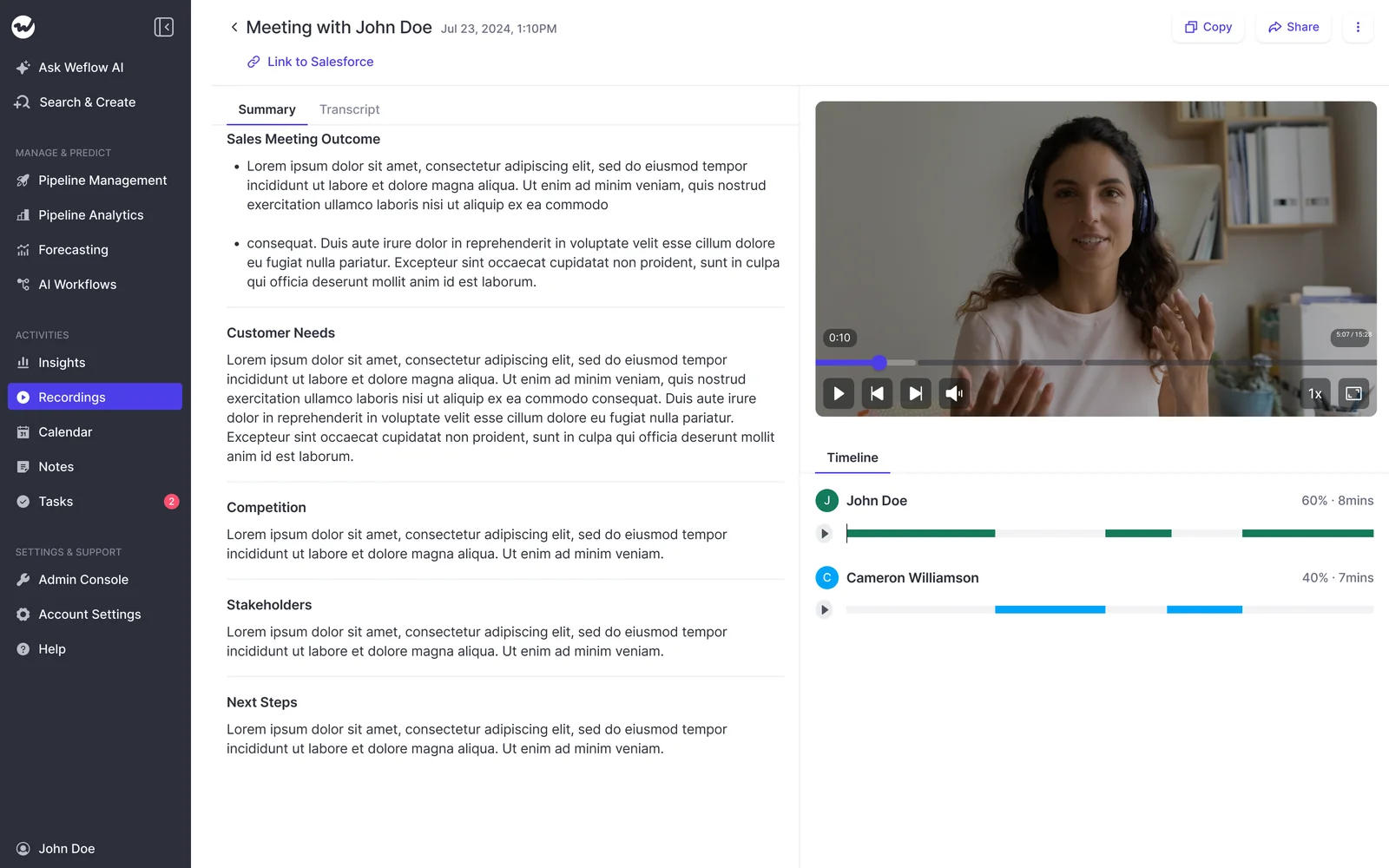
Weflow Conversation Intelligence records and transcribes the calls itself, on Zoom, Microsoft Teams and Google Meet, across 96+ languages with auto-detection. There's no dependency on Gong's or Clari Copilot's transcript, so the overlay trap can't happen.
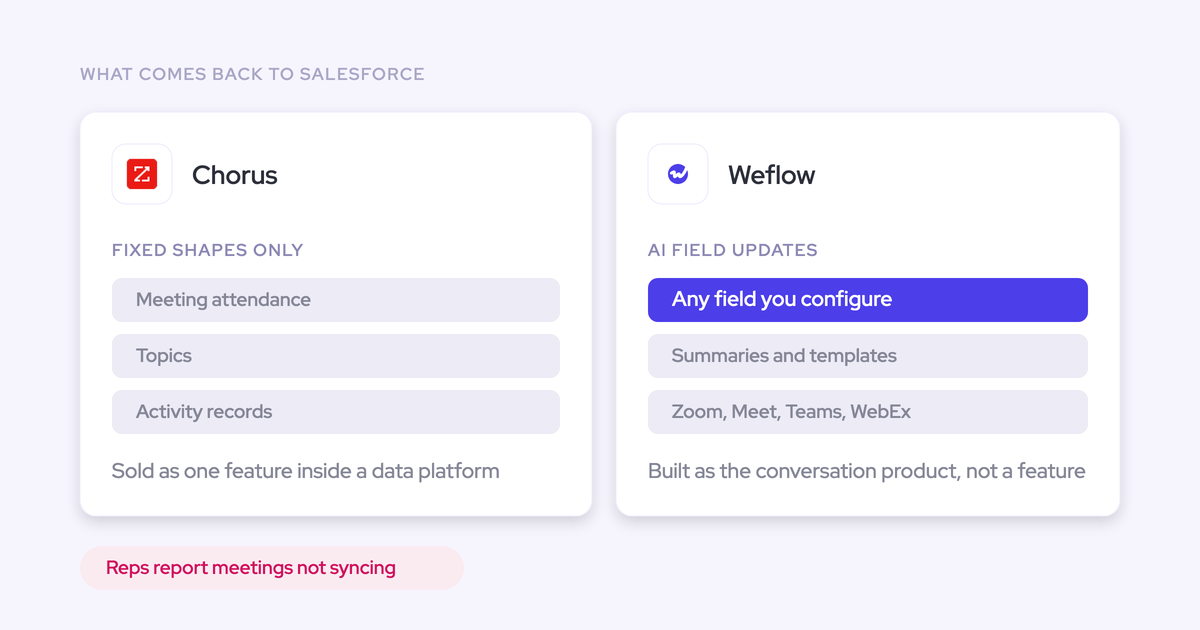
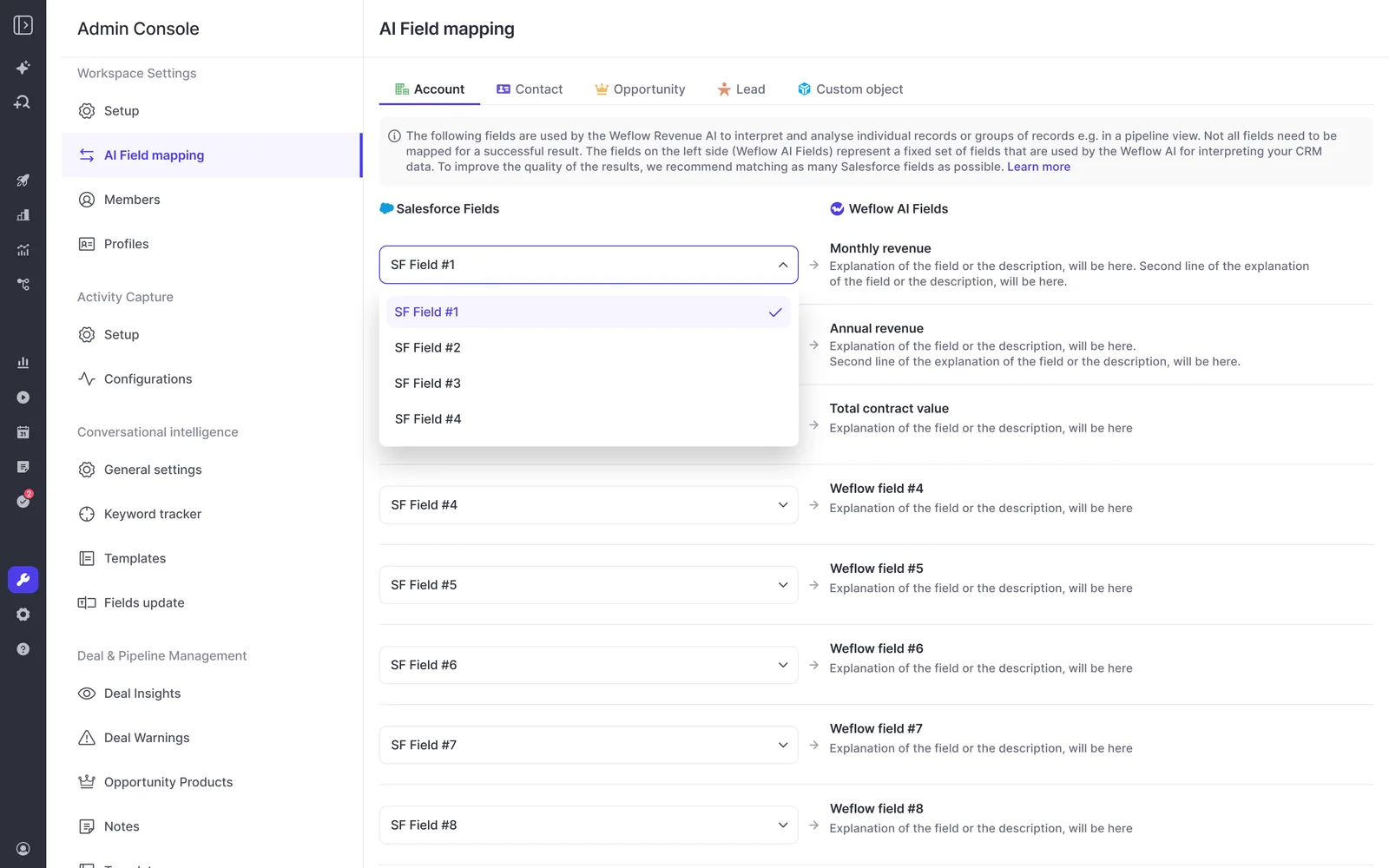
From there, AI Field Updates extract structured data from the conversation and write it into specific Salesforce fields: MEDDIC, MEDDPICC, SPICED, BANT, or your own methodology, with 250+ pre-built prompts and unlimited templates behind it.
That's the difference that shows up on the invoice. When Weflow goes live, the incumbent recorder gets cancelled at renewal instead of sitting underneath as a dependency.
Migrating your Gong or Clari archive with an API key
The archive is the reason most teams don't switch. Years of won deals, objections and coaching examples sitting inside the tool they want to leave.
Weflow imports and reprocesses that library from Gong, Chorus, Jiminny and others, at libraries in the thousands of recordings. The sequence is short:
- You share an API key for your current provider. No manual export, no file upload. If no API key exists, a raw file export can work but our team evaluates it first.
- Weflow imports recordings, metadata and transcripts, reusing the existing transcripts where possible and retranscribing where not.
- Weflow re-links each recording to the right Salesforce record. Where the provider's API carries the Salesforce association, it uses that directly. Where it doesn't, Weflow runs its own lookup to match recordings to the correct account, opportunity or contact.
A Gong migration takes about a week. Full implementation runs two to three weeks in three phases, and the technical setup is a single session with your Salesforce and mail admins.
Conversation data lands in Salesforce objects you own
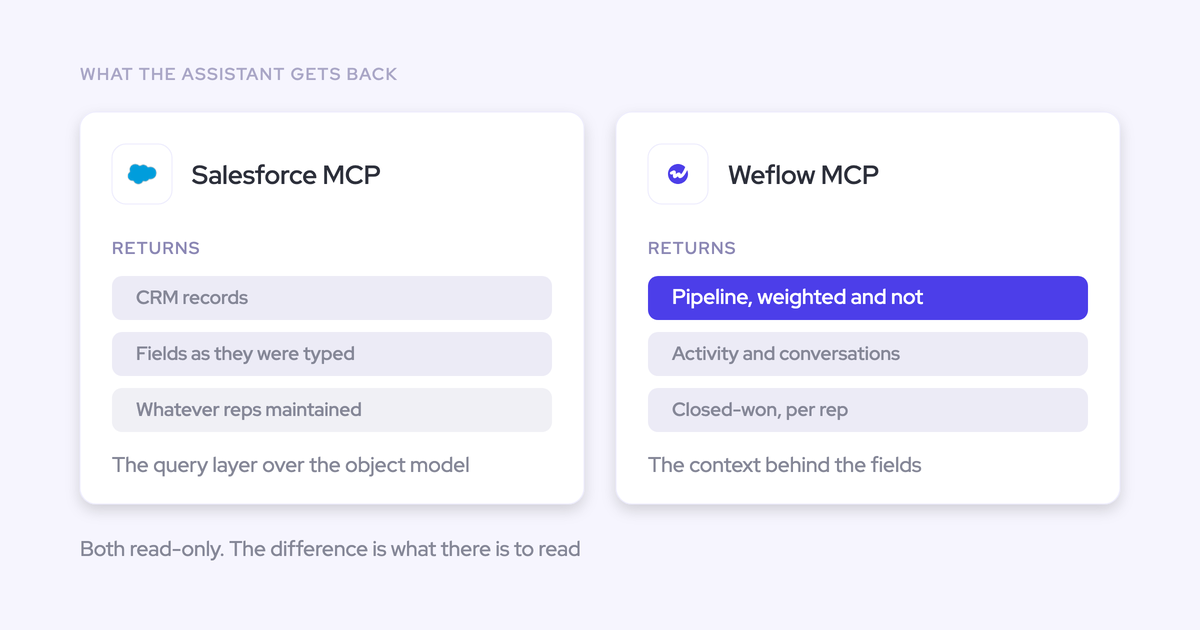
Everything Weflow captures and generates writes into native Salesforce objects: EmailMessage, Task, Event, and any standard or custom field you point it at, respecting your validation rules, field dependencies, permissions and role hierarchy.
That means the conversation layer is usable by your own reports, your own flows, and your own agents on day one, without reconciling a vendor schema back to the CRM. And it means the data is still yours the day the contract ends.
This is the first filter for anyone buying in this category a second time. We hear it in almost exactly these words:
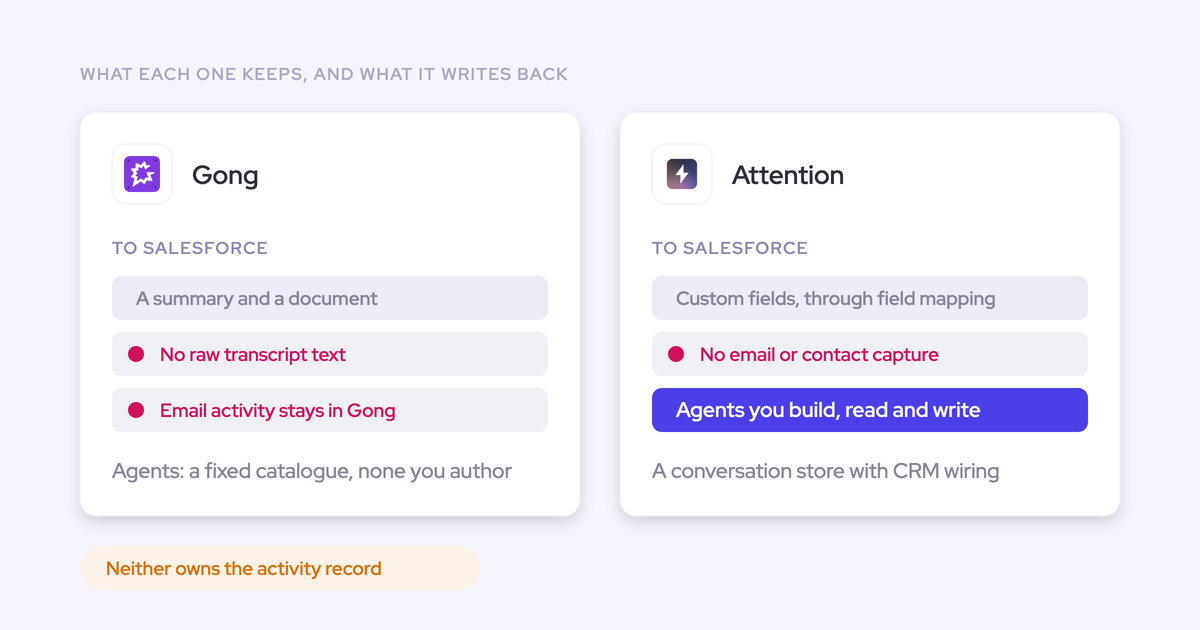
I've used GONG before. I'm a previous GONG user. I know they're weak and also you can never leave them because you don't own any of the data. And also they take you away from the Salesforce interface and you have to work within their interface.
Ask it of every vendor on your list, Weflow included: which object does this write to, and what survives if I leave?
Seat-based pricing and per-team modules a CFO can approve
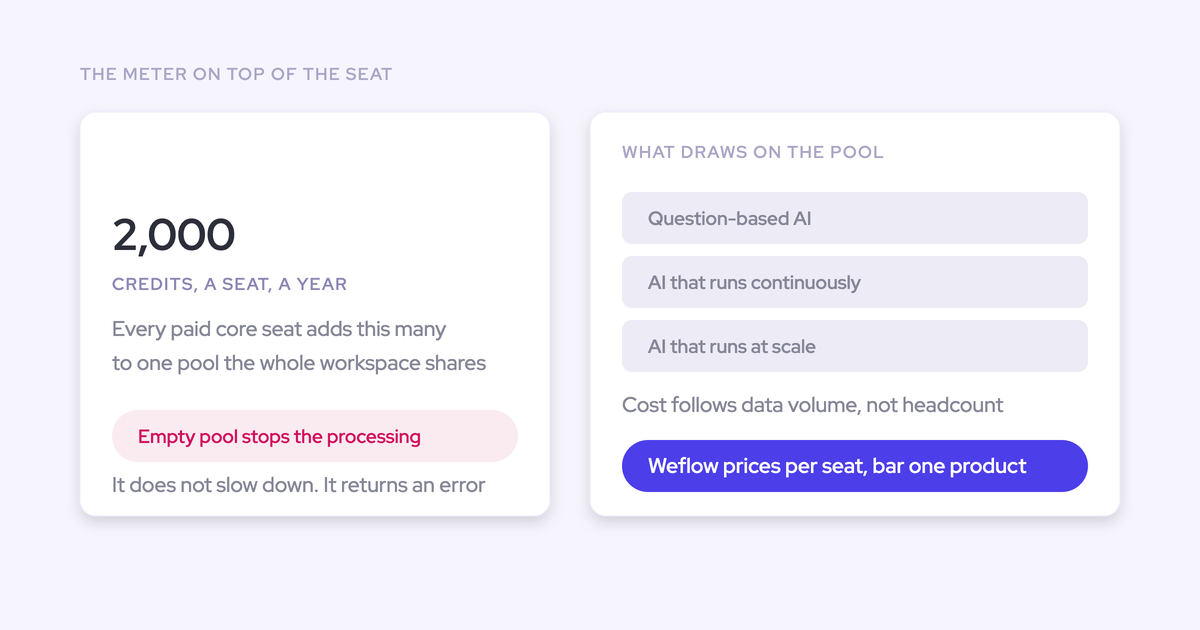
Weflow publishes its prices, charges per seat, and includes the AI in the seat. There's no bundle you have to buy to reach the capture layer.
| What you buy | Price per user per month | What it covers |
|---|---|---|
| Activity & Contact Capture | $19 | Emails, meetings and contacts auto-synced to the right Salesforce records |
| Conversation Intelligence | $39 | Recording, transcription, AI field updates, coaching scorecards, Mobile Copilot |
| Deal Intelligence & Forecasting | $39 | Deal signals, pipeline analytics, roll-up forecasting |
| Revenue AI Foundation | $49 | Activity & Contact Capture + Conversation Intelligence |
| Revenue AI Business | $59 | Foundation + Deal Intelligence |
| Revenue AI Enterprise | $79 | All Weflow products including Forecasting |
Ask Weflow AI and AI field updates are included in the seat with no metering. Agent Builder is the one consumption-priced product: a Free tier with 25 agent actions a month comes with every plan, then Growth at $299 a month for 500 actions and Scale at $999 a month for 2,500.
The modular part is what makes a partial consolidation approvable. Capture under everyone at $19, Conversation Intelligence under the customer-facing teams, forecasting only under the leaders who actually submit a number. Minimum 10 users, billed annually.
Which consolidation path fits your renewal window and stack
Three things decide this: whether your org has committed to Agentforce as its platform, when your recorder renews, and whether the goal is adding an orchestration layer or removing line items.
| Your situation | The path | Why |
|---|---|---|
| Agentforce is already the platform decision and the budget sits with the Salesforce contract owner | Momentum as the recorder | The native path has real pull, and Momentum's capture, Slack walls and consent handling are strong. Retire the incumbent at its renewal so you don't run both. |
| You want Momentum's field-writing but your recorder renewal is 10 months out | Overlay, with your eyes open | It works, and it costs you three line items until the recorder contract ends. Decide now whether you'll actually cancel then, or you'll be renewing both next year. |
| The mandate is fewer tools and a smaller invoice, on Salesforce | Replace the recorder outright with Weflow | One platform records, writes to your own Salesforce objects, and brings the Gong or Clari archive across. Published seat pricing, no bundle conversation. |
| Your forecasting contract is locked and the CFO won't fund a second one | Start with capture and conversation intelligence, add forecasting at renewal | The entry point has to be a capability you don't already own. Expanding into forecasting later is about $10 more per user per month, not a new six-figure contract. |
| Post-sales conversations on Service Cloud are in scope | Neither covers it fully today | Momentum is Sales Cloud only for now. Ask both vendors what's live today, not what's on the roadmap, because a roadmap answer means running two systems for another year. |
If your recorder renewal is locked, sequence around it rather than fighting it. Activity capture trials cleanly, demands nothing of the rep, and can show months of real activity from day one with a historical sync-back. That's the piece you can start now.
Conversation intelligence is a leadership decision about how the team runs, not something to put to an implicit vote by reps who've never been recorded. Make that one deliberately, timed to the window when you can genuinely switch the old recorder off.
Walk through the product yourself, no call required.
FAQ: Momentum, Gong, Clari Copilot, and consolidation
Does running two capture engines double-count meetings in Salesforce?
Yes. If an activity capture provider writes a meeting into Salesforce and a second tool writes the same meeting as its own event, you get two records for one conversation. Meetings per rep and meetings per closed opportunity are then double counted, which is exactly the reporting you bought the tools to get. The rule is one capture infrastructure writing to Salesforce, with everything else reading from it.
Can I buy Momentum without Agentforce?
No. Momentum is sold inside the Agentforce 1 Sales Edition bundle, which carries Momentum, Agentforce for Sales and Slack Enterprise+ on one license, or as an add-on to Agentforce for Sales. There's no standalone route to the capture layer, so evaluating Momentum means opening an Agentforce commercial conversation and moving the decision up to whoever owns the Salesforce contract.
Does Momentum replace Einstein Activity Capture?
Salesforce has named Momentum the future of call recording and activity capture inside Salesforce, which puts Einstein Activity Capture and Einstein Conversation Insights on a superseded path rather than a development path. No migration path, end-of-life date or pricing consequence has been given yet. If you standardized on EAC because it was the included native option, the native option now sits behind separate packaging.
How long does migrating off Gong to Weflow take?
The Gong migration itself takes about a week: recordings, metadata and transcripts re-imported through the Gong API and re-linked to Salesforce records. A full Weflow implementation typically runs two to three weeks across three phases, with the technical setup handled in a single session with your Salesforce and mail administrators. The fastest recorded rollout was three days for a 120-seat conversation intelligence replacement.
Who owns the conversation data if I leave the vendor?
It depends entirely on where the data was written. Data written into your own Salesforce objects stays with you when the contract ends, because it lives in a system you own. Data held in a vendor's own graph or cloud leaves with the contract, which is why teams stay on tools they dislike. Ask this first of every vendor in this category, before you ask about features.