Weflow vs Gong for EU Data Residency and AI Data Handling (2026)
Compare Weflow vs Gong on EU data residency, processing locations, and Zero Data Retention for AI.


If you're running a security review on a call recorder, it comes down to three questions: where call data is stored, where it's processed, and which AI model reads it. Weflow and Gong give very different answers.
Gong asks you to pick a storage region once, at onboarding, and defaults to the US. Even with EU storage, your data is still processed in the US, Israel and Ireland. Moving regions later is a paid relocation, and Gong doesn't say which model providers it uses.
Weflow, on the other hand, stores your data in the same region as your Salesforce org. We're a German company hosted in Frankfurt, and we name our primary model, Google Gemini, which runs under Zero Data Retention with no training on your data.
Weflow is the Revenue AI Orchestration platform for sales, customer success, and RevOps teams.
It's built for Salesforce teams.The product you're assessing is Weflow Conversation Intelligence, which records your customer calls and writes the outcomes into Salesforce as structured data.
Gong gets credit up front. Its certification set is broader than ours and includes ISO 27001. We don't hold ISO 27001 yet, and our target is December 2026. If ISO 27001 is a hard gate for you today, Gong passes and Weflow doesn't.
Every section below is written so you can copy it straight into your assessment.
Weflow vs Gong on residency, AI data handling and access
| Review dimension | Weflow | Gong |
|---|---|---|
| Data residency | Follows your Salesforce org's region. CRM data lives in your own Salesforce org. Recordings, transcripts and Weflow-only fields sit in the AWS region you choose: Frankfurt, New York or Sydney. | US or EU storage on AWS, chosen at onboarding, with the US as default. Processing happens in the US, Israel and Ireland even with EU storage. Moving region later is a paid relocation. |
| AI data handling | Third-party models, primarily Google Gemini. Zero Data Retention for AI processing. Customer data is never used to train models. | States that customer data is never used to train generative models. Model providers and their retention aren't disclosed. |
| Security certifications | SOC 2 Type II since 2021. ISO 27001 in progress with a December 2026 target, not held today. | SOC 2 Type II, ISO 27001, 27017, 27018 and 27701, CSA STAR, and the EU-US Data Privacy Framework with UK and Swiss extensions. |
| Integrations with other tools | Native: Salesforce, Gmail, Google Calendar, Outlook, Zoom, Teams, Meet, Slack and the Outreach dialer. No connector catalogue and no native warehouse connector. Salesforce only. | About 450 marketplace integrations and partner apps, about 30 dialers and 11 meeting platforms. Native CRM support for Salesforce, HubSpot and Dynamics 365. |
| Access from AI assistants (MCP) | Read-only connector for Claude, ChatGPT and any remote MCP client. Returns transcripts, summaries, playbooks, forecast calls and pipeline metrics. Admin toggle for transcript access. Not metered. | Three record-scoped tools. Returns AI insights, never raw transcripts. Read-only. Draws metered credits. |
| Raw data access outside the tool | REST API bulk-exports transcripts, metadata, scores and signals as JSON or CSV. Recordings export to your own cloud storage. | API returns transcripts, trackers and scorecards, capped at 3 calls a second and 10,000 a day. Warehouse delivery needs Data Cloud, about $5,000 a year. |
| Pricing | Published per seat: $19 to $39 per product, bundles at $49, $59 and $79. AI is included in the seat. | No public prices. Per-user license plus a platform fee by proposal, on a mandatory Foundation license with metered AI credits. |
In our experience, most European reviews are won or lost on the first two rows.
Why EU security reviews end up comparing Weflow and Gong
Conversation intelligence deals tend to be won at the security review, not the demo. A recording tool touches every customer conversation you have, so it ends up in front of people who want to know exactly where the data sits and who the sub-processors are.
As the commercial owner, you can't overrule them.
When we talk to European teams, the same three triggers come up again and again:
- Works councils in Germany and Austria: They want to see exactly what's captured, plus a written guarantee that no conversation data trains a model, including at any sub-processed LLM provider.
- Group procurement after an acquisition: GDPR due diligence moves to the parent group, so a mid-size team suddenly runs an enterprise-grade review with a legal team it doesn't control.
- End customers who refuse US storage: Defence, government and regulated European buyers ask where the recording of their conversation lives, and a US answer ends the discussion.
The review takes time even before anything goes live.
Underneath all of that, your reviewer is asking three separate questions:
- Where is the data stored, broken down by data type?
- Where is it processed, and by which sub-processors in which jurisdictions?
- Which AI model sees it, does anyone retain or train on it, and can the region change without a migration?
Whatever the trigger, a US-first platform with its own data layer will answer these questions differently from one that writes into your Salesforce.
That's what led HolidayCheck's sales ops lead, who'd used Gong before, to look for a European alternative with the same capabilities and less compliance risk. Their team now runs Weflow.
How Weflow answers the EU security review, point by point
Here's how we answer all seven points, including the ones where we might fall short.
Weflow stores your data in your Salesforce region
We spin up your Weflow instance in the same region as your Salesforce org, so a European org keeps its Weflow data in Europe. You can also override the default to keep data in the EU. Here's where each type of data lives:
| Data type | Where Weflow stores it |
|---|---|
| Activities, contacts and Weflow fields synced to Salesforce | Your own Salesforce org, physically separated from other customers by design |
| Call recordings (video and audio) | Weflow's AWS environment in the region you choose: Frankfurt, New York or Sydney |
| Transcripts | Weflow's AWS environment in your chosen region, and written to Salesforce with the call outputs |
| Weflow-only fields | Weflow's AWS environment in your chosen region |
| Temporary processing data | Same tenant isolation, deleted after processing |
Every record outside Salesforce is scoped to your workspace ID, with access enforced at the application layer. Data is encrypted at rest and in transit, and these controls are covered by our SOC 2 Type II audit.
Since you already approved your Salesforce region, residency doesn't turn into a migration project. One limit to flag: we document storage by data type, but not the processing location for every step, including Gemini inference.
Weflow names Google Gemini and applies Zero Data Retention
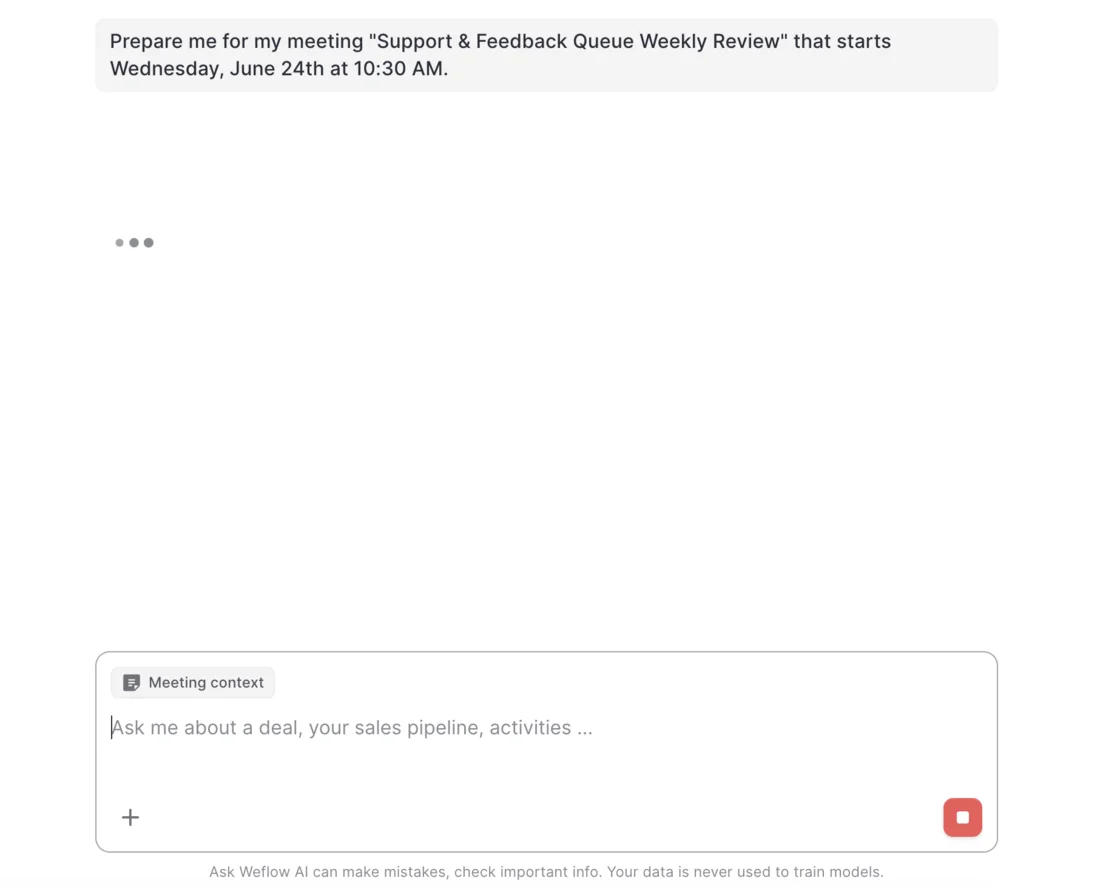
We run on third-party foundation models, mainly Google Gemini, under Zero Data Retention, and we never use your data to train them. That gives your works council exactly what it usually asks for: a named vendor and a contractual commitment.
- Model vendor: Google Gemini as the primary model.
- Retention: Zero Data Retention for AI processing.
- Training: Customer data is never used to train models.
We don't build our own model, and that's deliberate. It keeps the security answer simple, because you're reviewing a vendor you already know.
And here's the paperwork to back it up:
- A Data Processing Agreement with EU Standard Contractual Clauses.
- A public sub-processor list with advance change notice, so you can object before a new sub-processor takes effect.
- Breach notification within 48 hours.
Weflow holds SOC 2 Type II, with ISO 27001 in progress
We've held SOC 2 Type II since 2021, run third-party penetration testing, and publish our certificates and controls in our trust center.
We don't hold ISO 27001 today. ISO 27001 is underway, with a December 2026 target, so your procurement team should log it as in progress.
Weflow integrates your core stack, without a connector catalogue
Weflow connects natively to the tools Salesforce revenue teams use every day:
- CRM: Salesforce, with real-time, bi-directional sync.
- Email and calendar: Gmail, Google Calendar and Outlook.
- Meetings: Zoom, Microsoft Teams, Google Meet and Webex.
- Messaging: Slack.
- Telephony: The Outreach dialer, which your admin connects directly, plus Aircall, CloudTalk and Dialpad, which our team activates.
- BI tools and AI assistants: Tableau, Looker, Claude, ChatGPT and others through the API and MCP connector.
There are a couple of gaps, though. We don't have a native Snowflake, Databricks or BigQuery connector, so teams use our API to move data into a warehouse. And we're not an integration platform with a connector catalogue: we work only with Salesforce.
Weflow's MCP connector hands assistants transcripts behind an admin toggle
Weflow's official MCP connector gives Claude, ChatGPT and any remote MCP client read-only access to your conversation and forecast data, including transcripts, summaries, playbook results, tracker hits, coaching scores, forecast calls and pipeline metrics. It isn't metered, either.
That matters if marketing, CS or your own AI assistants already rely on transcripts. They keep their access, and you stay in control of it.
Your admin has two controls in the console:
- Enable MCP Connector switches the endpoint on for the workspace.
- Allow transcript access decides how deep it reaches. Switched off, assistants see AI summaries but never the verbatim transcript.
The console also lists every connected user with their email and connection date. Sign-in runs through your Salesforce authentication, so deactivating someone in Salesforce removes their Weflow access immediately.
Two limits to know about: The per-rep forecast breakdown is capped at 25 owners, and the connector doesn't return captured email content or Salesforce field values. Those live in Salesforce, so your Salesforce connector reads them.
Weflow's REST API exports transcripts, and recordings go to your storage
Weflow's REST API bulk-exports transcripts, metadata, scores and signals as JSON or CSV, on a schedule or on demand, so you can feed warehouses and BI tools like Tableau and Looker.
An exportable audit log records field write-backs and configuration changes for compliance review.
You can export video recordings through the API to your own cloud storage. And if you ever leave, everything Weflow wrote into Salesforce stays there, because those records are already yours.
Weflow publishes seat prices with AI included in every seat
Our per-seat prices are public, and AI summaries, field updates and Ask Weflow AI are all included rather than drawn from credits. Agent Builder is our only consumption-priced product. Contracts run on a 12-month term with a 10-user minimum.
How Gong answers the EU security review, point by point
Here's what your reviewer will find when they check Gong on the same seven points, based on Gong's own documentation and what we hear from teams switching over.
Gong stores data in the US unless you picked EU at onboarding
New Gong customers choose US or EU storage on AWS, with the US as the default. So if nobody picked EU at onboarding, your Gong data is most likely in the US.
| Question | Gong's answer |
|---|---|
| Where is data stored? | US or EU data center on AWS, chosen at onboarding, US by default |
| Where is data processed? | United States, Israel and Ireland, including for EU-storage customers |
| Where are sub-processors? | United States, UK and EMEA |
| What covers the transfers? | Standard Contractual Clauses in Gong's DPA and its Data Privacy Framework certification |
| Can the region change later? | Yes, as a paid relocation |
Gong's transfers are legally covered, but your data protection assessment will note that the data doesn't stay in-region for processing. And if residency becomes a commercial issue mid-contract, fixing it costs money.
Gong rules out model training but doesn't name its providers
Gong states that customer data is never used to train generative models. It doesn't disclose which model providers it uses, or whether those providers retain customer data.
Works councils now usually ask first whether any sub-processed LLM provider sees or keeps conversation data, and Gong's public documentation doesn't answer that in writing.
Gong holds ISO 27001, 27017, 27018, 27701 and SOC 2 Type II
This is where Gong is clearly stronger than us. Its compliance set covers:
- SOC 2 Type II, covering security, availability, confidentiality and privacy.
- ISO 27001, ISO 27017, ISO 27018 and ISO 27701.
- Inclusion in the Cloud Security Alliance STAR registry.
- EU-US Data Privacy Framework certification, with the UK Extension and the Swiss-US framework.
- PCI DSS compliant handling of data in transit.
Gong's marketplace lists about 450 integrations and partner apps
Gong's integrations go far wider than ours. The Gong Collective lists about 450 integrations and partner solutions. It also imports calls from about 30 dialers, records on 11 meeting platforms, and supports Salesforce, HubSpot and Dynamics 365 natively.
The flip side is that all that breadth turns into a switching cost. We've seen teams reshape their own stack around Gong, like moving from Google Meet to Zoom because Zoom works more smoothly with it.
Gong's MCP server returns insights, not transcripts, and draws credits
Gong's MCP server connects Claude, ChatGPT and Microsoft Copilot through three tools:
- ask_account answers a question about a single account.
- ask_deal answers a question about a single deal.
- generate_brief returns a structured summary for an account, deal or contact.
One thing Gong gets right is that personal access is the default, so each person connects with their own Gong credentials and sees only what Gong already lets them see.
There are some constraints, though:
- The server returns AI-generated insights only, never raw transcripts.
- It's read-only.
- Every MCP and API request draws metered credits, while the same brief generated by hand in the Gong interface is free.
- Connecting requires a paid Gong seat and a paid tier of the assistant, and free collaborator accounts can't connect.
Teams usually work around this by routing transcripts through Salesforce for Claude to read, or by having reps copy transcripts out of Gong by hand. Either way, downstream consumers lose direct transcript access through MCP.
Gong's API returns transcripts, and warehouse delivery needs Data Cloud
Gong's public API returns analyzed call data, including participants, trackers, scorecards and transcripts. It's capped at 3 calls per second and 10,000 calls per day, and the daily limit is the one bulk work tends to hit.
Sending Gong data to Snowflake, Databricks, BigQuery or Redshift requires Data Cloud, a separate application on top of the Foundation license that costs about $5,000 a year.
Gong quotes by proposal on top of a mandatory Foundation license
Gong doesn't publish prices. Instead, it charges a per-user license plus a platform fee that scales with user count, and quotes every buyer through a custom proposal. Foundation is mandatory, other applications sit on top, and seats are counted per application.
What Weflow and Gong cost once AI and exports are added
A European review adds a few cost lines to a Gong contract that you won't see in Weflow's. Here's how the two pricing models compare:
| Cost line | Weflow | Gong |
|---|---|---|
| Pricing model | Published per-seat prices for each product or bundle | Per-user license plus platform fee, quoted by proposal. Foundation is mandatory, and seats are counted per application |
| List prices | Weflow Activity & Contact Capture $19, Weflow Conversation Intelligence $39, Weflow Deal Intelligence & Forecasting $39. Revenue AI Foundation $49, Revenue AI Business $59, Revenue AI Enterprise $79. All per user per month, billed annually | Not published |
| How AI usage is charged | Included in the seat. Agent Builder is the only consumption-priced product: a free tier with 25 actions a month on every plan, then $299 a month for 500 actions or $999 a month for 2,500 | Metered credits on top of seats. Each paid core seat adds 2,000 credits a year to a company-wide pool that resets each contract year |
| MCP and API access | Not metered | MCP requests and API-based AI workflows draw credits |
| Warehouse delivery | Through the REST API, with no separate data product to buy. No native warehouse connector | Data Cloud, a separate application at about $5,000 a year |
| Changing data region | Region follows your Salesforce org and is a configuration, not a migration | Paid relocation |
| Minimums and term | 12-month term, 10-user minimum. Seats added mid-term are charged pro rata | Set in the proposal. Seats added after the renewal transaction are paid for across every application they need |
Since Gong doesn't publish prices, here's one real reference point: a Gong renewal proposal we saw for 45 licenses came to about $80,000 a year, with about $10,000 of that for forecasting.
At Weflow list prices, 45 seats on Revenue AI Enterprise (the full platform, forecasting included) come to $42,660 a year before volume discounts.
The gap mostly comes down to timing. Gong set its pricing when transcription was expensive, while we built Weflow after transcription and inference costs collapsed, which is why we can include AI in the seat instead of metering it.
How to move your Gong call history before Gong deletes it
Gong deletes customer data within 30 days of your contract ending, so you'll want to plan your migration around that window. We migrate your Gong recordings, transcripts and metadata through Gong's API at no charge, re-linked to the right Salesforce accounts.
Gong's API throttling sets the pace, so expect about a week for around 7,000 calls and two weeks or more for 20,000.
- Sign early enough: Leave room for the migration window plus an overlap before your Gong contract ends.
- Give us a Gong API key: Our team runs the import, so there's no manual export or file upload on your side.
- Import and map: We link each call to its account, opportunity or contact, using Gong's own Salesforce associations where its API returns them and our lookup service where it doesn't.
- Reprocess or keep as history: You can run migrated calls through AI field updates, or keep them as searchable history without touching Salesforce fields.
- Repoint downstream feeds: Marketing, CS and AI assistants move to our API, our MCP connector, or the transcripts in Salesforce. Analytics pointed at Gong's Salesforce object usually take a few days to repoint.
- Overlap before termination: Run both tools briefly so nothing is lost before Gong's deletion window starts.
If some recordings only exist as video files, you can bulk-import them with a CSV listing each call's participants, start and end time, and title. Weflow then matches each one to Salesforce automatically, at roughly 180 calls a day.
When Weflow fits your review and when to stay on Gong
It really comes down to which gate your review enforces. Residency and the model chain point toward Weflow, while certifications and integration breadth point toward Gong.
| If this is your gate | The better fit |
|---|---|
| Residency has to follow the Salesforce region you already approved | Weflow |
| Your works council needs the model vendor named, with Zero Data Retention and no training in writing | Weflow |
| You want seat prices you can put in a business case before talking to sales | Weflow |
| Marketing, CS and AI assistants need transcript access through API and MCP without metering | Weflow |
| You chose EU storage at Gong onboarding, and your DPA accepts SCC and DPF transfers for processing | Stay on Gong |
| ISO 27001 is required today | Stay on Gong |
| You depend on Gong's integration breadth across dialers, meeting platforms and partner apps | Stay on Gong |
| You run a CRM other than Salesforce | Stay on Gong |
See how Weflow captures activity, updates Salesforce fields from calls, and rolls up your forecast. Book a 30-minute demo.
FAQ: Weflow and Gong in a European security review
Where does Weflow process data, not just store it?
Storage follows your Salesforce org for CRM data and your chosen AWS region for recordings, transcripts and Weflow-only fields. Temporary processing data follows the same tenant isolation and is deleted after processing.
We don't document the processing location for every step, including Gemini inference, so we don't claim EU-only processing.
Can Weflow keep our data in Germany specifically?
Yes, for data stored outside Salesforce. We're a German company hosted in Frankfurt, and Frankfurt is one of the AWS regions you can choose. Your CRM data stays wherever your Salesforce org is hosted.
Is UK data residency available in Weflow?
Not currently. The AWS regions available for data outside Salesforce are Frankfurt, New York and Sydney.
Where do Weflow call recordings live if not in Salesforce?
Video stays in Weflow's AWS environment in your chosen region and streams back when you open a call, since Salesforce file storage isn't built for large files. Transcripts and call outputs land in Salesforce.
What can we hand our works council about Weflow?
You can give your works council:
- The Data Processing Agreement with EU Standard Contractual Clauses, the public sub-processor list, and our named model vendor (Google Gemini) with Zero Data Retention and no training.
- Configurable retention for recordings and transcripts.
- A notetaker name your admin sets, which every participant sees when it joins.
- Consent flows, including a Microsoft Teams pre-meeting email with an opt-in or opt-out link, and an in-call chat message whose removal option permanently deletes all recording data.
- The MCP transcript toggle, which controls whether assistants can read verbatim transcripts.
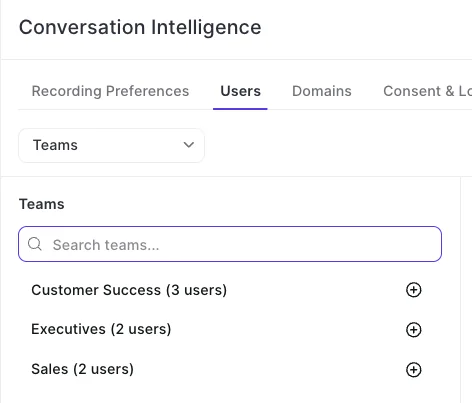
Your admin also controls exactly which users or teams the notetaker records.
How do deletion and termination work in Weflow?
Recordings are kept for the life of your subscription by default, but you can have them deleted after a set period, such as every 30 days, while keeping transcripts. You can also delete transcripts and keep only the AI summaries.
Records Weflow writes into Salesforce stay there after you cancel.
What do we give up moving from Gong to Weflow?
You give up four things:
- Integration breadth: Gong connects far more dialers, meeting platforms and partner apps.
- A single-rep coaching overview: Managers can see interaction metrics in Insights and coaching scores call by call, but there's no single page that pulls one rep's calls, scores and metrics together over time.
- Gong's deal board: Many reps like it.
- Multi-CRM support: Weflow works only with Salesforce.
On the other hand, Weflow matches or beats Gong on capture, AI field updates, summaries and how much your team can configure.