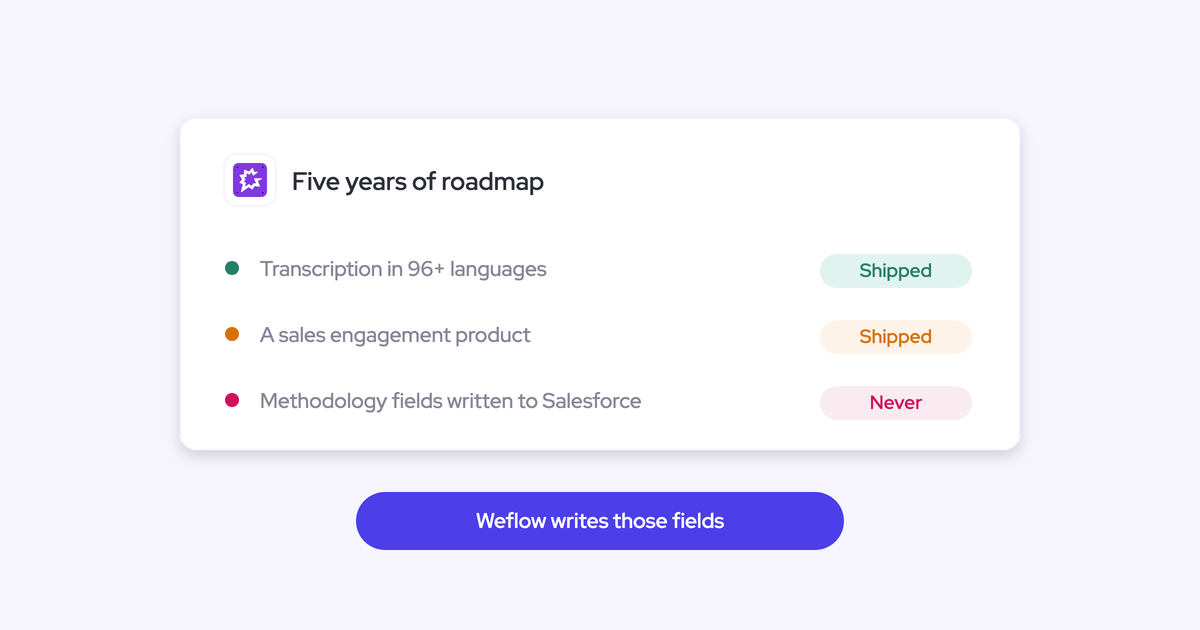

Renewing Gong? Why its insights never reach your Salesforce fields


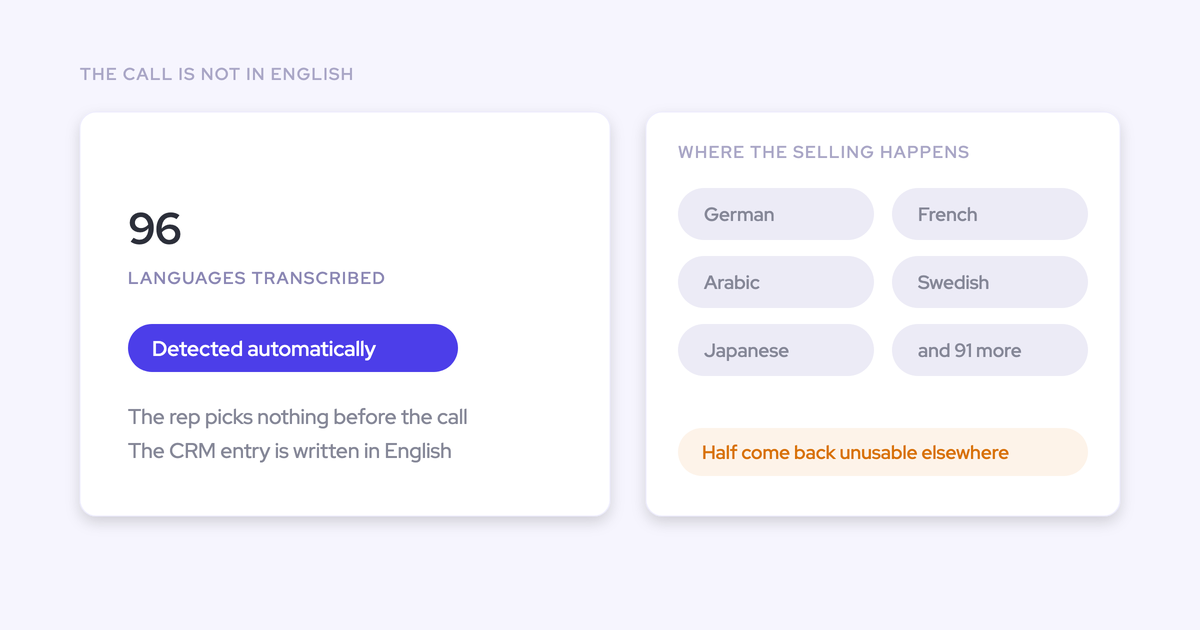
A Gong renewal doesn't turn on recording quality. Every tool in this category transcribes well now, you already know it, and thirty minutes on the recording screen won't give you anything you can take to a board.
What decides it is where the conversation ends up: structured records in the Salesforce you own, or intelligence in a cloud you rent for as long as you keep paying. Gong is genuinely strong, and this guide says exactly where. Then it judges the renewal on the part the demo doesn't show.
A Gong renewal is not a recording-quality decision
Recording and transcription are commoditized, so the feature grid tells you almost nothing. One CRO deep into a Gong evaluation put it to us plainly:
"I'm assuming yours is not much different than Gong's in that regard. That's not where the feature functionality of what we really want to make a decision on resides."
He's right. The interesting question starts the moment the call ends.
You're actually choosing between three paths, and they cost very different amounts over three years.
- The first is renewing Gong as it stands and accepting that the intelligence lives in Gong while your Salesforce methodology fields stay however your reps left them.
- The second is renewing Gong and closing the gap yourself, which in practice means RevOps and IT building the deal score and the field logic inside Salesforce as a separate project with its own maintenance tail.
- The third is moving to a platform where conversation intelligence is built to produce structured Salesforce records rather than a second place to go and look.
The rest of this guide judges all three on the same criteria: who owns the data, what gets written into the fields your deal review already reads, what coverage costs, and what leaving costs.
Where Gong is genuinely the stronger choice
Gong invented this category and still leads parts of it. Anyone telling you otherwise hasn't used it.
- Gong has the deepest conversation analytics on the market, and teams that live in that depth notice when it's gone.
- Gong is strong at the aggregated level, which matters because managers don't listen to individual calls.
- Gong can answer a methodology question across every call on an account, not just call by call, which is the view a manager reviewing a twelve-month cycle actually needs.
- Gong's interface is more polished than most alternatives, and some teams choose it for that alone. That's a real reason, not a soft one.
- Gong has a sales engagement product with prospecting and a dialer. Weflow has no sequencer and no dialer, and won't pretend otherwise.
- Gong does log activity to Salesforce. Activity logging on its own is not why teams leave.
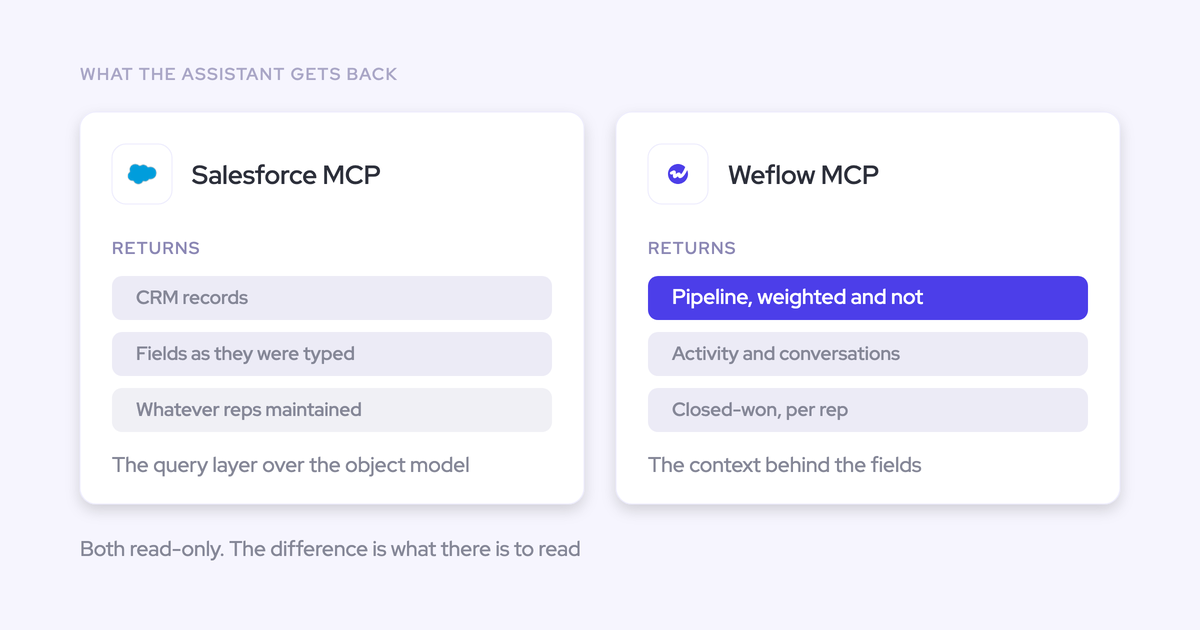
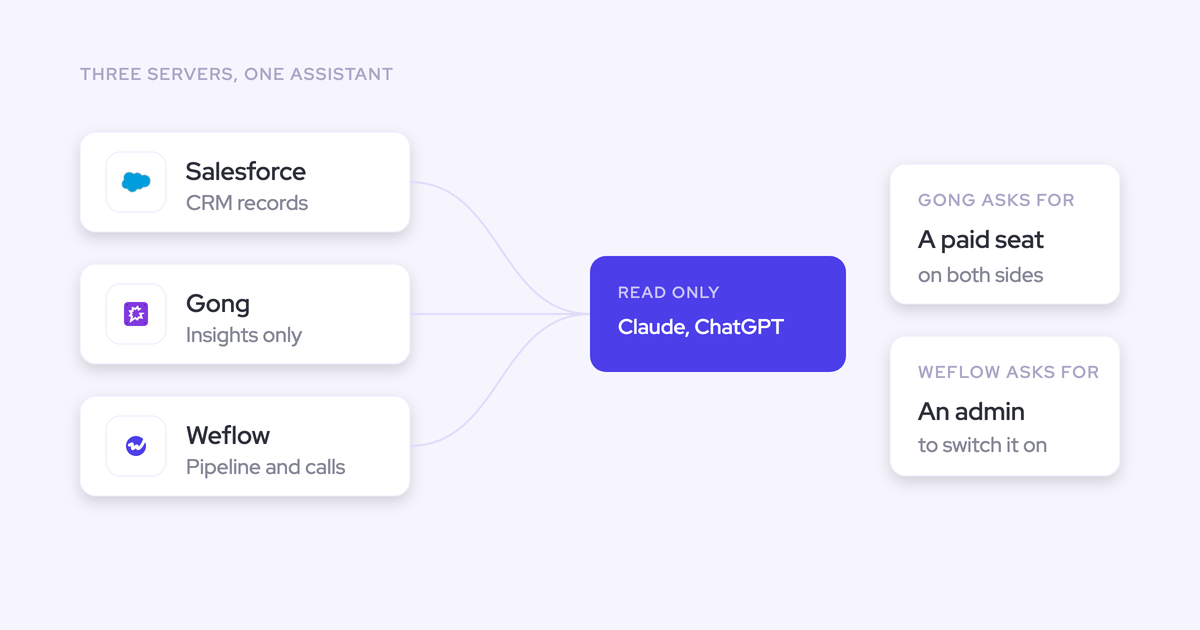
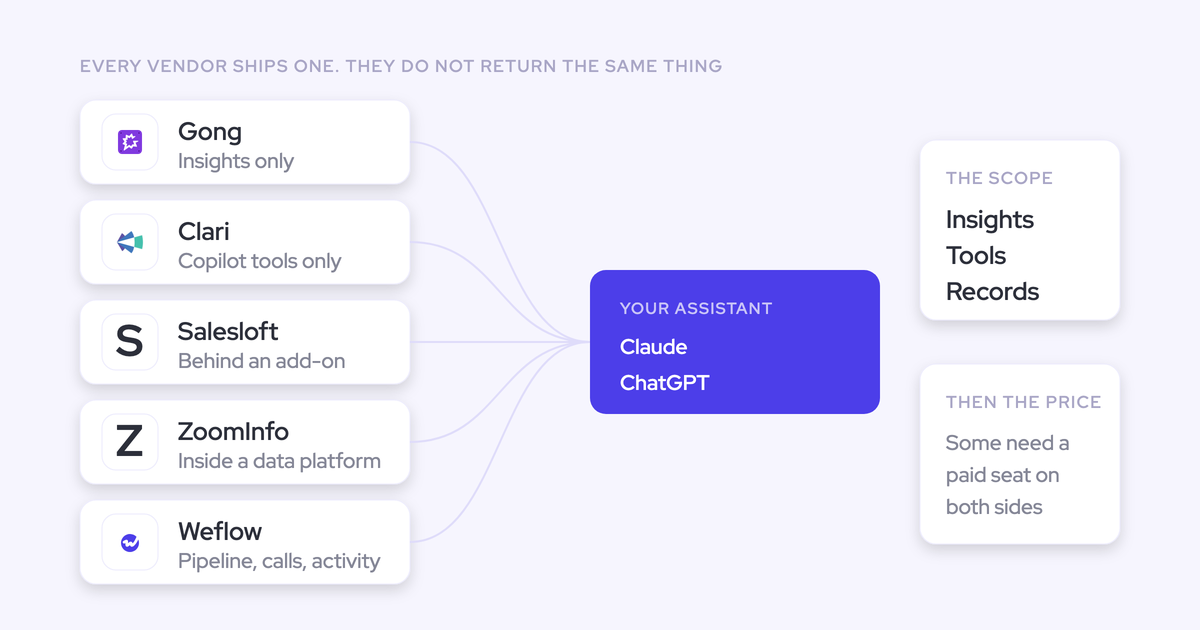
- Gong ships pre-built AI agents and an MCP endpoint, so external agents can query Gong data directly.
Hold all of that. It makes the next part harder to dismiss.
Why Gong's AI surfaces insights but leaves Salesforce fields empty
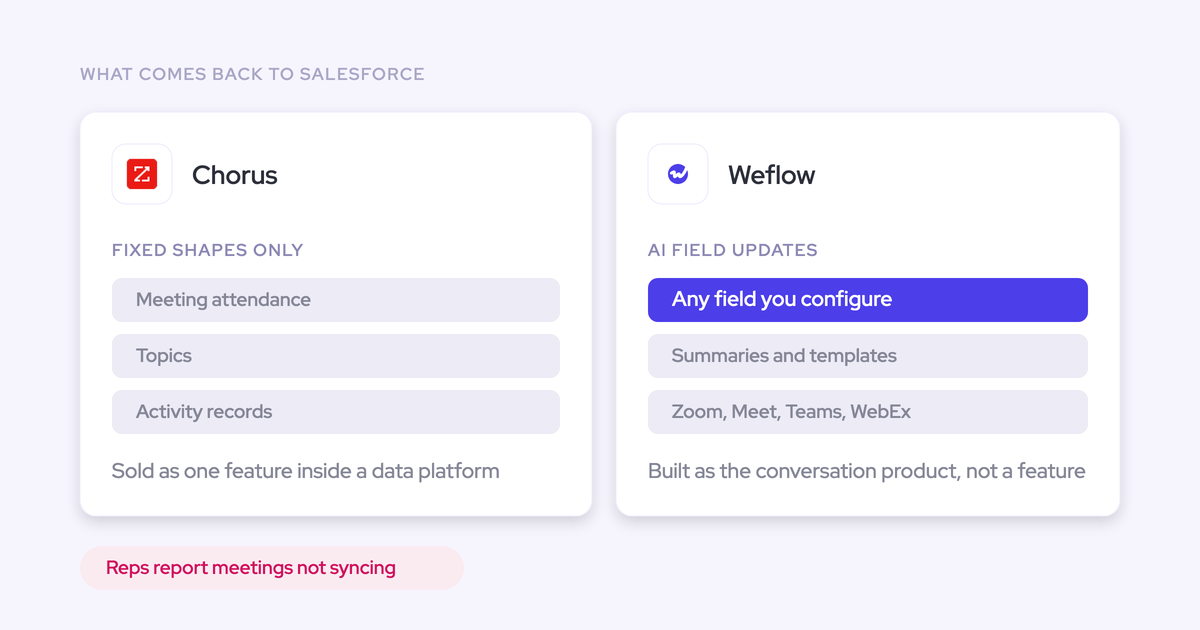
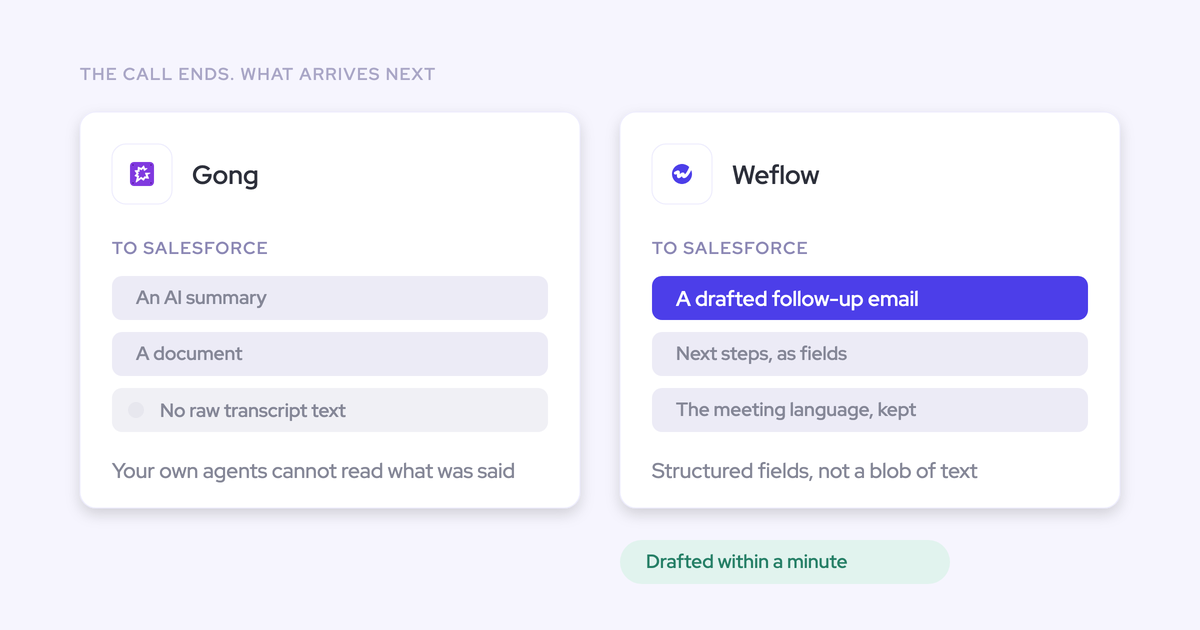
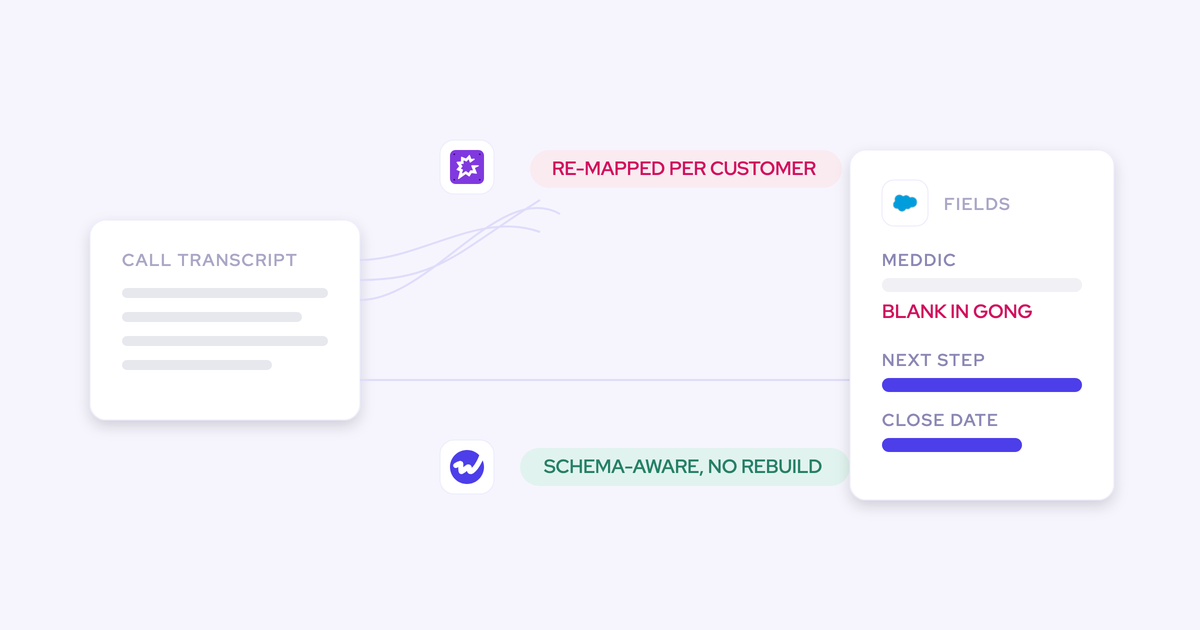
Gong does not auto-populate MEDDIC or other methodology fields in Salesforce from call transcripts. It surfaces the insight and leaves the field update to the rep, which means the update happens by hand after the fact, or it doesn't happen at all.
Across the Salesforce orgs we connect to, the methodology fields are almost always empty before anything is automated. That's not a Gong-specific failure of discipline. It's what happens when the write-back depends on a human remembering.
The reason runs deeper than a missing feature. Gong was founded in 2015, when transcription was expensive, and its architecture was built around a single strategy: get all the data into Gong.
Every design choice downstream inherits that. AI then arrived and got layered onto that foundation, which is why the intelligence is real and the CRM write is thin. One buyer who'd been through it described the field mapping as "a nightmare in Gong, and they really haven't overcome that properly."
The gap shows up most clearly on the artifact leadership actually coaches and forecasts against.
| The signal from the call | What Gong gives you | What the deal review reads |
| The economic buyer gets named on a discovery call | The moment is searchable, and a tracker can flag the mention | The Economic Buyer field on the opportunity, blank unless a rep types it in |
| Next steps are agreed in the last five minutes | A call recap the rep can read | Next Step and Next Step Date, filled the night before the forecast call from memory |
| The buyer quotes a seat count and a price band | A transcript containing the numbers | Amount, which nobody recalculated |
| Methodology adherence across the deal | Trackers detecting whether the topics were mentioned | A weighted score on the opportunity, which teams build separately with RevOps and IT |
Where your conversation data lives when you leave Gong
Gong keeps recordings, transcripts, and derived intelligence in its own cloud rather than as native Salesforce records, so the history you've accumulated ends when the subscription does. Gong data can display inside Salesforce through embedded components, which looks the same to a rep and is not the same thing at all.
Data held outside Salesforce can't trigger a Flow, can't be picked up by a validation rule, and won't be there for whatever AI agent you build on your own CRM next year.
A previous Gong user said this to us on a call, unprompted, before we'd made any argument:
"I've used GONG before. I'm a previous GONG user. I know they're weak and also you can never leave them because you don't own any of the data. And also they take you away from the Salesforce interface and you have to work within their interface."
Once the richest context about a customer sits in a second interface, that's where your managers go, and the CRM degrades a little more each quarter.
Three years later the account record in Salesforce is a shell and the real story is somewhere you're renting. Gong also provides no historical email or calendar backfill, so your reporting only ever starts at go-live, and it doesn't create the missing contact records in Salesforce, so the buying committee on the account stays half-mapped.
The criteria that decide a conversation intelligence platform renewal
Strip out transcription quality and six criteria are left. They're the ones we'd put in front of a board, and they apply whichever vendor you pick.
| What you're judging | Data stays in the vendor's cloud | Data written to your Salesforce objects |
| Who owns the history | Recordings, transcripts, and derived intelligence sit in the vendor's data layer, and ending the contract ends access to them | Summaries, activity, and field values land on Task, Event, EmailMessage, and the opportunity, and remain yours after any vendor change |
| What the deal review reads | The manager opens a second tool, and the Salesforce methodology fields stay whatever the rep last typed | Methodology answers, next steps, and account sentiment are written from the conversation, so the review reads the CRM |
| What your automations can act on | Flows, validation rules, and your own AI agents can't see a conversation layer held outside Salesforce | Every write is a native record, so reporting, Flows, and agents built on Salesforce include what was said on the call |
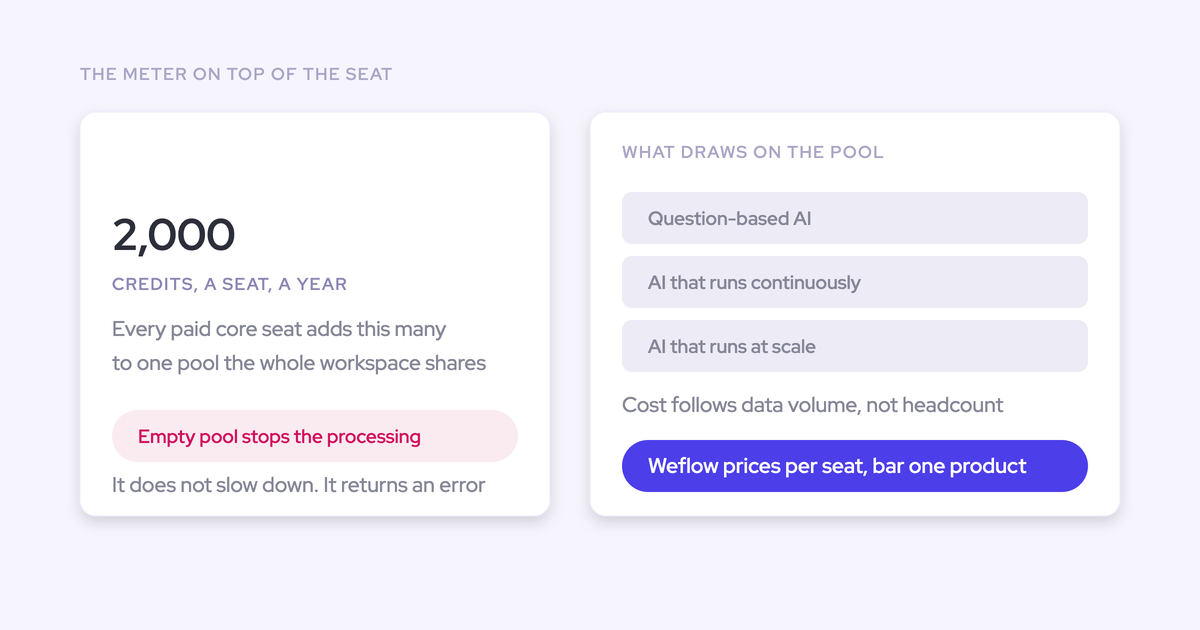
| Coverage across teams | The per-seat floor usually limits deployment to a subset of sales, and customer success goes without | Per-product, per-team bundling lets you put capture on everyone and the expensive layer only where it pays |
| Migration of existing history | No email or calendar backfill, so activity reporting starts on go-live day | Recordings re-imported by API key, plus up to 24 months of email and calendar history |
| Change-management cost | Reps work in a second interface sitting next to Salesforce and decide for themselves which one is real | Output arrives on the record the rep already opens, so the working surface stays Salesforce |
How Weflow's AI Field Updates write structured data to Salesforce
Weflow is the Revenue AI Orchestration platform for sales, customer success, and RevOps teams. On this criteria set, the thing it does differently is narrow and load-bearing: Weflow AI Field Updates extract structured values from the transcript and write them into the specific Salesforce fields your deal review already reads, on native objects you own.
Here's what actually happens around a call.
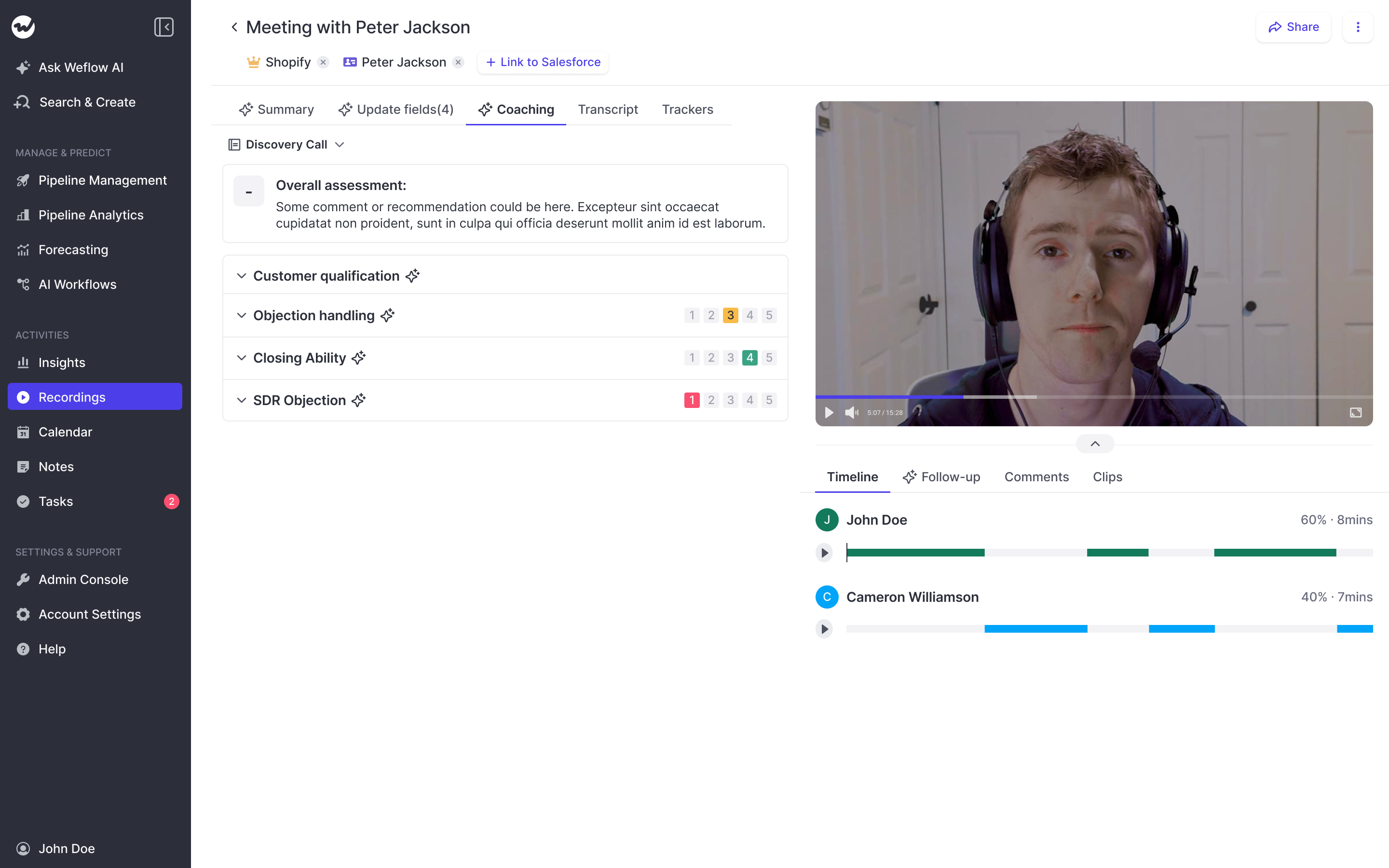
- The meeting ends. Within 30 to 60 seconds the rep has the processed recording, an AI summary in the format your admin configured, a drafted follow-up email, and a set of proposed Salesforce field updates.
- Each proposed update shows the current CRM value beside the suggested one. The rep accepts, edits, or rejects field by field, then writes them back in one click. Nothing changes in Salesforce without confirmation, and required fields stay locked.
- The summary is written onto the Salesforce Event with a link to the recording, so it appears on the opportunity activity timeline without the rep leaving the CRM.
- Templates are assigned per team, so sales, onboarding, and customer success each run their own qualification structure and write to different objects.

Above the per-call layer, AI Playbooks score the whole opportunity. They read every email, meeting, transcript, and CRM field on the deal, refresh on a schedule, write the result back to the corresponding Salesforce fields, and return a next-step recommendation.
That's the difference between a coaching score and a forecast signal: a deal forecast to close this quarter with no identified economic buyer is a risk you can act on, and you only see it when the methodology is evaluated across the deal rather than call by call.
Reps can override any field, and the override itself gets pressure-tested for plausibility against the deal.
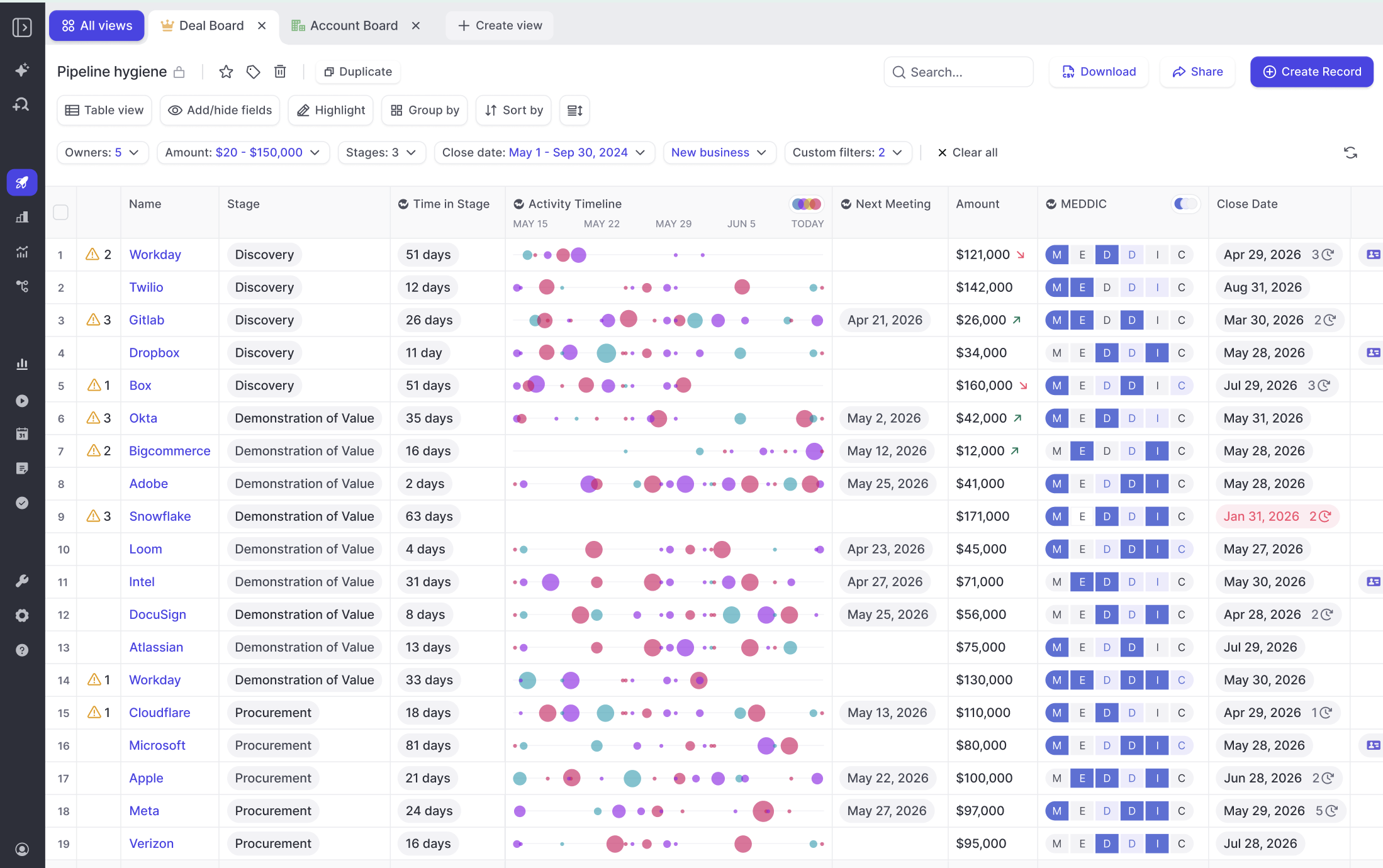
Weflow ships around thirty methodology templates and more than 250 pre-built prompts covering MEDDIC, MEDDPICC, SPICED, BANT, Challenger, and SPIN, and lets you map your own prompt to each element if your framework is homegrown. Blacklane runs at 96% of MEDDIC fields populated in Salesforce.
That number is a configuration outcome, not magic: accuracy depends on how well each prompt is written, which is why onboarding time goes into prompt and template work rather than into installing anything.
Two honest constraints. AI Field Updates cover standard objects and custom objects, but custom objects need our support team to set up. Lookup relationship fields aren't supported; every other Salesforce field type is.
When to stay on Gong and when to switch
Some of these evaluations should end with a renewal, and saying so is the only way the rest of this is worth reading.
| Stay on Gong if | Move to an AI-native platform built on Salesforce if |
| Your managers use the analytics depth weekly and can name what they'd lose | Your deal review reads Salesforce fields and those fields are empty |
| You want the sequencer and dialer inside the same product | You already run Outreach or Salesloft and want them left alone |
| FedRAMP is a procurement requirement | You need EU data residency and a GDPR file your group procurement will accept |
| Your CRM isn't Salesforce | You run Salesforce and want custom objects, validation rules, permissions, and hierarchies respected as they are |
| You've spent your change budget this year and adoption is fragile | Coverage is the constraint, and customer success and onboarding were priced out of the last rollout |
The build-it-yourself middle path deserves a harder look than it usually gets. Teams that want a weighted methodology score on the opportunity end up engineering it in Salesforce with RevOps and IT, on top of the tool they already bought.
That's a project with a launch date and a maintenance tail, and nobody puts it in the renewal business case.
Where Weflow isn't the answer: we're Salesforce only, with no HubSpot, Dynamics, or Pipedrive. ISO 27001 is in progress and not certified, and we're not FedRAMP, so US government contractors with that requirement should stop here.
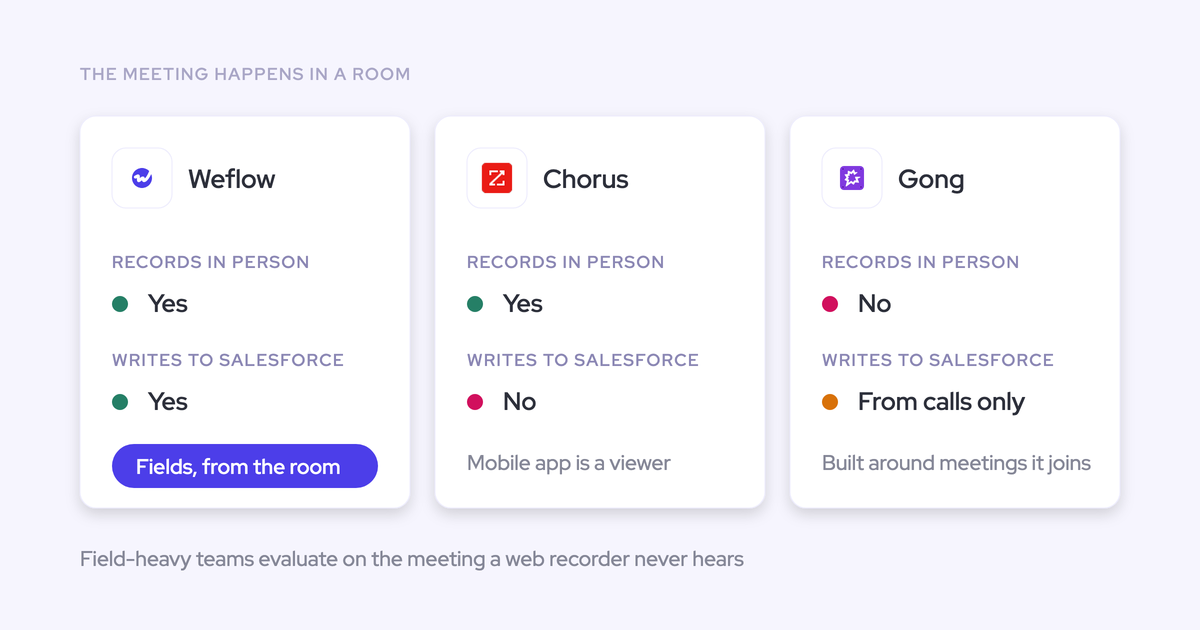
There's no sequencing, no dialer, no VoIP call capture today, and no live in-call coaching, only post-call scoring. And on raw conversation analytics depth, Gong is deeper. If that depth is what your organization runs on, the rest of this argument doesn't outweigh it.
What it takes to migrate off Gong
Switching cost is what keeps unhappy teams on a renewal, and most of it is fear of losing the archive. Here are the actual mechanics, the actual money, and who does the work.
How long migration takes and what transfers
- You share an API key for Gong. There's no manual export and no file upload. If no API key is available, a raw file export can work, but our team evaluates it first.
- Weflow imports the recordings, metadata, and transcripts. Existing transcripts are reused where possible, and retranscribed where they aren't.
- Each recording is relinked to the right Salesforce account, opportunity, or contact. Where the provider's API exposes the association, we use it. Where it doesn't, we run our own lookup matching so nothing lands orphaned.
- In parallel, up to 24 months of email and calendar history is backfilled into native Salesforce objects, which is history Gong never gave you.
- Your existing tracker set carries over rather than being rebuilt, and a historical crawl applies new trackers retroactively to past recordings.
The import itself runs about a week. Technical setup is a 30 to 45 minute session with a Salesforce admin and a Google Workspace or Microsoft admin. Full time to value is one to three weeks, and almost all of that is business logic: AI templates, warning rules, pipeline views, permissions.
What Weflow costs against Gong's pricing floor
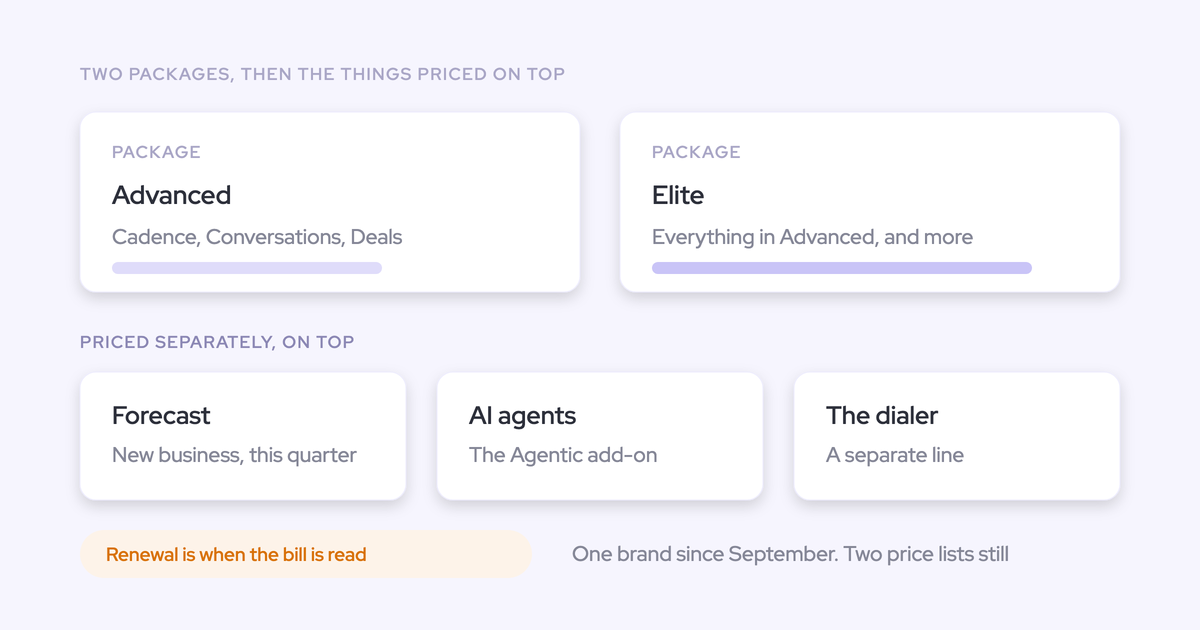
Gong's structure stacks. There's a per-seat foundation, a platform fee before any seat, and the coaching and forecasting depth sits in paid modules on top.
| Cost element | Gong | Weflow |
| Base per seat | Foundation from $1,600 per seat per year | Conversation Intelligence $39 per user per month; Activity & Contact Capture $19 |
| Platform fee | $5,000 per year Platform Access, before any seat | None |
| Coaching | Enable Essentials around $300 per seat per year; Engage around $800 | Included in Conversation Intelligence, with scorecards and coaching insights |
| Forecasting | Forecast Essentials around $300 per seat per year; Forecast around $800 | Revenue AI Enterprise at $79 per user per month, all products included |
| Implementation | Often a third-party partner at extra cost | No implementation fees |
| Dedicated CSM | Included only above $45,000 per year | Guided onboarding included, with a 14-day free trial |
Put numbers on it. A representative Gong quote for 27 users on a three-year term runs about $64,400 a year for Foundation plus Forecast Essentials plus Enable Essentials plus the platform fee, or about $48,200 a year for Foundation and the platform fee alone. Twenty-seven seats on Revenue AI Enterprise, the full platform including forecasting, is roughly $25,600 a year at list.
The obvious question is what's missing at half the price, and the honest answer is nothing structural. Gong set its pricing when transcription was expensive, and it's now held up by growth expectations against a valuation of around $7 billion on roughly $300 million in ARR.
The same capability costs materially less to build today. That's a cost-base difference, not a capability difference, and it's why we publish pricing openly instead of running the process one buyer described to us: "We had our third call with Gong because they refused to tell us pricing until now."
Who runs the implementation and onboarding
Gong routes smaller and mid-sized customers to third-party implementation partners rather than implementing itself, which adds a fee on top of a price you've already defended internally. The deeper problem isn't the invoice, it's split accountability. When adoption stalls, the software vendor and the partner can each point at the other while you own the outcome.
Weflow runs onboarding itself. For KORE Wireless that meant a five-phase rollout, activity capture first, then conversation intelligence, coaching, deal intelligence, and forecasting, with our team delivering live training including a real-time Portuguese translator for the Brazil team. One vendor, one throat to choke.
How to make the switch defensible to a team attached to Gong
Teams stay on Gong for reasons that have nothing to do with the architecture. Managers are attached to it, reps treat it as a perk, and removing a tool everybody knows is disruptive in a way that outweighs a pricing complaint. That's why buyers leave Gong on value rather than budget: the same person who won't pay $64,000 will happily pay it for something that clears the bar.
So build the case on things your team can see, not on the discount.
Don't put conversation intelligence to a rep pilot if your team has never been recorded. The pilot becomes a referendum on being tracked and you'll lose it on politics. Recording is a leadership decision about how the org runs, and it should be made as one.
What trials cleanly is activity and contact capture, because it asks nothing of a rep, and with the historical backfill it shows months of real activity from day one. Teams switching typically see 30 to 35% more emails and meetings captured, which is a number your board understands without a slide.
Then run the demo in your own Salesforce, against your own methodology fields, with the exact question your managers care about: does this write into the fields our deal review already reads. That's the claim we can't assert on a grid and can prove in thirty minutes. And give the managers who love Gong their answer up front: trackers carry over, clips and playlists are there, scorecards score every call instead of the handful anyone had time to review.
For the board, make it the ownership argument. The recordings, the summaries, the field values, and 24 months of backfilled history all sit in your Salesforce, which means the next renewal decision isn't held hostage by the archive. That's the one thing you can't buy back later.
See how Weflow captures activity, updates Salesforce fields from calls, and rolls up your forecast. Book a 30-minute demo.
Frequently asked questions
What happens to our years of Gong recordings, trackers, and playlists?
The recordings, metadata, and transcripts come across via the Gong API using an API key, and Weflow relinks them to the right Salesforce account, opportunity, or contact automatically. Your existing tracker set carries over rather than being rebuilt from scratch, and a historical crawl applies new trackers retroactively to past calls. Clips and playlists exist in Weflow from day one, so the onboarding library and objection-handling collections your enablement team relies on can be rebuilt on imported calls rather than lost.
Does Weflow handle multi-level account hierarchies?
Yes, and the honest framing is that hierarchy is a configuration question for any tool in this category, not a yes-or-no feature. Gong can handle parent, grandparent, and great-grandparent trees, but getting it there takes real configuration work, which is why buyers who've done it once treat it as a hard requirement. Weflow works exclusively with Salesforce and inherits your hierarchy, permissions, validation rules, and field dependencies as they're already defined, so the mapping work is against your own org rather than against a second data model.
Is Weflow secure and GDPR-compliant enough for a group procurement review?
Weflow is SOC 2 Type II certified, GDPR, CCPA, and HIPAA compliant, with Zero Data Retention for AI processing and a commitment that customer data is never used to train models. There's a Data Processing Agreement with EU Standard Contractual Clauses, a public sub-processor list with advance change notification, 48-hour breach notification, and selectable EU, US, and APAC regions with Frankfurt infrastructure for European customers. Two gaps to declare before your legal team finds them: ISO 27001 is in progress and not yet certified, and we are not FedRAMP.
Does Weflow match Gong's conversation analytics depth?
No. Gong is deeper on conversation analytics, and that's the trade you're making. Weflow gives you trackers across every recorded call rolled up by rep, team, and region, insight metrics like talk ratio, longest monologue, meeting volume and email responsiveness, clips, playlists, and coaching scorecards scored automatically against your methodology. Where we differentiate is what happens to the transcript afterwards: structured field writes into Salesforce and the templates and workflows built on top of them, not the analysis screen.
Can we roll Weflow out to all customer-facing teams, including CS?
Yes, and this is usually where the economics turn. Gong often isn't deployed across every customer-facing team because it costs too much to spread that wide, so coverage stays partial and customer success goes without. Weflow's products can be bought per team, so you can put Activity & Contact Capture at $19 per user per month on everyone, Conversation Intelligence at $39 where conversations matter, and the full Revenue AI Enterprise bundle at $79 only on the group running the forecast. Per-team AI templates mean CS and onboarding write their own qualification structure to their own objects instead of inheriting the sales template.