Weflow vs Gong: Who Actually Owns Your Call Data?
Decide in Weflow vs Gong whether call data lives in Salesforce or Gong's cloud, and what that costs.


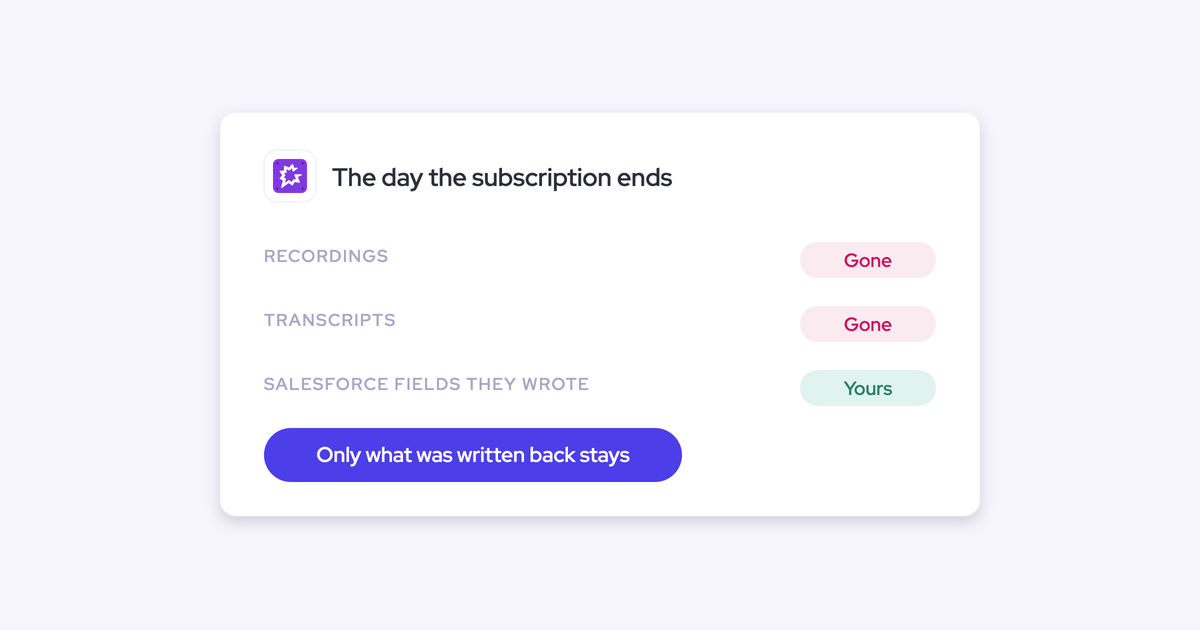

When a call ends, the intelligence in it goes one of two places. It becomes data inside your Salesforce, or it becomes an asset sitting in a vendor's cloud that you keep paying to access.
Weflow is the Revenue AI Orchestration Platform, the system RevOps teams use to coordinate humans, AI agents, and revenue data across the GTM motion. Gong is a conversation platform built around its own data layer, and the two answer the ownership question in opposite ways.
The line between Weflow and Gong is CRM depth. Weflow is built only on Salesforce and writes everything back into it, while Gong holds conversation and activity data in a data layer of its own. We treats that as an ownership and exit-cost audit, not a feature shootout, because the feature lists look similar and the architecture underneath does not.
- Ownership: Weflow writes call and activity data into native Salesforce objects the customer owns; Gong holds conversation and activity data in its own data layer.
- Capture surface: Gong's capture centers on the meetings it records, while Weflow also captures the email and meetings that happen between calls.
- Price structure: Gong stacks a per-seat foundation license, a platform fee, and paid add-on modules; Weflow prices by product or bundle, at roughly half of Gong's list rates.
- When Gong still wins: teams centered on Gong's coaching suite and account-level call rollups get more value staying there.
Weflow vs Gong at a glance: where the data lands
Weflow and Gong record calls in similar ways. Where they diverge is where the resulting data lives, how deeply it gets written into Salesforce, and how the pricing is structured.
| Dimension | Weflow | Gong |
|---|---|---|
| Where conversation data lives after a call | Written into native Salesforce objects the customer already owns | Mirrored into Gong's own data structure, separate from Salesforce, per teams we've migrated |
| Depth of Salesforce write-back | Respects custom objects, validation rules, field dependencies, and permission sets with no mapping step | Activity reaches Salesforce, but mapping depth and contact creation are the reported gap |
| Capture beyond recorded calls | Captures email, meetings, and contacts continuously, not only on recorded calls | Built around recorded meetings by design; email between calls is largely missing, per teams we've migrated |
| AI field updates into your own fields | Delivers the AI summary and proposed field updates within 30 to 60 seconds of the call ending; the summary is written onto the Salesforce Event | Logs activity to Salesforce, but structured field-level updates are not the reported strength |
| Where reps work day to day | Inside Salesforce, the interface reps already use | Pulls sellers into Gong's own interface, as switchers describe it |
| Pricing model | Per-product and bundled pricing, at roughly half of Gong's list rates | Foundation tier starts at $1,600 per seat per year before any add-on module |
The sections below open each of these rows in turn: what it costs you at exit, what an export actually gets you, and what the price gap is paying for.
Why RevOps leaders put Weflow next to Gong at renewal time
Teams running Gong do not start this evaluation because of budget alone. They start it because tens of thousands of dollars a year of conversation intelligence still leaves Salesforce blind, and reps still type field updates by hand after every call.
What we hear from teams leaving Gong is consistent: the decision is a value question, not a discount request. The output does not justify the price, and that is a different objection than the tool costs too much.
Most of these teams inherited a stack of point tools, call recording in one product, forecasting in another, activity capture done badly in a third, each with its own renewal and its own implementation scar. A new vendor gets judged on how many of those tools it lets the team switch off, not on which single feature it does best.
The other fear that comes up on almost every one of these calls is simpler: nobody wants reps asking whether to work in Salesforce or in the other tool.
That confusion is what a RevOps leader is trying to avoid when they start comparing Gong against something built to stay inside the CRM, and it is the same question worth asking against any other recorder, including our Gong vs Chorus comparison.
Gong maps your calls and emails into its own schema, and everything downstream inherits that
Data written into your own Salesforce objects works in your reports, automations, and AI the moment it lands, and it stays yours if you leave. Data mirrored into a vendor's schema does neither.
Gong maps captured emails and meetings into its own data structure rather than writing that activity back into the customer's Salesforce, as the teams we've migrated describe it.
Reporting, agents, and any warehouse model built on top of that schema all have to be reconciled back to the CRM, and the activity history built up over years stays with the vendor if the team ever leaves.
Buyers describe a compounding version of this cost after a few years on the tool: once the working surface moves out of Salesforce and into Gong's own interface, the CRM degrades further, because the richest context about the deal now lives somewhere else.
| While you stay on Gong | The day you leave Gong |
|---|---|
| Salesforce and Gong hold two versions of the same deal history | Years of activity history stay in Gong's cloud, not in your CRM |
| Reports and automations built on Salesforce miss the conversation layer entirely | Any AI or agent you build on Salesforce inherits that blind spot permanently |
Can't we just export it from Gong via the API?
An export gets you a data dump in Gong's schema. It does not get you structured values sitting in the Salesforce fields your reports and automations already read.
Gong sells that export as a separate line item.
Its Data Cloud add-on, which exposes Gong data to Snowflake, Databricks, BigQuery, and Redshift, runs about $5,000 a year on top of the seat and platform fees, as quoted to buyers we've talked with.
Philipp Stelzer, CPO and co-founder of Weflow, frames the limit of a recording this way:
Recording a conversation is only half the work. The value is created when the transcript is turned back into structured fields in the CRM.
That is why exporting to a warehouse does not close the gap it appears to close. The transcript still has to become fields on the opportunity record, not rows in a data lake, a point Stelzer expands on when he talks about turning conversations into structured CRM data.
Gong does log activity to Salesforce. That is not the same as owning it
Gong does log activity to Salesforce, so activity logging on its own is not why teams move off it. The problem is how deeply that activity gets mapped, whether contacts and contact roles get created, and whether the data is owned in Salesforce or mirrored from a vendor system.
Gong's capture is built around the meetings it records, so per the teams we've migrated, email between calls, field meetings, and contacts who never joined a call are largely missing from what reaches the CRM.
Janis Zech, CEO and co-founder of Weflow, describes the test worth running before signing anything:
Look at the Salesforce integration, trial it. That is often something that most CI providers don't start with. They see it as an afterthought.
That is the checklist worth running against Gong or any conversation intelligence vendor, and Zech lays out the full reasoning in why the Salesforce integration is the real CI selection criterion.
- Writes to the one meeting activity that already exists on the record, not a duplicate.
- Links every participant on the call to a contact or lead record.
- Relates the activity to the account and the correct opportunity, not just the account.
- Populates structured fields on the record, not a summary dropped into a text box.
Where Gong is genuinely the stronger choice
Gong is the stronger choice for teams that live inside its coaching suite and rely on account-level methodology summaries and coaching.
Gong lets a manager pull a methodology summary across every call on an account and then score the rep and help him improve.
Gong also sells genuine breadth as a suite. Enable Essentials and Forecast Essentials add coaching workflows and deal boards for about $300 per seat per year each, and the fuller Engage and Forecast tiers add prospecting and an in-app dialer for about $800 per seat per year each.
Coaching depth like that is a capability. Data ownership is architecture. One is a roadmap item a challenger can build toward; the other is a decision baked into how the product was built from the start.
How Weflow writes call intelligence into Salesforce objects you own
Weflow runs the opposite architecture from Gong. Weflow Conversation Intelligence reads the call and writes the resulting values into the Salesforce fields your reports already use, within minutes of the call ending.
- Weflow processes the recording and produces an AI summary in the team's configured format, usually within 30 to 60 seconds of the meeting ending.
- Weflow drafts a follow-up email in the same window, so the rep can send it while the conversation is still accurate.
- Weflow proposes Salesforce field updates drawn from what was actually said on the call, ready for the rep to review.
- Weflow writes the AI summary onto the Salesforce Event, so it shows up on the opportunity's activity timeline without the rep leaving Salesforce.
- On a recurring schedule, AI Playbooks re-score the whole opportunity against the team's methodology and write the result into the corresponding Salesforce fields.
Each proposed field update shows the rep the current Salesforce value next to the value the transcript supports, and the rep accepts, edits, or rejects it before one click writes it back.
That review loop is what we walk through in our piece on automating CRM data entry with AI, and it answers a question we hear on calls often: can the notes get published into the exact fields the team already tracks against, not a scorecard of Weflow's own.
AI Playbooks take that further by scoring the entire opportunity against the methodology rather than one call at a time, which is the quiet answer to Gong's account-level call summaries. The mapping logic behind which Salesforce field receives which value is covered in our framework for conversation intelligence workflows in Salesforce.
What Gong costs, what Weflow costs, and why the gap exists
Gong's price stacks three separate charges before a team even reaches the intelligence layer: a per-seat license, a platform access fee, and paid add-on modules.
Gong's price
Gong's Foundation tier starts at $1,600 per seat per year, covering interaction capture, the mobile app, trackers, and basic analytics. On top of that, Gong charges a Platform Access fee of $5,000 a year, and a dedicated customer success manager comes only with contracts above $45,000 a year.
That foundation has to be bought before any module gets added, which is what buyers consistently report to us as the real friction. There is no way to put most seats on a cheap capture tier and reserve the paid modules for a handful of power users.
Coaching and forecasting sit above Foundation as separate paid modules, worth comparing against dedicated sales forecasting tools before adding either one. Enable Essentials and Forecast Essentials run about $300 per seat per year each, and the fuller Engage and Forecast tiers run about $800 per seat per year each.
A representative quote buyers have shared with us, for 27 seats on a three-year term, comes to about $64,400 a year with Forecast Essentials and Enable Essentials added, or about $48,200 a year for Foundation and the platform fee alone.
Weflow's price
Weflow is priced by product and by bundle instead, so a team can put most seats on capture and reserve forecasting for the people who actually run forecast calls.
Weflow costs half of Gong's list rates, and that is not because the product is thinner.
Gong's pricing was set when transcription was expensive, and the same capability costs materially less to build today, so the gap is in when each product was built, not in what either one does.
Gong has also grown into a valuation, reported at around $7 billion against roughly $300 million in ARR, which puts pressure to keep pricing where it is.
| Cost component | Gong | Weflow |
|---|---|---|
| Base license | $1,600 per seat per year (Foundation) | Per-product or bundled per-user pricing |
| Platform fee | $5,000 per year, billed separately | None |
| Coaching and forecasting add-ons | $300 to $800 per seat per year, each module priced separately | Bought per product and per team, so forecasting is purchased only for the seats that need it |
| Representative annual cost, 27 seats | About $48,200 to $64,400, depending on modules added | We price at roughly half of Gong's list rates |
Migrating off Gong without a hole in your history
Switching off Gong does not mean starting your activity record from zero, because email and meeting history lives in your own mail tenant, not only in a vendor's cloud.
- Connect Weflow to Salesforce and to the customer's own mail tenant, a technical step that typically runs 45 to 60 minutes with a Salesforce admin and a mail admin present.
- Back-fill up to two years of historical email and meetings from that same mail tenant into Salesforce, so in-flight deals do not look artificially inactive on day one.
- Carry over the existing tracker set from the previous recorder, so keyword and competitor reporting does not restart from zero.
- Roll out in phases, by team or region, typically over two to three weeks, with implementation itself not charged.
Bastian Stosic, Head of Media Sales Operations at HolidayCheck, described the install this way:
It took less than an hour to install the managed package and start syncing data. Everything was live immediately.
Bastian Stosic, Head of Media Sales Operations, HolidayCheck
HolidayCheck and KORE Wireless ran this exact evaluation
HolidayCheck chose Weflow over Gong specifically because it needed a European, GDPR-safe alternative, and Bastian Stosic had used Gong himself before. As he put it:
Weflow ticked all the boxes: GDPR-compliant, tightly integrated with Salesforce, simple to use - and without the heavy price tag of U.S. vendors.
Bastian Stosic, Head of Media Sales Operations, HolidayCheck
KORE Wireless ran a formal evaluation against Gong and chose Weflow instead, because the value did not justify Gong's price by comparison. KORE rolled Weflow out in five phases, activity capture, conversation intelligence, coaching, deal intelligence, and forecasting, and now runs Ask Weflow AI on top of all of it.
Choose Gong if, choose Weflow if
| Choose Gong if | Choose Weflow if |
|---|---|
| Your team runs on a CRM other than Salesforce | Your team runs on Salesforce, with roughly 50 to 1,500 Salesforce seats, since Weflow works only with Salesforce and is built entirely on the Salesforce API |
| Coaching workflows, scorecards, and account-level call rollups are the center of how your managers run deal reviews | You need call intelligence written into the Salesforce fields and objects your reports and automations already read |
| Prospecting and an in-app dialer alongside conversation intelligence matter more to you than data ownership | You want per-product or bundled pricing instead of a foundation license plus stacked add-on modules |
| You are not troubled by conversation and activity data living outside the CRM | You need the activity record to survive a vendor switch intact |
For a Salesforce-first team, the decision comes down to the ownership question this whole comparison is built on: does the call become your data, or the vendor's. Coaching depth, the dialer, and account rollups are all negotiable. That one is not.
FAQ: what buyers ask when they compare Weflow and Gong
Does Weflow work if we're not on Salesforce?
No, Weflow works only with Salesforce. We built Weflow entirely on the Salesforce API, and we sell to teams running roughly 50 to 1,500 Salesforce seats. That depth is what lets Weflow respect custom objects, validation rules, and permission sets without a field-mapping step at setup, but it also means a team on another CRM should not shortlist us at all.
Where are Weflow's call recordings actually stored?
We do not store video files inside Salesforce. Video is exported through the public API to the customer's own cloud storage instead, because storing video in Salesforce is expensive at any scale. Transcripts and the structured outputs of the call, the summary, the field updates, the methodology scores, land in Salesforce and stay there, so the ownership argument holds even for the media file.
Is Weflow compliant enough to replace Gong for a European team?
Weflow holds SOC 2 Type II, HIPAA, GDPR, and CCPA compliance, runs zero data retention on customer data, and never uses customer data to train models. ISO 27001 work is in progress but not yet certified, and Weflow is not FedRAMP certified, so US government contractors that require FedRAMP are not a fit. HolidayCheck's move off Gong ran on exactly this GDPR requirement.
Can we run Weflow alongside Gong during an evaluation?
Yes, through compatibility mode. Weflow names the other tool's sending domain, delays its own sync by about ten seconds, and skips any message it recognizes as already logged. A clean bake-off still means one capture layer writing at a time, or compatibility mode switched on, because two tools writing activity to the same inbox at once produces duplicate records that distort every count you are trying to compare.
Will we lose the keyword trackers and call libraries we built in Gong?
No. An existing tracker set can be carried over when Weflow replaces another recorder, so keyword and competitor reporting does not restart from zero. Clips and shared playlists rebuild the coaching library on the new platform.
What does Weflow implementation cost and how long does it take?
We do not charge for implementation. Typical time to live runs two to three weeks, with a managed-service option where our team runs the configuration and the customer's RevOps team only answers questions.