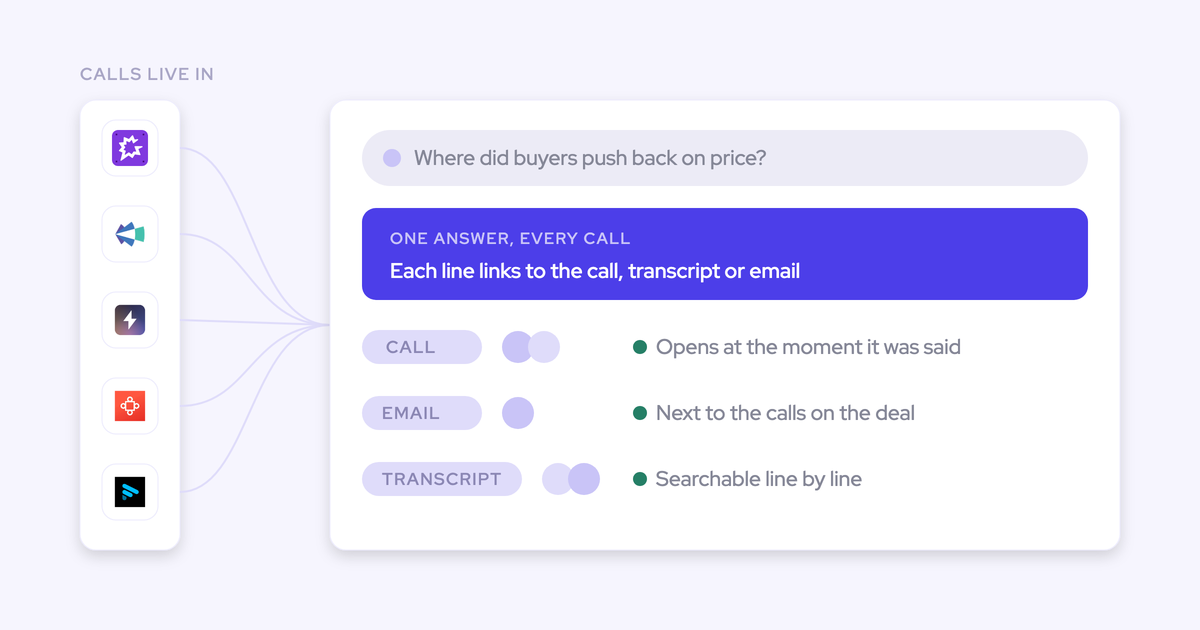
Gong Pricing Structure Explained: Every Module, What It Includes, and What It Costs
See how Gong pricing is built: Foundation, modules, platform fees, AI credits, and quote totals.


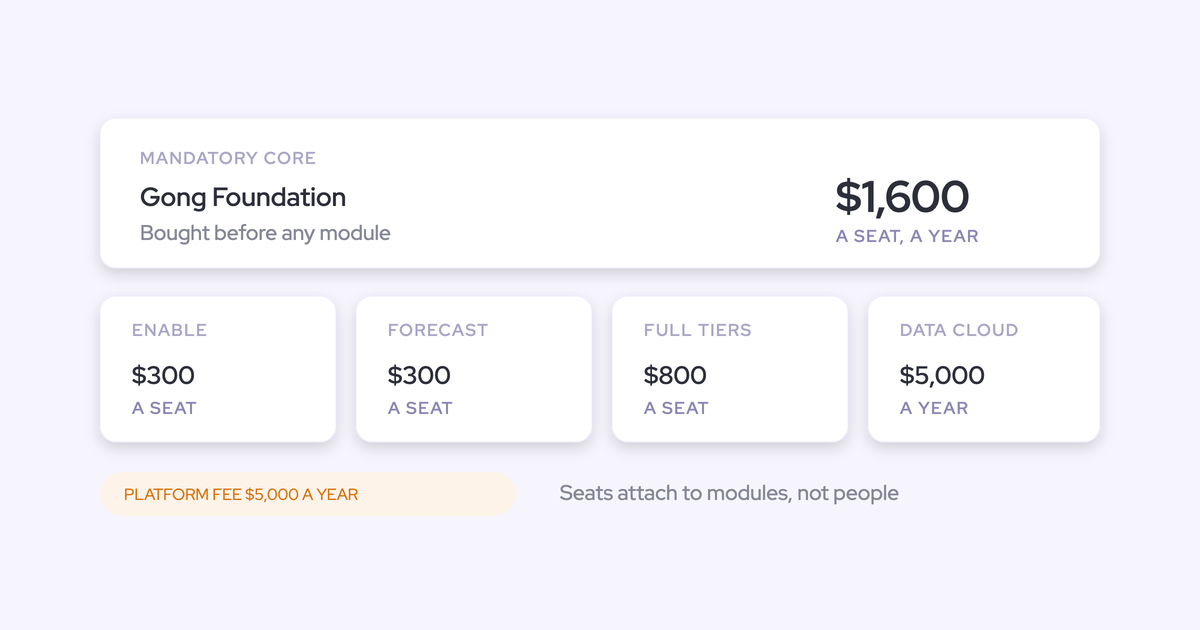

Gong doesn't publish pricing. So the quote sitting in your inbox is usually the first time anyone on your side has seen how the thing is actually built, and it tends to arrive as two big buckets: recording only, or recording plus forecasting.
Underneath those buckets there's a structure, and it's knowable. A mandatory core licence called Foundation. Applications sold on top of it. A flat platform access fee. Seats assigned per application rather than per person. And, as of the latest change, a credit pool metering some of the AI. Four of those five make the final number bigger than the per-seat figure on the slide.
This page maps every line of it, so you can defend the number or kill it in a finance conversation instead of guessing.
We're on the other side of a lot of these evaluations, usually with teams buying this category for deal execution, and the arithmetic below is what they end up rebuilding by hand. Gong first, in full. Weflow comes later, once the map is complete.
How Gong's pricing structure works: Foundation, applications, platform fee
A Gong quote isn't a per-seat price. It's three layers stacked, and only one of them is the capability you came for.
- Gong Foundation is the mandatory core licence. Every paid user needs one, and it carries capture, the mobile app, trackers, Ask Anything, and basic analytics.
- Applications are bought on top of Foundation. Enable Essentials, Forecast Essentials, Gong Forecast, Gong Engage, and Data Cloud all sit above the core, and none of them can be purchased without it.
- The platform access fee is a flat annual charge that applies before any seat or application cost.
That prerequisite rule is the whole shape of the quote. The entry price is never the price of the thing you wanted. It's the price of Foundation plus the price of the thing you wanted.
Which means the same capability costs a different total depending on which door you walked through. Evaluating Gong for coaching gets you Foundation plus Enable. Evaluating it for forecasting gets you Foundation plus Forecast. Same headline outcome, two different quotes, and the shared component is the biggest line in both.
Gong pricing by module: what each includes and costs
Here is every line item that can appear on a Gong quote, what it buys, and what it costs. Gong doesn't publish any of this, so treat the figures as representative numbers drawn from real quotes and Gong's own documentation rather than a rate card you can hold them to.
| Line item | What it is | What it includes | Price | How it's charged |
| Gong Foundation | The mandatory core licence | Interaction capture, mobile app, keyword and smart trackers, Ask Anything, basic analytics | From about $1,600 per seat per year | Per seat. Required before any application can be added |
| Gong Enable Essentials | Coaching application | Coaching workflows and scorecards | About $300 per seat per year | Per seat, on top of a Foundation seat |
| Gong Forecast Essentials | Forecasting application | Deal boards, win/loss | About $300 per seat per year | Per seat, on top of a Foundation seat |
| Gong Engage | The fuller engagement tier | Adds prospecting and an in-app dialer | About $800 per seat per year | Per seat, on top of a Foundation seat |
| Gong Forecast | The fuller forecasting tier | Deeper forecasting beyond Forecast Essentials | About $800 per seat per year | Per seat, on top of a Foundation seat |
| Data Cloud | Warehouse access add-on | Gong data exposed across Snowflake, Databricks, BigQuery and Redshift | About $5,000 per year | Flat annual fee, separate from seats |
| Platform Access fee | Flat annual platform charge | Platform access. A dedicated Customer Success Manager is included only on contracts above $45,000 per year | $5,000 per year | Flat annual fee, applies before any per-seat cost |
| Collaborator seat | The free tier for unassigned team members | Limited access. Excluded from AI Ask Anything and from the Gong MCP server entirely | Free | No charge, no seat assignment |
Read that table and one thing jumps out. The add-on modules are cheap next to the core.
Enable Essentials and Forecast Essentials each cost roughly a fifth of what Foundation costs. So the negotiation you think you're having, about which modules to include, is a rounding error next to the negotiation about how many Foundation seats you buy.
The Collaborator tier deserves a flag too. Free sounds like a way to widen access cheaply, but a Collaborator can't ask Ask Anything anything. It buys visibility, not intelligence, so anyone whose job involves getting an answer out of the conversation record needs a paid seat.
What's included in Gong Foundation, and is it enough?
Foundation covers capture and search, not coaching or forecasting. It includes interaction capture, the mobile app, keyword and smart trackers, Ask Anything, and basic analytics. That's a real product, and for a team whose problem is "we have no record of what's being said," it may genuinely be enough.
It's not enough for the two jobs most people are actually buying this category for. Here's the mapping:
| What you came for | What you have to buy |
| Recording, transcription, search, trackers | Gong Foundation alone |
| Coaching workflows and scorecards | Gong Foundation + Enable Essentials (or Gong Engage for the fuller tier) |
| Deal boards, win/loss, forecasting | Gong Foundation + Forecast Essentials (or Gong Forecast for the fuller tier) |
| Coaching and forecasting for the same person | Gong Foundation + Enable Essentials + Forecast Essentials, all three as separate seats |
| Gong data in your warehouse | Data Cloud, on top of everything above |
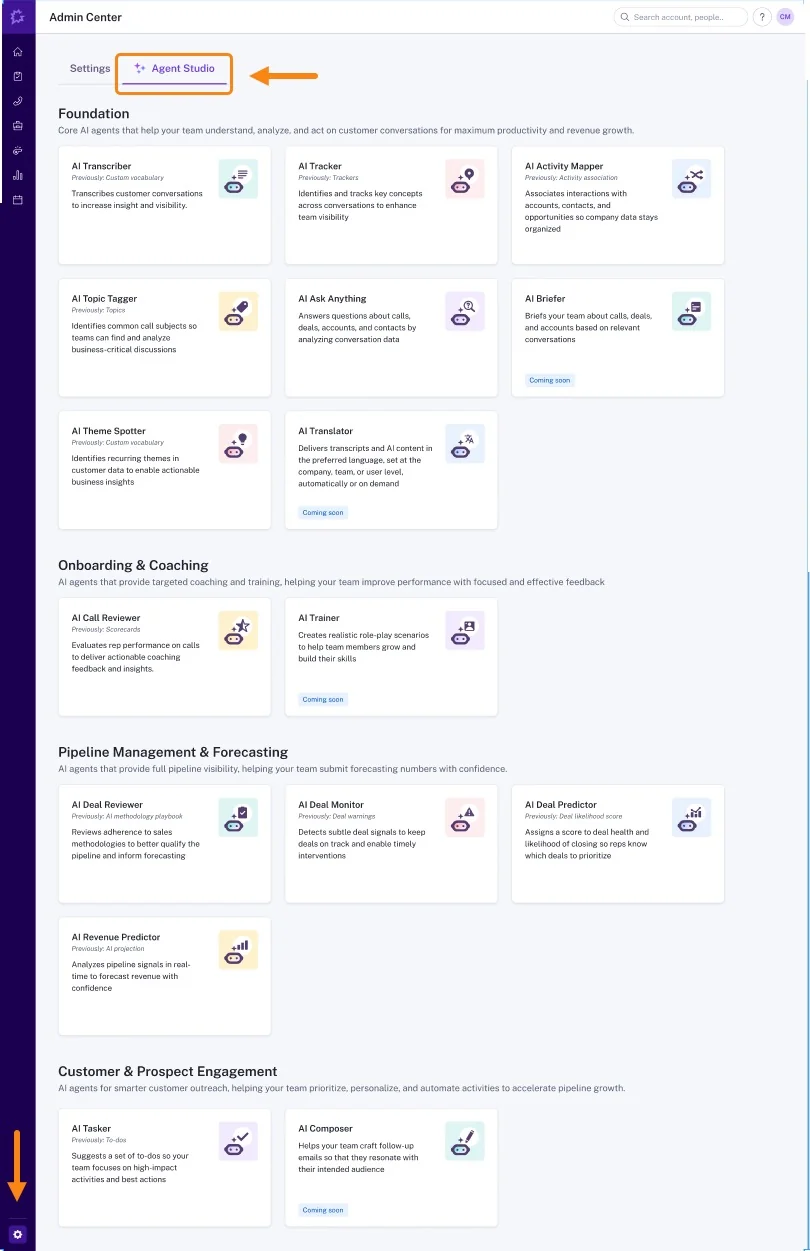
The same split runs through Gong's AI agents. Agent Studio holds eighteen named agents, and they're spread across four separately purchased packages: three run on any plan, six need Foundation, AI Call Reviewer and AI Trainer need Enable, AI Deal Reviewer needs Forecast, and AI Composer and AI Tasker need a Gong Engage licence.
So "Gong has eighteen agents" and "you get eighteen agents" are different statements, and the gap between them is four line items.
Why a Gong quote grows past the per-seat price
The per-seat number on the slide is the smallest number in the deal. Three mechanics push the real total above it, and none of them are negotiation tactics. They're how the pricing is designed.
This is the gap that catches rollout owners out. You socialize a figure early, you build the actual user list, and the number that comes back is nothing like the one people are holding in their heads.
Seats attach to Gong applications, not people
A Gong seat is assigned per application, not per person. Someone who needs deal functionality consumes a Foundation seat and a Forecast Essentials seat, so the cost of one human is the sum of every application they touch.
Take one sales manager who needs coaching and deal boards:
- Gong Foundation seat: about $1,600 per year
- Enable Essentials seat: about $300 per year
- Forecast Essentials seat: about $300 per year
- One person, three seats, about $2,200 per year, roughly $183 per user per month
Gong's admin screen shows seats in use per licence and per application against your contract totals, so the arithmetic is visible. It just isn't avoidable.
The practical consequence for a rollout: widening access to any single capability multiplies across two line items instead of adding one. That's why "let's give the frontline managers deal boards too" is never the small change it sounds like in the meeting.
Renewal timing changes what the same headcount costs
Gong grandfathers existing functionality at renewal by providing matching seats at no additional cost, and that includes headcount you add as part of the renewal transaction itself. Every seat added afterwards is bought separately, across every application that seat needs.
Gong's own worked example makes the point better than we can. A company renewing at 20 seats that grows to 30:
- Added at renewal: the extra ten arrive with both Foundation and Forecast Essentials at no cost.
- Added one month later: the same ten need both purchased at full price.
Same ten hires. Same capability. Two different invoices, decided by the calendar.
If you hire steadily rather than in step with your contract date, you pay for the difference, and it never appears in the model you build during the evaluation. Worth asking your rep directly how your planned headcount for the next twelve months maps against the renewal window before you sign the term.
Gong AI credits add a metered second number
Gong meters some AI usage in credits on top of per-seat pricing. Each paid core seat contributes 2,000 credits a year into a pool shared across the whole company, and the pool resets at the start of each contract year.
Two details matter more than the number.
First, the credit cost is set by the volume of data processed, not by the question asked. A call longer than ten minutes costs one credit, a call of ten minutes or less costs half a credit, and each email costs a tenth of a credit. So a broad question across a long date range on a busy account costs many multiples of a narrow one, and you can't predict the bill from the question.
Second, the pool is company-wide rather than per person. Heavy use by a few people consumes the allowance everyone else depends on, and you can't size the pool to the teams that need AI without buying more seats. Purchased top-ups expire at the end of the term and don't roll over.
Be fair to Gong here, because the dividing line is narrower than the headline suggests. What draws credits:
- Question-based AI Trackers
- The Gong MCP server
- API-based AI workflows
What stays included in the seat:
- Calls and call analysis, conversation insights
- Deal intelligence, forecasting, coaching
- Revenue and deal predictions
- Agent Studio agents run by hand by an individual user
Gong's framing is that credits are the alternative to raising seat prices for everyone, charging only the customers running continuous or large-scale AI, and keeping that processing inside Gong instead of exporting conversation data to an external tool. That's a defensible position, and the metered surfaces really are the automated ones.
The catch is where those surfaces sit in your plans. Gong's own guidance says AI Tracker configuration has the largest effect on credit consumption, and its recommended remedy is to unpublish trackers that no longer provide value and filter the rest by team, user, account type or deal stage. That turns the breadth of what you track into a budget decision.
The same brief is free when a person generates it in the Gong interface and costs credits when it comes through the API or the MCP server. So the cost rises specifically as you wire Gong into the rest of your stack, which is the opposite of what automation is supposed to do to a bill.
We want to make sure that you have predictable pricing, and it is very, very hard to achieve in the age of AI. — Philipp Stelzer, Co-founder and Chief Product Officer, Weflow
What a 27-user Gong quote actually totals
A representative 27-user quote on a three-year term lands at about $64,400 per year with Foundation, both Essentials modules, and the platform fee. Strip the modules out and it's about $48,200 per year for Foundation plus the fee alone.
| Line | Calculation | Annual cost |
| Gong Foundation, 27 seats | 27 × ~$1,600 | ~$43,200 |
| Platform Access fee | Flat | $5,000 |
| Subtotal: capture and search only | ~$48,200 | |
| Enable Essentials, 27 seats | 27 × ~$300 | ~$8,100 |
| Forecast Essentials, 27 seats | 27 × ~$300 | ~$8,100 |
| Total with coaching and forecasting | ~$64,400 |
That's about $199 per user per month all-in, before any AI credit top-up and before implementation.
Two things to take from it. The platform fee is a tenth of the bill at 27 seats, which is why it hurts small teams far more than large ones. And the modules that carry the capability you probably came for account for about a quarter of the total, while the prerequisite accounts for two thirds.
This is the number that ends up in front of a CFO, and it's why we hear the same line so often on switch calls.
How Weflow pricing compares to a Gong quote
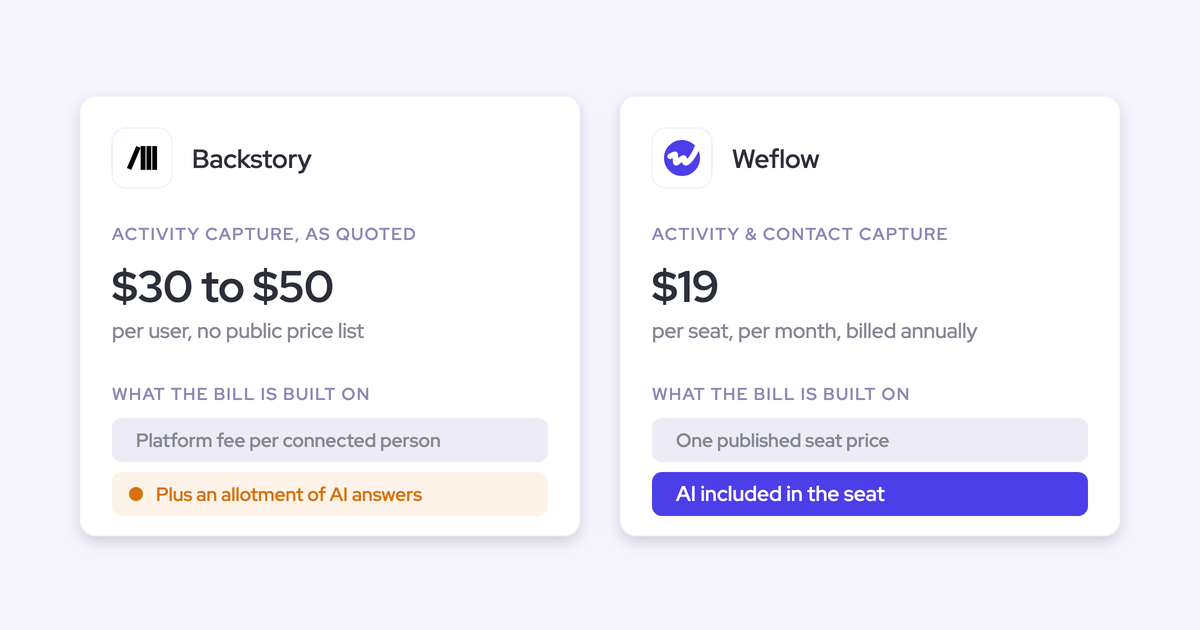
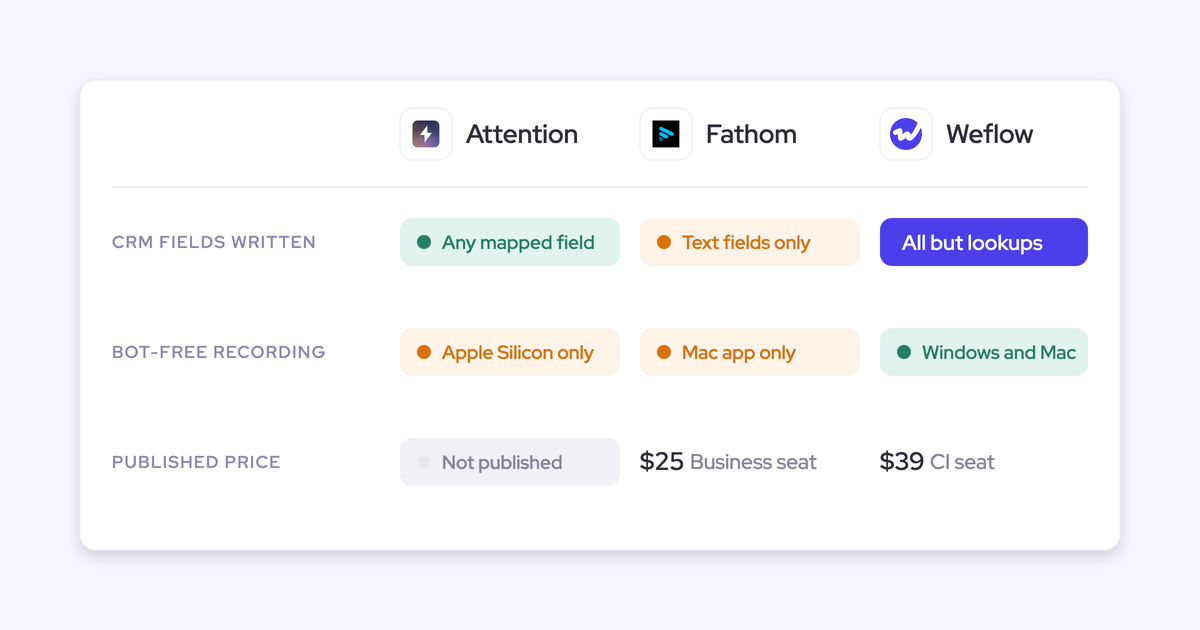
Weflow is the Revenue AI Orchestration platform for sales, customer success, and RevOps teams, and its prices are on the website. Three products at $19, $39 and $39 per user per month, three bundles at $49, $59 and $79, ten-user minimum, billed annually. You can verify every number in this section without talking to us, which is the entire point.
Where the two structures actually diverge:
| Dimension | Gong | Weflow |
| Price transparency | No published pricing. Figures come from quotes, and the structure is usually explained for the first time by a rep | Per-product and per-bundle list prices published on the website. |
| Entry structure | Mandatory Gong Foundation core licence from about $1,600 per seat per year, before any application can be added | No mandatory core. Buy Activity & Contact Capture at $19, Conversation Intelligence at $39, or Deal Intelligence & Forecasting at $39, or bundle them for discounted prices |
| Seat model | Seats attach to applications. One person needing coaching and deal boards consumes three seats | One seat per person on the product or bundle they need. Unlimited view-only licences included at no cost |
| Platform fee | $5,000 per year, flat, applied before any seat cost | None. No implementation fee either |
| AI metering | 2,000 credits per paid core seat per year, pooled company-wide. Trackers, the MCP server and API workflows draw down the pool. Top-ups expire | Recordings, transcripts, AI summaries, AI field updates and Ask Weflow AI Pro are included in the seat with no metering. Only Agent Builder is consumption-priced, per workspace rather than per user, with 25 agent actions a month free on every plan |
| Expansion path | A new application, priced per seat, on top of Foundation, at whatever the renewal calendar dictates | A step between bundles on the same contract: Revenue AI Foundation $49, Revenue AI Business $59, Revenue AI Enterprise $79 |
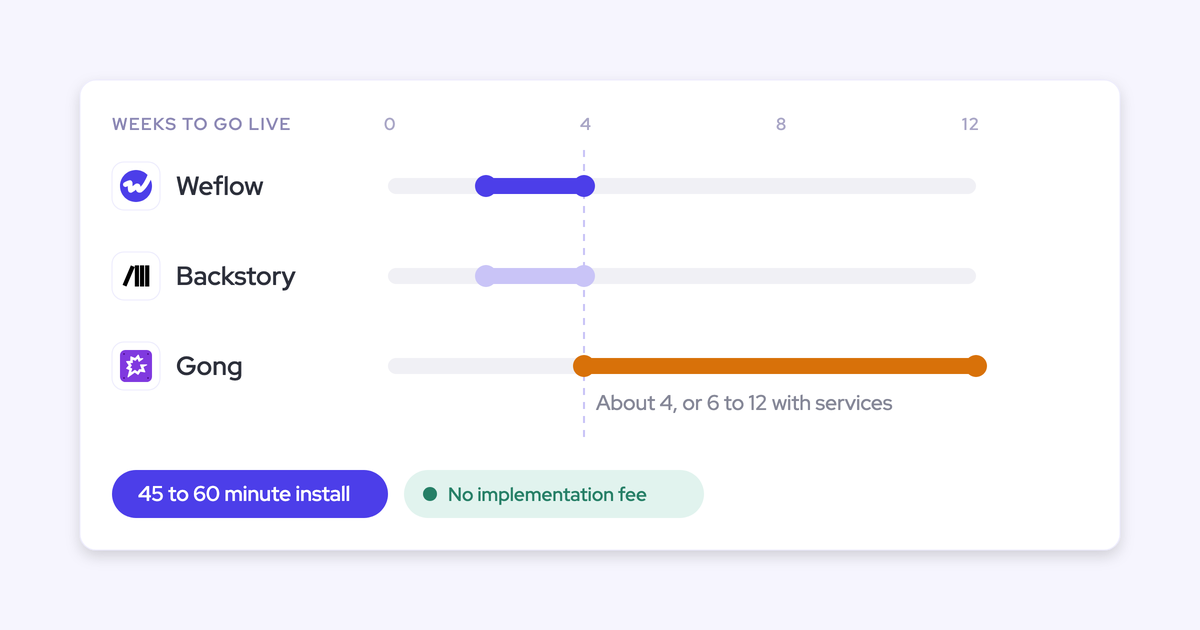
| Implementation | Smaller and mid-sized customers are routed to third-party implementation partners at a separate fee | Run by Weflow, included |
Run the same 27 users through it. Revenue AI Enterprise, the full platform including forecasting, is $79 per user per month at list: $25,596 a year, with no platform fee and no credit line underneath it.
That's before the multi-year discount, which is 20% on a three-year term, the same length as the Gong quote above.
The structural difference matters more than the headline, though. Because there's no mandatory core, you can put most of your seats on the capability they actually use and only pay the top price where the top capability is needed.
Twenty people on Revenue AI Foundation at $49 and seven leaders on Revenue AI Enterprise at $79 comes to $18,396 a year. That configuration simply isn't available when every seat has to carry the prerequisite first.
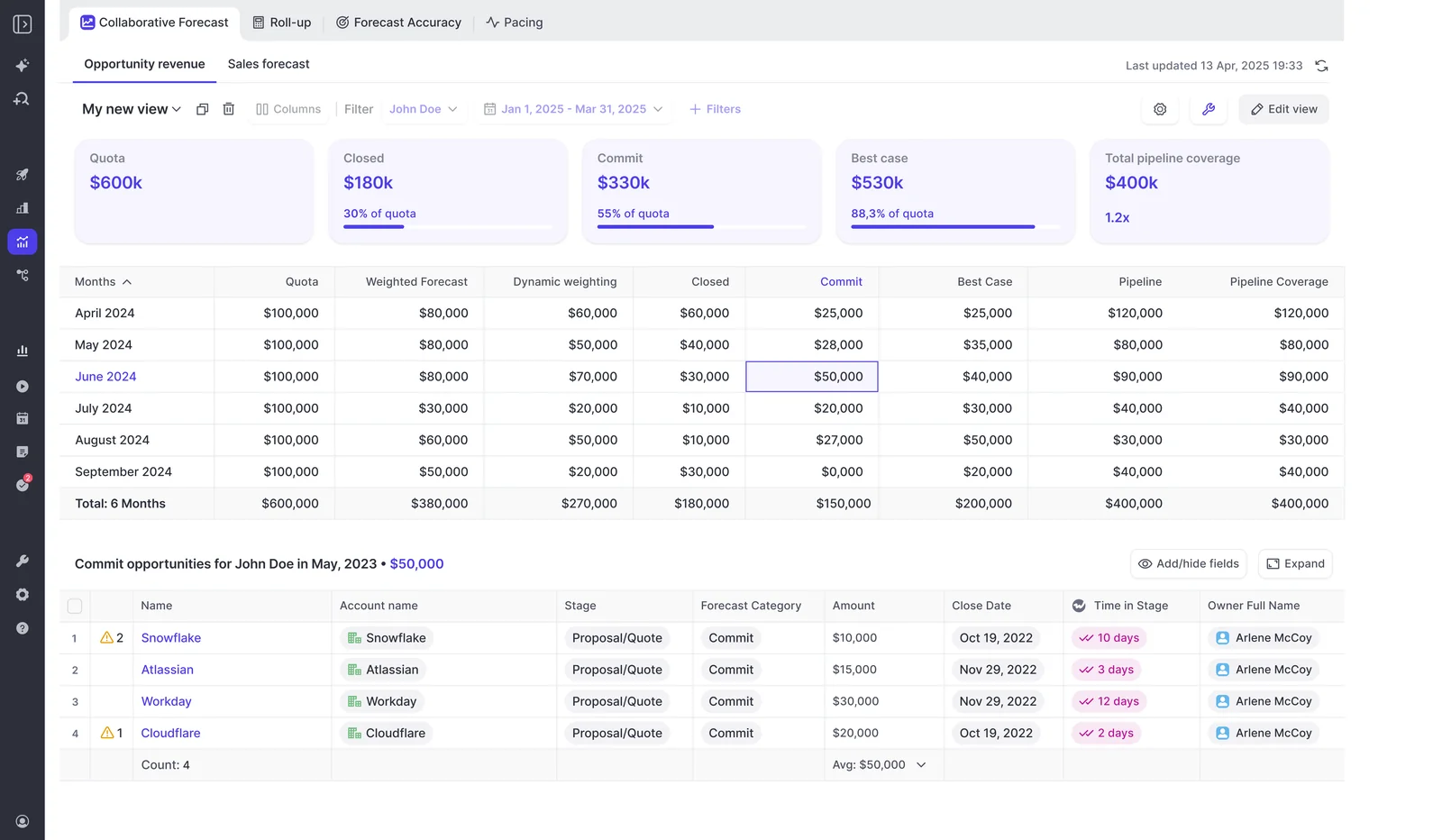
And when the forecasting conversation does come, it's a step rather than a procurement cycle. Adding Deal Intelligence on top of Revenue AI Foundation is $10 more per user per month, not a separate $100 to $200 per user contract that has to be justified on its own line to a CFO who already signed one this year.
On the AI side, the one thing Weflow meters is Agent Builder, and it's priced per workspace: Free with 25 agent actions a month on every plan, Growth at $299 a month for 500 actions, Scale at $999 a month for 2,500, and a custom enterprise package. Everything a rep touches daily sits in the seat, so nobody has to ration it.
Why Weflow can price at half of Gong
The gap is in when the products were built, not in what they do.
Gong set its pricing when transcription was genuinely expensive, and it now carries roughly $300 million in ARR against a valuation of about $7 billion. A company holding a multiple that size has to keep growing into it, which constrains how far it can discount and why buyers keep meeting a high floor before a single module is added.
Build the same capability after the transcription and inference cost curves collapsed and the cost base is structurally lower. That's the honest answer to "what's missing at half the price," and it's an answer about timing rather than about features.
We see ourselves as basically a new player in the space that's very AI native and with a focus on being very price aggressive. The core belief is if you build the best product at the most attractive price, that's a very hard thing to compete with. — Janis Zech, Co-founder and CEO, Weflow
We're not going to ask you to take that on faith. The proof we offer is a side-by-side trial with your own Salesforce data, not a discount argument, because in a category where everyone's demo sounds the same the only differentiator that survives contact is what you see yourself.
Buyers who've run both usually land somewhere honest about it:
When Gong is worth its price
Gong invented this category and still has the deepest conversation analytics in it. If aggregate-level analytics depth is your use case and budget genuinely isn't the constraint, the price gap can be a fair trade.
Choose Gong without much agonizing when:
- You need analytics depth at the aggregate level. Gong is strongest looking across the whole corpus rather than at one deal, and that's a real capability, not marketing.
- Your procurement gate names ISO 27001. Gong holds SOC 2 Type II plus ISO 27001, 27017, 27018 and 27701, CSA STAR listing, EU-US Data Privacy Framework certification with the UK and Swiss extensions, and PCI DSS compliant handling in transit. Weflow holds SOC 2 Type II, HIPAA, GDPR and CCPA compliance, with ISO 27001 in progress and targeted for December 2026. If your reviewer requires the certificate today, that's a fair reason to stay.
- You're not on Salesforce. Weflow works exclusively with Salesforce. No HubSpot, no Dynamics, no Pipedrive. A non-Salesforce team isn't a fit for us at any price, and we'd rather say that now than in week three of an evaluation.
- You need FedRAMP. Weflow isn't certified. Full stop.
What doesn't justify the gap, in our view, is the argument that a higher price signals a safer choice. That's the part buyers keep testing and keep failing to verify.
What switching from Gong to Weflow actually costs
Two costs reframe every budget at this point in an evaluation: the call history you'd lose, and the implementation nobody quoted for.
The history moves. Weflow imports and extracts recordings and transcripts from the conversation intelligence platform you're leaving, pulling them through that platform's API, at no extra cost, in about one to two weeks depending on volume. Because they land in your own CRM, they stay searchable by Weflow's AI afterwards, so a question about how an objection was handled last quarter still answers after the move.
One thing worth checking before you price that loss: Gong keeps recorded calls and all related artifacts, including transcripts and statistics, for up to three years by default. Calls anyone saved to the library are exempt and kept indefinitely. So the archive you think you're protecting may be smaller than the archive you think you have, and any team member can move calls into the library in bulk, which quietly changes retention without anyone approving it.
The implementation is ours. Gong routes smaller and mid-sized customers to third-party implementation partners at a separate fee, which is a line item that shows up late and splits accountability when adoption stalls. We hear the reaction verbatim:
Weflow runs its own onboarding, and there's no implementation fee. The technical setup takes thirty to forty-five minutes with a Salesforce admin and a mail admin in the room, plus about an hour to configure the workspace.
Be realistic about the rest, though. What stretches an implementation isn't the product, it's getting those two admins on the same call and deciding what the system should do: which methodology to score against, which fields to write. That's a change management conversation, and it's why one hour of setup often becomes one to three weeks of elapsed time.
Choose Gong if, choose Weflow if
Choose Gong if:
- Aggregate-level conversation analytics depth is the primary thing you're buying, and budget is not the binding constraint.
- Your security review requires ISO 27001 or FedRAMP certification today, not on a roadmap.
- You run a CRM other than Salesforce, which rules Weflow out entirely.
- Your renewal date and your hiring plan line up well enough that the grandfathering mechanic works in your favor rather than against it.
- Your team already knows Gong well and the internal cost of switching outweighs the annual difference, which at some seat counts it genuinely might.
Choose Weflow if:
- You need a number you can publish internally and defend line by line, from prices anyone can check on a website.
- You want one seat per person rather than a seat per application that person touches.
- You want most of your team on inexpensive capture while only leadership pays for forecasting, which a mandatory core licence prevents.
- An unpredictable metered AI line is the thing blocking approval, and you need recordings, transcripts, AI summaries, AI field updates and Ask Weflow AI included in the seat.
- You're rolling out in waves and want to pay for live seats, then expand into deal intelligence and forecasting as a step on the same contract.
- You run on Salesforce and want the captured activity, conversation data and AI field updates stored in native Salesforce objects you keep.
Walk through the product yourself, no call required.
FAQ: Gong pricing questions buyers ask
Does Gong publish its pricing anywhere?
No. Gong doesn't publish pricing, so every figure buyers see comes from a quote. The numbers on this page are representative figures drawn from real quotes and from Gong's own documentation, and they'll vary with seat count, term length and negotiation. Use them to sanity-check the quote in your hand, not as a rate card.
What is the Gong platform access fee?
The Gong platform access fee is a flat $5,000 per year charged in addition to per-seat licences, and it applies before any seat or add-on cost. It's proportionally brutal at small seat counts: on a 27-user quote it's about a tenth of the annual bill. Gong includes a dedicated Customer Success Manager only on contracts above $45,000 per year.
What does a free Gong Collaborator seat include?
A Gong Collaborator is a team member with no seat assignment. Collaborator accounts are free and carry limited access, and they're excluded from the AI entirely: no Ask Anything, and no connection to the Gong MCP server. So the free tier buys visibility, not intelligence, and anyone who needs an answer out of the conversation record needs a paid seat.
How many AI credits come with a Gong seat?
Each paid core seat contributes 2,000 credits a year to a pool shared across the whole company, and the pool resets at the start of each contract year. Cost is driven by data volume rather than the question: a call over ten minutes costs one credit, a call of ten minutes or less costs half, and an email costs a tenth. Purchased top-ups expire at the end of the term and don't roll over.
Does Gong include a dedicated customer success manager?
Only on contracts above $45,000 per year. Below that threshold you don't get a named CSM, which is worth knowing before the value of the relationship gets factored into your business case.
What are Weflow's minimum seats and contract terms?
Weflow has a ten-user minimum and bills annually, with published prices per product ($19, $39, $39) and per bundle ($49, $59, $79). Volume discounting starts around thirty to forty seats and multi-year terms carry their own discount. There's a 14-day free trial with guided onboarding, and for evaluations two weeks can't cover, such as a forecasting motion that needs a cycle to run, there's a three-month paid pilot written as the first three months of a multi-year agreement with an opt-out at the end.