Migrating from Gong at renewal: a 90-day plan to keep your call library
Learn how to migrate from Gong at renewal in 90 days and keep your call library linked to Salesforce



Your Gong renewal is the one month a year you have real leverage. The thing that usually stops teams from using it isn't the product comparison. It's the archive: years of recorded calls, objection handling, won-deal examples, all sitting inside the tool you want to leave.
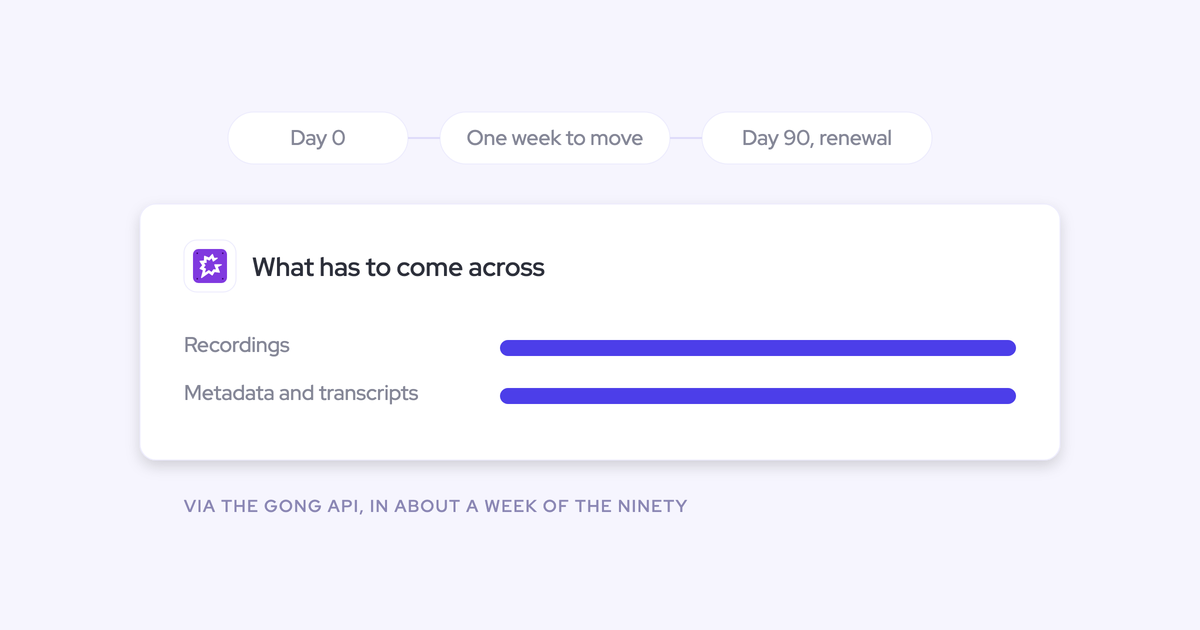
Both of the things that make leaving feel riskier than staying are solvable. The archive can migrate with you, recordings and transcripts included, re-linked to the Salesforce records they belong to. And the switch fits the window if you run it as a dated plan instead of a project that starts when someone gets around to it.
That's what this is: three honest options, the criteria that decide between them, and a 90-day timeline that lands before your fiscal year turns. The archive is worth protecting because it's what your deal reviews and 1:1s actually run on, not because history is nice to have.
Why you can only leave Gong at renewal
No CFO will fund two conversation intelligence tools at the same time. That single fact collapses the whole decision into the renewal window, and it's why an exit that's obvious on product grounds is only possible on a calendar.
We hear the same shape of it on calls constantly, and it's rarely one contract in isolation:
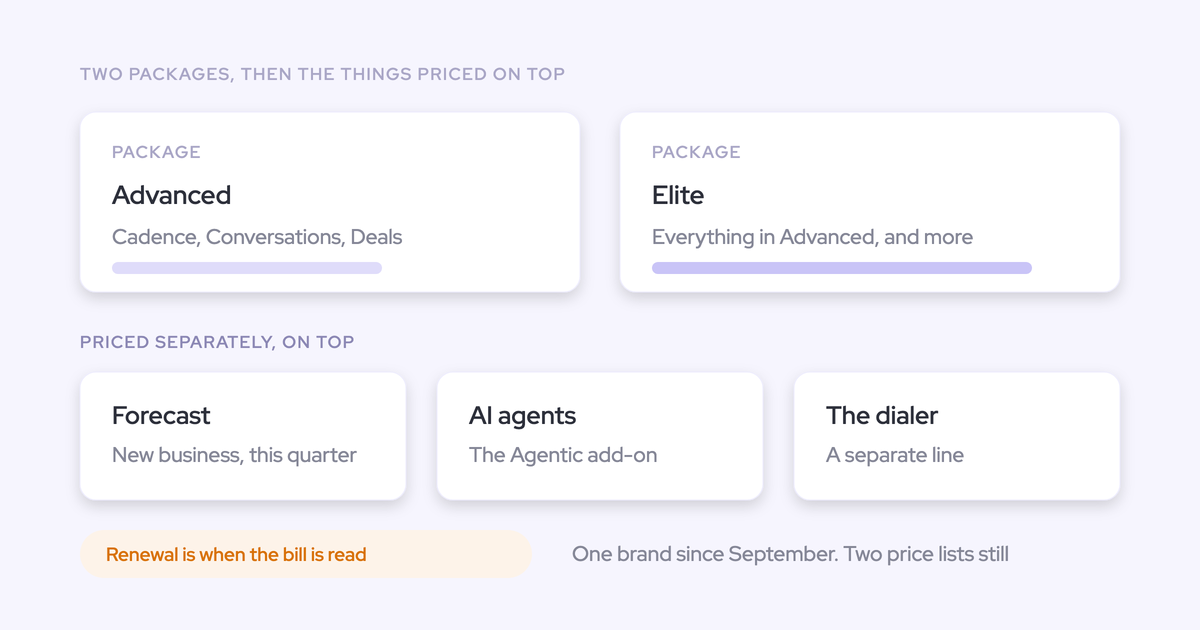
Miss it and you're in for another twelve months. And the number you're renewing at isn't the number you'll pay.
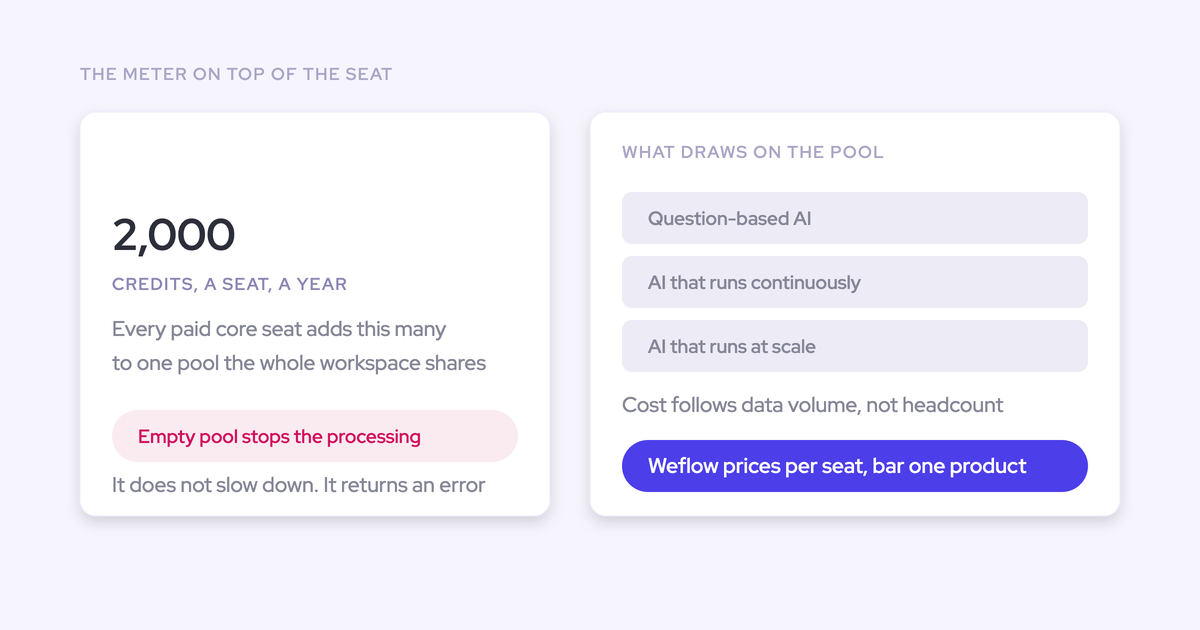
Gong has moved AI onto consumption pricing on top of its per-seat license, so the AI line grows as adoption grows. For finance, that turns a known annual cost into an open-ended one. For you, it turns every conversation about rolling AI out to more of the team into a cost conversation instead of a value one.
The real switching cost is the Gong call archive
The switch is priced by the history you'd lose, not by the new license. That's the whole blocker, and it's structural rather than accidental.
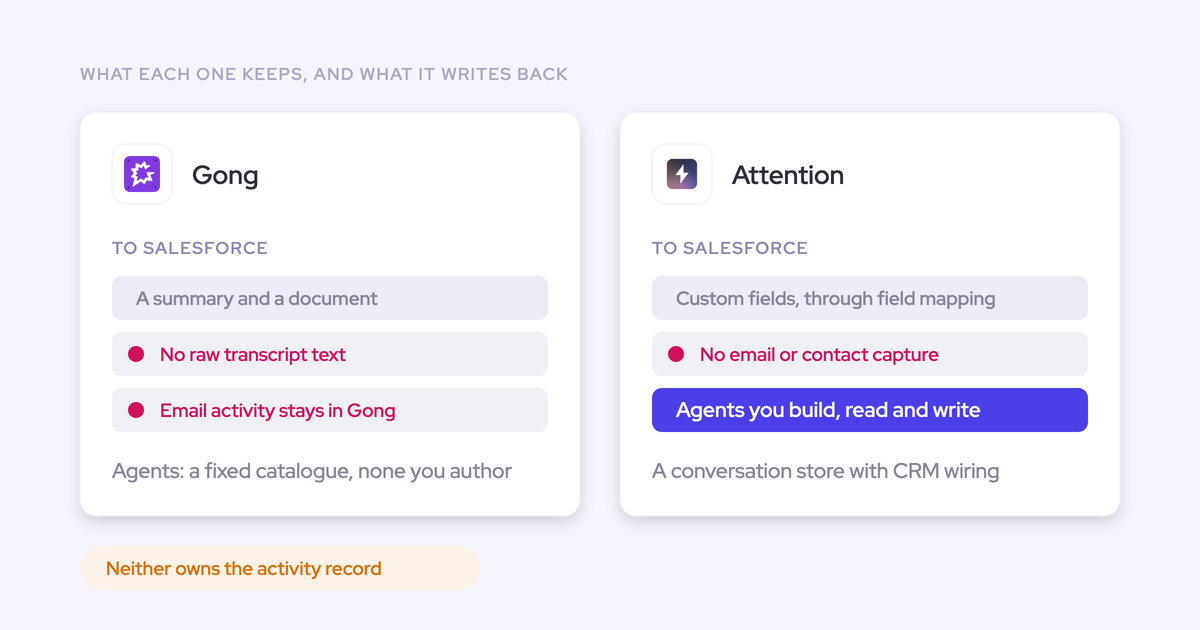
Gong stores recordings, transcripts, and the intelligence built on them in its own cloud rather than as records in your Salesforce. Gong does log activity into Salesforce, so activity logging by itself isn't the reason teams leave. The recordings and the conversation layer are.
I've used GONG before. I'm a previous GONG user. I know they're weak and also you can never leave them because you don't own any of the data.
Here's what that means concretely at exit:
| What you built up | Where it lives with Gong | What you'd need for it to survive |
| Call recordings and transcripts | Gong's own cloud, retrievable through its API | Imported into the new system and linked to the account and opportunity |
| Coaching examples, clips, objection library | Gong's library, tied to the subscription | Reprocessed so the history is searchable and scoreable again |
| Tracker and keyword reporting | Gong's tracker configuration | Carried over so competitor and pricing reporting doesn't restart at zero |
| Emails and meetings | Logged to Salesforce, mapped into Gong's structure | Native Task, Event, and EmailMessage records your flows and reports can read |
The incumbent has no incentive to make this easy. Gong charges roughly $1,000 to import recordings into its platform, and it charges to relocate your data between regions. That tells you how the exit side gets treated.
Three ways to handle the Gong renewal
There are three honest paths here, and they differ on what happens to the archive and the calendar, not on feature grids.
| Path | What happens to the archive | Budget outcome | Timeline exposure |
| Renew | Stays intact | Another year at the current price, plus a growing AI consumption line | None this year, same decision in twelve months |
| Switch, start fresh | Lost at contract end | Lower, immediately | Fits the window easily, usually dies internally |
| Switch, import the library | Migrates and gets re-linked to Salesforce | Lower, and the shape of the budget changes | Fits the window if you start selection in Q3 |
Renew and revisit in twelve months
Renewing is a defensible choice, and we'd say so on a call. You keep the archive, you keep the analytics depth, and you don't spend a quarter of your own time on a migration.
What it costs is the thing you already know: another year at a price your team is questioning, plus an AI line that grows exactly as adoption succeeds. If your managers genuinely live in Gong's aggregated views, that trade can be worth it.
Switch and start the call library from zero
Any replacement recorder works going forward. The problem is what happens to everything before day one.
The coaching examples your enablement lead built the onboarding program on, the objection history, the calls behind your last three big wins: all of it stops existing the day the contract ends. This is the path most teams assume is the only alternative, and it's the reason previous exit attempts stalled in a room somewhere.
GONG has been the CI tool for a good while. Meaning we have so many recordings, so many flows in line with that, and of course the integration with Salesforce.
Switch to a platform that imports the Gong library
If the existing library can be imported and reprocessed under the new system, the argument that keeps teams stuck disappears and the decision goes back to product and price, where it belongs.
Test whether it's real rather than marketing. Ask for the mechanism, the volume it's been run at, how long it takes, and what the recordings are linked to when they land. A vendor who describes it as "we can look at a file export" is telling you it isn't a product.
The criteria a Gong replacement has to pass
Five pass-fail criteria decide this. Take the list into every vendor call, including the Gong retention call.
- The archive imports, not exports. Ask whether recordings, metadata, and transcripts come across, whether they're reprocessed so they're searchable and scoreable, and what Salesforce record each one links to afterward. Ask for the largest library they've moved.
- The data lands in Salesforce objects you own. Ask which objects specifically. If the answer isn't Task, Event, EmailMessage and your own fields, you're buying the next data cloud. Test it: can a Salesforce flow read what the tool writes?
- The whole switch fits the window. Selection, contract, import, configuration, rollout. If a vendor can't be tested against a written requirements list inside two weeks, they've failed the timeline criterion before the migration even starts.
- The vendor can staff a real rollout. Security certifications, an uptime commitment you can check, named customers at your seat count, and someone who owns onboarding end to end rather than handing you a help center.
- The budget is a known number. Seat-based, published, AI included. Any metered line means your cost rises as adoption succeeds, which is the problem you're leaving.
Where Gong is still the stronger choice
Gong invented this category and still has the deepest conversation analytics in it. That's not a courtesy line, it's the thing that should give you pause.
Specifically, these are the capabilities that don't come with you:
- Aggregated analytics depth. Gong is strong at the roll-up level, which is where sales managers actually work. As one prospect put it to us: Gong is very strong on the aggregated level, because going through individual calls is time consuming and managers won't do it.
- Account-level methodology summaries. Gong can summarize qualification across every call on an account, not just call by call. On a long cycle, that's the view a manager needs, and a tool that only summarizes single calls feels like a downgrade.
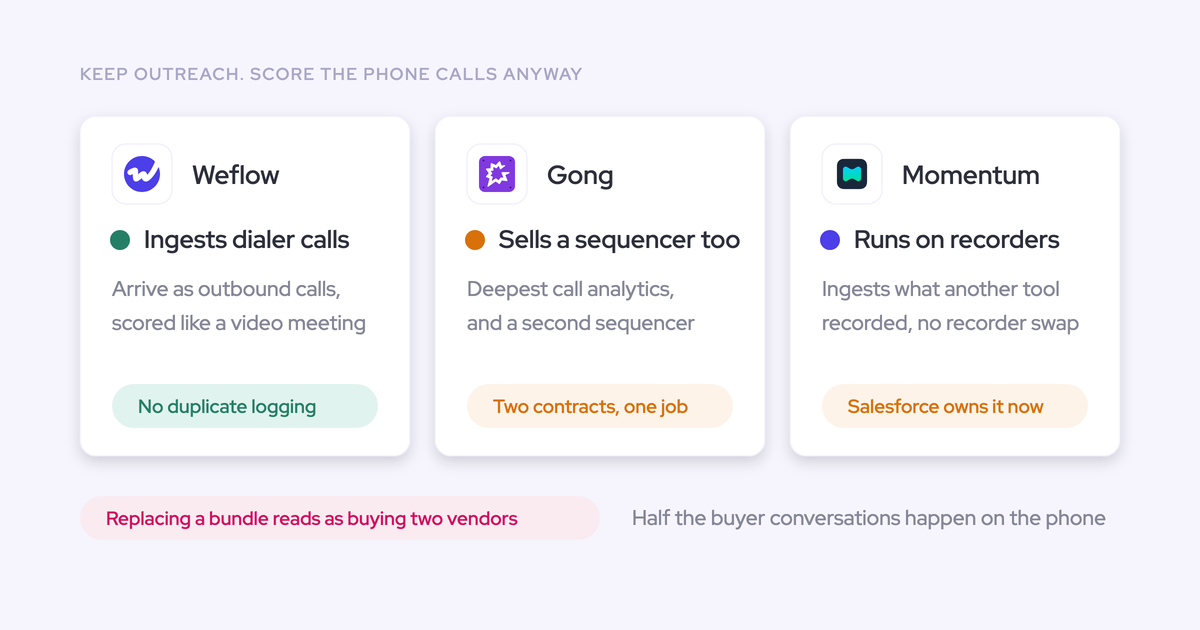
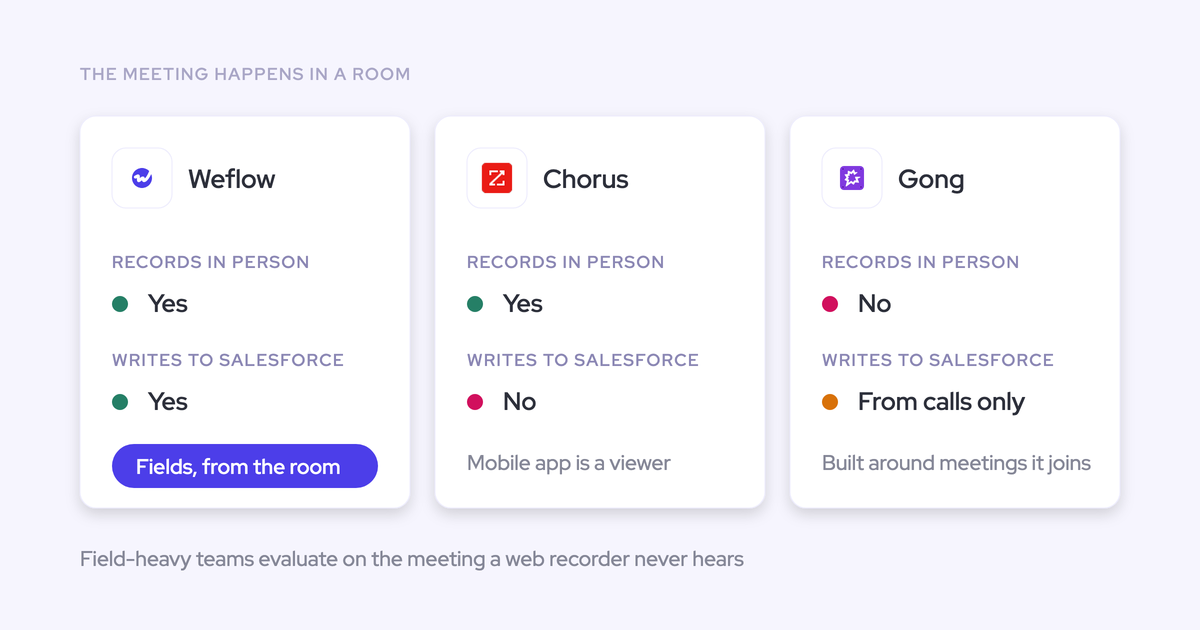
- Gong Engage and the dialer. Weflow has no sales engagement product, no sequencing, and no dialer. VoIP and phone call capture is a gap too. A phone-heavy motion running on Gong's dialer should think hard before moving.
And one on our side of the ledger. Weflow's forecast roll-up, submissions, and quota data live in the Weflow app rather than being written back into Salesforce, even though activity, transcripts, summaries, and AI field updates all land in the CRM. If your rule is that reps work in Salesforce and nowhere else, roll-up submission breaks that rule. The weighted forecast and the AI projection still work, because both run off CRM data with no rep input.
How Weflow migrates the Gong call library
Weflow is the Revenue AI Orchestration platform for sales, customer success, and RevOps teams, and the Gong migration is one of the reasons teams reach us in the renewal window rather than after it.
The sequence is short:
- You generate a Gong API key and hand it over. No manual export, no file upload, no CSV wrangling on your side. If no API key is available, a raw file export can work but our team evaluates it first.
- Weflow pulls recordings, metadata, and transcripts through the Gong API, at libraries in the thousands of recordings.
- Transcripts are reused where the API carries them, and retranscribed where it doesn't.
- Everything is reprocessed through Weflow's AI, so the historical library is searchable and scoreable under the new system rather than sitting there as an archive of files.
- Each recording is re-linked to the right Salesforce record.
That last step is the one to interrogate, because it's the difference between a migrated library and a pile of MP3s.
Where the Salesforce association is retrievable through Gong's API, Weflow uses it directly to map each recording to the correct account, opportunity, or contact. Where it isn't, Weflow runs its own lookup matching so the recording still lands connected.
The import runs in about a week, and it costs nothing.
Where the data lands: Salesforce objects you own
Weflow writes captured activity into native Salesforce objects: Task, Event, and EmailMessage, plus your own standard and custom fields. That's the answer to the question Gong taught you to ask, which is what you keep if you ever leave the next vendor too.
Because the records are native, three things follow. Salesforce flows can read and trigger on them. Your own reports and BI tools can query them. And they stay in your org after any cancellation, because they were never mirrored from somewhere else.
| Vendor-cloud model | Native-object model | |
| Where captured data lives | The vendor's own data layer | Your Salesforce, as records on standard objects |
| Can a Salesforce flow act on it | No | Yes |
| Can your BI tool query it | Through an export or a second license | Directly, like any other Salesforce data |
| What happens at cancellation | Access ends with the contract | The records stay in your org |
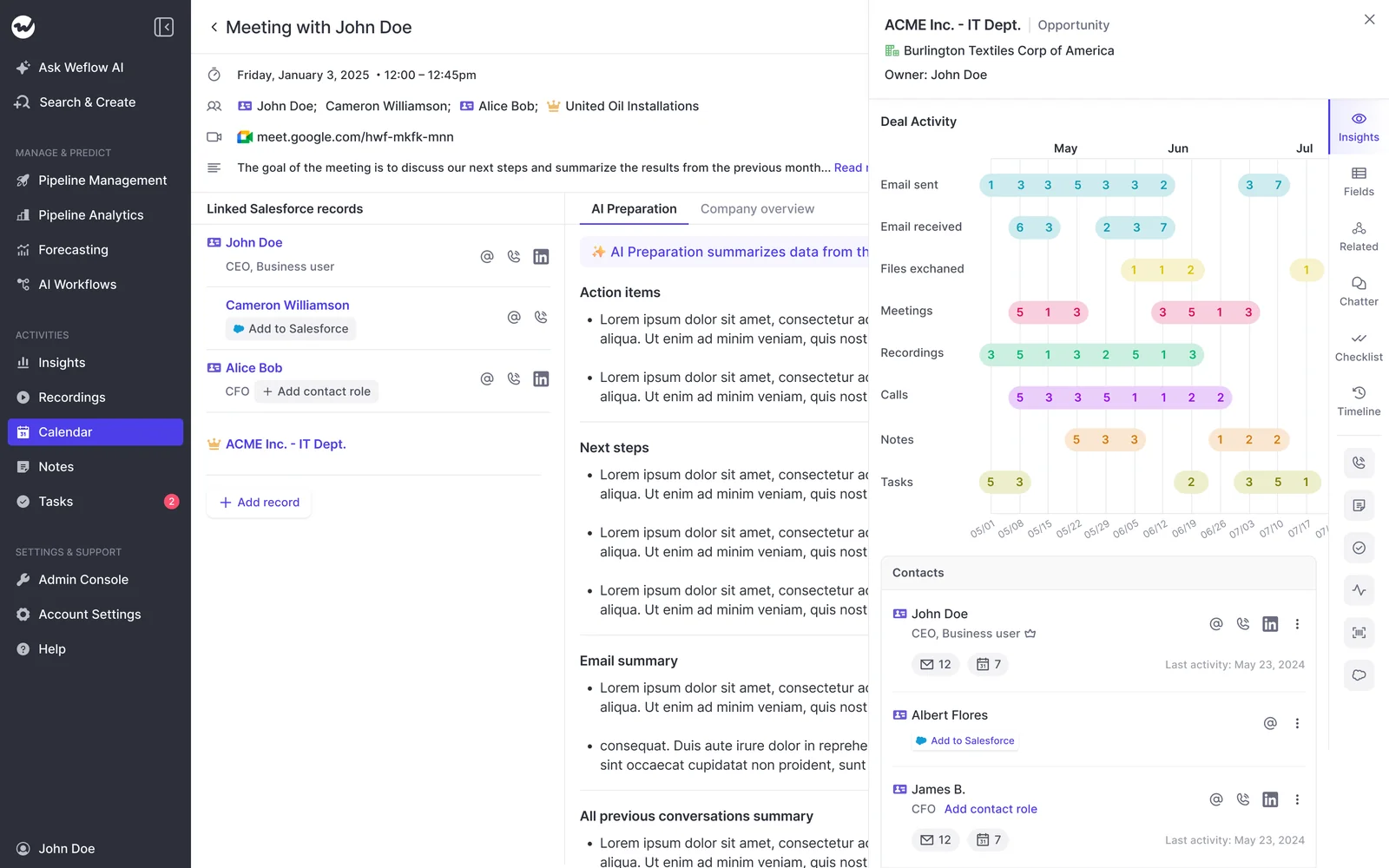
One more thing that matters at rollout: recording a meeting doesn't create a second meeting. Weflow writes the summary onto the one meeting activity that actually happened, so meetings per rep and meetings per closed opportunity don't quietly double-count.
The 90-day migration timeline that fits the window
Run it as three dated phases: decide, migrate, go live. The archive import happens in the middle phase, early enough that nothing is at risk when the Gong contract lapses.
Days 1–30: requirements, shortlist, and a two-week bake-off
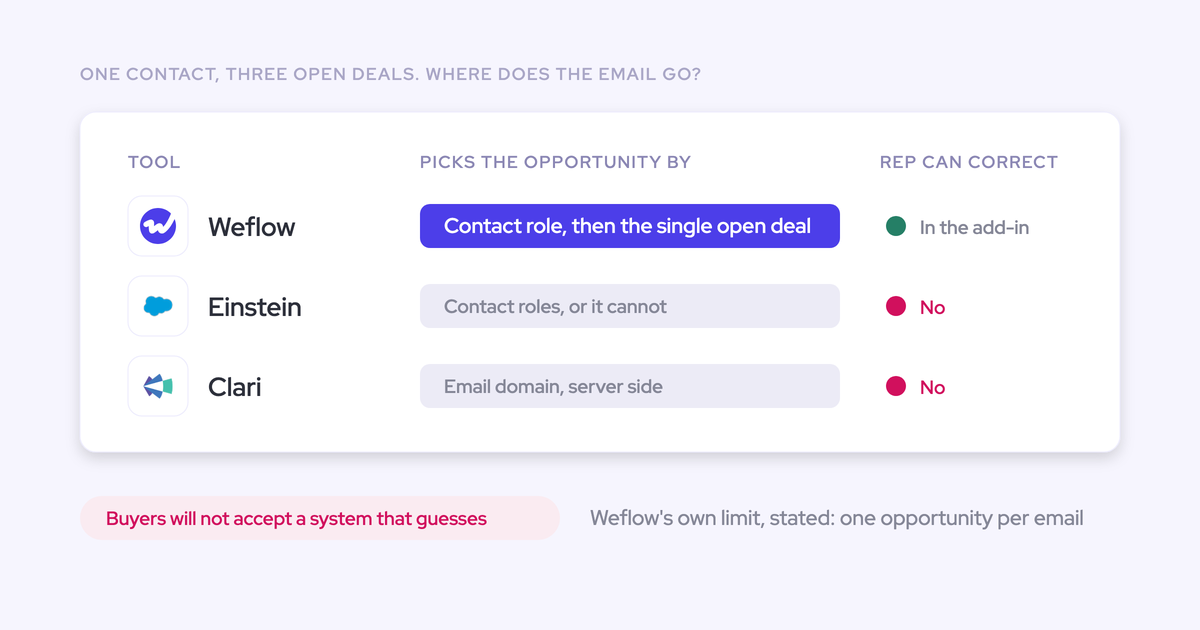
- Write the requirements down before any demo. Archive import and re-linking, native-object storage, opportunity-level mapping (not just account), EU residency if you need it, inbound as well as outbound email, and reporting you can build yourself.
- Share the same list with two or three vendors. Same list, same questions, so the comparison is real.
- Pilot for about two weeks. Run one capture tool against the inbox at a time. Two capture engines competing over the same emails produce duplicate and conflicting logging, and you'll blame the wrong vendor.
- Score against the list, not the demo. A demo always looks good. Capture failures show up later.
- Cut anyone who can't be tested in a fortnight. That's the timeline criterion doing its job.
Days 31–60: contract, archive import, and Weflow configuration
- Sign, then hand over the Gong API key. The import runs in the background for about a week while you do everything else.
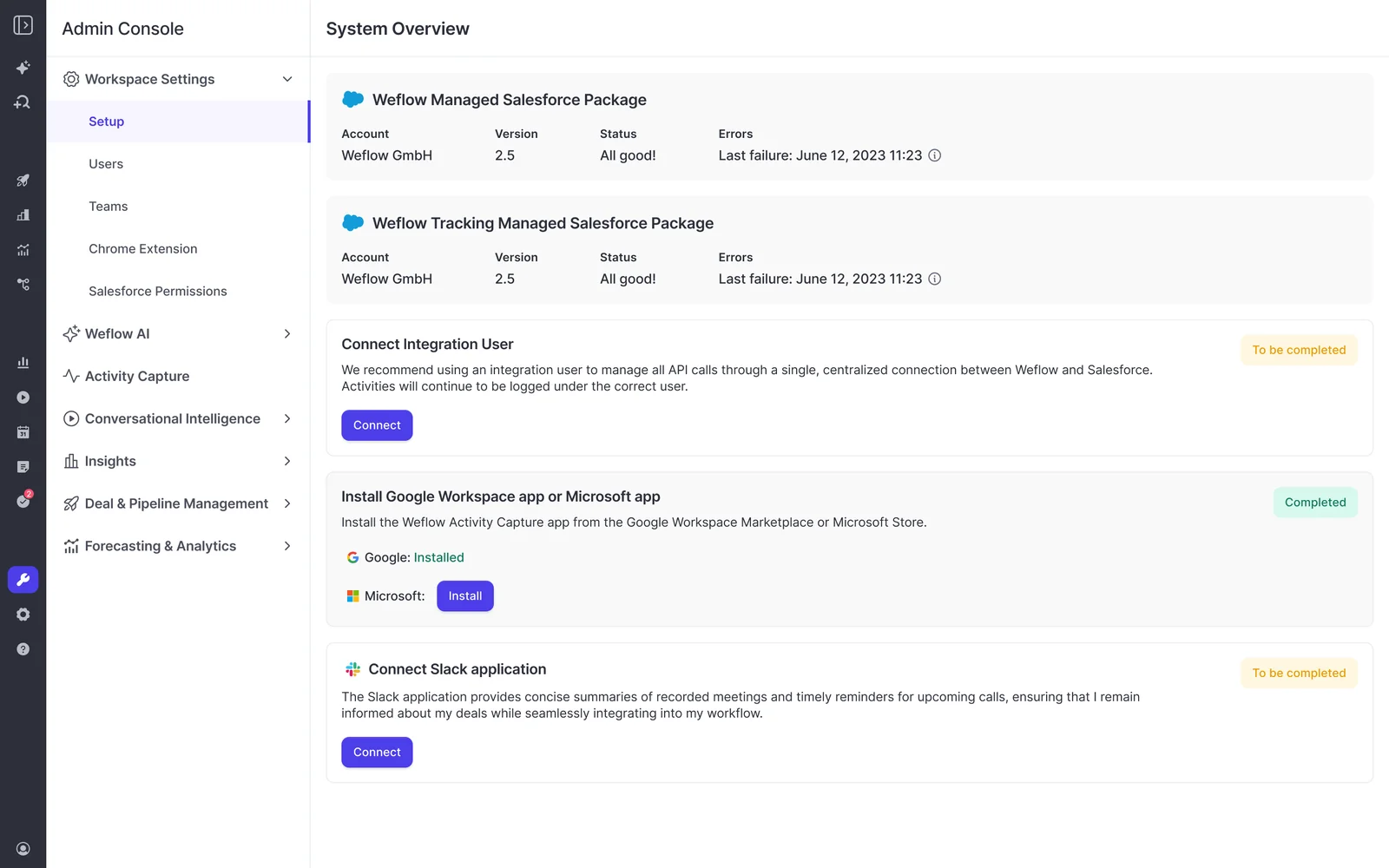
- Complete the technical setup. It's a 30 to 45 minute session with a Salesforce admin and your Google Workspace or Microsoft admin. Sign-in runs through Salesforce authentication only, so there's no separate identity for IT to provision or deprovision.
- Decide the consent flow. Opt-out is what most teams pick: the meeting records by default, guests are notified in chat and can stop it. Opt-in and manual are both supported, and the wording and language are yours to set.
- Carry the tracker set over from Gong. Competitor, pricing, and objection tracking keeps running instead of restarting from zero.
- Configure the business logic. AI field mappings, playbook templates, deal warnings against your own slippage patterns, pipeline views, permissions.
- Backfill historical activity. Up to 24 months of emails, meetings, and contacts as standard, up to three years custom.
By day 60 the new system holds both the past and the present, which is the position you need to be in before you touch the Gong contract.
Days 61–90: phased rollout and switching Gong off
- Roll out team by team. This is safe rather than sloppy: any meeting or email that fails to sync can be recovered, the mapping rule corrected, and the record backfilled later, whether the gap was a week or a month ago.
- Verify the migrated library. Open a handful of closed-won opportunities from last year and check the imported recordings are linked to the right record and searchable.
- Train against real calls. Role-based sessions on your own migrated conversations, not a sandbox.
- Check the capture health view. Duplicate accounts, duplicate contacts, non-converted leads, and any capture setting not yet configured all surface there before they become months of missing activity.
- Let the Gong contract lapse. There's nothing left inside it that you need.
What replacing Gong costs: seat-based pricing, AI included
The question we get asked most directly on these calls is this one:
If I'm spending in the 75k range with Gong, what would I expect to spend with you, give or take.
Here's the list-price answer. Weflow Conversation Intelligence is $39 per user per month billed annually. Bundled with Activity & Contact Capture as Revenue AI Foundation it's $49. Add Deal Intelligence at $59, and full Forecasting at $79. Minimum ten users, volume tiering with a meaningful breakpoint from roughly 30 to 40 seats.
At 100 seats, Conversation Intelligence lists at $46,800 a year and Revenue AI Foundation at $58,800, before any volume discount. There's no platform fee and no implementation fee.
| Dimension | Gong | Weflow |
| Seat license | Foundation from $1,600 per seat per year | Conversation Intelligence $39 per user per month, Revenue AI Foundation $49 |
| Platform fee | $5,000 per year, before any seat cost | None |
| AI pricing model | Consumption-based, on top of seats | Included in the seat, unmetered |
| Coaching and forecasting | Paid add-on modules, roughly $300 to $800 per seat per year each | Bundled tiers at $59 and $79 per user per month |
| Migrating your recording library in | Around $1,000 | Free |
| Dedicated CSM | Contracts above $45,000 per year | Vendor-owned onboarding as standard |
The shape of the budget changes as much as the number. Recordings, transcripts, AI templates, and Ask Weflow AI prompts are included with no caps and no meter, so the line item you take to your CFO stays the same size in month twelve as it was in month one.
Phased rollout keeps the first invoice small in a way Gong's structure doesn't allow. Because Weflow is priced per product, you can put the whole customer-facing org on Activity & Contact Capture and Conversation Intelligence and add Forecasting only for the leadership group that runs the number. That's how a 260-seat deployment stays affordable.
RevOps teams that already switched from Gong to Weflow
This is a walked path, not a proposal.
HolidayCheck moved off Gong for a European, GDPR-safe platform, chosen by a team lead who had used Gong before and knew exactly what he was giving up.
Weflow ticked all the boxes: GDPR-compliant, tightly integrated with Salesforce, simple to use - and without the heavy price tag of U.S. vendors.
Bastian Stosic, Head of Media Sales Operations, HolidayCheck
KORE Wireless evaluated Gong and chose Weflow instead, on value rather than on budget:
the value didn't justify its price compared to Weflow
KORE Wireless, on evaluating Gong
KORE ran a five-phase rollout: Activity Capture first, then Conversation Intelligence, coaching, Deal Intelligence, and Forecasting last. Weflow owned onboarding end to end, including live training delivered with a real-time Portuguese translator for the Brazil team. IDnow made the same move.
FAQ: migrating from Gong at renewal
Does migrating recordings from Gong to Weflow cost anything?
No. The Gong migration is free and runs off a Gong API key you generate and share, with no manual export or file upload on your side. Weflow handles the import, which takes about a week for libraries in the thousands of recordings. If no API key is available, a raw file export can work but our team evaluates it first.
Do Gong trackers and keyword reports carry over?
Yes. Your existing tracker set carries over to Weflow, so competitor mentions, pricing conversations, and objection tracking keep reporting instead of restarting at zero. Weflow trackers run across every recorded call and roll up by rep, team, and region, and a new tracker can be applied retroactively to past recordings, including the ones imported from Gong.
Can we move off US data hosting when we leave Gong?
Yes. Weflow runs on selectable EU, US, and APAC regions, with European infrastructure in Frankfurt. On the procurement side you get GDPR compliance, a Data Processing Agreement with EU Standard Contractual Clauses, a public sub-processor list with advance change notice, and a 48-hour breach notification commitment.
This comes up more often than you'd think:
our data is currently housed in the US for Gong, which is causing many issues. When we're having conversations with customers that work for the military, they don't want that to be stored in the US. And we spoke to Gong about moving our data and doing that migration and they want to charge us a lot of money to do it.
What replaces Gong Engage and the dialer?
Nothing in Weflow does. There's no sequencing, no cadences, no dialer, and no VoIP call capture, and we'd rather you find that out here than in week three of an implementation.
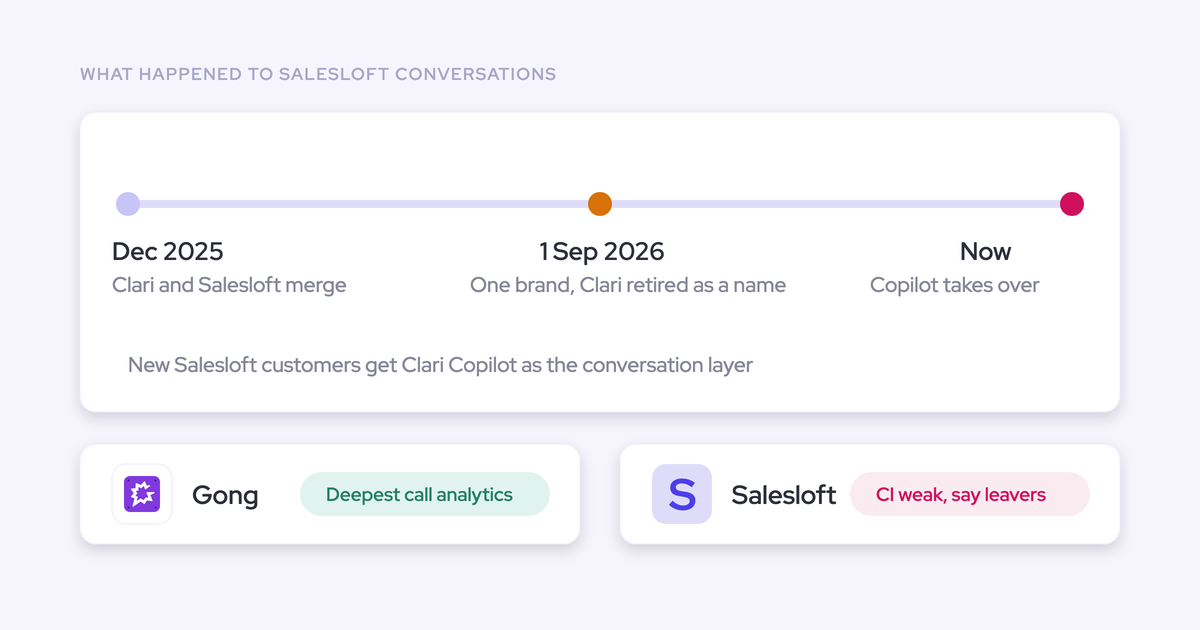
If you're running Gong for all three jobs, keep or add a specialist sequencer like Outreach, Salesloft, or Apollo alongside Weflow. The decision framework is what each seat actually uses. Most orgs discover that only the BDRs and a couple of AEs sequence, and everyone else is holding an expensive license for capture they can buy separately for less.
Can Weflow support a rollout across hundreds of seats?
This question comes up honestly and often:
I had someone the other day say to me, this can't be true, this is definitely a fake company, this is too good to be true, they're telling you too cheap of a price. Are they going to be there in a year?
The checkable answers: SOC 2 Type II since 2021, HIPAA, GDPR, and CCPA compliance, a 99.5%+ uptime SLA with a public status page, and regular third-party penetration testing. ISO 27001 is in progress, not certified, and Weflow is not FedRAMP certified, so US government contractors requiring FedRAMP aren't a fit.
On the operational side, sign-in runs only through your Salesforce authentication, so IT provisioning and deprovisioning is a non-event. Onboarding is vendor-owned at multi-region scale, as KORE Wireless's five-phase rollout shows.
How should we run a trial before signing?
Run a two-week bake-off against a written requirements list, with two or three vendors on the same list. Weflow includes a 14-day free trial with guided onboarding, which fits inside the Days 1–30 phase without threatening the window.
One rule for the trial: keep only one capture tool live against the inbox at a time. Two running in parallel compete over the same emails and produce duplicate logging, and you'll end up scoring a vendor on a problem you created.
See how Weflow captures activity, updates Salesforce fields from calls, and rolls up your forecast. Book a 30-minute demo.