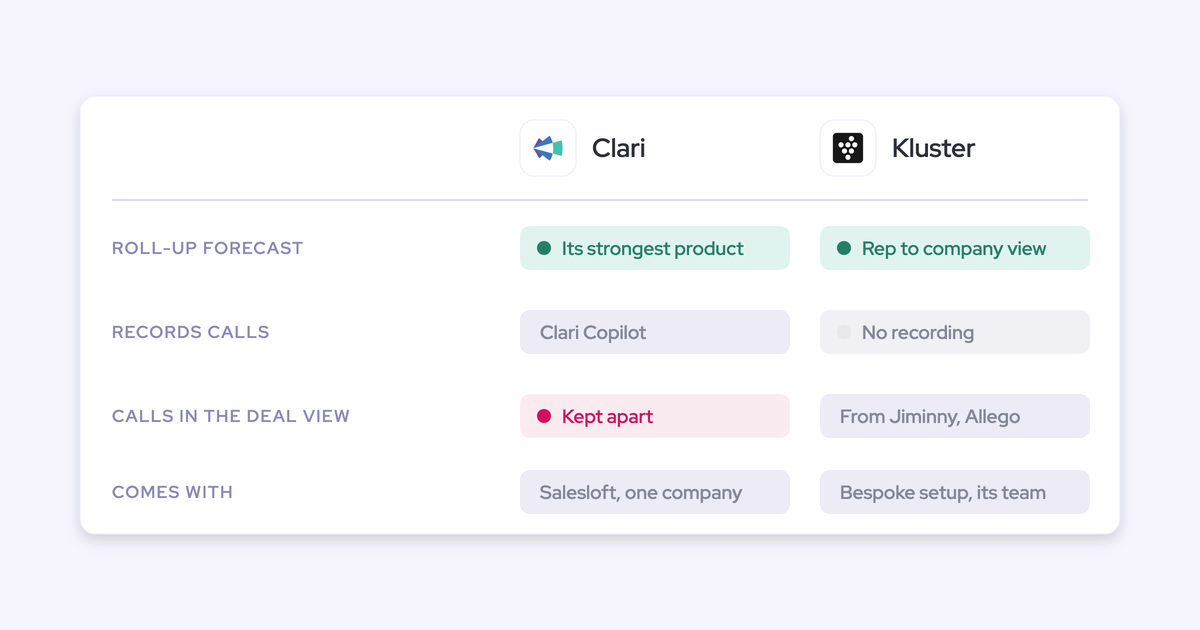
Gong credits explained: What's included, what's metered, and how to estimate annual usage
Learn what's included in Gong credits, what's metered, and how to estimate annual usage.


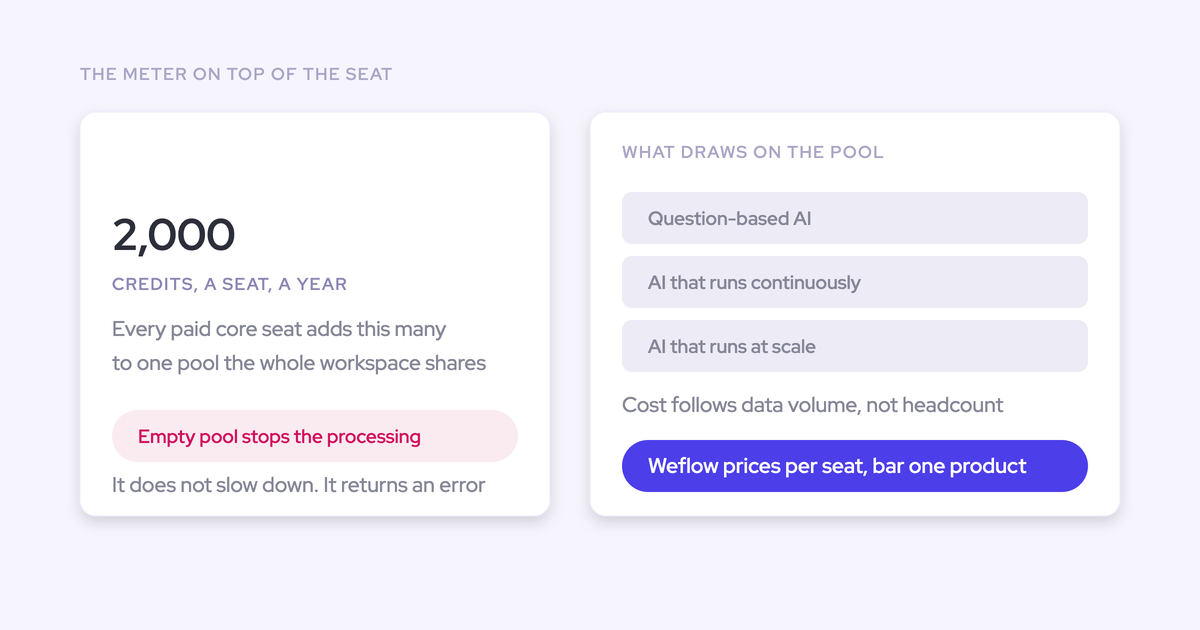

Gong credits cover specific AI workflows on top of seat and application fees. To budget a renewal, separate those fixed charges from your included credit pool, estimate each metered workflow, and price the shortfall using your contracted top-up rate.
Don’t treat every Gong AI interaction as billable usage. Individual in-product AI remains included with the required seat. Question-based AI Trackers, MCP requests, and API-based AI workflows consume credits.
The calculation below separates known costs from assumptions. You’ll get a credit-demand worksheet, exhaustion and recovery rules, and contract questions to settle before finance approves the number.
Weflow is the Revenue AI Orchestration platform for sales, customer success, and RevOps teams. We’ll compare Gong’s model with the pricing behind Weflow deal execution workflows, without assuming that switching makes sense for every team.
Gong and Weflow AI pricing at a glance
Gong combines seat and application fees with a shared credit pool. Weflow prices its products per seat and confines consumption pricing to Agent Builder.
| Gong | Weflow |
|---|---|
| Base packaging: Mandatory Gong Foundation license plus optional application seats. | Base packaging: Three standalone products or Revenue AI bundles, with a 10-user minimum and annual billing. |
| Included AI: Normal call analysis and individual in-product AI use, subject to the required application access. | Included AI: Recordings, transcripts, AI summaries, AI field updates, templates, and Ask Weflow AI within the relevant product. |
| Metered AI: Question-based AI Trackers, MCP requests, and API-based AI workflows. | Metered AI: Agent Builder actions, priced by workspace rather than user. |
| Allocation: Each paid core seat contributes 2,000 annual credits to one company-wide pool. | Allocation: Agent Builder includes 25 actions per workspace per month. Paid packages offer 500 or 2,500 monthly actions. |
| Exhaustion: Metered processing stops. Gong requires an explicit top-up purchase. | Exhaustion: Everyday conversation intelligence has no usage pool to exhaust. Confirm Agent Builder’s package-limit behavior before deploying agents. |
| Pricing visibility: Use your quote for seat, application, and top-up rates. | Pricing visibility: Published product, bundle, and Agent Builder package prices. |
| Expansion: More application access adds seat fees; broader automated processing increases credit demand. | Expansion: More users or broader product coverage changes seat cost; more agent actions changes the workspace package. |
Why RevOps compares Gong and Weflow at renewal
A Gong renewal deserves a cost review even when the team likes Gong. Satisfaction doesn’t tell finance whether the company uses enough of what it buys.
We hear this in evaluations: nobody asked the RevOps owner to replace Gong, but the owner still needs to defend the bill. Hiring expanded the seat count. Usage didn’t necessarily deepen with it.
Credits add another question: what happens to cost and availability when useful AI moves from individual use into automated workflows?
Gong’s rationale is reasonable. Credits charge for continuous or large-scale processing rather than raising seat prices for every customer. The tradeoff is that RevOps now owns a consumption forecast alongside the license budget.
Gong renewal cost has four budget layers
A complete Gong budget separates fixed fees, included capacity, metered demand, and purchased capacity. The middle two are credit quantities, not extra invoice lines.
| Layer | Worksheet input | Budget consequence |
|---|---|---|
| Seat and application fees | Contracted quantities and rates | Sets the fixed annual cost. |
| Included credits | Eligible paid core seats × 2,000 | Offsets metered demand. |
| Metered demand | Data processed across every metered run | Determines whether the pool covers usage. |
| Top-ups | Shortfall plus purchasing terms | Adds cost only when you purchase credits. |
Gong Foundation and application seats
Gong Foundation is the prerequisite for application purchases. Applications include Enable Essentials, Forecast Essentials, Gong Forecast, Gong Engage, and Data Cloud.
Gong assigns seats per application. One person can occupy a Foundation seat and additional application seats, so counting people alone won’t reproduce the quote.
- List each core license and application line separately.
- Record the quantity, annual rate, discount, and effective dates.
- Assign each user group the applications its workflows require.
- Keep platform, service, and implementation charges separate if your quote includes them.
Included annual Gong credit pool
Each paid Gong core seat contributes 2,000 credits per contract year to a shared company pool.
Included annual pool = eligible paid core seats × 2,000.
Use the eligible core-seat count, not the sum of every application seat. Keep introductory allocations and purchased credits on separate worksheet lines so they don’t inflate next year’s recurring allowance.
Estimated metered Gong credit demand
Gong credit demand follows the underlying calls and emails processed across metered runs.
| Data processed | Credit cost |
|---|---|
| Call longer than 10 minutes | 1 credit |
| Call of 10 minutes or less | 0.5 credits |
| 0.1 credits |
Estimated metered demand = sum across every metered run of (long calls × 1 + short calls × 0.5 + emails × 0.1).
Count processing, not just unique records. The same call can contribute to several trackers and appear in repeated MCP or API analyses.
Contracted Gong credit top-ups
Top-up cost depends on your Gong contract, including the rate and any minimum purchase or package requirements.
Credit shortfall = max(0, estimated demand − included pool − other applicable credits).
For a simple per-credit contract, multiply the shortfall by the contracted rate. If Gong sells you a minimum quantity or package, price the purchase you must make instead.
No top-up rate means no defensible dollar estimate. Stop at the credit shortfall and request the missing terms.
Which Gong AI features consume credits?
Gong meters three surfaces: question-based AI Trackers, MCP requests, and API-based AI workflows. Inventory them separately because each grows differently.
Question-based AI Trackers
Question-based Gong AI Trackers consume credits as they process calls and emails within their configured scope.
- Trigger: The published tracker processes eligible conversations.
- Data scope: The calls and emails matching its filters.
- Recurrence: Processing continues as eligible data arrives.
- Forecasting input: Annual processed volume by data type for each tracker.
A usable inventory row names the tracker, its owner, its filters, its active period, and its expected processing volume. Don’t use one company-wide activity estimate for every tracker.
Gong MCP requests
Gong MCP requests consume credits when an external assistant asks Gong to analyze conversation data.
- Trigger: A request from an MCP-connected assistant or workflow.
- Data scope: The underlying conversations relevant to the selected record and request.
- Recurrence: Every request performs a new analysis, including repeated questions.
- Forecasting input: Requests per year multiplied by expected processing per request.
Gong’s MCP tools include ask_account, ask_deal, and generate_brief. A portfolio workflow needs separate record-level requests, so don’t budget it as one question.
API-based AI workflows
Gong’s API-based AI workflows consume credits when they run programmatic analysis. Don’t label every API operation as metered AI.
- Trigger: A schedule, record event, or programmatic request.
- Data scope: The calls and emails each analysis processes.
- Recurrence: Each execution repeats processing; brief sections can create separate analyses.
- Forecasting input: Executions, analyses per execution, and data per analysis.
| Workflow | Inventory separately |
|---|---|
| Scheduled account brief | Accounts, schedule, open-ended sections, conversation scope |
| Triggered deal analysis | Trigger volume, repeat triggers, data per run |
| Integration rerun | Reason for rerun, successful repeated analyses, processing volume |
Which Gong AI features remain included?
Gong keeps normal call analysis and individual in-product AI use outside the credit meter. Included usage still requires the appropriate seat and application access.
| Included activity | Boundary to preserve |
|---|---|
| Calls, call analysis, and conversation insights | Normal product processing remains included. |
| Deal intelligence and forecasting | The user needs the relevant application access. |
| Coaching and revenue or deal predictions | Included processing doesn’t remove application fees. |
| Individual use of Agent Studio agents | Manual in-product use remains included. |
| Manually generated in-product briefs | The API or MCP path consumes credits instead. |
| Viewing previously processed data | Viewing doesn’t trigger a new metered analysis. |
The access method matters. A brief generated manually inside Gong can remain included while the same brief generated through MCP or an API draws from the pool.
How to calculate annual Gong credit demand
Build the Gong calculator from one row per tracker or workflow, then sum the processing demand. Keep assumptions visible enough that an integration owner can challenge them.
The worked example below uses hypothetical planning inputs, not customer usage benchmarks. It assumes a full contract year and no introductory allowance or existing top-ups.
Calculate Gong’s included annual credit pool
Multiply the eligible paid core-seat count by 2,000.
Example assumption: 50 paid core seats × 2,000 = 100,000 included annual credits.
Take the seat count from your contract and reconcile the resulting allowance with Gong’s allocation. Resolve any difference before modeling spend.
Calculate question-based AI Tracker demand
Calculate each question-based Gong AI Tracker separately, using the annual data volume that tracker processes.
| Hypothetical tracker | Long calls | Short calls | Emails | Annual credits |
|---|---|---|---|---|
| Tracker A | 24,000 | 6,000 | 120,000 | 39,000 |
| Tracker B | 12,000 | 4,000 | 60,000 | 20,000 |
| Total | 59,000 |
Tracker A’s calculation is 24,000 + 3,000 + 12,000 = 39,000 credits. Those volumes represent processing by that tracker, not necessarily unique company-wide conversations.
For a partial-year rollout, forecast only the active period. Confirm how any historical processing enters the allocation rather than assuming it costs nothing.
Calculate MCP and API workflow demand
Multiply expected executions by analyses per execution and credits per analysis. This exposes the cost of repeated requests and multi-section briefs.
| Hypothetical workflow | Annual executions | Analyses per execution | Data per analysis | Annual credits |
|---|---|---|---|---|
| MCP questions | 2,000 | 1 | 10 long calls, 4 short calls, 30 emails = 15 credits | 30,000 |
| API briefs | 1,000 | 2 open-ended sections | 10 long calls, 2 short calls, 40 emails = 15 credits | 30,000 |
| Total | 60,000 |
Example annual demand = 59,000 tracker credits + 60,000 programmatic credits = 119,000 credits.
The brief example assumes both open-ended sections process the stated data. Replace that assumption with the actual structure and processing scope of your briefs.
Convert the credit shortfall into top-up cost
Subtract the included pool from estimated demand, then apply your actual purchasing terms.
Use scenarios instead of presenting one forecast as certain. Here, tracker volume stays constant while programmatic demand changes.
| Scenario | Explicit assumption | Total demand | Shortfall against 100,000 | Simple per-credit cost |
|---|---|---|---|---|
| Base | Half the expected programmatic volume | 89,000 | 0 | $0 required by this model |
| Expected | Programmatic volume as modeled | 119,000 | 19,000 | 19,000 × contracted rate |
| High usage | Double the expected programmatic volume | 179,000 | 79,000 | 79,000 × contracted rate |
These dollar formulas exclude purchase minimums, package rounding, and any reserve you deliberately buy. If the top-up rate is missing, the shortfall column is the final defensible output.
What can make Gong credit usage exceed forecast?
Gong usage can outrun the forecast when scope or repetition grows without a corresponding seat increase. Headcount alone won’t explain that variance.
Broad AI Tracker scope
Gong identifies AI Tracker configuration as the largest influence on credit consumption. Trackers covering every conversation process more data than focused trackers.
| Broad configuration | Focused configuration |
|---|---|
| Every team | The team responsible for the use case |
| Every account type | The segment where the answer changes a decision |
| Every deal stage | The stages where the signal matters |
Keep broad coverage when it earns its cost. Document that choice so a future admin doesn’t mistake it for an accidental default.
Repeated Gong MCP and API requests
Gong reanalyzes underlying calls and emails on each MCP or API request. Asking the same question twice consumes credits twice.
In the hypothetical calculator, one MCP analysis costs 15 credits. Three equivalent analyses cost 45 credits, even if they use the same conversations.
Include iterative questions, scheduled reruns, and duplicate successful analyses in the forecast. Confirm failed-request billing separately rather than assuming every error consumes credits.
Open-ended automated brief sections
Each open-ended section in a Gong automated brief performs its own analysis of the selected conversations.
- Inventory open-ended sections separately from fixed fields.
- Record the data scope each section analyzes.
- Count sections, not just completed briefs.
- Remove overlapping sections that produce answers nobody uses.
Don’t apply an open-ended-section multiplier to every field in a brief. Model the processing that actually happens.
What happens when Gong credits run out?
Gong stops new metered processing when the shared pool reaches zero. It doesn’t automatically purchase credits or issue an automatic top-up charge.
| Surface | At zero balance | Operational consequence |
|---|---|---|
| MCP and metered API requests | Return errors | Connected assistants and automations stop receiving those results. |
| Question-based AI Trackers | Stop processing new calls and emails | New conversations stop contributing tracker results. |
| Automated briefs | Stop generating | Workflow owners lose their scheduled or triggered output. |
Metered processing that stops
An empty Gong pool interrupts the workflows that consume credits, not the entire Gong deployment.
- MCP-connected assistants receive errors on requests that need processing.
- Metered API workflows stop producing new analysis.
- AI Trackers stop processing new eligible conversations.
- Automated briefs stop generating.
Assign an incident owner before these workflows become dependencies for forecast preparation or account reviews.
Data and features that remain available
Previously processed Gong data remains viewable after credit exhaustion. Included capabilities stay outside the credit meter.
Users retain access to normal call analysis and individual in-product AI within their licensed coverage. A stopped automated brief doesn’t mean the underlying conversation archive disappears.
Automatic recovery versus manual restart
Adding Gong credits restores API and MCP processing automatically, but admins must resume AI Trackers manually.
- Complete the approved credit purchase and confirm the updated balance.
- Test an MCP request and a metered API workflow.
- Resume the affected AI Trackers manually.
- Verify automated brief delivery and confirm whether missed work needs resubmission.
- Check the processing gap with workflow owners before closing the incident.
Automatic service recovery doesn’t prove that an external integration replayed failed jobs. Check the caller’s retry behavior too.
How can RevOps control Gong credit consumption?
Manage Gong consumption by workflow, with a named owner and an expected run rate. A shared pool needs shared governance, not informal requests to use less AI.
Scope AI Trackers to business value
Keep each Gong AI Tracker only as broad as its business decision requires.
- Name the person who acts on the results.
- Define the team, account type, and deal-stage scope.
- Review whether the output changes a decision.
- Unpublish trackers that no longer provide value.
Gong identifies unpublishing as the way to stop a tracker consuming credits. Leaving an unused tracker published preserves its processing demand.
Govern automated MCP and API requests
Put controls in the calling workflow where you can enforce them, rather than assuming Gong provides every limit you need.
| Control | Owner | What to define |
|---|---|---|
| Schedule and scope | Workflow owner | Frequency, records, date range, brief sections |
| Retry policy | Integration owner | When to retry, when to stop, who receives errors |
| Duplicate prevention | Integration owner | How to avoid repeating successful work unnecessarily |
| Expansion approval | RevOps | Who approves broader scope or more frequent execution |
Monitor shared-pool usage against plan
Review Gong’s actual credit burn against your forecast monthly, with more frequent checks during a rollout or usage spike.
| Monitoring field | Decision it supports |
|---|---|
| Opening balance, consumption, purchases, closing balance | Reconciles the pool. |
| Actual versus planned consumption | Flags usage variance. |
| Workflow or tracker attribution, where available | Identifies what needs investigation. |
| Remaining-period forecast | Updates top-up exposure. |
| Purchase approval lead time | Determines when procurement must act. |
Don’t assume the admin reporting exposes every dimension. Confirm available breakdowns and use integration logs to fill any gaps.
Confirm enforceable limits and alerts
Get Gong’s current limit and alert behavior in writing before treating it as a budget control.
- Which consumption thresholds trigger alerts?
- Who receives them, and can you change the recipients?
- Can admins enforce limits by user, team, tracker, or integration?
- Does a limit stop processing or merely send a notification?
- How quickly does the reported balance reflect usage?
An alert tells you to act. It doesn’t reserve credits for a critical workflow.
What should your Gong contract confirm?
Your Gong contract review should close every input that changes cost, access, or recovery. Use this checklist as a procurement worksheet, not a list of assumed product capabilities.
| Question | Contract answer to record | Source to obtain | Owner | Budget impact |
|---|---|---|---|---|
| Which seats contribute credits? | Eligible types and quantities | Order form and allocation confirmation | Procurement | Included pool |
| How do midyear changes work? | Added-seat, removed-seat, and proration rules | Contract terms | Procurement | Allowance and fixed fees |
| Which applications do workflows require? | Access by role and use case | Quote and entitlement confirmation | RevOps | Application-seat cost |
| What does a top-up cost? | Rate, minimum purchase, packages, discounts | Commercial schedule | Procurement | Shortfall cost |
| When do credits expire? | Included reset and purchased-credit expiration | Contract terms | Finance | Unused-capacity exposure |
| What usage can admins inspect? | Available attribution, exports, and reporting delay | Written product confirmation | Gong admin | Forecast auditability |
| What limits and alerts exist? | Scope, recipients, thresholds, enforcement | Written product confirmation | Gong admin | Interruption risk |
| What happens after exhaustion? | Restart, replay, and missed-processing behavior | Recovery documentation | Integration owner | Restoration work |
| Who implements and supports the rollout? | Responsibilities, fees, and escalation path | Statement of work | Project owner | First-year total |
How to compare Gong and Weflow annual cost
Compare Gong and Weflow for the same roles, workflows, and contract period. Equal seat counts don’t establish equivalent coverage.
| Cost component | Gong calculation | Weflow calculation |
|---|---|---|
| Recurring licenses | Foundation plus required application lines | Selected standalone products or bundles by user group |
| Variable AI | Required top-up purchases under contracted terms | Selected Agent Builder workspace package |
| External dependencies | Assistant subscriptions and other required systems | Retained engagement tools and other required systems |
| First-year work | Applicable services and internal implementation effort | Migration, overlap, configuration, and internal rollout effort |
Model Gong from your signed quote
Gong’s annual total starts with your commercial terms, not a market-average seat price.
Annual Gong cost = fixed contract fees + planned top-up purchases + applicable service charges.
Show external assistant subscriptions and internal operating effort separately. Gong MCP access requires a paid Gong seat and a supported paid assistant tier, so the connector alone isn’t the full workflow cost.
Keep expected and high-usage totals side by side. Finance needs to see the exposure if adoption exceeds the plan.
Model Weflow from published pricing
Weflow Conversation Intelligence costs $39 per user per month, billed annually. Recordings, transcripts, summaries, AI field updates, templates, and Ask Weflow AI don’t carry usage metering.
| Product or bundle | Per user/month, billed annually | Coverage |
|---|---|---|
| Weflow Activity & Contact Capture | $19 | Email, meeting, and contact capture |
| Weflow Conversation Intelligence | $39 | Conversation recording, analysis, and AI field updates |
| Weflow Deal Intelligence & Forecasting | $39 | Deal health, pipeline analytics, and forecasting |
| Revenue AI Foundation | $49 | Activity & Contact Capture plus Conversation Intelligence |
| Revenue AI Business | $59 | Revenue AI Foundation plus Deal Intelligence, without pipeline analytics or forecasting |
| Revenue AI Enterprise | $79 | All three products, including pipeline analytics and forecasting |
Weflow has a 10-user minimum and includes free view-only licenses (up to one per recording license). Budget paid access by required product coverage, not every person who needs to review a recording.
Agent Builder is the consumption-priced exception. Its packages apply per workspace, not per user.
| Agent Builder package | Monthly actions | Monthly price | Cost over 12 months |
|---|---|---|---|
| Free | 25 | $0 | $0 |
| Growth | 500 | $299 | $3,588 |
| Scale | 2,500 | $999 | $11,988 |
As a hypothetical list-price example, 50 Weflow Conversation Intelligence users cost $23,400 annually. Adding one Agent Builder Growth workspace brings that total to $26,988.
That example excludes forecasting, activity capture, and migration effort. Don’t compare it with a Gong quote covering those additional jobs.
Compare equivalent role coverage
Price each role against the work it must perform in Gong or Weflow. Free visibility and paid AI access aren’t interchangeable.
| Role | Gong check | Weflow check |
|---|---|---|
| Sellers | Foundation and required coaching, deal, or engagement applications | Conversation Intelligence, capture, and deal coverage as needed |
| Managers | Coaching and forecast application access | Paid workflow access versus view-only consumption |
| RevOps | Administration, application access, API and MCP requirements | Administration, product coverage, Agent Builder requirements |
| Executives | Dashboard access versus Ask Anything or MCP access | View-only dashboards versus paid interactive workflows |
| Cross-functional viewers | Collaborator limits and required access paths | Free view-only access within Salesforce authentication requirements |
Weflow uses Salesforce authentication and works exclusively with Salesforce. Confirm that every intended viewer can authenticate before counting free licenses as company-wide access.
Where Gong is stronger than Weflow
Gong has deeper conversation analytics than Weflow. If your enablement process depends on that depth, a credit meter alone isn’t a reason to leave.
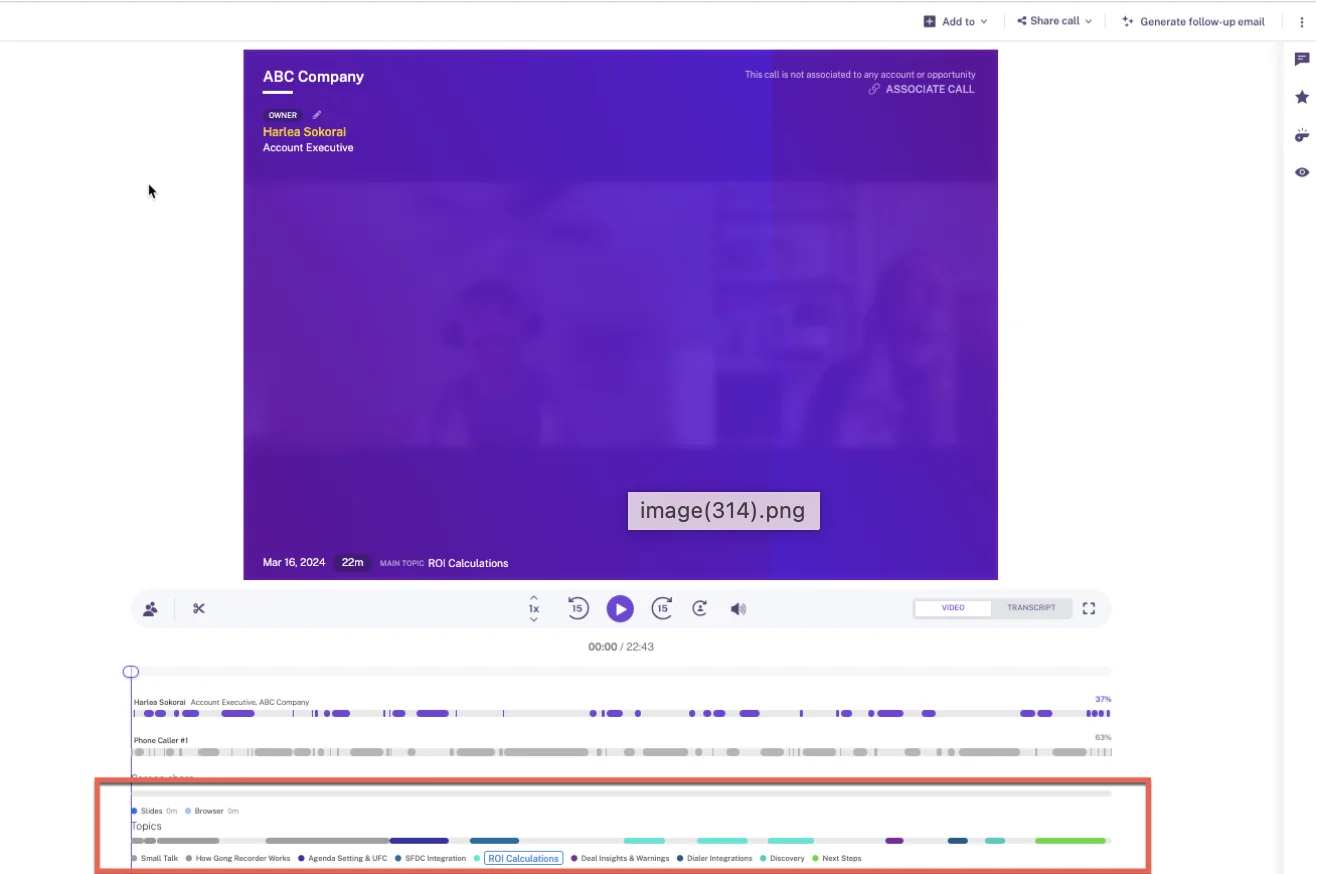
Gong’s call page, for example, maps named topics across the recording timeline. That gives reviewers a direct way to navigate the conversation.
- Choose Gong when its conversation analytics support coaching workflows you use consistently.
- Keep Gong when cross-functional integrations and archive access would cost more to replace than the expected savings.
- Credit Gong’s included individual AI use when most work happens inside its interface.
Weflow has no live in-meeting assistant or real-time battlecards. If live assistance is a requirement, validate the specific alternative rather than treating post-call analysis as equivalent.
Where Weflow makes AI spend more predictable
Weflow separates everyday conversation intelligence from consumption-priced agent workflows. More summaries, AI field updates, or Ask Weflow AI questions don’t create a second usage bill.
The operating benefit starts with usable data. Weflow writes AI-extracted values into Salesforce fields, where your reports and automations can use them without someone copying a summary.
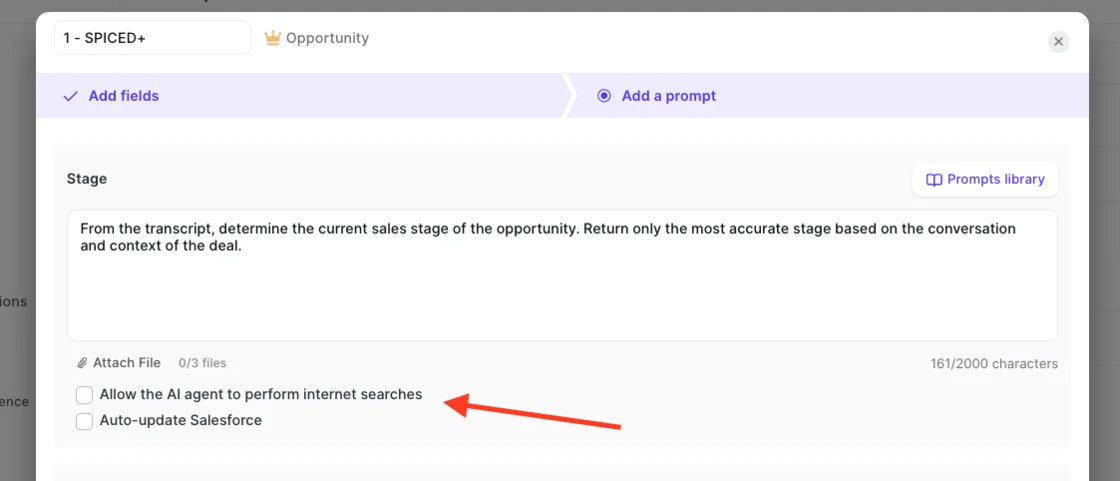
Admins can configure field-update prompts and choose whether Salesforce updates happen automatically. For fields such as Opportunity Stage, keep review in place until you trust the extraction.
| Cost surface | Gong | Weflow |
|---|---|---|
| Individual in-product AI | Included with required access | Included with relevant product access |
| Question-based tracking and programmatic AI | Shared credit demand | No equivalent blanket claim: scope the required workflow and distinguish included features from Agent Builder |
| Custom agent workflows | Validate available capabilities, applications, and credit demand | Published workspace action packages |
| Structured Salesforce field updates | Validate the required workflow and commercial coverage | Included in Weflow Conversation Intelligence |
Weflow’s data ownership also has boundaries. Captured activity and structured field values land in Salesforce, but video files remain with Weflow. Forecast submissions, targets, and tracker hits don’t all live in Salesforce either.
Budget predictability should survive precise questions. It shouldn’t depend on claiming that every capability is unlimited or every artifact lives in the CRM.
What does switching from Gong require?
Switching from Gong requires an archive plan, a dependency review, and explicit acceptance of capability gaps. License savings don’t complete any of those jobs.
Preserve conversation history and access paths
Inventory who uses Gong’s archive before deciding what must move. Sales rarely owns every dependency.
| Asset | Consumers to check | Validation required |
|---|---|---|
| Recordings and transcripts | Sales, customer success, marketing, product | Export rights, formats, volume, costs, destination access |
| Clips, libraries, and scorecards | Enablement and managers | What transfers, what needs rebuilding, what stays archived |
| API and assistant access | RevOps, executives, integration owners | Replacement endpoints, permissions, downstream consumers |
Gong’s MCP server returns generated insights, not raw transcripts. Don’t mistake MCP access for a transcript export route.
Test a representative export and destination import before canceling access. Don’t assume a new vendor can reproduce every historical artifact.
Rebuild Salesforce integrations and workflows
Every Gong-dependent Salesforce workflow needs an owner and a tested replacement path.
- Inventory field mappings, activity records, reports, and automations.
- Check record matching and duplicate prevention during overlap.
- Test validation rules and field dependencies against real records.
- Review recording-object access and sensitive transcript visibility.
- Validate access restrictions rather than assuming interface visibility equals Salesforce permissions.
Weflow follows Salesforce permission sets and role hierarchy, but list-view restrictions and Lightning component visibility don’t define the same access model. Teams using those interface controls need a separate configuration review.
Validate capability gaps and rollout ownership
Make unsupported workflows and implementation accountability go/no-go criteria.
| Risk | Required action | Owner |
|---|---|---|
| Gong Engage replacement | Retain or select a sequencing and dialing system; Weflow doesn’t replace sales engagement. | Sales operations |
| Live meeting assistance | Accept the gap or retain a separate capability. | Sales enablement |
| Agent-driven CRM writes | Separate agent output from field-update workflows. Weflow Agent Builder output doesn’t directly write its conclusions into Salesforce fields. | RevOps |
| Multi-tenant deployment | Validate mail-tenant configuration and recording coverage before committing. | IT |
| Rollout and support | Name implementation, training, migration, and escalation owners in the agreement. | Project sponsor |
A short pilot can test capture and conversation intelligence. Proving a forecasting process takes a working cadence, not just a configured demo.
Choose Gong or Weflow based on operating fit
Keep Gong when its differentiated capabilities justify the total cost and you can govern metered demand. Choose Weflow when its included AI, modular coverage, and Salesforce field updates match the work you need.
Choose Gong if…
- Your team depends on Gong’s deeper conversation analytics and uses them consistently.
- Most AI use stays inside Gong, or your automated demand fits a funded credit plan.
- You have confirmed top-up terms, alerts, and recovery responsibilities.
- Archive and integration dependencies make switching more expensive than staying.
Choose Weflow if…
- Your revenue teams run on Salesforce and need structured conversation outcomes in their records.
- You want summaries, AI field updates, and Ask Weflow AI included without usage metering.
- You need different product coverage for different user groups.
- You can budget Agent Builder separately and accept the capability gaps identified in your pilot.
Before approval, put both options on one worksheet: fixed annual cost, variable-cost assumptions, required capabilities, and migration work. An unknown top-up rate belongs in the decision as an unresolved input, not a guessed number.
See how Weflow captures activity, updates Salesforce fields from calls, and rolls up your forecast. Book a 30-minute demo.
Frequently asked questions about Gong credits
Gong’s credit rules establish the baseline, but your contract must resolve seat adjustments and top-up purchasing terms.
Do only paid Gong core seats add credits?
Each paid Gong core seat contributes 2,000 annual credits. Don’t count additional application seats or free Collaborators as separate contributions. Verify the eligible quantity against your contract and allocation.
Do unused Gong credits roll over?
Gong’s included pool resets at the start of each contract year. Purchased top-up credits expire at the end of the contract term and don’t roll over. Confirm those dates when deciding how much reserve to buy.
Does in-product Gong AI use credits?
Individual in-product AI use remains included with the required seat and application access. Question-based AI Trackers and MCP or API-based AI workflows consume credits. The access method can change the billing treatment of the same analysis.
Are Gong top-up credits added automatically?
No. Gong requires an explicit purchase. When the pool empties, metered processing stops rather than triggering an automatic paid top-up. Assign purchasing authority before critical workflows depend on the pool.
Can Gong Collaborators use Ask Anything or MCP?
No. Gong Collaborators have free, limited access but can’t use AI Ask Anything or connect to the Gong MCP server. Count those requirements as paid-access needs when building the role matrix.
What if Gong omits the top-up rate?
Calculate annual credit demand and the shortfall, but leave top-up dollars unresolved.
- Request the contracted per-credit or package price.
- Confirm minimum purchases and volume discounts.
- Get expiration dates and activation timing in writing.
How should midyear seat changes be modeled?
Apply Gong’s contracted adjustment rules from each change’s effective date. Don’t assume additions receive a full annual allowance or removals immediately reduce the pool.
Adjusted allowance = opening annual allocation + confirmed seat-related additions − confirmed seat-related reductions.
Keep seat-fee changes on a separate line. Ask Gong to reconcile both calculations before finance signs off.