Gong AI Agents Explained: Every Agent, Which Plan Includes It, and How Weflow Compares
See every Gong AI agent, which plan includes it, and how Gong compares with Weflow.



Gong markets eighteen AI agents. What it doesn't publish anywhere is a single view of what each one does, which of its separately purchased packages you need to get it, which agents are genuinely new and which are features you already had under a different name, or how the credit meter moves your bill once people start using them.
So that's what this is. Every agent in Gong's Agent Studio, in plain terms, mapped to the licence it needs, with the renamed ones flagged and the credit mechanics laid out well enough to model. Then the decision sitting underneath all of it: a fixed catalogue you configure inside Gong's bounds, or a builder you author your own agents and AI-powered deal execution workflows on.
Weflow sells against Gong, so read the second half with that in mind. We'll also name where Gong is the better buy and where our own newest product isn't mature yet, because a comparison that never says either of those things isn't worth your time.
What are Gong AI agents and Agent Studio?
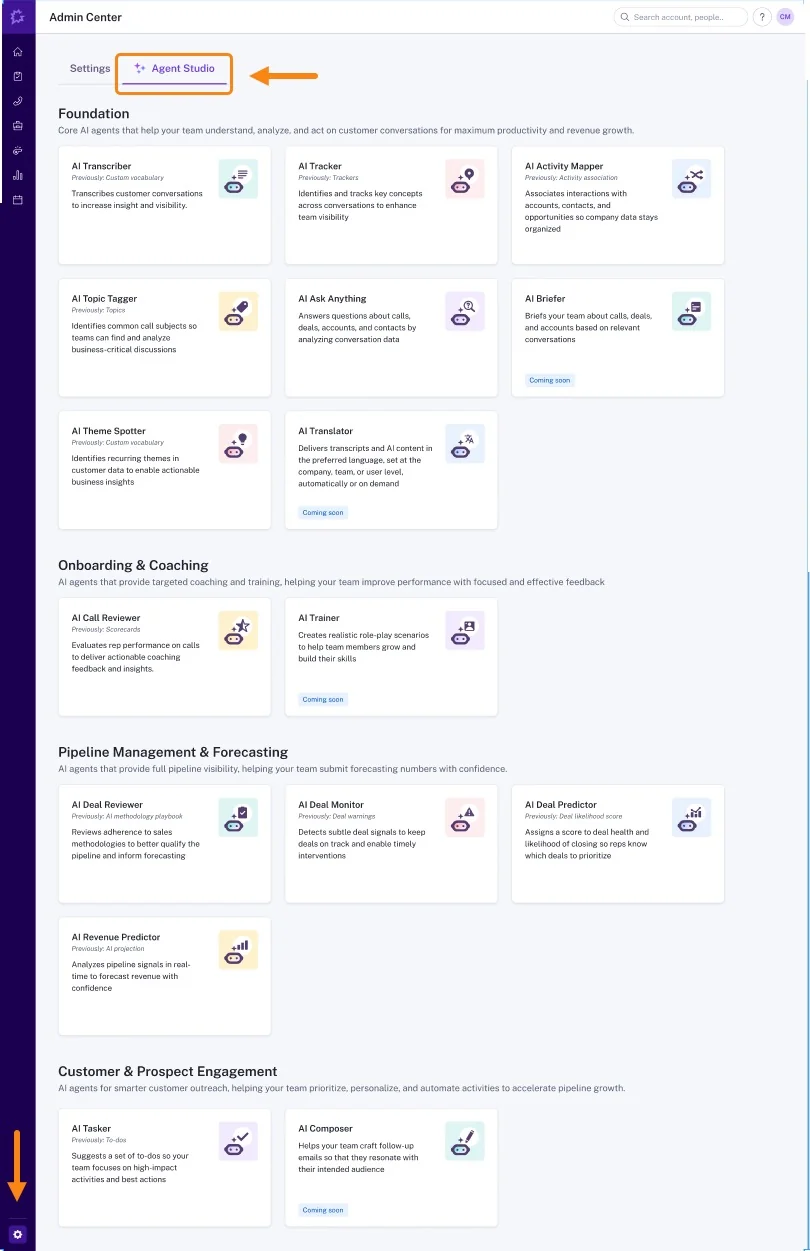
Gong AI agents are the eighteen named agents Gong groups under Agent Studio in the Admin center. Agent Studio is a catalogue of pre-built agents Gong ships and you configure. It is not a place to build agents.
That naming gap is the first thing to clear up: you searched "Gong AI agents," the help centre calls it Agent Studio, and the deck your team saw probably called it agentic AI. Same thing.
The eighteen sit in four groups:
- Conversation intelligence: AI Call Reviewer, AI Theme Spotter, AI Topic Tagger, AI Transcriber, AI Translator
- Deals and forecasting: AI Deal Monitor, AI Deal Predictor, AI Deal Reviewer, AI Revenue Predictor
- Workflow automation: AI Activity Mapper, AI Ask Anything, AI Composer, AI Tasker, AI Data Extractor
- Content and knowledge creation: AI Builder, AI Trainer, AI Briefer, AI Tracker
Gong's own Agent Studio screen tells you most of what you need to know about the shape of the product. Several agents carry a "Previously" label naming the older feature they used to be, a few are badged coming soon, and there is no control anywhere on the page to create one.
All 18 Gong AI agents and what each does
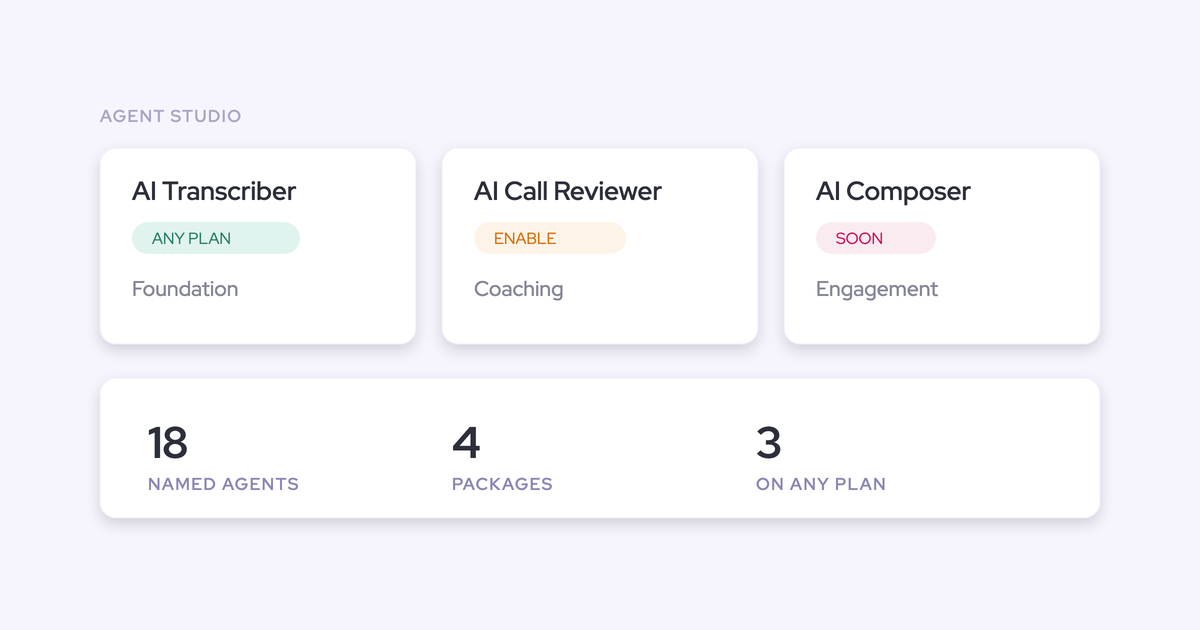
Here's the full inventory. One note on the licence column before you read it: Gong publishes the split as three agents available on any Gong plan, six requiring Gong Foundation, and five gated behind specific applications, with four agent pages stating no availability at all. Where I can tie a named agent to a named licence from Gong's documentation, the cell says so. Where I can't, it says that instead of guessing.
| Agent | Group | What it does | Licence |
| AI Call Reviewer | Conversation intelligence | Scores calls against a scorecard. Without company-level automatic scoring switched on, it only suggests answers for a human scorer to accept or edit. | Enable Essentials or Enable |
| AI Theme Spotter | Conversation intelligence | Surfaces recurring themes across conversations from a prompt you supply. | Any plan, Foundation, or unstated |
| AI Topic Tagger | Conversation intelligence | Segments a recording into named topics along the call timeline. | Any plan, Foundation, or unstated |
| AI Transcriber | Conversation intelligence | Transcription, with the company vocabulary list that teaches it your product and competitor names. | Any plan, Foundation, or unstated |
| AI Translator | Conversation intelligence | Translates conversation content into another language. | Any plan, Foundation, or unstated |
| AI Deal Monitor | Deals and forecasting | Runs eight fixed deal warnings on open deals: no activity, ghosted, overdue, not enough contacts, no power, pricing not mentioned, red flag, stalled in stage. | Any plan, Foundation, or unstated |
| AI Deal Predictor | Deals and forecasting | Predicts the outcome of individual deals. | Any plan, Foundation, or unstated |
| AI Deal Reviewer | Deals and forecasting | Runs a methodology playbook against the deal. Seven ship pre-built: MEDDICC, BANT, SPIN, Challenger, SPICED, Solution Selling, Sandler. Status and notes sync two ways with the CRM opportunity. | Forecast Essentials or Gong Forecast |
| AI Revenue Predictor | Deals and forecasting | Projects revenue for the period from deal-level signals. | Any plan, Foundation, or unstated |
| AI Activity Mapper | Workflow automation | Associates calls and emails with the right CRM account, contact and deal. | Any plan, Foundation, or unstated |
| AI Ask Anything | Workflow automation | Answers a question about a call, deal, account or contact. Being replaced on the call page by Gong Assistant, with the rest of the surfaces still on the older single-question experience. | Any plan, Foundation, or unstated |
| AI Composer | Workflow automation | Drafts messages inside Gong Engage. | Gong Engage |
| AI Tasker | Workflow automation | Creates and manages tasks inside Gong Engage. | Gong Engage |
| AI Data Extractor | Workflow automation | Pulls specified values out of calls and emails. It can draw on any non-private conversation in the workspace, including ones the admin who configured it cannot open. | Any plan, Foundation, or unstated |
| AI Builder | Content and knowledge creation | Generates content assets from your calls: scorecards, enablement docs, training material, battlecards, FAQs, call scripts. It does not build agents. | Foundation |
| AI Trainer | Content and knowledge creation | Runs simulated customer conversations against personas generated from your own recorded calls, 5 to 30 minutes with a difficulty setting, graded with the same scorecards used on live calls. | Enable |
| AI Briefer | Content and knowledge creation | Produces structured briefs on an account, deal or contact. | Any plan, Foundation, or unstated |
| AI Tracker | Content and knowledge creation | Tracks keywords, phrases and concepts across conversations. Question-based trackers are the single biggest driver of credit consumption. | Any plan, Foundation, or unstated |
Which Gong agents are renamed features, not new capabilities
Four of the eighteen are long-standing Gong features relabeled as agents, and a fifth carries a name that says the opposite of what it does.
| Agent name today | The feature it already was |
| AI Transcriber | The custom vocabulary list |
| AI Tracker | Smart trackers |
| AI Activity Mapper | CRM entity association |
| AI Topic Tagger | Topic models |
| AI Builder | Not a builder at all. It generates content assets, not agents. |
None of this makes the features bad. Topic models are good, smart trackers are good, and Gong's transcription with a tuned vocabulary is as accurate as anything in the category.
AI Topic Tagger, for example, is the track that runs along a Gong call timeline and names each stretch of the conversation. Useful, and years old.
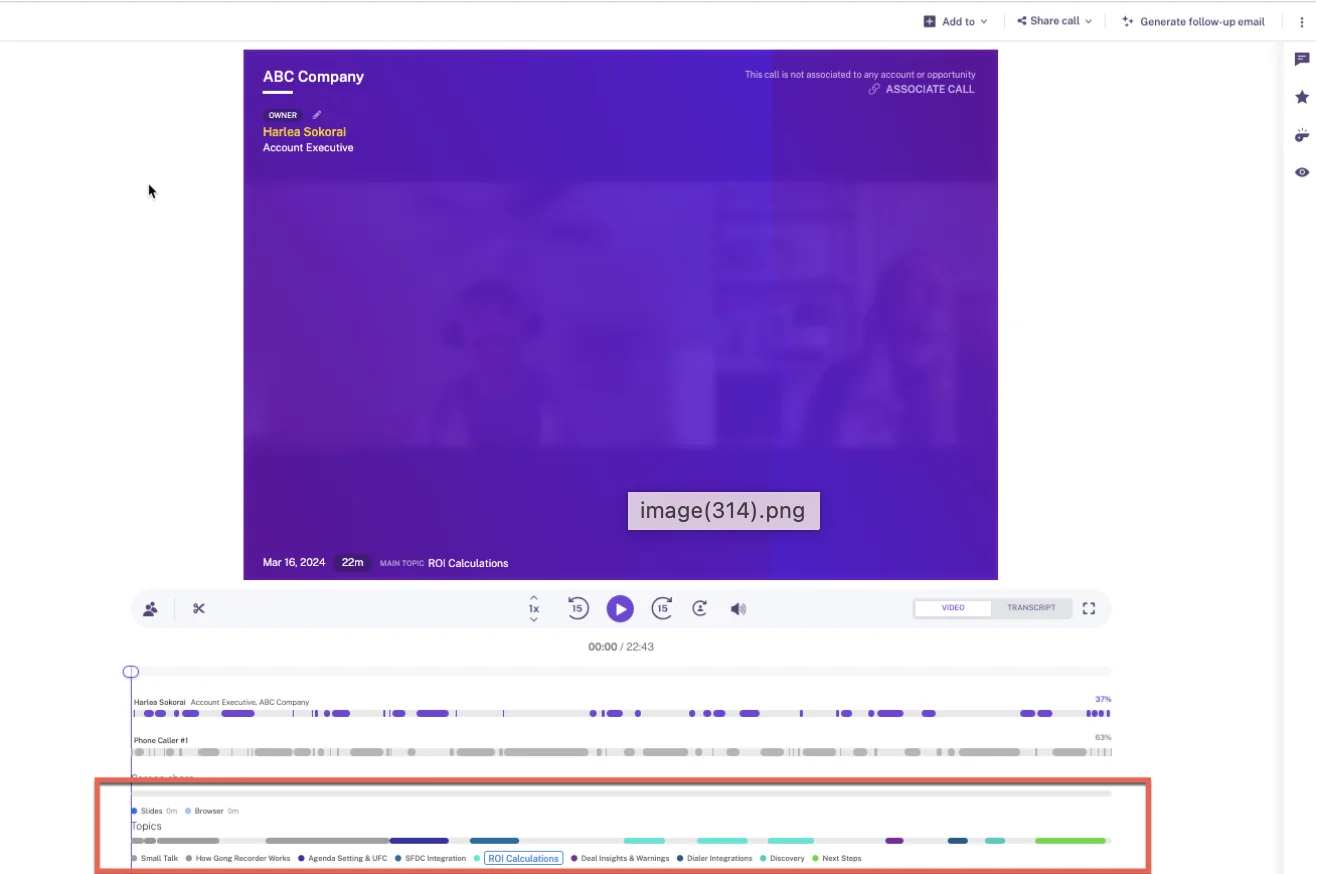
The reason it matters for your evaluation is arithmetic. If four of the eighteen are renames and one is a content generator wearing a builder's name, then the count of genuinely new agentic capability is thirteen, not eighteen, and a slide that says "18 AI agents" is describing a portfolio, not a shipment.
That's worth knowing before you carry the number into a board conversation and someone who used Gong two years ago asks what changed.
Which Gong plan includes which AI agents
The full agent set requires four separately purchased packages. Gong sells a mandatory core licence, Gong Foundation, plus applications bought on top of it, and no application can be bought without Foundation.
| Package | What it is | What it unlocks in Agent Studio |
| Any Gong plan | Includes the older plan generations still running in parallel | Three of the eighteen agents |
| Gong Foundation | The mandatory core licence. Nothing else can be purchased without it | Six agents, including AI Builder |
| Enable Essentials or Enable | The coaching and enablement application | AI Call Reviewer, AI Trainer |
| Forecast Essentials or Gong Forecast | The forecasting application | AI Deal Reviewer, and with it the seven methodology playbooks |
| Gong Engage | The engagement application | AI Composer, AI Tasker |
| Not published | Four agent pages state no availability at all | Four agents |
Two consequences worth surfacing before you get to a quote.
First, seats are assigned per application. Giving one person access to agents across all four groups costs the sum of four seat prices, not one. If you're sizing a rollout where reps need call review, managers need methodology playbooks, and SDRs live in Engage, you're not buying one seat type, you're buying three or four and mapping people to them.
Second, the entry price is never the price of the thing you came for. A team evaluating Gong for coaching is quoted Foundation plus Enable. A team evaluating it for forecasting is quoted Foundation plus Forecast. Same headline capability, different total, decided by which door you walked in.
And one more thing that trips up long-standing customers: three generations of Gong plan run in parallel, so what "any plan" means depends on when you last signed. If you haven't renewed since March 2025 you're on a previous plan model, and even the data encryption settings differ between generations.
How Gong prices AI agents: seats plus credits
Gong meters AI in credits that sit on top of per-seat pricing. Each paid core seat contributes 2,000 credits a year to a pool shared across the whole company, and the pool resets at the start of each contract year.
The pooling matters more than the number. Because the allowance is company-wide, heavy use by a few people eats the allowance everyone else depends on, and you can't size the pool to the teams that actually need AI without buying more seats. Top-up credits expire at the end of the term. They don't roll over.
What draws credits:
- Question-based AI Trackers
- The Gong MCP server
- API-based AI workflows
What doesn't:
- Calls and call analysis, conversation insights
- Deal intelligence, forecasting, coaching, revenue and deal predictions
- Agent Studio agents run by hand by an individual user, however often they run them
The dividing line is automation and volume, not capability. Which produces an odd result: the same brief costs nothing generated by hand in the Gong interface and costs credits generated through the API or MCP. The meter follows the access method, not the work. Your Gong AI bill therefore rises specifically as you wire Gong into the rest of your stack, which is the opposite of how automation is supposed to behave.
Cost is set by the volume of data processed, not by the question you asked:
- A call longer than ten minutes: 1 credit
- A call of ten minutes or less: half a credit
- Each email: a tenth of a credit
So a broad question across a long date range on a busy account can cost many multiples of a narrow one, and you can't predict the bill from the question. Processing new data draws credits. Viewing data already processed doesn't.
Credit to Gong for being direct about the lever: it says tracker configuration has the largest effect on consumption, and recommends unpublishing trackers that no longer provide value and filtering the rest by team, user, account type or deal stage. That's honest guidance. It also means the breadth of what you track across conversations is now a budget decision rather than an analytics one.
Gong's own framing is that credits are the alternative to raising seat prices for everyone, charging only the customers running continuous or large-scale AI, and keeping processing inside Gong rather than exporting conversation data to an external tool. That's a defensible position. It just isn't the position your CFO is evaluating.
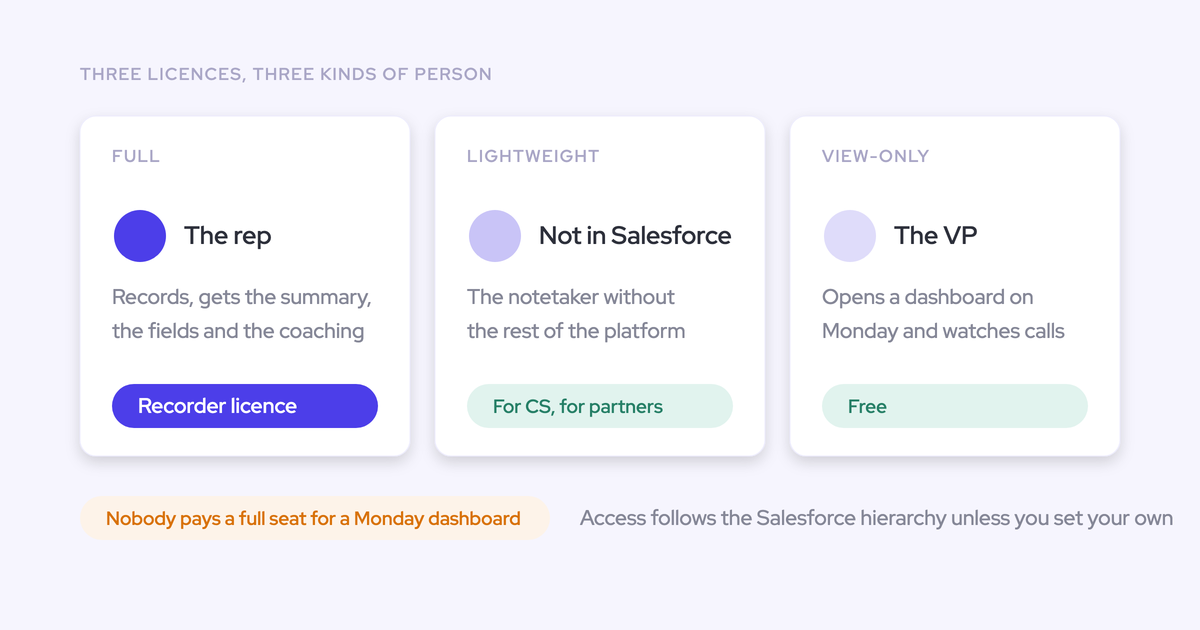
One last cost detail people miss: a Gong team member with no seat assignment is a Collaborator, free of charge, with no AI Ask Anything and no MCP access. The free tier buys visibility, not intelligence. Anyone whose job needs a question answered from the conversation record needs a paid seat.
Can you build your own AI agent in Gong?
No. Gong Agent Studio is a fixed catalogue, and there is no facility to author a nineteenth agent or to compose agents into a multi-step flow.
Configuration is real, and it's more than a toggle. You supply a question, a prompt, a vocabulary term, a scorecard or a filter. But you're always supplying it to an agent whose purpose Gong already fixed.
Look at where the edges are:
- Deal warnings: exactly eight, all defined by Gong. You can switch each on or off and adjust how long before it triggers. You cannot define a new one. A risk pattern specific to your motion, a compliance step, a required stakeholder, a partner sign-off, has nowhere to become a warning.
- Methodology playbooks: seven pre-built, customisable, and you can build one from scratch, but only inside Gong's element model, where each element maps to a tracker that decides how Gong recognises it in conversation.
- Composition: no agent offers it. A trigger, a record lookup, a reasoning step and a delivery action assembled by you doesn't exist. A workflow Gong didn't anticipate has no home, however precisely you can describe it.
Then there's the part buyers raise unprompted, which is that configuring inside the bounds still doesn't tell you what happened inside them.
One of the problems we really have with a lot of the AI features within GONG is that it's kind of a black box. So if I want to do theme spotting or something like that, I can give it a prompt, but then I don't really know what it does from there to go and capture that or analyze that data.
And permissions don't behave consistently across the catalogue either. AI Data Extractor can draw on any non-private call or email in the workspace, including ones the configuring admin can't open, so a business admin sees extraction results derived from conversations they're blocked from reading. AI Builder does the opposite and excludes calls its creator can't access. For a security review, that means there's no single true sentence about what a Gong agent can reach. It depends which agent you're asking about.
Gong's fixed catalogue vs Weflow's Agent Builder
The decision isn't eighteen agents against some other number. It's a proven catalogue you configure within a vendor's bounds against a platform where your team authors its own agents over data it owns.
| Dimension | Gong | Weflow |
| Agent authoring | Eighteen pre-built agents, configurable within bounds Gong set. No nineteenth agent, no multi-step composition | Agent Builder: you write the trigger, the record lookup, the prompts and the action, chained into schedule-triggered or record-triggered flows |
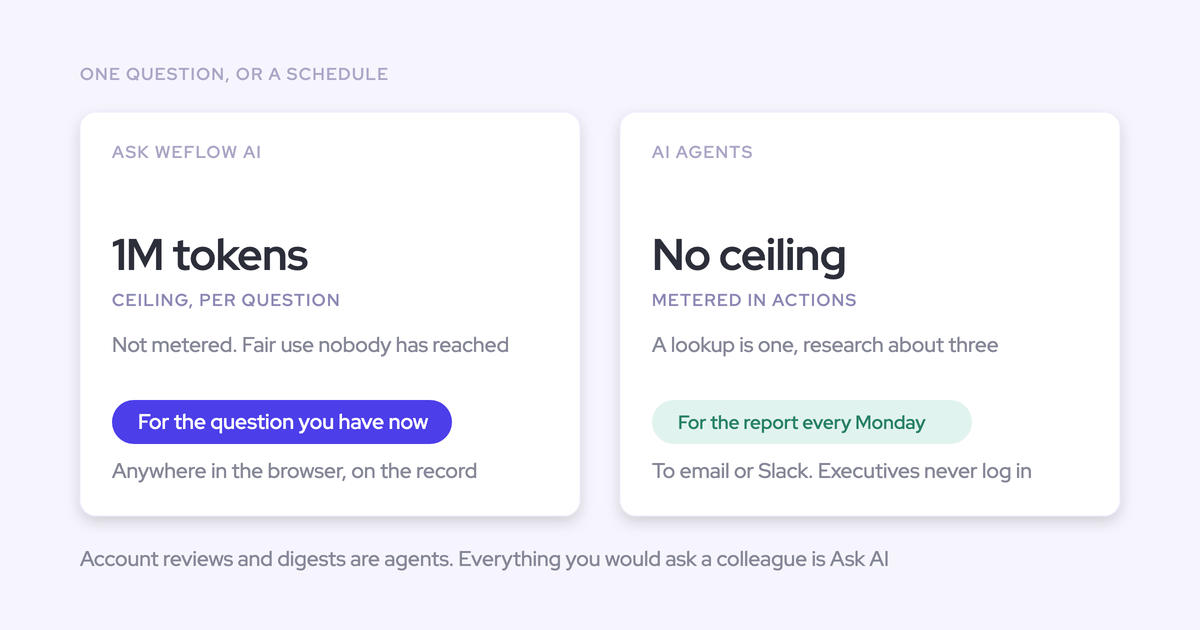
| Pricing model | Per-seat plus a company-wide credit pool of 2,000 credits per paid core seat per year, resetting annually, with top-ups that expire | Per-seat with AI included. Ask Weflow AI Pro is unmetered under a fair use policy no customer has reached. Agent Builder is the one metered component, priced per workspace |
| Where the data lives | In Gong. An AI summary and a document go to Salesforce, not the raw text. Calls kept three years by default, indefinitely if anyone saved them to the library | In native Salesforce objects the customer owns, including the conversation text. If you stop using Weflow the data stays |
| External AI access | MCP server with three read-only tools, one record at a time, AI-generated insights only, never raw transcripts. Paid seats required on both sides. Every request metered | MCP connector reaching playbooks, call summaries, transcripts and forecast calls, with a separate admin toggle for whether assistants may read full transcripts. Not metered |
| Package structure | Mandatory Foundation core plus applications. Full agent set spans four separately purchased packages, seats assigned per application | Three products or three bundles, published prices, one seat covers everything in the bundle. Ten-user minimum |
| Maturity | Invented the category. Deepest conversation analytics in the market, broadest set of proven out-of-the-box agents | Capture, conversation intelligence and forecasting are established. Agent Builder is the newest product and the least mature |
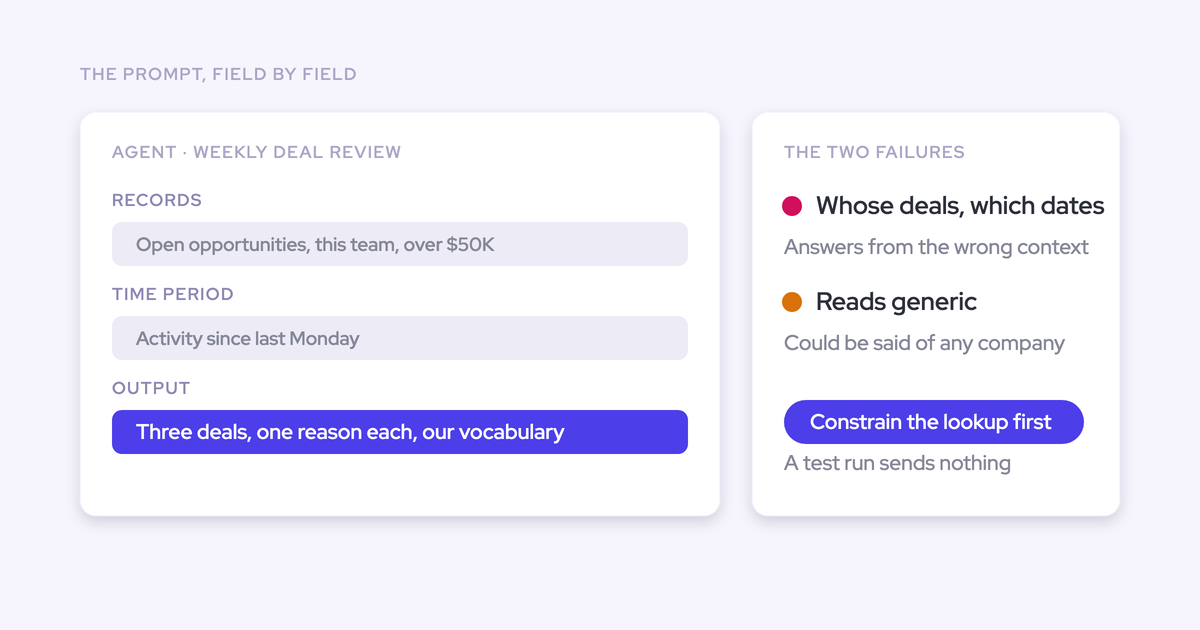
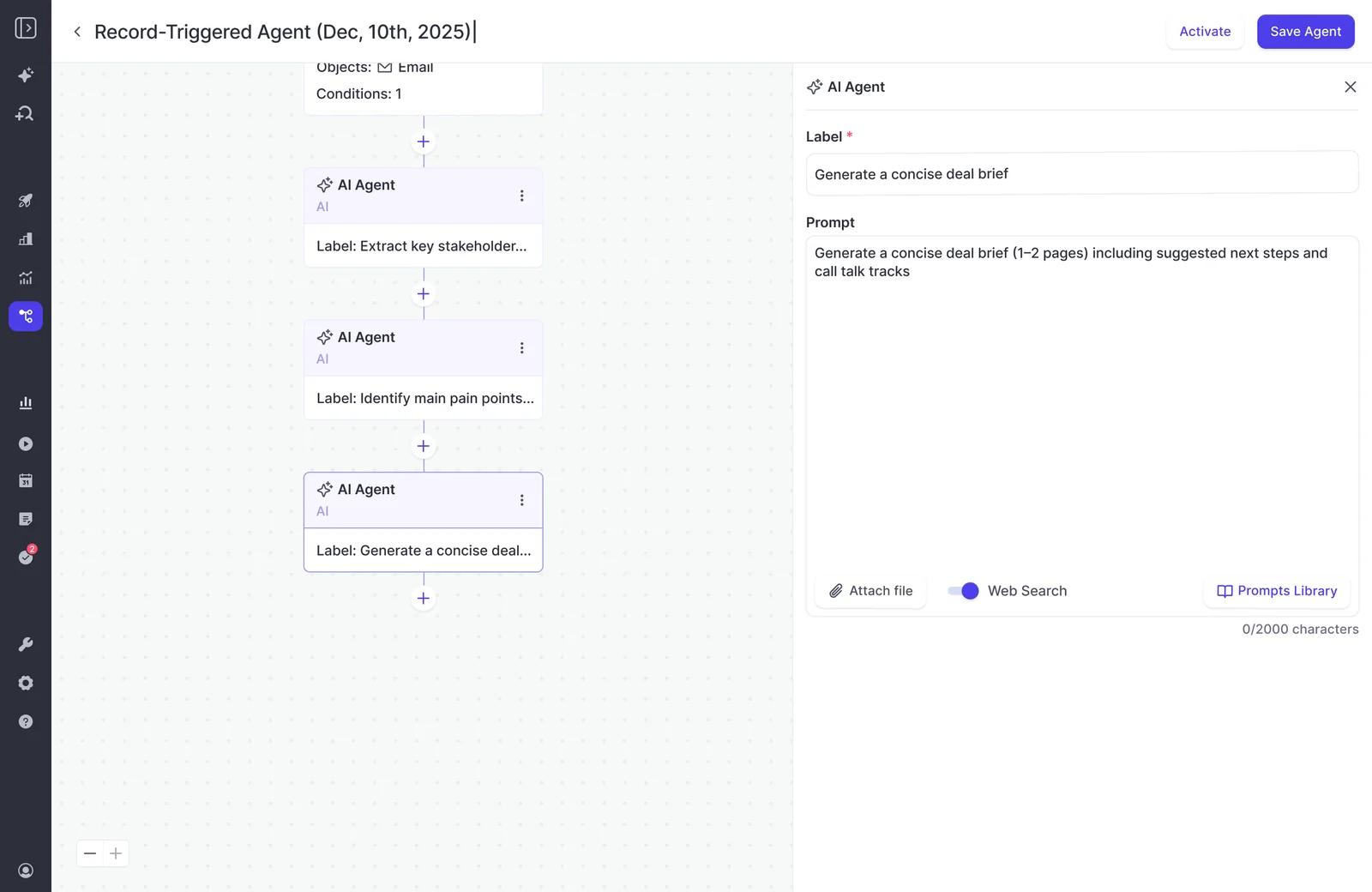
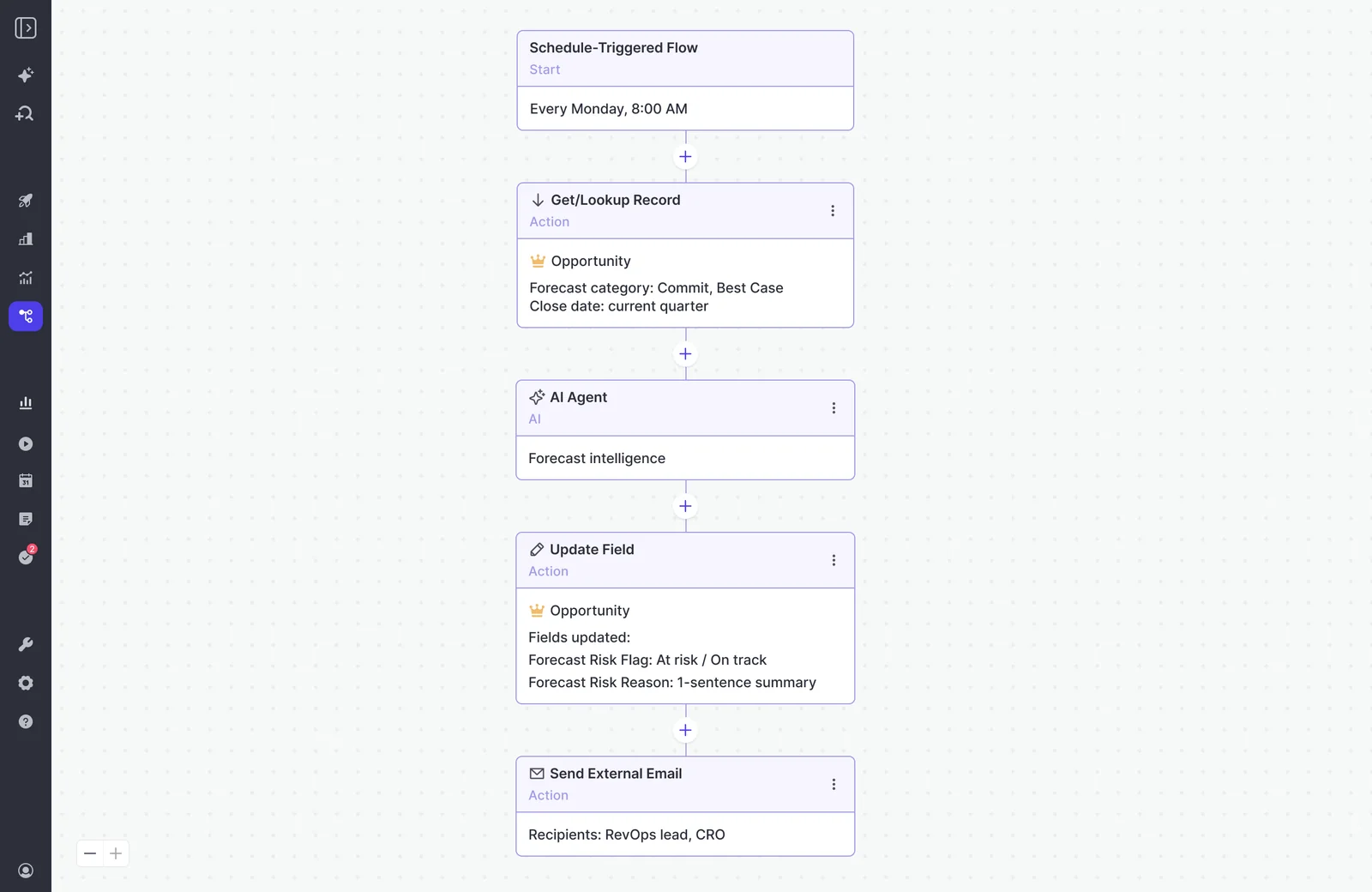
Here's the shape of the other side of that trade. A Weflow agent starts with a lookup that names the object, the stage and the date window, then an AI step, then an action that writes a Salesforce field, posts to Slack or emails a person.
Where Gong is the stronger choice
Gong invented conversation intelligence and still has the deepest analytics in the category. That's not a courtesy line, it's the reason it keeps winning shortlists.
Specifically:
- Breadth of proven agents. Gong's out-of-the-box agent set is still among the widest in the category, and most of it has been in production for years.
- AI Trainer. Roleplay against personas generated from your own recorded calls, graded with the same scorecards you use on live calls, is a real capability and we don't have an equivalent.
- Compliance depth. SOC 2 Type II, ISO 27001, 27017, 27018 and 27701, Cloud Security Alliance STAR, EU-US Data Privacy Framework with the UK extension. Anyone telling you Gong is weak on formal compliance is wrong and it's checkable.
- Institutional familiarity. If half your leadership team has run Gong before, that's real implementation risk removed. Don't discount it because it isn't a feature.
If what you want is the widest set of proven conversation analytics agents today, and you have no ambition to author your own, staying on Gong is a defensible decision and you should make it without guilt.
Where Weflow pulls ahead: agents over data you own
Weflow is the Revenue AI Orchestration platform for sales, customer success, and RevOps teams, built for teams running on Salesforce. Three things a catalogue can't become no matter how many agents get added to it: authorship, data ownership, and a bill that doesn't move.
Agent Builder: author your own agents, prompts, and workflows
Weflow's Agent Builder lets your team write its own agents, prompts and multi-step workflows over your own revenue data instead of picking from a list.
An agent is a trigger, a lookup, one or more AI steps, and an action. Schedule-triggered on Monday at 8am, or record-triggered when a field changes. The action can update a Salesforce field, send an email, post to Slack, or create a report.
One thing we learned the hard way and now build into every template: the lookup step matters more than the prompt. An agent that retrieves a constrained record set before the AI step, naming the object, the stage and the date window, produces materially better output than the same prompt run without one. Skip it and a prompt that returns a strong answer in chat returns an empty report from the agent. The lookup is what tells the model what it's allowed to look at.
This is the direct answer to the objection that ends more Gong renewals than price does.
I wanted control. And I really felt like Gong was a walled garden, and they wanted to have you do everything that you wanted to do inside that platform. And I didn't want to do that. I wanted to write my own prompts, build my own workflows. I wanted to have that trigger into Salesforce or Slack or whatever surface we wanted.
Call and deal data lands in Salesforce objects you own
Everything Weflow captures and generates is written into native Salesforce objects that belong to you, including the conversation text.
Gong sends an AI summary and a document to Salesforce rather than the raw transcript. That single difference decides whether you can build on your own conversation data. A summary is somebody else's interpretation. Raw text on an object you own is a corpus you can query, embed, or point your own model at.
It's also what makes the question "which CRM fields are wrong on the deals we lost last quarter" answerable, because an agent can read what was actually said rather than what a vendor decided to surface.
We use the native objects in Salesforce. If you ever stop using Weflow, the data persists. It is your data.
External assistants reach it too. The Weflow MCP connector is switched on per workspace by an admin, with a separate toggle deciding whether connected assistants may read full transcripts or only AI summaries. Through it, Claude or ChatGPT reaches playbooks, call summaries, transcripts and forecast calls. The admin console lists every connected user and the date they connected, so nobody discovers an attached assistant six months later.
Seat pricing with AI included, one published meter
Weflow publishes its prices and bundles AI into the seat. One component is metered, and it's the one that genuinely consumes tokens at scale.
| What you buy | Price | What's included |
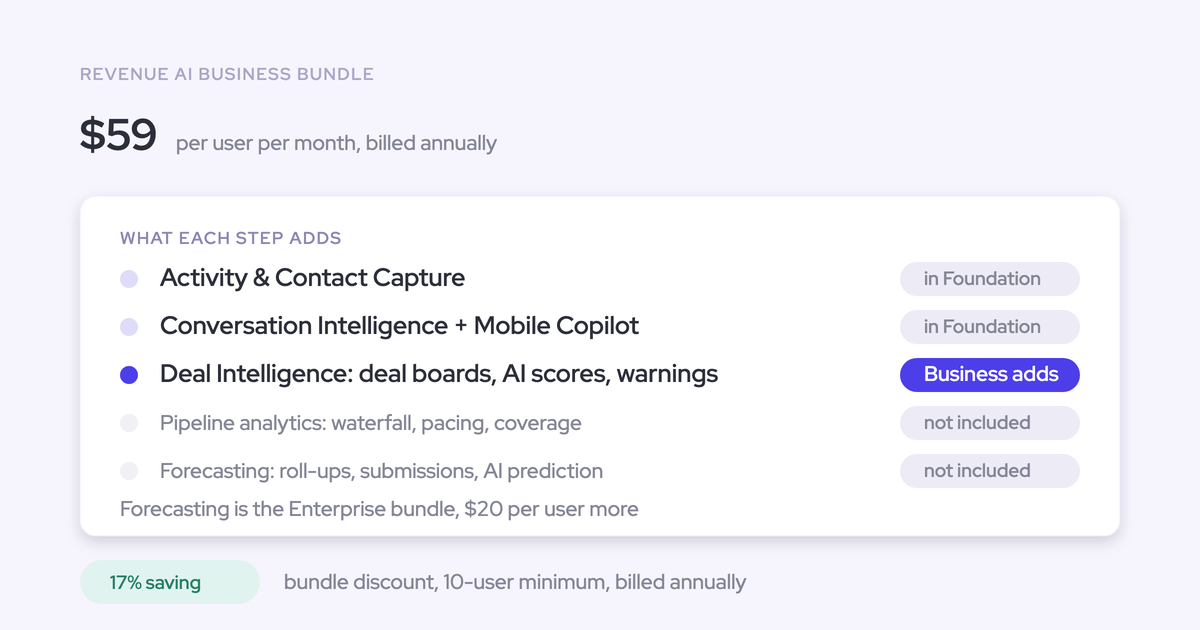
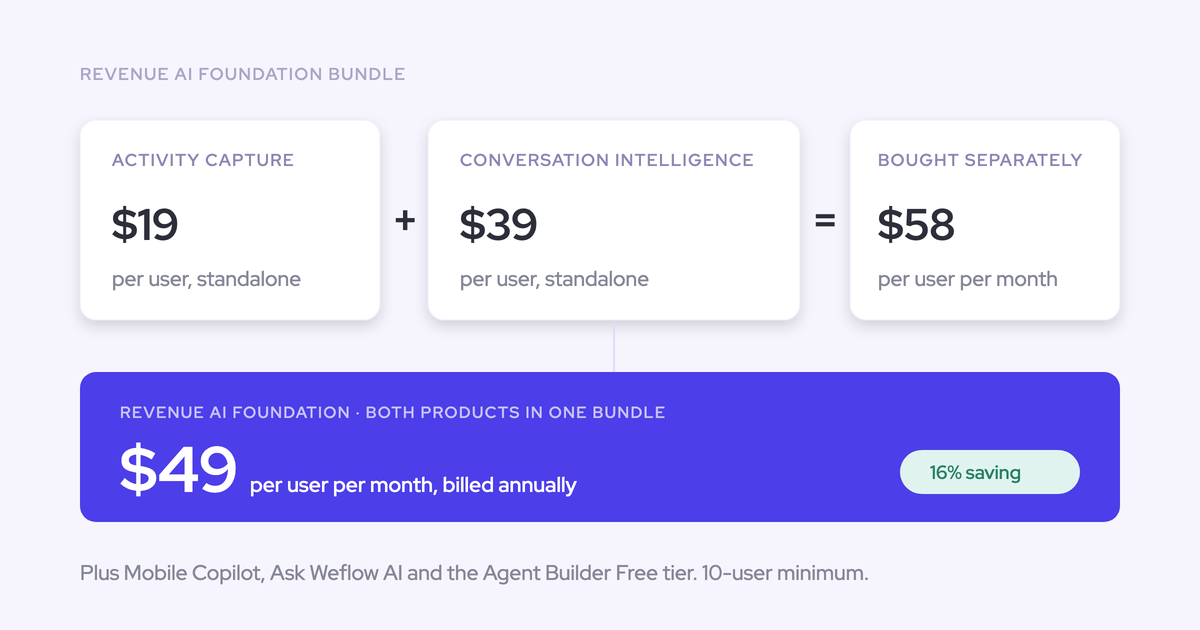
| Activity & Contact Capture | $19 per user per month | Ask Weflow AI Pro, Agent Builder Free |
| Weflow Conversation Intelligence | $39 per user per month | Mobile Copilot, Ask Weflow AI Pro, Agent Builder Free |
| Weflow Deal Intelligence & Forecasting | $39 per user per month | Ask Weflow AI Pro, Agent Builder Free |
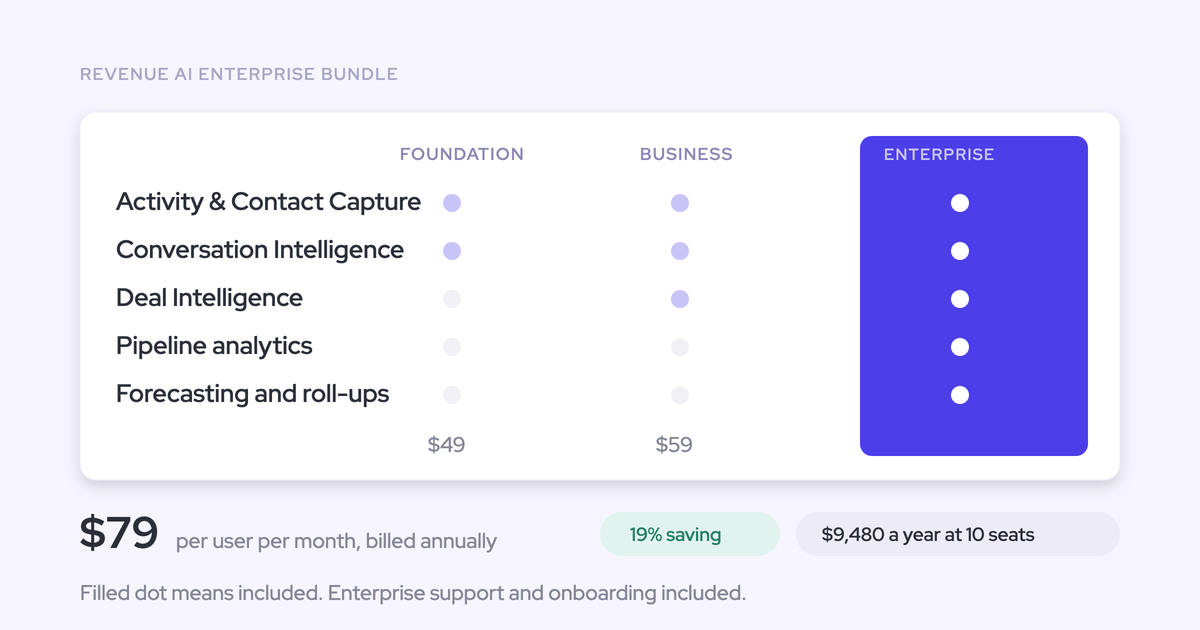
| Revenue AI Foundation | $49 per user per month | Activity & Contact Capture + Conversation Intelligence |
| Revenue AI Business | $59 per user per month | Foundation plus Deal Intelligence |
| Revenue AI Enterprise | $79 per user per month | All Weflow products, including Forecasting |
| Agent Builder Free | Included in every plan | 25 agent actions per month, per workspace |
| Agent Builder Growth | $299 per month | 500 agent actions per month, per workspace |
| Agent Builder Scale | $999 per month | 2,500 agent actions per month, per workspace |
Annual billing, ten-user minimum, volume discounts on larger deployments.
Note that Agent Builder is priced per workspace, not per user. Five hundred agent actions a month is a company allowance, not a per-head one, and the tier boundary is a hard line you cross only by buying the next tier.
The argument isn't that this is cheap. It's that it's predictable, and predictability is what you're actually defending in front of finance.
We want to make sure that you have predictable pricing, and it is very, very hard to achieve in the age of AI.
— Philipp Stelzer, Co-founder and Chief Product Officer at Weflow
Where Weflow falls short today
Agent Builder is our newest product and the least mature thing we sell. Capture, conversation intelligence, deal intelligence and forecasting are established. The orchestration layer that turns context into an action is still being built, and the honest position is that data-driven action orchestration isn't fully solved yet, by anyone.
The specific limits you'd hit in month one:
- Pre-built AI Playbooks only score forward-dated deals. They re-evaluate every three hours, but only for opportunities created or changed after the playbook was configured. Your existing pipeline, which is the pipeline you actually wanted scored, stays blank until someone regenerates it record by record or asks us to run a batch in the backend. Neither is offered in the setup flow, and it's invisible at rollout because new deals fill in normally.
- Deal warnings and AI Playbook scores are Weflow fields, not Salesforce fields. You can see a deal flagged at risk inside Weflow and you can't put that flag in the board dashboard if that dashboard runs on Salesforce or Power BI. The workaround is an agent that writes the assessment into a Salesforce field you create, which works, and which you have to build. Weflow fields are marked with a W in the interface, so you can tell at a glance what will and won't reach a report.
- No read-only admin role. Seeing everything in the workspace requires full admin, which also carries the ability to change the configuration. The analysts who most want the complete view are exactly the people you may not want editing templates.
- No AI Trainer equivalent. We do post-call coaching and scorecards. We don't do simulated roleplay.
- ISO 27001 is in progress, targeted December 2026, not held. SOC 2 Type II, HIPAA, GDPR and CCPA are in place. FedRAMP is not, so US government contractors requiring it aren't a fit.
Migrating from Gong to Weflow: calls, transcripts, timeline
The reason teams stall on a tool they've outgrown is the archive, not the licence. Years of recorded calls, every objection and coaching example, sitting inside the product they want to leave.
Here's how the move actually runs:
- Weflow imports your recordings and transcripts through Gong's API, at no extra cost. Depending on volume it takes about one to two weeks.
- The imported transcripts land in your own Salesforce, so they stay searchable by Weflow's AI after the cutover. A question about how an objection was handled last quarter still answers.
- Technical setup is a 30 to 45 minute call with a Salesforce admin and a mail admin in the room. Configuring the workspace takes about another hour.
- Business logic is the real work: which methodology to score against, which fields to write, which warnings to run. That's a change management conversation, not a configuration task.
What stretches an implementation is getting two admins on different teams into the same call, plus deciding what the system should do. Not the product. Worth saying plainly so a one-hour setup claim doesn't read as an overpromise.
One clock is already running either way: Gong keeps recorded calls and all related artifacts, transcripts and statistics included, for up to three years by default. Calls anyone saved to the library are exempt and kept indefinitely. Any team member can bulk-add calls to the library from search, with no mention of retention in the flow, so your actual retention posture is set by rep behavior rather than admin policy. Worth auditing before you plan a migration around what you think you have.
Choose Gong if, choose Weflow if
Three questions decide it. Do you need to author agents Gong didn't build? Must the data live in your CRM? Can your budget carry a consumption line that grows as adoption succeeds?
Choose Gong if:
- You want the broadest set of proven, out-of-the-box conversation analytics agents today and don't need to author your own
- Account-level methodology summaries across every call are a workflow your managers already run and won't give up
- Roleplay training graded against live-call scorecards is part of your enablement plan
- Your team has run Gong before and that familiarity is worth more to you than the packaging complexity
- Your budget can absorb Foundation plus the applications you need, plus a credit line that moves with automation
Choose Weflow if:
- You want to write your own agents, prompts and multi-step workflows rather than configure someone else's catalogue
- Your conversation and activity data has to sit in native Salesforce objects you own, readable by your own agents and by external assistants over MCP
- You need a number you can defend in one line, with AI bundled into the seat and one published meter
- You want capture, conversation intelligence and forecasting from one platform instead of four packages from one vendor
- You can live with Agent Builder being our newest product, and with the playbook and reporting limits named above
See how Weflow captures activity, updates Salesforce fields from calls, and rolls up your forecast. Book a 30-minute demo.
FAQ: Gong AI agents and alternatives
Which Gong AI agents are included in every Gong plan?
Three of the eighteen agents run on any Gong plan. The other fifteen are gated: six require the Gong Foundation core licence, AI Call Reviewer and AI Trainer require Enable Essentials or Enable, AI Deal Reviewer requires Forecast Essentials or Gong Forecast, AI Composer and AI Tasker require Gong Engage, and four agent pages publish no availability at all. No application can be purchased without Foundation, so nobody buys a single package.
Do Gong AI agents consume credits when reps use them?
Not when a person runs them by hand. An Agent Studio agent opened and run by an individual user in the Gong interface consumes nothing, however often they run it. Credits are drawn by question-based AI Trackers, the MCP server, and API-based AI workflows. Cost follows the volume of data processed, not the question asked: a call over ten minutes is one credit, a call of ten minutes or less is half, an email is a tenth.
Can Claude or ChatGPT query Gong's AI agents through MCP?
Partly. The Gong MCP server exposes exactly three read-only tools: ask_account, ask_deal, and generate_brief. Each works on one named record at a time, so an assistant can't ask across a portfolio or a time period in a single call. It returns AI-generated insights only and never raw transcripts, message bodies or activity lists. You need a paid Gong seat on one side and a paid tier of the assistant on the other, Collaborator accounts can't connect at all, and every request draws credits.
Can Gong's deal warnings and methodology playbooks be customized?
Within limits. AI Deal Monitor offers exactly eight warnings, all defined by Gong, and you can switch each on or off and adjust how long before it triggers, but you can't define a new one. AI Deal Reviewer ships seven methodology playbooks that you can customise, and you can build a playbook from scratch, but only inside Gong's element model where each element maps to a tracker.
How much does Weflow's Agent Builder cost per month?
Agent Builder is priced per workspace, not per user. Every Weflow plan and bundle includes the Free tier at 25 agent actions per month. Growth is $299 per month for 500 agent actions, Scale is $999 per month for 2,500, and there's a custom Enterprise package above that. It's the one metered component in Weflow; Ask Weflow AI Pro is included with every plan and isn't metered.
What happens to Gong call history if you switch to Weflow?
Weflow imports your recordings and transcripts through Gong's API at no extra cost, in about one to two weeks depending on volume, and they land in your own Salesforce where they stay searchable by Weflow's AI. Check what you have first: Gong keeps calls and their transcripts for up to three years by default, and only calls someone moved into the library are kept indefinitely.