5 Weflow MCP Prompts to Check Whether a Deal Really Has a Champion
Learn 5 Weflow MCP prompts to verify a rep's champion claim against deal evidence in Claude.


These five Weflow MCP prompts help you test a rep’s champion claim against the available deal evidence in Claude. You’ll separate what the contact has done from what the rep believes, then turn the gaps into questions for your next deal review. The goal is a better qualification conversation.
A contact who answers emails and attends demos gives you evidence of engagement. Internal advocacy takes more: opening doors, navigating the buying process, and helping the purchase move forward when you’re not in the room. We’d rather leave that distinction unresolved than let an AI summary turn a busy relationship into false confidence.
Weflow is the Revenue AI Orchestration platform for sales, customer success, and RevOps teams. Built for Salesforce teams, Weflow exposes captured records, transcripts, AI playbook output, and their Salesforce mappings through Model Context Protocol (MCP). That gives Claude underlying evidence to inspect. You can also review deals directly inside Weflow with Ask Weflow AI.
Scope the deal before running Weflow MCP prompts
Give Claude one opportunity, a defined review period, and your champion criteria before asking it to interpret the relationship. Weflow MCP exposes records and their Salesforce mappings, so the opportunity identifier anchors the review to the right deal.
This workflow starts with an approved, working Weflow MCP connection in Claude. Before running a prompt:
- Choose the strategic opportunity you want to inspect.
- Set a review window that includes the buying milestones you care about.
- Bring the rep’s champion claim, if you have it, and your team’s qualification criteria.
| Input | What to provide |
|---|---|
| Opportunity, required | A Salesforce opportunity ID or URL. If you use a name, include the account and owner to distinguish similar deals. |
| Review period, required | Explicit start and end dates. |
| Claimed champion, optional | Name, contact identifier if available, and the rep’s exact claim. Without a name, the prompts search for an explicit champion claim. |
| Champion criteria, optional | Your team’s criteria. Without them, the prompts examine ownership of the pain, internal advocacy, buying-process progress, and access to the economic buyer. |
| Additional context, optional | Known uncaptured interactions, changes in the buying committee, or relevant earlier milestones. |
| Next review date, optional | A manager-set date for revisiting unresolved questions. |
Run the prompts in order for a full review, or use one on its own. Each prompt retrieves its own evidence rather than treating an earlier AI answer as a source. If Claude finds several matching opportunities, resolve the match before continuing.
Test the champion claim with Weflow MCP
Start with the recorded claim, then inspect the contact’s actions. Weflow MCP gives Claude access to the conversation records behind AI playbook output, so you can challenge an interpretation rather than simply repeat it.
1. Identify who the rep calls the champion
Find the explicit champion claim before evaluating anyone’s influence. A Salesforce field records a qualification assertion; it doesn’t establish that the contact has acted on your behalf.
Inputs: Opportunity, review period, optional claimed champion, and champion criteria.
Run in: Claude with your approved Weflow MCP connection.
Identify the rep’s champion claim for this opportunity.

Opportunity: [ID or URL]
Review period: [start date to end date]
Claimed champion: [name and claim, or leave blank]
Team champion criteria: [criteria, or leave blank]

Use Weflow MCP to resolve the opportunity and retrieve
available methodology fields, AI playbook output,
recordings, transcripts, and relevant activity records.
Stop and ask me if the opportunity match is ambiguous
or the review period is missing.

Find explicit statements identifying a champion.
Distinguish rep statements, CRM field values,
AI-generated interpretations, and customer statements.
If authorship or the source date is unavailable, say so.

Treat a champion name I supply as manager-provided context
unless a retrieved record independently supports the claim.
If no explicit claim exists, report that.
Don’t select the most active contact as a substitute.
Keep multiple named candidates separate.

Return:
1. Scope and coverage: records inspected, unavailable
   material, and any unresolved opportunity mapping.
2. A candidate table: identity, claimed role, who or what
   made the claim, source date/reference, and ambiguity.
3. Separate Evidence, Inference, and Unknowns sections.

Evidence must distinguish recorded assertions from actions.
Use available links, record IDs, or transcript locations.
Don’t invent references.

Use my criteria. If blank, use ownership of the pain,
internal advocacy, buying-process progress, and access
to the economic buyer as inspection questions.

Don’t score or certify anyone, change records,
or contact the customer.
Output layout:
| Candidate | Claimed role | Claim provenance | Date and reference | Unresolved ambiguity |
|---|---|---|---|---|
| [Identity] | [Recorded claim] | [Speaker, field, or AI output] | [Available source reference] | [What remains unclear] |
Customize: List several candidates if the rep names more than one. Keep their claims separate throughout the review. If nobody has explicitly named a champion, use that gap as your first question for the rep.
2. Check how the claimed champion engages
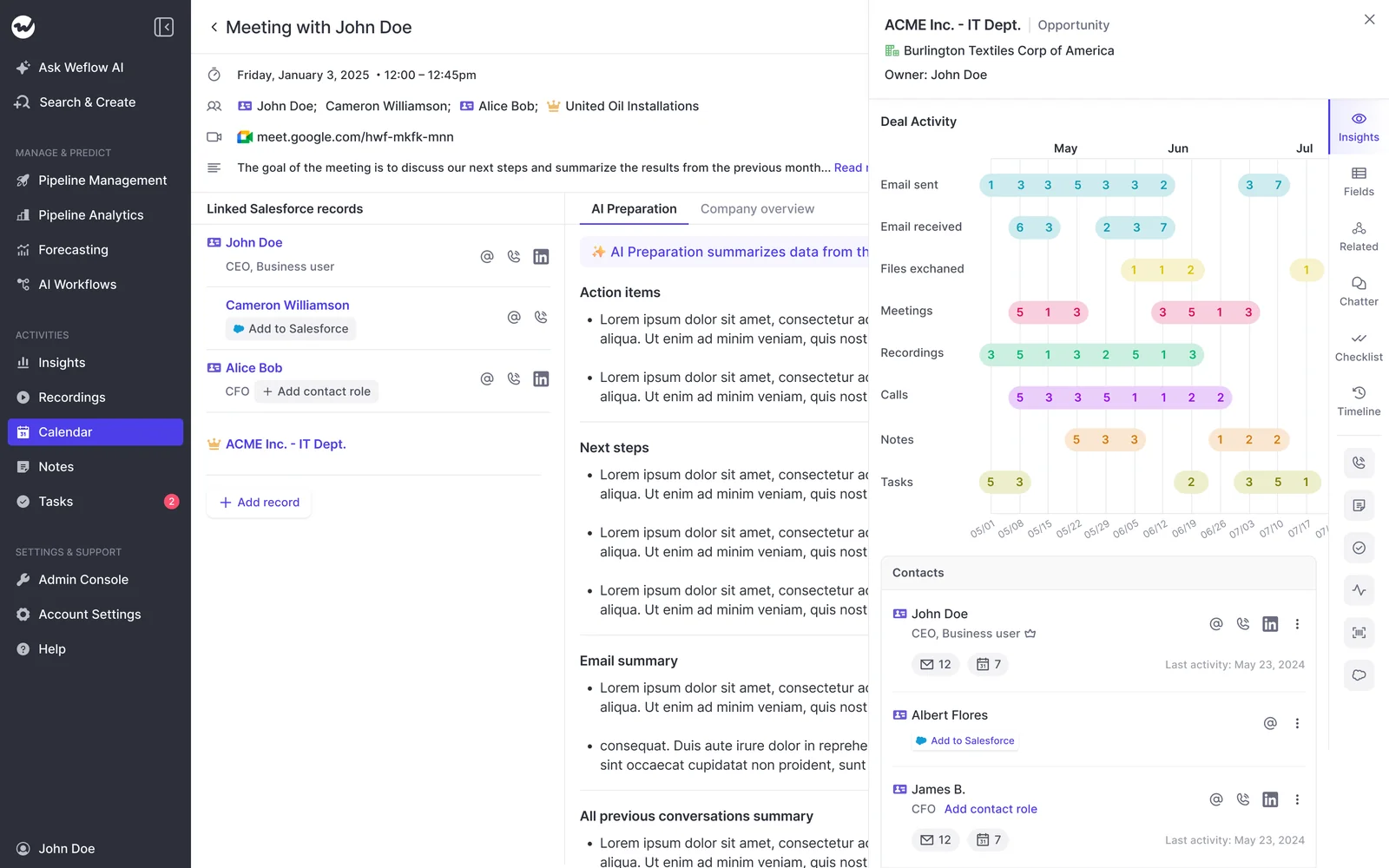
Describe the contact’s participation without treating responsiveness as advocacy. Weflow shows opportunity activity and the people involved, giving you the relationship history behind the rep’s account.
Inputs: Opportunity, review period, candidate or candidates, and champion criteria.
Run in: Claude with your approved Weflow MCP connection.
Inspect how the claimed champion engages on this deal.

Opportunity: [ID or URL]
Review period: [start date to end date]
Candidate(s): [names or contact IDs, or leave blank]
Team champion criteria: [criteria, or leave blank]

Resolve the opportunity through Weflow MCP.
Ask me to resolve an ambiguous match or missing dates.
If no candidate is supplied, retrieve explicit champion
claims first. If none exists, stop and report that gap.

Retrieve available emails, meeting records, transcripts,
and related activity mapped to this opportunity.
Inspect the underlying records, not just earlier AI answers.

Build a dated interaction table showing the candidate’s
participation, who initiated the exchange where known,
what they said or did, and any documented follow-through.

Distinguish invitations from attendance, commitments from
completed actions, and seller follow-ups from buyer replies.
Use activity counts only when the retrieved records support
them, and label the period and coverage they represent.

Return:
1. Scope and coverage: what you retrieved and inspected,
   unavailable content, and uncertain mappings.
2. The dated interaction table with available references.
3. Evidence: observed engagement and attributed statements.
4. Inference: what the pattern suggests, with its basis.
5. Unknowns: what engagement cannot establish.

Use my champion criteria. If blank, examine pain ownership,
internal advocacy, buying-process progress, and access
to the economic buyer. Engagement alone proves none of them.

Keep candidates separate. Don’t invent dates or citations.
Don’t score, certify, update records, or contact anyone.
Output layout:
| Date | Interaction | Candidate’s participation | Documented follow-through | Source |
|---|---|---|---|---|
| [Source date] | [Email or meeting] | [Observed action or attributed statement] | [Outcome or unknown] | [Available reference] |
Customize: For a long sales cycle, widen the window to include earlier introductions and buying milestones. Keep older actions dated so an introduction from months ago doesn’t stand in for current influence.
3. Test how the champion advances the buying process
Look for actions that advance the purchase internally. Weflow’s captured conversations let you examine what the contact promised, what happened afterward, and where the evidence stops.
Inputs: Opportunity, review period, candidate or candidates, and your champion criteria.
Run in: Claude with your approved Weflow MCP connection.
Test the evidence of internal advocacy on this opportunity.

Opportunity: [ID or URL]
Review period: [start date to end date]
Candidate(s): [names or contact IDs, or leave blank]
Team champion criteria: [criteria, or leave blank]

Use Weflow MCP to resolve the opportunity.
Ask me about ambiguous matches or missing dates.
If candidates are blank, retrieve explicit champion claims.
If no claim exists, report the gap rather than choosing
someone based on engagement.

Retrieve relevant transcripts, activities, methodology
fields, and AI playbook output. Trace interpretations
back to underlying records wherever available.
Don’t use an earlier AI answer as evidence.

Apply my criteria. If blank, examine:
- Does the contact own the pain and describe inaction’s cost?
- What evidence supports advocacy inside the company?
- What have they done to advance the buying process?
- Have they opened access to the economic buyer?

Separate observed actions, reports of internal actions,
promises, and AI interpretations. A promise to introduce
us isn’t a completed introduction. Meeting a senior person
doesn’t establish that person’s buying authority.

Return:
1. Coverage: inspected sources, unavailable records,
   and unresolved mapping or attribution.
2. A criterion-by-criterion table with evidence type,
   dated source references, inference, and unknowns.
3. The specific proof still needed for each criterion.

Keep candidates separate. Use available record references,
links, or transcript locations; don’t invent any.
Don’t assign a score or certify champion status.
Don’t change records or contact the customer.
Output layout:
| Criterion | Evidence and type | Date and source | Inference | Unknown or missing proof |
|---|---|---|---|---|
| [Your criterion] | [Action, report, or promise] | [Available reference] | [Supported interpretation] | [What still needs testing] |
Customize: Paste your company’s actual champion criteria, including what counts as proof. MEDDIC, MEDDPICC, or a blended methodology should guide the questions, not force the answer into a universal score.
Turn champion evidence gaps into deal-review questions
Use the gaps to decide what the rep needs to validate next. Weflow supplies the captured deal evidence; your review should turn that evidence into questions the rep can answer and actions you can revisit.
4. Challenge the champion claim against the evidence
Test the strongest case for the champion, then look for evidence that weakens it. Missing proof and contradictory evidence deserve different questions.
Weflow doesn’t capture conversations in shared customer Slack channels. If advocacy happens there, its absence from the captured record leaves an unknown, not evidence that the contact failed to act.
Inputs: Opportunity, review period, champion claim, criteria, and optional uncaptured context.
Run in: Claude with your approved Weflow MCP connection.
Pressure-test the champion claim on this opportunity.

Opportunity: [ID or URL]
Review period: [start date to end date]
Champion claim: [candidate and claim, or leave blank]
Team champion criteria: [criteria, or leave blank]
Known uncaptured context: [details, or leave blank]

Resolve the opportunity through Weflow MCP.
Ask me about ambiguous matches or missing dates.
If the claim is blank, retrieve explicit champion claims.
If none exists, report that rather than inventing one.

Retrieve the underlying activity, transcripts, methodology
fields, and playbook output needed to test the claim.
Revisit sources behind any earlier findings.
An earlier AI answer isn’t a source.

Use my criteria. If blank, examine pain ownership,
internal advocacy, buying-process progress, and access
to the economic buyer.

State the strongest supported case for the claim.
Then distinguish:
- Contradictory evidence.
- Promises with no documented follow-through.
- Missing or inaccessible evidence.
- Plausible alternative interpretations.

Don’t treat a missing record as proof an action never happened.
Label uncaptured context I supply as manager-provided,
not independently retrieved evidence.

Return:
1. Coverage: inspected records, unavailable material,
   and uncertain mappings.
2. A challenge table: disputed claim, evidence or gap,
   dated reference, alternative interpretation,
   and required validation.
3. Separate Evidence, Inference, and Unknowns sections.

Keep candidates separate. Don’t invent citations,
force a negative conclusion, or assign a champion score.
Don’t certify status, change records, or contact anyone.
Output layout:
| Claim under review | Contradiction or coverage gap | Source | Alternative interpretation | Required validation |
|---|---|---|---|---|
| [Specific claim] | [Evidence or missing material] | [Available dated reference] | [Inference] | [Question or observable proof] |
Customize: Add known offline conversations or customer-channel activity with dates and provenance. Claude should preserve that context separately from the records it retrieves.
5. Prepare champion questions for your rep
Build an agenda that connects each challenge to evidence and a next step. Weflow MCP supports the inspection, but digital evidence alone cannot certify that someone is a champion.
The rep still needs to reason about the relationship. Ask what changed inside the customer’s organization, how they know, and what the contact will do next.
Inputs: Opportunity, review period, candidate, criteria, optional prior findings, and a manager-set review date.
Run in: Claude with your approved Weflow MCP connection.
Prepare my champion discussion with the opportunity owner.

Opportunity: [ID or URL]
Review period: [start date to end date]
Candidate(s): [names or contact IDs, or leave blank]
Team champion criteria: [criteria, or leave blank]
Prior findings or open questions: [optional]
Next review date: [manager-set date, or leave blank]

Resolve the opportunity through Weflow MCP.
Ask me about ambiguous matches or missing review dates.
If no candidate is supplied, retrieve explicit champion
claims. If none exists, make that the first discussion topic.

Retrieve and inspect the underlying records needed
to support the agenda. Treat prior findings as leads
to investigate, not as sources.

Use my criteria. If blank, examine pain ownership,
internal advocacy, buying-process progress, and access
to the economic buyer.

Return:
1. A short opening assessment separating Evidence,
   Inference, and Unknowns. Say “not enough evidence”
   wherever that’s the supported conclusion.
2. Coverage: inspected records, unavailable material,
   and unresolved mappings.
3. An ordered agenda. For each question, include:
   the evidence or gap behind it, available dated references,
   and the observable proof that would resolve it.
4. An action table with proposed ownership, required proof,
   and my next review date. Leave the date unset if blank.

Prioritize questions about internal advocacy and access
to power over questions about activity volume.
Keep the questions constructive and candidates separate.
Distinguish manager-provided context from retrieved evidence.

Don’t invent source links or treat proposed actions as agreed.
Don’t score or certify anyone, update Salesforce,
or send customer outreach.
Output layout:
| Priority | Question for the rep | Evidence or gap | Proof needed |
|---|---|---|---|
| [Discussion order] | [Specific question] | [Dated source or unknown] | [Observable validation] |
| Proposed action | Proposed owner | Required proof | Review date |
|---|---|---|---|
| [Validation step] | [Person or role] | [What resolves the question] | [Manager-set date] |
Customize: Set the discussion order around the deal’s next buying milestone. Agree on ownership with the rep, then revisit the evidence on your chosen date.
FAQ: Using Weflow MCP to review deal champions
Keep the opportunity scope and source coverage visible whichever interface you use. A useful champion review lets you trace the interpretation back to the deal record.
When should I use Ask Weflow AI instead?
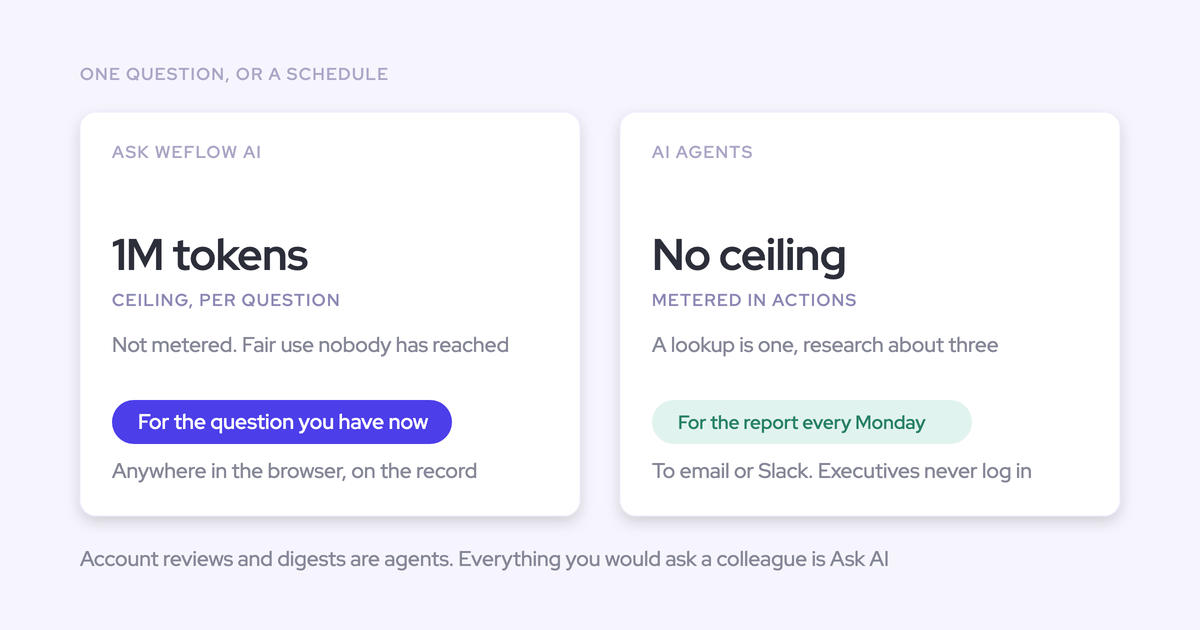
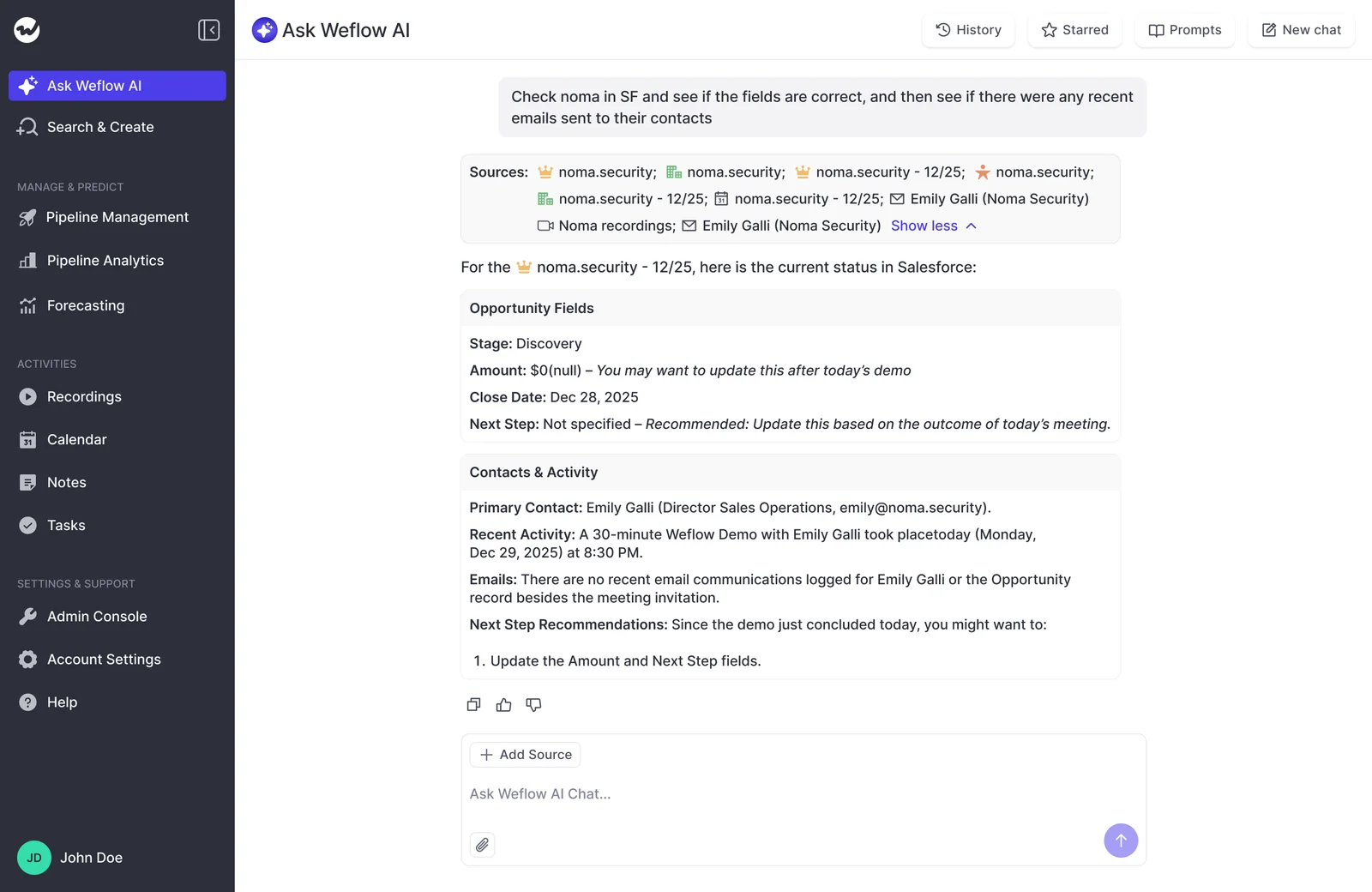
Use Ask Weflow AI when you’re already reviewing a deal, account, or filtered deal board inside Weflow. Use Claude through Weflow MCP when Claude is where you want to conduct the analysis.
Ask Weflow AI brings Salesforce records, captured activities, and transcripts into the conversation. Its source list lets you inspect the material behind an answer.
| Dimension | Ask Weflow AI | Claude through Weflow MCP |
|---|---|---|
| Working surface | Inside Weflow | Inside Claude |
| Scoping method | Select a deal, account, recording, or filtered deal board as context. | Identify the opportunity and define the review scope in your prompt. |
| Review context | Questions grounded in Weflow’s selected sources. | Analysis of captured records and Salesforce mappings retrieved through the connector. |
Should I also connect Claude to Salesforce?
Add a Salesforce connection when your review needs CRM records beyond the material you’re retrieving through Weflow MCP. Weflow provides a direct route to captured conversations and playbook output, even though transcripts also reach Salesforce on the recording object.
| Information needed | Access route |
|---|---|
| Captured activities, transcripts, and AI playbook output with Salesforce mappings | Weflow MCP |
| Additional Salesforce objects and fields | Salesforce’s connector |
| Weflow forecast submissions and targets | Weflow MCP; these don’t live in Salesforce objects. |
For this champion review, prioritize the underlying interactions and qualification claims. Adding forecast data won’t establish internal advocacy.
Can Weflow MCP use a saved deal board?
No. Weflow MCP exposes captured records and their Salesforce mappings, not saved deal boards or pipeline views by name. Ask Weflow AI can use a deal board directly as context inside Weflow.
For a single-deal review in Claude, supply the opportunity identifier. If you found the deal through a board, carry over the specific opportunity rather than the board name.
Can Claude review every call on an opportunity?
You can ask Claude to inspect the available opportunity transcripts through Weflow MCP. Whether a particular answer covers every call depends on what Claude retrieved and inspected, so the coverage report is part of the answer.
- Retrieved: Which recordings did the connector return?
- Inspected: Which transcripts did Claude actually examine?
- Unavailable: Which known calls lacked accessible content?
- Unresolved: Which records had uncertain opportunity mappings?
A meeting record shows that a meeting exists. It doesn’t establish that Claude read its conversation.
How do I correct Claude’s champion assessment?
Correct the specific interpretation and show what should change. Keep your new context distinct from evidence Claude independently retrieves through Weflow MCP.
- Identify the disputed statement and its source.
- Supply the missing context, corrected identity, or relevant record.
- Ask Claude to revisit the underlying evidence and explain which inference changes.
- Keep unresolved questions visible instead of replacing the original answer with an unsupported conclusion.
Should I update Salesforce from Claude’s champion assessment?
Review the conclusion with the rep before changing the Salesforce champion field. These prompts deliberately stop at investigation and proposed validation steps.
- Agree on what the evidence supports.
- Separate demonstrated advocacy from promises and engagement.
- Record the unresolved qualification question alongside the supporting evidence.
- Make any field change through your approved workflow.
Leave the review with a specific action the rep owns and a date to revisit the proof.