The GTM Orchestration Layer: How RevOps Coordinates Humans and AI Agents
Learn how RevOps coordinates humans, AI agents, and data in the GTM orchestration layer




You keep hearing that RevOps is becoming the orchestrator of the go-to-market stack. It's showing up in job descriptions now, not just on conference stages. What nobody has handed you is the operating model: what the job actually is on a Tuesday, with a team of two and a quarter's reporting already late.
So the AI mandate lands, and it lands on top of everything else. No extra headcount. No benchmark to tell you whether you're behind or fine.
That anxiety is the norm, not a verdict on you. This piece turns the slogan into something concrete: what the orchestration layer is, why the job structurally lands on RevOps, what has to be true underneath it before agents are worth anything, and where most teams actually sit on the maturity curve. Weflow is the Revenue AI Orchestration platform for sales, customer success, and RevOps teams, and this operating model is the thing we built it to run, so we'll be straight about which parts of it are solved and which aren't.
What is the orchestration layer for GTM?
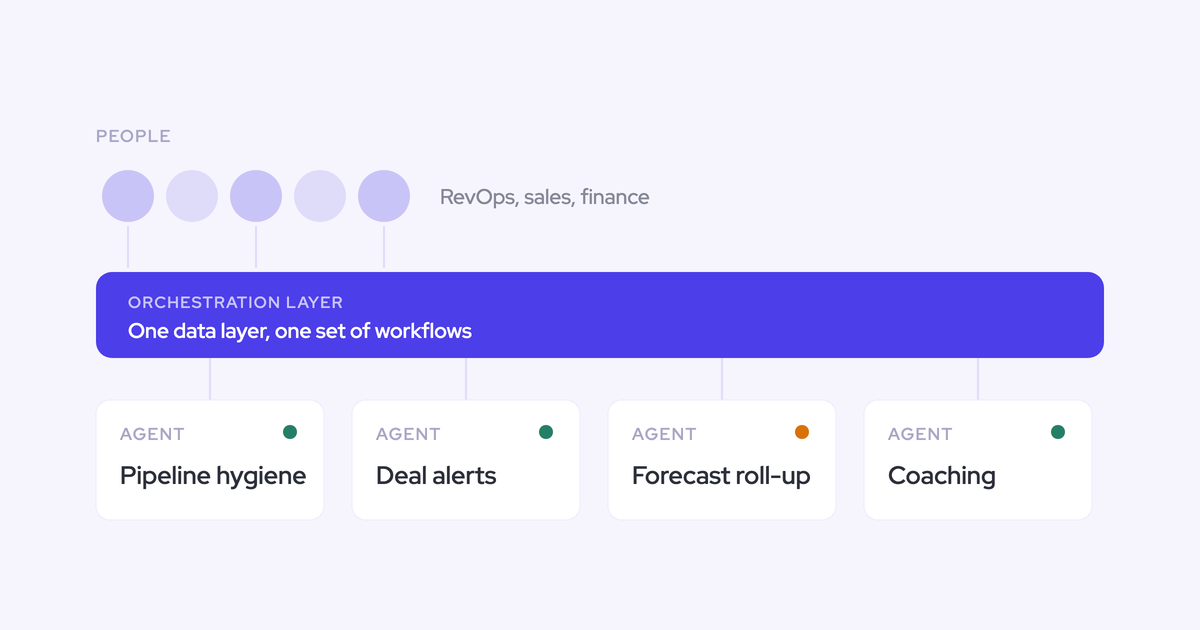
The orchestration layer for GTM is the operating model in which RevOps designs, runs, and governs the shared workflows that humans and AI agents both use to act on one unified data layer. It's a layer, not a tool: the coordination sits above the individual systems and decides what gets acted on, by whom, and with what data underneath it.
Three phrases in that sentence carry the weight.
- Shared workflows. Not each rep's personal prompt collection. A defined set of plays, designed once, that everyone gets the output of.
- One unified data layer. Activity, conversations, contacts, and CRM records in one queryable place. Agents are only as good as the data they can reach.
- Governed. Whether an agent takes an action or hands it to a human is a decision your team makes, per workflow, not a default the vendor set for you.
The consequence is the part worth carrying into your next leadership meeting. When RevOps owns the workflows that decide what a hundred sellers look at on Monday morning, RevOps is allocating the company's most expensive resource.
What I find so interesting is that, you know, the kind of using agents to orchestrate actions is something that is essentially giving RevOps the power of resource allocation.
Why AI agent orchestration is landing on RevOps
It's landing on RevOps by structural default, not because anyone chose you for it. And it's not a prediction anymore, it's written down.
What I find really, really interesting is that suddenly we see responsibility for orchestrating agents as part of the job description of revenue operations. Now I've seen that. I've read that now.
Three separate forces put the job there.
Reps can't each run a portfolio of agents
Agents multiply faster than individual humans can supervise them. Ask an AE to design, prompt, monitor, and correct five to ten agents alongside their number and you get either abandonment or a mess nobody can audit.
The economics only work when the design is shared: one person builds the play, a hundred people receive the output. That's a single-owner job, and the owner has to sit outside any one team.
RevOps already owns the data, tools, and processes
Agents run on three things: the data, the systems, and the process definitions. RevOps already holds all three.
IT owns infrastructure but not the funnel. Enablement owns behavior but not the object model. Sales leadership owns the number but not the fields it's calculated from. RevOps sees the process closer to the ground and in more detail than anyone else in the company, which is exactly what agent design needs.
There's no other natural home. That's why it feels like the job was assigned without a conversation.
Orchestration tooling isn't plug-and-play yet
AI only reached the application layer of the revenue stack about two years ago. Large parts of the signal-to-workflow chain simply haven't been built yet as products, which means combining signals, data quality, and AI workflows still takes someone technical inside the revenue team.
That's why it feels like pressure without a playbook. It's also the window. Teams that can assemble the pieces now outrun the teams waiting for a finished product, and the function doing the assembling moves from tooling to deciding where everyone else spends their time.
Why pointing an LLM at Salesforce isn't orchestration
Because the agent inherits whatever your data is, and then answers with total confidence.
Everyone tries this first. Connect a model to Salesforce, ask it for the truth about the pipeline, and it produces something fluent that's wrong in ways nobody in the room can see. Half the meetings were never logged. The MEDDIC fields are empty. The same account exists three times.
| What you ask the agent | What your data actually lets it answer |
|---|---|
| Which deals are at risk this quarter? | The deals somebody bothered to update. A deal with no logged activity reads as quiet, not as risky. |
| Who's the real decision maker on this account? | Whichever contact exists in Salesforce, which may be one person who filled in a form two years ago. |
| Why did we lose these deals? | The reason code a rep picked from a dropdown, not what the buyer actually said on the call. |
This is the moment every AI project stops being about models and becomes a data foundation project. It's the unglamorous work leadership hoped to skip.
We just need, in order to make agents really much stronger and much more accurate, we need more data to feed these agents.
Here's the honest part. You cannot fix the foundation first in one heroic cleanup. Ten or fifteen years of architecture decisions are sitting on it: objects nobody dares delete, integrations whose owner left, custom fields feeding a report the board still reads. That's a migration, and it competes with the quarter.
So the path that works improves the foundation at the source while delivering something. Capture the activity and the conversations automatically, write the structured output into the fields your reports already read, and the foundation gets better every week without a program nobody has capacity for. Skip that sequence and you get pilots that demo beautifully and change nothing.
The three layers of Revenue AI Orchestration
Revenue AI Orchestration is a stack of three layers built in order: a system of truth, a system of intelligence, and a system of action. The order is a dependency, not a preference. Intelligence bought on top of data that was never captured has no foundation, and agents bought on top of that have less.
| Layer | What it is | What breaks without it |
|---|---|---|
| System of truth | Automatic capture of activity, contacts, and conversations, unified with CRM data into one queryable layer | Everything above it is confidently wrong, and nobody can tell which parts |
| System of intelligence | Deal health, risk signals, methodology gaps, forecast signals generated from that data | You have raw records and no judgment, so inspection stays a manual read of every deal |
| System of action | Agent workflows and field writes that turn context into a nudge, a draft, or an automated step | Insight sits in a dashboard nobody opens and nothing changes in the field |
System of truth: the unified data layer
The unified data layer combines activity, conversation, contact, and CRM data into one place an agent can query. Not a dashboard. A layer other things read from.
Capture quality is what decides everything downstream, which is why we treat it as the foundation rather than as data hygiene. A play that reads only CRM fields returns what the rep typed, which is the number the team already didn't trust. A play that joins conversation data to CRM data returns what actually happened.
We weren't buying conversation intelligence. We were buying a unified data layer that the entire go-to-market motion could run on, and a partner who understood that distinction.
— Scott Jones, SVP of GTM Revenue Intelligence & Enablement at KORE Wireless
System of intelligence: deal and conversation intelligence
The intelligence layer is structured judgment generated from the truth layer: deal health scores, risk signals, methodology gaps, forecast predictions.
It's different from the reports you already produce in one specific way. Your dashboards describe what reps entered. This layer adds an assessment of the deal built from evidence the rep didn't have to type.
AI can be extremely impactful because it adds an objective layer to everything.
System of action: agent workflows humans still govern
The action layer is where context becomes a nudge, a draft follow-up, a field write, or a message in the channel where the team already works.
Autonomy is the governance decision, and it's yours per workflow. Some plays should write the field automatically. Some should draft and wait. Some should only ever tell a human what to look at. A platform that decides that for you has taken the one control you actually need to hold.
Managers have been asking for this layer for years, usually in the same words: fine, but what does the dashboard tell my people to do next?
Who runs the AI agents in a revenue team
RevOps designs and governs the shared workflows. Everyone else consumes the output. Agents execute the defined work.
| Role | What they own in this model |
|---|---|
| RevOps | Workflow design, prompts, data mapping, autonomy levels, monitoring, and which agents exist at all |
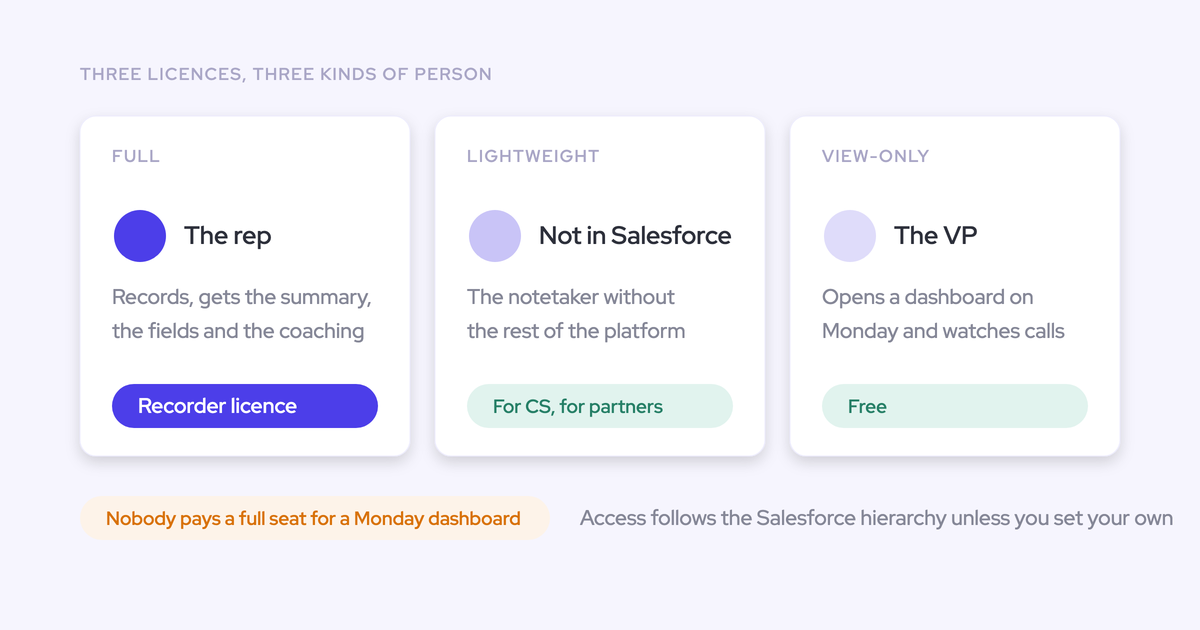
| Reps | Acting on what arrives: the flagged deal, the drafted follow-up, the prepped meeting. Ad hoc questions through chat |
| Managers and VPs | Inspection and coaching off the intelligence layer instead of off a rep's recollection |
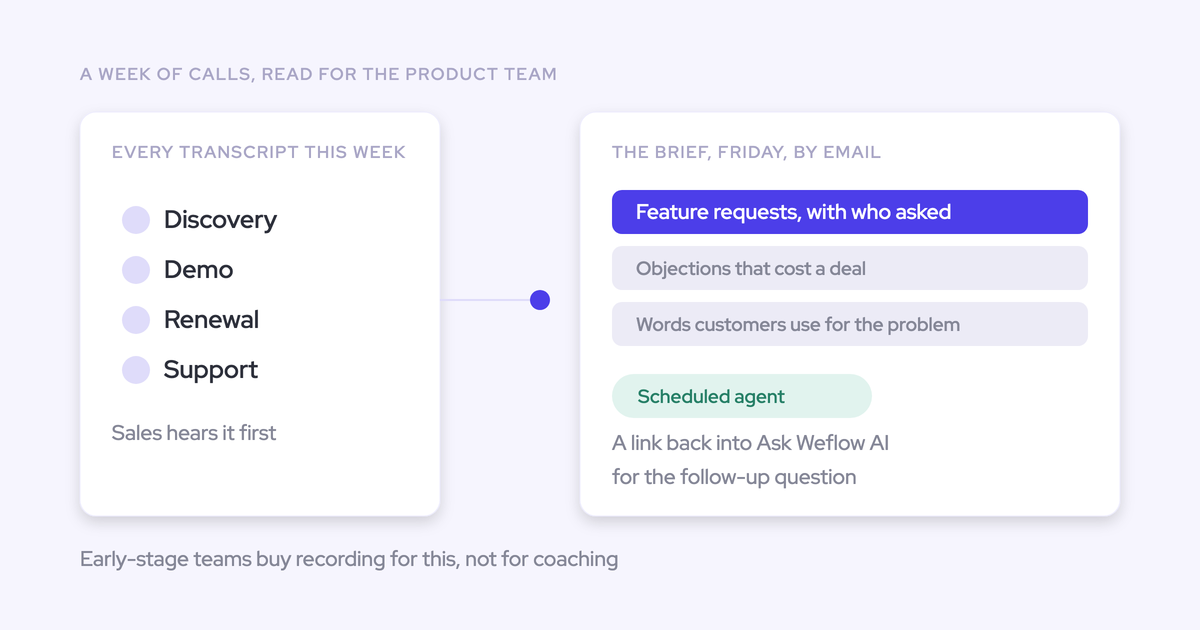
| Executives | Scheduled readouts they didn't have to request, plus the ability to ask their own questions |
| Agents | The defined work: reading records and conversations, writing fields, drafting, delivering |
The orchestration layer will continue to be RevOps and the interaction layer will be chat, whether that's in Slack, in a tool, or in email.
This expands the RevOps role rather than shrinking it. Spans of control widen, a manager starts managing a mix of people and agents, the analyst seat turns into an intelligence seat, and new functions appear around agent operations and go-to-market engineering. What a manager measures changes with it: not just headcount, but consumption and observability.
What orchestration looks like in a RevOps week
In practice it's a small set of recurring, governed plays that push a conclusion to a person instead of publishing a report someone has to open. You design each one once. It runs on schedule after that.
The plays teams actually reuse:
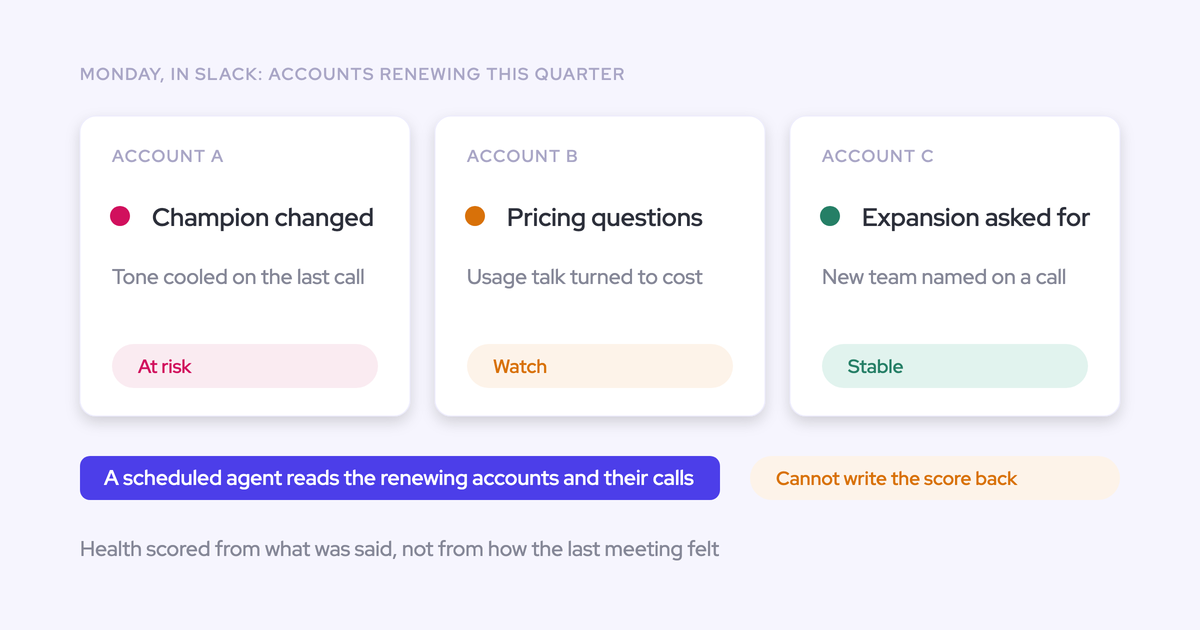
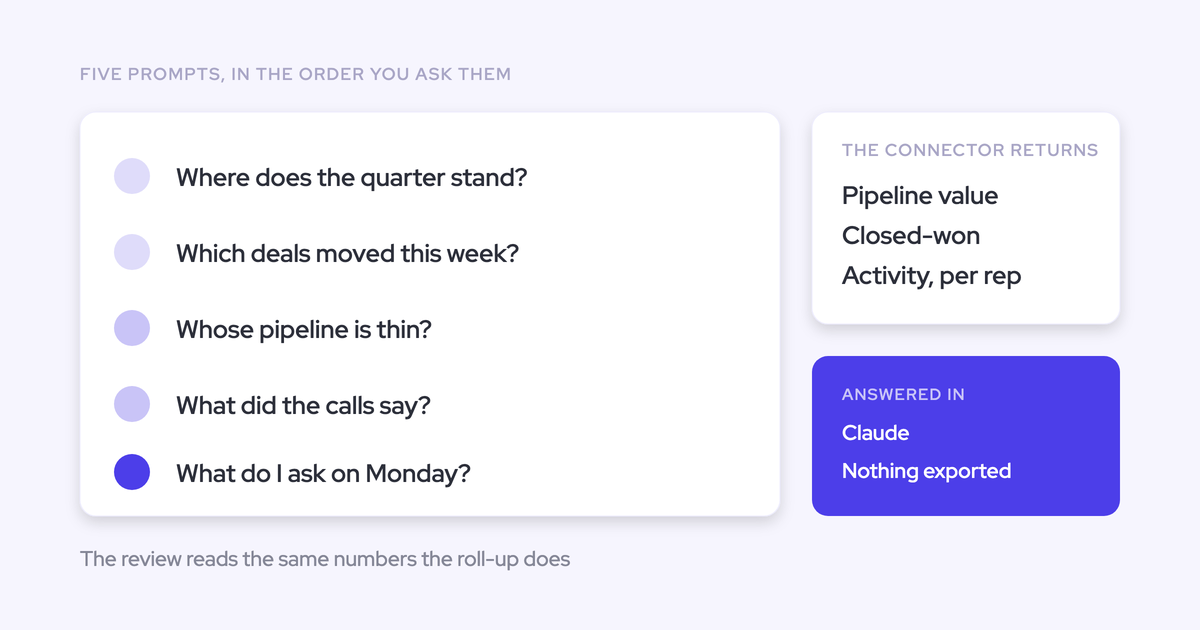
- Monday pipeline pass. Scheduled trigger reads every open opportunity plus the activity and transcripts attached to it, names the deals that need action this week, and pre-writes the follow-up for the owner.
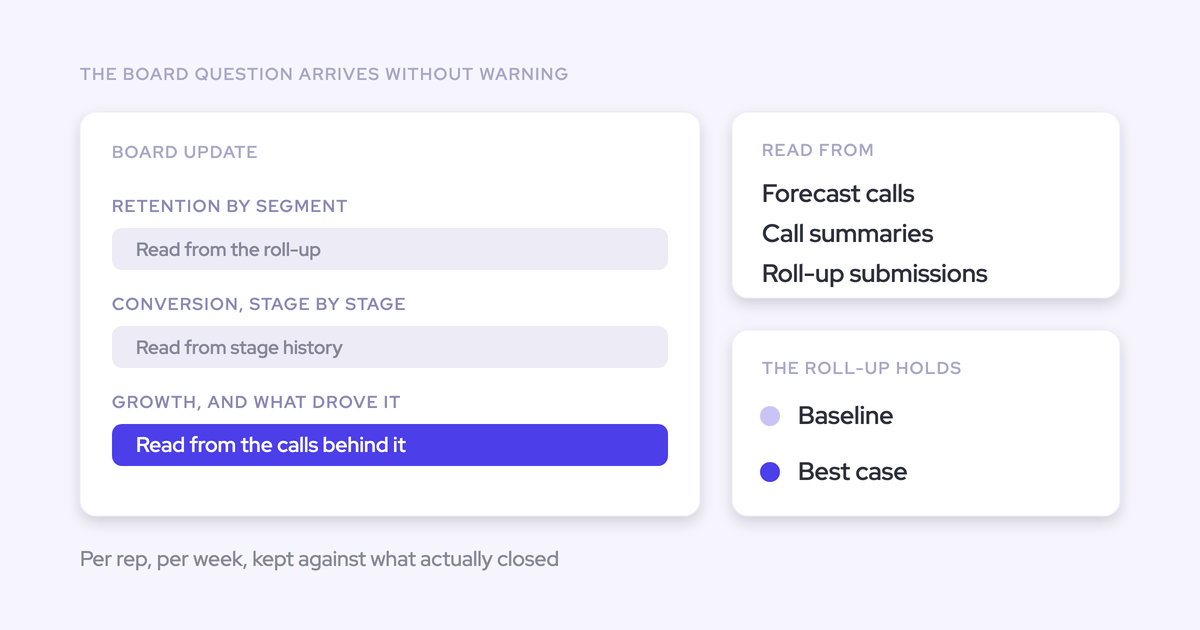
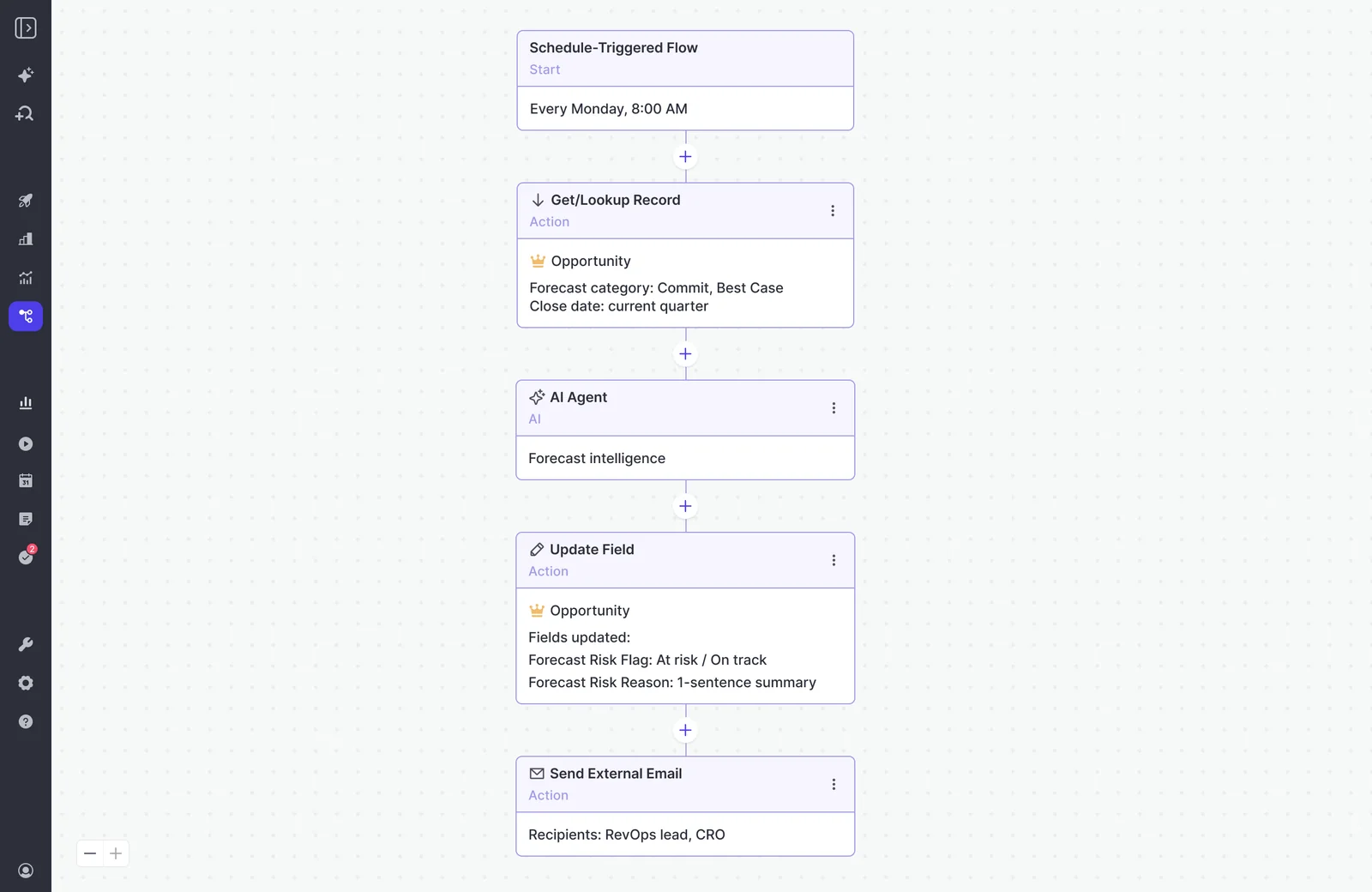
- Weekly risk scan before the forecast call. Reads commit and best case deals for the current quarter, flags each one at risk or on track with a one-line reason, writes the flag to the record, and emails the RevOps lead and the CRO before anyone joins the call.
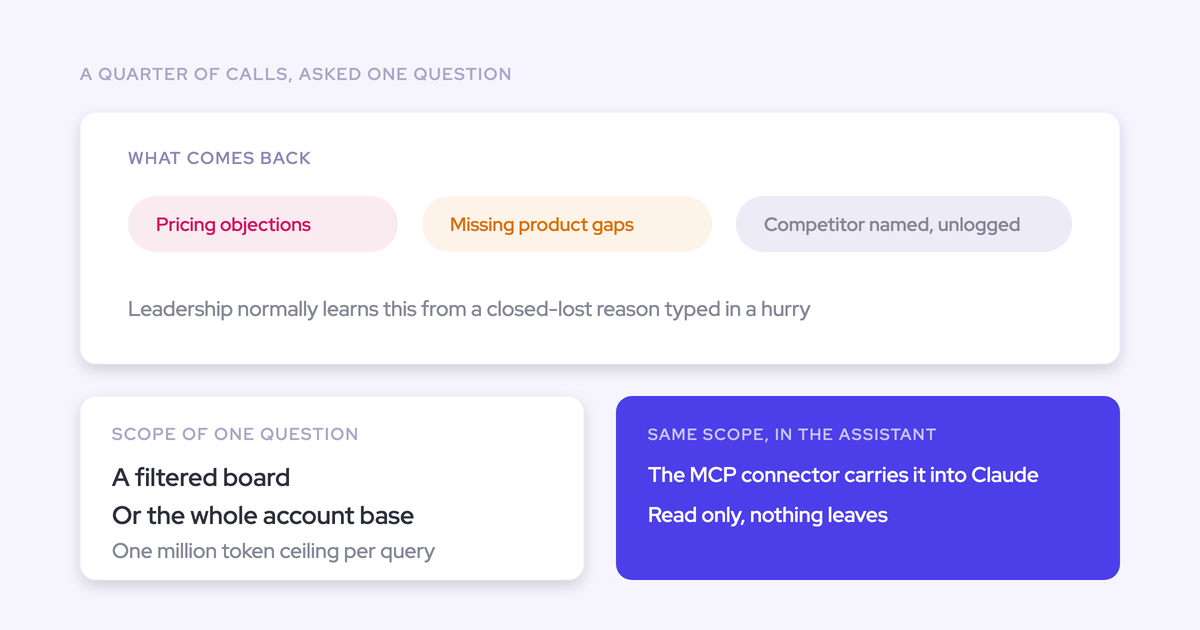
- Monthly closed-lost read. Reads every lost opportunity in the period from the conversations rather than the reason-code dropdown, and returns which competitors showed up and which objections recurred.
- Methodology gap analysis. Reads open deals against your methodology and ranks them by what's missing, using what was said on calls rather than what a rep remembered to type.
- Account handovers. Sales to CS, or rep to rep, with a brief built from the actual email and meeting history on the account instead of a Confluence page written from memory.
Notice what none of these require: a project team, a data warehouse build, or a rep changing their behavior. That's why the model fits a team of one to three. The work is front-loaded design, not daily operation.
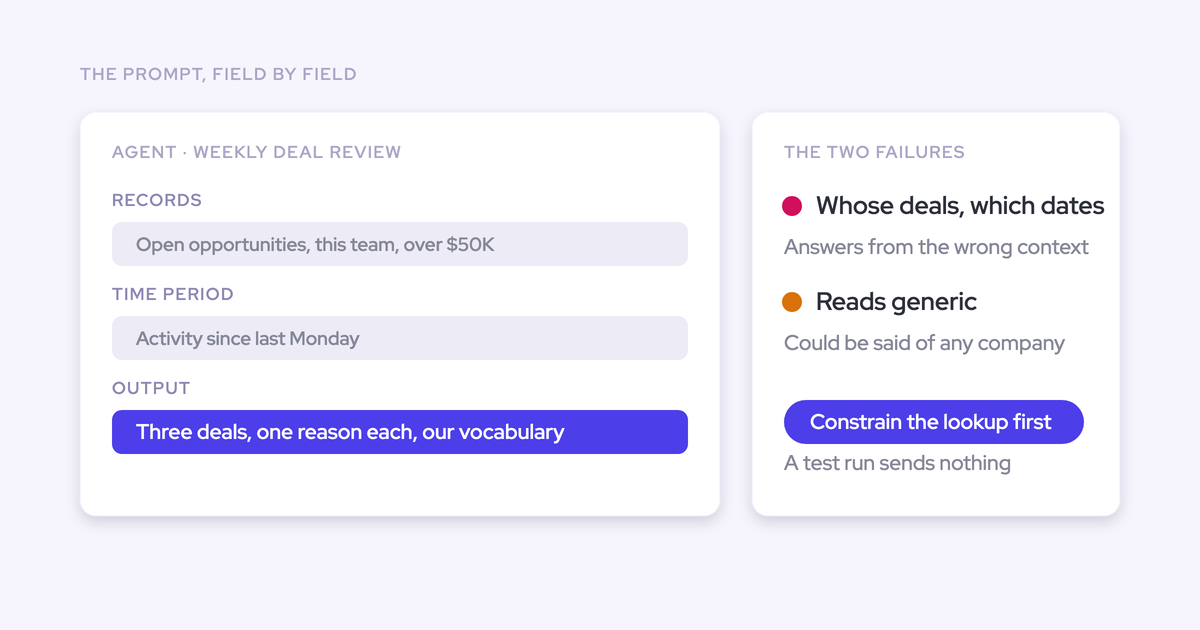
In Weflow, this is Agent Builder: a schedule or record trigger, a Salesforce lookup with field-level filters, an agent step carrying your prompt, and a delivery step that writes a field, sends an email, or posts to Slack.
The RevOps AI maturity scale: where you stand
The RevOps AI maturity scale runs from zero to five, and most teams sit lower than the LinkedIn discourse implies. That's the benchmark you've been missing.
| Stage | Name | What's true at this stage |
|---|---|---|
| 0 | Ad hoc and manual | No defined processes, no prioritization method, the team works on whatever it was asked for |
| 1 | Manual but defined | Intake and sprint cadence are written down. The work is still done by hand |
| 2 | Systematized rigor | Those processes live in a system, with intake and capacity formalized |
| 3 | AI-augmented workflows | AI is used inside the defined processes |
| 4 | Agentic assistance | Agents run parts of the workflow |
| 5 | AI-first autonomous operations | Agents operate independently, with monitoring on top |
Read it as a sequence, not a menu. If your intake isn't written down and your priorities aren't ranked, the honest next step is stage one, not agents. Nobody can automate a process that only exists in people's heads.
And if you jump ahead or jump around, it's like AI without a purpose. Right? And instead of building blocks of creating this incredible AI first operating model in an org, you're kind of just throwing blocks into a pile, and then you're not sure why it's not adding up or it's not driving impact because you're not really building anything. You're just creating a pile.
Two things can be true at once, and for most teams they are: the data foundation isn't ready, and the mandate is real anyway. Sequence beats speed. Moving one stage up this quarter beats a pilot at stage four that quietly dies in month three.
How Weflow supports Revenue AI Orchestration
Weflow implements the three-layer stack for revenue teams that run on Salesforce.
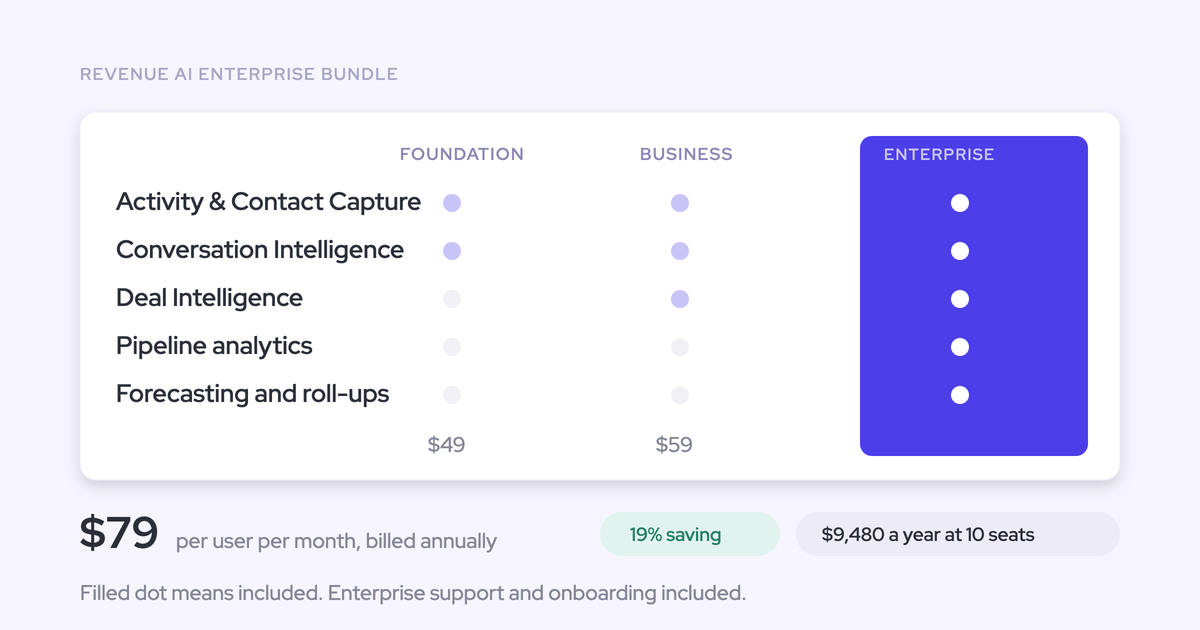
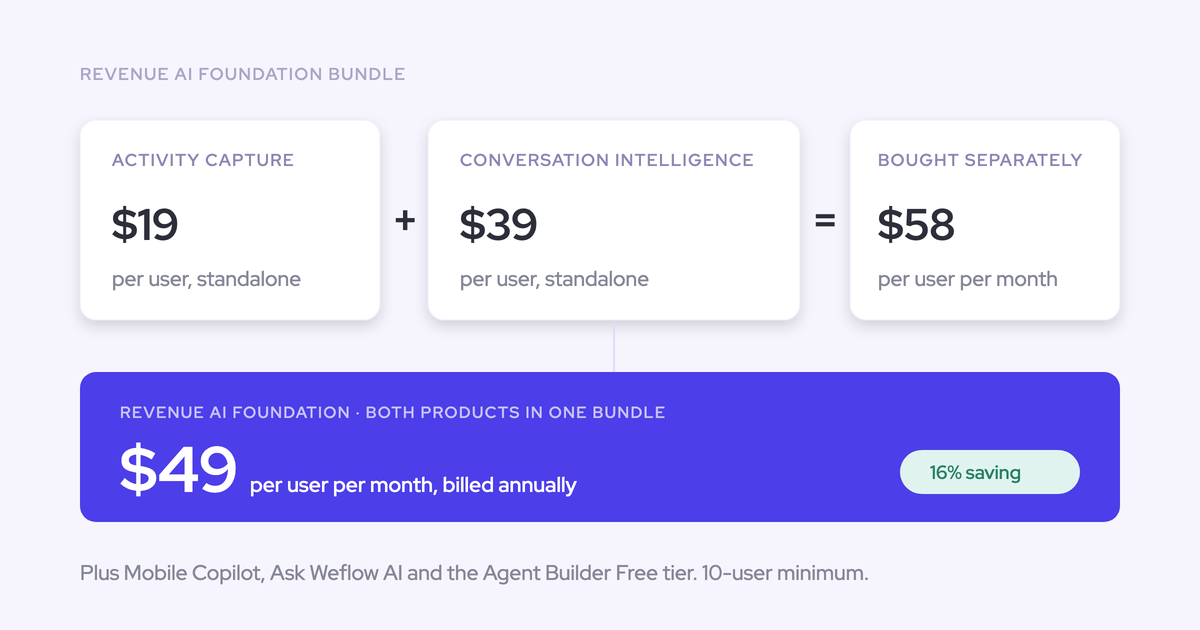
- System of truth: Weflow Activity & Contact Capture syncs emails, meetings, and contacts to the right Salesforce records, and Weflow Conversation Intelligence records and transcribes conversations and writes structured output into the fields you choose.
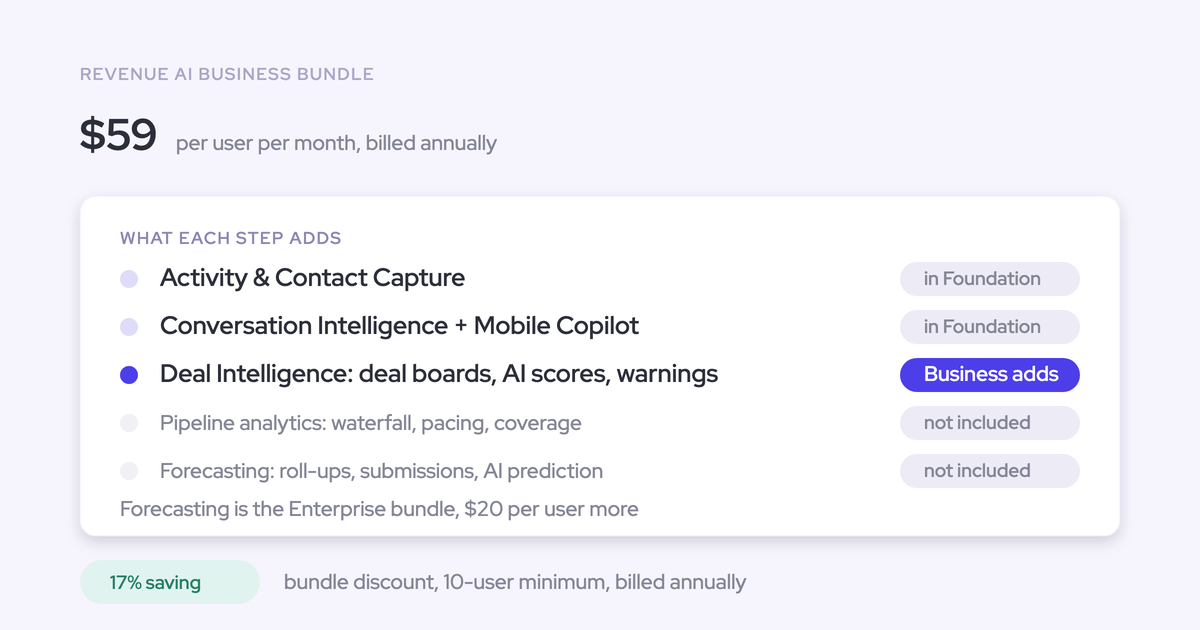
- System of intelligence: Weflow Deal Intelligence & Forecasting adds deal signals, health scoring, warnings, pipeline analytics, and forecast roll-ups on top of that data.
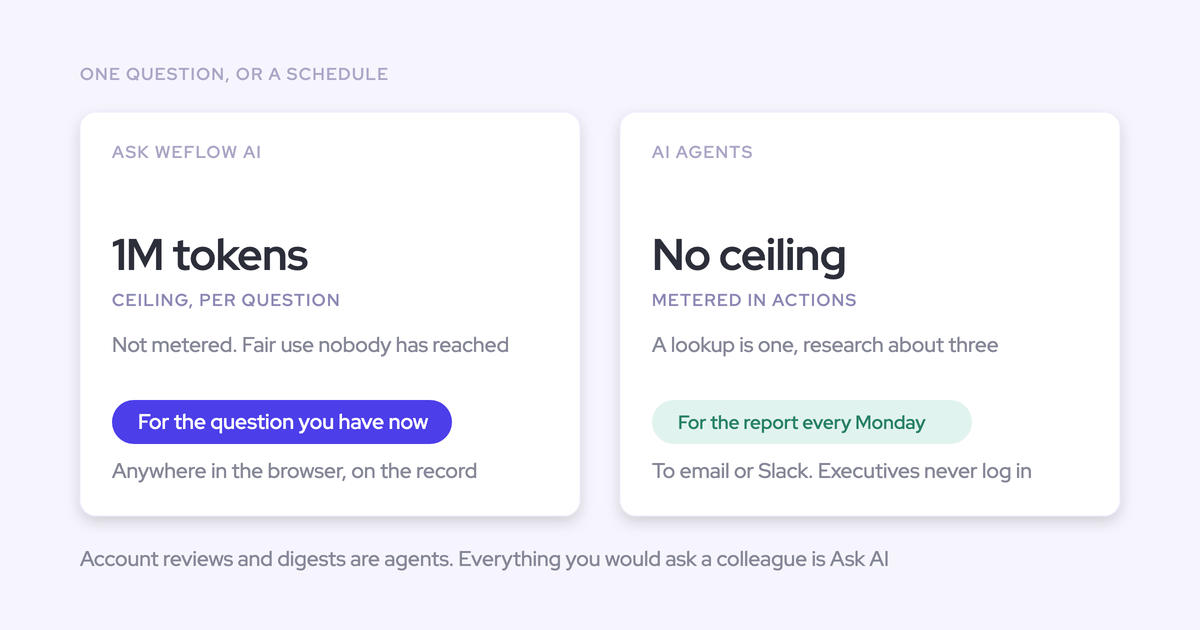
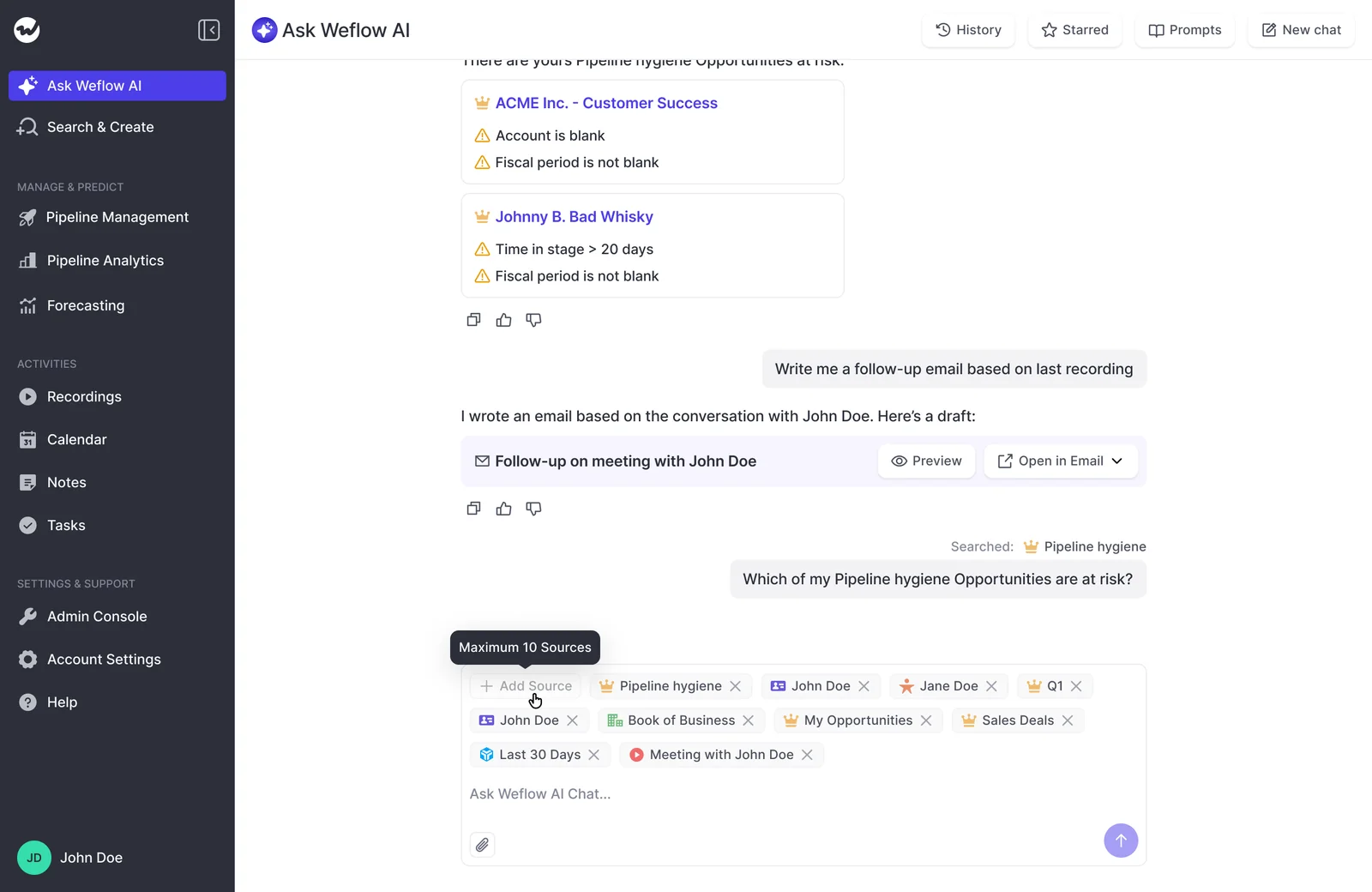
- System of action: Agent Builder runs the scheduled and record-triggered plays, and Ask Weflow AI answers questions across calls, deals, accounts, and pipeline, including from inside a Salesforce record page.
Two structural points matter more than any feature here.
Everything Weflow captures and generates lands in your own native Salesforce objects, so your reporting, your automations, and your agents can read it. And Weflow exposes a public API, so if your company has standardized on Claude or ChatGPT or an agent framework you built yourself, the revenue data is reachable from your orchestration layer, not just from ours. We hear that requirement on almost every enterprise call now: meet people where they already work.
On cost, everything at Weflow is priced per seat except Agent Builder. Ask Weflow AI, AI summaries, and AI field updates are included in the seat, with bundles from $49 per user per month and standalone products from $19, minimum ten users, billed annually. Agent Builder is the one consumption-priced product: a free tier with 25 agent actions per month is included in every plan, then $299 per month for 500 actions and $999 per month for 2,500. That split is deliberate, because an invoice that grows with adoption is what makes teams ration the AI they just bought.
Now the caveat, because this reader deserves it. Agent Builder is our newest product and it is not as mature as capture, conversation intelligence, deal intelligence, and forecasting. The provable value today is the truth and intelligence layers. Data-driven action orchestration isn't fully solved yet, by us or by anyone else, and if a vendor tells you otherwise on a first call, ask them what happens when the data is wrong.
If you want the role itself broken down, grab the free RevOps AI Orchestrator Cheatsheet and keep it next to your planning doc.
Frequently asked questions about Revenue AI Orchestration
How does the orchestration layer coexist with tools we already own?
It sits on the shared data foundation, so the tools you own keep their jobs. Outreach, Salesloft, and Apollo still run the cadences and their activity lands in the same Salesforce records the orchestration layer reads; Weflow doesn't do sequencing or dialing. This is an operating model, not a rip-and-replace, and Weflow's products can be bought individually, so you can start where you have a gap rather than where a suite forces you.
Will AI orchestration costs grow uncontrollably with usage?
It's a legitimate fear, and it's the thing that stalls most rollouts.
Look for a model that keeps daily AI inside predictable seat pricing and confines metering to agent actions, which are the only part that genuinely consumes at scale. That's how Weflow prices it, and it's why nobody has to ration access to the features that drive daily value.
How much RevOps time does an orchestration layer take to run?
The work is front-loaded design and governance, not daily operation. Weflow's technical setup is a single 45 to 60 minute session with your Salesforce admin and mail admin; most of the real time goes into configuration, meaning team structure, methodology, which fields AI should populate, and warning rules. Time to live is typically two to four weeks, or four to six for a large org, and we run onboarding ourselves rather than handing it to a partner, with a managed option where your team mainly unlocks access and answers questions.
Does orchestrating agents replace RevOps roles or expand them?
It expands them. Spans of control widen, managers run a mix of people and agents, the analyst role shifts from producing reports to producing intelligence, and functions like agent operations and go-to-market engineering appear alongside. The bigger change is positional: a function that owns the workflows deciding where a hundred sellers spend Monday morning has resource allocation power it never had as a reporting shop.
What is a go-to-market engineer, and do we need one?
A go-to-market engineer is a RevOps-adjacent hire who combines a solid understanding of how go-to-market engines work with the ability to fold AI into them so the business flows. Useful, but not a prerequisite: the orchestration responsibility sits with RevOps either way, and the role only pays off when it's tied closely to RevOps' funnel context.
And the GTM engineer needs to have that context too. They can't operate in a silo. They have to know how these deals progress down funnel and what the impact is of what they're doing in sourcing pipeline.
If you're deciding what to do next quarter, pick the stage above where you actually are, write down one recurring play you'd trust an agent to run, and check whether the data that play needs is being captured today. That's the whole job, started.