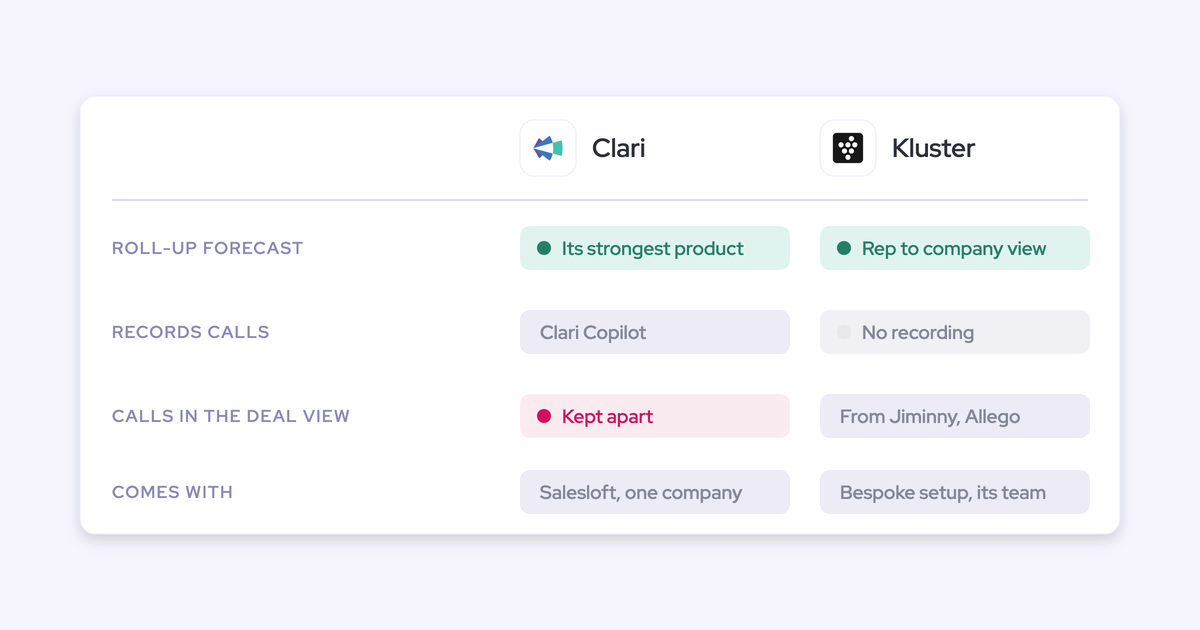
Weflow vs Gong for multilingual sales teams using Salesforce
Decide between Weflow vs Gong for multilingual Salesforce teams, including language auto-detection.


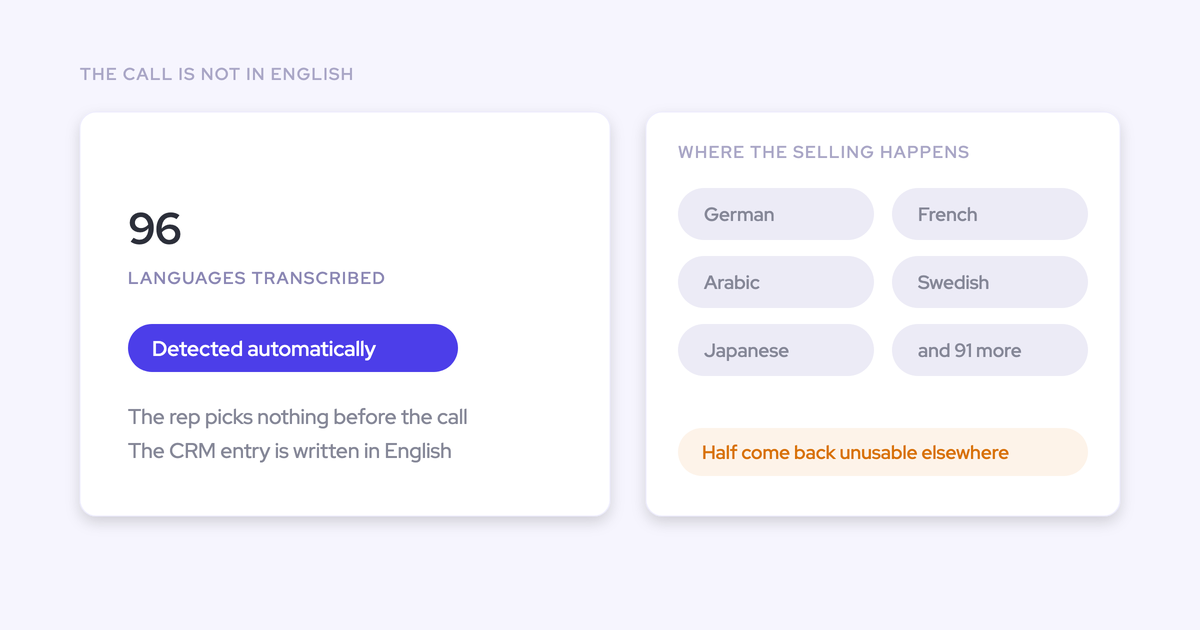

A language count won't tell you whether your managers can trust the output of a sales call. A German transcript can look readable while missing the condition attached to a buying commitment. That mistake then reaches the summary, the coaching score, and the Salesforce record your team uses in the next deal review. You need to test the whole path.
Your requirement is local conversations in, consistent management data out. Customers need follow-ups they can use, while headquarters needs records it can compare across regions. That makes the destination of each output part of the buying decision, alongside transcription accuracy. It's the operational problem behind Weflow Deal Hygiene.
Weflow is the Revenue AI Orchestration platform for sales, customer success, and RevOps teams. For this comparison, our position is direct: choose Weflow when standardized Salesforce output takes priority. Choose Gong when deeper conversation analytics matter more. Both need to prove their multilingual workflows on your calls.
Weflow vs Gong: multilingual comparison at a glance
Weflow and Gong overlap on transcription coverage. The more useful differences sit in output language, Salesforce write-back, analytics, and pricing.
| Requirement | Weflow | Gong |
|---|---|---|
| Language handling | Transcribes 96 languages and detects the spoken language without manual selection. | Supports transcription in 96+ languages. Validate detection behavior on your production calls. |
| Downstream AI | Offers configurable AI templates and methodology scoring at call, opportunity, and rep levels. Test each language separately. | Offers deeper conversation analytics. AI Builder searches English calls by default unless users select a non-English folder or stream. |
| Follow-up language | Generates the follow-up email in the meeting language. | Verify follow-up language behavior and the required application in your evaluation. |
| Salesforce output | Writes summaries in the workspace language and supports structured AI Field Updates. | Inspect the exact destination fields, language controls, and extraction workflow during the trial. |
| Analytics depth | Combines call coaching with deal-level and rep-level methodology scoring. | Stronger fit for advanced conversation review, topic analysis, and enablement workflows. |
| Deployment fit | Works exclusively with Salesforce. Doesn't provide sales engagement or live in-meeting assistance. | Offers conversation intelligence alongside applications such as Gong Engage for sales engagement. |
| Pricing model | Weflow Conversation Intelligence costs $39 per user per month, billed annually, with a 10-user minimum. | Quote-based pricing with Gong Foundation, optional applications, and credits for specified AI usage. |
Why language counts cannot separate Weflow and Gong
Weflow's 96 languages and Gong's 96+ languages don't establish which product handles your regional sales motion better. Neither number proves Swiss German accuracy or consistent analysis of mixed-language calls.
A transcription error can corrupt downstream output. But a readable summary can also conceal an imperfect transcript. Score both against the recording rather than treating either as proof that the other is correct.
| Published language coverage tells you | Workflow testing tells you |
|---|---|
| A vendor supports transcription in a language. | Whether names, amounts, objections, and commitments survive your accents and dialects. |
| A language appears in the supported set. | Whether search, scorecards, and AI prompts retrieve and interpret those calls. |
| The input falls within the advertised scope. | Whether customer-facing and Salesforce-facing outputs use the right languages. |
Which multilingual conversation workflow should buyers compare?
Compare Weflow and Gong from spoken-language detection through Salesforce write-back. A transcript-only trial stops before the work your managers depend on.
- Detect: Identify the spoken language without recurring rep configuration.
- Transcribe: Preserve the facts and meaning of the conversation.
- Follow up: Draft customer communication in the meeting language.
- Analyze: Support coaching, search, trackers, and questions across regions.
- Write back: Produce standardized summaries and structured Salesforce values.
Can conversation intelligence detect language without rep input?
Weflow detects the spoken language automatically. Reps don't need to choose a language before each meeting, which removes one recurring setup task.
Test the normal workflow and the recovery path in both products:
- Start a call without selecting a language.
- Check what happens when the opening language differs from the main conversation.
- Ask the vendor to demonstrate recovery after incorrect detection.
- Count any rep steps needed to correct and regenerate the outputs.
Can multilingual transcription handle dialects, accents, and code-switching?
Neither Weflow's nor Gong's language count proves performance on your dialects. Use recordings your regional managers recognize as representative, including calls they already find difficult to review.
- Include regional dialects, such as Swiss German, rather than testing only standard German.
- Use speakers with different accents within the same language.
- Include calls that switch between English and a local language.
- Check product names, numbers, interruptions, and technical vocabulary.
Have a fluent reviewer verify the buying commitments. A misspelled product name and a reversed budget objection shouldn't carry the same weight.
Do multilingual scorecards, search, and AI analysis work?
Transcription coverage doesn't establish feature-level language support. Gong AI Builder illustrates the distinction: its default search covers English calls unless users explicitly select a non-English folder or stream.
| Capability | Behavior to test | Expected output | Failure signal |
|---|---|---|---|
| Scorecards | Apply the same rubric across languages. | Scores reflect the conversation evidence. | Regional scores change because the system misses qualification details. |
| Search | Find a known non-English call. | The relevant call appears within the intended scope. | The call disappears under default settings. |
| Trackers | Test local phrasing and translated concepts. | The relevant discussion registers. | Only the English wording produces a result. |
| AI prompts | Ask equivalent questions across regions. | Answers preserve meaning and distinguish missing evidence. | The answer sounds confident but contradicts the recording. |
| Deal analysis | Review a deal with calls in several languages. | The analysis includes context from each region. | One language dominates while other calls contribute nothing. |
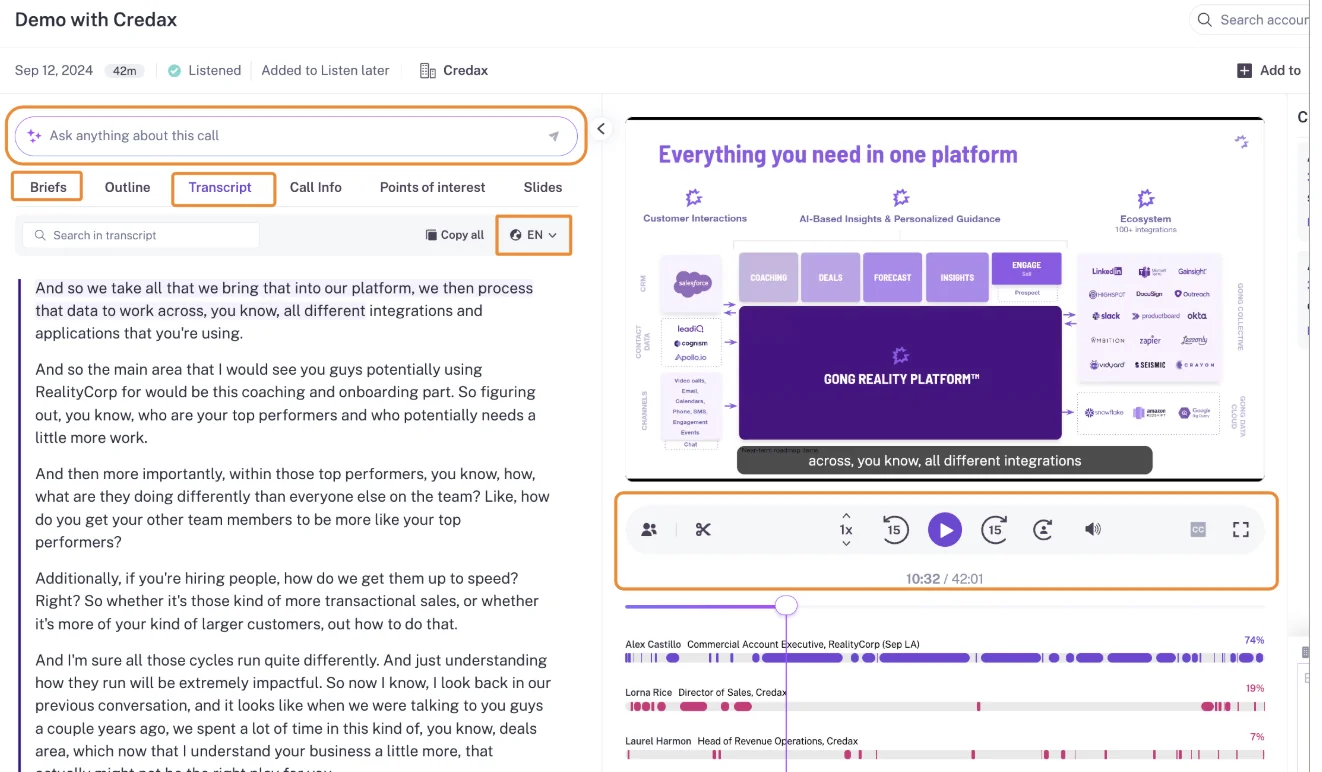
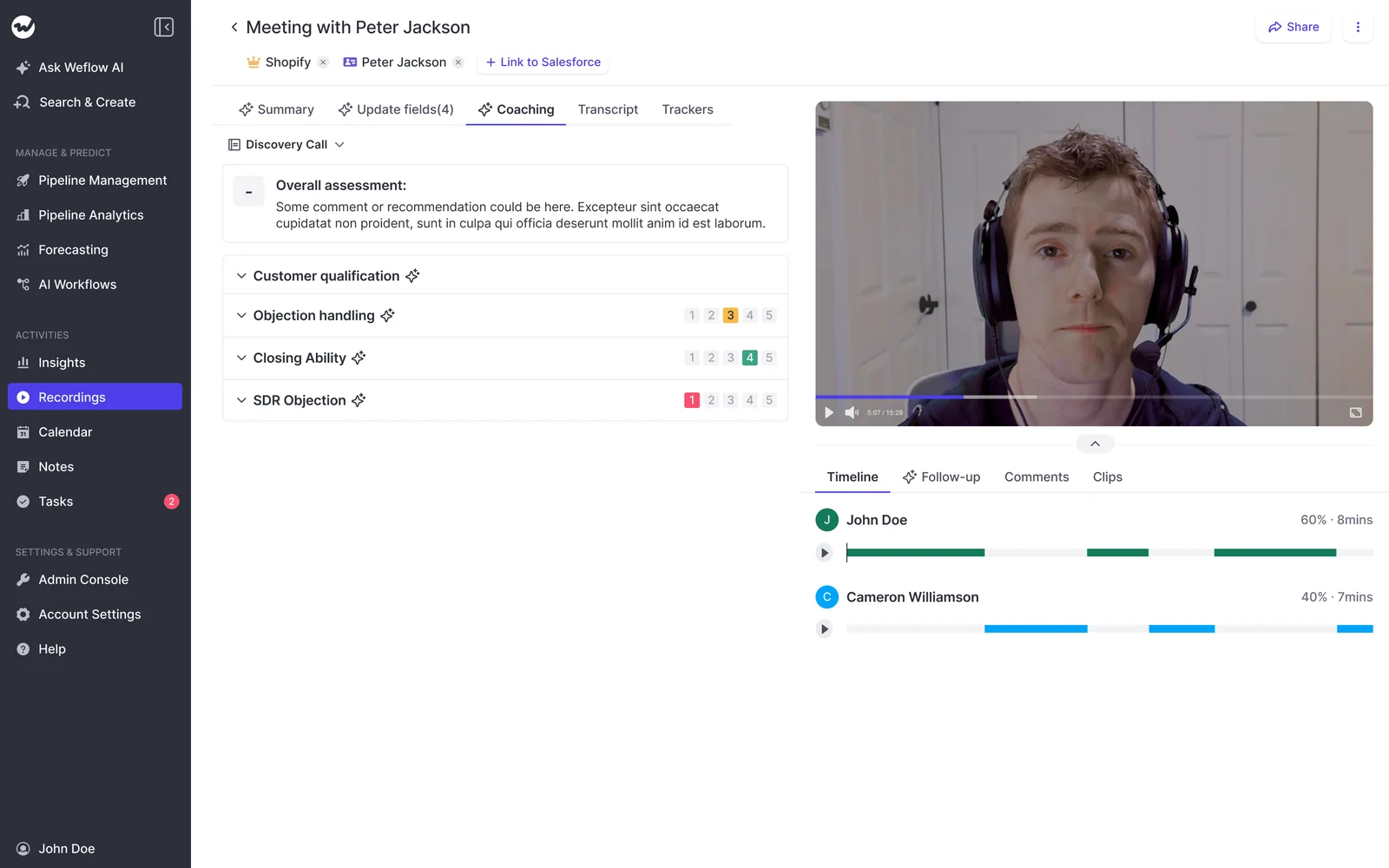
Gong's call view combines transcript access, call questions, and a speaker timeline. Weflow's coaching view combines a configurable scoring rubric with the recording. These screens show different review surfaces, not proof of multilingual accuracy.
Can sales follow-ups stay in the meeting language?
Weflow generates the follow-up email in the language used during the meeting. Your company's internal working language doesn't have to dictate how a rep writes to a customer.
- Input: A sales meeting held in German.
- Customer-facing output: A German follow-up draft.
- Rep check: Confirm the commitments, names, and tone before sending.
For Gong, reproduce this scenario and confirm the required application. Don't infer automatic language routing from the presence of an email-composition feature.
Can Salesforce output stay in one company language?
Weflow writes the Salesforce summary in the workspace language. With an English workspace, a German call produces a German follow-up and an English CRM summary.
| Customer-facing output | Salesforce-facing output |
|---|---|
| Follows the meeting language. | Uses the workspace language for the summary. |
| Supports communication with the customer. | Supports shared understanding in cross-region deal reviews. |
| The seller checks tone and commitments. | The admin and manager verify destination language and field behavior. |
Test structured fields separately from summaries. A workspace-language summary doesn't, by itself, prove that every custom extraction prompt follows your language policy.
Does call output become structured Salesforce data?
Weflow AI Field Updates write conversation-derived values into Salesforce fields. That's the difference between reading a call recap and filtering opportunities by what the customer actually said.
| Transcript archive | Text summary | Structured Salesforce update |
|---|---|---|
| Preserves the conversation for review. | Condenses the conversation into readable notes. | Populates a defined field with an extracted value. |
| A person or another system must interpret the text. | A manager still reads the recap to find the relevant fact. | Reports and automations can use the value directly. |
| Test retrieval and access. | Test factual accuracy and output language. | Test meaning, allowed values, permissions, and validation rules. |
Ask both vendors to update the Salesforce fields your team uses. A polished summary isn't a substitute for demonstrating the write-back.
Where Gong is stronger for multilingual sales teams
Gong is the stronger choice when conversation-analytics depth and its wider application suite outweigh Salesforce-output simplicity. We wouldn't recommend switching a team that depends on those capabilities without testing the replacement workflow first.
Gong offers deeper conversation analytics
Gong's strongest advantage is the depth of its conversation analytics. Give that advantage weight if your managers and enablement team regularly use it.
- Gong's topic track segments recordings into named discussion areas for call review.
- Gong supports methodology summaries across calls on an account, rather than limiting review to individual meetings.
- Gong AI Trainer supports simulated customer conversations and scorecard-based evaluation with an Enable license.
Those are reasons to choose Gong, not evidence that every capability behaves identically across languages. Include the analytics your team actually uses in the multilingual trial.
Gong covers sales engagement workflows Weflow does not
Gong Engage gives buyers a sales engagement application within Gong's suite. Weflow doesn't offer sequencing or sales engagement.
| Workflow requirement | Gong | Weflow | Buyer implication |
|---|---|---|---|
| Conversation intelligence and sales engagement from one vendor | Offers Gong Engage alongside its core product. | Requires a separate engagement provider. | Gong deserves priority if one-vendor coverage is a firm requirement. |
| Keep an existing engagement provider | Evaluate whether Gong Engage adds value to the current stack. | Works alongside providers such as Outreach and Salesloft. | Compare the total stack and capture responsibilities, not just the recording license. |
If replacing Gong means adding a separate engagement product, include that cost and rollout in the decision. Removing one contract doesn't automatically mean reducing work.
Where Weflow fits multilingual Salesforce teams better
Weflow fits teams whose main requirement is turning local conversations into consistent Salesforce records. The advantage combines automatic language detection, destination-specific output, and configurable field write-back.
Weflow automates spoken-language detection
Weflow starts language detection without asking the seller to configure each meeting. Admins can set notetaker defaults, but manual language selection isn't part of the normal rep workflow.
| Rep does | Weflow does |
|---|---|
| Holds the customer conversation without selecting a transcription language. | Detects the spoken language and processes the recording. |
| Reviews the resulting customer communication. | Generates the follow-up in the meeting language. |
Automatic detection doesn't remove recording consent or admission requirements. A recorder waiting outside the meeting can't capture the conversation.
Weflow keeps follow-ups in the meeting language
Weflow separates customer communication from internal reporting language. Sellers don't need to translate the standard follow-up just because headquarters works in English.
- The customer meeting takes place in French.
- Weflow generates a French follow-up draft.
- The seller checks the draft and sends it through their email workflow.
Ask Weflow AI can also produce a summary or follow-up in a specific local language on request.
Weflow standardizes Salesforce output across regions
Weflow writes call summaries to Salesforce in the workspace language, giving regional teams a shared language for deal review. Managers can understand the record without asking the local seller to translate it.
| Fragmented output | Standardized output |
|---|---|
| Each regional summary uses the meeting language. | Salesforce summaries use the workspace language. |
| Managers need local interpretation before reviewing a deal. | Managers read the summary in the company working language. |
| Reps translate notes to satisfy internal requirements. | Weflow separates the follow-up language from the Salesforce summary language. |
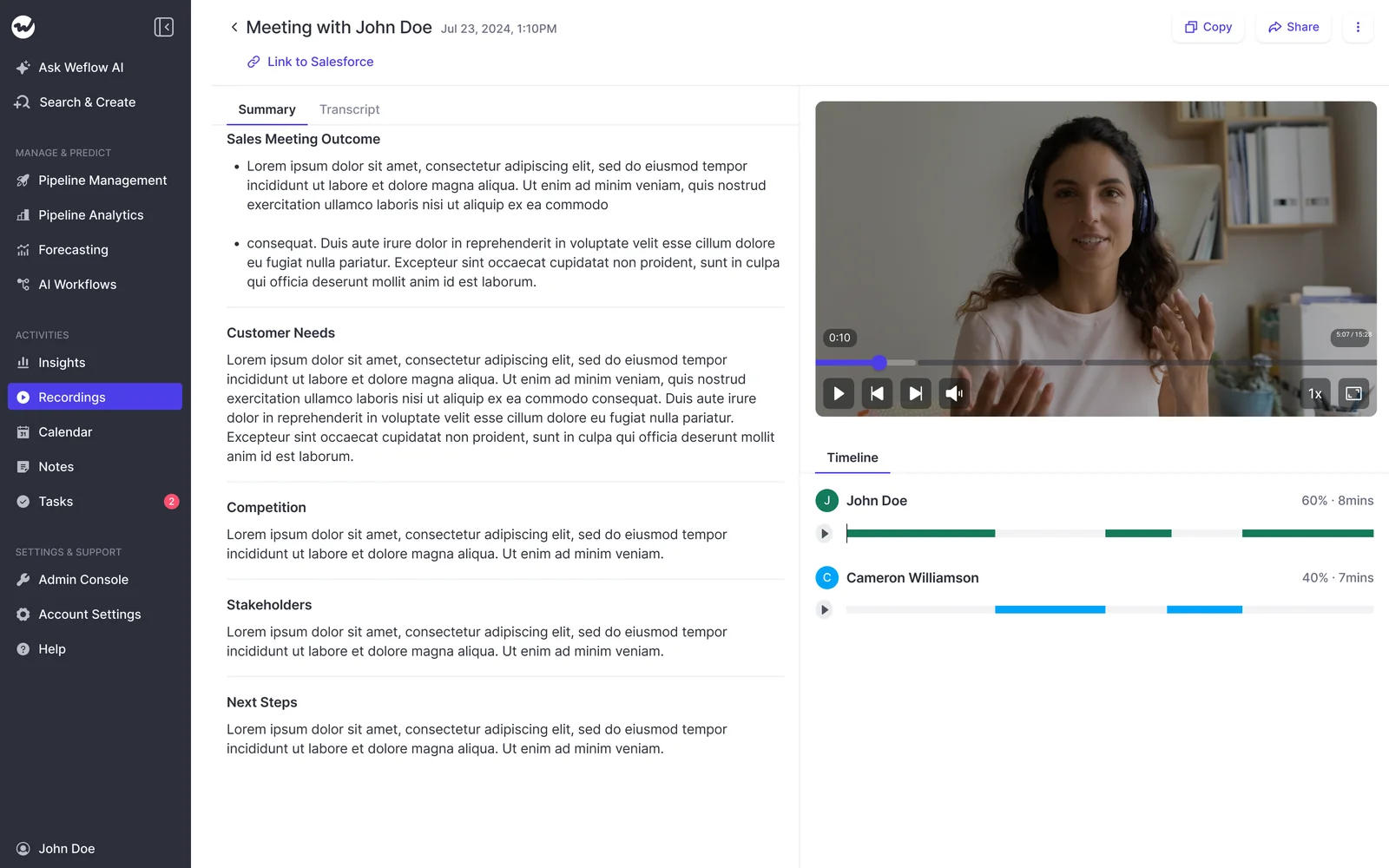
Weflow's post-meeting view organizes the summary into customer needs, competition, stakeholders, and next steps. During your trial, check those sections against the original-language recording.
Weflow AI Field Updates create reportable CRM data
Weflow AI Field Updates extract values from a processed call and write them into Salesforce fields. Admins define what the value means and whether a person reviews it before write-back.
- Define the extraction: Select the destination field and write the prompt, including what doesn't count.
- Review the suggestion: Compare the proposed value with the current Salesforce value.
- Validate the write: Check permissions, dependencies, and Salesforce validation rules.
- Expand automation: Enable automatic updates where the output has earned your trust.
Weflow reads allowed picklist values before writing, so an extraction must match the field's accepted options. Lookup relationship fields aren't supported by AI Field Updates.
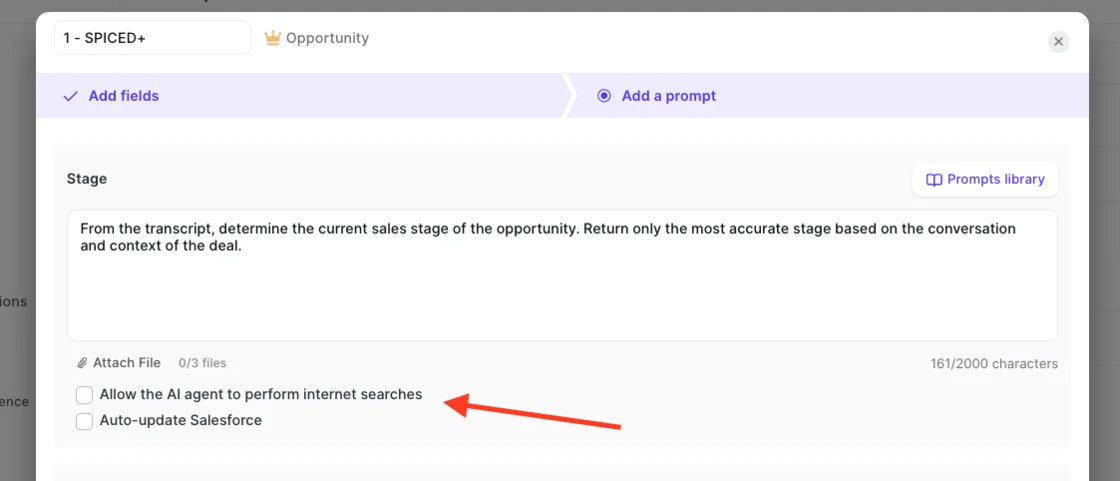
The Weflow prompt editor exposes the Auto-update Salesforce control. Keep interpretive fields, especially Opportunity Stage, under review until you trust the extraction across your regions.
For cumulative qualification, distinguish a single-call update from an AI playbook. Weflow's scheduled playbooks evaluate the broader opportunity record rather than treating the latest call as the whole deal.
How do Weflow and Gong pricing models differ?
Weflow publishes standalone product prices. Gong requires a quote for its core license and applications, with credits governing specified AI workloads.
| Commercial question | Weflow | Gong |
|---|---|---|
| Conversation intelligence seat price | Weflow Conversation Intelligence costs $39 per user per month, billed annually. | Request a quote for the required licenses. |
| Core prerequisite | Available standalone, with no platform fee. | Gong Foundation is mandatory before purchasing applications. |
| Capture plus conversation intelligence | Revenue AI Foundation combines Weflow Activity & Contact Capture and Weflow Conversation Intelligence for $49 per user per month, billed annually. | Confirm the required scope and applications in the quote. |
| AI usage | Recordings, transcripts, AI templates, and Ask Weflow AI prompts have no usage metering. Agent Builder actions have separate allowances. | Specified AI workloads use a company-wide credit pool. Confirm which features and access methods consume credits. |
| Minimum and term | 10 paid users minimum, with annual billing. | Confirm minimum seats, billing terms, and renewal conditions. |
| View-only access | View-only licenses (up to one per recording license) at no additional cost. | Confirm access rights and pricing for non-selling stakeholders. |
| Implementation | No implementation fee. | Confirm who delivers implementation and any separate charges. |
Weflow Agent Builder includes 25 agent actions per month in its Free tier. Higher action allowances use separate workspace pricing. Don't extend the unmetered conversation-intelligence claim to every agent workflow.
Gong's credit treatment also needs precision. For example, manually generating a brief in Gong doesn't consume credits, while generating it through the API or MCP server does. Budget for how your team will access the output.
How to run a multilingual proof of concept
Run Weflow and Gong against the same representative calls and score each output separately. Use the following stages as your trial sequence, with regional managers judging meaning and RevOps checking Salesforce behavior.
Sample languages, accents, dialects, and code-switching
Build the sample around your team's actual call mix, including the cases most likely to fail.
- Language: Include every language that matters to the rollout.
- Region: Represent local dialects and accents within each language.
- Speaker pattern: Include mixed-language meetings and several speakers.
- Call difficulty: Add interruptions, poor audio, technical terminology, and conditional commitments.
Keep a fluent reviewer responsible for each language. An English summary alone can't establish whether the original conversation survived intact.
Test every recording source your team uses
Test the production capture path, not just an uploaded file or one meeting platform. Weflow Conversation Intelligence supports Zoom, Google Meet, Microsoft Teams, and WebEx.
| Source | Regional users | Sample call | Capture owner | Expected destination |
|---|---|---|---|---|
| Supported video meetings | List users by actual meeting platform. | Use a normal customer meeting. | Name the selected recorder. | Recording, summary, and agreed Salesforce fields. |
| Dialer or telephony | Identify teams using each provider. | Use an actual provider recording. | Confirm the provider and any ingestion path. | Verify support before assuming equivalent processing. |
| In-person meetings | Include field sellers where relevant. | Test an in-person conversation. | Test Mobile Copilot for Weflow. | Verify the resulting recording and Salesforce output. |
| Historical imports | Include users who depend on the archive. | Use an export from the incumbent. | Agree the migration owner. | Confirm supported formats, metadata, and processing. |
Check missed recordings separately from transcription errors. Weflow's notetaker joins as a participant and needs admission where the meeting uses a lobby.
Score transcripts and downstream outputs separately
A single accuracy rating hides where the workflow broke. Use the same rating definitions for each output in Weflow and Gong.
A practical trial scale is pass, needs correction, or unsafe to use. These are evaluation labels, not vendor benchmarks.
| Output layer | What the reviewer checks |
|---|---|
| Transcript | Names, amounts, conditions, objections, and speaker meaning. |
| Summary | Correct commitments, missing context, and unsupported conclusions. |
| Follow-up | Language, tone, ownership, and promised next steps. |
| Scorecard | Whether each assessment follows the rubric and recording evidence. |
| Search and AI analysis | Whether known non-English evidence appears and supports the answer. |
| Salesforce fields | Meaning, destination language, allowed values, and successful write-back. |
Watch for plausible but irrelevant extractions. A MEDDIC Metrics field containing company headcount may satisfy the field format while saying nothing about the customer's expected business value.
Verify local follow-ups and standardized Salesforce output
Test both destinations from the same call. For an English Weflow workspace, use an acceptance sheet like this:
| Meeting language | Expected follow-up | Expected Salesforce summary | Actual result |
|---|---|---|---|
| German | German | English | Record the observed language and corrections. |
| French | French | English | Record the observed language and corrections. |
| Arabic | Arabic | English | Record the observed language and corrections. |
| Mixed-language call | Agree the required customer language before testing. | English | Check detection and both outputs explicitly. |
Repeat the test for each structured field that matters to your deal reviews. Summary-language success doesn't excuse inconsistent field output.
Measure corrections, review effort, and rep steps
Measure the human work required to make Weflow's and Gong's outputs usable. A workflow that needs constant translation or correction carries a cost beyond the license.
- Track corrections per call, grouped by language and output layer.
- Measure manager review time and rep editing time.
- Count manual language selections and regeneration steps.
- Record failed writes, duplicate activities, and incorrect record associations.
- Separate unsupported assertions from harmless wording changes.
Set pass/fail thresholds before the trial. Treat unsupported changes to commercial commitments or Opportunity Stage as blockers, and agree how much routine editing your team will accept.
What must you validate before switching from Gong?
Validate historical access and workflow continuity before signing a replacement contract. A multilingual trial can succeed while the migration still disrupts marketing, customer success, or Salesforce reporting.
Plan for historical recordings and transcript consumers
Inventory who uses Gong's archive and how they reach it. Recording volume alone doesn't define the migration scope.
| Consumer | Data dependency | What to preserve |
|---|---|---|
| Sales and enablement | Recordings, clips, coaching examples, and scorecards. | Required history, access permissions, and usable review paths. |
| Marketing and product | Customer language, objections, and feature requests. | Searchable source material and the context behind extracted insights. |
| Customer success | Promises, implementation context, and renewal discussions. | Account associations and access to relevant conversations. |
| RevOps and IT | Exports, APIs, CRM fields, and external assistants. | Working interfaces, metadata, retention, and access controls. |
Gong's MCP server returns AI-generated insights rather than raw transcripts. Don't assume an existing assistant connection provides an archive-export route.
Scope historical ingestion directly with Weflow. Confirm supported files, metadata, reprocessing, and costs before treating the migration as included.
Prevent duplicate meetings and broken Salesforce workflows
Assign one owner to each capture and write-back responsibility before Weflow and Gong overlap. Recording a meeting shouldn't make Salesforce count it twice.
- Before cutover: Inventory record types, field mappings, reports, automations, permissions, and capture owners.
- During overlap: Check meeting duplication, participant matching, account associations, and opportunity links.
- After cutover: Reconcile activity totals, test dependent automations, and verify historical access before disabling the incumbent.
Test account ambiguity deliberately. Weflow's activity mapping uses open opportunities and contact roles; unresolved cases fall back to the account. An admin should recognize that outcome rather than mistake it for missing data.
For groups with several mail tenants, validate the rollout with Weflow before committing. Don't assume one administrative setup covers every acquired entity.
Choose Weflow or Gong based on workflow priority
Choose Weflow for standardized Salesforce output and Gong for deeper conversation analytics, provided the chosen workflow passes your regional tests.
| Choose Weflow if | Choose Gong if |
|---|---|
| Your Salesforce record is the primary destination for conversation outcomes. | Your managers depend on Gong's deeper conversation-review workflows. |
| You need local-language follow-ups alongside workspace-language CRM summaries. | Your tested Gong configuration meets the required language behavior across its applications. |
| You want configurable field extraction and unmetered conversation-intelligence usage. | You accept the required applications and credit model for the analytics you use. |
| You already have, or don't need, a separate sales engagement provider. | Keeping conversation intelligence and sales engagement with one vendor matters. |
Choose Weflow for standardized Salesforce output
Weflow fits multilingual teams that want customer conversations to become usable Salesforce data without repeated translation or manual entry.
- Your organization runs on Salesforce and wants summaries in one workspace language.
- Your reps need follow-ups in the language of the meeting.
- Your admins want defined extraction prompts, field mappings, and review controls.
The trade-off is clear: Weflow doesn't match Gong's analytics depth, offer sales engagement, or provide live in-meeting assistance.
Choose Gong for deeper conversation analytics
Gong fits teams whose daily management and enablement workflows depend on its conversation-analytics depth.
- Your team uses advanced call analysis enough to justify the required licenses.
- Your multilingual trial confirms the behavior of each relevant AI feature.
- Your purchase favors Gong's wider suite over a separate engagement provider.
The trade-off is accepting the configuration, application costs, and metered AI paths your workflow requires. Settle those details with the same care as transcription quality.
See how Weflow captures activity, updates Salesforce fields from calls, and rolls up your forecast. Book a 30-minute demo.
Frequently asked questions
Weflow documents automatic language detection and destination-specific summaries, but dialect accuracy, code-switching, and migration still need validation against your team's requirements.
Does Weflow require reps to select a language?
No. Weflow detects the spoken language automatically, so reps don't need to select a language for each meeting.
Admins can configure notetaker defaults. The workspace language governs the Salesforce summary, which is a separate setting from the language spoken on the call.
How should teams test Swiss German and regional dialects?
Test Weflow and Gong with representative dialect recordings and a fluent reviewer. Standard German support doesn't establish Swiss German accuracy.
- Use calls from the regions and speakers included in the rollout.
- Check names, amounts, negations, and buying commitments against the audio.
- Score the summary and Salesforce updates separately from the transcript.
- Measure correction time before deciding the workflow is ready.
Can Weflow handle code-switching within one meeting?
Test this in your proof of concept. Weflow's automatic detection and 96-language coverage don't establish reliable handling of every language combination within a single meeting.
Use a call that opens in English and moves into a local language. Check whether the transcript preserves both parts and whether the follow-up uses the intended customer language.
Does Gong AI Builder search non-English calls automatically?
No, not under its default scope. Gong AI Builder searches English calls unless the user explicitly selects a folder or stream in another language.
Run the same request with the default scope and then with a known non-English folder. That separates a retrieval-default problem from missing conversation evidence.
Can managers review Weflow AI Field Updates before write-back?
Yes. Weflow supports manual review of AI-suggested values alongside current Salesforce values, as well as automatic updates.
- Suggest: Start interpretive fields in review mode.
- Review: Correct outputs and refine prompts across representative languages.
- Automate selectively: Enable automatic write-back where results justify it, while retaining review for consequential fields.
Which meeting platforms does Weflow Conversation Intelligence support?
Weflow Conversation Intelligence supports Zoom, Google Meet, Microsoft Teams, and WebEx. Test your actual organizer, lobby, consent, and tenant settings rather than relying on a meeting-platform logo.
Does Weflow provide live in-meeting assistance?
No. Weflow doesn't provide a live in-meeting assistant or real-time battlecards triggered by objections or competitor mentions.
Weflow produces summaries, field updates, follow-ups, and coaching output after processing the recording. If live assistance is mandatory, Weflow doesn't meet that requirement.
How should global teams handle GDPR and recording consent?
Run legal review alongside technical testing. Weflow's GDPR compliance doesn't replace your organization's responsibility to establish an appropriate recording policy. This isn't legal advice.
- Policy: Have counsel approve recording rules for the relevant jurisdictions and meeting types.
- Notice: Verify attendee notification, consent, and opt-out behavior.
- Platform: Test each meeting service rather than assuming the same consent mechanics everywhere.
- Storage: Confirm recording, transcript, and processing locations separately, along with retention and deletion.
- Access: Test permissions for recordings, Salesforce summaries, exports, and AI-generated assessments.
Weflow holds SOC 2 Type II certification, supports GDPR compliance, uses Zero Data Retention for AI processing, and doesn't use customer data to train AI models. Zero Data Retention for AI processing doesn't mean Weflow never stores recordings.
What happens to historical Gong recordings when switching?
Switching to Weflow doesn't automatically establish an import path for your Gong history. Agree on exports, destination storage, and continued access before ending the incumbent contract.
Gong keeps recordings and related artifacts for up to three years by default, while calls in its library are exempt from that retention schedule. Those policies don't guarantee access after cancellation.
- Confirm which recordings, transcripts, and metadata you can export and under what terms.
- Identify library content and any history your team must preserve.
- Agree with Weflow on supported ingestion, processing, ownership, and costs.
- Prove that the required users and systems can access the migrated material before canceling Gong.