Clari vs Kluster: Enterprise Forecasting Compared (2026)
Decide if Clari or Kluster fits enterprise forecasting: roll-ups, renewals, expansion, and more.


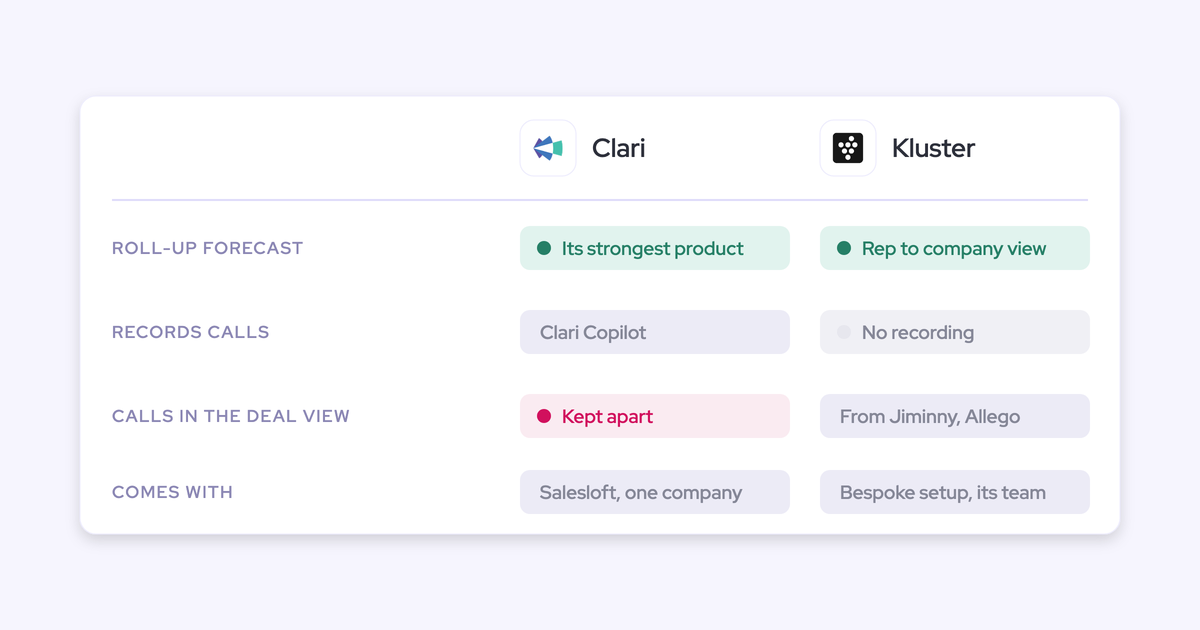

Clari and Kluster answer different forecast questions. Clari runs the sales roll-up: commit and best case, rep to CRO, in a fast top-down view. Kluster builds a finance-owned revenue model, with recognized revenue, scenarios and frozen board packs, and its own forecasting team builds it for you.
If your Clari renewal has turned into an audit, "which tool does more" won't settle it. Ask which argument your board is actually having, bookings or recognized revenue, and what your team will still open twelve months from now.
Some teams land on a third answer: the sales call, deal by deal, with call and activity data underneath, at a price that matches what they use. For those teams, Weflow Deal Intelligence & Forecasting belongs on the shortlist. Weflow is the Revenue AI Orchestration platform for sales, customer success, and RevOps teams, built for Salesforce teams.
How Clari, Kluster and Weflow compare on ten forecasting capabilities
The three tools all roll up a call. Where they differ most is what feeds the forecast and who configures it.
| Capability | Weflow | Clari (Salesloft) | Kluster |
|---|---|---|---|
| Forecast submissions and roll-ups | Baseline and best case tied to named deals, an independent manager call, and logged overrides. Submission is web app only. | Fast top-down view and Quick Submit. A call is a number with notes, and leaders see only the level below them. | Rolls every rep, team and region into one company view and tracks each rep's submissions week by week. |
| AI forecast prediction | Low, middle and high range, ready 48 to 72 hours after the history import. Needs six months of history. | AI Forecast covers current-quarter new business and needs four quarters with 50+ closed deals each. RevOps teams report 12 to 18 months before it's useful. | Blends deal-based, stage-based, pacing and AI methods with rep judgment. |
| Multiple forecast types | Parallel setups for new business, renewal and expansion, each with its own amount field, date field, targets and model. No consumption forecasting. | Segments for new business, renewals and upsells, plus account-based forecasting with a Pace number for existing-customer revenue. | Separates new business, renewals, upsells and downgrades, and forecasts recognized revenue, including usage-based contracts. |
| Opportunity snapshots | Automatic snapshots every few hours, plus a 12-month Salesforce history import. | Time Series Data Hub snapshots opportunity, account and activity data. | Snapshots the pipeline for conversion reporting. Frequency isn't documented. |
| Pipeline waterfall | Created, increased, pulled in, pushed out, lost, decreased and won, with every bar drilling to its deals. No flow view. | Weekly, monthly or quarterly waterfall grouped by any CRM field, plus Salesloft's Deals Flow Chart. | Shows what closed, was pushed or dropped from starting pipeline. No documented any-two-dates waterfall with the deals behind each bar. |
| Forecasting setup and rollout | Free onboarding run by Weflow. After that, your admin owns every change. | Admins can now build forecasts, but quotas are entered twice and changed through file uploads. | Kluster's forecasting experts build every deployment, with a set-up fee. |
| Integrations | Salesforce, Gmail, Outlook, Google Calendar, Zoom, Teams, Meet, Webex, Slack and the Outreach dialer. Salesforce only. | Salesloft's data layer covers Salesforce, Dynamics, Snowflake, Databricks, Gmail and more. Deals and Forecast run on Salesforce only. | Reads from Salesforce or HubSpot, syncs Gmail, imports calls from Jiminny and Allego. |
| Access from AI assistants (MCP) | Read-only connector with forecast calls beside live pipeline and the gap between them, plus per-rep metrics, summaries and transcripts. | Clari Forecast MCP server with live forecast data and snapshots, plus a Copilot MCP server for call data. | Free Claude connector over a data layer Kluster maps in a 30-minute call. |
| Raw data access | REST API bulk-exports transcripts, metadata, scores and signals as JSON or CSV. No native warehouse connector. | Forecast history exports as CSV, and Salesloft syncs to Snowflake and Databricks. | Scheduled bulk delivery to your warehouse. No documented public API. |
| Pricing | Published: $39 per user per month for Deal Intelligence & Forecasting, $79 for the Revenue AI Enterprise bundle. | Quote-only through Salesloft, with forecasting sold as an add-on. | Quote-only on its site, priced per Sales Account plus a set-up fee. |
The tool sections below follow the same order. Pricing gets its own section after them.
Why a Clari renewal puts Kluster on the shortlist
The renewal makes you re-run the forecasting decision, and Kluster is the obvious enterprise alternative. It sells to the same CRO and CFO at PE-backed and listed companies, and it competes with Clari head-on.
We hear the same story on calls. Two years in, the team uses three things: the roll-up, a simple pipeline view and deal inspection. One buyer put it like this:
We mostly use Clari for roll-ups, simple pipeline analytics, and to inspect and the price point for that is crazy high.
The triggers behind the review tend to stack up:
- Usage is lower than the invoice assumes. In one account we spoke with, Clari license usage sat at about 8%, and a batch of reps had never synced their calendar.
- Support got worse after the merger. Buyers tell us the account management and CS model changed, and the instance went stale without anyone keeping it current.
- The board forecast lives somewhere else. Teams export the worldwide consolidation into Tableau every cycle because the forecast views aren't what they present to the CFO and CEO.
- The core is good, but the roadmap isn't moving. Most buyers like the roll-up. What they doubt is that it will do more, and they're paying a premium for a few views.
Some of you come from the other direction. You're already on Kluster, RevOps wants to consolidate, and forecasting usage is thin:
Forecasting usage is not really happening at all if I'm honest.
Which forecast question is your board actually asking?
Pick the tool built for the argument your board is having. Clari answers "what will sales book, and is the call honest?" Kluster answers "what revenue will we recognize, and what does the board pack say?"
| The question in the boardroom | The tool built for it |
|---|---|
| Is the sales call honest, and what will we book this quarter? | Clari: a mature top-down roll-up of commit and best case |
| What revenue will we recognize this year, and what goes in the board pack? | Kluster: a finance-owned model from pipeline to bookings to recognized revenue |
| Is the sales call honest, and does what was said on calls back it up? | Weflow: the sales roll-up fed by captured activity and conversation data |
Kluster's pitch lands when the board fights about revenue run rate rather than bookings. One RevOps leader described exactly that:
But right now people are wrapped around the axle on the revenue and are we hitting the revenue number for the total year, versus what does it take to get there from a bookings perspective.
If that's your boardroom, Kluster is answering your question. If your board asks whether the sales number will land, Kluster answers a question nobody's asking. In that case you're choosing between Clari's roll-up and a roll-up that also reads the conversation, which is where Weflow fits.
How Weflow Deal Intelligence & Forecasting runs the sales forecast
Weflow is built for mid-market B2B revenue teams that run on Salesforce, and it scales to enterprise. Forecasting is one module on a platform that also captures activity and conversations, and that turns out to matter later in this comparison.
Reps tie every Weflow forecast call to named deals
Each rep submits two numbers, a baseline and a best case, and selects the opportunities behind each one. Weflow keeps every version. You can see whether a rep's call moved during the quarter or never moved at all.
Managers submit their own call beside the reps' calls instead of replacing them, and they can build it from deals their team owns. Every override carries a timestamp, the name of whoever made it, and the reason.
- The rep submits a baseline and best case and picks the deals behind each.
- The manager submits an independent team call, deal by deal.
- Any override is logged with who made it and why.
- The calls roll up to the VP and CRO, and the rep call, manager call and override stay visible side by side.
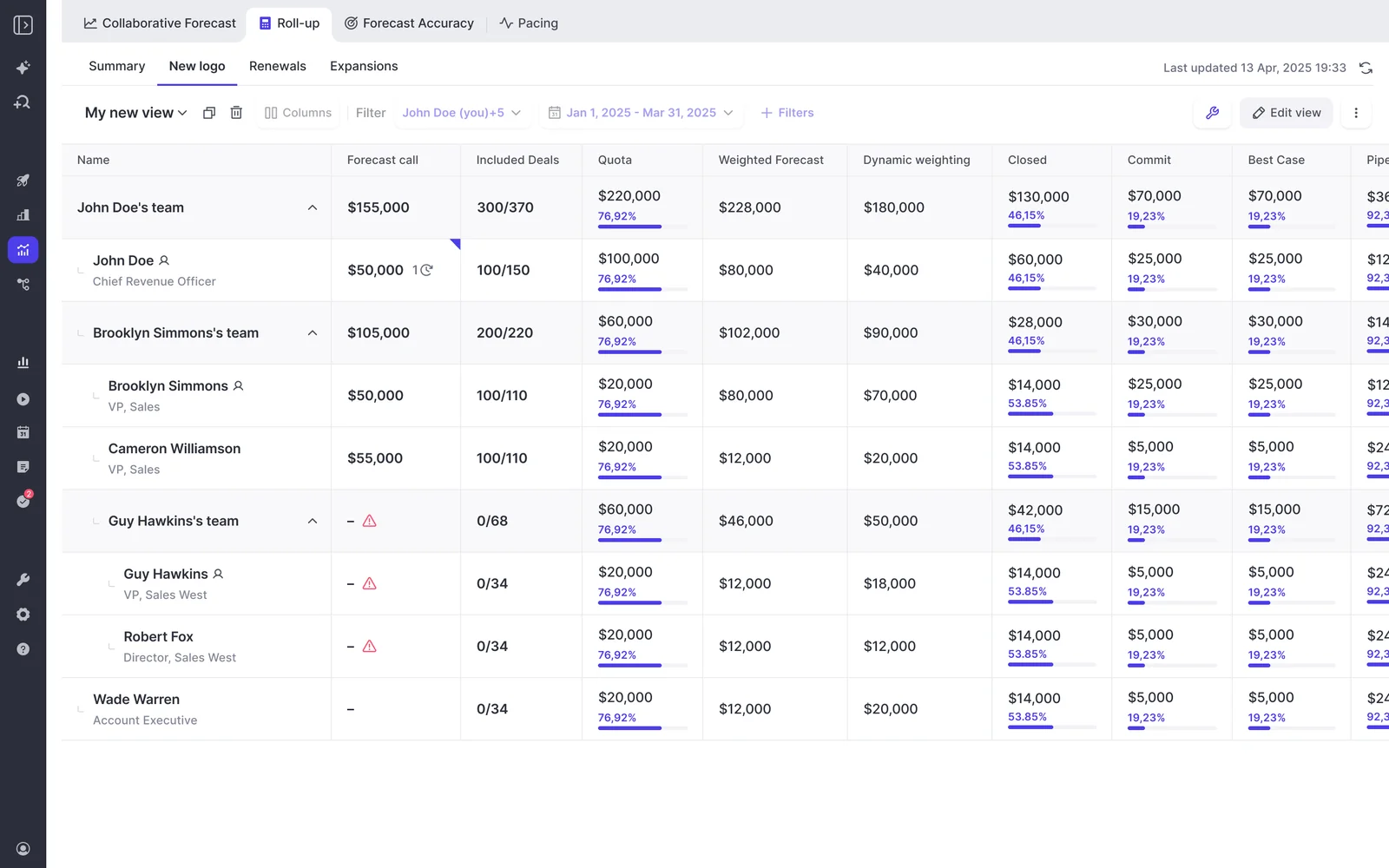
Two limits apply here:
- Submission happens in the web app only. Weflow emails a reminder when a forecast is due, but nobody can send a number from their phone.
- Submissions aren't written to a Salesforce field. They live in Weflow and are reachable over the MCP connector.
Weflow's AI projection goes live days after the history import
Weflow's AI projection is ready within 48 to 72 hours of the historical import and returns a low, middle and high range. It needs at least six months of opportunity history and works from up to two years of it.
Weflow builds a separate model for each forecast configuration, so new logo and renewal are projected from their own history. The model reads more than fifty deal signals and refreshes nightly. On the pacing chart, the projection sits beside the weighted forecast and the team's roll-up, and the gap between the three becomes the agenda for your forecast call.
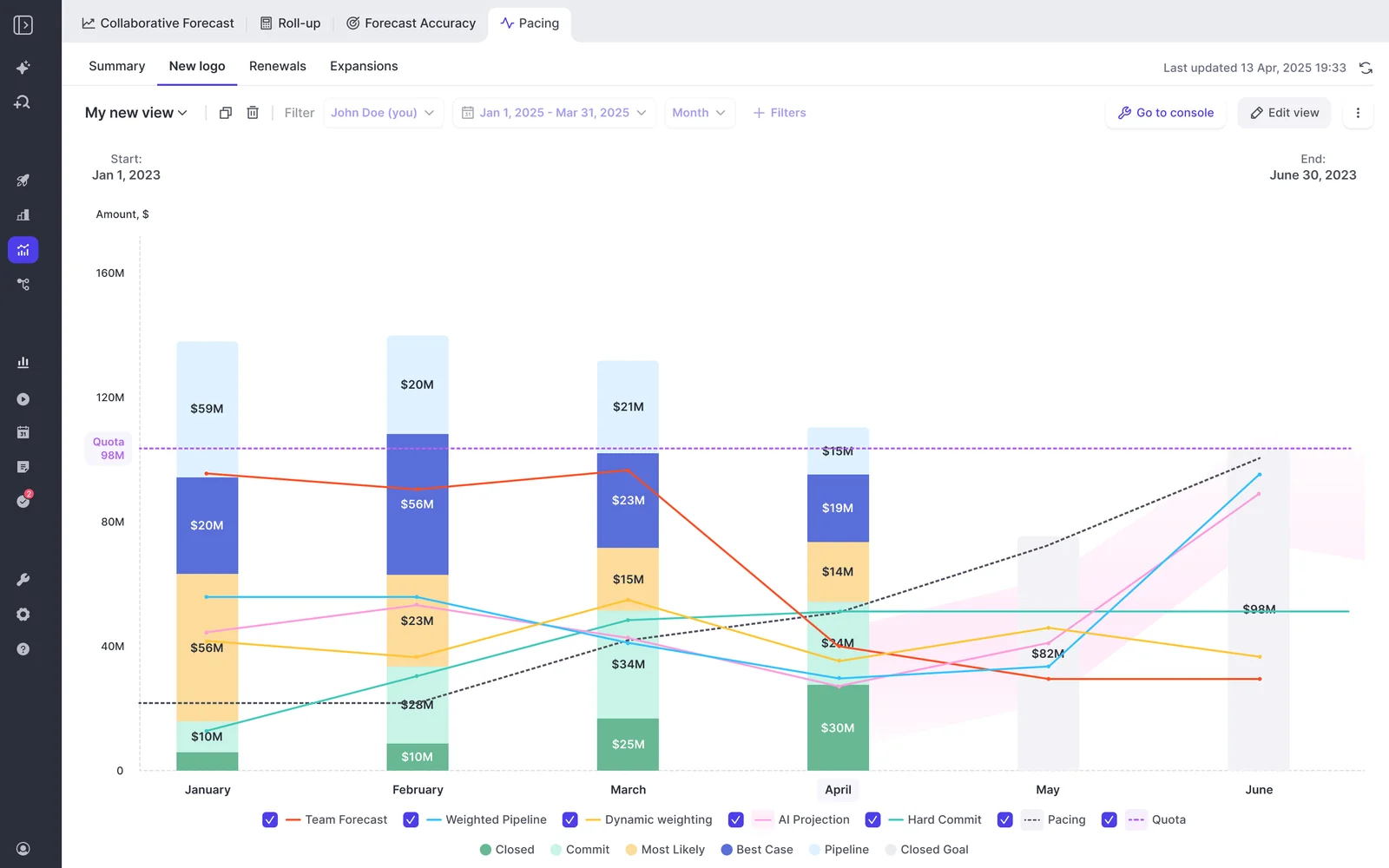
The projection doesn't yet adjust for ramping reps, so a new hire's line rests on very little history of their own. When the model isn't confident, it shows no range and says why.
Weflow runs new business, renewal and expansion as separate forecasts
Each revenue motion gets its own forecast setup in Weflow, with its own amount field, date field, stages, targets and AI model. A single blended forecast hides the motion that's failing. Separate setups show you which one it is.
- A renewal setup can run on contract start date instead of close date.
- An expansion setup can exclude deals with negative net new ARR, so contraction stays out of it.
- A combined quota can run beside separate targets per motion, with a tab for each plus a combined view.
- A setup can forecast on opportunities or on opportunity product line items.
The limits:
- Every setup in a workspace shares one period type.
- Targets are amounts, not deal or logo counts.
- Weflow doesn't forecast consumption revenue.
- There's no account-level board that rolls renewal work up by customer.
Weflow snapshots the pipeline every few hours for the waterfall
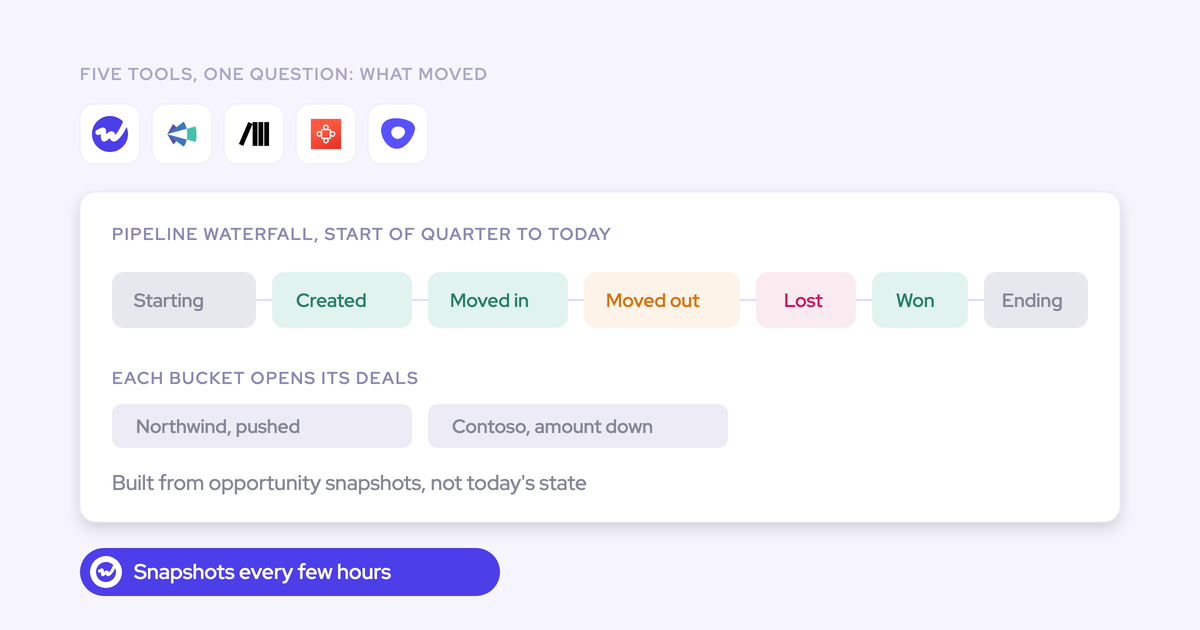
Weflow snapshots every opportunity every few hours, and that history feeds the waterfall. Starting pipeline reconciles to ending pipeline through created, increased, pulled in, pushed out, lost, decreased and won. Each bar drills through to the deals behind it.
That's how you answer "this was committed last week, where is it now?" without anyone building a sheet on Monday morning.
History from before rollout comes from a 12-month Salesforce import. For custom fields, that history depends on Salesforce field history tracking having been on. Weflow has no flow view, which Clari offers.
Weflow sets up forecasting with you, then your admin owns changes
Weflow runs onboarding itself, and onboarding is free. After that, your admin changes configurations, filters, the hierarchy and formula columns directly. A new forecast column is an edit in the admin console, not a ticket that comes back after the quarter it was meant for.
Forecasting takes longer to set up than capture or conversation intelligence, because you're encoding your operating cadence: who submits, how often, at deal or manager level, against which quota. Your existing Salesforce forecast settings don't carry over.
Every configuration change re-runs the history import. Pipeline analytics can show partial numbers for up to a day or two afterwards, so settle the configuration before you show the views to sellers.
Weflow connects to Salesforce, calendars, meeting tools and Outreach
Weflow integrates natively with:
- Salesforce
- Gmail, Outlook and Google Calendar
- Zoom, Microsoft Teams, Google Meet and Webex
- Slack
- The Outreach dialer, whose calls arrive as recordings with transcripts and summaries
If Outreach or Salesloft also logs email, compatibility mode keeps the same message from landing in Salesforce twice. Weflow works only with Salesforce. It has no native Snowflake, Databricks or BigQuery connector, and it isn't an integration platform with a connector catalog.
Weflow opens forecast and call data to Claude and your warehouse
Weflow's read-only MCP connector returns the latest submitted forecast call beside the live pipeline total, plus the gap between them. That lets an assistant like Claude tell you whether a team is calling above or below its own pipeline.
The connector also returns:
- Per-rep pipeline metrics, including win rate, coverage and gap to forecast, with the opportunity IDs behind them
- Call summaries and playbook results
- Full transcripts, behind a separate admin toggle
Per-rep breakdowns are capped at 25 owners, so a large org gets aggregate answers unless the question is narrowed to a team. For BI and the warehouse, the REST API bulk-exports transcripts, metadata, scores and signals as JSON or CSV.
How Clari Forecast runs the sales forecast inside Salesloft
Clari and Salesloft merged in December 2025 and now ship one monthly release. Forecasting carries the Clari name as Clari Forecast, while capture, engagement and deal management belong to Salesloft.
Clari's top-down roll-up is the view leaders don't want to lose
Clari's top-down forecast view is the usability bar for this category. A CRO sees each direct report's commit and best case at a glance and edits inline. Quick Submit updates every month and week of a quarter in one action. A week-by-week history shows how each call moved.
The hierarchy drills eight levels deep, and managers with permission can submit on behalf of reps. Any replacement has to match that speed, Weflow included.
The limits sit in what a call contains and how far down a leader can see:
- A Clari forecast call is a number with notes. Forecasters list the deals behind it in the notes field.
- Leaders see what each direct report submitted, but not what the reps underneath said.
- Deals roll up by opportunity owner, so routing one rep's deals to different managers needs workarounds.
- Overlays and opportunity splits need extra work before the forecast reflects them.
in Clari it's very difficult to understand my SVP saying this, but what my reps are saying.
Salesloft's AI Forecast predicts current-quarter new business only
Salesloft's AI Forecast predicts new business closing in the current quarter, trained on your own Salesforce history. Salesloft switches it on per team after an engineering check of your data. A team needs four preceding quarters with at least 50 closed opportunities each.
Each open deal gets a high, medium or low close probability. Credit where it's due: in deployments we've seen, the prediction tends to land close to the quarter's actual result, and it can stay the most-checked part of Clari after other modules fall out of use.
Two limits come up repeatedly on calls:
- RevOps teams tell us the projection takes 12 to 18 months before they find it useful.
- It looks only three months ahead, so teams build a rolling twelve-month forecast outside Clari.
Clari splits new business, renewals and upsells into forecast segments
Clari Forecast lets admins split the forecast into segments such as new business, renewals and upsells, each with its own opportunity criteria and visible hierarchy. Account-based forecasting runs beside it for existing-customer revenue. Each account carries a machine-predicted Pace number that sellers adjust with an override and a comment, which suits variable or consumption revenue.
Only one quota period can be active at a time.
Clari's Time Series Data Hub feeds its pipeline waterfall
Clari's Time Series Data Hub snapshots opportunity, account and activity data automatically. Its Waterfall view shows pipeline change weekly, monthly or quarterly, broken into types such as amount decreases, slipped deals and lost deals. You can group each type by a CRM field, for example losses by competitor.
Salesloft's Deals Flow Chart adds a flow view of how deals moved between forecast categories, with new and pulled-in deals shown below the line. Clari also has an annual pacing view that tracks year-to-date results against the annual number. Even so, some teams still rebuild the movement analysis in Tableau every cycle.
Clari admins can build forecasts now, but quotas still need file uploads
Clari admins can now build a forecast themselves. That used to require Clari's support team. Teams have told us that adding a quarterly target, a new forecast call or a column change historically went through professional services.
Several admin chores remain:
- Quotas already in Salesforce are entered again in Clari, and parent levels are set separately.
- Changing quotas means downloading a file, editing it in Excel and uploading it again.
- Saved views are edited one by one. One org we spoke with had 86 of them.
- Every user connects their own Salesforce account to submit a forecast.
Clari connects through Salesloft's Unified Revenue Data Layer
Salesloft's Unified Revenue Data Layer syncs with Salesforce, Microsoft Dynamics, Snowflake, Databricks, Gmail, DocuSign, ZoomInfo and LinkedIn. Recording integrates with Zoom, Teams, Google Meet and Webex.
Deals and Forecast run on Salesforce only, in the Professional with API, Enterprise or Unlimited editions.
Clari offers Forecast and Copilot MCP servers plus CSV exports
Clari has three routes for AI assistants:
- Clari Forecast MCP server. Gives Claude and ChatGPT live forecast data and historical snapshots, scoped to each user's Clari permissions. A Clari admin switches it on in Clari Studio, and users need a Claude or ChatGPT Business or Enterprise plan.
- Copilot MCP server. Reaches call data only.
- Salesloft MCP server. Read-only, in beta, and requires the paid Agentic add-on. It returns call summaries but not raw transcripts.
For raw data, admins export up to two years of forecast history as a CSV, and Salesloft's data layer syncs to Snowflake and Databricks.
How Kluster builds the finance-owned revenue forecast
Kluster is a UK-based forecasting and reporting company that sells agentic revenue forecasting to the CEOs, CFOs, CROs and boards of PE-backed and listed companies. Its buyer is the executive team and finance, not the sales floor.
Kluster rolls every rep, team and region into one company view
Kluster rolls forecasts up from every rep, team and region into one company view, and its experts build the model around your sales process. It tracks each rep's submissions week by week against history, so you can see who calls too optimistically and who sandbags. It also records which adjustments were rep-driven and which were manager-driven.
Kluster blends several forecasting methods with rep judgement
Kluster combines deal-based, stage-based, sales pacing and AI methods with the reps' submitted judgment, after cleaning and enriching your CRM data first. Kluster markets 96%+ forecast accuracy from its 2024 to 2025 customer data. That figure is Kluster's own marketing claim.
Kluster forecasts recognised revenue alongside new business and renewals
This is Kluster's clearest line against every sales-side tool, including Weflow. Kluster:
- Separates new business, renewals, upsells and downgrades
- Runs revenue recognition for fixed-fee, bookings-based and usage-based contracts
- Logs every forecast change in an audit trail
- Builds board packs you can freeze as a snapshot and keep for audit and due diligence
- Models what-if scenarios and works a revenue target back into the pipeline needed to hit it
Kluster tracks what closed, slipped or dropped from starting pipeline
Kluster snapshots the pipeline so you can see how much of the quarter's starting pipeline closed, was pushed or dropped out, and it uses that history in board reporting on conversion. It also ships more than 180 prebuilt revenue and forecast reports.
Kluster doesn't publish how often it takes snapshots, and it documents no waterfall between any two dates with the deals behind each bar.
Kluster's own forecasting experts build every deployment
Kluster delivers every deployment through its own team of forecasting and data experts rather than as self-serve software. It puts integration at hours, configuration at days and full deployment at weeks.
The evaluation itself is a strong move. Kluster offers a free pilot: its experts load and clean your data, set it up within 24 hours and run a one-hour live forecasting session on your own numbers. The tradeoff is that setup and later changes run as a vendor services project, with a set-up fee and optional consultancy.
Kluster pulls in Gmail plus call data from Jiminny and Allego
Kluster reads your Salesforce or HubSpot data in. Gmail history shows up in Kluster's deal view, but nothing is logged to the CRM, and Kluster documents no Outlook equivalent.
Calls reach Kluster only from a separate recorder such as Jiminny or Allego, whose calls appear on the opportunity timeline.
Kluster offers a free Claude connector and scheduled warehouse delivery
Kluster's free Claude connector runs over a data layer its team maps in a 30-minute setup call. That layer covers your hierarchy, fiscal calendar, forecast categories, revenue streams and renewal logic. Kluster's argument is that Claude connected straight to a CRM guesses at those definitions, and that's a fair point.
Data reaches your warehouse in scheduled bulk updates. Kluster publishes no developer documentation for a public API.
The data neither Clari nor Kluster puts under the forecast
Both shortlisted tools leave you with a forecast that isn't fed by the conversations and activity underneath it. A forecast is only as good as that data. This is the axis where the decision gets made, because forecasting parity alone doesn't win a switch.
One buyer evaluating us against Clari said it plainly:
I don't see your solution being better than Clari. I see your solution being able to do at least 80% of what we had with Clari.
That's an honest read for a mature setup. So the question becomes what the incumbent can't do at all.
Clari Forecast doesn't read Clari Copilot call data
Clari grew by acquisition. Wingman became Copilot, Groove followed, then the Salesloft merger. Each product arrived with its own data model, and none was rebuilt onto a common foundation.
The result: Clari Forecast doesn't use Clari Copilot call data. Customers who own both pipe transcripts into a separate AI workspace and rebuild the join themselves. Buying both products under one invoice doesn't give you one data layer.
Kluster records no calls and tells you to run Gong beside it
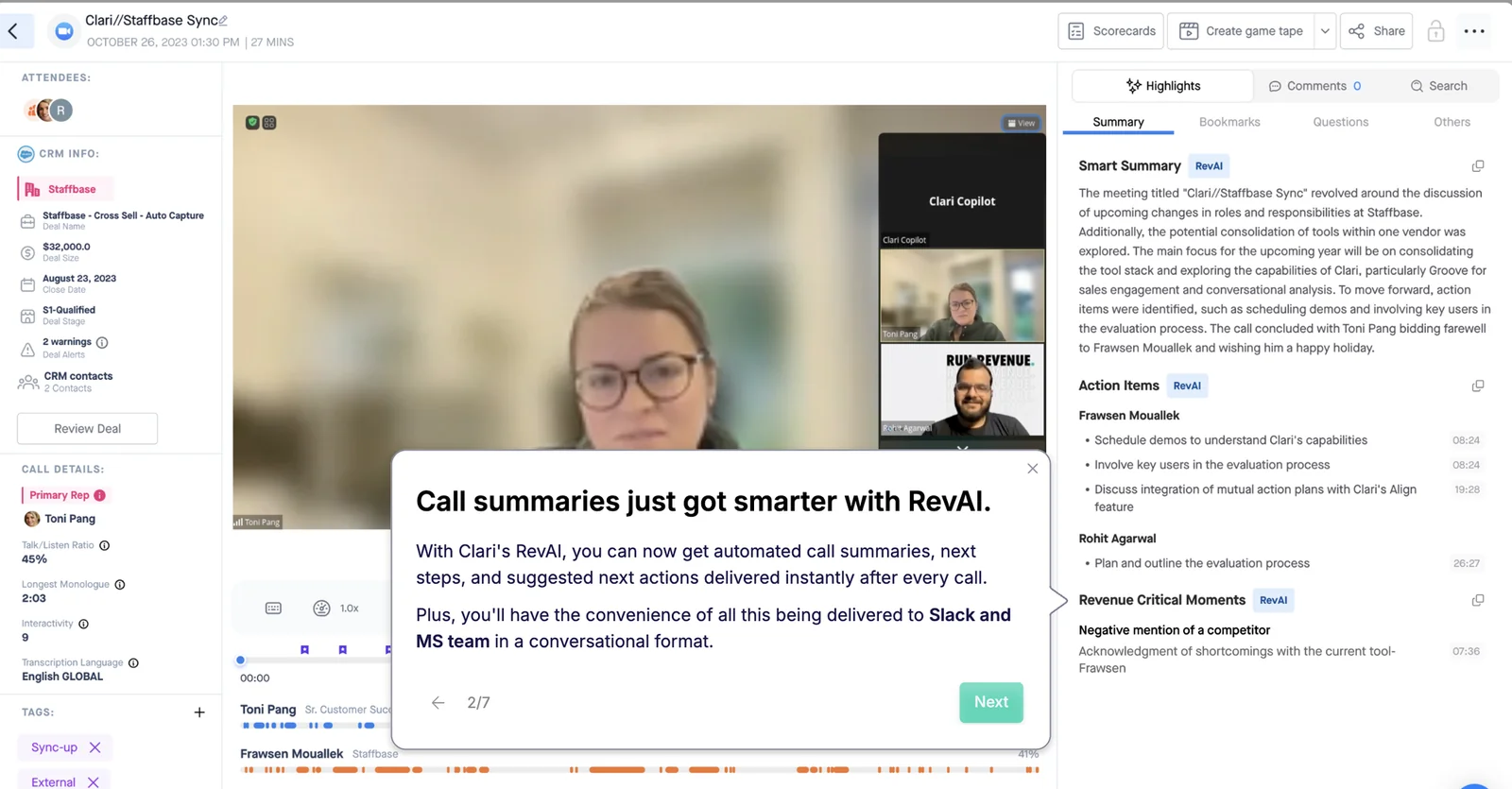
Kluster has no conversation intelligence. It doesn't record, transcribe or analyze calls, and it doesn't log activity to your CRM. Its own comparison positions Gong for the sales organization and Kluster for the forecast.
For you, that means a second vendor, a second contract and a second data model to reconcile before the forecast can see what buyers said.
Weflow feeds the forecast from captured calls and activity
Weflow Activity & Contact Capture and Weflow Conversation Intelligence feed deal signals, deal warnings and the AI projection on the same platform as the forecast. Weflow forecasting works best on that data layer. Without it, the roll-up runs on what reps remembered to type.
Deal warnings show up inside the submission screen, at the moment a rep picks which deals to commit. Typical rules include:
- A close date pushed more than twice
- Only one contact on the deal
- No activity in a set number of days
- Too long in the current stage
That stops unhealthy pipeline from entering the call, instead of flagging it in a report after the number is already wrong.
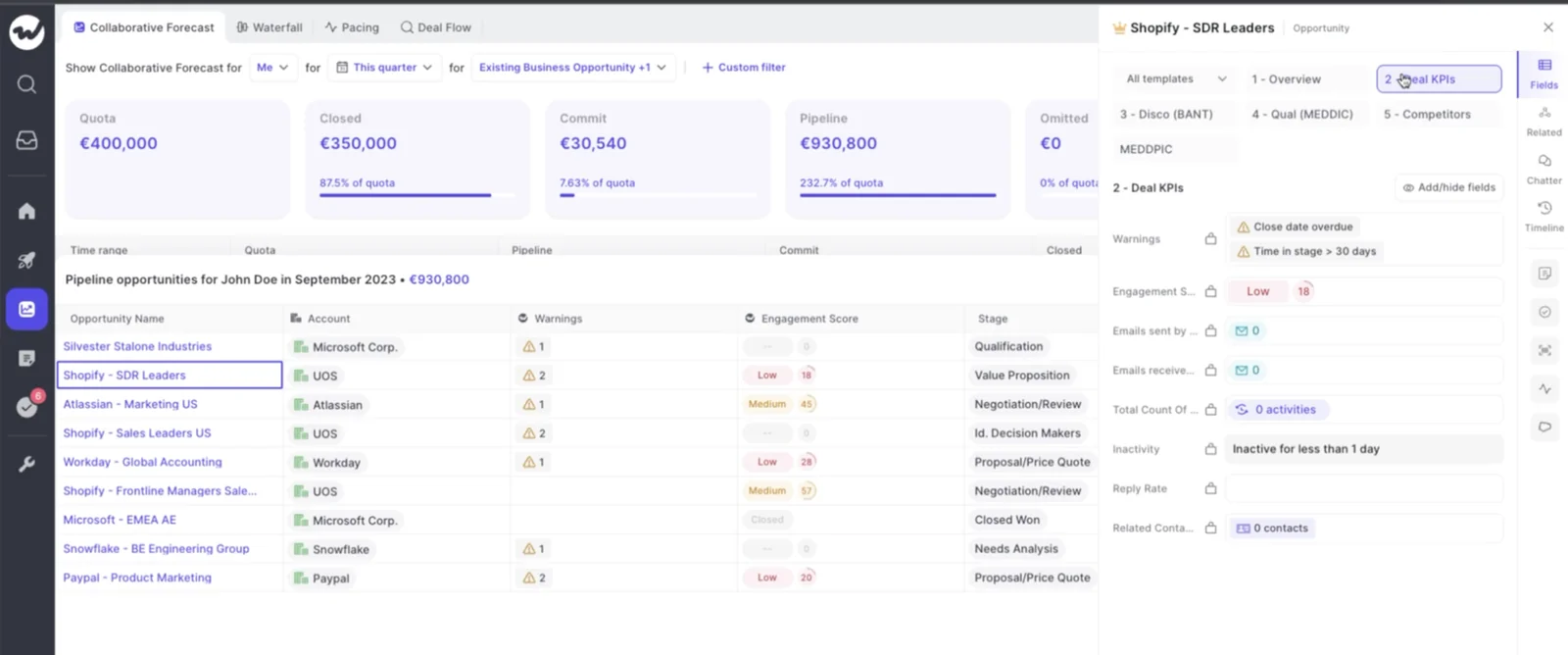
Zeotap ran a tight weekly, monthly and quarterly cadence and still couldn't trust the forecast, because next steps, close dates and activity were missing from the pipeline. Once that data was complete, the cadence started producing an accurate number.
With Weflow, we forecast within 7% by week 4 of the quarter.
Tibor Stefán, Chief Revenue Officer at Zeotap
Where Clari or Kluster is the better pick than Weflow
Two kinds of org should stay where they are, and Weflow forecasting has gaps you should know about before you book a demo.
Clari fits very large orgs with years of roll-up configuration
Clari's enterprise roll-ups at 1,000+ reps are more mature than ours. If you run a sales org at that scale, with years of configuration you don't want to rebuild, renewing is a defensible call.
The same goes if you already run Salesloft for engagement and want to keep it. A sponsor or CRO who loves the tool is also a real reason to renew. Sales leaders often see Clari as the industry standard, and that view carries weight internally.
Kluster fits companies whose board argues about recognised revenue
If finance co-owns your forecast and the board argues about recognized revenue, Kluster is built for you. Weflow doesn't do any of this:
- Recognized revenue and consumption forecasting
- Scenario models
- Frozen board packs
- Delivery by a dedicated forecasting team
What Weflow forecasting doesn't do today
- Weflow doesn't forecast recognized revenue or consumption revenue.
- Weflow doesn't build frozen board packs.
- Weflow doesn't support opportunity splits or overlay forecasting.
- All forecast configurations in a workspace share one period type.
- Reps and managers can't submit a forecast from a phone or chat tool.
- Forecast submissions aren't written to a Salesforce field.
- Weflow has no pipeline flow view.
- Weflow works only with Salesforce.
What Clari, Kluster and Weflow cost for your seat count
Only Weflow publishes prices. Clari is quote-only through Salesloft, with forecasting sold as an add-on. Kluster is quote-only per Sales Account, plus a set-up fee.
| Cost element | Weflow | Clari (Salesloft) | Kluster |
|---|---|---|---|
| Pricing model | Per seat, with AI usage included. Agent Builder is priced per workspace. | Quote-only. Salesloft sells Advanced and Elite packages with paid add-ons. | Per Sales Account named in the order form. |
| Published list price | Deal Intelligence & Forecasting $39 per user per month. Revenue AI Enterprise bundle $79. | None published. Our estimate is $120 to $180 per user per month. | None on its site. A HubSpot Marketplace listing shows $1,250 a year plus a 25% annual customer success fee. |
| What costs extra | Agent Builder beyond the free 25 actions a month: $299 for 500 actions, $999 for 2,500, or a custom Enterprise package. | Forecasting, AI agents and the Dialer are add-ons. MCP access comes with the agent add-ons. | Optional consultancy, and the customer success fee on the HubSpot listing. |
| Setup and services | Onboarding is free, with no implementation fees. | Professional services, which we estimate at $15k to $50k. | A set-up fee, separate from the subscription. |
| Minimums and billing | 10 users, billed annually. | Not published. | Not published. |
The Clari figures are our estimates, since Clari and Salesloft publish no seat prices. Kluster's HubSpot listing doesn't say whether that price is per user or per company.
For a reference point on Weflow, around 62 seats on the full Revenue AI Enterprise platform lands near $58K a year. Putting most reps on a smaller bundle and only managers on the full platform brings that same team to roughly $45K. If you're blocked by a forecasting renewal, you can also start with capture and conversation intelligence and add forecasting later for roughly $10 more per user per month.
How contracts and pilots differ for Clari, Kluster and Weflow
The three vendors differ most on how you can test them and how you can leave.
| Term | Weflow | Clari (Salesloft) | Kluster |
|---|---|---|---|
| Free trial or pilot | 14-day free trial with guided onboarding. | No free trial and no self-serve signup. | Free pilot built within 24 hours, plus a 7-day trial on the HubSpot listing. |
| Paid pilot | Three-month paid pilot that forms the first three months of a multi-year agreement, with an opt-out at the end. | Not published. | Not offered. The pilot is free. |
| Standard term | 12 months, with no shorter term. Multi-year discounts apply. | Quote-only. Terms not published. | Set in the order form, and renews automatically for the same term. |
| Seat changes mid-term | No reductions, but seats can be reassigned when someone leaves. | Not published. | Extra Sales Accounts are pro-rated. |
| Exit | Opt-out at the end of the paid pilot. | Not published. | Cancel 30 days before the end of the term. Fees are non-refundable. |
Forecasting can't be judged in two weeks. The instance has to be configured, and a roll-up motion has to run for a cycle. That's why we offer the three-month paid pilot for forecasting evaluations.
What switching off Clari or Kluster actually involves
Your forecast history and calculated columns come with you. The political blockers have workarounds that don't require winning a fight in your first quarter.
Bring Clari forecast history and formula columns into Weflow
The calls your team submitted in Clari import into Weflow from Clari's API or a CSV, so you don't lose the history. Opportunity history comes from Salesforce, so the AI projection doesn't wait on the Clari import. The quarter-by-month period most Clari teams use is supported.
- Settle the configuration. Choose the amount field, the stage or forecast-category basis and the record-type filters. Decide which legacy formula fields to retire before you connect anything.
- Import history. Bring in submitted calls from Clari and let the Salesforce history import run.
- Rebuild your calculated columns. Clari columns become Weflow formula fields: Best Case plus Commit, renewals due in a period, net or gross dollar retention, or your own stage weighting.
- Run a full cycle. Put the weekly submission through a real cycle before you switch Clari off.
Consolidate off Kluster when your sales leader likes it
When the head of sales likes Kluster and won't move, a license-cost argument loses. Land pipeline management and capture first, and leave forecasting where it is. Once your team works deals in Weflow every week, the usage data shows whether the forecast should follow.
Work alongside a PE sponsor who standardised one tool
If your sponsor has standardized a forecasting tool across the portfolio, displacing it is a political fight, not a technical one:
The PE firm really loves Clari. They've been using it for years. So they like the visual.
Coexist first. Weflow writes clean activity into Salesforce, the incumbent reads it, and the incumbent's forecast gets better. You own the data layer, and you can revisit forecasting at the next renewal window from inside a working relationship.
Pick Clari, Kluster or Weflow by your forecast question
Choose Weflow if…
- Your board asks whether the sales number will land, and you want commit and best case tied to named deals every week.
- You want call and activity data feeding the forecast on one platform, instead of joining two vendors yourself.
- Your renewals and expansion need their own forecasts, with renewals running on contract date.
- You want your admin to own forecast changes, at a published price that matches what you use.
Choose Clari if…
- You run a very large sales org, at 1,000+ reps, where Clari's roll-up maturity matters most.
- Your leaders depend on the inline top-down view and Quick Submit and don't want to retrain.
- You already run Salesloft for engagement and want to stay on one vendor.
- You have years of configuration you don't want to rebuild.
Choose Kluster if…
- Your board argues about recognized revenue rather than bookings.
- Finance co-owns the forecast and needs usage-based revenue modeled.
- You need scenario models and frozen board packs for investors and auditors.
- You want a vendor team to build and run the model, and you're fine running a separate call recorder beside it.
If Weflow's list sounds like your team, watch an admin change a forecast setting live, on your kind of setup. See how Weflow captures activity, updates Salesforce fields from calls, and rolls up your forecast. Book a 30-minute demo.
Questions CROs ask when comparing Clari and Kluster
Does Kluster record calls or log activity to Salesforce?
No. Kluster doesn't record or transcribe calls, and its Gmail sync shows email history inside Kluster's deal view without logging it to the CRM. Call data reaches Kluster only from a separate recorder such as Jiminny or Allego, and Kluster positions Gong beside itself for the sales org.
Which tool forecasts recognised revenue rather than bookings?
Kluster. It runs revenue recognition for fixed-fee, bookings-based and usage-based contracts. Clari and Weflow forecast bookings, and Clari adds account-based forecasting with a Pace number for variable or consumption revenue from existing customers.
How long until each tool's AI forecast is trustworthy?
- Weflow: the AI projection is ready within 48 to 72 hours of the history import and needs at least six months of history.
- Clari: Salesloft's AI Forecast needs four quarters with 50+ closed deals each, and RevOps teams report 12 to 18 months before it's useful.
- Kluster: its own team builds the model, with deployment in weeks.
Can Weflow forecast renewals by contract date instead of close date?
Yes. A separate renewal forecast configuration in Weflow can use the contract start date in place of the close date. It carries its own amount field, targets and AI model, apart from new business.
Where does a Weflow forecast live: Salesforce, Weflow or MCP?
In Weflow. Forecast submissions, targets and roll-up data live in the Weflow app, and assistants reach forecast calls through Weflow's MCP connector. No submitted forecast number lands on a Salesforce field today. Opportunity edits you make in Weflow still write straight back to Salesforce.
Does Weflow support opportunity splits, overlays or consumption revenue?
No. The Weflow roll-up follows the opportunity owner, so a split deal counts in full for its owner, and overlay forecasting isn't available. Weflow also doesn't forecast consumption revenue.
Can reps submit a Weflow forecast from their phone?
No. Weflow emails a reminder when a forecast is due and flags a missing submission as a warning, but the submission itself happens in the web app.
What changed for Clari customers after the Salesloft merger?
Clari and Salesloft merged in December 2025 and now ship one monthly release covering Clari, Clari Copilot, Salesloft and Groove. Clari Capture is now part of Salesloft Deals, and Clari Copilot is replacing Salesloft Conversations. Clari's pricing page now leads to a Salesloft Talk to Sales booking page.