
The Clari alternative for mid-market forecasting


Your Clari renewal is on the calendar, and you already know what you think. The roll-up works. Almost nothing around it has moved since you signed.
That complaint is fair, and so is the other half of it: Clari's roll-up forecasting is genuinely good, and any replacement has to match it before it gets to argue about anything else. Weflow is the Revenue AI Orchestration platform for sales, customer success, and RevOps teams, and Weflow Deal Intelligence & Forecasting is the part of it that would take over the forecast.
This article walks the renewal decision the way a RevOps leader actually has to walk it: what Clari still does well, where it breaks specifically for mid-market Salesforce teams, how Weflow covers the views and the process you run today, where Clari is still the better answer, what each costs, and how to start before the renewal closes without asking your CFO to pay for two forecasting tools.
Why RevOps teams rethink Clari at renewal
The renewal window is the only month you have leverage, so it's the month the decision gets made. Three options, and you're picking one:
- Renew as-is and accept another year of the same product.
- Cut back seats to the handful of people who genuinely live in the forecasting screen.
- Replace it and consolidate the layer underneath while you're at it.
We hear all three named on calls, usually with a project name attached.
The trigger is almost never a single missing feature. It's the gap between what shipped and what the category did. Clari has no agent builder for revenue workflows, its Ask AI draws on limited data and can't produce a PDF or CSV artifact, and buyers tell us the AI features are slow enough that people stop asking.
Underneath that sits an ownership change. Salesloft and Clari are now one private-equity-backed company, and Salesloft is still a standalone application rather than a native part of Clari's forecasting platform. Our read is straightforward: a merged sponsor-backed entity optimizes contract value first and roadmap second, which is exactly what buyers describe when they say the investment stopped.
So the question in the room stops being "will this get better" and becomes "what has actually shipped in twelve months, and who else pulled this out and survived."
What Clari's forecasting still does well
Clari's roll-up forecasting is mature, flexible, and the strongest product in its suite. That isn't a polite concession, it's the thing that sets the bar.
What a replacement has to match:
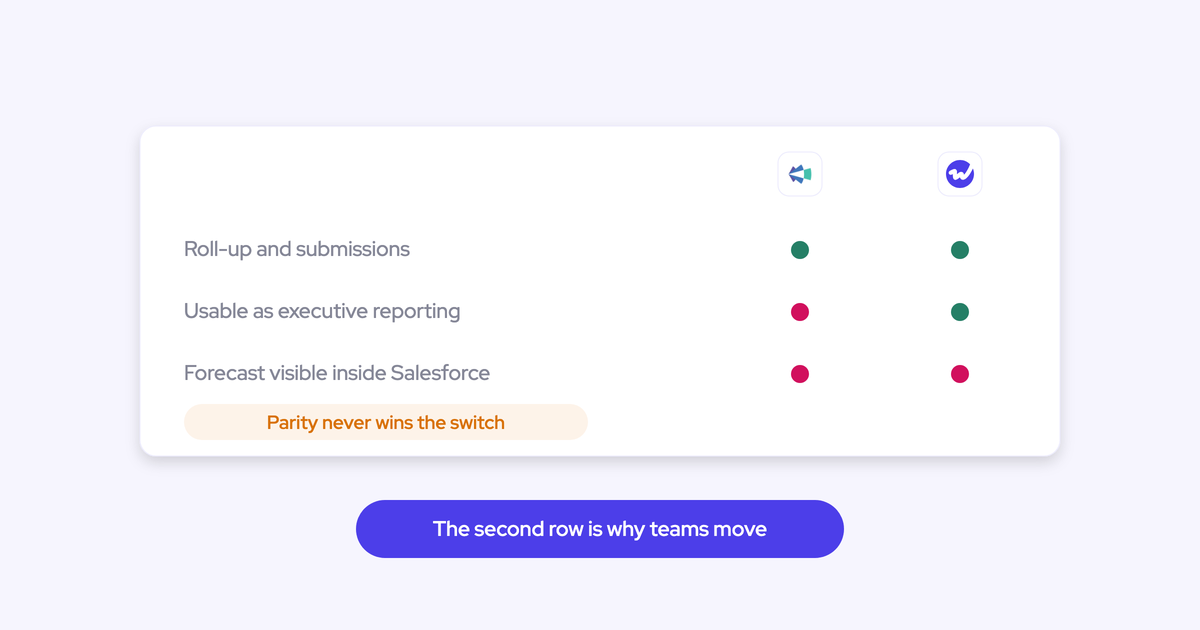
- The submission mechanics. Quick Submit updates all the months and weeks of a quarter in one action, the quarter-navigation dropdown gets you around fast, and the inspect view is where managers actually work. Buyers use these as the usability benchmark, and they're right to.
- The three views teams live in. The pipeline waterfall, the pacing view, and the comparison of where this quarter stands against the same day in prior quarters. Most of the rest of the interface goes unused.
- The process story. Clari sells a forecasting methodology to the CRO, not just a tool, which is why the CRO who bought it is often still fond of it while the operator running it is not.
- Roll-ups at real enterprise scale. Above a thousand reps, Clari's roll-up hierarchy is more proven than anything we can claim. If that's your org, weigh it.
Where Clari breaks for mid-market RevOps teams
The five breaks below aren't bugs waiting on a sprint. They're consequences of how Clari was assembled: forecasting built in-house, conversation intelligence acquired, its own logic and data layer held outside Salesforce, and a commercial sweet spot of roughly 500 to a few thousand employees.
That's why waiting for a fix isn't a strategy. None of these get fixed by a release note.
Every forecast change routes through a professional services ticket
You can't administer your own forecast. New quarter target, new forecast call, a change to how the roll-up works, even the columns in a view: it goes to Clari's professional services team.
A ten-minute change becomes two weeks and a bill. So the process ossifies around whatever got configured at implementation, and when the business reorganizes, which it does every year, the forecasting tool is the last thing to catch up.
There's a second cost that shows up in your own headcount. Because Clari holds its own logic and mappings rather than following your Salesforce permissions and configuration, your admins maintain a parallel system: mappings, duplicate logic, and training users on a second set of rules.
Forecast structure is locked to the Salesforce hierarchy
Clari can't give you a forecast abstracted from your Salesforce hierarchy, which is the constraint buyers name first when we ask what they'd change.
The practical version: one sales leader running multiple products with different teams underneath cannot get separate forecasts for each. You get the org chart, and the org chart is not how the business is run.
Teams also report Clari can't distinguish accounts with several open opportunities, which matters more than it sounds. Clari Capture maps activity server-side using the email domain, so a thread on an account with three live deals gets attributed by guess, and every deal-health signal built on top of it inherits that guess.
Conversation intelligence data never reaches the forecast
Clari's conversation intelligence came in through the acquisition of a separate recording company, and it does not share data with the forecasting product. Call signal never touches the number.
Clari Copilot doesn't write AI field updates back to Salesforce fields or objects, doesn't produce methodology scorecards for MEDDIC or MEDDPICC, and doesn't give rep-level coaching insight. Customers who own both products end up piping transcripts into a separate AI workspace, pulling structured insight out, and hand-feeding it back to the CRM.
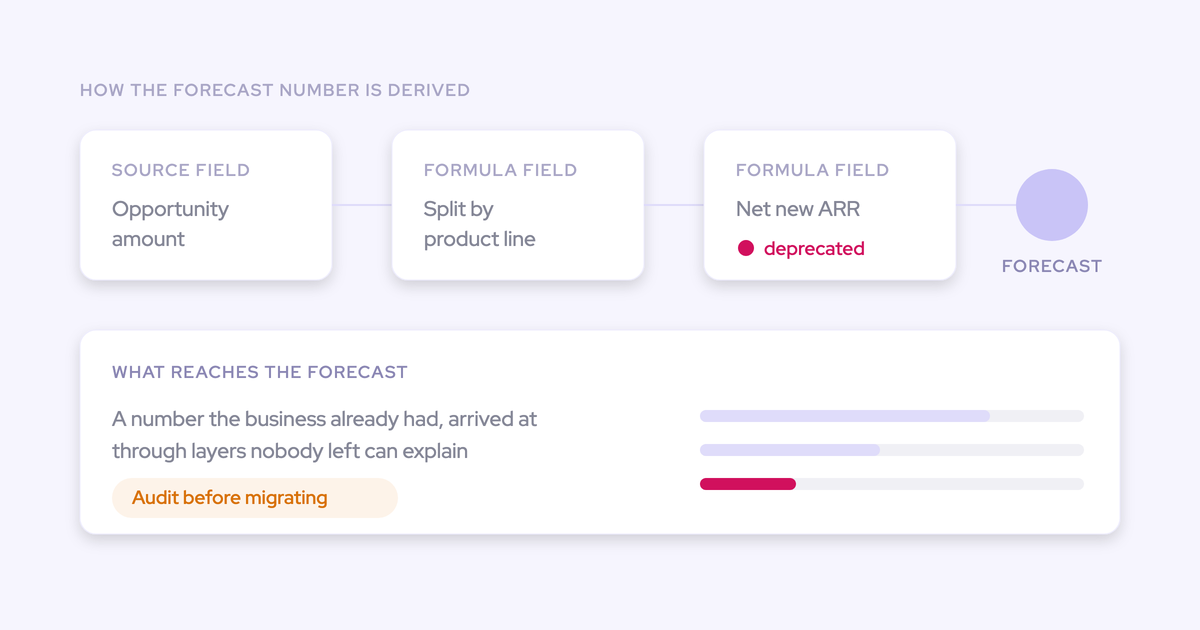
Which leaves the forecast where it started: assembled from CRM fields nobody maintained. Clari is strong and flexible at roll-up, weak at deal-by-deal health, weak at spotting deals being pushed, and it does not measure forecast accuracy at all. After four years, a team still can't say how close its calls were.
Board reporting gets rebuilt in Tableau every quarter
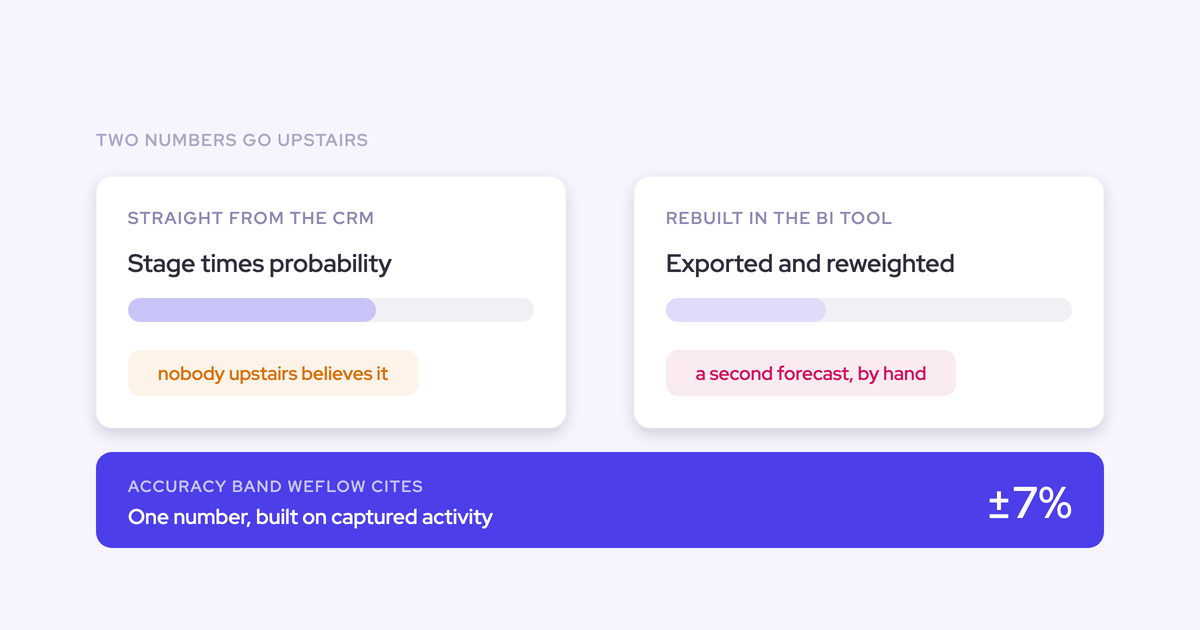
The forecast your CFO and CEO debate is not the one that comes out of Clari.
"Clari is clearly not suited as a reporting tool to present to this type of stakeholders. So we're using Tableau. So we kind of are flowing the data from Clari to Tableau."
That's a week of someone's quarter, every quarter, to rebuild the worldwide consolidation one layer away from the system that produced it. RevOps business partners do the same thing at team level, rebuilding forecast dashboards directly off Salesforce data.
It's also the clearest signal in any evaluation: when the tool isn't trusted as the reporting surface, the licence count stops matching the number of people doing the work.
The renewal motion never got implemented
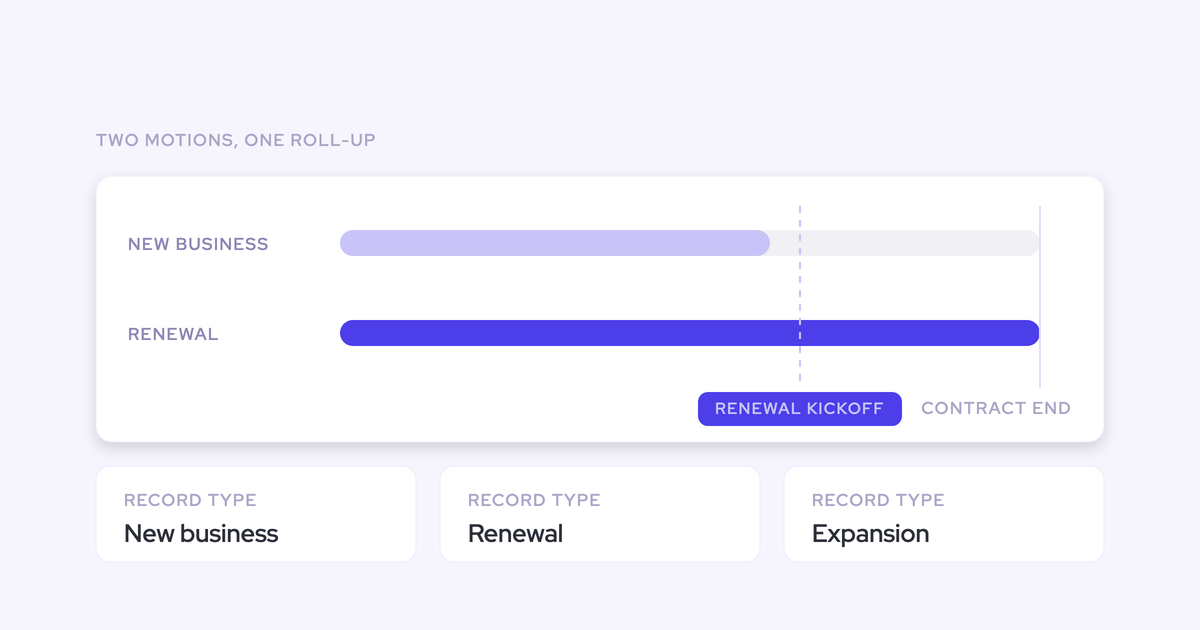
New business runs in Clari. Renewals run in Salesforce, the way they always did.
Renewals sit in the same pipeline as new business with nothing that fires ahead of the contract end date, so a renewal becomes somebody's problem three weeks out and the first sign of trouble is a customer who already decided.
In a business where account managers and CSMs outnumber the new-logo reps several times over, the largest share of revenue is the share with no forecasting process behind it. Clari is deployed on AEs and their managers and rarely across CS and AM, so there's no data layer over most of the revenue base either.
How Weflow replaces Clari forecasting for mid-market teams
Weflow was built as one platform, not assembled from acquisitions. Activity & Contact Capture, Conversation Intelligence, and Deal Intelligence & Forecasting read the same unified data layer, and everything they capture and generate lands in native Salesforce objects you own.
That's the reason the answers below hold together instead of being six features that happen to share a login.
How Weflow covers waterfall, pacing, and same-day comparisons
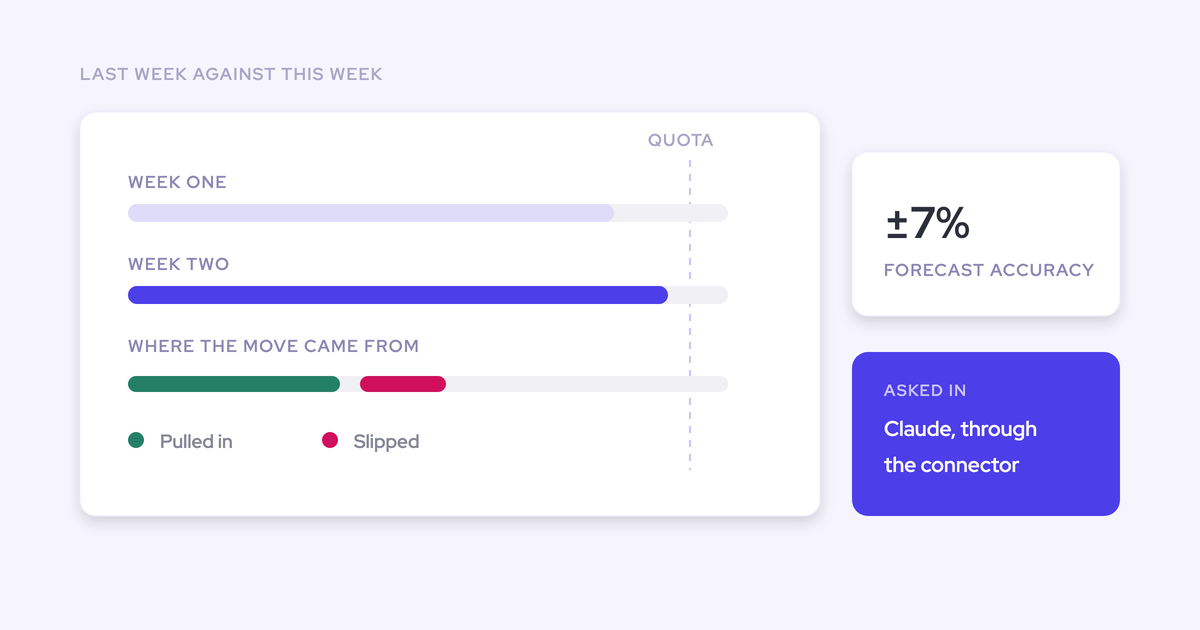
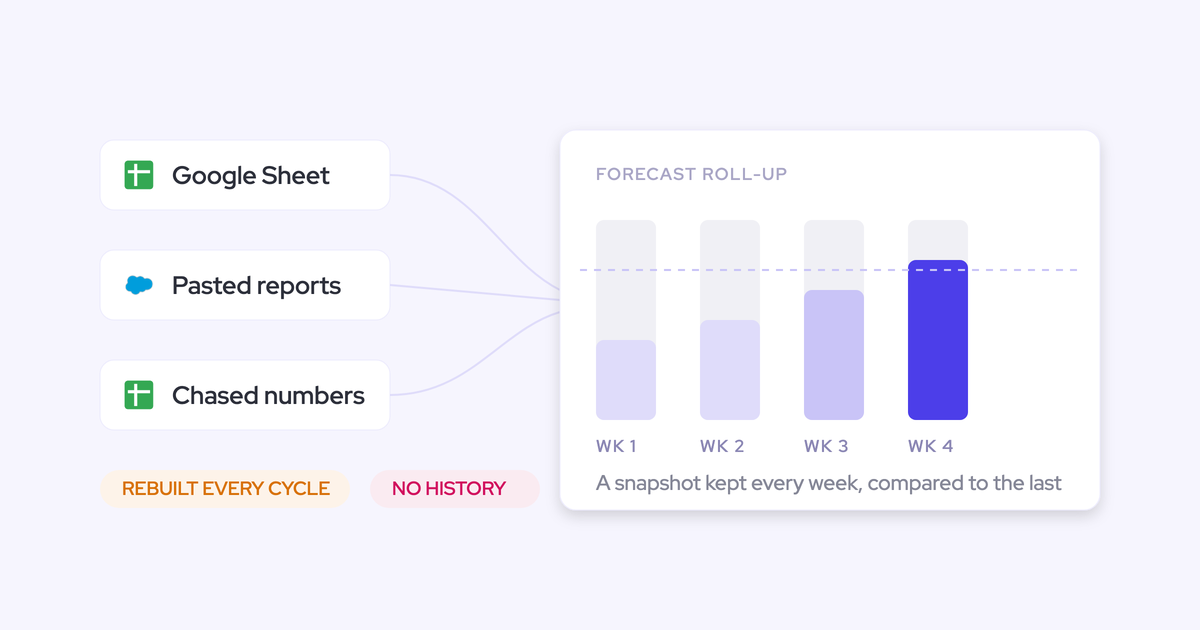
Weflow snapshots opportunity data every few hours and builds the pipeline analytics from that time series, not from current state. Which is what makes the three views you live in possible:
- Waterfall. Reconciles starting pipeline to ending pipeline through newly created, increased, moved into the period, moved out, decreased, lost, and won. Every bucket drills through to the actual opportunities with whatever fields you care about, so the view names the deals causing the problem, not just the problem.
- Pacing and benchmarks. Stage conversion by month and stage, deal size, cycle length, time in stage, and quota attainment, out of the box against your own closed-won history.
- Same day, prior quarters. The hardest one to reproduce, because Salesforce overwrites fields and won't history-track calculated or roll-up fields at all. That's why teams without snapshotting end up standing up a warehouse to answer a management question.
One honest gap up front: Clari has a pipeline flow view and Weflow doesn't. Waterfall and pacing, yes. Flow, no.

Three forecast methods that produce a defensible corridor
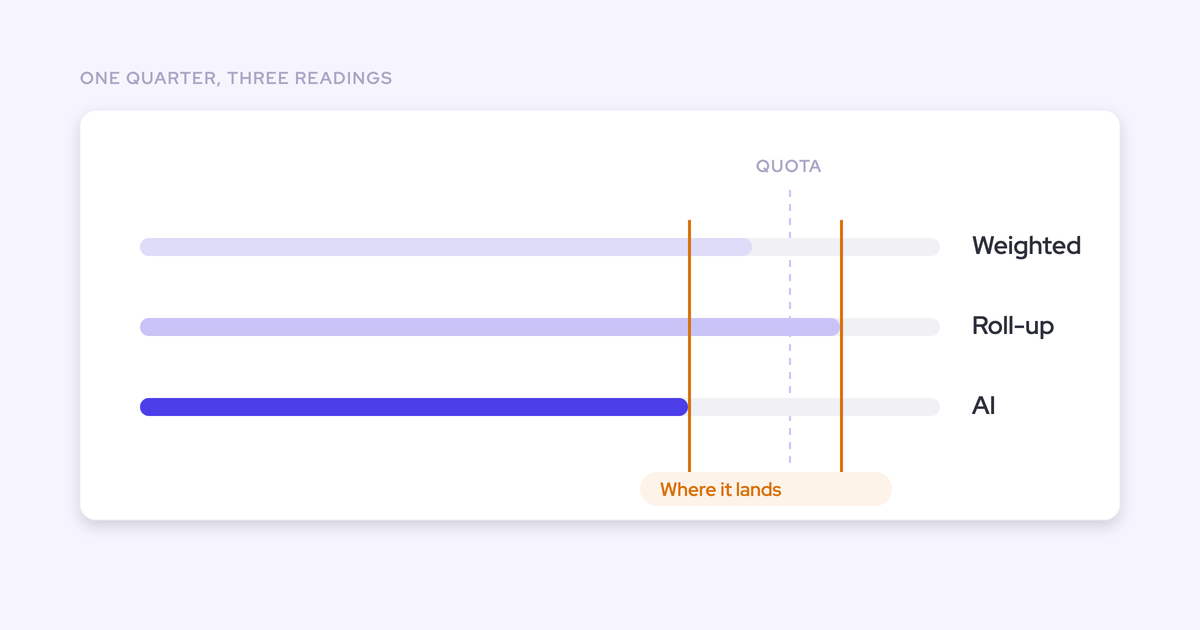
Weflow runs three forecast methods side by side, and the gap between them is the agenda for your forecast call:
- Weighted forecast derived from your historic stage close rates, with dynamic weighting on recent windows. This is what the pipeline mathematically implies.
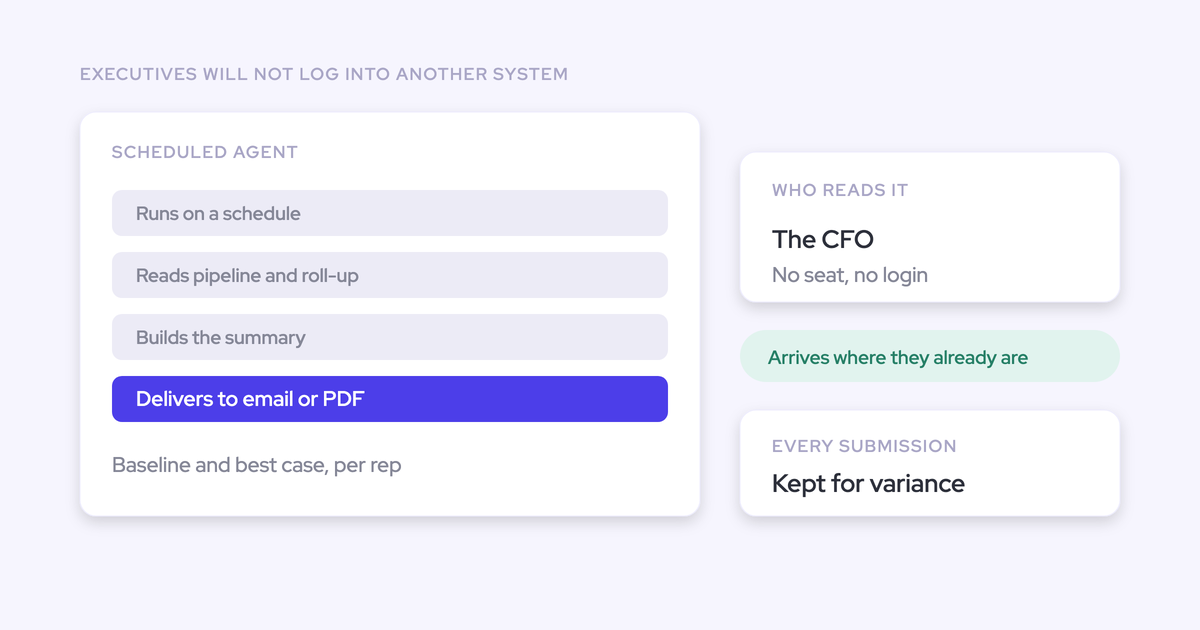
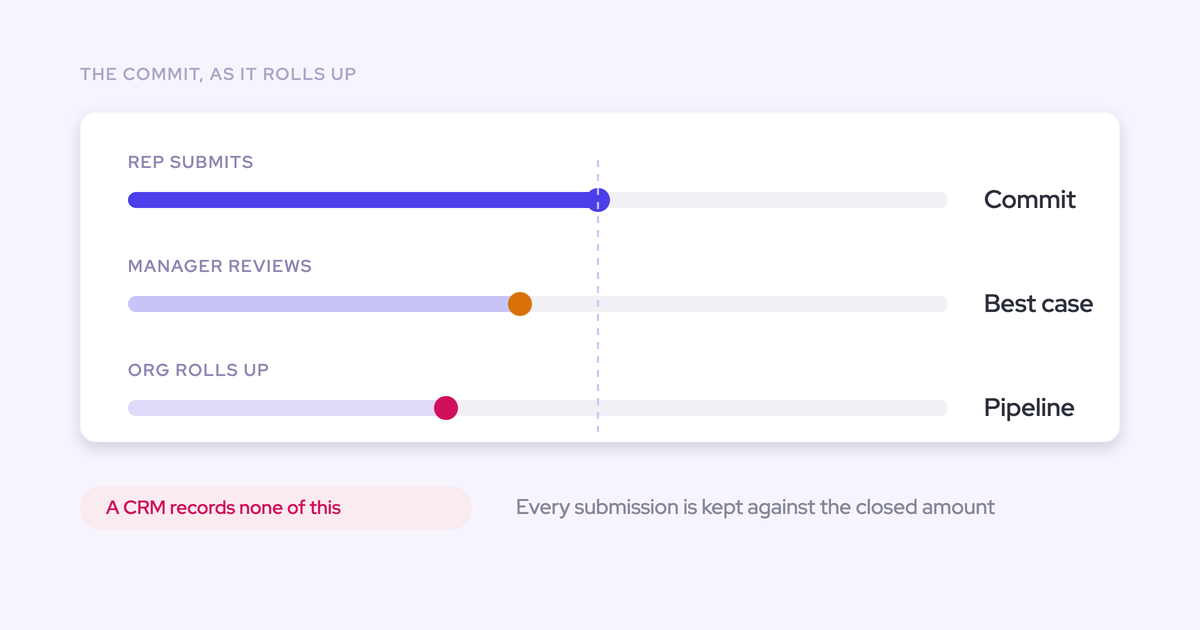
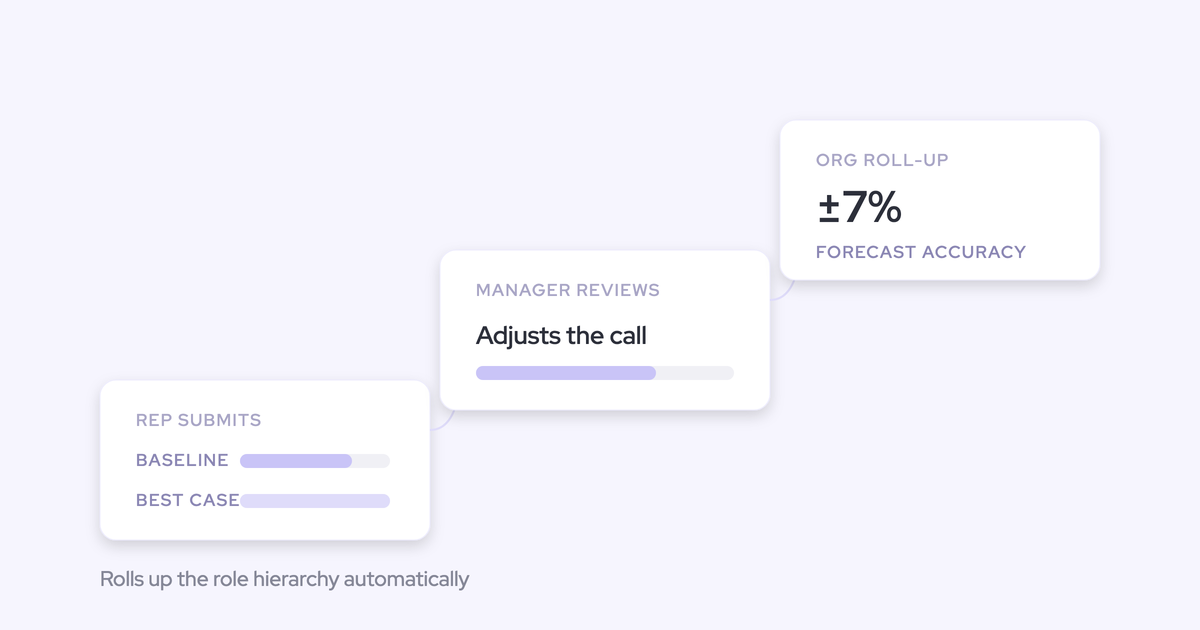
- Rep and manager roll-up. Each rep submits a baseline and a best case, either as a total or by selecting the specific opportunities behind each number, with a comment. Every submission is versioned, deadlines can lock the field, and manager overrides sit next to the rep's original, timestamped and attributed, instead of erasing it.
- AI projection built on more than fifty deal-level signals and up to two years of history, returning a landing range rather than a single number. It reads deal behavior: seasonality, rep performance, conversion rates, communication cadence, whether a next meeting is booked, whether the deal is healthy against your methodology. A large deal that's being worked badly gets projected down.
Three numbers give you a corridor. Where they converge is the credible range you take into a board conversation. Where they diverge is the coaching: a rep sitting far above the weighted number is telling you something, and so is a rep whose call never moves all quarter.

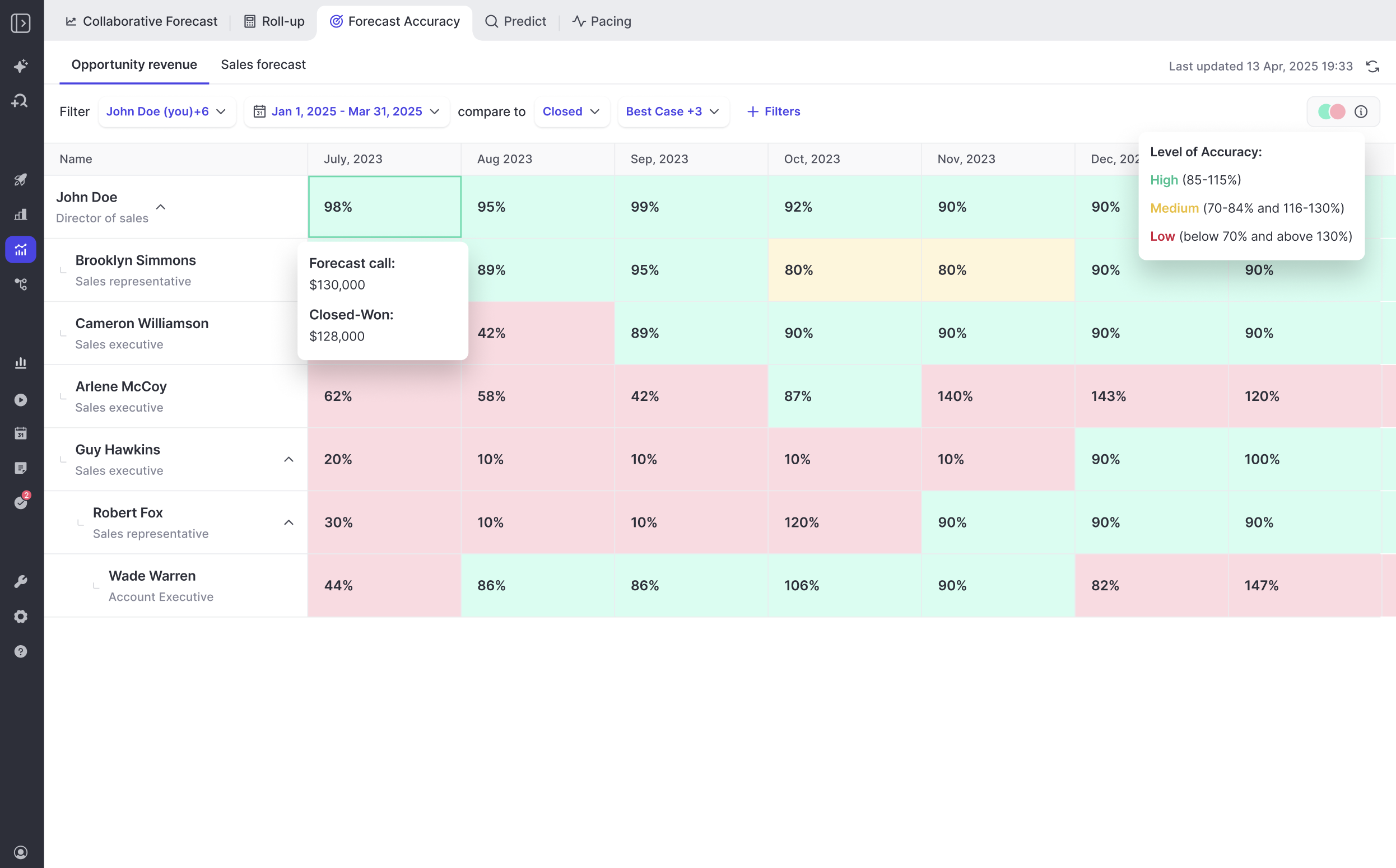
Then the part Clari doesn't do. Weflow records every forecast submission against the final closed amount, so you get called-versus-closed variance per rep, per manager, and by segment across consecutive quarters. Forecast accuracy becomes a coached metric instead of an argument about who was right last quarter.
Call and activity signal actually feeds the forecast
Because capture, conversation intelligence, and forecasting sit on one data layer, a call changes the forecast through a chain you can trace.
Weflow Activity & Contact Capture writes emails, meetings, and contacts server-side into native Salesforce objects, mapped to the right opportunity. Weflow Conversation Intelligence extracts structured answers from the conversation and writes them into your Salesforce fields, methodology fields included, respecting validation rules and permissions.
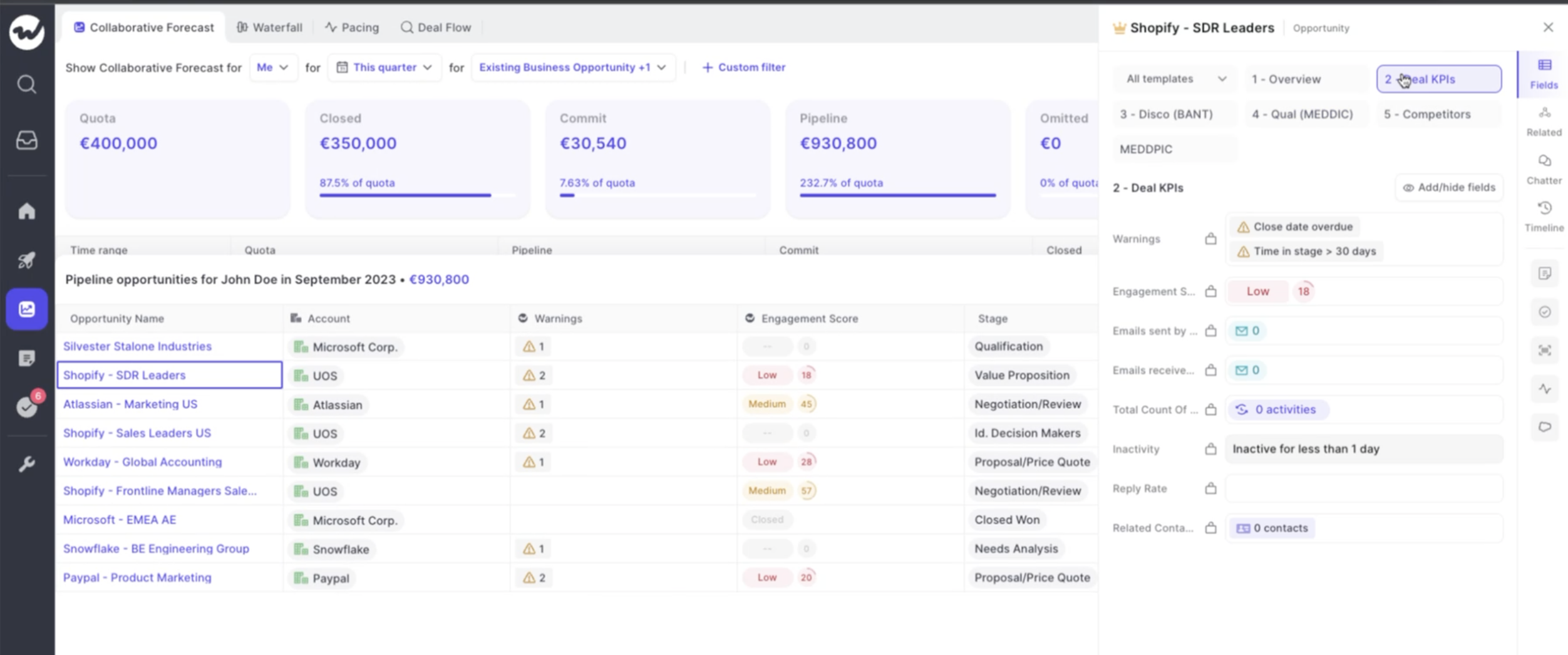
On top of that, Weflow computes fields Salesforce doesn't have: a rolling four-week activity timeline, days inactive, last and next meeting, per-contact engagement, activity velocity. You author warnings as rules against any of them, because a 60-day cycle and a 12-month cycle don't agree on what silence means.
The important bit is where those warnings appear. They surface inside the forecast submission screen, at the moment a rep picks which deals to commit, which stops unhealthy pipeline entering the number instead of explaining it afterwards.
"We have so many customers that come to us and say, oh, we need to improve our forecasting. We need to improve our forecast accuracy. And, you know, then you peel back the onion and you see that data is missing, visibility is missing, understanding of what's going on is missing. And so it's not about then creating a roll up forecast or something. It's really fixing the root cause from a first principles perspective."
— Janis Zech, Co-founder and CEO, Weflow
Self-service admin instead of professional services tickets
Everything you currently ticket, you do yourself in the Weflow admin console. And Weflow follows your existing Salesforce permissions and configuration, so there's no parallel logic layer for your admins to maintain.
| Change | On Clari | In Weflow |
| Add a quarter target or change a quota | Professional services ticket | RevOps sets it per Salesforce user; an annual quota breaks into quarters and months, each still editable by hand |
| Create a new forecast call or change the cadence | Professional services ticket | Self-serve, per forecast setup |
| Change the roll-up or the columns in a view | Professional services ticket | Drag columns, save filter presets, done |
| Who can see targets, who can submit and adjust | Parallel mappings and logic maintained alongside Salesforce | Follows existing Salesforce permissions; submission and adjustment rights restrictable to managers |
| Implementation | Reported $15k to $50k in professional services fees | No implementation fee; Weflow runs onboarding itself |
Small detail that operators notice: where individual rep quotas don't add up to the team target, the remainder is carried on the manager, so gap to target stays visible instead of quietly disappearing.
A forecast hierarchy abstracted from Salesforce
Weflow supports its own hierarchy, independent of your Salesforce hierarchy. That's the exact scenario Clari refused: one leader over multiple products and teams, with a separate forecast for each.
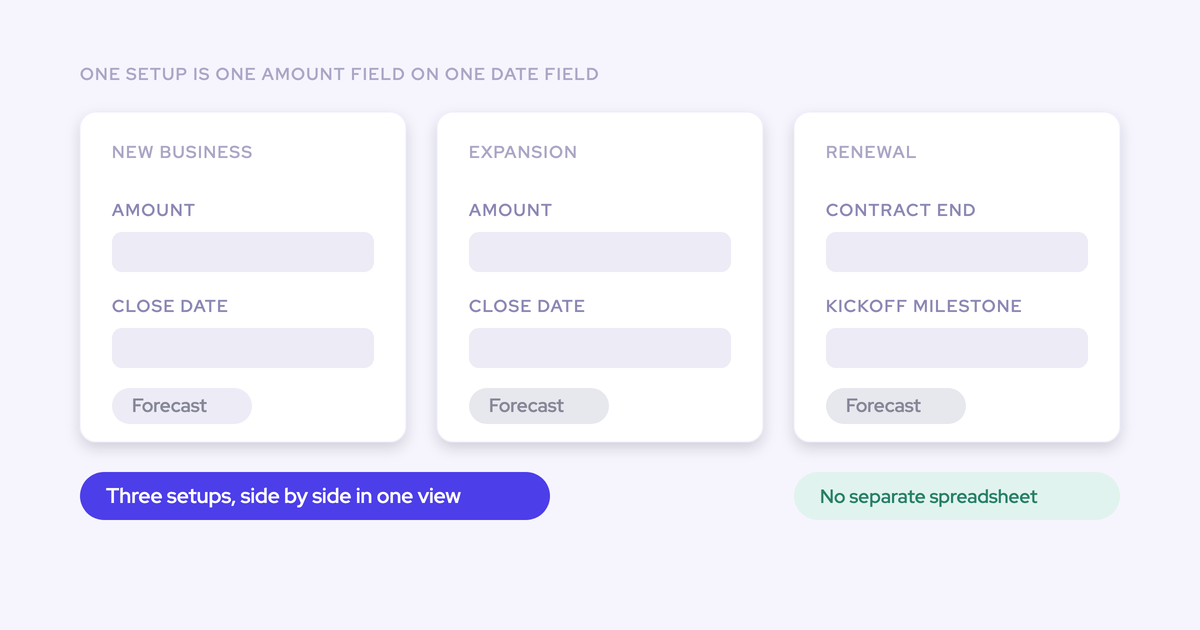
Underneath it, an org can run several forecast setups in parallel. Each has its own foundation revenue field, date field, stages, cadence, targets, and forecast calls, which is how new business, expansion, and renewals stay honest instead of hiding inside one blended number.
Two more things multi-motion teams ask for and get:
- Record types keep their own shape. New Business, Renewal, Existing Business, Partner: each with its own stage path, forecast-category mapping, and independent roll-up.
- Combined quota and separate targets at the same time. One number a rep carries overall, plus per-deal-type targets, with roll-up shown in a tab per deal type and a combined view.
The tradeoff to know: the foundation field applies to everyone in a setup. A team forecasting on incremental ARR and a team forecasting on a calculated revenue field need two setups, not one.
Renewal forecasting as its own motion
Renewal forecasting in Weflow is a motion, not a filter. It tracks contract end dates, fires a configurable renewal-kickoff milestone ahead of expiry, and rolls renewal opportunities up in their own pipeline separate from new business.
That kickoff milestone is the whole point. Customers on multi-year contracts signal intent to leave one to two years out, long before the deal ever appears in a forecast, and the signals that carry that far are engagement and conversation signals rather than pipeline fields.
Which is also why capture and conversation intelligence across CS and AM matter, not just across the AE team.
Where Clari is still the stronger choice
Some of these will rule Weflow out for you. Better you read them here than find them in week three of an evaluation.
- Roll-ups above a thousand reps. Clari's enterprise roll-up hierarchy is more proven at that scale. If you're running that org, that's a real reason to stay.
- Pipeline flow. Weflow matches pacing and waterfall and has no flow view. If flow is a view your leadership genuinely reads every week, you lose it.
- Forecast submissions live in the Weflow app. Submissions, targets, and roll-up data sit in Weflow, not in Salesforce, and come out through the public API for BI. Everything else Weflow produces writes to Salesforce, but a team with a hard rule that reps work only inside Salesforce can't use roll-up submission. The weighted forecast and AI projection still work for them, since both run off CRM data with no rep input.
- The roll-up doesn't weight by stage probability. It sums the chosen amount field on the selected deals. If you think in probability terms, point the forecast at a weighted Salesforce field or treat the raw sum as best case and use the baseline for conviction.
- One opportunity lands in one period. The date field is configurable, but Weflow can't recognize part of a deal this quarter and the rest next. Delivery schedules and campaign line items that span quarters won't reproduce.
- Multi-currency with dated rates. Weflow reads the standard Salesforce currency field and doesn't apply dated exchange rates. Teams that need them point the forecast at their own converted amount field.
- Consumption revenue. Weflow forecasting fits booking-based models best. If most of your revenue is usage that doesn't sit on the opportunity, this is a weaker fit and you should say so early.
- Salesforce only. If part of your group runs a different CRM, Weflow deploys on the Salesforce side and nowhere else.
One more, and it's the one that decides whether any of this works: forecasting takes about three months to prove out, because you need enough cycles to compare called against closed.
"If you don't run an operating cadence, the best tool in the world won't help you. You have to look at forecasting as a holistic process that has various ingredients to make it successful."
— Philipp Stelzer, Co-founder and CPO, Weflow
Weflow vs Clari pricing: what each actually costs
Weflow publishes its prices. Clari's are quote-only, so the figures below are our read from evaluations and reported deals, not published numbers.
| Weflow | Clari | |
| Per-user price, billed annually | Activity & Contact Capture $19, Conversation Intelligence $39, Deal Intelligence & Forecasting $39. Bundles: Revenue AI Foundation $49, Revenue AI Business $59, Revenue AI Enterprise $79. Published list prices. | Estimated $120 to $180 per user per month, with regular increases reported. Products aren't sold standalone. |
| Implementation and change fees | None. Weflow runs onboarding itself at no charge, and forecast changes after go-live are self-serve. | Reported $15k to $50k professional services implementation, and post-launch forecast changes route back through professional services. |
| Seat types | Full seats plus unlimited free view-only licenses for leaders and stakeholders who only read dashboards. Seats reallocate between types quarterly. | Paid seats for the forecasting audience, typically AEs and their managers rather than CS and AM. |
| Minimum commitment | 10 licenses. Multi-year discounts of 10% for two years and 20% for three. | Quote-only annual contracts. Per-seat cost falls sharply as seat count rises, so a small deployment pays the most per seat. |
That last row is the mid-market mismatch in one line. Clari's pricing is tuned for total contract value at enterprise scale, and its sweet spot rarely reaches companies under 500 people, so a 26-seat deployment carries enterprise economics without enterprise leverage.
How to switch without paying for two forecasting tools
Here's the objection that kills most of these deals, and it has nothing to do with product: a CFO who has already signed a forecasting renewal will not approve a second forecasting tool. Come back at renewal, which is eleven months away and after next year's budget is set.
So don't argue with it. Route around it. Land on capabilities the Clari contract doesn't block, then expand into forecasting when the contract ends.
Land on capture and conversation intelligence first
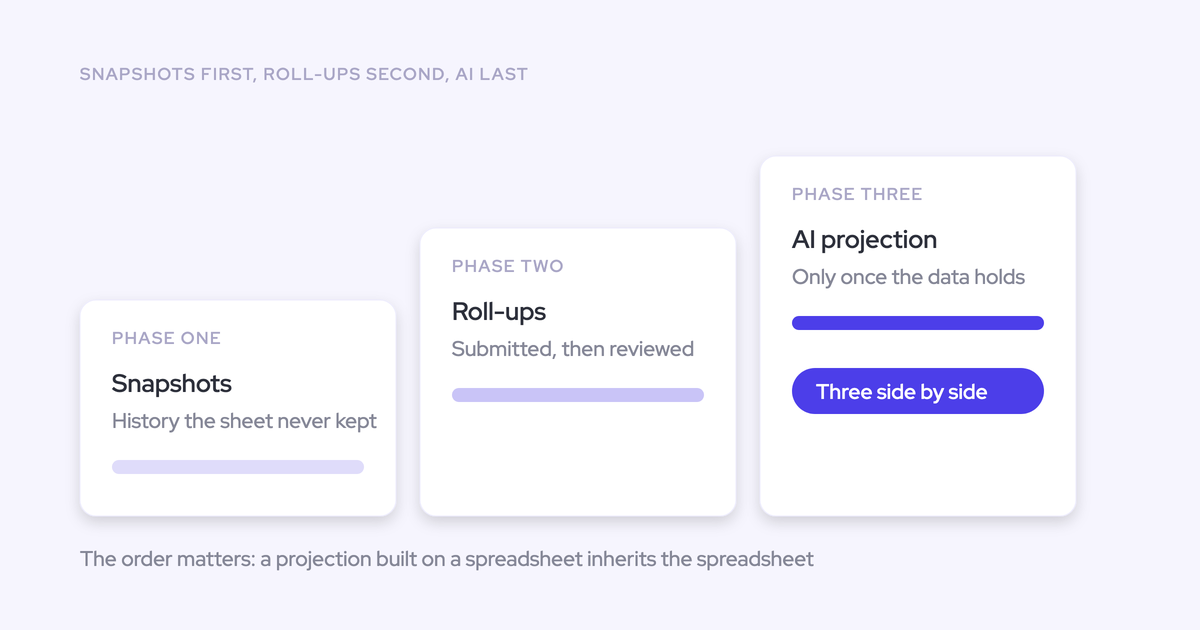
Activity & Contact Capture and Conversation Intelligence sit outside the blocked line item, and they're the two things Clari is weakest at. Together that's Revenue AI Foundation at $49 per user per month, or $19 and $39 standalone.
They also prove out fast, because they act on the meetings and emails already happening. Fourteen days is enough, on your own Salesforce, with a historical sync-back available so there's real history in the reports on day one.
Coexistence is genuinely fine here, with one rule. Clari reads activities from Salesforce, so cleaner Salesforce activity makes Clari's own engagement data better while you're still paying for it. Running two capture engines at once is the failure mode: you get duplicate activities and reporting nobody can reconcile. One capture layer feeding Salesforce, everything else reads from it.
If a sequencer like Outreach or Salesloft is also writing email to Salesforce, Weflow's compatibility mode delays its own sync, checks for the other tool's tracking pattern, and steps back rather than duplicating the record.
Expand into forecasting when the Clari contract ends
At renewal, forecasting is a per-user step on a platform your team already uses. Revenue AI Foundation at $49 to Revenue AI Enterprise at $79, on seats already deployed and configured.
That's an internal approval, not a new procurement cycle. No security review, no vendor onboarding, no six-figure signature next to a six-figure signature.
And the forecast is better on day one than any cold start, because by then you have months of captured activity mapped to opportunities, AI field updates in your Salesforce fields, and snapshot history behind the waterfall and the same-day comparison. The AI projection is only as good as the data foundation underneath it, and yours has been building since the first phase.
What the migration takes: timeline, owners, cost
A tool swap doesn't compete with Clari. It competes with your RevOps backlog, and the backlog usually wins. So it has to arrive as a managed project with a fixed timeline, named owners, and a price.
Weflow runs onboarding itself rather than handing it to a partner, in three phases against a mutual action plan:
- Technical implementation, 45 to 60 minutes. Two Salesforce managed packages, one integration user with a dedicated permission set, and one mail app installed centrally in Microsoft Entra or Google Workspace. Needs your Salesforce admin and a mail admin in the room, and no code deployment.
- Configuration. Where the real time goes: team structure and hierarchy, sales methodology, which custom fields AI should populate, playbooks, deal warnings, prompt templates, then forecast setups, cadence, and quotas.
- Role-based rollout. Separate leadership and rep training, which in a large org runs to fifteen or more sessions.
Typical time to live is two to four weeks, or four to six weeks for a large org, with no implementation fee. Capture and conversation intelligence can go from implementation to rollout in about two weeks; forecasting takes longer because it's the encoding of an operating cadence, not a configuration task.
There's also a managed-service option where Weflow does the heavy lifting and your team only answers questions and unlocks access. We offer it because the blocker in most of these deals is RevOps bandwidth, not product fit.
How KORE Wireless made forecasts evidence-based with Weflow
KORE Wireless came in with the problem you'd recognize: a forecast built on numbers the sellers had already talked up.
"We felt like our forecasting and our bookings pipeline knowledge was flawed. Sellers were over-inflating the value of deals. We felt like we needed validation around that to be able to inform our business more intelligently."
— Scott Jones, SVP of GTM Revenue Intelligence & Enablement, KORE Wireless
They evaluated Gong and chose Weflow instead, then rolled out in five phases in data-foundation order: Activity Capture, then Conversation Intelligence, then Coaching, then Deal Intelligence, then Forecasting. They also use Ask Weflow AI.
Weflow owned onboarding end to end, including live training with a real-time Portuguese translator for the Brazil team.
"It's no longer third-party hearsay from reps or sales leaders. It's now proof in front of us – AI summaries that tell us we're not talking to the economic buyer, that we're single-threaded, whatever it might be."
— Scott Jones, SVP of GTM Revenue Intelligence & Enablement, KORE Wireless
"We've built a foundation where every forecast is grounded in evidence, not optimism. The next chapter is using that same data discipline to sharpen how we price, message, and prioritize across the entire go-to-market motion. This isn't the finish line, it's the infrastructure everything else now runs on."
— Scott Jones, SVP of GTM Revenue Intelligence & Enablement, KORE Wireless
That rollout order is the one we'd recommend to anyone leaving Clari, and it happens to be the same order the CFO objection forces you into anyway.
FAQs about replacing Clari with Weflow
What does Weflow's AI do that Clari Copilot doesn't?
Weflow writes AI field updates from calls straight into your Salesforce fields, produces methodology coaching scorecards for MEDDIC, MEDDPICC, SPICED, BANT and others, generates deal summaries and follow-up emails, and scores individual deals with an AI projection built on 50+ signals. Clari Copilot transcribes without field writes, methodology scorecards, or rep-level coaching insight. Ask Weflow AI also answers across calls, deals, accounts, and pipeline and can produce reports, where Clari's Ask AI draws on limited sources and can't generate downloadable artifacts.
Do forecast submissions write back to Salesforce?
No. Forecast submissions, targets, and roll-up data live in the Weflow application and come out through the public API for BI tools. Everything else Weflow produces, activity, transcripts, summaries, AI field updates, and opportunity edits, writes back into native Salesforce objects. If you have a hard rule that reps work only inside Salesforce, you can't use roll-up submission, though the weighted forecast and AI projection still run because neither needs rep input.
Can Weflow forecast on a custom ARR or converted-currency field?
Yes. A forecast setup is built on any opportunity currency field, standard, custom, or formula, indexed on a date field you choose, so incremental ARR or a booking forecast field works as the foundation. Weflow reads the standard Salesforce currency field and doesn't apply Salesforce dated exchange rates, so if you need dated conversion you point the forecast at your own converted amount field and keep the numbers on your finance team's logic.
Can Weflow run alongside Clari before the renewal closes?
Yes, and it's the pattern we recommend when the renewal is blocked or a PE sponsor has standardized on Clari. Weflow handles capture and conversation intelligence, writes clean activity into Salesforce, and Clari reads that activity for forecasting, so both get better. The one thing to avoid is running two capture engines at the same time, which produces duplicate activities and inflated meeting counts.
Can Weflow support a rollout across hundreds of sellers?
Weflow sells into Salesforce orgs of roughly 50 to 1,500 seats at companies from 200 to 10,000 people, and runs onboarding itself rather than through third-party partners, with role-based training split between leadership and reps. A large rollout typically goes live in four to six weeks, and the managed-service option puts the delivery work on Weflow so your RevOps team only answers questions and unlocks access. Above a thousand reps on a single roll-up hierarchy, Clari is the more proven option and we'll tell you that on the call.
What is the minimum commitment?
Paid contracts start at ten licenses, billed annually, with unlimited view-only seats included. Clari's contracts are annual and quote-only, with no self-serve signup.
See how Weflow captures activity, updates Salesforce fields from calls, and rolls up your forecast. Book a 30-minute demo.