Roll-up Forecasting Explained: Rep Submits, Manager Reviews, Org Rolls Up
Learn roll-up forecasting: rep submits, manager reviews, org rolls up on a weekly cadence.




Your forecast week probably looks like this. You open the pipeline, walk deal by deal through one rep's list, then the next rep's, then the next. Somewhere in there you make a number out of what you heard and what you privately know about who oversells.
It eats hours, and the figure that comes out isn't really anyone's conviction. One buyer described their own process as talking about deals without ever taking a step back to the roll-up. That's most mid-market teams.
There's a named alternative, and it isn't complicated: roll-up forecasting. Three moves, one weekly rhythm. It's the motion Deal Intelligence & Forecasting is built around, but the motion comes first and it works on paper before it works in software. This article explains the motion.
What is roll-up forecasting?
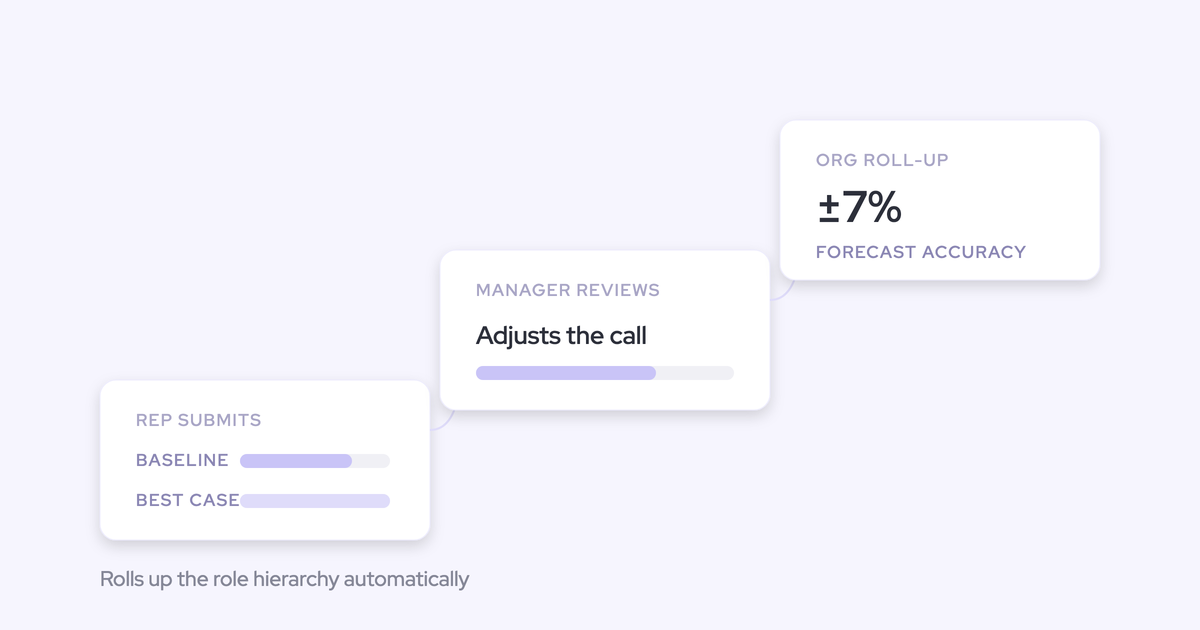
Roll-up forecasting is a bottom-up motion in which each rep submits their own forecast call, each manager reviews it and makes an independent call of their own, and the numbers aggregate up the reporting hierarchy from rep to manager to VP to exec.
The org's number is built from the judgment of the people closest to the deals, rather than extracted from them one deal at a time.
Three moves, and that's the whole framework:
- The rep submits a baseline and a best case, tied to the specific deals behind each figure.
- The manager reviews and makes their own call, which sits next to the rep's rather than replacing it.
- The org rolls up automatically, at every level, read against quota.
Everything else in this article is either how those three moves work in practice or what breaks when one of them is missing.
Why the deal-by-deal forecast walkthrough breaks down
The walkthrough doesn't fail because your reps are lazy or because you run the call badly. It fails structurally, and it fails the same way in every company we talk to.
Reps not entering their number into a shared sheet isn't a discipline problem. It's the default state of every spreadsheet forecast that has ever existed.
| What you're living with | The structural cause |
| Ten reps, ten spreadsheets, and no combined number | Nothing enforces one place to submit, so the roll-up is a copy-paste job someone does by hand every week |
| Someone snapshots the pipeline every Monday morning | Salesforce overwrites fields and keeps no history of how the pipeline moved, so last week's picture doesn't exist unless a human saved it |
| Every forecast call is a debate rather than a review | Nothing recorded what the rep said last week, so there's no prior position to hold the new one against |
| The call is a round robin of deal status and nobody is coached | Deal inspection got folded into the forecast call, so reps sit on mute until their name comes up |
| The submitted number is a mood | One figure with no range and no named deals behind it invites optimism in month one and pessimism in month three |
| You can't say whose call is reliable | The number a rep gave and the amount that actually closed are held in two different places and never compared |
And the whole apparatus scales in the wrong direction. Five reps is survivable. Fifty reps holding ten to fifty deals each makes a deal-by-deal call arithmetically impossible.
"What you miss in a spreadsheet is three main things. Typically reps do not go into a spreadsheet and report their numbers, so it is only a manager forecast. You cannot do a deal by deal forecast call because with fifty reps each holding ten to fifty deals a quarter it is just too complicated. And you cannot inspect which deals are slipping or stalling because a lot of context is missing."
Native Salesforce forecasting doesn't rescue you either. It shows the pipeline as it stands right now, with no rep submission, no stored history of how it moved, and no quota management sitting on the same page. That gap is exactly why teams fall back to a spreadsheet.
The three moves of the roll-up forecasting motion
Each move has one owner and one output, and each one exists to fix a specific failure listed above. Run two of the three and the chain leaks.
| Move | Who owns it | What it produces |
| 1. Submit | The rep | A baseline and a best case, tied to named deals, with a comment |
| 2. Review | The manager | An independent call that sits alongside the rep's, not over it |
| 3. Roll up | The system | One number at every level of the hierarchy, read against quota |
Reps submit a baseline and a best case on named deals
Two numbers, not one. The baseline is what the rep is confident closes in the period. The best case is what closes if timing goes their way.
The gap between them is the useful part. That gap is the coverage a manager coaches into, and a single committed figure collapses it and hides exactly where the risk sits.
Then the second half of the move: each number is tied to the specific opportunities behind it, not typed into a box. A rep with eleven open deals in the month picks four for the baseline and adds two more for the best case, with a line of comment on why.
Now the review runs on deals instead of on a total. You're not arguing about whether $400k is realistic. You're asking why the Acme renewal is in the baseline when nobody has spoken to the economic buyer.
Managers review and adjust without erasing the rep's call
The manager makes their own call, and it is not simply the sum of their reps. It can be higher or lower, and it comes with its own justification.
"The best companies forecast on a weekly basis for the current month and the next upcoming two months. They let their reps make a forecast call, and then they let their managers make an independent forecast call that is not just a roll up of the reps who report into them, but a separate estimate of what they think their team can achieve, with their own justification. A good tool then lets you handpick the individual deals that number is made up of."
Here's the part most teams get wrong. The manager's adjustment has to sit next to the rep's original, not overwrite it.
When a manager quietly rewrites the number, or submits on the rep's behalf, what reaches the top has no history attached. After a missed quarter, nobody can say whose judgment was wrong.
So the rep who calls 120% every quarter keeps calling 120%, and the manager who correctly trimmed it gets no credit. Two editable figures, both preserved, is what makes the chain accountable.
The forecast rolls up the hierarchy against quota
Submissions aggregate up the reporting chain automatically: rep to manager to VP to exec. No one assembles it.
Read against quota is the other half. Quota, gap to target and gap to forecast belong on the same page as the deals, at every level, because a rep's quota and a manager's revenue target are usually different numbers and both have to be visible against the same pipeline.
One practical detail worth stealing: where the sum of individual rep quotas doesn't add up to the team target, carry the remainder on the manager. The gap stays visible instead of quietly disappearing into the roll-up.
This is the view most mid-market managers have never had:
"Right now our forecast process suboptimal, okay. We're using the Salesforce module, we take a look at it, we end up talking about deals without really a step back roll up of the forecast."
The weekly cadence is the discipline, not the tool
The three moves only produce anything if they repeat on a fixed rhythm. Same days, same order, every week.
Here's a working shape you could run from next Monday:
- Monday to Wednesday: reps work deals and update the pipeline. Nothing forecast-related happens yet.
- Thursday: pipeline is current and each rep submits their baseline and best case on named deals.
- Thursday or Friday: the manager runs deal reviews with the pod, then reviews and adjusts the roll-up.
- Friday afternoon: the forecast locks. Whatever is in it is what gets discussed.
- Monday: prep questions go out on the deals that moved.
- Tuesday: the forecast call, same time, same agenda, same people.
The specific days matter far less than fixing them. What the lock buys you is that every number in the roll-up reflects the same freshness of data.
"Then on Friday, the week before, you might have like a pipeline snapshot lock, meaning that if you don't get your updates in by Friday at four pm, wherever your time zone is, we're not going to talk about it because you missed your chance to update."
Once the rhythm repeats, the forecast call changes shape entirely. You stop asking "what's your number" and start asking one question, deal by deal:
That question is the whole mechanism. It forces the reason for a change to be said out loud while the deal is still alive, instead of reconstructed at quarter end when it's too late to act.
Is it another meeting? Honestly, yes and no. The forecast call itself is an hour, but the motion costs more than that across the org, and pretending otherwise is how these things get abandoned in month two.
What it replaces is bigger than what it adds. The deal-by-deal walkthrough disappears into the submission and the deal review, and the call becomes about the deltas.
And no software creates the rhythm for you. This is the honest part, and it's the part we raise on sales calls before we show anything.
"If you don't run an operating cadence, the best tool in the world won't help you. You have to look at forecasting as a holistic process that has various ingredients to make it successful."
How roll-up forecasting makes accuracy a track record
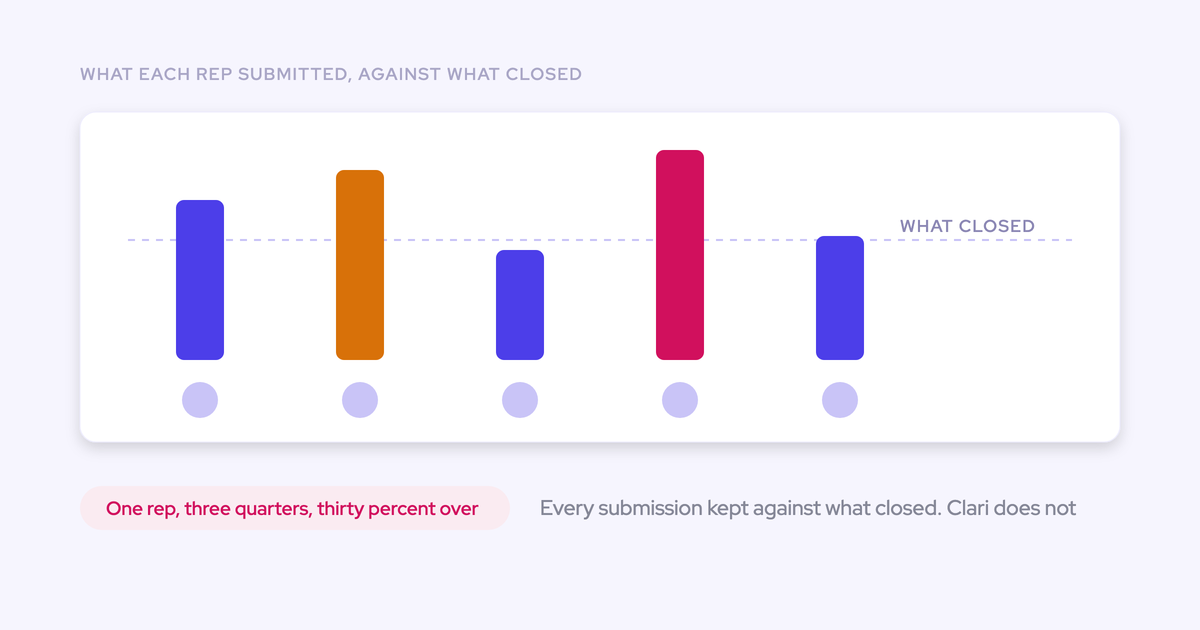
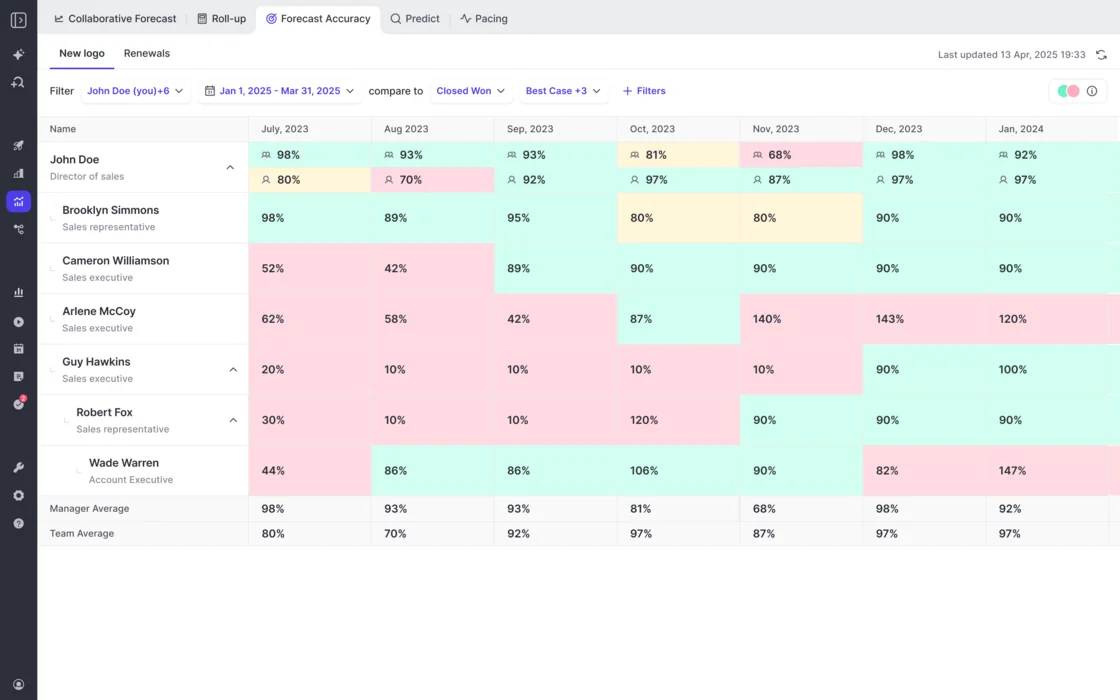
Because each submission is locked at a point in time, you can compare it against what actually closed. Per rep, per manager, quarter after quarter.
That single mechanic changes the politics of the forecast call. You already know who sandbags and who over-calls. After two or three cycles you can show it, which turns the conversation from an argument about opinions into coaching against a record.
For reference: the strongest revenue teams land around 95% forecast accuracy, and the average sits nearer 85%. That ten-point spread doesn't get closed by a better model. It gets closed by submitting often enough to be judged, and measuring the result.
Zeotap is the clearest version of this we can point at:
"With Weflow, we forecast within 7% by week 4 of the quarter."
Worth being precise about why that worked. Zeotap already ran a tight weekly, monthly and quarterly cadence before Weflow. What was missing was complete pipeline data underneath it, so the accuracy figure is what a working cadence produces once the deal records stop lying.
One piece of advice on how you use the accuracy numbers: publish them, and celebrate the reps who call it right rather than naming the ones who missed. Accuracy that gets punished turns straight back into sandbagging.
When roll-up forecasting fits, and when it doesn't
It fits when:
- Your revenue is booking-based. Contracted deals map cleanly onto an opportunity roll-up.
- You will commit to a weekly rhythm and defend it in the calendar, even in a bad quarter.
- You have a shared definition of a qualified opportunity plus written entry and exit criteria per stage, so the deals reps select are comparable to each other.
- You can separate your motions. New business, expansion and renewal have different conversion rates, and one blended number hides the one that's failing.
It's the wrong first move when:
- There's no cadence at all. No locked pipeline before the call, no weekly meeting, no defined deal review. Build the rhythm first, on a spreadsheet if you have to.
- Your revenue is consumption-based. Usage doesn't sit on the opportunity, so the roll-up has nothing honest to sum. Split the rep-owned bookings forecast from a finance-owned usage model instead.
- Nobody trusts reps to call it objectively yet. That's real, and it's usually a symptom rather than the disease.
One thing in the motion's favor if your CRM is messy: the roll-up survives bad stage data better than a weighted forecast does, because it runs on named deals and a human's call rather than on stage probability. If reps routinely drag deals from first stage to closed won, your weighted number is already fiction and the roll-up is the honest one.
And if you're on the fence about readiness, start anyway. Forecasting is a muscle. The number is the outcome of the training, not the training itself, so an imperfect roll-up run for two quarters beats a perfect one you never started.
How Weflow runs the roll-up forecasting motion
Weflow is the Revenue AI Orchestration platform for sales, customer success, and RevOps teams, built for teams that run on Salesforce. Forecasting inside it is built around the three moves rather than around a dashboard.
Start with the fair question: how is this different from a well-built spreadsheet? A good sheet can absolutely hold two numbers, a comment box, and last week's submission next to this week's. We've met managers who built exactly that and ran it well.
What the sheet can't do is combine ten of them, version every revision, keep the manager's override next to the rep's original, re-roll when the org changes, and compare the locked call to the closed amount two quarters later. Those are the mechanics the motion needs at scale, and they're structural, not a matter of building the sheet better.
Mapped to the three moves:
- Move one: each rep submits a baseline and a best case, either as a total or by selecting the specific opportunities behind each figure, with a free-text comment. A reminder email deep links them straight into the submission.
- Move two: managers override at deal or total level, and every override is timestamped, attributed and stored with its rationale rather than replacing what the rep said. Every submission is versioned, so you can see whether a rep's call moved during the quarter or never moved at all.
- Move three: submissions roll up to manager, VP and exec automatically, with quota, gap to target and gap to forecast as columns on the same page as the deals.
The roll-up view is where the whole motion becomes one screen, including who has and hasn't submitted:
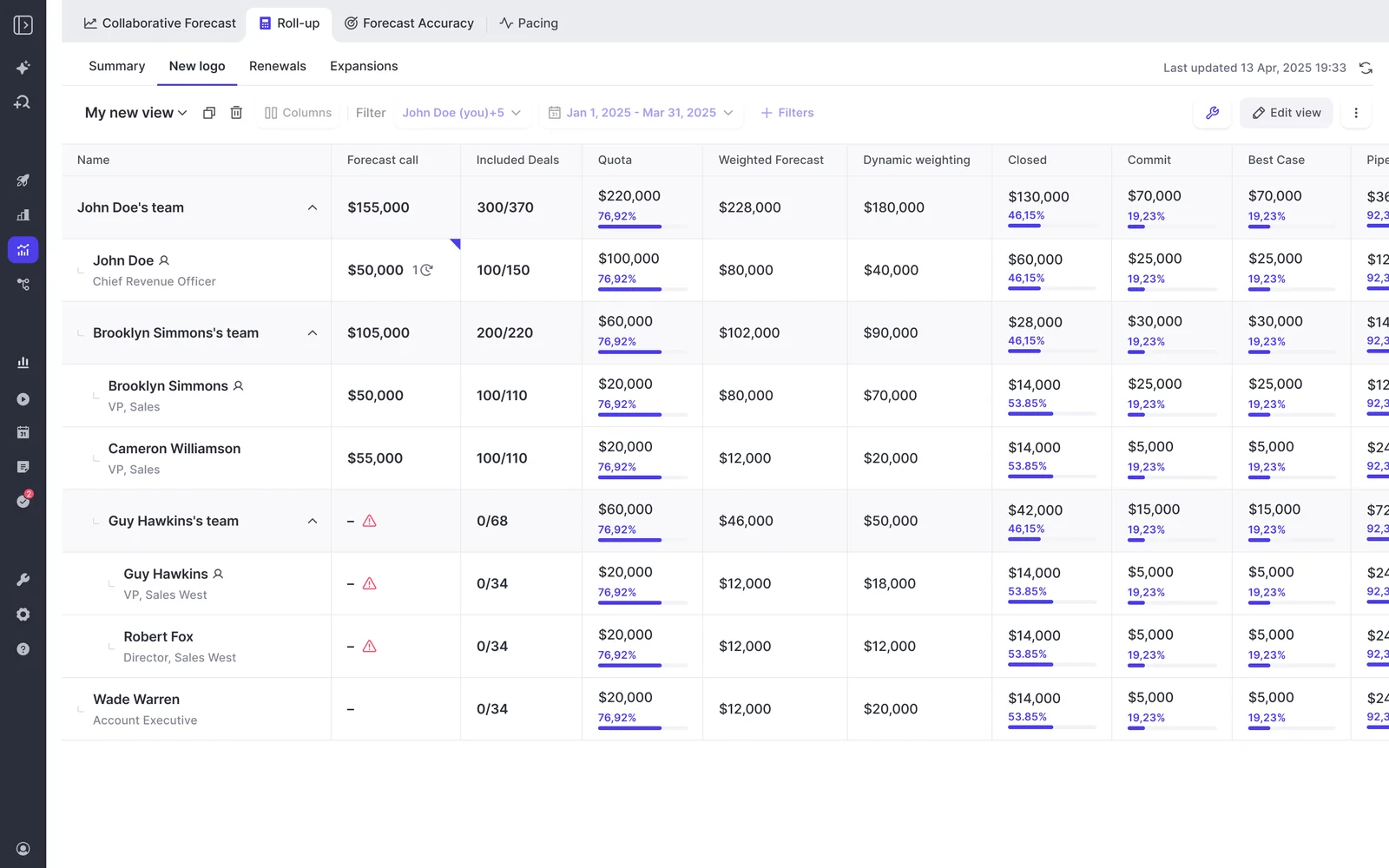
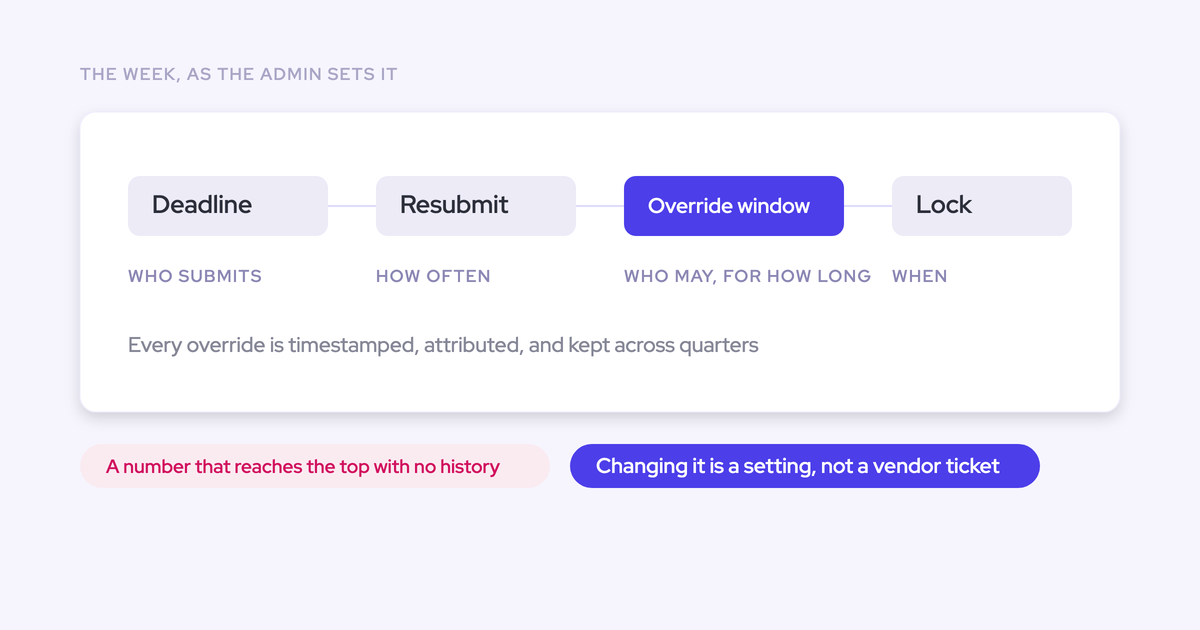
The cadence itself is configurable rather than fixed by us: submission deadlines, how often reps resubmit, who may submit, who may override, how long an override stays open, and when the forecast locks. The lock is what makes accuracy measurable, because a submission fixed at a point in time can be compared with the outcome.
That comparison then runs per rep, per manager and by segment across consecutive quarters:
One extra thing a spreadsheet structurally can't do: deal warnings show up inside the submission screen, at the moment the rep is choosing which deals to commit. Close date pushed twice, single-threaded, silent for three weeks. That's what stops unhealthy pipeline entering the forecast, rather than surfacing it in a report after the number is already wrong.
Now the limits, plainly.
Forecast submissions, targets and roll-up data live in the Weflow app and are not written back into Salesforce. Everything else Weflow captures does land in native Salesforce objects, and opportunity edits made in Weflow write straight back. Forecasting is the exception, because it sits on top of the pipeline rather than adding forecast fields to your CRM. If you've decided reps live in Salesforce and nowhere else, roll-up submission breaks that rule, and you should know it before a demo, not after.
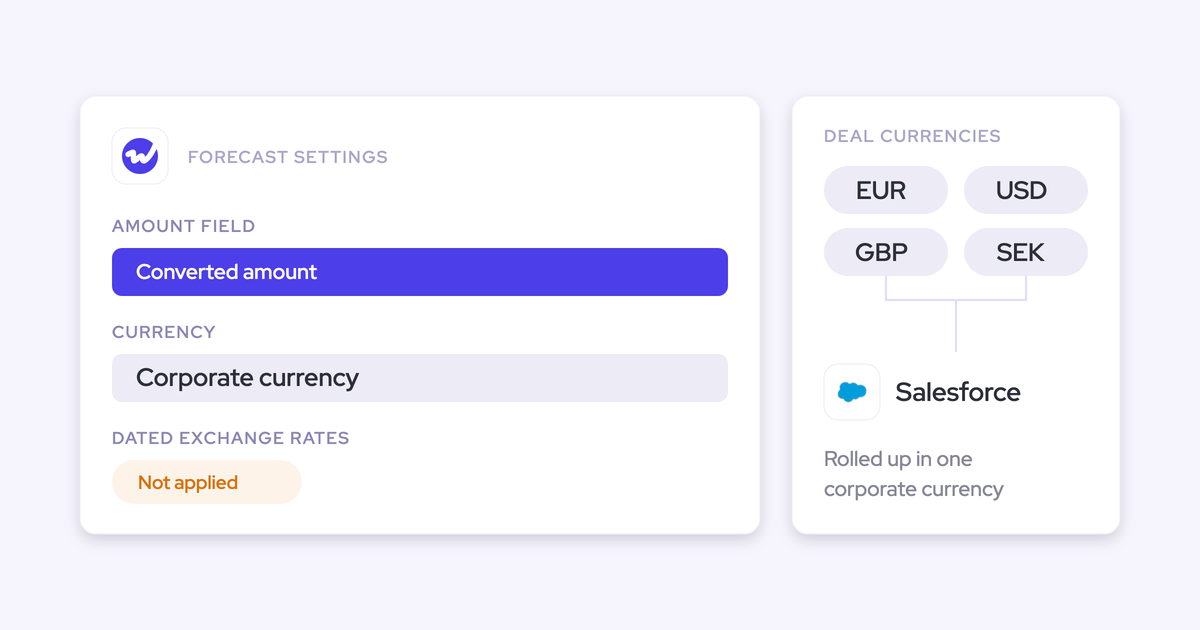
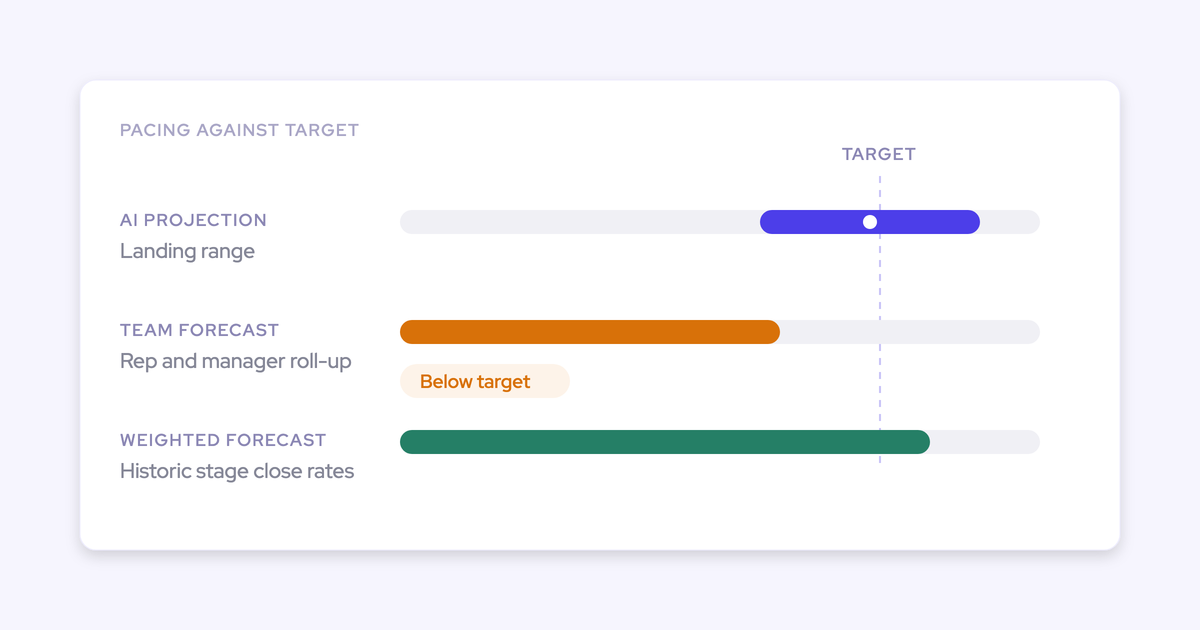
The roll-up sums the amount field you point it at. It doesn't apply stage probability weighting, which is deliberate: the weighted forecast and the AI projection run alongside it as separate reads, so you get a corridor rather than one number nobody trusts.
No tool creates a cadence. If there's no weekly rhythm underneath, Weflow automates nothing and the number it produces gets exactly the same suspicion as the spreadsheet it replaced. That's the first conversation we have with teams who come to us for forecasting.
Common roll-up forecasting mistakes
- Buying the tool before the cadence exists. Software automates a rhythm, it doesn't invent one, and a forecasting purchase with nothing running underneath it gets shelved inside a year.
- Letting one editable number collapse the chain. If the manager's call overwrites the rep's, you've lost the only evidence that would tell you whose judgment to trust next quarter.
- Managers submitting on behalf of reps. It feels efficient in week three of a bad quarter and it deletes the accountability the motion exists to create.
- Changing the meeting rhythm without explaining why. Reps build prep habits around a predictable format, and moving the day or the agenda quietly degrades the quality of every number in the roll-up.
- Blending motions into one forecast. New business, expansion and renewal convert at different rates, so a single number hides which motion is actually missing.
- Forecasting on pipeline nobody inspected. Forecasts miss because unhealthy deals carry real dollar value into the number, not because the arithmetic is wrong. Haircutting the total treats the symptom and the same miss repeats next quarter.
- Treating the number as the point. The forecast is the output of the process. If the weekly motion isn't also making your team better at working deals, you've built a reporting ritual.
Free guide: getting started with bottom-up forecasting
Roll-up forecasting FAQs
Will reps actually submit their forecast every week?
Some will, some won't, and that's a management problem before it's a tooling one. Reps don't adopt forecasting products the way they adopt a notetaker; forecasting is a leadership motion and it needs a deadline with consequences behind it.
What helps in practice: a reminder that deep links the rep straight into their submission, a hard lock time, and a forecast call that genuinely doesn't discuss anything submitted late. What helps most is the deal data underneath being right, because reps resist submitting numbers built on records they know are wrong.
How long does the weekly roll-up forecasting motion take?
The submission itself is minutes per rep once the deals are current. The deal review is where the real time goes, and that's time you're already spending, badly, inside the walkthrough.
Don't budget it as a one-hour meeting though. A forecast cadence burns calories across the whole org, and teams that treat it as a single calendar slot are the ones that quietly stop running it.
Does roll-up forecasting fit if reporting lines don't match Salesforce?
They rarely do. Overlays, pods, regional splits and dotted lines all live outside the Salesforce manager field.
In Weflow the team structure and hierarchy are configured during onboarding, so the roll-up path follows how you actually report rather than how your CRM user records happen to be wired. Worth checking on any tool you evaluate: Gong's forecast roll-up follows the Salesforce hierarchy, which means teams whose lines differ end up maintaining a placeholder structure purely to make the roll-up resolve.
Does the submitted forecast write back into Salesforce?
No. Forecast submissions, targets and roll-up data live in the Weflow app.
Everything else lands in Salesforce: activity, transcripts, summaries, AI field updates, and any opportunity edit made in Weflow. If you need the roll-up in a BI tool, you pull it through the public API rather than reading it from Salesforce.
Can I lock forecast submissions before the forecast call?
Yes, and you should. Deadlines lock the submission field, and locking is what makes accuracy measurable, because a number fixed at a point in time can be compared with what actually closed.
How often reps resubmit is configurable too. Weekly against a monthly period is the common shape, which works out to a lot of submissions across a quarter and is exactly what turns the forecast into a track record.
What does forecasting cost in Weflow?
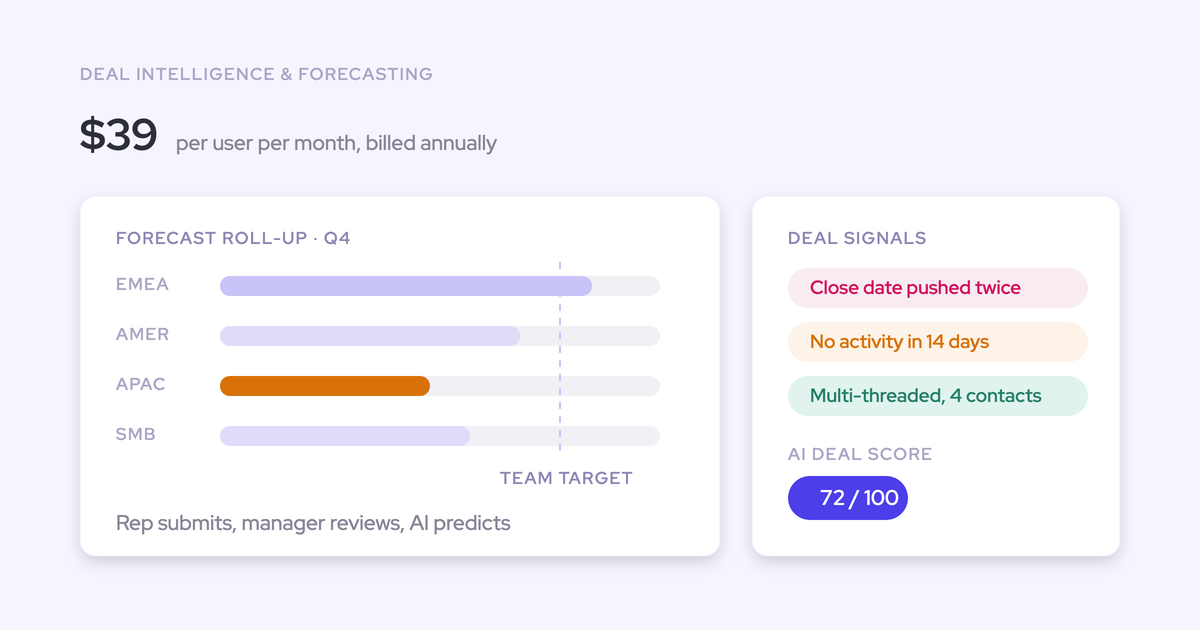
Weflow Deal Intelligence & Forecasting is $39 per user per month, billed annually, and it includes pipeline management, deal signals, pipeline analytics and the full forecasting layer. It can be bought standalone.
Inside the bundles, forecasting sits in Revenue AI Enterprise at $79 per user per month. Revenue AI Business at $59 includes Deal Intelligence but not pipeline analytics or forecasting, which is the packaging detail people most often miss. Minimum is 10 users, and view-only seats for leaders who just read dashboards are free.
One honest note on evaluating it: capture and conversation intelligence prove themselves in a two-week trial. Forecasting doesn't, because it only proves itself once the motion has run for enough cycles to compare predicted against actual. Plan for a quarter, not a fortnight.