
Why sales commits called at 90% close at 50%, and how to tighten commit accuracy


Commit accuracy is the measured rate at which deals called commit actually close in the period, scored against the rate the team claimed. It's a number, not a feeling. And most teams have never calculated it.
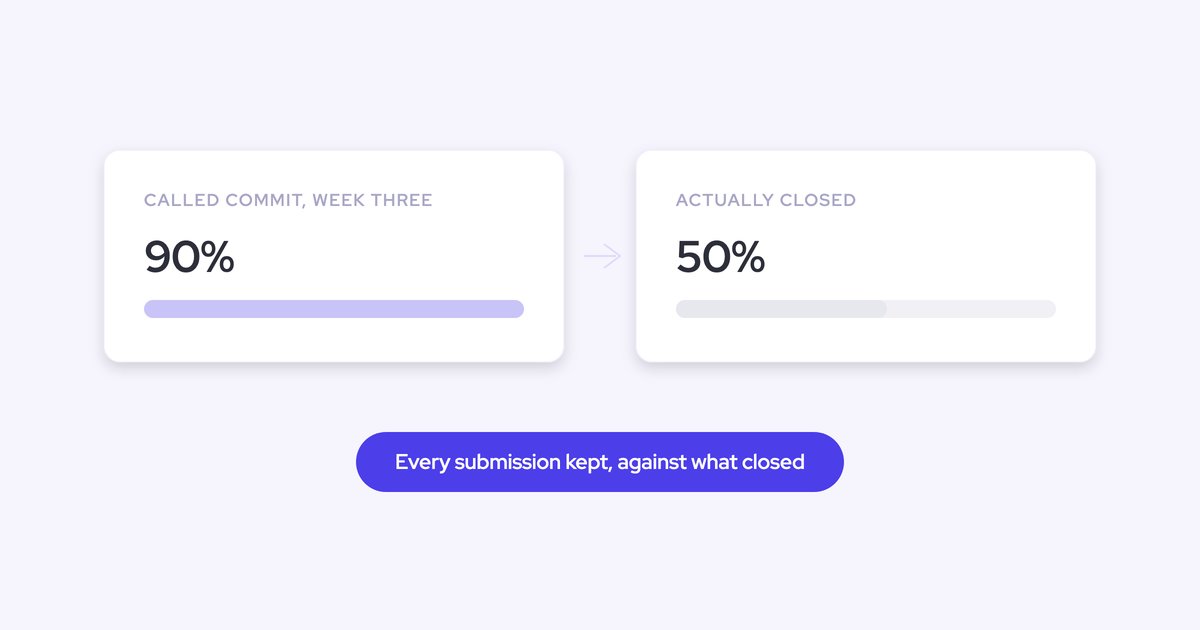
That's why the 90/50 gap keeps happening. When commit gets called at 90% and lands at 50%, the forecasting tool didn't fail. The commit definition did: commit has become a judgment category that means whatever each manager decides it means, assigned on confidence, and never once scored against what closed.
This article gives you the cheap test that proves it on your own data, the criteria that make commit defensible, the cadence that keeps it calibrated, and how forecast submission and roll-ups keep the called number in the same place as the closed number so you can finally score the gap.
Why commit deals don't close at the called rate
The gap is structural. Commit is a category with no shared definition, no retained history to score it against, and no evidence requirement, so it can only be right by luck.
"Now you talk to a sales leader, what's your commit? They'll tell you, well, it's ninety percent, eighty percent. And then you find out that only fifty or sixty percent of those deals won. Okay. Well, something's wrong with your commit process then. Right. That's the kind of thing you start thinking. It's a flawed process ultimately."
Three things produce that gap. They compound, which is why fixing one of them never moves the number much.
Commit means something different to every manager
Home-grown forecast categories drift away from the stages they were built to describe. So the roll-up sums numbers that aren't comparable, and nothing in it can be checked.
| Manager A's team | Manager B's team |
| Commit means verbal yes from the buyer, paper not started | Commit means signature expected this month, procurement engaged |
| Commit is the number the rep believes on a good day | Commit is the number the manager will personally defend |
| Slipped commits move to next quarter's commit | Slipped commits drop back to best case |
Both managers submit into the same column. Leadership adds the two together and calls it a forecast.
Then there's the human layer on top, which every RevOps leader recognizes instantly:
Leadership knows this, so it haircuts the number with a gut feel. Now the board number is two people's instincts stacked on each other.
And inconsistent data is worse than missing data. An empty field is honestly empty. A filled one invites a decision built on it.
Salesforce keeps no snapshot to score commit against
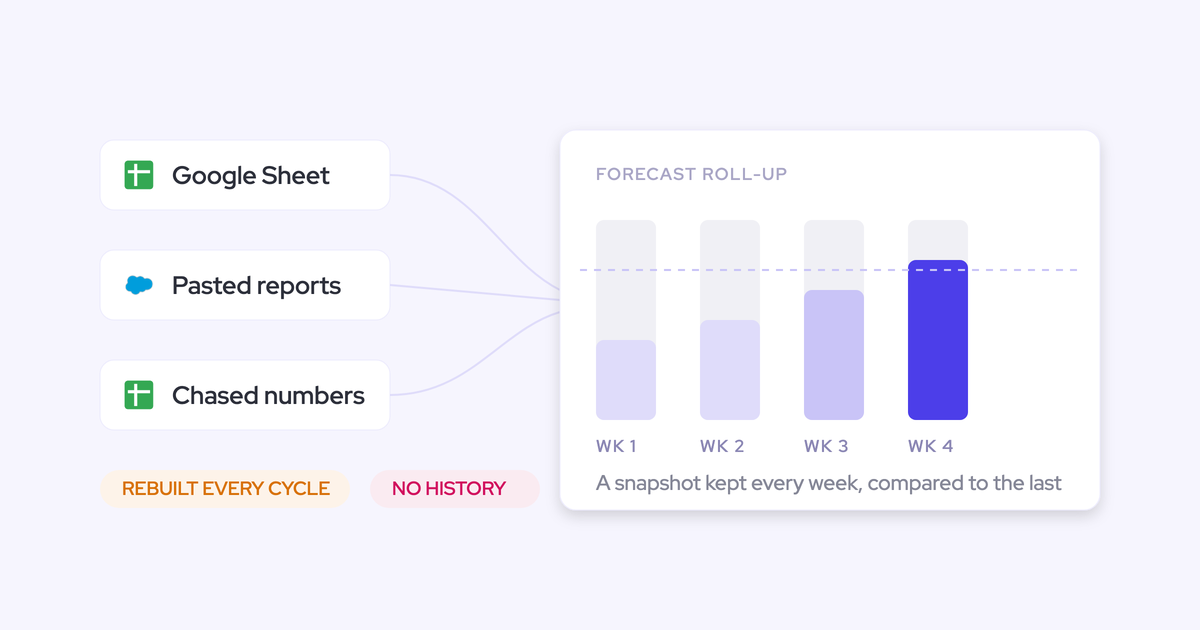
Salesforce overwrites the field and keeps no history of what the pipeline looked like last month, unless someone enabled field history tracking on that field in advance. Calculated and roll-up fields can't be history-tracked at all, and the custom amount field you forecast on is often exactly that.
So the week-10 commit list and the closed-won list are never reconciled. The commit process is never scored, which is why it never corrects itself.
That's the moment a management question turns into a data engineering project with a bill attached. Most teams quietly drop the question instead.
Commit is assigned on confidence, not buying milestones
Nothing in Salesforce stops a rep dragging a deal from the first stage straight to closed won in one click. No entry or exit criteria are enforced, so stages get skipped, and the qualification fields that were supposed to back the call sit empty.
What's actually behind most commit calls:
- A stage the deal was moved into without anything verifying it got there.
- MEDDIC or SPICED fields that were never filled, so nobody can say which deals are genuinely qualified.
- A close date that has already been pushed three times without anyone counting.
- A next step field that's blank, and a last logged activity from six weeks ago.
- One contact on a deal that in reality has five people on the email thread.
Strip those away and the only remaining input is rep confidence. Confidence is a mood. You can't roll up a mood.
How to test whether your commit process is broken
Snapshot the commit list at a fixed point in the quarter, count what actually closed, and compare the realized rate against the rate your team claims commit represents. You don't need a warehouse to do it once.
- Pick a fixed point. Week 10 of the quarter works, because it's late enough that reps have real information and early enough that the call is still a prediction.
- Export the commit list as it stands that day: opportunity name, owner, manager, amount, close date. Save it somewhere nobody can edit.
- Before you look at anything else, ask three managers what probability they think commit represents. Write down what they say.
- On day one of the next quarter, pull the closed-won list for the period.
- Count the conversion two ways: by deal count and by amount. They rarely agree, and the difference tells you whether your misses are concentrated in the big deals.
- Split it by rep and by manager. Then do the same thing again next quarter.
Now read the result. A claimed 90 landing at 50 isn't a bad quarter, it's a definitional problem: the category is being assigned on optimism and relationship rather than on anything checkable.
A claimed 75 landing at 73 is a forecast you can hire against, even though the number is lower.
Direction matters too. Commit converting well above the claimed rate is sandbagging, and it's just as expensive, because you left capacity and spend on the table against a number you always knew you'd beat.
One catch, and it's the whole reason this test is rare: it needs a snapshot you kept. If nobody retained the week-10 list, you can't run it retroactively. You can only start retaining it from now.
How to define commit criteria you can evidence
Commit is defensible only when it requires named conditions a manager can check on the record. Not a confidence level, not a percentage the rep picks off a dropdown.
The useful frame is two gates. Is the deal real, and can it land in this period? Each gate is a short list of fields, roughly a handful per gate, so managers inspect a checklist instead of holding a debate.
Anchor commit to verifiable buying milestones
The criteria have to be things the buyer has done, because seller activity is exactly what a rep can produce on demand. Stages and categories built on buyer milestones stay honest; ones built on seller activity inflate whenever the quarter gets tight.
A starting set worth arguing about with your sales leaders:
- The economic buyer has been in a live conversation on this deal, not just named on the record.
- Pricing has been presented and the buyer has responded to it commercially, not just received it.
- The buying process is written down: who signs, in what order, how long procurement takes at this account.
- There's a close plan with dates the buyer has explicitly agreed to.
- More than one person on the buying side is actually replying, measured from captured activity rather than from contact count.
- The close date hasn't moved since the deal entered its current stage.
Every one of those can be challenged with evidence. That's the point. A commit call you can only argue with opinion is the thing you're trying to get rid of.
Keep opportunity stage and forecast category separate
Stage records the process. Forecast category records the judgment. Align them loosely, never fuse them automatically.
| Opportunity stage | Forecast category | |
| What it records | Where the deal verifiably is: discovery, proposal, negotiation | Whether it closes in this period: commit, best case, pipeline |
| Who owns it | The process, ideally set from events like a quote being created | The rep, reviewed by the manager |
| What breaks when it's misused | Reps advance deals on optimism, so stage conversion rates stop being comparable and the weighted forecast is built on noise | Auto-flipping category from stage removes the one input only a human can give, and commit becomes a mechanical restatement of stage |
A deal in discovery should never be commit. That's alignment, and you can enforce it as a rule. But a deal reaching negotiation shouldn't flip to commit by itself, because the buyer's timeline is a separate question from the deal's progress.
Teams that re-platform often take the chance to rip out drifted custom categories and go back to commit, best case and pipeline tied to stages. That's the right instinct, as long as "tied" means constrained, not automated.
The cadence that keeps commit calibrated
Criteria only hold if a rhythm enforces them and a scoring loop corrects them. Commit accuracy is a weekly discipline with a quarterly scoreboard, not a report generated at quarter end.
"It's not necessarily the math in the number. A lot of what I've seen in my experience, and a lot of what was proven to be true, is the inputs that take place before the output. How many people in RevOps have walked into their very first forecast meeting, and the VP of sales says to the team, how much are you committing? They're looking for the magic number. But that is just the output of the process you should be setting up."
Run a fixed weekly forecast submission rhythm
Fix the days. That's what makes every number in the roll-up reflect the same freshness of data, which is the precondition for comparing anything.
- Reps clean their pipeline by a set day, usually Thursday. Amounts, close dates, next steps.
- Managers run deal reviews with their pod on Friday, on a selected set of deals rather than the whole list.
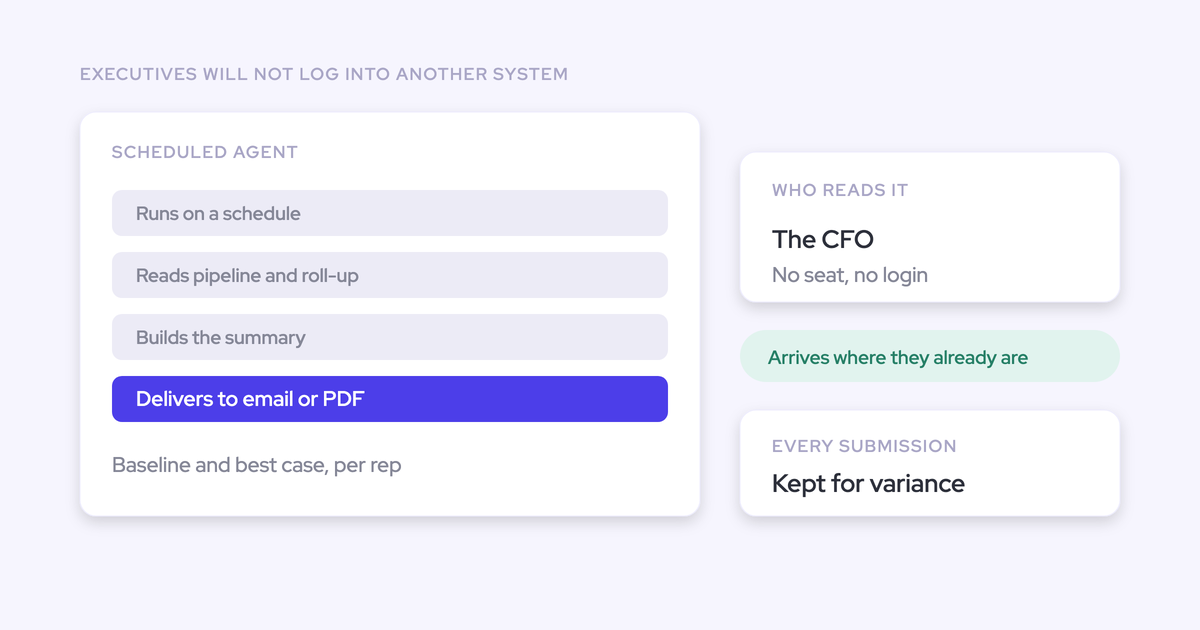
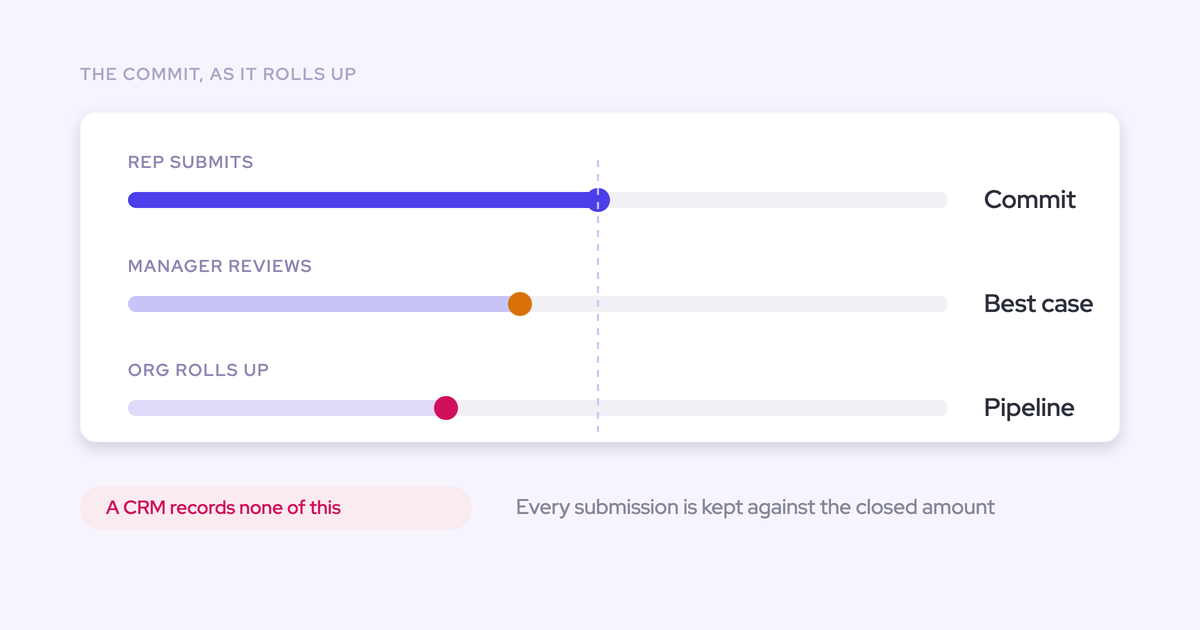
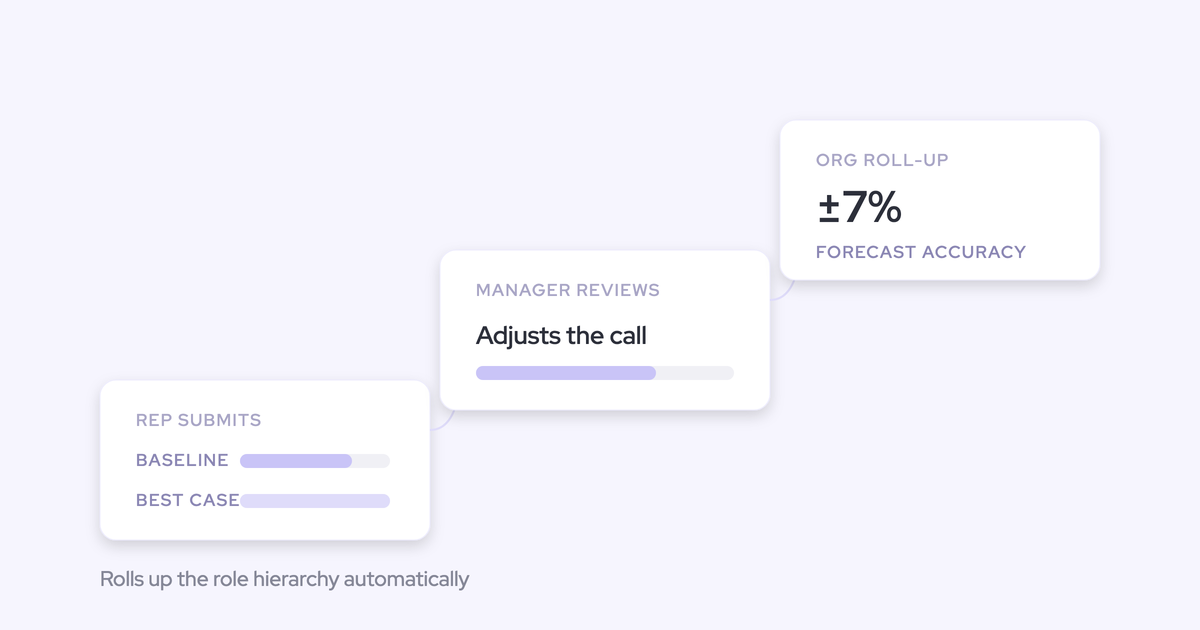
- Reps submit two numbers, not one: a baseline they're confident closes, and a best case if timing goes their way.
- Managers review the roll-up and adjust, with their change sitting beside the rep's original rather than replacing it.
- The forecast call happens on the same day every week, and it inspects the gap between what reps said and what the deal evidence supports.
Two numbers instead of one matters more than it sounds. The baseline is what the business plans on. The gap between baseline and best case is the coverage the manager coaches into. A single committed number collapses both and hides where the risk sits.
And keep deal inspection out of the forecast call. When they're the same meeting, the room is too full, there's no time, and it degenerates into "what's up with that deal, okay, next" while everyone else sits on mute.
Score and publish commit accuracy every quarter
Lock the called number at a fixed week, score it against actuals at quarter end, publish the result, and celebrate the teams that got it right instead of naming the ones that missed.
"Don't just talk about it, but lead by example and measure predictability and celebrate when you're doing it well. So we had a clearly defined process for forecast accuracy. Like, we would take the fourth forecast of a quarter, like week four, everyone got logged in, we put it onto a Confluence page, and towards the end, we wouldn't punish publicly the people who got it wrong. There's multiple reasons for that, right? But we would celebrate the teams and people who got it right."
Public punishment teaches people to protect themselves, which produces worse forecasts, not better ones. Public celebration teaches people that being right is the currency.
The week-four lock is the load-bearing part. Lock it later and you're scoring a report of what already happened.
What this surfaces is the thing nobody can currently prove: the rep who misses by 30% three quarters running. Right now that rep costs the company a board reset every quarter and it never shows up anywhere a manager can act on. With a scoreboard, the forecast conversation becomes a track record instead of a debate.
How Weflow makes commit accuracy measurable in Salesforce
Everything above needs three things Salesforce doesn't retain on its own: the called number, the snapshot history, and evidence at the moment the rep commits. Weflow is the Revenue AI Orchestration platform for sales, customer success, and RevOps teams, and this is the part of it that stores the discipline's raw material.
Every forecast submission recorded against final closed amount
Weflow records every forecast submission against the final closed amount, which produces variance per rep, per manager and per segment across consecutive quarters.
That's the whole "whose call is worth trusting" question turned into a report. The called number and the closed number stop living in different places, so you can query the gap after the fact instead of arguing about who remembered what.
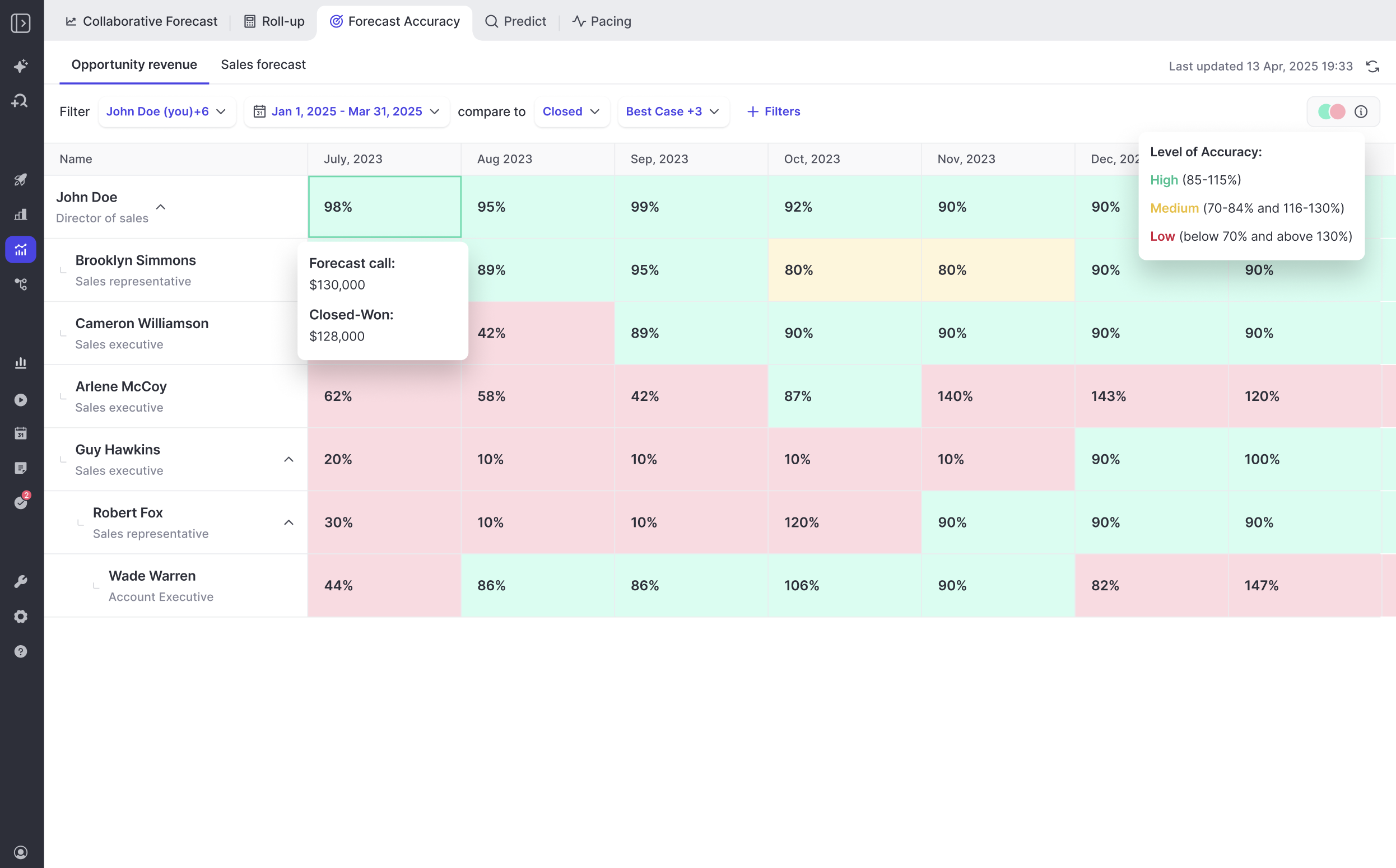
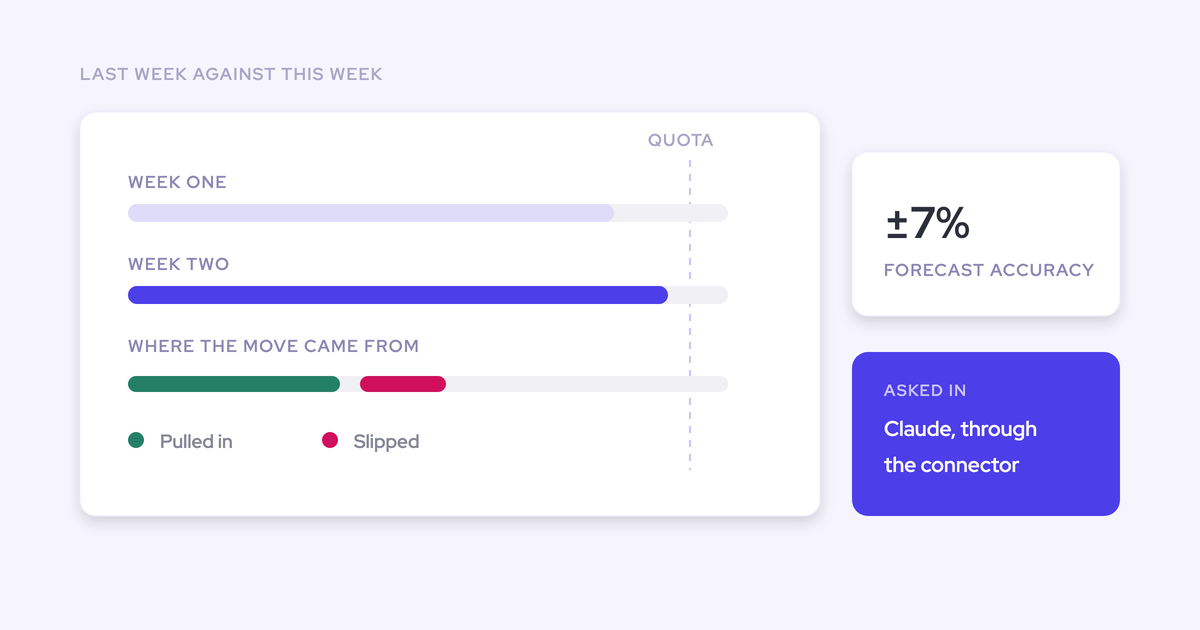
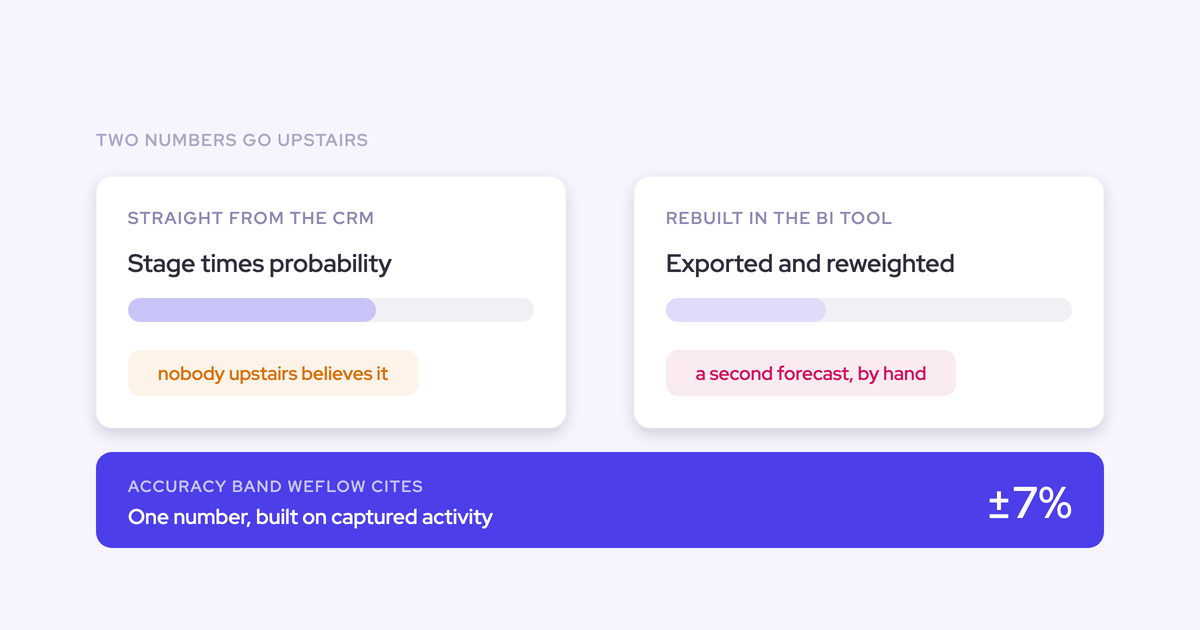
Zeotap runs its forecast on this process and lands within roughly 7% accuracy. That number is a consequence of the loop, not of the software: they lock a call, score it, and coach the variance.
Versioned submissions tied to named opportunities
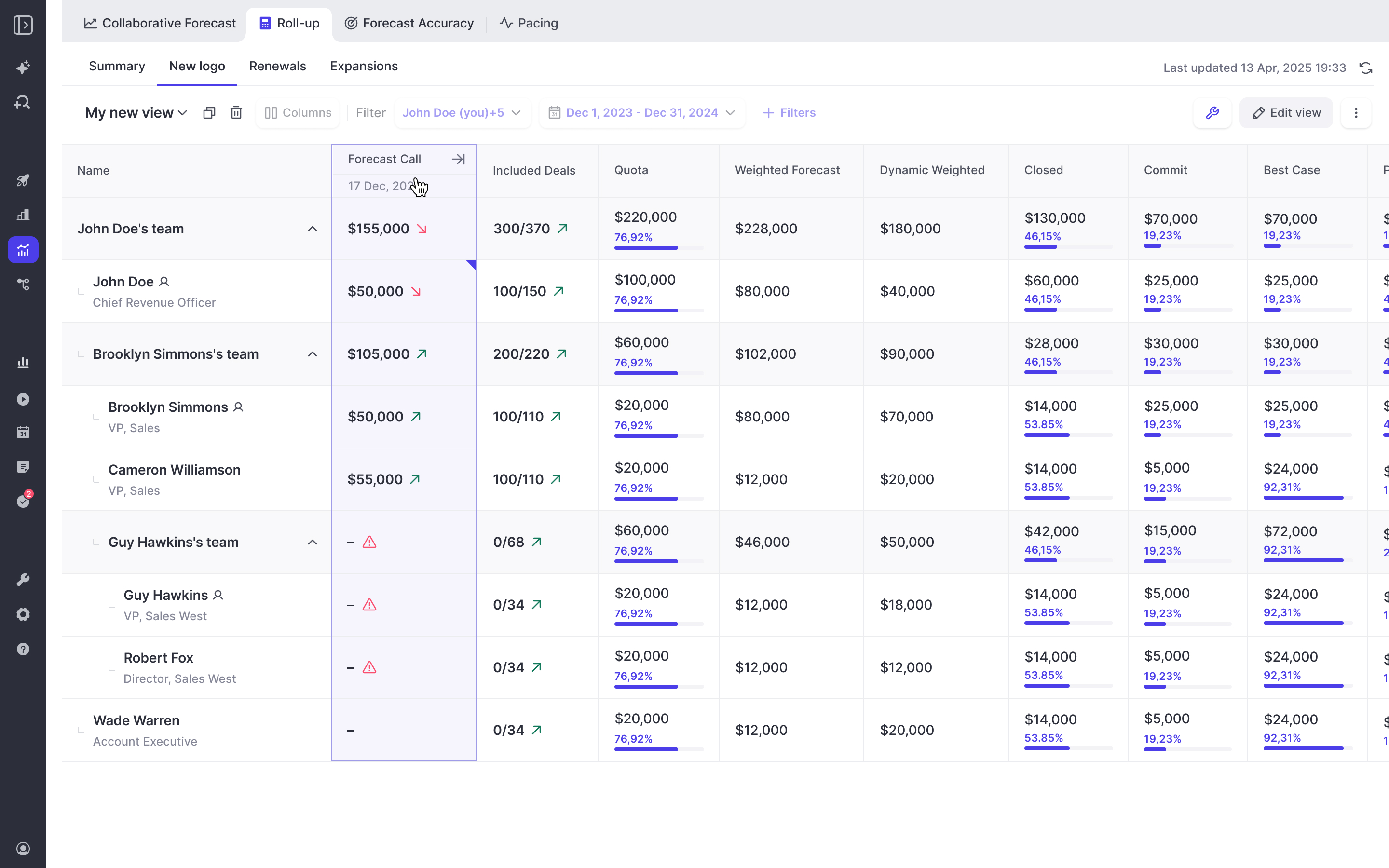
Each rep submits a baseline and a best case, either as a total or by ticking the specific opportunities behind each figure, with a comment. Every revision is retained.
Because the number is tied to named opportunities rather than typed into a box, the forecast review runs deal by deal instead of arguing about a total. Managers can override, and the override sits next to the rep's original. Deadlines can lock the field.
The version history is what makes commit coachable. You can see whether a rep's call moved during the quarter as they learned things, or never moved at all, which is its own tell.
Three forecast methods produce a landing corridor
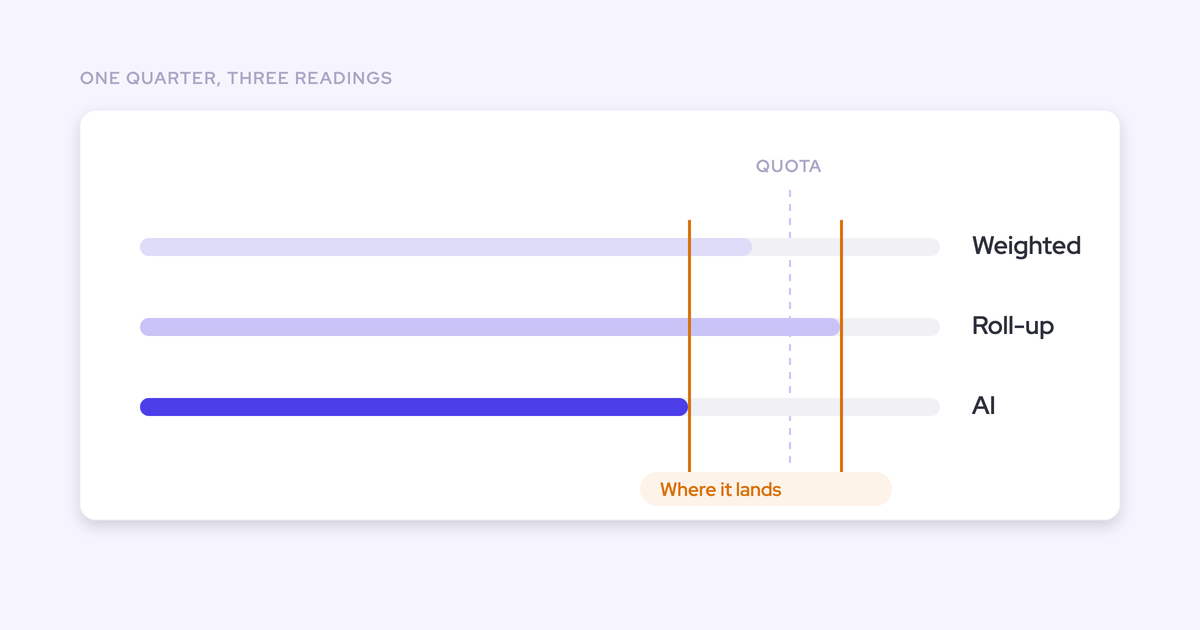
Weflow runs a weighted forecast, the rep and manager roll-up, and an AI projection side by side, so you get a corridor instead of a single number nobody trusts.
| Method | What it reads | What the gap signals |
| Weighted forecast | Historic stage conversion rates from your own closed deals | A roll-up far above it means the team is calling deals the pipeline math doesn't support |
| Roll-up | What the people closest to the deals submitted | A submission that never moves all quarter is a rep who isn't actually forecasting |
| AI projection | More than fifty deal-level signals and up to two years of history, returned as a range | A projection below the roll-up on a big deal usually means the deal is being worked badly |
The divergence is the agenda for the commit conversation. Where all three converge, you have a credible range to take into a board meeting. Where they split, you have a specific deal and a specific rep to inspect.

Deal warnings flag weak commits at submission
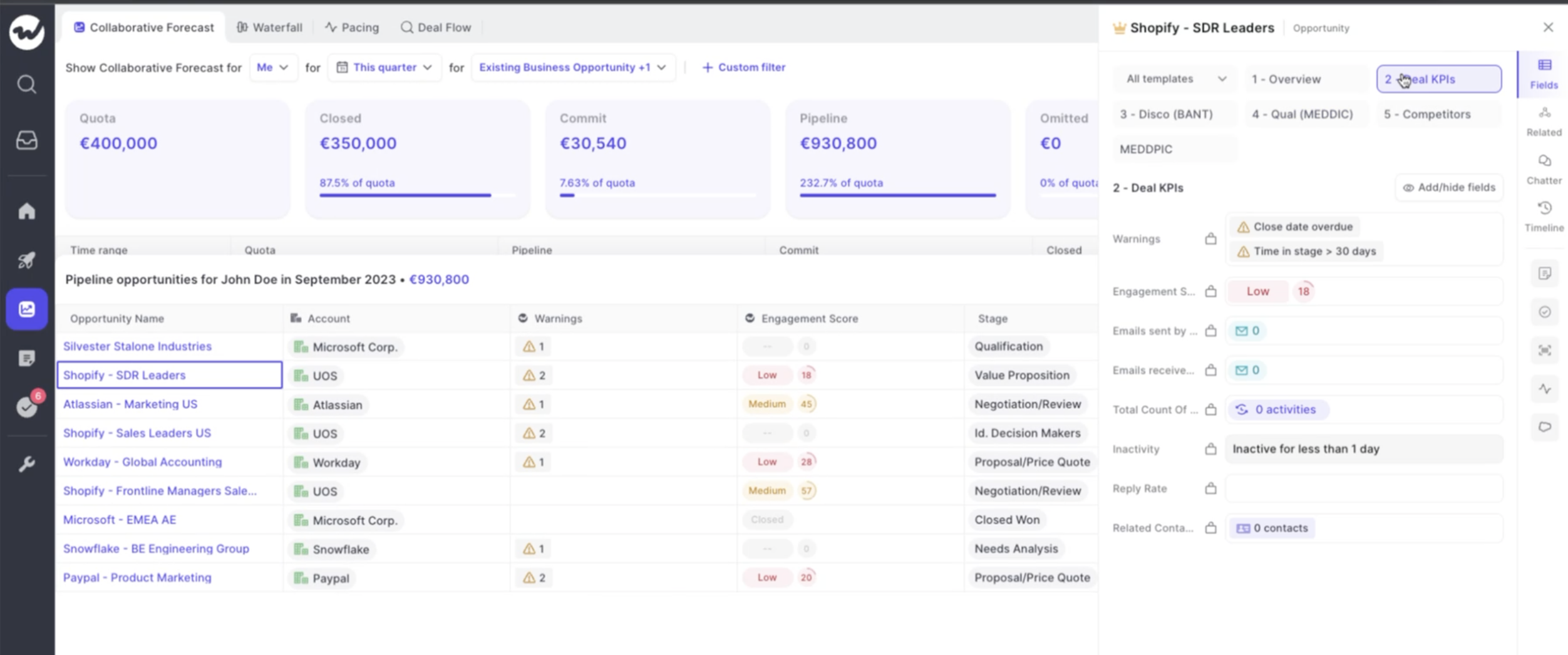
Weflow surfaces deal warnings inside the forecast submission screen, at the moment the rep chooses which deals to commit. That's what stops unhealthy pipeline entering the forecast instead of surfacing it in a report after the number is already wrong.
The warnings are rules your admins author against any Salesforce field or any of Weflow's computed fields, because a warning only works when it encodes your slippage patterns and your cycle length. Typical triggers:
- Close date pushed more than twice.
- Only one contact attached to the deal.
- No activity for a number of days you set against your own sales cycle.
- Days in the current stage beyond your benchmark from closed-won deals.
- A missing methodology field on a deal being committed.
Days in stage and total close-date push count are tracked automatically, so you're not building custom fields and the automation to populate them just to get the two signals every commit review needs.
What Weflow won't fix: the commit definition is yours
Weflow won't tell you what commit should mean at your company. Those criteria are a process decision your sales leaders and RevOps have to make and defend. The platform enforces them, measures them, and shows you the variance. It doesn't invent them.
"forecasting is really like a muscle you need to train and the number in the end, that's sort of the outcome of a long, long training cycle, exercise cycle that you went through before."
One more boundary worth knowing before you evaluate. Activity, transcripts, summaries and AI field updates all land in native Salesforce objects, and edits made in Weflow write straight back. Forecast submissions, targets and roll-up data are the exception: they live in the Weflow application rather than as new Salesforce forecast fields.
If your org has a hard rule that reps only ever work inside Salesforce, roll-up submission breaks it. The weighted forecast and the AI projection still work for you, because both run off CRM data with no rep input. And if you snapshot forecasts into a BI tool, you pull the roll-up through the public API rather than reading it from Salesforce.
Free: The Ultimate Sales Forecasting Guide, the full cadence, categories and accuracy loop in one document you can take to your CRO.
FAQ: commit accuracy and the forecast process
Will reps have to submit deals manually, is this more admin?
The rep owns the judgment call and nothing else. A reminder email deep-links them straight into the submission, where they tick the deals behind their baseline and best case.
Everything around the call arrives without typing: activity and contacts captured automatically, qualification fields written from the conversation, warnings computed from the deal itself. That's the test any fix has to pass, because every extra field a rep is asked to fill is a field that gets filled badly or not at all.
Does the forecast roll-up hold up above the first manager level?
Yes. Submissions roll up rep to manager to VP to executive automatically, and each level submits its own number rather than inheriting one.
This is where a lot of tools break, and buyers tell us so directly: the view works at the first-line manager and falls apart a level above. Keeping each level's own submission, with manager overrides sitting beside the rep's original instead of erasing it, is what makes accountability survive the hierarchy.
Is the AI projection just stage probability in disguise?
No. The AI projection reads more than fifty deal-level signals and up to two years of history, including communication cadence, whether a next meeting is booked, rep performance, seasonality and whether the deal is healthy against your methodology, and it returns a range rather than a single number.
It owes nothing to rep self-reporting, which is exactly what makes it a check on commit rather than an echo of it. A large deal that's being worked badly gets projected down no matter what category the rep picked.
How should renewals be committed versus new business?
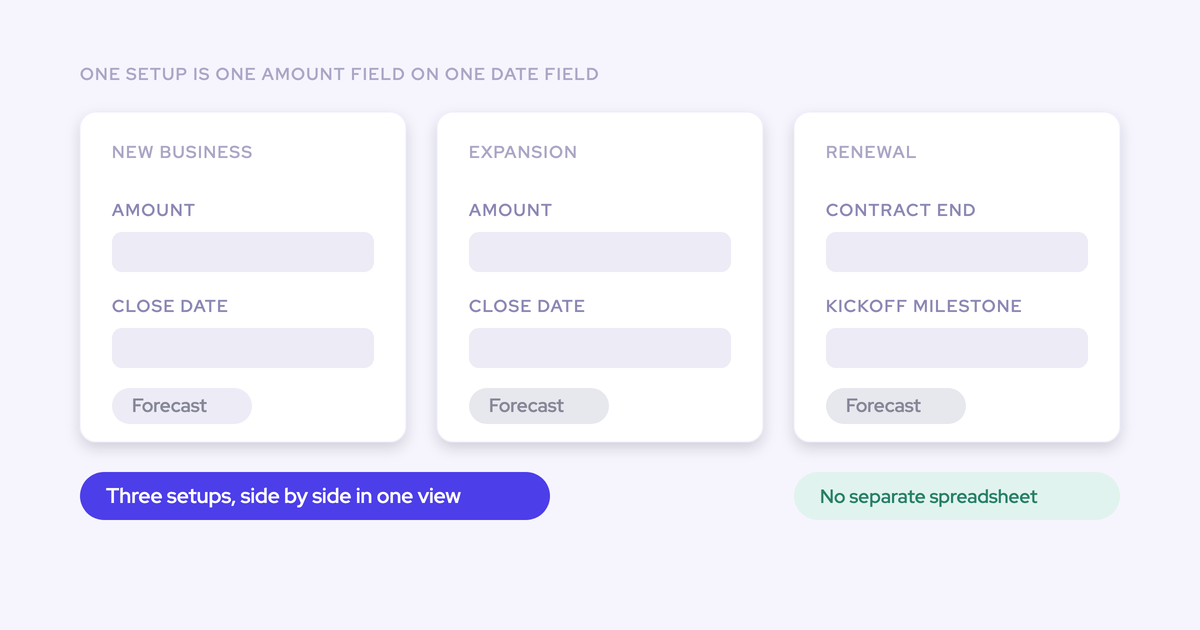
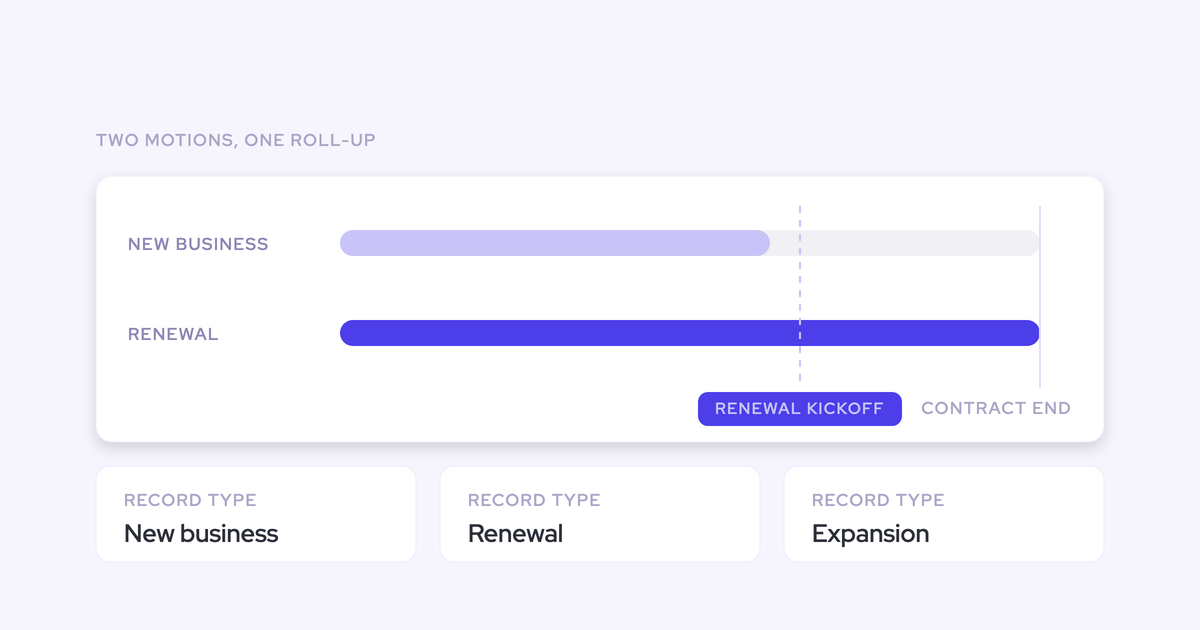
Separately. Renewals are a different probability world, and blending them into one commit number hides risk in both directions.
Weflow forecasts renewals in their own pipeline view, tracks contract end dates, and fires a configurable renewal-kickoff milestone ahead of expiry. That matters because renewals are the motion that never gets implemented: new business runs in the forecasting tool while the renewal team still forecasts out of Salesforce, and in most companies the renewal base is the larger number.
What is a good commit conversion rate?
There isn't a universal benchmark, and chasing one is the wrong goal. Calibration is the goal: the realized rate matching the claimed rate, quarter after quarter.
A claimed 90 landing at 50 is broken. A claimed 75 landing at 75 is a forecast you can plan hiring and spend against. Treat overall forecast accuracy as a target you iterate on, moving from around 80% toward 85, then 90, and read it for what it is: a lagging indicator of how well the whole sales organization is being run.