Weflow vs Clari: An Honest Comparison for Teams Facing a Clari Renewal
Compare Weflow vs Clari for renewal: data ownership, Salesforce-native admin, deal risk, and cost.



A RevOps leader four years into a Clari contract asked us on a renewal call: "what is it that Weflow can bring to the table that Clari couldn't do for us in the four years that we've been customers?"
This article is the honest answer to that question.
The gaps you've lived with, the professional-services ticket for a ten-minute change, the forecast rebuilt in Tableau every cycle, the renewals team still forecasting in raw Salesforce, were never implementation failures a better rollout would have fixed.
They're structural, and we'll walk through them gap by gap, including where Clari is still the stronger choice and when you shouldn't switch at all.
Weflow vs Clari at a glance
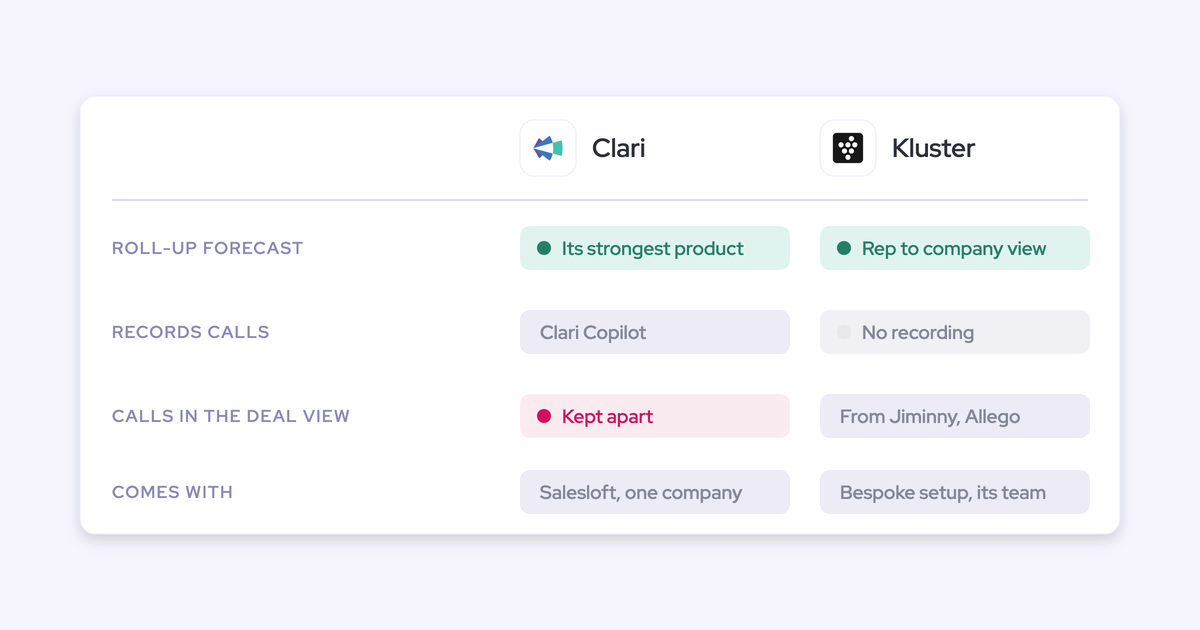
Weflow and Clari differ on where the data lives, who administers the tool, whether deal reality informs the forecast, and what it all costs. They don't diverge much on roll-up mechanics, which is Clari's strongest ground.
| Dimension | Weflow | Clari |
| Where the data lives | Native Salesforce objects the customer owns, readable by your own reports, automations, and AI | Clari's own cloud; Salesforce is a source, the intelligence stays in Clari |
| Admin and configuration | RevOps configures forecast calls, targets, views, and warnings directly, self-service | Changes routed through customer success and professional services |
| Deal-level risk signals | Days in stage, push count, and customer-authored warnings tracked automatically on every opportunity | Weak at deal-by-deal health; stuck and pushed deals are dug for manually |
| Conversation data in the forecast | Calls and emails write to the same Salesforce data layer the forecast reads | Forecasting and conversation intelligence products don't share data |
| Forecast accuracy measurement | Forecast-vs-actual variance tracked per rep and manager across quarters | No built-in measurement against actuals |
| Roll-up at massive enterprise scale | Strong for mid-market and enterprise, not yet matched at 1,000+ reps | Clari's best territory: deep, flexible roll-up mechanics at huge scale |
| Pricing and evaluation | Transparent pricing from $19 to $79 per user per month, no implementation fees, 14-day trial on your own Salesforce org | Quote-only; reported at $120 to $180 per user per month plus reported services fees, demo-led evaluation |
Why Clari customers start looking at alternatives when the renewal lands
Nobody rips out a forecasting tool because they're bored with it. You do it at renewal, because that's the one month a year you have leverage, and by then the pattern has usually been building for years.
The complaints we hear on these calls are consistent and sound roughly the same:
The product we used in '23 is exactly the product we use in '26.
The recurring triggers that make users evaluate Clari alternatives:
- A product that stopped visibly shipping: "no improvements, no efficiencies, no growth," and a promised AI agent that "disappeared off the grid."
- Every config change routed through professional services, so a ten-minute task takes two weeks and comes with a bill.
- The forecast presented to the CFO is rebuilt in Tableau every cycle because the tool's own views aren't presentable to that audience.
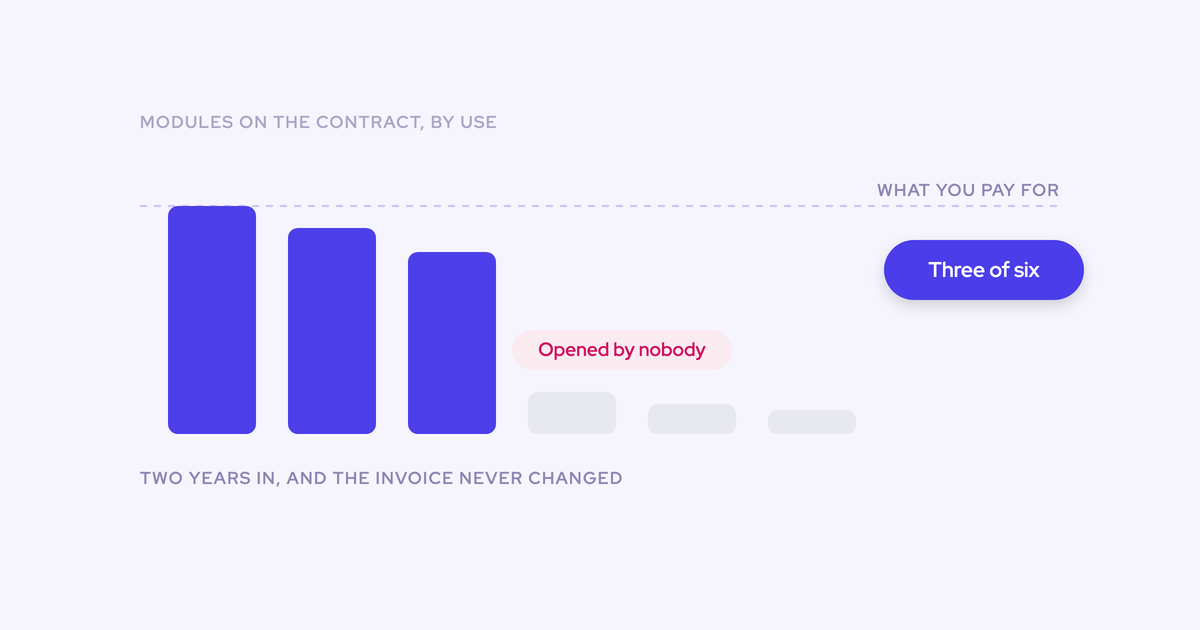
- Half the modules unused, and the renewals team still forecasting in raw Salesforce because that motion was never set up.
- Reliability incidents: "my CEO randomly lost access to all his forecasting," "we just get a lot of crashes," "everything's a trouble ticket."
- A six-figure bill that, after all of the above, buys a roll-up and little else.
If any of that reads like your last four years, the question stops being whether Clari will improve and becomes what to replace it with.
Most teams shortlist two or three vendors and run the same use case through each; our rundown of the best sales forecasting tools covers the wider field if you're still building that list.
The structural difference: Clari sits on top of your data, Weflow builds it inside Salesforce
Clari was designed as a leadership roll-up tool and sold top-down to the CRO. It was never a rep tool or a CS tool, so the activity data underneath the forecast stayed as thin on day 1,400 as it was on day one.
Its conversation intelligence came in through an acquisition and remained a separate product, which is why call data never reaches the forecast. The two products don't read the same data layer, so customers who own both end up piping transcripts into an AI workspace and rebuilding the join by hand.
Everything Clari learns about your pipeline lives in Clari's cloud, and when the contract ends, it stays there.
Weflow is built the other way around.
Weflow captures emails, meetings, and contacts, writes call summaries and methodology fields from conversations, and builds forecasts, and all of it lands in native Salesforce objects you own. Activity capture, conversation intelligence, and forecasting are one built platform reading one unified data layer, not acquired parts wearing the same logo.
Your reports read the data directly. Your automations run on it. If you ever stop paying us, the data is still yours, because it's automatically written to Salesforce.
That distinction is why swapping Clari for another tool with the same architecture just restarts the four-year clock.
"If your data quality is bad, your AI agents can't do their magic. They just take bad data and turn it into more bad data, but faster."
Janis Zech, CEO of Weflow
The most common thing we hear at renewal stage is some version of: the tool was a well-organized opinion sitting on activity data nobody trusted. We agree, and that's the problem Weflow was built to fix first.
Where Weflow pulls ahead of Clari, gap by gap
Everything below is a direct answer to the renewal-call question: what can Weflow bring that Clari couldn't in four years. None of these are features we bolted on to win a comparison grid. They're consequences of Weflow owning the data layer in your Salesforce, which is why Clari couldn't close them from where it sits.
Forecast admin you run yourself
In Weflow, RevOps creates a new quarterly target, spins up a new forecast call, changes the roll-up logic, and adjusts view columns directly in the product, the same day, at no charge.
Those are exactly the changes that go through Clari's professional services team, where a ten-minute task returns two weeks later with an invoice.
Deal warnings, quota settings at org, team, and individual level, forecast cadences, and pipeline views are all customer-configured in Weflow, so the tool moves when the org chart does.
The pipeline waterfall, pacing, and same-day quarter comparison, built from automatic snapshots
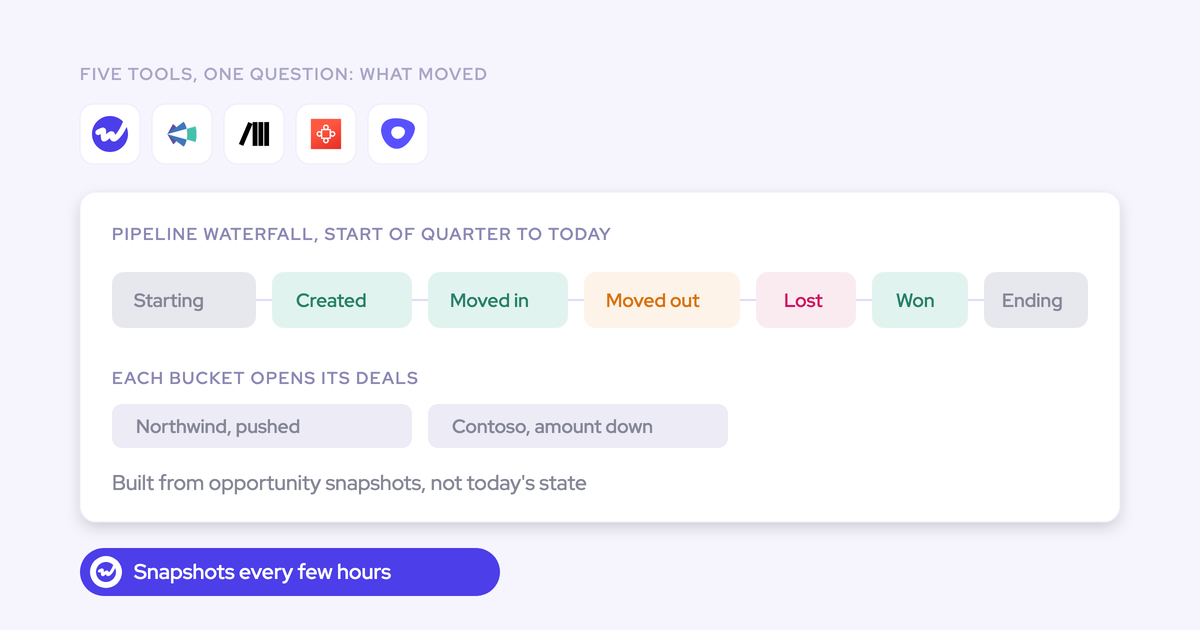
The three Clari views your leadership actually uses survive the switch. Weflow snapshots your opportunity data every few hours from day one and builds the pipeline waterfall, the pacing view, and the day-35-versus-day-35 prior-quarter comparison out of the box, no warehouse and no data engineering project.
- The waterfall reconciles starting pipeline to ending pipeline through created, increased, moved in, moved out, decreased, lost, and won, and every bucket drills through to the actual deals. It answers why a quarter that opened strong is ending thin.
- Pacing shows where the quarter stands against quota across every forecast method at once.
- The same-day comparison answers the question leadership asks every quarter and Salesforce reporting structurally cannot, because Salesforce overwrites fields and keeps no pipeline history.
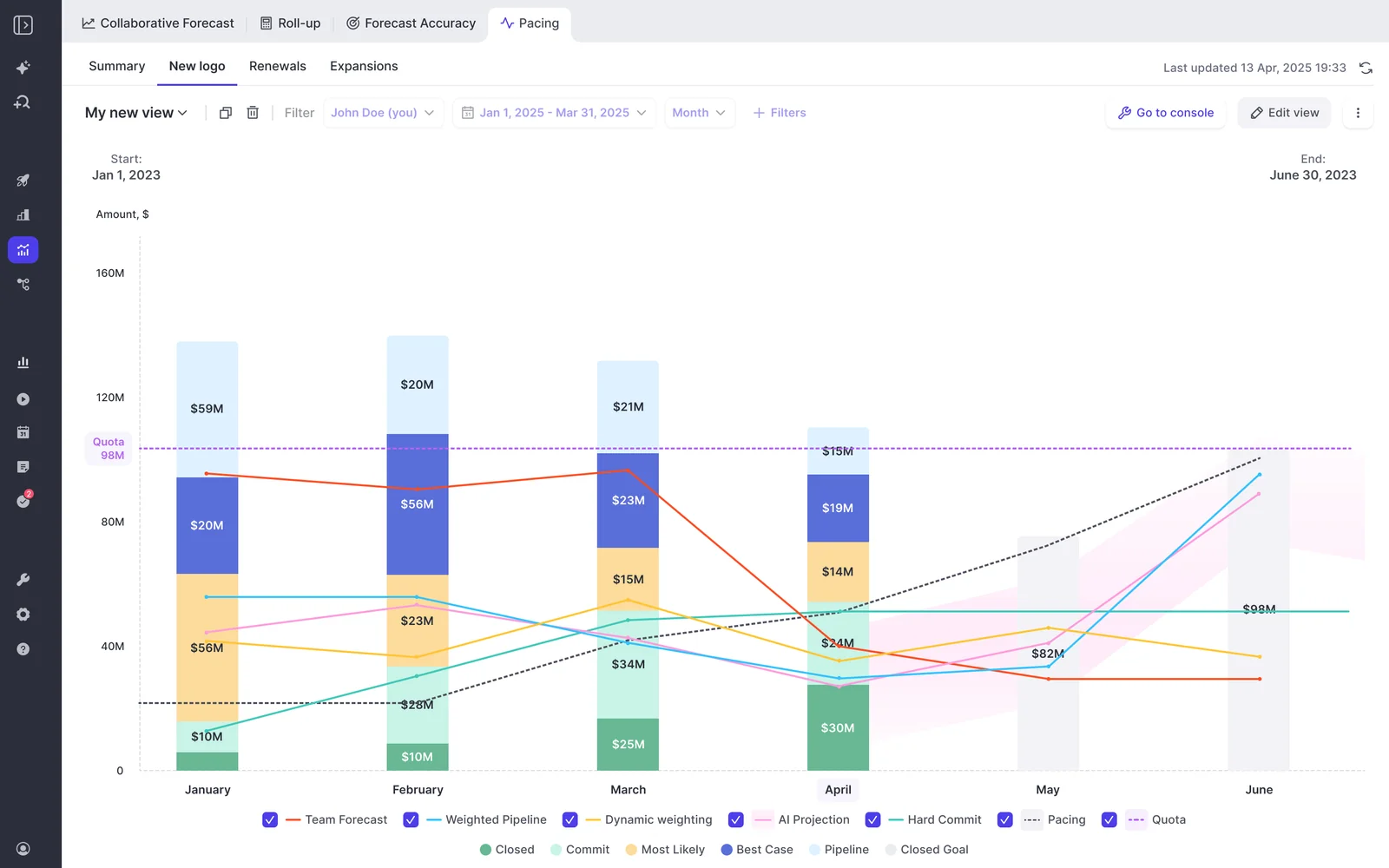
Weflow's pacing view: closed, commit, best case, and pipeline stacked per month, with team forecast, weighted pipeline, and AI projection lines against quota.
One prospect described what they wanted from us as "let me travel back in time": what did the pipeline look like in January versus now, what slipped, what closed won, what closed lost. That's what continuous snapshots buy you, and it's the drill-through Clari's views didn't give them.
Deal-level risk Clari never surfaced: days in stage, push count, and warnings on the forecast screen
Weflow tracks days in stage and close-date push count automatically on every opportunity, with no custom fields to build and no automation to maintain.
A dead deal and a live one stop looking identical in the roll-up, which is the deal-level blindness Clari customers paid a deal tool to fix and never got.
One RevOps leader told us about a rep showing 4x coverage built from 150 open deals, and nobody works 150 deals in a quarter, so the coverage number was fiction and so was the forecast resting on it.
Catching that meant digging deal by deal before every forecast call. Weflow's coverage view shows what the ratio is actually made of, unprompted.
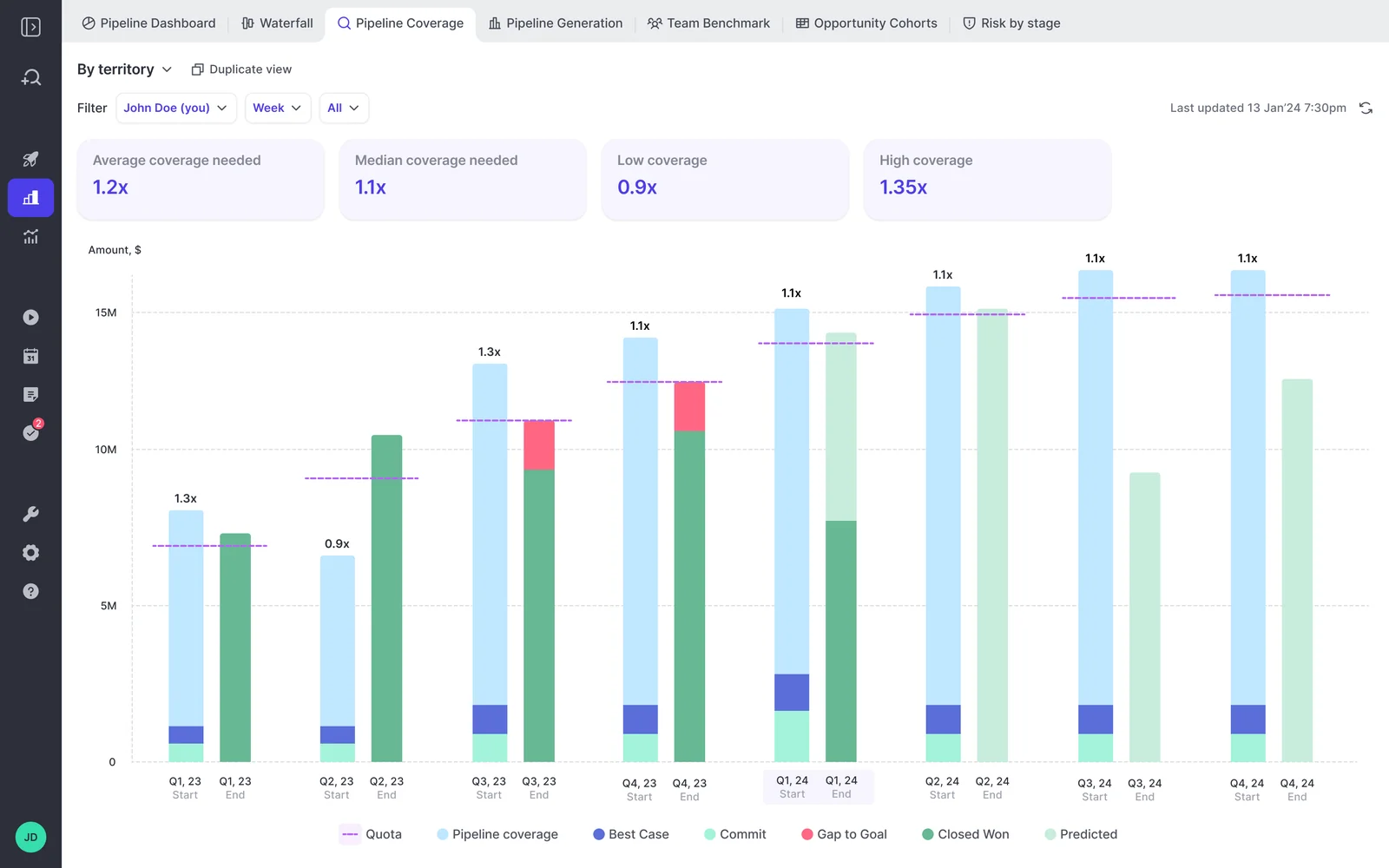
Pipeline coverage per quarter, broken into commit, best case, predicted, and gap to goal, so a padded ratio is visible instead of dug for.
Warnings are authored by you, against your own slippage patterns: a close date pushed more than twice, one contact on a six-figure deal, a missing methodology field, silence for fourteen days on a sixty-day cycle.
Those warnings surface inside the forecast submission screen, at the moment the rep picks which deals to commit. Unhealthy pipeline gets stopped before it enters the number instead of explained after the number was wrong.
Call and email reality that actually feeds the forecast
In Weflow, what happened on the calls and email threads informs the forecast, because both products write to the same Salesforce objects. Clari can't do this: its forecasting product and its conversation intelligence product don't talk to each other, so customers who own both pipe transcripts out into a separate AI workspace and carry the insight back to the CRM by hand.
Weflow Conversation Intelligence records and transcribes the call, then writes the structured outputs into Salesforce fields: the summary, the next steps, the methodology values your forecast views filter on.
Deal health scoring, warnings, and the AI projection all read that same data. The chain runs call to fields to deal health to forecast, with no export in the middle.
This settles the argument every forecast call gets stuck on. The CRM says the deal is stale, the rep says "I met them yesterday, it's fine," and today you can't tell who's right.
When activity and conversation data land on the opportunity automatically, the answer is on the record, and the manager moves from I-need-to-trust-you to here's-what-actually-happened.
Forecasting on the field your business runs on, with versioned submissions and accuracy per rep
Weflow forecasts on the field you actually manage by, including a custom ARR field or a converted-USD amount for multi-currency roll-ups.
We answer this first because it's the first thing Clari-weary buyers check: almost nobody runs on the standard Amount field, and a forecast pointed at the wrong field is wrong on arrival, however good the charts are.
The submission mechanics are built for teams that want a track record, not a debate.
Reps submit a baseline and a best case, tied to named opportunities rather than typed into a box, with a comment. Every submission is versioned, managers can override with their own independent call, and deadlines can lock the field.
Forecast-vs-actual variance is then tracked per rep and manager across quarters, which is the measurement Clari never gave you: after four years, you still couldn't say whose Monday number was worth listening to.
The full mechanics live in Weflow Deal Intelligence & Forecasting.
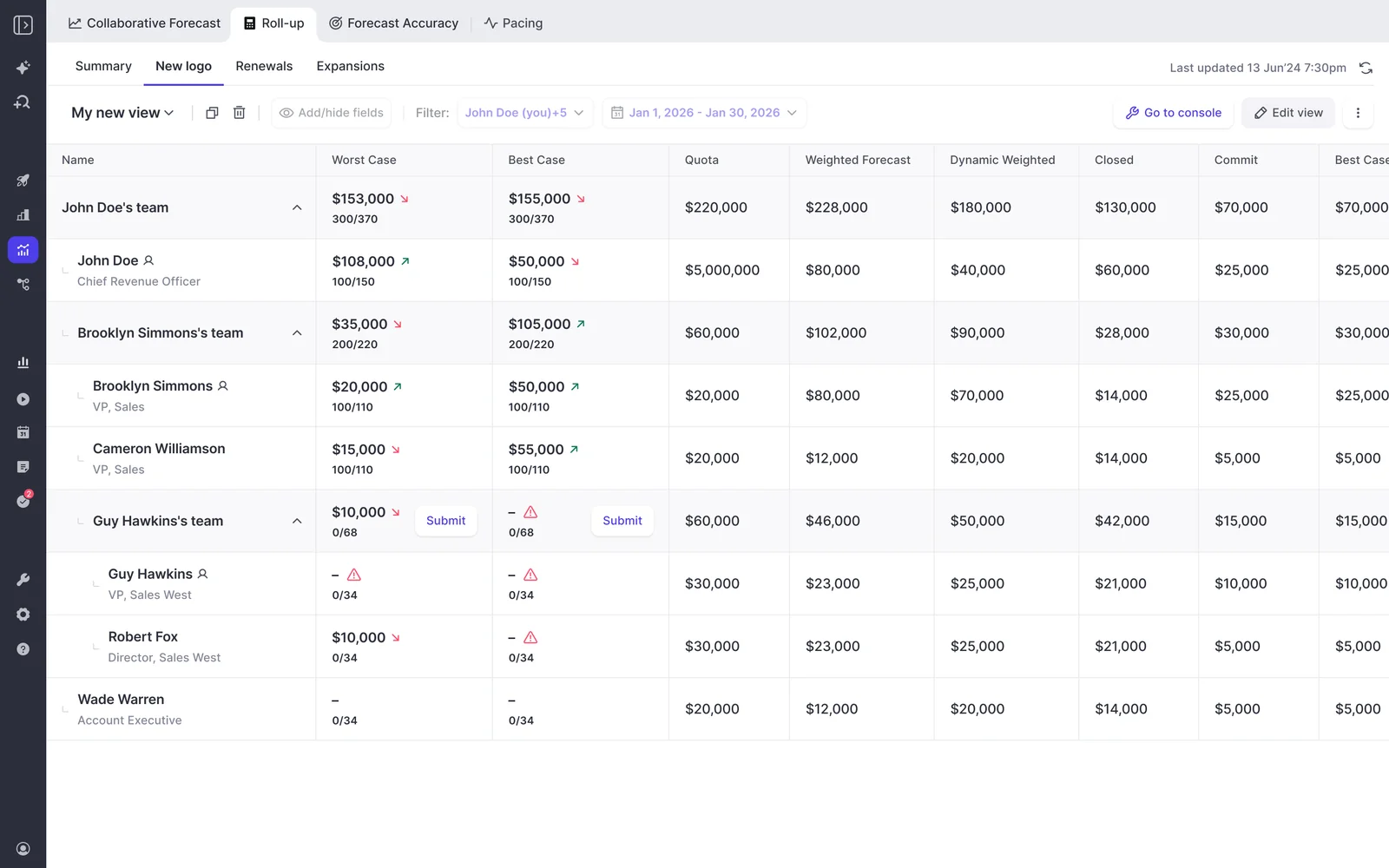
The roll-up on worst case and best case, per rep and team, with trend arrows and submission status inline.
Philipp Stelzer, Weflow's co-founder and CPO, describes the cadence this is built for:
"The best companies forecast on a weekly basis for the current month and the next upcoming two months. They let their reps make a forecast call, and then they let their managers make an independent forecast call that is not just a roll up of the reps who report into them, but a separate estimate of what they think their team can achieve, with their own justification. A good tool then lets you handpick the individual deals that number is made up of."
That independent manager call, deal by deal, is exactly what the versioned submissions support, and you can hear the full methodology in his conversation on forecast roll-ups.
Note: The roll-up sums the raw value of the chosen field on the selected deals, with no stage-probability weighting applied. If your team thinks in weighted terms, either forecast on a weighted Salesforce field as the foundation or treat the raw sum as best case and use the baseline call for conviction. The weighted pipeline view and the AI projection do model likelihood; the roll-up itself deliberately doesn't.
Where Clari is still the stronger choice
Clari's roll-up mechanics are genuinely strong, flexible, and proven at a scale we haven't matched yet. A global org rolling up thousands of reps across complex hierarchies is Clari's home turf, and the roll-up itself was never the gap. The layer underneath it was.
There are situations where staying with Clari makes sense:
- A private equity sponsor has standardized Clari across the portfolio. That decision wasn't made in your company and you won't win the political fight in year one. Run Weflow's activity capture underneath instead: Clari reads activities from Salesforce, so cleaner captured data improves the Clari forecast too, and you revisit the roll-up question later from a stronger position. This gets you closer to accurate forecast data.
- Your forecast runs on highly custom setups where deal data lives on non-standard Salesforce objects. Some of those setups we can support and some we can't, and the only honest answer is to validate feasibility during a trial before you sign anything.
- The roll-up is genuinely all you use and all you need, and the price is acceptable. If nothing in the previous section stung, a migration isn't worth your quarter.
What Weflow and Clari actually cost
Weflow's pricing is transparent: $19 per user per month for Activity & Contact Capture, $39 for Conversation Intelligence, $39 for Deal Intelligence & Forecasting, and bundles at $49, $59, and $79, billed annually with a 10-seat minimum.
Implementation costs nothing and Weflow runs onboarding for free.
Clari doesn't publish pricing at all, it's quote-only, so you get on a call to find out. From what we see in deals it runs $120 to $180 per user per month, usually with a professional-services implementation fee reported between $15k and $50k on top.
| Weflow | Clari | |
| Per-seat price | $19 to $79 per user per month, published | Quote-only; reported $120 to $180 per user per month |
| Implementation fees | None; onboarding run by Weflow | Reported $15k to $50k in professional services |
| Ongoing config changes | Self-service, included | Routed through services, typically billed |
| Terms and minimums | 12-month standard, 10-seat minimum, bundle, volume, and multi-year discounts | Annual contracts, negotiated per deal |
| Mixed plans | Different bundles per team on one contract | Not sold standalone per module |
For sizing a business case: at 62 seats, Weflow's Activity capture plus Conversation Intelligence cost around $36K a year, and the full platform costs around $58K. Mixing plans, putting most reps on Activity Capture plus Deal Intelligence and a handful of managers on the full forecasting bundle, brings the same 62 seats to roughly $45K. Those are the reference points our buyers use before a formal quote.
What migrating from Clari to Weflow looks like
A Clari-to-Weflow migration fits inside a renewal window because Weflow runs it. Your team answers questions and unlocks access; you don't project-manage it. That distinction decides these deals in practice, because a tool swap doesn't compete with Clari, it competes with your own backlog, and a co-project loses to the backlog every time.
The timeline and who does the work
Time to live is typically two to three weeks, and Weflow charges nothing for implementation. Onboarding runs as a project against a mutual action plan with named owners on both sides, in three phases:
- A 45-to-60-minute technical implementation with your Salesforce admin and mail admin in the room, which connects the systems.
- Configuration, where the real time goes: team hierarchy, methodology, which fields AI populates, warnings, forecast types and cadences.
- Role-based rollout with separate leadership and rep training.
Capture and conversation intelligence can go live in two to three weeks. Forecasting takes longer because it encodes an operating cadence, who submits, how often, against which quota, and that's a process decision before it's a tool one.
For teams with no RevOps bandwidth at all, a managed-service option exists where Weflow does the heavy lifting outright. Scott Jones, SVP of GTM Revenue Intelligence & Enablement at KORE Wireless, chose exactly that:
"I made a deliberate choice to let Weflow own end-to-end onboarding rather than pull my team off revenue-generating work. That's exactly the kind of partnership leverage I was looking for."
Scott Jones, SVP of GTM Revenue Intelligence & Enablement, KORE Wireless
Running Weflow alongside Clari during the transition
Coexistence through a transition quarter works cleanly, with one rule: one capture engine feeding Salesforce.
Clari reads activities from Salesforce, so Weflow capturing underneath actually improves the Clari forecast while you transition. The failure mode is two capture engines writing the same emails and meetings at once, which duplicates activities and distorts every metric built on them.
- Do run Weflow capture as the single infrastructure writing to Salesforce, and let Clari consume the cleaner data during the overlap.
- Do use compatibility mode if another tool is still logging email, so Weflow detects the other tool's record and steps back instead of writing a duplicate.
- Don't run both capture engines against the same inboxes, and don't assume removing user permissions on the old tool is enough to stop its sync.
Nothing is lost at cutover, because the history was never only in the tool: Weflow can backfill up to two years of emails and meetings from your own mail tenant into Salesforce, so in-flight deals show their real activity history from day one.
What a 14-day trial proves, and what it can't
The trial runs on your own Salesforce org with white-glove setup included, so you're evaluating your data, not a demo environment. In 14 days you can prove:
- Capture quality: emails, meetings, and contacts landing on the right opportunities, with backfilled history making the picture real immediately.
- The Salesforce integration depth: your custom fields, your validation rules, your permissions, respected as they are.
- Whether the forecast can point at your custom ARR or converted-amount field, and whether the waterfall, pacing, and coverage views hold up against what you had.
- Feasibility of any non-standard-object setup, which must be checked here, before you sign, not after.
What a trial can't prove is forecasting accuracy itself. A forecast proves out by comparing predicted against actual across cycles, and that takes roughly three forecast cycles, not two weeks.
We'd rather tell you that now than have you discover it in month two. What the trial does establish is whether the data layer underneath the forecast is sound, and that layer is what your last four years were missing.
Choose Weflow if, choose Clari if
Choose Weflow if:
- You're a Salesforce-first team and you want the activity, conversation, and forecast data owned in native Salesforce objects rather than a vendor's cloud.
- Your RevOps team wants to administer its own forecast process, without a services ticket for every target, view, or cadence change.
- You need deal-level risk, days in stage, push count, and warnings, feeding the forecast instead of a roll-up sitting on top of unverified pipeline.
- You want CS, account management, and a real renewals motion on the platform, at a price that makes whole-org coverage defensible.
- Your renewal clock is real, and a two-to-three-week managed migration fits where a services quarter doesn't.
Choose Clari if:
- You run a very large enterprise roll-up across thousands of reps and that mechanic, at that scale, is genuinely all you need.
- A PE sponsor or group leadership has mandated Clari across the portfolio; run capture underneath it and revisit later.
- You're not on Salesforce, because Weflow is Salesforce-only by design and won't pretend otherwise.
If you're in the first group, the fastest way to know for sure is to test it on your own data.
Bring your own Salesforce org and your custom amount field, and see how Weflow captures activity, updates fields from calls, and rolls up your forecast before your renewal window closes.
Book a 30-minute demo and we'll set the trial up around your renewal date.
FAQ
What happens to our Clari pipeline history and trend data when we leave?
The pipeline snapshots inside Clari don't export as a usable time series, so that trend history effectively stays behind, and we'd rather say that plainly than pretend otherwise. Weflow starts building its own snapshot history from the day it's connected, and it backfills up to two years of emails and meetings from your mail tenant into Salesforce, so activity history and engagement signals are complete immediately even though the quarter-over-quarter pipeline comparison rebuilds from your start date forward.
Can we present the forecast to the CFO directly from Weflow, or is this another BI export?
The roll-up, pacing, and waterfall views are built to be the reporting surface, so the number leadership debates is the number the system produced. And because everything underneath lives in native Salesforce objects, any BI tool your finance team already uses reads the data directly, without the hand-assembled Tableau cycle that eats a week of every quarter today.
Is Weflow ready for a group-level security and procurement review?
Yes. Weflow holds SOC 2 Type II certification, is GDPR and CCPA compliant, provides a DPA with EU Standard Contractual Clauses, maintains a public sub-processor list with advance change notice, and commits to breach notification within 48 hours. Uptime is backed by a 99.5 percent-plus SLA with a public status page, and the only way to sign in is through your Salesforce authentication, so there's no second identity to manage or deprovision. ISO 27001 is in progress, not yet certified, and we are not FedRAMP certified, so US government contractors requiring FedRAMP are not a fit. Everything else lives in our trust center.
What are Weflow's contract terms, minimums, and seat flexibility?
The standard contract is 12 months with a 10-seat minimum, billed annually against published list pricing, with bundle, volume, and multi-year discounts stacking on top. Seats can be reassigned when someone leaves, though there's no contractual right to reduce seat count mid-term. For buyers whose real fear is a repeat of the last rollout, we've offered a negotiated early opt-out after three months, because it answers that fear honestly: if the product doesn't land, you leave.
Who owns adoption this time, and what does the rollout look like?
Named owners on both sides, from day one, written into the mutual action plan, which is the direct answer to the no-owner rollout that sank the last tool. The rollout is role-based, with reps trained on what the product does for them, and the product earns rep usage by working where reps already work: fields written from calls instead of typed, pipeline edited in Salesforce-synced views instead of a second system of record. A recording-health dashboard shows exactly which meetings were captured and why any were missed, so trust in the data doesn't erode silently. KORE Wireless rolled out across four regions with what Scott Jones called "probably the most flawless rollout of any product I've ever been involved with," and their sandbox beta users asked for the tool back within days when it was removed.
We've prototyped our own Clari replacement, so why buy Weflow instead of building?
The prototype was never the hard part, and we say that with respect, because the prototypes we see are good. Maintenance is the hard part: the snapshotting, the hierarchy roll-ups, the permissions model, the mail and calendar integrations, all of it has to keep working while your team also runs the business. The honest comparison is Weflow's per-seat price against the ongoing cost of owning that build, in RevOps hours, at your billable rate, forever. If your build wins that math, build it. In our experience the math stops favoring the build the first time the business reorganizes.
Does Weflow work with CRMs other than Salesforce?
No. Weflow works only with Salesforce and is built entirely on the Salesforce API, which is a deliberate trade: going deep on one CRM is what lets it respect your custom fields, custom objects, validation rules, and permission sets with no field-mapping step at setup. There's no HubSpot, Dynamics, or Pipedrive support, and a team on another CRM is not a fit. A group running Salesforce in some operating companies and another CRM elsewhere can deploy Weflow on the Salesforce footprint only.