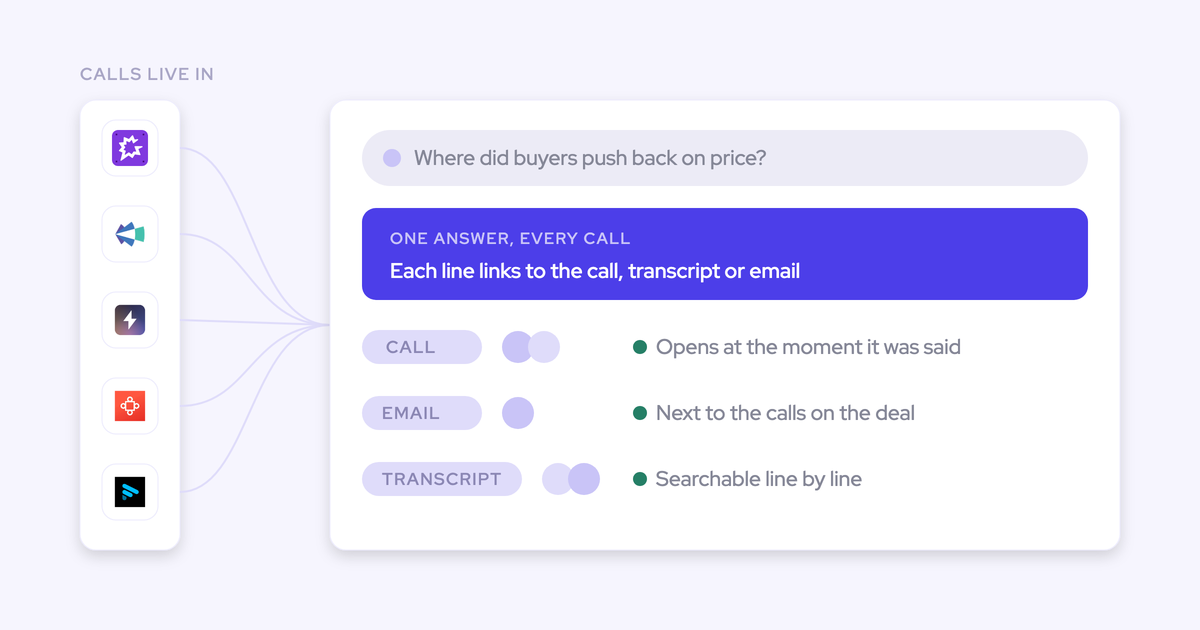
Momentum (Salesforce) vs Attention: Two Slack-First Tools, and What Neither of Them Replaces
Decide between Momentum vs Attention—and see why neither replaces your revenue data layer.



On the surface where these two tools compete, they're close to level. Both push deal workflows into Slack. Both write AI-generated field updates into Salesforce. Both ship an agent builder, and both answer questions about calls and pipeline in something that looks like chat. Run a feature bake-off and you'll come out the other side with two long lists and no decision.
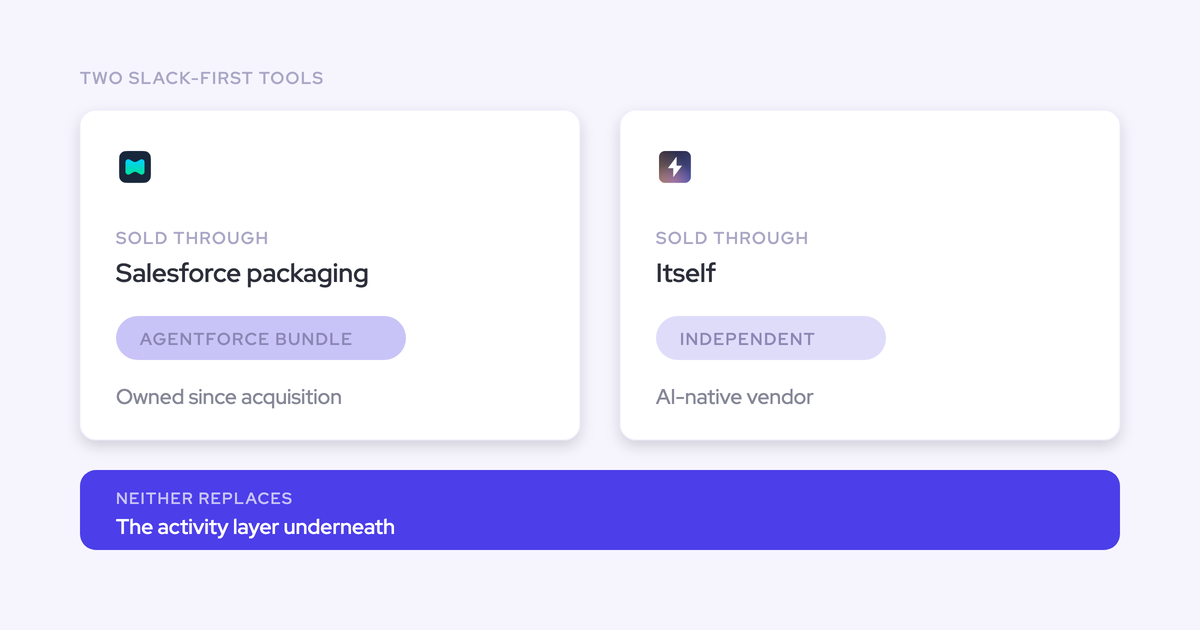
The axis that actually separates them is one neither vendor puts on a slide. Momentum is a Salesforce-owned product now, sold only inside Agentforce packaging. Attention is an independent AI-native vendor you buy on its own contract. That difference decides who signs, what else moves in your stack, and how much of the decision is still yours.
And there's a second thing, which is the reason this comparison rarely closes cleanly: both are orchestration surfaces sitting on top of a data layer neither of them sells you.
This article adjudicates the pair on the ownership axis first, then names the gap that survives whichever one you pick. If your job here is deal execution run out of Slack, you'll get a straight answer on both.
Momentum vs Attention at a glance
| Dimension | Momentum (Salesforce) | Attention |
| Who owns it | Salesforce, which acquired it to extend Agentforce 360 and Slackbot with conversation data from Zoom, Google Meet and other third-party channels | An independent AI-native vendor, no platform owner behind it |
| How you buy it | Only inside Salesforce packaging: the Agentforce 1 Sales Edition bundle, which carries Momentum, Agentforce for Sales and Slack Enterprise+ on one license, or as an add-on to Agentforce for Sales | A standalone contract with the vendor, with no platform commitment attached |
| Where output lands | Slack and Microsoft Teams channels, plus structured fields on the Salesforce opportunity | Slack, plus fields written from what happened on the call |
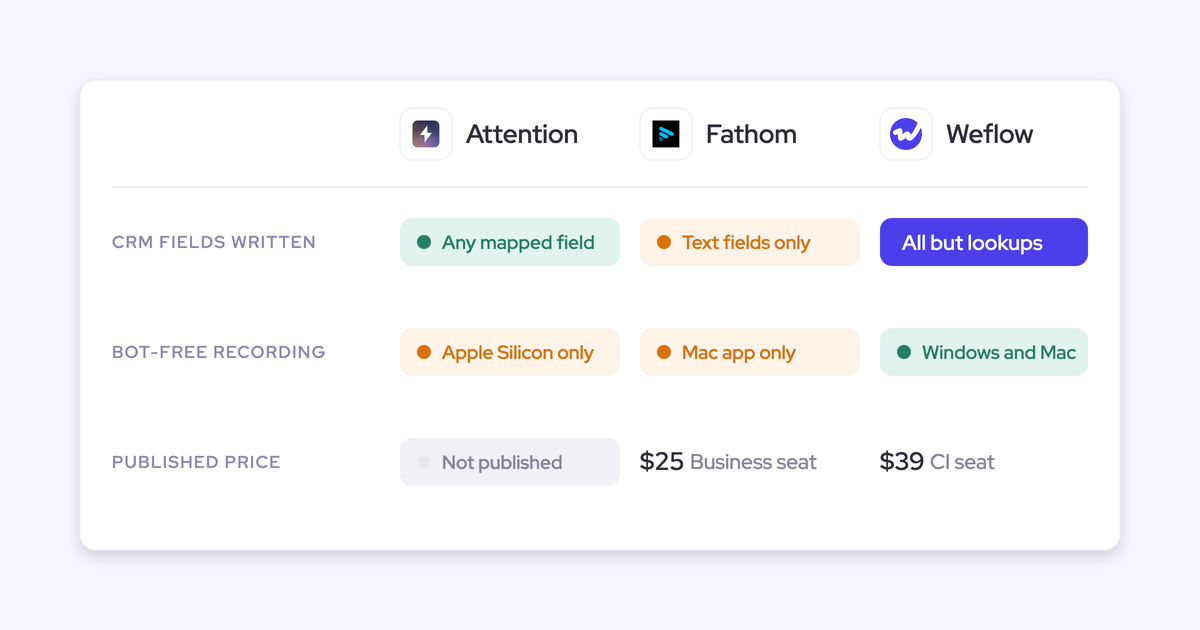
| Capture scope | Native recording on Zoom, Microsoft Teams and Google Meet, a bot for platforms it has no native integration with, plus telephony, email and SMS | Call-centric. No email or contact capture from Outlook or Google Workspace, and no Outlook add-in or Google extension for mapping |
| Salesforce coverage | Sales Cloud only today. Other clouds including Service Cloud are in development, and the Salesforce Voice integration is still being built | Writes to Salesforce as part of the call workflow; capture is not sold as a standalone product |
| Forecasting | No forecast process in its own stated scope of capture and ingest, structure and context, execute and orchestrate | Reporting-first: no roll-up or collaborative forecasting, no forecast accuracy measurement, no pipeline analytics or dashboards |
| Historical backfill | Migrates years of recordings out of an incumbent recorder, and can retroactively fill a newly created Salesforce field across every past conversation | No equivalent retroactive backfill has come up in the evaluations we've seen |
| Agent builder and Ask AI | Multi-step workflow and agent builder at rough parity with the rest of the category | Leads the emerging cohort on agent-builder flexibility and Slack integration, though the agent tooling is still maturing. Ask AI is at genuine parity |
Read the table top to bottom and the pattern is obvious. The rows where these two differ are ownership, packaging and capture breadth. The rows where they match are the Slack workflows and the agent builder, which is exactly the surface that put them both on your shortlist.
Why Momentum and Attention land on the same shortlist
They land together because they solve the same visible problem in the same visible place: the rep didn't update the CRM, so the system writes the fields and asks a human in Slack to approve them.
That's the shape of nearly every mid-cycle evaluation we sit in. One RevOps leader described their Momentum cycle to us in exactly those terms:
"We're in a sales cycle with Momentum as a tool that we would use to just populate data against Salesforce fields and write to Slack for having a human in the loop approval of changes to Salesforce records."
Attention gets evaluated for the same job, and often lands in a team that's already carrying tool fatigue:
So the confusion is earned. Both tools write fields, both post to Slack, both let you build agents on top. If you're comparing demos, you're comparing two versions of the same demo.
What Salesforce owning Momentum changes about this decision
Evaluating Momentum is no longer evaluating a point tool. It's opening a Salesforce platform conversation, and that moves the decision up to whoever owns the Salesforce contract.
Momentum is now the data foundation beneath Agentforce
Salesforce doesn't position Momentum as a conversation intelligence product. It positions it as the layer the Agentforce agents run on, described in three parts:
- Capture and ingest: unstructured interactions across calls, emails, SMS, Slack, support tickets and cases.
- Structure and context: extract, structure and route that first-party data in real time, into the CRM and into Data Cloud or another data lake.
- Execute and orchestrate: feed the agents that act on it, including the Deal Execution Agent that auto-fills CRM data, the Coaching Agent that analyzes calls for moments like objection handling, and the AI CRO Agent that answers plain-language pipeline questions.
The pitch is deliberately not "a better recorder." It's the precondition for everything agentic Salesforce sells.
Which means a buyer who wants call summaries in Slack is being sold the bottom of an agent platform. Worth knowing before the second call.
Momentum is sold only inside Agentforce packaging
There's no route to buying Momentum's capture and field-writing layer on its own.
| Momentum | Attention | |
| The purchase | The Agentforce 1 Sales Edition bundle (Momentum, Agentforce for Sales and Slack Enterprise+ on a single license), or an add-on to Agentforce for Sales | A single independent contract for the tool |
| Who signs | Whoever owns the Salesforce relationship | Whoever owns the tool budget |
| What else moves | Your Agentforce commitment and your Slack tier, tied to your Salesforce renewal cycle | Nothing beyond the line item |
Neither vendor publishes clean per-seat pricing, so we won't invent numbers for either. What we can say with confidence is the shape: one is a bundle negotiation with your CRM vendor, the other is a per-seat purchase you can cancel without touching anything else.
If your team is committing to Agentforce anyway, the bundle is a reasonable place to land. If you wanted conversation capture writing into Salesforce and nothing more, you're buying an agent platform to get it.
Where Attention is the stronger choice
- Agent-builder flexibility. Among the next-generation conversation intelligence players, Attention is ahead on how freely you can wire conversation-triggered actions into Slack.
- Native Slack integration. If Slack is where your deal desk actually runs, Attention was built for that surface rather than adapted to it.
- One contract, no platform entanglement. You buy it, you run it, and if it doesn't work you stop. Nothing in your Salesforce or Slack commercials moves because of it.
- Ask AI at parity. Attention answers questions about calls, deals and pipeline, produces reports and sales assets, and runs deeper analytics. This is not a dimension that will separate it from anything else on your list.
One honest caveat, and it's the vendor's own trajectory rather than a flaw: the agent tooling is still early. Buy it for what it does today, not for the roadmap slide.
Where Momentum is the stronger choice
- Teams as well as Slack. Momentum pushes field automations, coaching output and clips into Microsoft Teams channels too, so a Microsoft-first org isn't disqualified.
- Capture breadth. Native recording on Zoom, Teams and Google Meet, a named bot for platforms without a native integration, plus telephony, email and SMS.
- Structured methodology writes. MEDDPICC and SPICED elements, the Three Whys, next best action and a last meeting summary land in their own Salesforce fields, alongside custom free-text, date and numeric fields. Reportable columns, not a paragraph dumped in a notes field.
- Append-safe field writing. Momentum can append a timestamped entry instead of overwriting, so a rep's own text survives. If your team already maintains qualification fields by hand, this is what makes automatic writing safe to switch on.
- Migration and retroactive backfill. It pulls years of recordings out of an incumbent recorder, and a field created today can be populated across three years of past conversations in a batch run.
- The Slack clip walls. Ten to fifteen second clips cut automatically and posted into channels grouped as a wall of love, a wall of competitor mentions, a wall of product feedback. Nobody selects the moment. A competitor named on a call reaches leadership the same day.
- Consent handled in the recorder. Native consent tracking, a right-to-be-forgotten mechanism, and recording that stops when a participant declines.
It also has credible advocates who aren't Salesforce:
"You got to eat your vegetables. You got to do the basics. You have to get the basics in place or else you just get sloppy outputs. And that means a tool like Momentum, which is going to capture information from every call, every email, put it into a structured format in your CRM so that you can report on it, understand it."
— Kyle Norton, Chief Revenue Officer at Owner.com
The boundary on all of that is scope. Momentum works with Sales Cloud only today. Support for other clouds including Service Cloud is under development, and the Salesforce Voice integration is still being built.
So a support or success organization can't use it yet. The promise that every customer conversation lands in one place stops at the handover to post-sales.
The data layer neither Momentum nor Attention replaces
Both tools are orchestration surfaces. Neither is available to you as the standalone capture-and-forecasting foundation a Salesforce-run revenue team still needs underneath.
Which means picking one of them adds a surface. It doesn't consolidate your stack, and the difference shows up in three specific places.
Neither sells standalone activity and contact capture
| The question | Attention | Momentum |
| Does it capture email and contacts into Salesforce? | No. Capture is call-centric, with no email or contact capture from Outlook or Google Workspace | Yes. It ingests email and SMS alongside calls and telephony |
| Can you buy the capture layer on its own? | No. Capture isn't sold standalone | No. It arrives inside the Agentforce packaging |
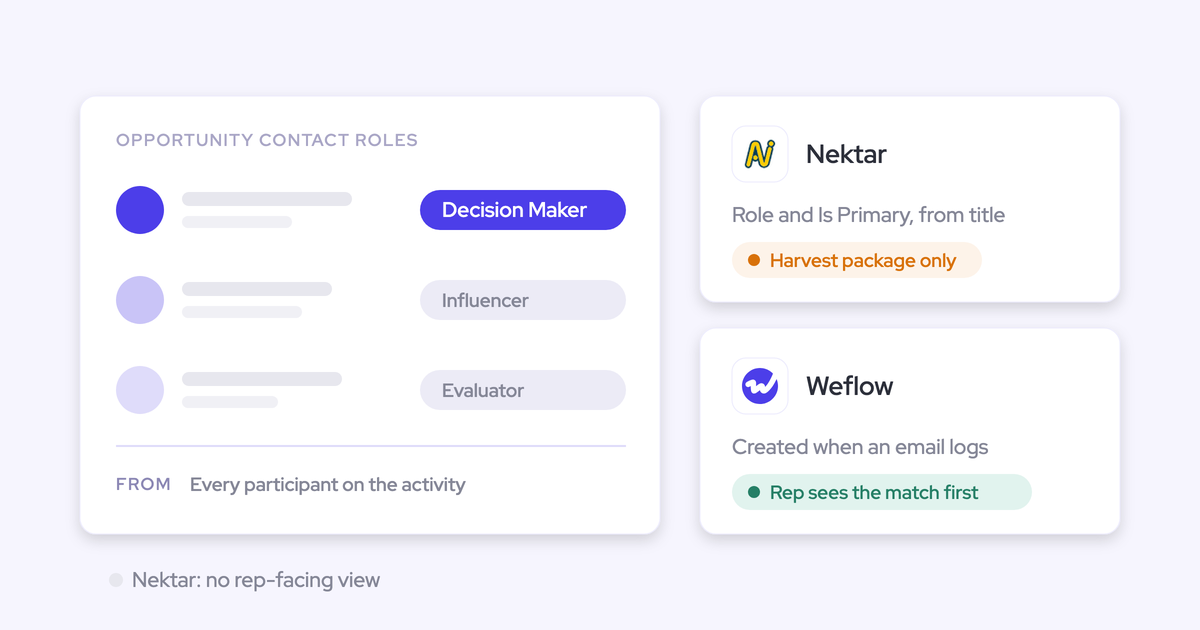
| How does meeting-to-opportunity mapping work? | Calendar-event-to-opportunity mapping is unreliable, with no Outlook add-in or Google extension to correct it | It matches external attendee emails to contacts, derives the account, then picks the open opportunity carrying the most opportunity contact roles, breaking ties on LastActivityDate |
| Which Salesforce clouds? | Writes to Salesforce as part of the call workflow | Sales Cloud only today, with other clouds in development |
Read Momentum's mapping chain again, because it has a dependency in it. The whole thing rests on opportunity contact roles being maintained.
Where they aren't, every open opportunity scores zero and the tie-break falls to whichever record a rep touched most recently, which is not the record the meeting was about. With no open opportunity at all, the call lands on the account by domain and never reaches a deal.
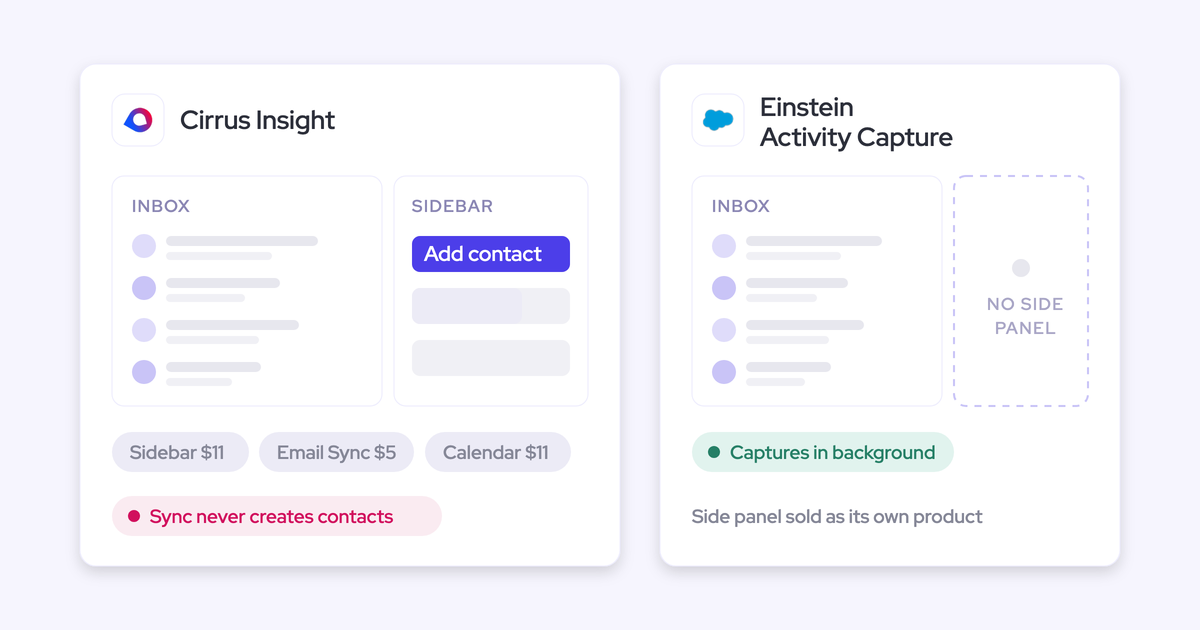
That's the same dependency that makes Einstein Activity Capture unreliable in accounts with several live deals, and opportunity contact roles are one of the least-maintained objects in any CRM.
Forecast roll-up sits outside both tools' stated scope
Attention is reporting-first. It has limited deal intelligence, no roll-up or collaborative forecasting, no forecast accuracy measurement, and no pipeline analytics or dashboards. If you run a weekly submission cadence, there's nowhere in Attention to run it.
Momentum doesn't claim a forecast either. Its own three layers are capture and ingest, structure and context, execute and orchestrate. No forecast process is named in any of them.
So the honest reading is this: both tools improve the inputs to a forecast, and neither hosts the forecast. Your roll-up still lives wherever it lives today, which for most mid-market teams is a spreadsheet rebuilt by hand every Monday.
Two capture tools mean duplicate meeting events in Salesforce
Run a conversation tool next to a separate activity capture tool and Salesforce ends up with two records for the same meeting. Each vendor legitimately represents meeting activity, so each writes its own event object, and neither knows about the other.
"This is often a problem when you have multiple providers for CI and AC. They basically both create an event object, which creates a duplicate. So in your reporting you need to deduplicate that, which is really annoying."
— Janis Zech, Co-founder and CEO of Weflow
The cost isn't cosmetic. Every metric counted per meeting, meetings per rep, touches per closed opportunity, meeting-to-close ratios, is inflated until someone deduplicates it.
Teams living this end up asking the two vendors to agree ownership: one system writes the meeting activity, the other attaches its summary and field updates to that same record instead of creating a second one. It's a reasonable ask and it's rarely in anyone's contract.
"If you record a meeting, it's not another meeting. It's the same meeting."
Where Weflow fits underneath Momentum or Attention
Weflow is the Revenue AI Orchestration platform for sales, customer success, and RevOps teams, built for teams that run on Salesforce. It's the capture-and-forecasting layer this comparison keeps pointing at, and it's sold as products you can buy on their own.
Mapped against the three gaps above:
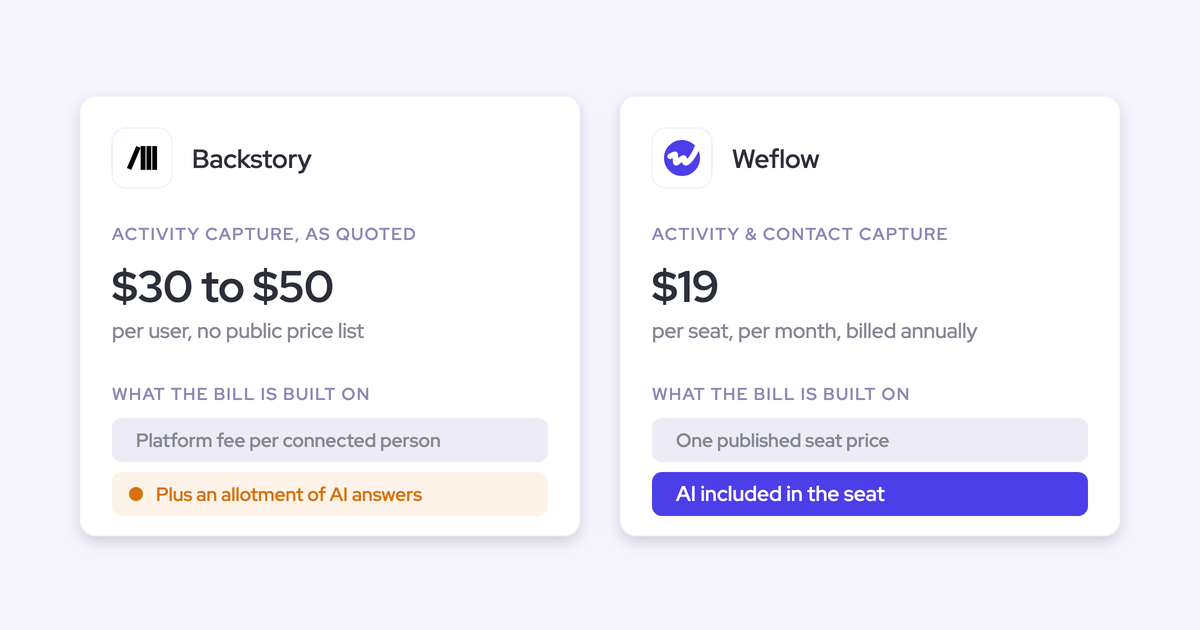
- The capture gap. Weflow Activity & Contact Capture auto-syncs emails, meetings and contacts from Outlook and Google Workspace to the right Salesforce record, creates missing contacts, sets opportunity contact roles, and can backfill the previous 12 to 24 months. It's sold standalone at $19 per user per month.
- The forecast gap. Weflow Deal Intelligence & Forecasting runs deal health scoring, pipeline analytics, automated roll-ups across the Salesforce role hierarchy, deal-by-deal submissions and forecast accuracy tracking. Standalone at $39 per user per month.
- The duplicate-event gap. One activity record per meeting, because one system owns the write.
- The ownership gap. Everything lands in native Salesforce objects you already own.
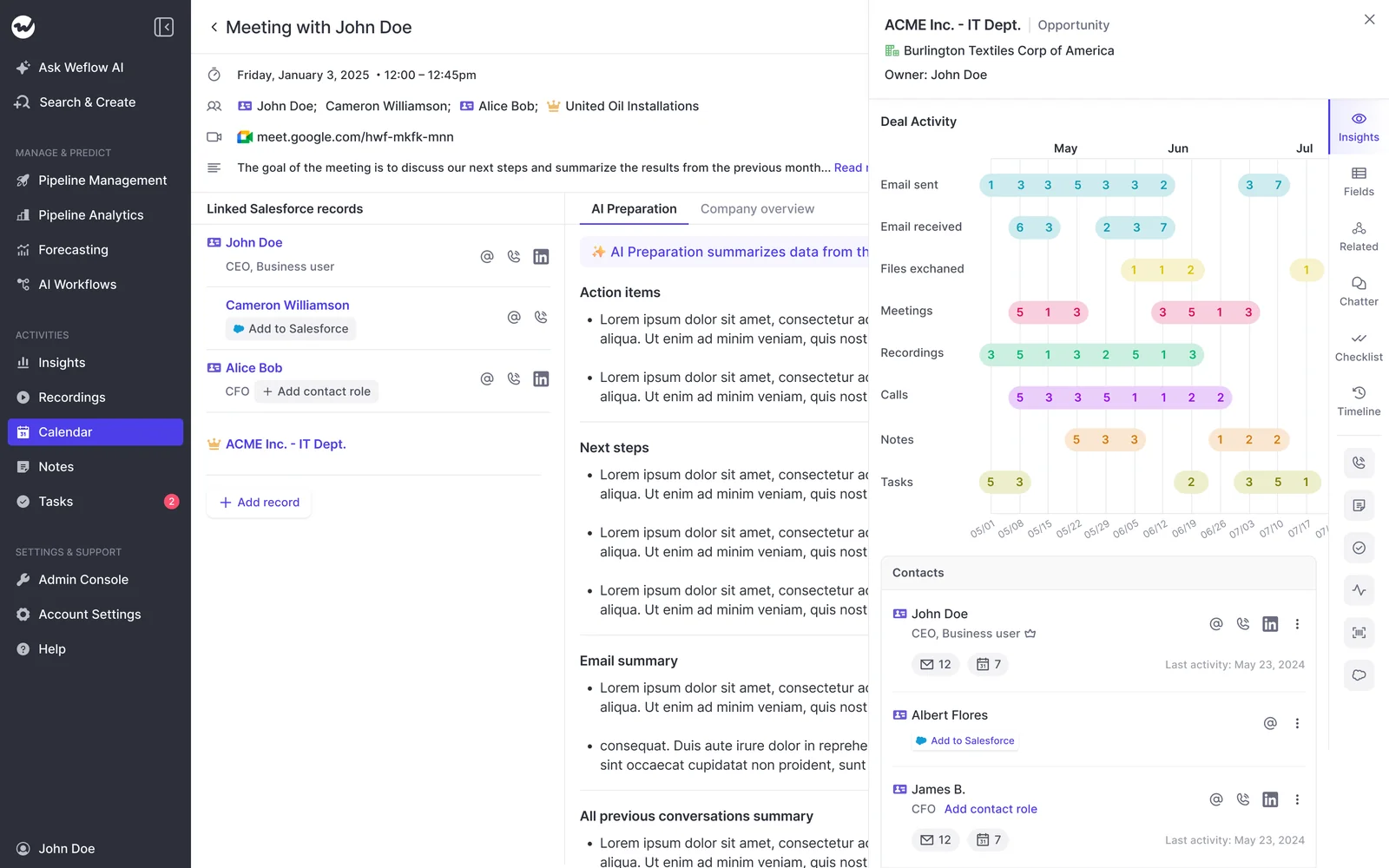
The activity picture that produces looks like this on the record: emails, meetings, calls and contacts against one company, with sync status visible.
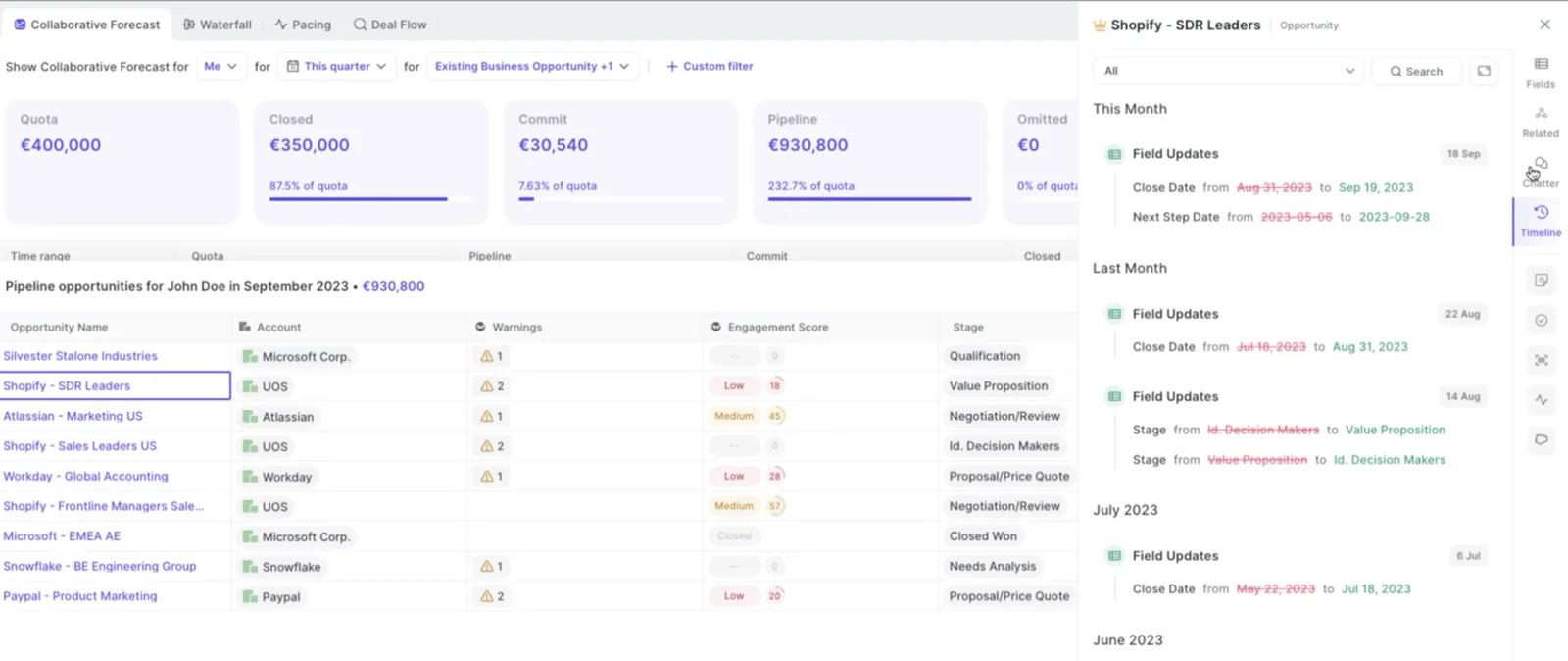
And the roll-up runs on the same data, with the field-change history sitting beside each deal.
On the ownership question, our position is the same one we'd want from any vendor:
"We use the native objects in Salesforce. If you ever stop using Weflow, the data persists. It is your data."
— Janis Zech, Co-founder and CEO of Weflow
Now the limits, because you'll find them anyway:
- Weflow works exclusively with Salesforce. No HubSpot, no Dynamics. Momentum at least serves Teams-based orgs on the delivery side; the CRM boundary here is hard, and if you're not on Salesforce we're out of the running.
- Weflow's deal warnings and AI Playbook scores are Weflow fields, not Salesforce fields. You can see a deal flagged at risk inside Weflow and you can't drop that flag into a Salesforce dashboard or Power BI report without building an agent to write it back.
- Weflow doesn't do sequencing, dialing or SMS capture. Outreach, Salesloft and Apollo run alongside it, not underneath it.
Bundles start at $49 per user per month, priced per seat with AI usage included, and the pricing is published rather than quoted after three calls.
See how Weflow captures activity, updates Salesforce fields from calls, and rolls up your forecast. Book a 30-minute demo.
Choose Momentum if, choose Attention if
Choose Momentum if:
- You're already committing to the Agentforce path, so the bundle consolidates a decision rather than opening a new one.
- Your team runs on Microsoft Teams as well as, or instead of, Slack.
- You need capture across calls, telephony, email and SMS in one product, and Sales Cloud is the only cloud you care about this year.
- You have years of recordings in an incumbent tool and want them migrated, or you want a new field populated retroactively across past conversations.
- Voice-of-customer as a Slack feed is genuinely part of the job, not a nice-to-have.
- You're a European team where consent handling has stopped previous recording rollouts before they started.
Choose Attention if:
- You want an independent contract with nothing else attached to it, and you'd rather not open a Salesforce commercial conversation.
- Slack is the surface your deal motion actually runs on.
- Call-triggered orchestration is the whole job, and your capture and forecasting are already handled elsewhere.
- Agent-builder flexibility is what you're buying, and you're comfortable with tooling that's still maturing.
And the third path: if the problem you're really solving is incomplete activity data and a forecast built by hand, this shortlist doesn't contain the answer. Fix the layer underneath first, then pick your orchestration surface on top of it.
Momentum vs Attention: frequently asked questions
Can you buy Momentum without buying Agentforce?
No. Momentum is sold only through Salesforce packaging: inside the Agentforce 1 Sales Edition bundle, which carries Momentum, Agentforce for Sales and Slack Enterprise+ on a single license, or as an add-on to Agentforce for Sales.
There's no route to the capture and field-writing layer on its own. Practically, that means the person who signs is whoever owns your Salesforce contract, not whoever owns the tool budget.
Does Attention capture emails and contacts from Outlook or Gmail?
No. Attention's capture is call-centric: it doesn't capture emails and contacts from Outlook or Google Workspace, and capture isn't sold as a standalone product.
There's also no Outlook add-in or Google extension for mapping, and its calendar-event-to-opportunity mapping is unreliable, so non-call activity doesn't reach Salesforce dependably.
Can you run a forecast roll-up in Momentum or Attention?
Neither runs a forecast process. Attention has no roll-up or collaborative forecasting, no forecast accuracy measurement and no pipeline analytics. Momentum's own stated scope, capture and ingest, structure and context, execute and orchestrate, names no forecast at all.
If your team submits a number every week, that cadence still needs a home outside both tools.
Will Attention create duplicate events next to my activity capture tool?
Yes. Running Attention for conversation intelligence alongside a separate activity capture tool writes two records into Salesforce for the same meeting, because each vendor creates its own event object and neither knows about the other.
You then deduplicate in reporting, and every per-meeting metric is inflated until you do. The fix teams ask for is an ownership agreement: one system writes the meeting activity, the other attaches its summary and field updates to that same record.
Does Momentum work with Microsoft Teams or only Slack?
Both. Momentum delivers field automations, coaching output and call clips into Slack and Microsoft Teams channels, so a Microsoft-first org isn't excluded. It also records natively on Microsoft Teams, Zoom and Google Meet.
Attention's strength is Slack specifically, which matters if your revenue team already lives there.
What does the Momentum acquisition mean for Einstein Activity Capture?
Salesforce has named Momentum the future of call recording and activity capture inside Salesforce, which puts Einstein Activity Capture and Einstein Conversation Insights on a superseded path rather than a development path.
What hasn't been given is a migration path, an end-of-life date, or any pricing consequence. So a team standing on EAC today is being told the native route is changing without being told what to do about it.
Our advice: don't invest further in configuring EAC, and evaluate a capture layer whose roadmap doesn't depend on one vendor's internal product decisions.
How does Momentum handle recording consent under GDPR?
Momentum is GDPR compliant, with native consent tracking, a right-to-be-forgotten mechanism, and recording that stops automatically when a participant rejects consent. The consent page itself is customizable.
Handling it inside the recorder matters, because a participant declining halts capture rather than producing a recording someone has to delete afterwards. We don't have equivalent detail on Attention's consent handling, so ask them directly if you're running a European rollout.
Do I still need a separate capture and forecasting layer?
Yes, if you need emails, meetings and contacts captured into Salesforce on their own terms, and a forecast roll-up you can run each week. Neither Momentum nor Attention sells you that as a standalone layer.
The principle to hold onto is one record: one system owns the meeting activity in Salesforce, and everything else attaches to it instead of writing its own copy.
Weflow sells that layer separately, Activity & Contact Capture at $19 per user per month and Deal Intelligence & Forecasting at $39, writing to native Salesforce objects you keep whether or not you keep us. Settle that layer first. The orchestration surface is the easier decision once it's in place.