Best AI sales forecasting tools for Salesforce revenue teams (2026)
Compare the best AI sales forecasting tools for Salesforce, including Clari and Weflow.



If you're reading this, you've already decided the current answer isn't good enough. Either a Clari renewal is sitting on your desk at $120 to $180 a seat for a tool half your managers stopped opening, or the forecast still gets rebuilt by hand every week out of Salesforce reports and a Google Sheet, stale by the time the last manager replies.
So this isn't a survey of the category. It's the eight options a RevOps leader actually shortlists, judged on the five things that decide these evaluations: whether the AI scores each deal or just the aggregate, whether the roll-up can escape the Salesforce reporting hierarchy, whether call data ever reaches the number, whether pipeline history exists without a warehouse project, and what it really costs to buy and run.
One thing up front: no tool fixes a forecast cadence that doesn't exist. We build Weflow, the Revenue AI Orchestration platform for sales, customer success, and RevOps teams, and AI forecast prediction is one of the things it does. Weflow is first in this list, and where it's weaker than Clari is written into its own entry rather than left out.
AI sales forecasting tools for Salesforce at a glance
The eight realistic options diverge less on features than on four structural things: how the prediction is computed, whether the roll-up can express your org, whether pipeline history exists, and how you're allowed to buy.
| Tool | Best for | How the AI predicts | Hierarchy flexibility | Pipeline history | Price and trial |
|---|---|---|---|---|---|
| Weflow | Salesforce teams that want the forecast built on captured activity, contact and conversation data | Scores each deal on 50+ signals and up to two years of history, returns a base, mid and high corridor next to the weighted forecast and the roll-up | Own hierarchy, abstracted from the Salesforce reporting structure | Opportunity snapshots and tracked field history built in; days in stage and close-date pushes captured automatically | $39/user/month for Deal Intelligence & Forecasting, $79 for the full platform; 14-day free trial, no implementation fees |
| Clari | Enterprise roll-ups at 1,000+ reps with a stable reporting hierarchy | Opportunity score computed from historical performance, and widely ignored by the teams that own it | Bound to the Salesforce hierarchy; can't calculate a field, so derived metrics get built in Salesforce first | Waterfall compares one date to another date, doesn't show what moved between them | $120 to $180/user/month plus $15k to $50k implementation; quote-only, no trial or self-serve signup |
| Gong Forecast | Teams whose primary need is conversation analytics with forecasting attached | Built on Gong's own captured conversation and activity data, held in Gong's cloud | Roll-up follows the Salesforce hierarchy; placeholder structures required when reporting lines differ | Lives in Gong's interface rather than as CRM data your own reporting can read | Quote-only; typically around twice Weflow's per-seat level |
| Salesforce Collaborative Forecasts | Teams that need a submitted number inside the CRM and nothing more | No deal-level projection | Salesforce role hierarchy only | None: no snapshots, no waterfall, no quota-to-forecast in one place | No extra vendor spend |
| Spreadsheets | Teams whose forecast cadence isn't settled yet | Whatever formula you write, applied by hand | Any shape you can build, maintained manually forever | Only if someone remembers to save a copy every week | Free, plus a week of RevOps time every week |
| People.ai | Relationship mapping and account planning | AI-Native Forecasting launched October 2025, new next to established forecasting vendors | Unproven in our evaluations | Unproven in our evaluations | PeopleGlass free tier for the lighter product; forecasting quote-only |
| Revenue.io | Phone-heavy inside sales teams that want reps to stay in the Salesforce UI | Real-time in-call coaching (Moments) rather than deal-level forecast prediction | Runs inside Salesforce, so Salesforce structures apply | Built around telephony and coaching, not pipeline history | Not published |
| Attention | Lightweight activity insight | Reporting-first; no roll-up or collaborative forecasting, no forecast accuracy measurement | No roll-up, so the question doesn't apply | No pipeline analytics or dashboards | Not published |
How to evaluate AI forecasting tools for Salesforce
Five questions separate tools that improve the forecast from tools that re-display the pipeline. You test them in a pilot. You cannot read them off a feature grid, because feature parity is not data-quality parity.
Does the AI score each deal or only the aggregate?
A projection built from the aggregate inherits everything wrong with your history. Weak stage discipline and half-captured activity go in, and a confident number comes out.
That's why so many opportunity scores end up rendered on screen and read by nobody. Once a score has been wrong in front of a manager, it's dead.
The test: ask the vendor to show you two deals of the same size and stage that project differently, and explain which signals caused the gap. A model that reads deal behavior (next meeting booked, communication cadence, methodology health, days in stage, push count) can answer that. A model that projects from the aggregate can't.
And a prediction is only as good as the data under it. We learned that the hard way:
"The best AI models are based on the data foundation. If you do not automate good data quality on an opportunity by opportunity basis, it will be very hard to have accurate prediction models. We actually launched a prediction forecast before we had automated Salesforce data capture, and we found that it was not that accurate, which made us realize you have to solve it end to end."
Janis Zech, Co-founder and CEO, Weflow
Can the roll-up escape the Salesforce reporting hierarchy?
The forecast a business runs on rarely matches the CRM user hierarchy. When a tool can only read the manager field, you either distort Salesforce to fit the tool or maintain a parallel structure whose only job is to make the roll-up resolve.
The org shapes that break hierarchy-bound tools:
- One sales leader running multiple products with different teams under them
- Overlays and specialists who sit outside the reporting line but carry number
- Pods and dotted lines where the deal owner and the forecast owner differ
- A global view that compares all enterprise reps against each other, not team by team
- Manager-level targets that need to exist alongside the manager's individual target
This is the single most common complaint we hear from Clari leavers:
The test: ask for a forecast that compares every enterprise rep globally, ignoring who they report to. If the answer involves creating Salesforce users or profiles that don't correspond to real people, you're buying maintenance.
Does call and activity data actually reach the number?
When forecasting and conversation intelligence are separate applications, what was said on the call never informs the forecast. The review then runs on stage-and-amount math while the transcripts sit in another portal.
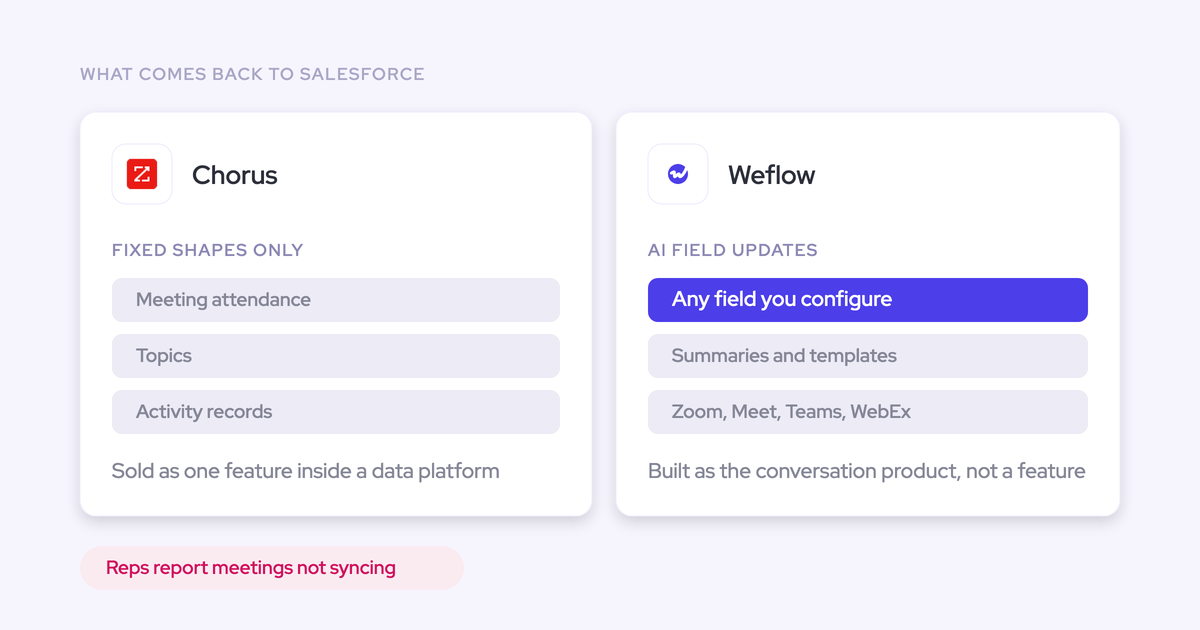
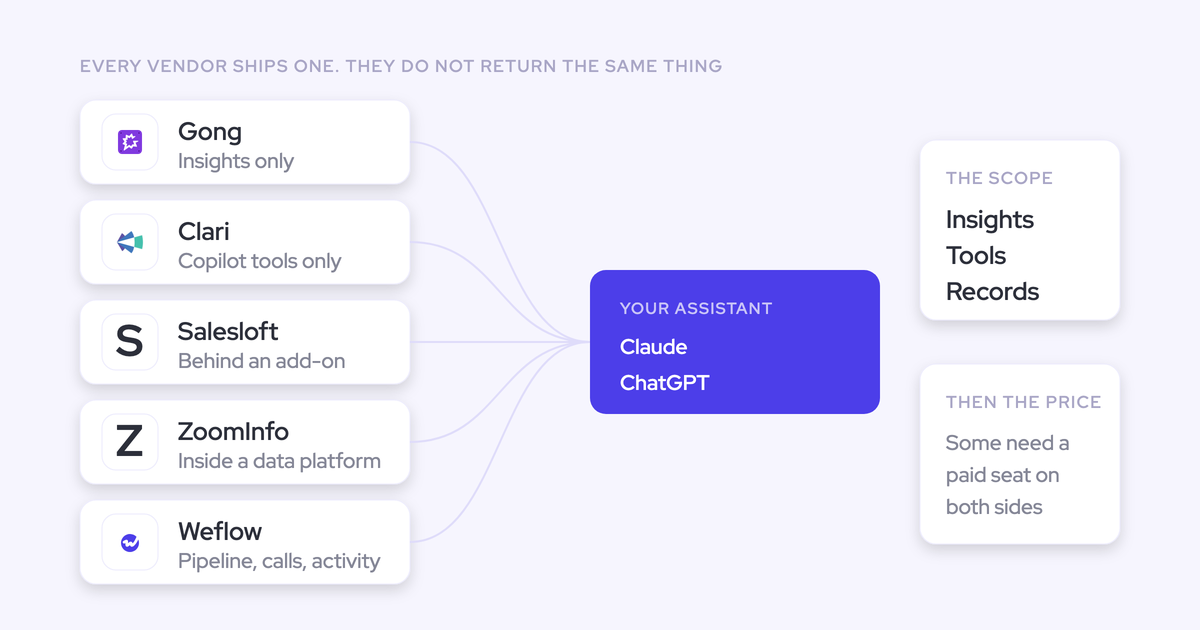
Clari is the clearest case. Its forecasting product and Clari Copilot don't talk to each other, so teams that own both end up piping transcripts into a separate AI workspace and feeding structured insight back to the CRM by hand.
The test: ask whether the forecast and the conversation layer read the same data, and which Salesforce fields the conversation layer writes. If the methodology score lives in the vendor's own scorecard and your MEDDPICC fields stay empty, you now have two versions of the truth and still no answer where the deal review happens.
Can it snapshot pipeline and show what moved?
Almost every pipeline-health question is a comparison of the same pipeline at two points in time. Salesforce overwrites the field and keeps no history, so after the fact the evidence simply doesn't exist.
Questions you can't answer without snapshots and tracked field history:
- How are we doing at day 35 of this quarter compared with day 35 of the last three?
- Which deals slipped out of the quarter, and which got pulled in?
- When was that amount cut, and by how much?
- Coverage looked fine in week one. What changed by week six?
That's the real choice: the tool does it, or you fund a data engineering project to answer a management question.
What does it cost, and can you test it first?
Quote-only pricing, implementation fees and no trial aren't just contract costs. They're evaluation costs.
You write requirements down and run two or three vendors against the same list. A vendor who needs three calls before naming a price, and a paid services engagement before you see your own data in the product, can't be piloted inside that window.
There's a political cost too, and it usually decides seat count rather than vendor:
1. Weflow: AI forecasting built on captured Salesforce data
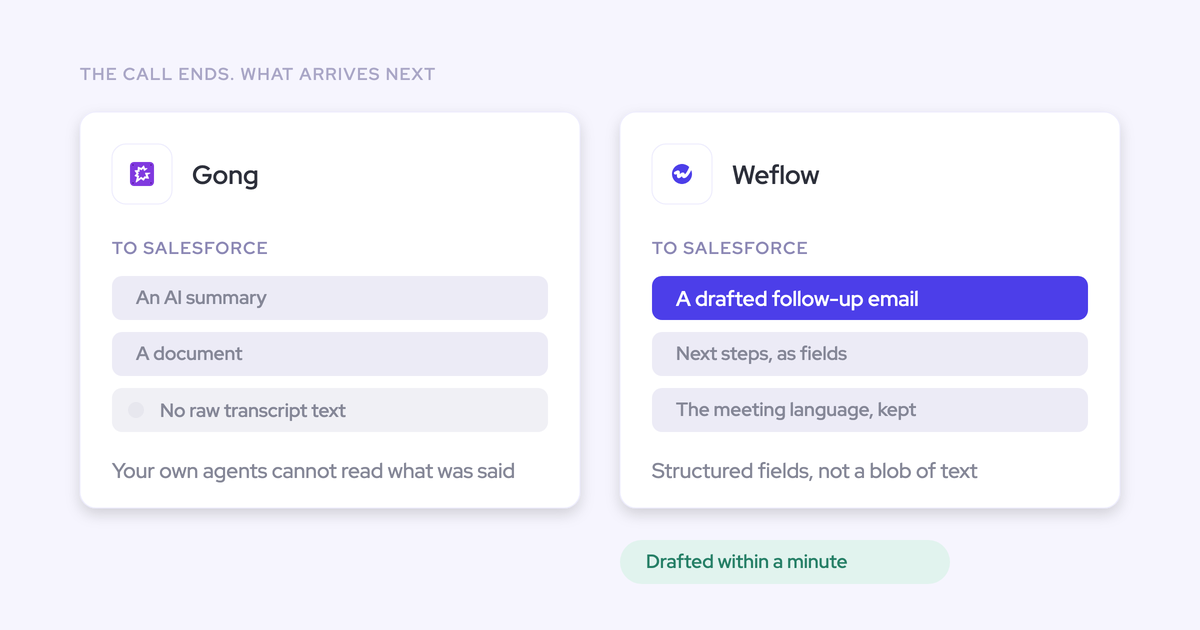
Weflow is the option where the forecast sits on the same captured data as everything else: activity, contacts, and conversations, all landing in native Salesforce objects you own. Three modular products, one platform, so the call actually informs the number instead of living in a second tool.
Quick specs
- Deal Intelligence & Forecasting: $39/user/month standalone. Revenue AI Enterprise (all products, including forecasting): $79/user/month. Foundation $49, Business $59, both billed annually.
- Minimum 10 users. Unlimited view-only licenses. No platform fees, no implementation fees, no usage-based charges.
- 14-day free trial with guided onboarding.
- Salesforce only. Sign-in runs through your Salesforce OAuth and SSO, so there's no second identity to deprovision.
- SOC 2 Type II, GDPR, HIPAA, CCPA, Zero Data Retention. ISO 27001 in progress. Not FedRAMP certified.
What it does well
Three forecast methods run side by side: a dynamically weighted forecast off your own stage conversion rates, the rep and manager roll-up, and an AI projection built on 50+ deal-level signals and up to two years of history that returns a corridor rather than a single number.
"What I am a big fan of is combining three main metrics to keep it simple: a dynamically weighted forecast that looks at your last six and twelve months of stage conversion rates, a bottom up roll up forecast, and an AI prediction based on the data foundation. The AI prediction is not one number, it is actually a mid, high, and base case, so you have a corridor, because the reality is it is a corridor and a lot of things can happen."
Janis Zech, Co-founder and CEO, Weflow
The gap between the three is your forecast call agenda. It's also the thing a revenue leader can take into a board conversation without pretending to one decimal place of certainty.
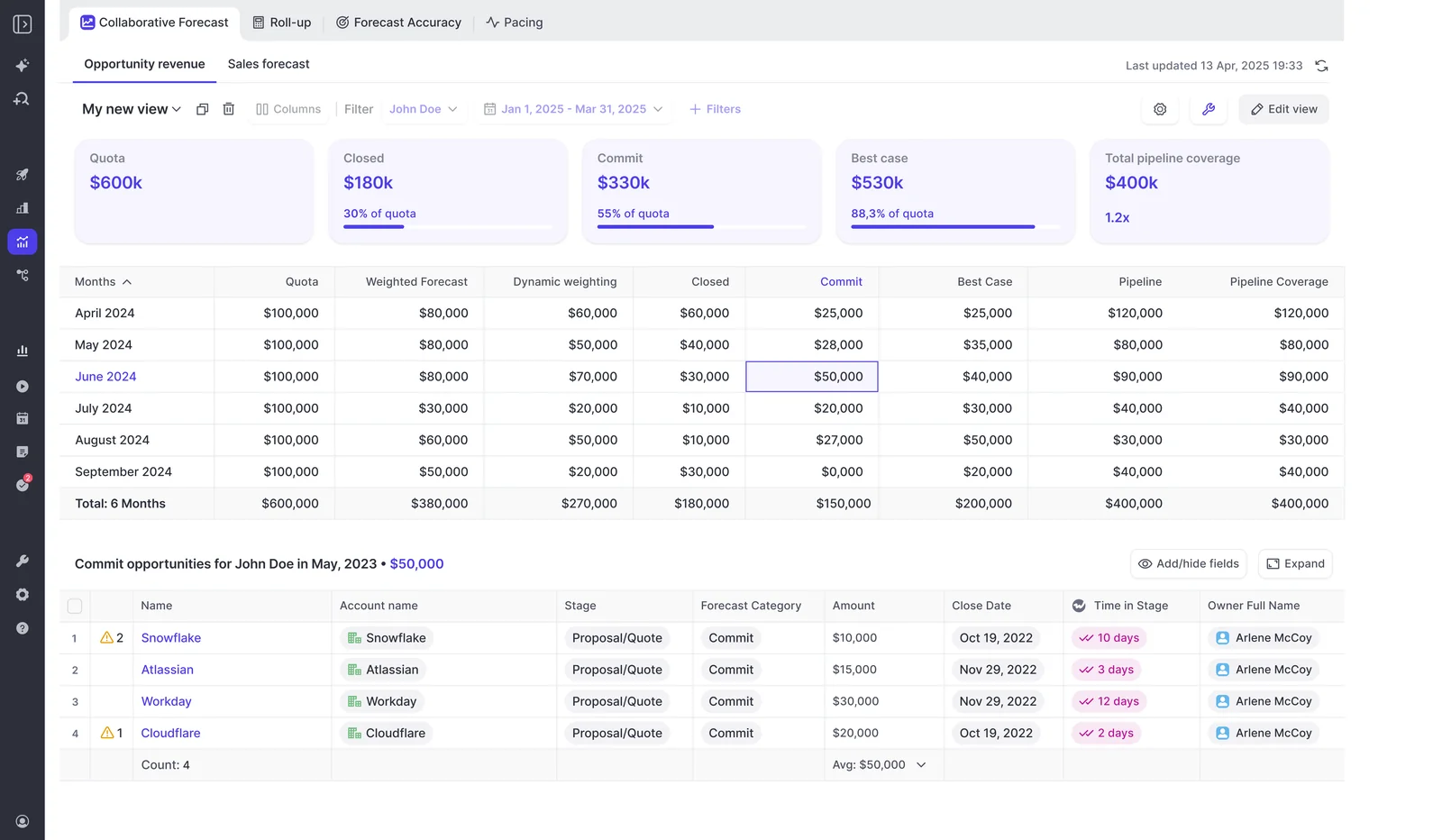
The AI projection scores each deal individually. It reads seasonality, rep performance, conversion rates, communication cadence, whether a next meeting is booked, and whether the deal is healthy against your methodology, so a large deal that's being worked badly projects down instead of propping up the number.
The hierarchy is yours, not Salesforce's. Build a forecast that compares all enterprise reps globally, or one leader across several product teams, without touching your CRM user structure.
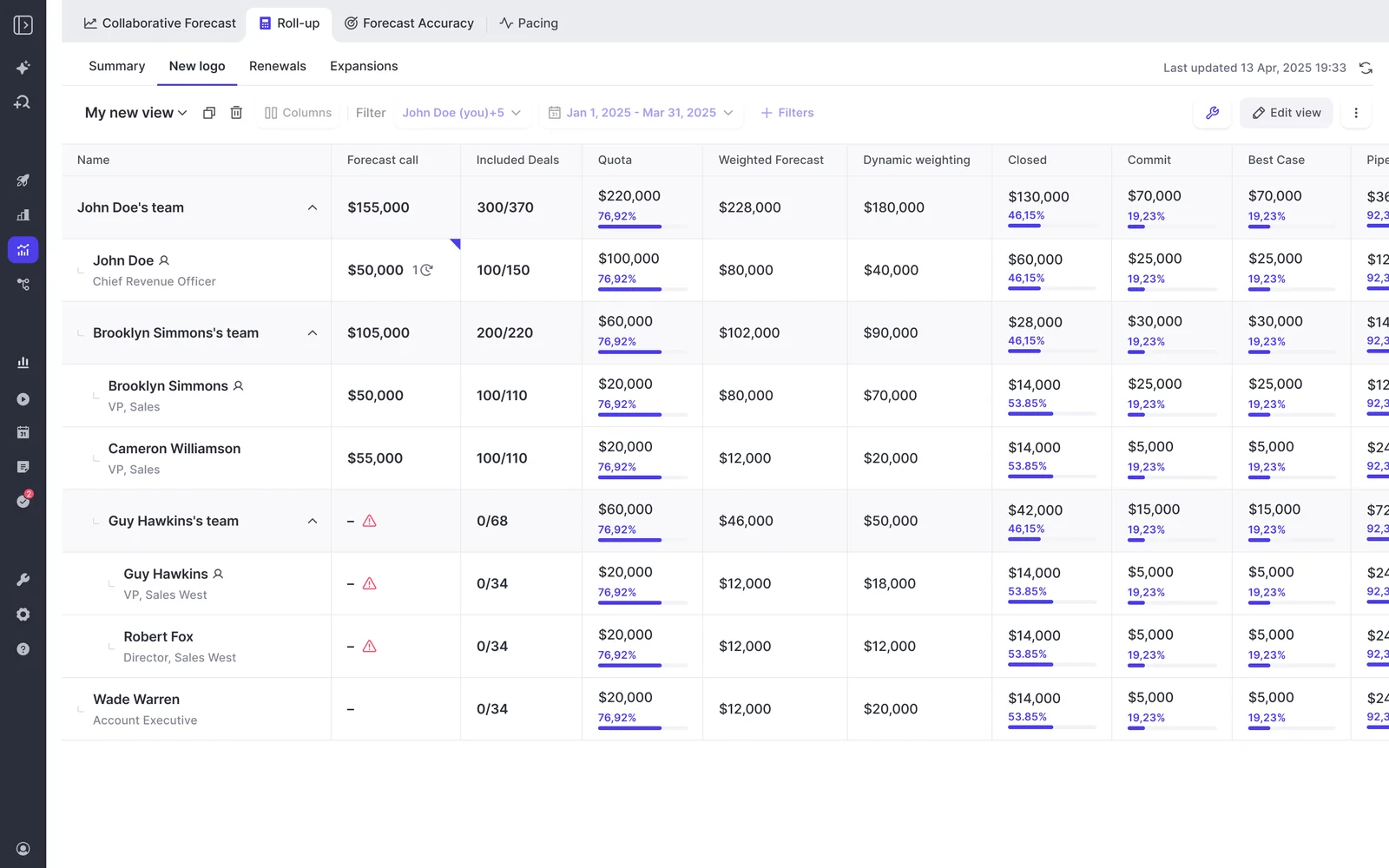
Parallel forecast setups handle multiple motions properly. Each setup is built on one chosen amount field indexed on one chosen date field, with its own stages, targets, cadence and roll-up, so new business, renewal and expansion stay honest instead of blending into one number that hides the motion that's failing.
The roll-up itself is built for accountability rather than a single editable figure:
- Each rep submits a baseline and a best case, either as a total or by selecting the specific opportunities behind each number, with a comment.
- Every submission is versioned, so you can see whether a rep's call moved during the quarter or never moved at all.
- Managers override rather than overwrite, and deadlines lock the field.
- A reminder email deep-links the rep straight into their submission.
Pipeline history is built in. Opportunity snapshots track week-over-week change, field history is tracked, and days in stage plus total close-date push count are captured on every opportunity without you creating custom fields and the automation to populate them.
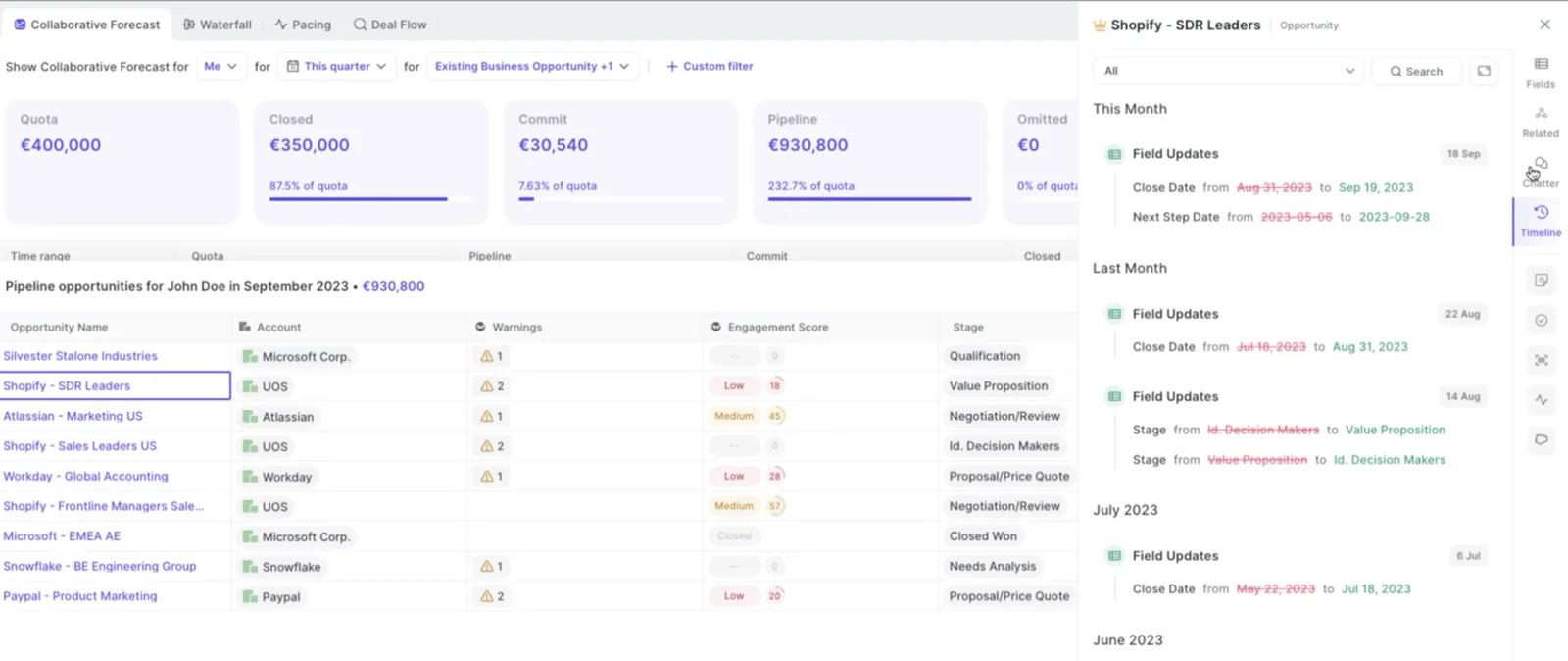
Forecast accuracy is measured, not assumed: forecasted versus actual, by rep and by manager, over time. Zeotap runs its forecast on Weflow at ±7% accuracy.
Where it falls short
- Forecasting was historically the weaker part of the platform. It matured fast and now wins evaluations, but Clari's enterprise roll-ups at 1,000+ reps are more mature. If that's your scale and your hierarchy is stable, be skeptical of us.
- Forecast submissions, targets and roll-up data live in the Weflow layer, not as Salesforce fields. Everything else Weflow produces lands in native Salesforce objects. If you've decided reps live in exactly one system, know that the weighted forecast and AI projection still run off CRM data with no rep input, but roll-up submission does not.
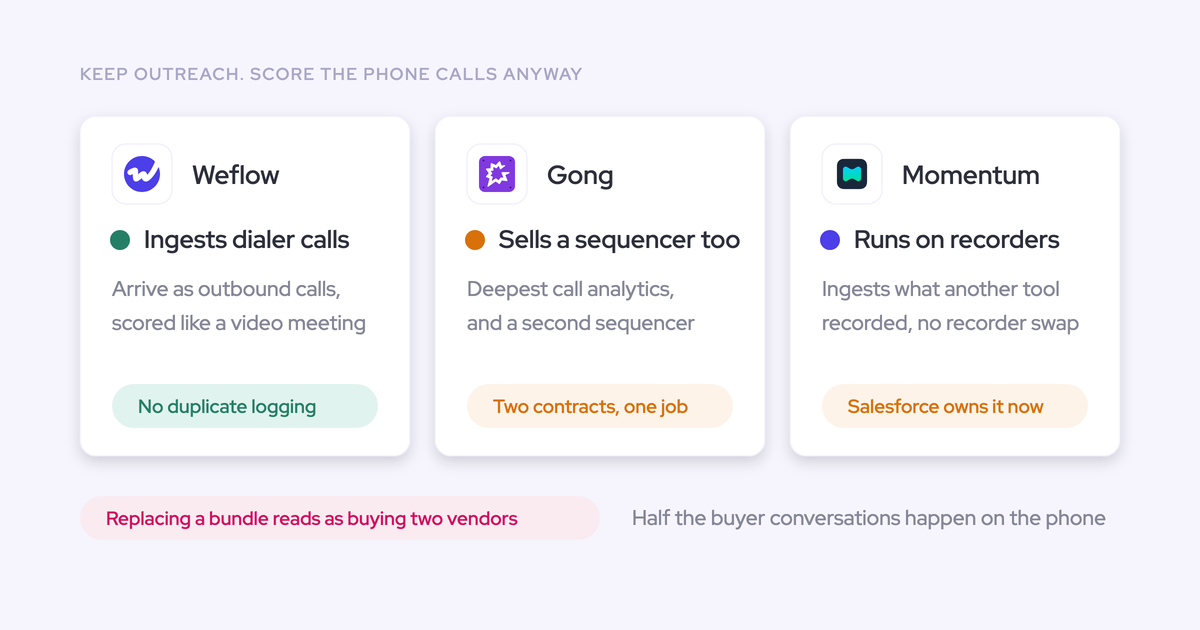
- No sales engagement, no dialer, no VoIP or phone-call capture. A phone-heavy motion isn't fully covered by capture today.
- Salesforce only, and not FedRAMP certified.
A prospect who ran the bake-off put the honest version better than we would:
That was about the forecasting screens in isolation. What tipped it was the other 20%: the capture, the conversation data, and the price.
Best for: mid-market Salesforce revenue teams that want the forecast, the deal intelligence and the conversation data on one data layer, and that want to pilot before they sign. Scales to enterprise.
2. Clari: mature enterprise roll-ups at a premium price
Clari's forecasting is genuinely strong, and pretending otherwise is how vendors lose credibility with this reader. At 1,000+ reps with a stable reporting hierarchy, its roll-up mechanics are the most mature in the field.
In practice, three views carry the deployment: the pipeline waterfall, the pacing view, and the comparison against the same day in previous quarters. Most of the rest of the interface goes unused.
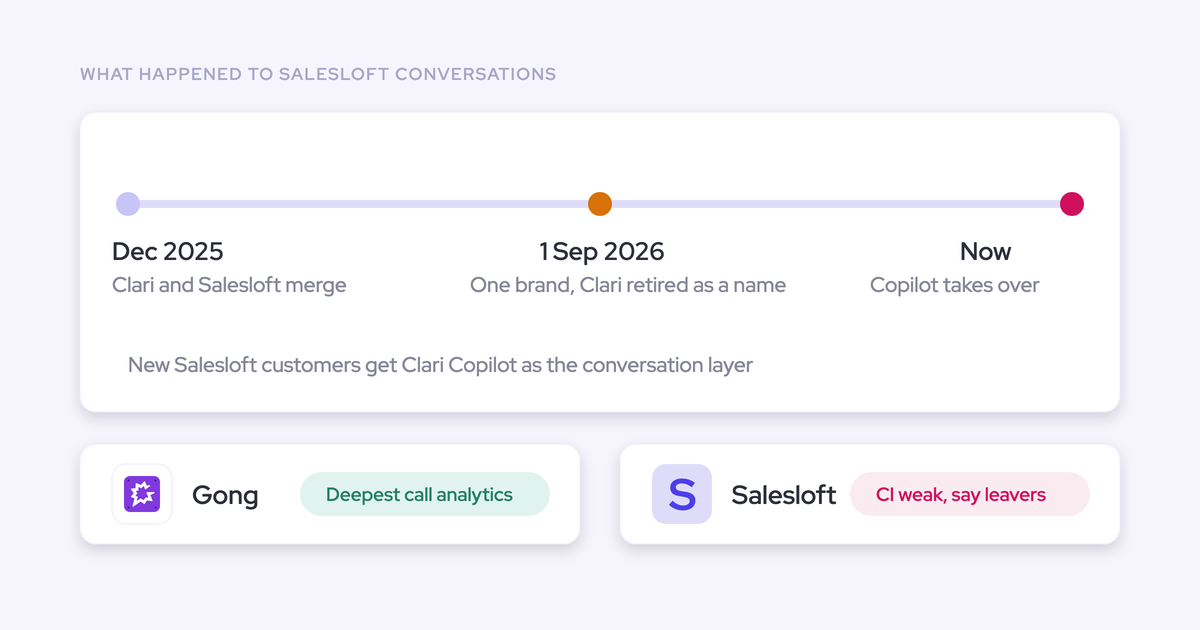
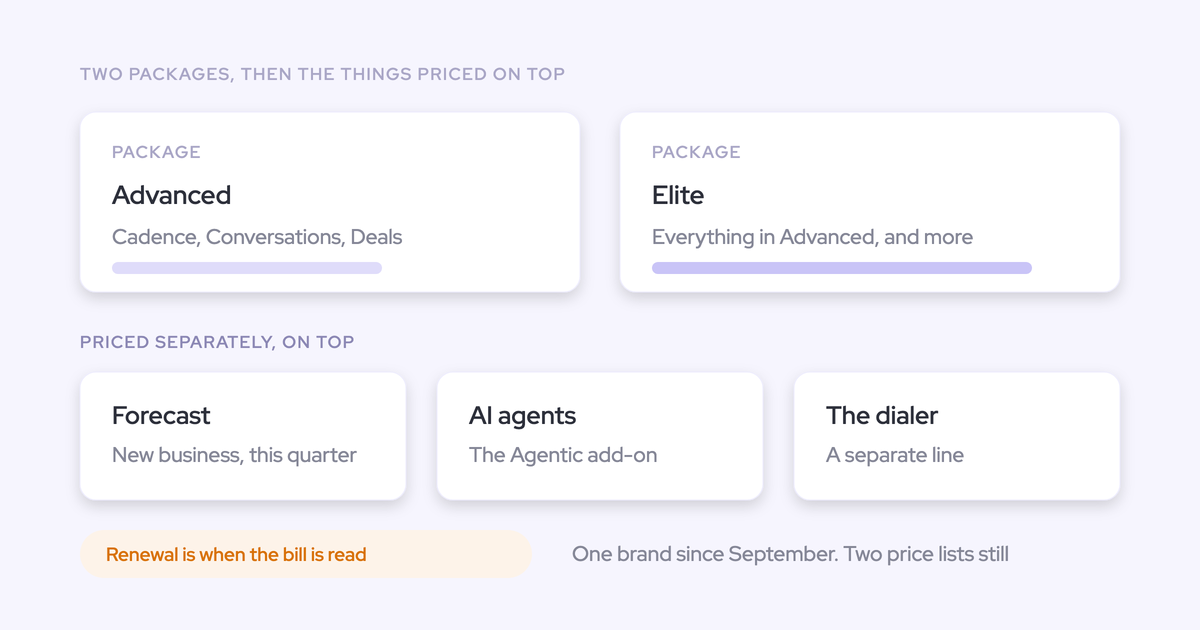
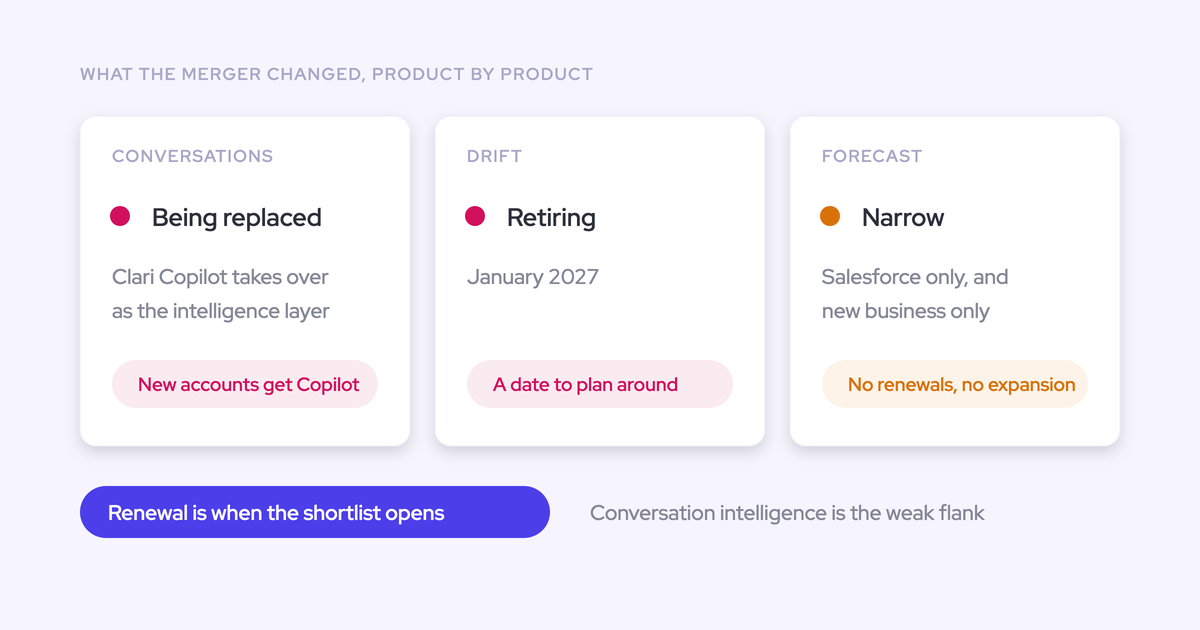
The structural problem is how Clari was assembled. Wingman became Copilot in 2022, Groove arrived in 2023, and the Salesloft merger added a fourth application. Separate data models, separate interfaces, one brand. Consolidating onto Clari doesn't reduce the number of systems you run, it reduces the number of invoices.
The operational limits RevOps teams hit, in roughly the order they hit them:
- Clari can't calculate a field. Any derived metric (a swing between best case and worst case, a delta between what a rep committed and what their manager submitted) has to be built as a Salesforce formula field first, so a five-minute reporting question becomes a change request.
- It can't compare two date fields relative to each other, so views that depend on one date falling after another get hard-coded by quarter and quietly stop being correct when the calendar moves.
- The waterfall compares one date to another date rather than showing the movement, which is why teams export to Tableau to see what actually happened in between.
- The multi-level forecast shows what each direct report submitted but not what the reps beneath them said, so nobody can see where in the chain a number was changed.
- Clari Capture maps activity server-side by email domain, so it misattributes when an account has several open opportunities.
- The opportunity score is computed from historical performance and inherits whatever's wrong with that history.
Then there's the commercial shape. Clari runs $120 to $180 per user per month with $15k to $50k in implementation fees, no trial, and no self-serve signup, and per-seat cost falls as seat count rises, which tells you the pricing is tuned for total contract value.
Low usage is what turns that into a renewal fight. When a poorly implemented instance goes stale, the license count stops matching the number of people doing the work, and RevOps starts pricing a replacement.
Best for: large enterprise forecasting orgs whose hierarchy matches the CRM, whose budget absorbs the seat price, and whose conversation intelligence need is served elsewhere.
3. Gong Forecast: call insights locked to the Salesforce hierarchy
Gong invented conversation intelligence and still has the deepest conversation analytics in the market. If your primary problem is understanding what happens on calls, Gong is the strongest product here, and it does things others don't, like summarizing a methodology across every call on an account rather than call by call.
Forecasting is the attachment, not the core. Two things decide it for a Salesforce team:
- The roll-up follows the Salesforce hierarchy. When your reporting lines differ from the CRM manager field, you build placeholder structures purely so the forecast resolves, and every future org change has to be made twice.
- The data lives in Gong's interface. Field mapping back into Salesforce is where evaluations stall, and reps end up working in a second UI.
On price, the fair framing is timing rather than greed. Gong set its pricing when transcription was expensive. The same capability is built at a materially lower cost base today, which is the substantive answer when a buyer asks what's missing at half the price.
Best for: teams whose main investment case is conversation analytics and coaching, with forecasting as a secondary benefit.
4. Salesforce Collaborative Forecasts: native, but no history or waterfall
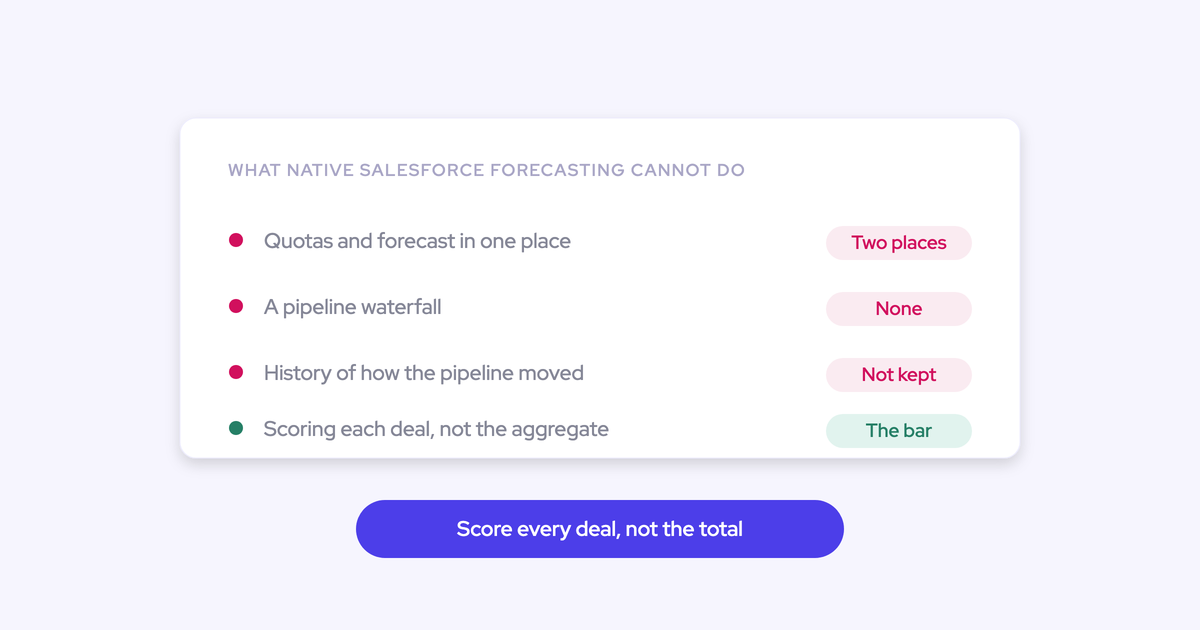
Native forecasting is the honest baseline: no extra vendor, no second login, the number lives in the CRM. It's also the reason this category exists, because it can't do the job a forecast process needs.
What it can't do, in the terms you'll repeat to your CFO:
- No pipeline snapshots, so no history of how the pipeline moved
- No waterfall, so when the number drops you ask reps which deals slipped and why
- No day-35-this-quarter versus day-35-last-quarter comparison without a warehouse
- No quota management and forecasting against quota in one place
- Roll-up bound to the Salesforce role hierarchy, full stop
That's the pattern. Teams stay native, discover the missing history, and end up in a spreadsheet anyway.
Best for: small teams with a short cycle who need a submitted number and don't yet need to explain what changed.
5. Spreadsheets: the real incumbent, stale on arrival
The spreadsheet is the most common forecasting incumbent we meet, more common than any named vendor. Companies with thousands of sellers pull Salesforce reports, paste them into Sheets, and spend the week chasing managers.
It's free, it bends to any hierarchy you can imagine, and the number at the end is only as fresh as the last person who replied. Every week, forever.
Here's the case for keeping it a bit longer, which vendors rarely make: if you don't have a cadence yet, buying a tool won't create one.
"So I think this whole ending up with a number, right, I think most of our listeners will notice, we talked about this a few times, but forecasting is really like a muscle you need to train and the number in the end, that's sort of the outcome of a long, long training cycle, exercise cycle that you went through before."
Janis Zech, Co-founder and CEO, Weflow
We challenge prospects on this on sales calls: who submits, how often, at deal or manager level, against which quota. If those answers don't exist, fix the cadence in the sheet first, then encode it in a tool.
Best for: teams still designing the process, and finance models that will exist alongside whatever you buy anyway.
6. People.ai: strong relationship mapping, brand-new forecasting
People.ai is strongest at relationship mapping and account planning, and the free PeopleGlass tier makes it easy to try that part without a procurement cycle. For an enterprise team whose real gap is knowing who's actually in the buying committee, it's a reasonable buy.
Its forecasting product, AI-Native Forecasting, launched in October 2025. That's brand new next to vendors who have been running enterprise roll-ups for a decade, and we haven't seen it hold up against a serious requirements list yet.
Best for: teams whose primary problem is relationship visibility, not forecast process. If you need a roll-up next quarter, this isn't where we'd start.
7. Revenue.io: Salesforce-native calling with real-time coaching
Revenue.io's wedge is a Salesforce-native dialer with real-time in-call coaching, branded Moments. That's a genuine differentiator: Gong and Weflow both coach after the call. Revenue.io coaches during it.
It also delivers the thing some buyers explicitly ask for.
The heritage is inside sales and telephony, with HIPAA and TCPA support and local presence dialing. It's built around the phone and the coaching moment, not around a forecast roll-up process, so if you came here for hierarchy flexibility and pipeline history, this isn't the answer.
Best for: phone-heavy inside sales teams who want reps living in Salesforce and coaching happening live.
8. Attention: activity reporting rather than roll-up forecasting
Attention is reporting-first. It reports on activity, and for a small team that wants lightweight insight into what's happening, that can be enough.
For a forecast process it isn't. There's no roll-up or collaborative forecasting, no forecast accuracy measurement, and no pipeline analytics or dashboards, so the criteria this article is built on mostly don't apply.
Best for: teams wanting activity insight without a forecasting process attached. Not a shortlist candidate if you own the roll-up.
Which forecasting tool fits your team's situation
The pick follows the situation, not the feature grid.
| Your situation | What we'd do |
|---|---|
| Clari renewal on the desk, usage low, price rising | Weflow. You keep the three views you actually use, get deal-level prediction and a hierarchy that matches your org, and land at $79 for the full platform instead of $120 to $180 for forecasting alone. |
| Forecast still lives in a spreadsheet, but the cadence works | Weflow. The weekly manual cycle disappears: submissions, roll-up, weighted forecast and snapshots all run off live CRM data. |
| No cadence yet, nobody owns submission | Fix the process first. Design who submits, how often, against which quota, then buy. A tool bought before the cadence is a tool nobody opens. |
| Renewals and expansion have never had a real forecast | Weflow. Parallel setups per record type, each with its own stage path, quota, cadence and roll-up, which is the motion incumbent deployments almost never get around to. |
| Call data has to reach the number | Weflow. Forecasting, deal intelligence and conversation intelligence sit on one captured data layer, so methodology health and engagement feed the projection. |
| Conversation analytics is the real gap, forecasting is secondary | Gong for depth of analytics, or Weflow if you want the conversation turned into Salesforce fields at about half the seat cost. |
| 1,000+ reps, stable hierarchy, budget approved | Clari. Its enterprise roll-up maturity at that scale is the honest answer, and we'd rather you hear that from us than discover it in month three. |
| PE sponsor or leadership has mandated Clari | Don't fight it. Coexist on capture and conversation data, improve the data Clari reads, and revisit forecasting at the political window. |
That last row deserves more than a table cell, because it's the most common blocked deal we see.
Clari reads activities from Salesforce. So you can run Weflow as the capture and conversation layer, let Clari consume cleaner Salesforce activity, and both get better.
The one thing not to do is run two capture engines against the same mailboxes. That produces duplicate activities and distorts every count built on top of them. One capture infrastructure feeding Salesforce, one forecasting tool reading it.
Walk through the product yourself, no call required.
What changed in forecasting tools heading into 2026
- Clari and Salesloft are one company. The merger completed on 3 December 2025 under CEO Steve Cox, with roughly $450 million in ARR across more than 5,000 customers. The products have not become one: they still run as separate applications with separate interfaces. If you run both, you have a single point of commercial dependency you didn't knowingly sign up for, and leaving one usually means deciding about both.
- People.ai shipped forecasting in October 2025. A name that was previously a relationship-mapping vendor now appears on forecasting shortlists, with a product that's months old rather than years.
- Momentum was acquired by Salesforce. It now feeds Agentforce 360 and Slack with conversation data from Zoom and Google Meet, so evaluating Momentum is evaluating Salesforce's native path, not an independent point solution.
- RevOps teams now prototype their own forecasting tool before taking a vendor call. AI coding assistants made the prototype cheap. Maintenance didn't get cheap: the data model, the snapshotting, the permissions, the hierarchy roll-up and the integrations all have to keep working while you run the business. Vendors are now priced against the cost of owning the internal build.
- Buyers expect deal-level prediction as standard. Stage-and-amount math with a probability field no longer passes as AI forecasting, and the incumbents' scores were built on thin, mis-mapped data.
How we evaluated and ranked these tools
The criteria come from the requirements lists RevOps teams write before they take a vendor call, and the verdicts come from what surfaces in bake-offs against those lists: switch conversations with teams leaving Clari, Gong and Einstein Activity Capture, hands-on configuration work in customer orgs, and public pricing where a vendor publishes it.
Where a competitor is stronger than us, it's stated in their entry. Where pricing isn't public, we've said so rather than estimating. And we sell one of the eight tools here, which is why the Weflow entry carries its shortfalls instead of a footnote.
FAQ
Can Weflow reproduce Clari's pipeline waterfall and pacing views?
Yes, and that's the first thing to test in a trial. Weflow has waterfall and pacing views, and the pacing chart shows AI Projection, Team Forecast and Weighted Forecast side by side against Pipeline, Commit and Closed. Opportunity snapshots track week-over-week pipeline change, which is what makes the quarter-over-quarter comparison possible.
Do I need a data warehouse for pipeline snapshots?
No. Weflow snapshots opportunity data and tracks field history as part of the product, so the day-35 comparison, the slipped-deal view and the amount-change history exist without a warehouse project. Days in stage and total close-date push count are captured on every opportunity automatically, without you creating custom fields and the automation to populate them.
Can I run separate new business, renewal, and expansion forecasts?
Yes. Weflow runs parallel forecast setups, one per Salesforce opportunity record type, each with its own stage path, forecast-category mapping, quota, cadence and roll-up. That's how the renewal motion finally gets a process instead of sitting in the same pipeline as new business with no milestone before the contract end date. Each setup is built on one chosen amount field indexed on one chosen date field, so a team forecasting incremental ARR and a team forecasting a calculated revenue field need two setups.
Are Weflow forecast submissions stored as Salesforce fields?
No. Forecast submissions, targets and roll-up data live in the Weflow application rather than as Salesforce fields, while everything else Weflow captures and generates lands in native Salesforce objects. The weighted forecast and the AI projection both run off CRM data with no rep input, so they work regardless. If you need the roll-up downstream in a BI tool, you pull it through the public API rather than reading it from Salesforce.
Does forecast data export to BI tools with record IDs?
Yes, through the public API, with batch extraction so it lands in your warehouse or lakehouse rather than staying inside our screens. The exported rows carry the CRM record IDs, which is what makes the feed reconcilable against Salesforce instead of a second dataset nobody trusts. Meeting video is the one exception: recordings are exported to your own cloud storage rather than stored in Salesforce, because CRM storage is expensive, while transcripts and structured outputs land natively.
Can Weflow run alongside Clari if leadership keeps it?
Yes, and it's the pattern we recommend when the decision is political rather than technical. Clari reads activities from Salesforce, so Weflow captures activity, contacts and conversations into your CRM, and Clari's forecasting consumes cleaner data than it had before. The failure mode is running two capture engines against the same mailboxes, which creates duplicate activities. Compatibility mode exists for the transition period: Weflow delays its sync, checks for the other tool's tracking pattern, and skips the message if it finds one.
What does migrating off Clari to Weflow involve?
It runs as a project in three phases against a mutual action plan: a 45 to 60 minute technical implementation with your Salesforce admin and mail admin, a configuration phase, then a role-based rollout with separate leadership and rep training. Time to live is typically two to four weeks, or four to six for a large org.
Forecasting takes the longest, because it isn't a tool topic. It's the encoding of your operating cadence: who submits, how often, at deal or manager level, against which quota. We run onboarding ourselves rather than handing it to a partner, there's a managed-service option when RevOps bandwidth is the blocker, and there are no implementation fees.