
6 best Clari alternatives for mid-market revenue teams (2026)


Nobody re-platforms their forecast because they're curious. There's a date: June, late August, end of September, whatever month your Clari contract lapses. That date is why you're reading a list like this, and it's why the evaluation gets compressed into six weeks instead of six months.
So this piece is written for that moment, and it's going to be honest in both directions. Clari's roll-up forecasting is genuinely strong, and its forecast submission and roll-up mechanics are the part teams miss most when they leave. The reasons teams leave anyway are specific and operational: per-seat pricing that outgrew the value, a product that hasn't moved in years, and an overlay that never becomes the reporting your CFO actually sees.
You've already learned that feature parity isn't outcome parity. So the six paths below get judged on the things that decide a switch: where the data lives and who owns it, whether the forecast can bend to your hierarchy, whether call data reaches the number, and what the whole thing really costs.
Why revenue teams leave Clari at renewal
The trigger is almost never one feature gap. It's a convergence: the invoice lands, the product looks the same as it did three years ago, adoption has gone stale, and the number you present to the board isn't actually made in the tool you're renewing.
Here are the five reasons that come up most often on switch calls.
Per-seat pricing and services fees that outgrow the value
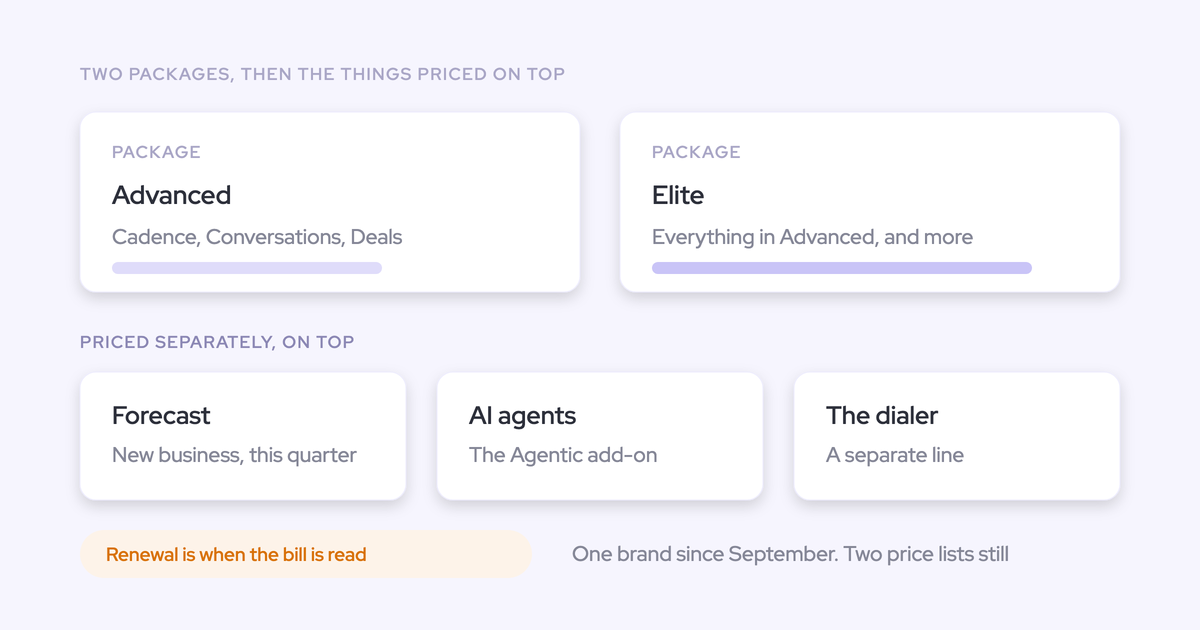
Clari runs roughly $120 to $180 per user per month, quote-only, with reported professional-services fees of $15,000 to $50,000 on top. There's no free trial and no self-serve path.
The pricing is also regressive on size. A small footprint gets punished: around $46,000 for 26 seats is a figure we've seen, while large enterprise deals come in materially cheaper per seat. That's pricing tuned for total contract value, not for a mid-market team.
Then adoption drifts, and seats stop matching users. That's usually the moment RevOps starts cutting licenses instead of expanding them.
These different tools like Sales Loft and Clari are pretty expensive and they're kind of getting old too. We use Clari for the forecasting piece primarily.
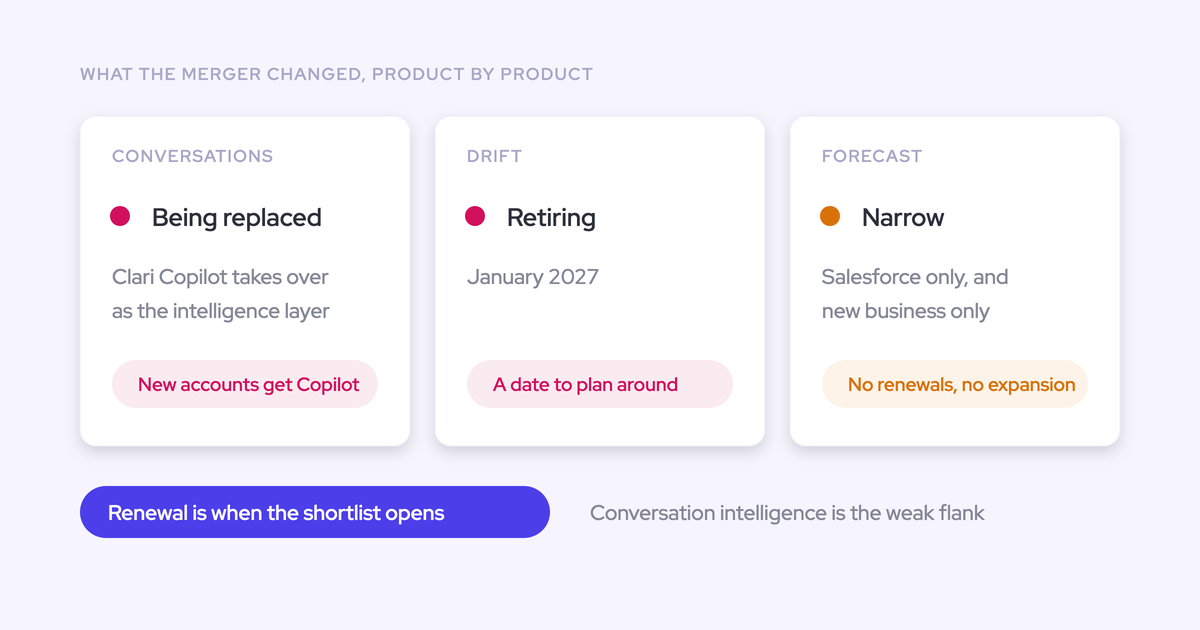
A product that has stood still since the Salesloft acquisition
This is the reason buyers say out loud first, and it's the hardest one for Clari to answer.
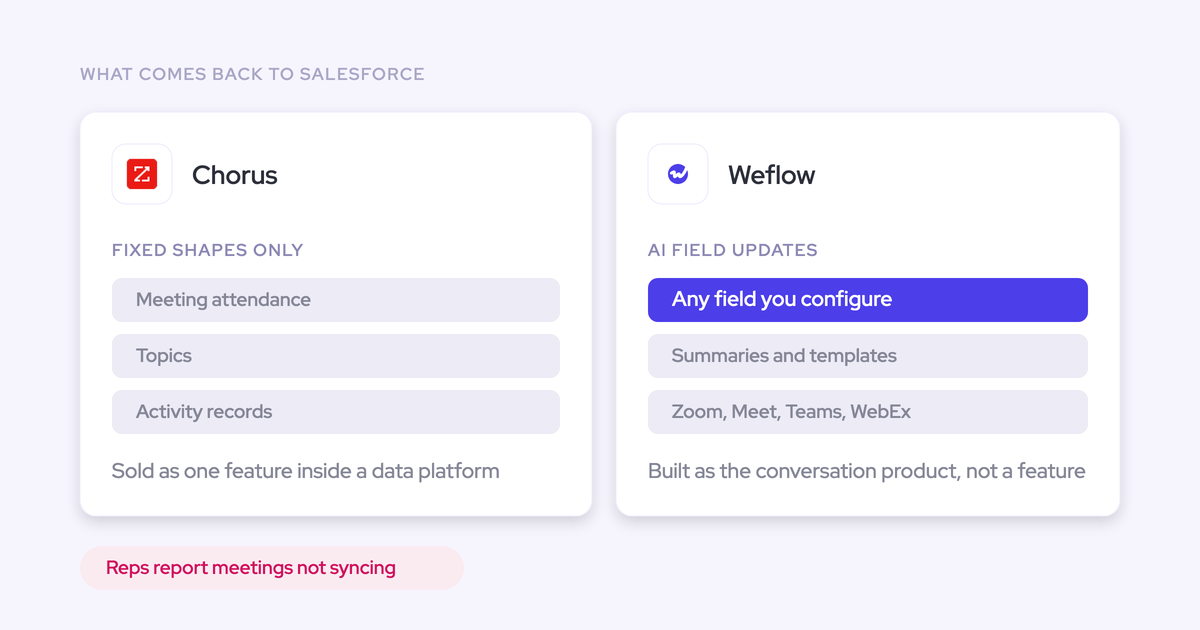
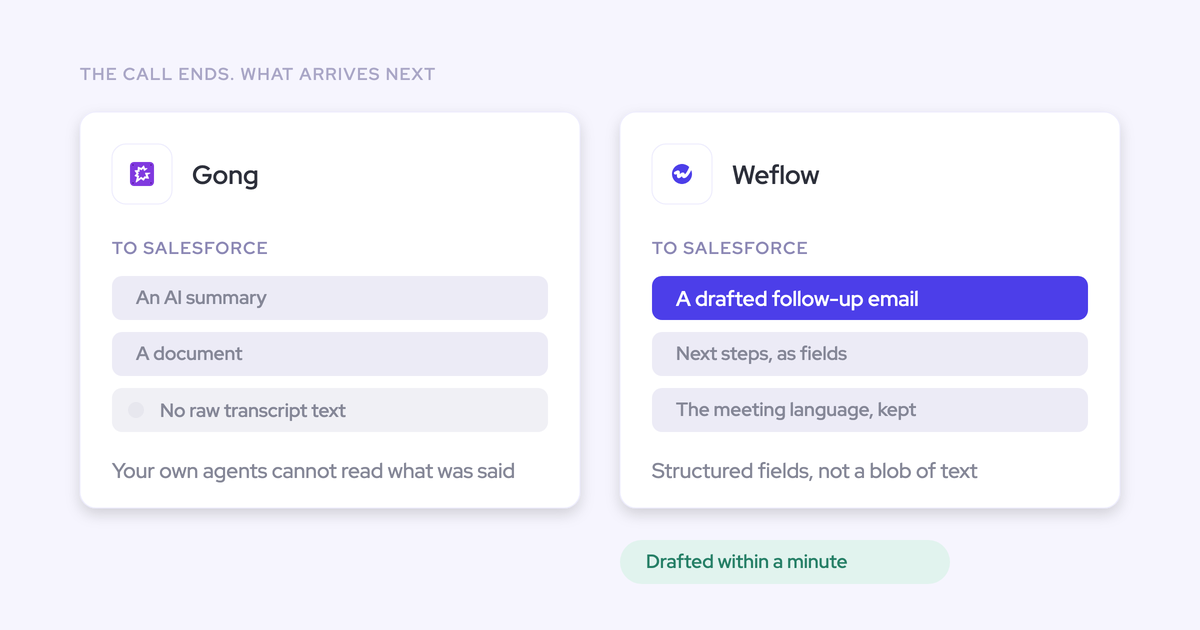
Salesloft and Clari now sit under one private-equity-backed owner, and Salesloft remains a standalone application rather than a native part of the forecasting platform. Copilot, the conversation intelligence side that came in by acquisition, has stalled: no AI field updates into Salesforce fields, no methodology scorecards for MEDDIC or MEDDPICC, no rep-level coaching depth.
An overlay that never becomes your Salesforce reporting
Clari holds its own logic and its own mappings alongside Salesforce, which means it never turns into your native reporting layer.
The consequence shows up every quarter in the same place: the deck. Clari's forecast views aren't presentable to a CFO or a board, so the worldwide consolidation gets exported and rebuilt somewhere else.
Clari is clearly not suited as a reporting tool to present to this type of stakeholders. So we're using Tableau. So we kind of are flowing the data from Clari to Tableau.
Read that back slowly. You're paying six figures for a forecasting system that isn't the source of truth for the only forecast that matters. We also see RevOps business partners quietly rebuilding forecast dashboards straight off Salesforce data instead of using Clari at all, which is the clearest signal a tool has lost the room.
Forecasts locked to the Salesforce role hierarchy
Clari's forecast structure follows the Salesforce hierarchy, and it doesn't bend.
The same rigidity is why the second motion never gets built. Renewals and expansion are always next on the list, for years, so new business runs in Clari and the renewal team forecasts out of Salesforce reports.
In a business where AMs and CSMs outnumber new-logo reps several times over, the largest slice of revenue ends up with no forecast process behind it at all.
Conversation intelligence that never feeds the forecast
Clari's forecasting product and its conversation intelligence product don't talk to each other. Call data never informs the number.
Teams that own both end up piping transcripts into a separate AI workspace to extract structured insight, then hand-copying it back into the CRM. That's the fragmentation the two products were bought to remove.
And the layer underneath the roll-up is thin. Clari Capture maps activity server-side by email domain, so emails get missed when a contact isn't on the right account, and activity gets misattributed the moment an account carries several open opportunities. It doesn't measure forecast accuracy either, so after four years a team still can't say how close its calls were.
What Clari still does well, and who should stay
Clari's roll-up forecasting is the real thing, and any list that pretends otherwise isn't worth your time.
Three things Clari genuinely earns credit for:
- Roll-up maturity at scale. At 1,000+ reps, Clari's roll-up mechanics are more mature than anything a newer platform has shipped.
- The methodology sell. Clari sells a process to the CRO, not just a tool: predictability, repeatability, an operating cadence a board conversation can hang off. That's why it lands, and it's why replacing it is partly a process problem.
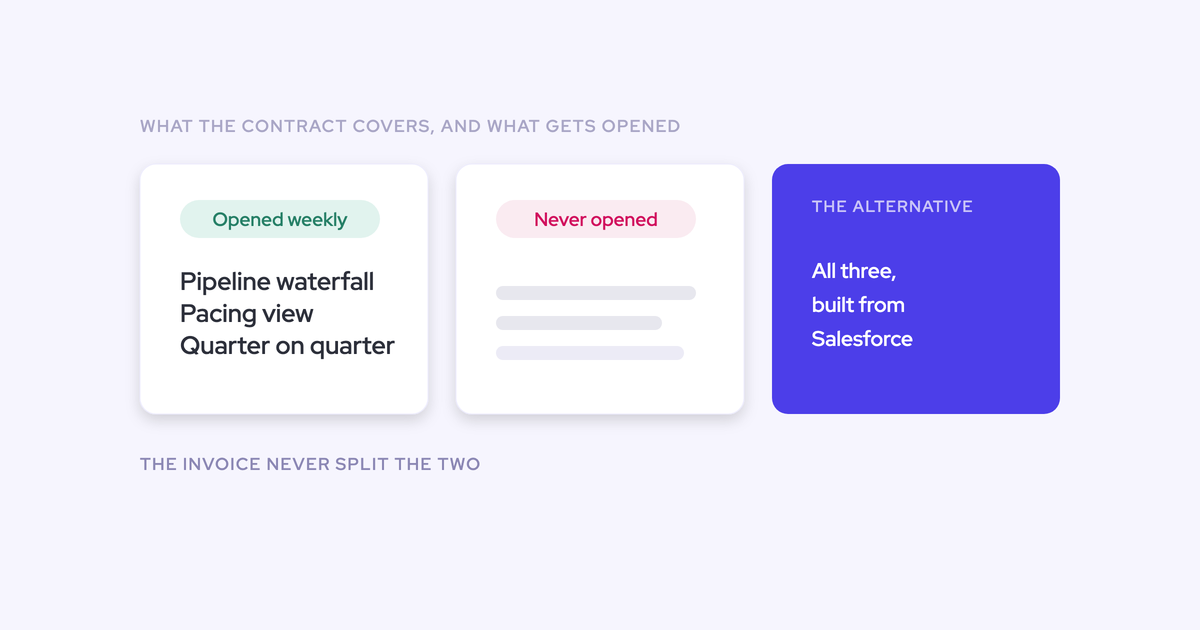
- The three views that actually get used. The pipeline waterfall, the pacing view, and where the quarter stands against the same day in prior quarters. Those are the views a replacement gets judged on.
Stay on Clari, or renegotiate rather than switch, if:
- You run a very large enterprise roll-up and roll-up mechanics are the whole job.
- Your only complaint is the invoice, in which case a seat reduction at renewal is cheaper than a re-platform.
- Your sponsor or board has standardized on Clari. In that case skip to the coexistence section further down, because your constraint is political, not technical.
What to look for in a Clari alternative
Turn the five leave-reasons into criteria and take them into every demo. This is the list to paste into your requirements doc, along with how you test each one inside a two-week pilot rather than taking the vendor's word.
| Criterion | Why it matters when leaving Clari | How to test it in a trial |
| Data ownership | Clari is an overlay. When it goes, its layer goes with it, and nothing it held is available to your own reporting or flows. | Ask where captured activity and call outputs are stored. Then build a Salesforce report on them yourself, and query them in a flow. |
| Forecast flexibility beyond the hierarchy | You already know what breaks: one leader over multiple products, and a renewal motion that was never implemented. | Configure a second forecast with its own hierarchy, revenue field, stages and targets. If that needs a services engagement, it isn't flexible. |
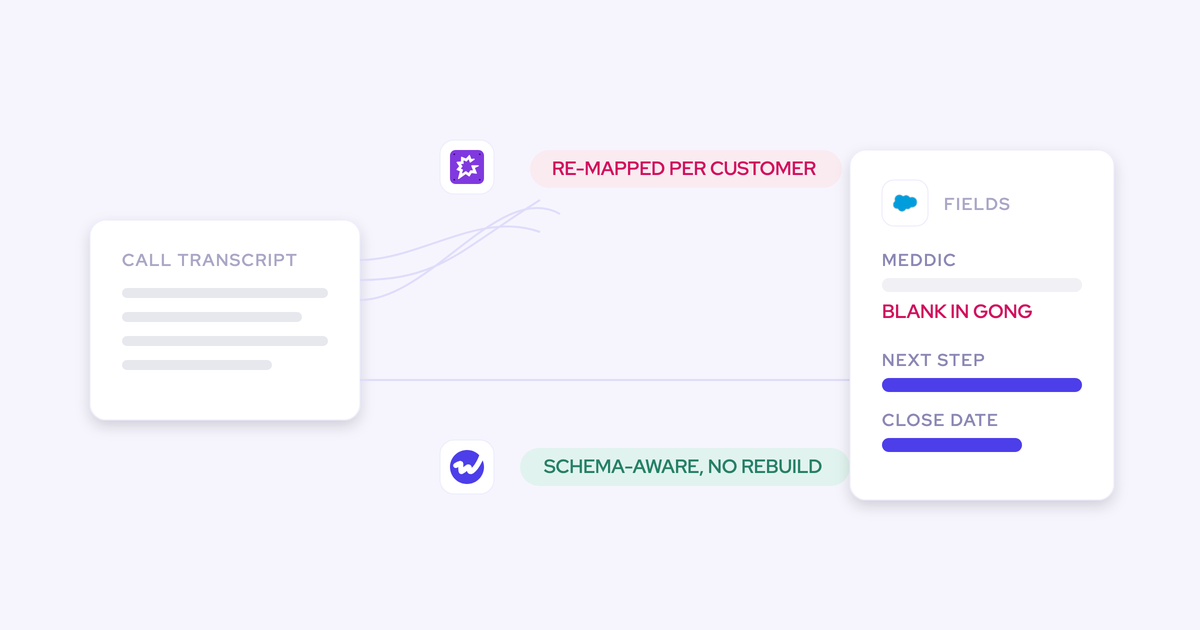
| One data layer from call to forecast | Clari's CI and forecasting don't talk, so deal health is an opinion with a dashboard on it. | Record a real call, then check whether the qualification detail lands in your Salesforce fields and shows up on the deal in the forecast view. |
| Pipeline history and board-grade reporting | Salesforce overwrites the field, so the same-day-last-quarter comparison is the hardest Clari view to reproduce. | Ask whether the tool snapshots opportunities itself. If the answer is a warehouse, you've bought a data-engineering project. |
| Total cost, published | Quote-only pricing plus services fees is how the number climbs every renewal. | Get list pricing in writing, per product, plus implementation cost. Compare against your current all-in per-seat number. |
| Admin overhead | Clari means maintaining a parallel logic layer, and routing changes through CS. | Have your admin change a mapping, a stage path and a permission themselves during the trial. Time it. |
One more test that separates the shortlist fast: does the tool respect your existing Salesforce permissions and configuration, or does it ask you to reproduce them somewhere else?
The 6 best Clari alternatives for mid-market teams
These are the six realistic paths, and they're not all like-for-like replacements. That's deliberate. In practice teams do one of three things: replace the whole thing, assemble the pieces, or go native and build. An honest list has to cover all three.
| Option | What it replaces in Clari | Where the data lives | Published pricing |
| Weflow | Capture, conversation intelligence, deal intelligence and forecasting | Native Salesforce objects you own | Yes, $19 to $79 per user per month |
| Gong | Conversation intelligence, some forecasting | Gong's own data layer, with activity logged to Salesforce | No, quote-only |
| Native Salesforce plus a warehouse | Forecast surface only, if you build the rest | Salesforce and your warehouse | Salesforce licensing plus build cost |
| Attention | Call capture and call-based reporting | Salesforce, call-centric | No, quote-only |
| Revenue Grid | Activity and email sync only | Salesforce | No, quote-only |
| Fireflies | Clari Copilot only | Fireflies, unless synced into Salesforce | Yes, low per-seat |
1. Weflow: capture, conversation intelligence and forecasting built as one platform
Weflow is the Revenue AI Orchestration platform for sales, customer success, and RevOps teams, built for revenue teams that run on Salesforce. It's the entry on this list that answers the five reasons above in order, so let's take them in that order.
Where it's strong
Data ownership is structural, not a setting. Everything Weflow captures and generates lands in native Salesforce objects your org owns: emails and meetings on EmailMessage, Task and Event, contacts and contact roles created on existing accounts, call outcomes written into the standard and custom fields your team already tracks against. That means your Looker or Tableau reports read it directly, and a Salesforce flow can trigger off it. Cancel Weflow and the data stays.
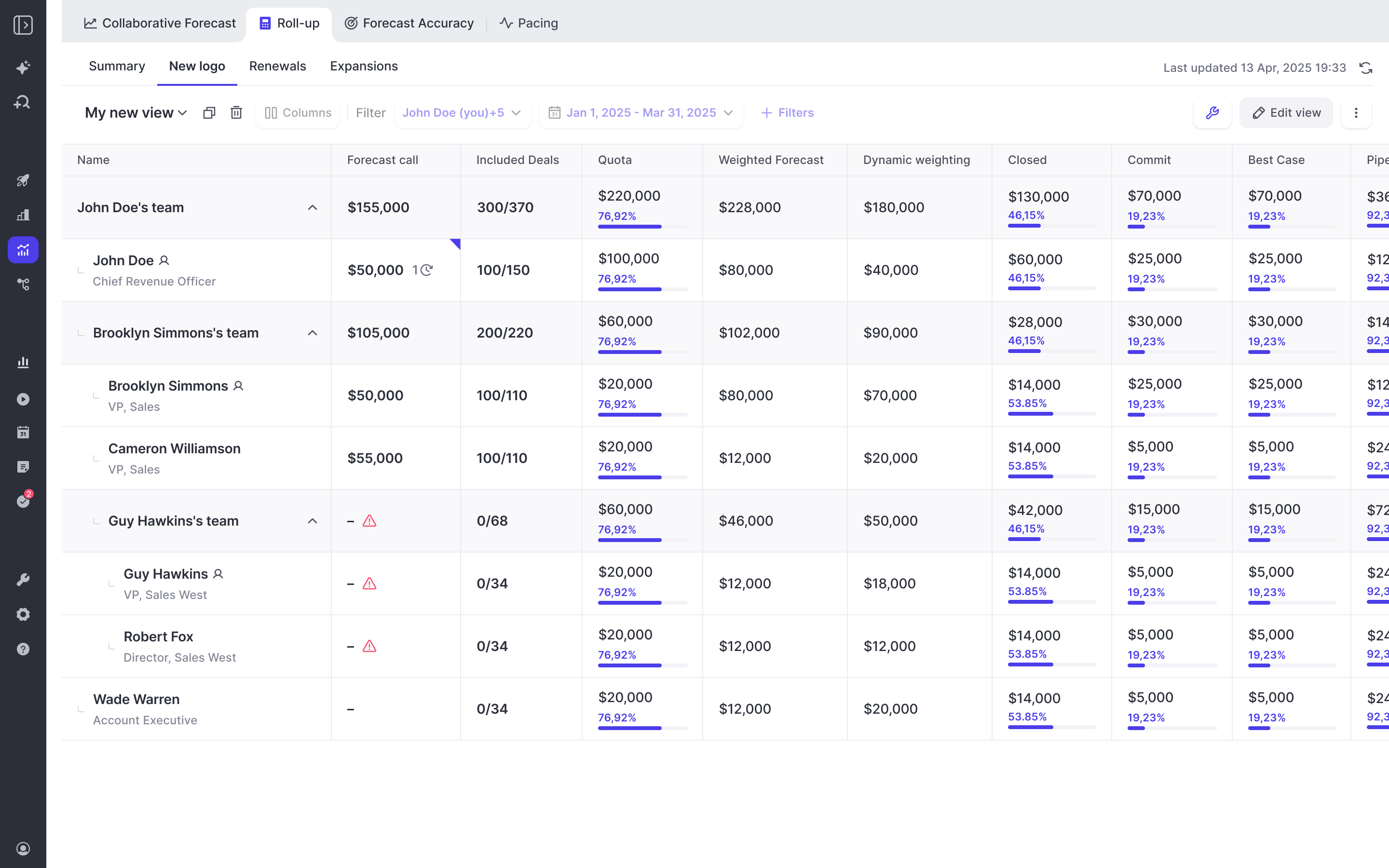
Forecasting that bends to your org, not to the role hierarchy. A Weflow forecast setup is built on a chosen Salesforce amount field indexed on a chosen date field, and you can run several setups in parallel, each with its own stages, cadence, targets and forecast calls. New business against renewals against expansion, licenses against services, one leader across multiple products. Each Salesforce opportunity record type keeps its own stage path, forecast-category mapping and independent roll-up.
That's the direct answer to that hierarchy limitation, and to the renewal motion that never got implemented.
Call data actually reaches the number. Capture, Conversation Intelligence and Deal Intelligence & Forecasting were built as one platform, so the notetaker's output isn't a transcript in a second portal. Weflow Conversation Intelligence writes methodology answers, next steps and qualification detail into your Salesforce fields, and those same fields drive the deal warnings and engagement scores you inspect in the forecast. Fifty-plus deal signals, deal health scoring, and warnings you configure by team and stage.
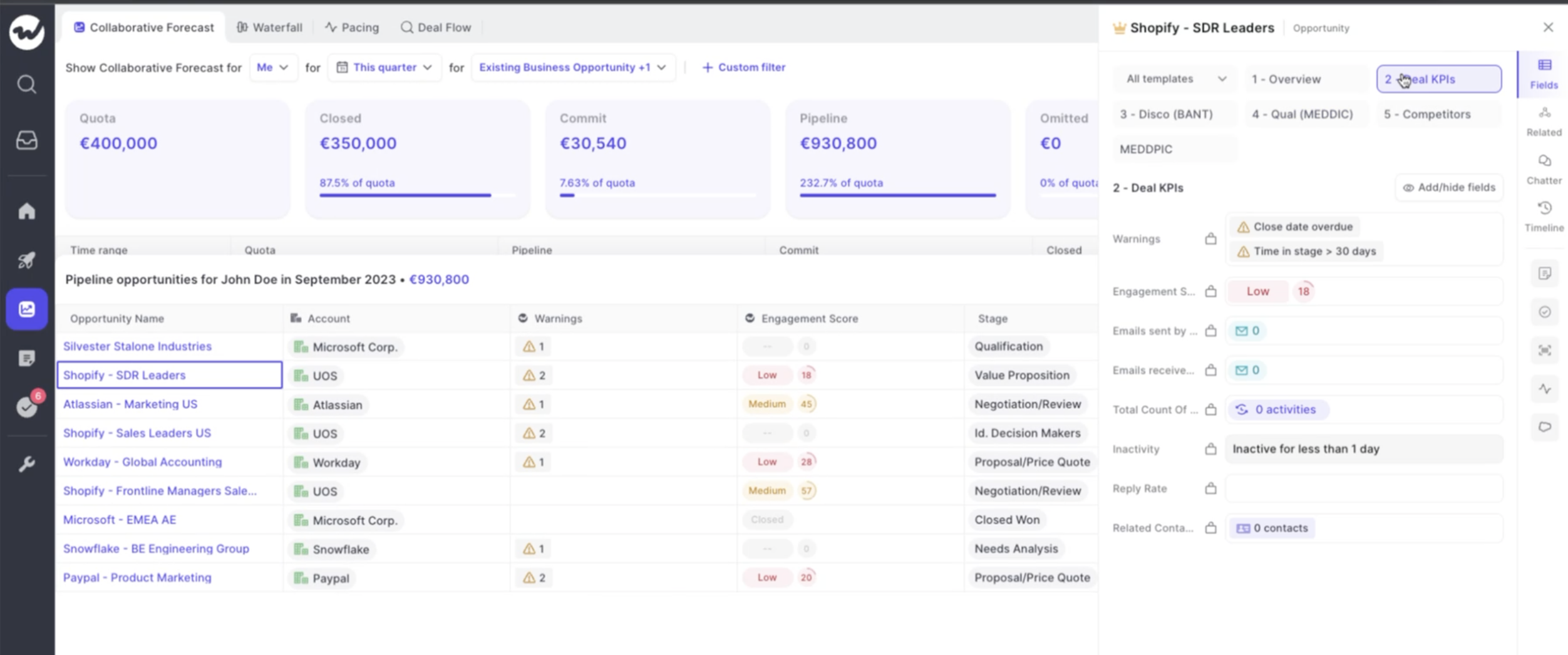
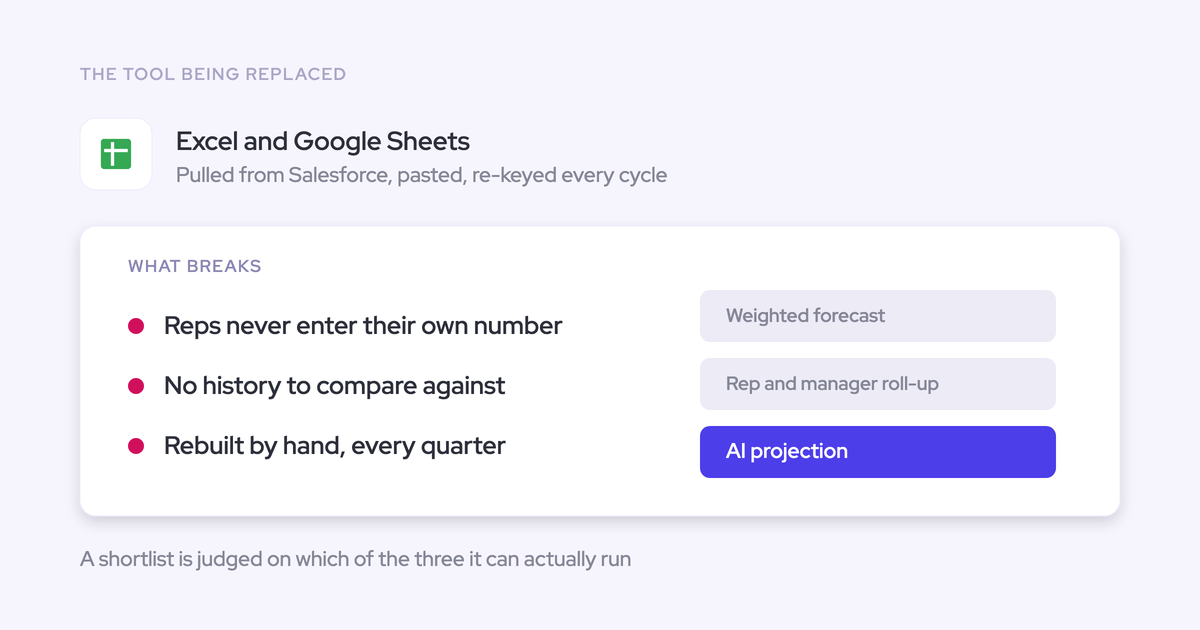
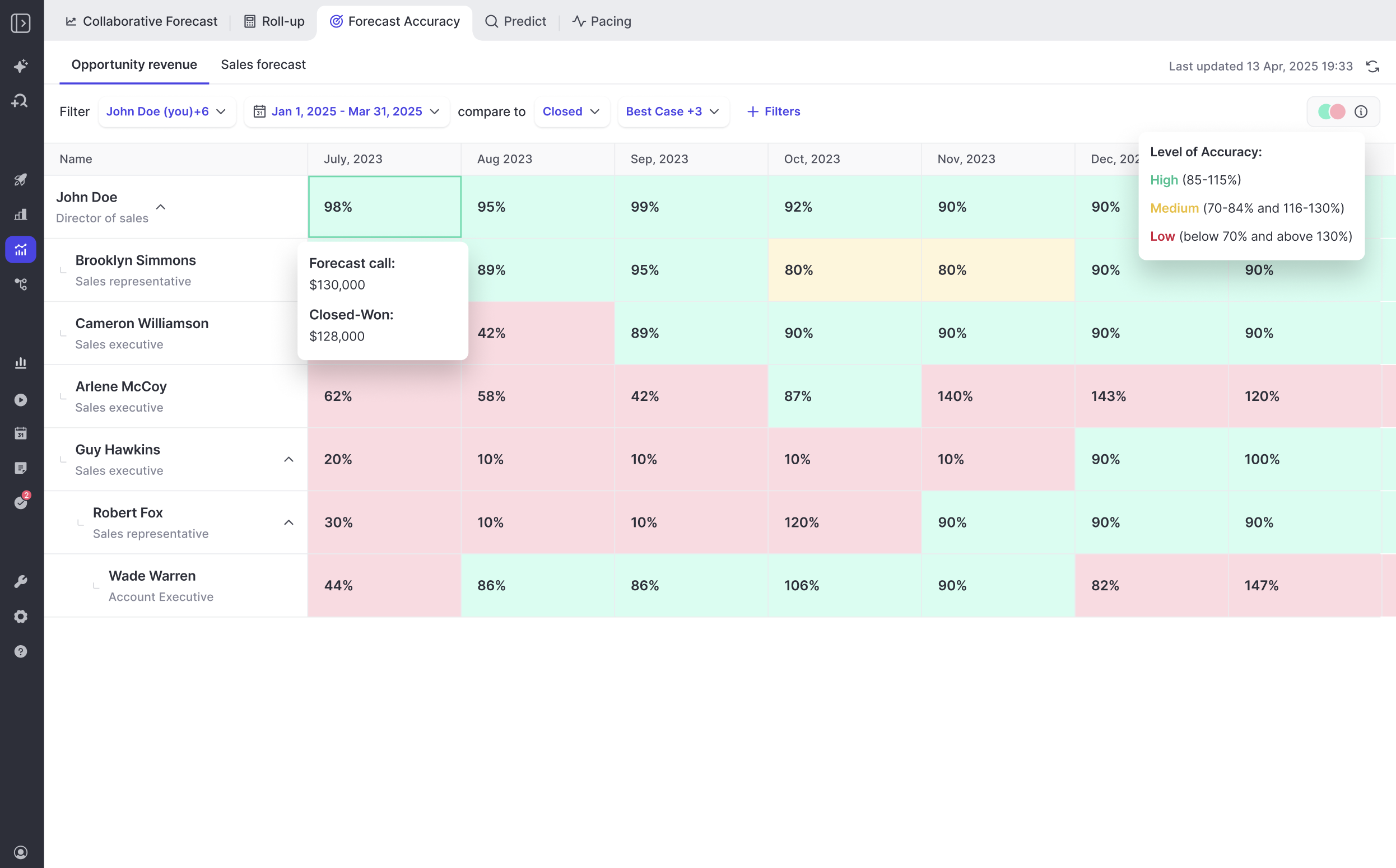
The three Clari views you actually use, plus the one Clari never gave you. Waterfall, pacing and deal flow are built in, and Weflow snapshots opportunities itself, so the same-day-last-quarter comparison doesn't require a warehouse. Weflow also tracks forecast accuracy, forecasted versus actual, by rep and by manager, which Clari doesn't do at all.

Lower admin, no parallel logic layer. Sign-in happens only through your Salesforce authentication, so there's no second identity to provision or deprovision. Weflow follows your field-level security, role hierarchy, validation rules and record types as they are, and admins make changes themselves in a self-service console instead of filing a ticket with CS.
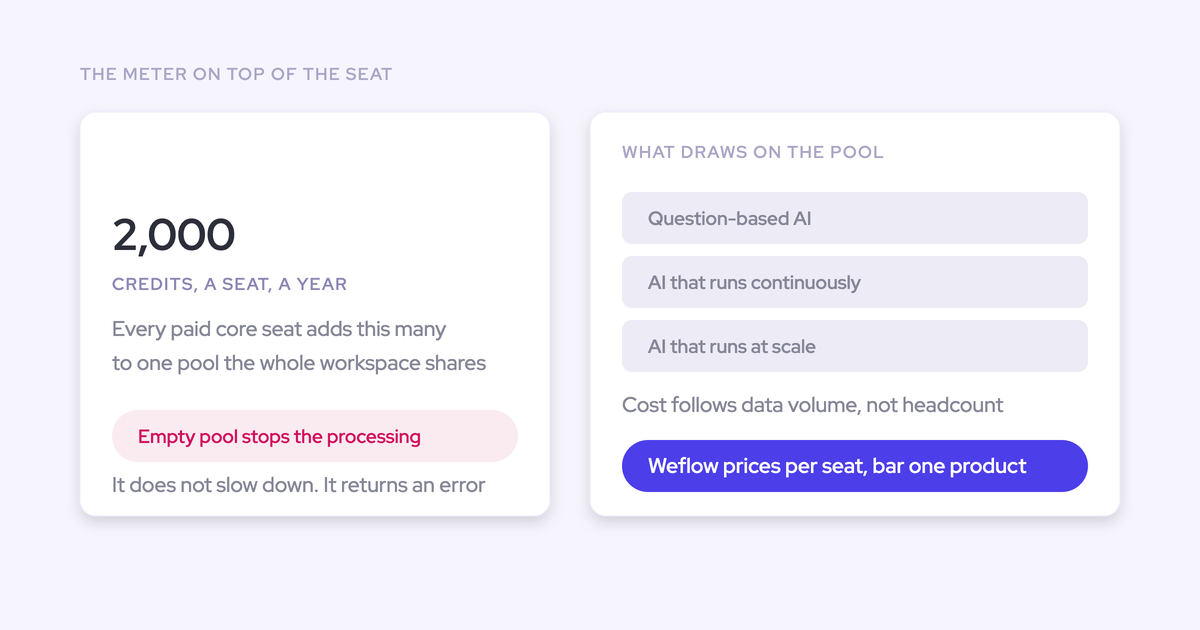
A different cost base, not a thinner product. Weflow prices at $19 to $79 per user per month against Clari's reported $120 to $180, with no implementation fees, no usage metering, and a 14-day free trial. The saving comes from building after transcription and inference costs collapsed, not from cutting capability. On results: Zeotap forecasts within ±7% using Weflow's process and lifted win rate 12%, and IDnow cut slipped deals by 60% using AI deal warnings.
Where it falls short
- Weflow's forecasting is newer than Clari's. It's competitive and moving fast, but if your job is a 1,000-rep enterprise roll-up, Clari's mechanics are more mature and you should weigh that honestly.
- Forecast submissions, targets and roll-up data live in the Weflow app, not as Salesforce fields. Everything else, activity, transcripts, summaries, AI field updates, opportunity edits, writes back to Salesforce. If your rule is that every number must live inside Salesforce, roll-up submission breaks it. The weighted forecast and AI projection still work for you, because both run off CRM data with no rep input, and BI teams pull the roll-up through the public API.
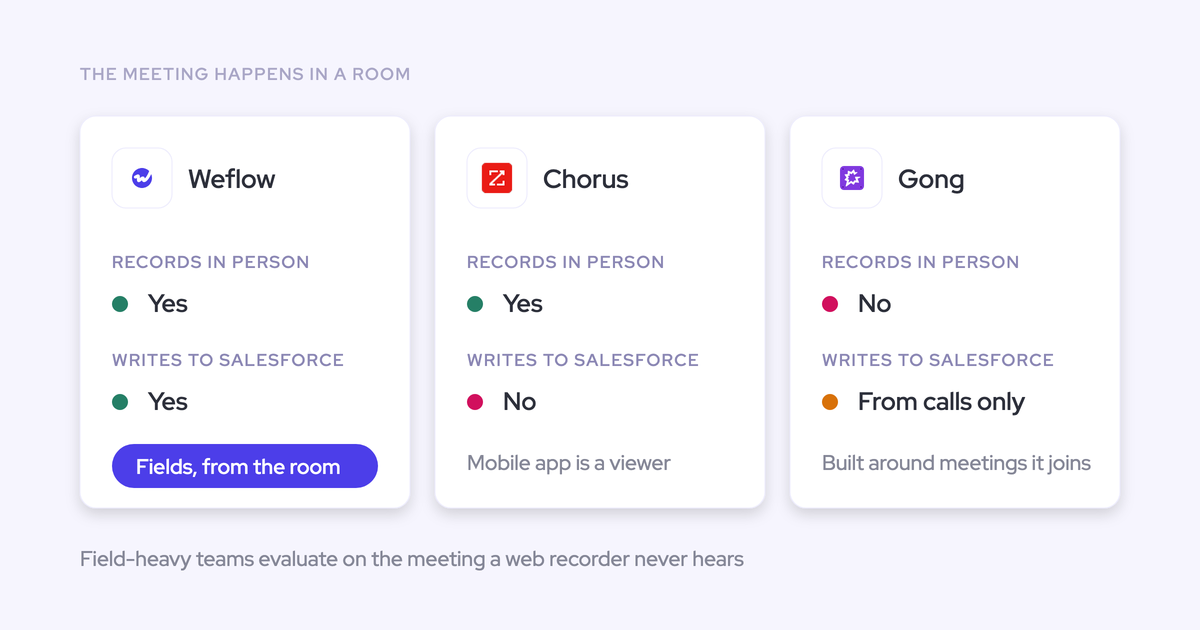
- No VoIP or phone-call capture today, so a phone-heavy motion isn't fully covered. No sales engagement either, which Clari has alongside in Salesloft. Weflow runs next to Outreach, Salesloft and Apollo instead.
- Not FedRAMP certified.
Pricing: Activity & Contact Capture $19, Conversation Intelligence $39, Deal Intelligence & Forecasting $39 per user per month. Bundles: Revenue AI Foundation $49, Revenue AI Business $59, Revenue AI Enterprise $79. Annual billing, 10-user minimum, unlimited view-only licenses.
Best for: Salesforce-first mid-market teams consolidating Clari plus a notetaker plus Einstein Activity Capture into one platform, who care more about owning the data under the forecast than about roll-up mechanics at ten thousand reps.
2. Gong: deepest conversation analytics, with forecasting attached
What it is: the company that invented conversation intelligence, now with a forecasting product attached.
Where it's strong: nobody has deeper conversation analytics. Gong will summarize a methodology across every call on an account, not just call by call, which is exactly what a manager reviewing a nine-month cycle needs. It logs activity to Salesforce too, so activity capture on its own isn't the reason teams move off it.
Where it falls short against the criteria you just set:
- Gong holds its own data layer. That's the thing switchers name unprompted.
I've used Gong before. I'm a previous Gong user. I know they're weak and also you can never leave them because you don't own any of the data. And also they take you away from the Salesforce interface and you have to work within their interface.
- Field mapping is a known pain: "the mapping of fields is a nightmare in Gong, and they really haven't overcome that properly."
- Pricing is quote-only and set in an era when transcription was expensive. One buyer told us it took three calls before Gong would name a number.
- At Gong's scale, a mid-market customer's feature request effectively never ships.
Pricing: quote-only, no published list.
Best for: teams whose top priority is conversation analytics depth and coaching, and who can live with the intelligence sitting in a vendor cloud rather than their CRM.
3. Native Salesforce forecasting plus a BI warehouse
What it is: not a vendor. Some teams call it Project Native: decommission Clari, run Collaborative Forecasts, snapshot into a warehouse, build the rest in BI.
Where it's strong: the data is already yours, there's no new contract, and your admin controls everything. If you have real ops capacity and a hard budget ceiling, this is a legitimate path rather than a consolation prize.
Where it falls short:
- Native Salesforce can't manage quotas and forecast against them in one place.
- There's no pipeline waterfall, and no history of how the pipeline moved, because Salesforce overwrites the field.
- The same-day-last-quarter view therefore means standing up snapshots in a warehouse. A management question becomes a data-engineering project with a bill attached.
If you're also leaning on Einstein Activity Capture for the data underneath, know its limits going in: activity isn't stored in the core database, so you get one canned report and no flows, it can't create contacts, and it maps to an opportunity reliably only when an account has exactly one. It's free to 100 users, then around $50 per user per month.
Best for: teams with strong ops capacity, minimal budget, and genuine tolerance for building and maintaining the layer themselves.
4. Attention: call-centric capture with reporting-first deal intelligence
What it is: an AI platform focused on what happens on calls, with reporting built off that call activity.
Where it's strong: call-based reporting, and it puts call activity into Salesforce.
Where it falls short for a Clari replacement: this isn't a forecasting product. No roll-up or collaborative forecasting, no forecast accuracy measurement, no pipeline analytics or dashboards, and limited deal intelligence. Capture is call-centric rather than a full activity layer: it doesn't pull emails and contacts from Outlook or Google Workspace, calendar-event-to-opportunity mapping is unreliable, and there's no add-in or extension for a rep to correct a mapping.
Pricing: quote-only.
Best for: teams that want call reporting and aren't trying to run a forecast process out of the same tool.
5. Revenue Grid: activity and email sync for Salesforce
What it is: an activity and email sync tool for Salesforce, and a real head-to-head option on that layer.
Where it's strong: it fixes the data foundation, which is the layer Clari Capture is weakest on. If your complaint is missing emails and misattributed activity, this addresses it.
Where it falls short: it covers one of the six criteria. There's no forecasting job here at all, so you'd pair it with the native path above or another forecast layer.
One bake-off caution: don't run two capture tools against the same inbox during a trial. They compete over the same emails and you'll get duplicate logging, then conclude both are broken. Disable one first, or use a compatibility mode.
Best for: teams whose Clari pain is capture quality, not forecasting.
6. Fireflies: standalone AI notetaker for the conversation layer
What it is: a standalone AI notetaker that records, transcribes and summarizes.
Where it's strong: it replaces Clari Copilot, the weakest layer in the suite, at a fraction of the cost. Recording and summarizing are commoditized now, and Fireflies does them well.
Where it falls short: the transcripts live in Fireflies, not the CRM, unless you sync them into Salesforce in a structured form. It does nothing for the forecast, nothing for activity and contact capture, and it adds a portal rather than a capability if nobody joins the transcript to the deal record.
Best for: teams assembling pieces rather than consolidating, or teams keeping an existing notetaker while they buy the capture and deal intelligence layers separately.
Which Clari alternative fits your situation
The right answer is a function of your constraint, not a ranking.
| Your situation | The fit |
| Salesforce-first mid-market team, consolidating three tools into one at renewal | Weflow. One platform covers capture, conversation intelligence and forecasting, and everything lands in objects you own. |
| Conversation analytics depth is the number one requirement | Gong. Accept that the intelligence sits in Gong's cloud and that pricing is quote-only. |
| Budget-constrained with real ops and data engineering capacity | Native Salesforce plus a warehouse. Budget the snapshot build honestly before you commit. |
| 1,000+ reps, roll-up mechanics are the whole job | Stay on Clari and renegotiate seats. A re-platform buys you less than a better contract does. |
| Your PE sponsor or board standardized on Clari | Coexistence. Land capture and conversation intelligence now, expand into forecasting at the political window. |
| Your only real gap is conversation intelligence | Fireflies for a cheap fix, or Weflow Conversation Intelligence if you want the call writing into your Salesforce fields. |
| Your only real gap is activity and email capture | Weflow Activity & Contact Capture or Revenue Grid, tested one at a time on the same inbox. |
How to migrate off Clari without losing your history
The fear underneath every one of these evaluations is losing four years of history. It's worth separating what's genuinely at risk from what isn't.
Most of the history was never Clari's to keep. Your emails and meetings live in your mail tenant and in Salesforce, and Weflow can backfill up to two years of them from the mail server into Salesforce. Everything Salesforce already holds stays.
What does leave with the overlay is the overlay's own layer: Clari's submission history, its mappings, its stored forecast versions. That's real, and no vendor can hand it back to you. Export what you need before the contract lapses, and treat forecast accuracy as something you start measuring fresh from the switch.
The sequence that works:
- Write the requirements down before you take a demo. Reportable in your BI tool, mapped to opportunities and custom objects, incoming as well as outgoing email, a second forecast setup your admin can build alone. Then run two or three vendors against the same list.
- Pilot for about two weeks. Backfill from a past date so the trial shows months of real activity instead of an empty timeline. If a vendor can't be tested against a written list in a fortnight, they don't make the shortlist.
- Use compatibility mode while two tools overlap. One capture layer writes to Salesforce, everything else reads from it. Two capture engines on the same inbox is the failure mode, not the coexistence.
- Roll out in data-foundation order. Capture first, because it asks nothing of your reps and works the day you enable it. Conversation intelligence next, because reps feel that win personally. Deal intelligence after that. Forecasting last.
- Time it against the renewal date, backwards. Technical setup takes 30 to 45 minutes with a Salesforce admin and your Google or Microsoft admin. Full time-to-value runs one to three weeks, most of it spent on business logic: AI templates, forecast types, cadences, quotas, warning rules.
Forecasting comes last for a reason. It isn't a toggle, it's an operating cadence encoded in software, so it needs sales leadership in the room and it takes longer than the tooling suggests. Running capture first also means you have several weeks of clean data by the time the forecast design is agreed.
Running Weflow alongside Clari when you can't switch yet
Some readers can't remove Clari this cycle no matter what the evaluation says.
When a sponsor has standardized across the portfolio, replacement is a political problem wearing a technical costume. Your CFO has already signed the forecasting renewal and will not approve a second forecasting tool. So don't attack the renewal. Land on what the mandate doesn't cover.
Here's how it wires up. Clari reads activities from Salesforce, which means:
- Weflow runs capture and conversation intelligence into your native Salesforce objects.
- Clari consumes cleaner, more complete activity from Salesforce than its own domain-based mapping produced.
- Your reps get notes, summaries and field updates they didn't have. Your admin gets activity data that's reportable and usable in flows.
- Both tools get better, and nobody has to explain to the sponsor why Clari was switched off.
Then, when the political window opens, forecasting is a bundle step rather than a new procurement cycle: Revenue AI Foundation at $49 per user per month to Revenue AI Enterprise at $79, instead of a second contract at $120 to $180 a seat.
The one failure mode to avoid: don't run two capture engines in parallel. Both will write, you'll get duplicate activities, and every activity metric built on top will be inflated. One capture layer feeds everything, and set Einstein Activity Capture's event sync to one direction if it's still on.
FAQ: switching from Clari
Can Weflow forecast renewals and expansion as separate motions?
Yes. Weflow runs parallel forecast setups, each with its own revenue field, date field, stages, cadence, targets and forecast calls, and each Salesforce opportunity record type keeps its own stage path, forecast-category mapping and independent roll-up. So new business, renewal and expansion roll up separately instead of hiding inside one blended number.
What does Weflow cost compared to Clari?
Weflow publishes list pricing: $19 to $79 per user per month depending on the product or bundle, annual billing, 10-user minimum. Clari runs roughly $120 to $180 per user per month, quote-only, with reported professional-services fees of $15,000 to $50,000. Weflow charges no implementation fee, no platform fee and no usage metering, and sells the three products standalone, which Clari does not.
Is there a free trial, and how fast is setup?
Weflow offers a 14-day free trial with guided onboarding. Clari has no free trial and no self-serve signup. Technical setup takes 30 to 45 minutes with your Salesforce admin plus your Google Workspace or Microsoft admin, capture works from day one, and backfill lets the trial show months of real activity instead of an empty start. Forecasting stands up last, because it's a process decision, not a switch.
Does Weflow respect Salesforce permissions, hierarchy, and record types?
Yes. The only way to sign in to Weflow is through your Salesforce authentication, using OAuth and whatever SSO your org already enforces, so there's no separate identity to manage and deactivating a user in Salesforce removes their Weflow access immediately. Weflow follows your existing field-level security, permissions, role hierarchy, validation rules and field dependencies, and writes into your record types rather than imposing its own.
Do I lose my activity history when I leave Clari?
Everything already in Salesforce stays, and everything in your mail tenant stays, which is where the activity history actually lives. Weflow can backfill up to two years of historical emails and meetings from the mail server into Salesforce, so you can switch the old capture off in the morning and have the gap filled. What leaves with the overlay is Clari's own submission and mapping layer, so export what you need before the contract ends.
What security certifications does Weflow hold?
Weflow is SOC 2 Type II certified, HIPAA compliant with a BAA available, and GDPR and CCPA compliant, with a DPA incorporating EU Standard Contractual Clauses, a public sub-processor list, and selectable EU, US and APAC data regions including Frankfurt infrastructure for European customers. Zero data retention applies to AI processing and customer data is never used to train models. ISO 27001 is in progress, not certified, and Weflow is not FedRAMP certified, so US government contractors requiring FedRAMP aren't a fit.
See how Weflow captures activity, updates Salesforce fields from calls, and rolls up your forecast. Book a 30-minute demo.